

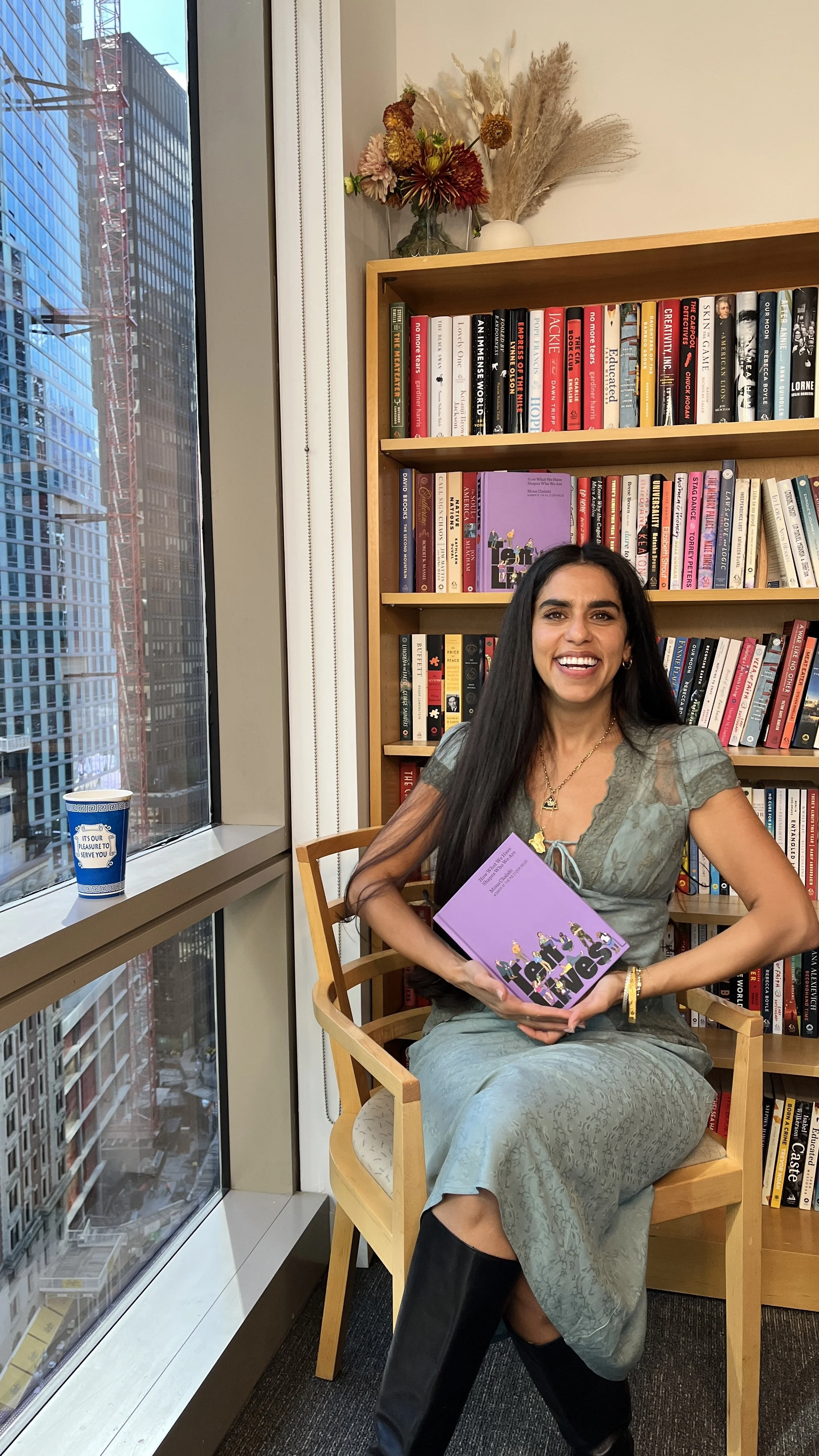
Today on The Stacks, we’re joined by Pulitzer Prize–winning journalist, writer, and illustrator, Mona Chalabi, to talk about her debut book, Ten Lives: How What We Have Shapes Who We Are. In this book, Mona combines research, data visualizations, interviews with ten people from different socioeconomic backgrounds, and her own experiences to explore how money shapes our emotions, decisions, identities, and insecurities. In this episode, we talk about why we feel so much shame around money, how she found her subjects for the book, and her decision to focus on income instead of wealth.
Our book club pick for November is Famesick by Lena Dunham. We will be discussing the book with Phoebe Robinson on Wednesday, November 25.
LISTEN NOW
Apple Podcasts | Spotify | Google Podcasts | Overcast | Stitcher | Transcript
Everything we talk about on today’s episode can be found below in the show notes and on Bookshop.org and Amazon.
Ten Lives by Mona Chalabi
Invisible Child by Andrea Elliot
“Ep. 232 What Should the Rules Be with Andrea Elliott” (The Stacks)
There Is No Place for Us by Brian Goldstone
“Ep. 368 The Homelessness Myth Doesn’t Match Reality with Brian Goldstone” (The Stacks)
All the Presidents Men by Carl Bernstein and Bob Woodward
“The Short Stacks 22: Ibram X. Kendi//How to be an Antiracist” (The Stacks)
Limitarianism by Ingrid Robeyns
Are You My Mother? by Alison Bechdel
Fun Home by Alison Bechdel
Feeding Ghosts by Tessa Hulls
Cannon by Lee Lai
The Best We Could Do by Thi Bui
Good Talk by Mira Jacob
“Ep. 174 The Best We Could Do by Thi Bui -- The Stacks Book Club (Mira Jacob)”
Lemons Lemons Lemons Lemons Lemons by Sam Steiner
Christmas Day by Sam Grabiner
To support The Stacks and find out more from this week’s sponsors, click here.
Connect with Mona: Instagram | Substack | Website | X/Twitter
Connect with The Stacks: Instagram | Threads | Shop | Patreon | Goodreads | Substack | Youtube | Subscribe
To contribute to The Stacks, join The Stacks Pack, and get exclusive perks, check out our Patreon page. If you prefer to support the show with a one-time contribution, go to paypal.me/thestackspod.
The Stacks participates in affiliate programs. We receive a small commission when products are purchased through links on this website.
TRANSCRIPT
*Due to the nature of podcast advertising, these timestamps are not 100% accurate and will vary.
Mona Chalabi 0:00
Because I talked about myself a lot, it's so bad to say on the podcast. There's almost a little part of me that's like, don't read, don't read, don't read it. I don't want people to know some of this stuff. I'm serious. I feel like I had to include it to be intellectually honest. It's so weird. I like on this podcast being like, buy the book, but you know, if you don't want to write the book, read the book.
Traci Thomas 0:22
Definitely buy it. You don't want to read it. Like that's a that's a you thing.
Mona Chalabi 0:25
Exactly, exactly. Maybe that's the ask at the end of this: buy the book, don't read it. Perfect.
Traci Thomas 0:30
Yeah, gift it. Welcome to the Stacks, a podcast about books and the people who read them. I'm your host Traci Thomas, and today we are joined by Pulitzer Prize-winning journalist, writer, and illustrator Mona Chalabi. We're here to talk about her debut book, "10 Lives: How What We Have Shapes Who We Are." In this book, Mona combines research, data visualizations, her own experiences, and interviews with 10 people from different socio-economic backgrounds to explore the ways that money shapes our emotions, decisions, identities, and insecurities. Our book club pick for November is Fame Sick by Lena Dunham, which we will be discussing with Phoebe Robinson on Wednesday, november 25. If you enjoy this podcast and you want more bookish content and community? Consider joining us over on Patreon and Substack. Our Patreon is a space for community. If you're looking for a virtual book club, if you want to be chatting about the books you love and hate on our Discord, Patreon is the place for you. Over on Substack, you can subscribe to my newsletter Unstacked, where you're going to hear me talk about books, pop culture, whatever is on my mind. No matter what you choose, I don't think you can go wrong. You can even do both. But what your support means for me and for this team is that you make it possible for us to make the show every single week. So head to Patreon.com/slash the stacks to join the stacks pack and subscribe to my newsletter Unstacked at Traci Thomas Substack. Com. All right, now it's time for my conversation with Mona Chalabi. All right, everybody, I am so excited today. I am joined by Pulitzer Prize winner, big fucking deal, Mona Chalabi, whose new book is called 10 Lives: How What We Have Shapes Who We Are. Mona, welcome to the stacks.
Mona Chalabi 2:27
Thank you for having me, Traci.
Traci Thomas 2:29
I'm so excited. I have to tell you, one of my listeners DM'd me a video of you talking about your book and was like, "You should check this out." And I was like, "Okay."
Mona Chalabi 2:41
What video is this? I don't know. I've barely spoken about.
Traci Thomas 2:44
Did you do like an unboxing video? Some funny video. It was that video. They were like, "I think you might like her." This person's name, Yolanda, and I was like, "Okay, let me see." And so I started like scrolling on your page. I started like looking you up, and I was like, "Oh, I definitely like her." I reached out to your team. I was like, "Please send me the book. The book is so amazing. For people who don't know, can you just give them like 30 seconds or so? Tell them what the book is.
Mona Chalabi 3:07
Yes. First of all, thank you to Yolanda. I'm really grateful to to be here. The book is called 10 Lives because to write it, I followed 10 people, and these 10 people come from every step on the U.S. income ladder. So there's somebody on the who comes from the richest 10%, then the next 10%, then the next 10%, all the way down to the poorest 10%. And when I first started writing this book, I said to the publisher, "I will file this." Sorry, I'm talking as a journalist. I will send you the manuscript, the finished manuscript, 18 months from now. That is not how things panned out, and it's a good thing that that's not how things panned out because it ended up taking me six years to write the book. I spent five years following these people's lives, and the book is really, really dances back and forth between the micro and the macro in some ways. Like it is very much about these people recounting all of the minutiae of their lives, but the thing that's really nice is nobody is expected to be a perfect kind of class representative. Like the person who is, I was really open to, for example, someone who was in the poor, the richest 10%. Sorry, I was really open to them being a person of color, for example, right? And then you can use the charts to explain how most of the richest 10% is actually composed of white people in the U.S., but here's this person. As it turns out, that isn't actually what what ended up happening. But again, the charts and the data can kind of contextualize this stuff, and and yeah, zoom out from this one person's experience. That's yeah, 30 seconds, and it's not good. I'm still getting my head around how to talk about it.
Traci Thomas 4:39
You're doing great, and also the charts are illustrated that you've you illustrate, which is so fucking cool that you could do that. I like I'm just I'm really taken by you because like you're very charming and like fun, and also you're really fucking smart, and also you understand like numbers and you can draw, which I feel like. Usually, people can't do both. It's like, oh, you have like a math brain or you have an art brain, but you have both brains.
Mona Chalabi 5:07
That's very, very generous. I would say that my drawing skills have a limit. Like my friends, my close friends will like relentlessly mock me for like, for example, like you know, a child, a friend will have a baby, and I'll draw the baby, and they're like, "Why do you hate my child?" And and I think that in a way, that is also I think has has helped the work. Actually, I think the the my work feels approachable. It feels accessible, partly because like you look at and you are like, I can fucking draw that, and that's fine. I want you to have that reaction.
Traci Thomas 5:48
I am truly, I am bad at two things, and I am going to tell you what they are. They have to be things you are good at: math and drawing.
Mona Chalabi 5:56
I knew it. I knew it. But can I say that the number of people who tell me I am just so bad at maths, and it really it makes me sad because I think so much of that is about an emotional reaction rather than a really intellectual. Like I don't doubt for a second that if I can do it, Traci. Honestly, I promise you. And I look at like really little kids that are as excited about their one two threes as their ABCs, and then something happens along the way. Often again to girls, to people of color, this idea that like this isn't necessarily for you. I was working on a story years and years ago about 23andMe and people shifting their racial and ethnic identities. Such a sorry, such a weird tangent, but I found it fascinating. This idea that people would spit into a tube, and then a company would tell them, "You're actually not this, you're that," and then they would like reorient themselves, and I was reading through all of the transcripts of this academic research, and one of the people they'd interviewed had identified as black, did 23andme, and found out that he was part Jewish, and he was like, "Oh, it makes sense actually, because I'm really good at math." I was just like, "Why does that? Why does that have to come from some place like that's so sad to me? It's so sad as well.
Traci Thomas 7:06
That is sad. I will. I'll say this to complicate things. I am black and Jewish and bad at math. So I don't. I don't blame my mother or my father or any of my ancestors. My brother's so good at math, and I am I am open to being like a data point of like a black woman who thinks she's bad at math but isn't. But I'm also very open to the idea that I am genuinely bad at math. I have six year old twins, and they'll be like, "Mom, what's 147 plus like 392?" And I'm literally like, "Mommy can't do it. Mommy doesn't know. We could work together and get like a piece of paper, but like I can't just do it. I I am the worst. Also, I love that you call it maths. I always forget that that's what British people do.
Mona Chalabi 7:50
I'm sorry, I tried to like... it sounds pretentious.
Traci Thomas 7:52
Maths is so much better. No, it's so much better. Maths is maths is better. Anyways, the book, the book, the book, the book, the book.
Mona Chalabi 8:01
Okay, book.
Traci Thomas 8:02
Can you explain the deciles to people? Because that's how it's organized.
Mona Chalabi 8:05
Yeah, it's funny. Yeah, I wanted to stay clear of like statistical terms like that, but it is super relevant. So the thing that most listeners will probably be more familiar with is this concept of percentile, especially when you're a parent, because there's a lot of that. Literally, from the time that you're pregnant, I've seen friends boasting about like their child's head circumference and terrifying things like that.
Traci Thomas 8:30
So weird.
Mona Chalabi 8:30
It's awful, awful, awful, awful. And again, this is kind of also a throughline throughout the book. I'm actually quite against also the overquantification of stuff, and I'm really skeptical of data and its place in the world. But so obviously, a percentile is each. It's if you were to take the entire population. In this case, let's take the entire U.S. population. Each percentile has 1% of all of the U.S. population in it. And for this book, I took deciles. So each one of those groups now contains 10% of the U.S. population. So when I'm talking about the richest 10%, I'm talking about the top decile, and that's if you were to line up everyone in the U.S. from the poorest person to the richest. I'm grabbing the richest 10%,
Traci Thomas 9:13
and the groups are equal size, which means that like the top 10, the top decile of the richest people actually encompasses a huge range of income, whereas like the bottom might only encompass a small range of of money. I mean, you show it. You have a graph in the book that shows it really beautifully. But that was interesting to me because it's not just divided. It's not divided equally. It's not like if you make 50,000, you fall here. If you make 100,000, you fall here, and it goes by 50 1000s. It's like if you make 23 or less, you're in the bottom. But the top is anyone who makes like 250, all the way up to like a bazillion.
Mona Chalabi 9:53
Exactly. And the thing that again is so powerful, as you say, is those two groups contain the exact same number of individuals. So this idea that there are as many individuals in the U.S. earning less than $23,000 as there are earning over $272,000 is, I think, quite quite a shift in our thinking about income inequality. Again, the book was partly born out of a frustration of the endless conversations about the richest 1% that I almost felt like they were kind of lacking in a in a sort of intellectual honesty. Like I would be in rooms with people where we'd all be talking about the richest 1%, and there's something kind of convenient and safe and comfortable about that us versus them mentality. When I know I'm like looking at the person across the dinner table from me, and I'm thinking, you might not be in the richest 1%, but you are fucking loaded, and your material reality is vastly different to mine, and mine is vastly different to this other person further down the table. And I wanted to have those uncomfortable conversations.
Traci Thomas 10:53
Yeah, and you start the book with this story of like looking in people's grocery carts as a kid, and your mom sort of being like, don't do that. Like, stop staring. Essentially, and which is really this bigger conversation about shame. And so, I'm wondering, in all this research you've done, why do you think there's so much shame around money? Why do you think people are so weird about it?
Mona Chalabi 11:16
My God, there's so many reasons. I think one of the things that came out was that intellectually, a lot of people have divested from this idea of the American dream. You might be like, you know, I see the ways in which this country is broken; it's not functioning as a meritocracy. You can't just move up through hard work. But emotionally, deep down, I think a lot of us still kind of buy into it. That if we just work hard enough, and if we just, you know, do things right, we can move up, and then that translates to a lot of shame when you're not where you hope to be on that ladder. I think there's also a lot of shame in wealth as well. I think a lot of people who have money, they have very complicated feelings about, and you know I've I've encountered that so much since I moved to the US. Like, I think everyone will have this experience of having a friend who you feel is not being completely transparent with you about the realities of their economic circumstances. There was one friend who, when I moved here, we became really, really close. You know, she'd complain to me about as we were all complaining about the price of rent and how expensive things have been. I talk about another friend in the book. This isn't this isn't the same one. But this friend, I remember we'd been friends for maybe four or five years, and she invited me to her parents' home. And I just had a feeling, Traci. I looked it up online. I looked it up online. I was like, whoa. And honestly, I kind of didn't want to go. If I'm really really honest, and I kind of made my excuses, I knew it was going to be an environment in which I was going to feel very, very uncomfortable. All of her other friends are also very, very wealthy white people. Who you know, I kind of already have an idea of what those vacations look like. You know, you're swimming and then you're drying off in the country house, and I don't know. No, I can't even swim. I'm not going to have a good time. I'm not going to have a good time. And basically, we had this difficult conversation, and she confessed to me that while she had been saying to me, "My God, rent is so expensive. I don't know whether or not to take this job. It pays 68,000 instead of 75." Well, actually, her and her cousin co own a building in Manhattan worth $63 million.
Traci Thomas 13:18
Got it.
Mona Chalabi 13:19
Now that's like quite an extreme example, but there are lots of people that are cosplaying a different economic class than the one that they really belong to, and I think that is deeply, deeply problematic for and and it's a way of us actually staying stuck in this current level of economic inequality.
Traci Thomas 13:38
Do you think that? I mean, I know there's like a lot of different solutions, so let me not be too like, what's the solution? But do you think that the talking about it and the being more transparent about it is a solution to some of this? Like, do you think that if you went to a dinner party and someone was like, "Well, you know, I make $75,000 a year, and I'm set to inherit 6 million. Like, do you think that that alleviates the shame? Do you think that that would make things better if we knew more about the people around us and their financial situations?
Mona Chalabi 14:14
I mean, this literally happened the other night. Like, I was with friends who were like, "What's your book about?" And I started talking about. They had their friends. What some of the friends knew, they had their friends, and it started this whole conversation. I don't think it alleviated the shame. I think actually a lot of people were feeling more ashamed at the table. And it's not that it's like this magic pill that fixes everything, but I guess the analogy that I would give is like, and it's a really really clumsy analogy. I'm still trying to figure out how to talk about this, but if somebody's talking to me about racism, I want to know what race they are. I want to know what their what their experience has been. Like, let's say this is let's say we're not talking via video right now, right? And it's just a phone call. I'm going to be like, like Traci, if you're talking about racism, and I'm just going to be like, can I just inquire, like? Yeah, what is your your your race as you're talking about this stuff? And I think lots of people are talking about money without having to do that act. Yeah, and and so it's almost like they're all like talking from this like view from nowhere, which is bullshit. Like it's absolute bullshit. I it means that we don't really understand where power lies in the room, if everyone's able to hide behind this, like this nothing, I don't know. And I think about it, particularly when it comes to economic writing. Again, if I'm reading a piece of journalism where somebody's reporting on it could be race riots or it could be like just talking about this administration in the U.S., I'm going to click on that byline. I'm going to sometimes do a Google image search of that name. Yeah, I want to know where this person is coming from. And again, this idea that people can write about economic justice without disclosing how much they are insulated from the from the affordability crisis, from the shocks in this system, it's just intellectually dishonest. It just is.
Traci Thomas 15:58
No, I I agree with that. I agree. I mean, I let's talk about the journalism a little bit because one of the things that people who listen to this show will know is that one of my favorite kinds of journalism is like deep investigative journalism. Like, I I love every year the book that wins like Pulitzer Prize nonfiction is always like one of my favorite books from the previous year, and I have had Andrea Elliott on, who wrote Invisible Child. I have had Brian Goldstone on, who wrote There's No Place for Us. And I have talked to a lot of journalists who do the thing where they embed with people of a different economic or racial group. They talk about that work. They talk about their lives. They follow them, and we always have this conversation on the show about the ethics of that. What does it mean to profit off of other people's lived experiences? What are you doing with the money? What is the arrangement? Would you buy them a meal? Would you pay them? Blah blah blah. Like I, this question I talk about and think about all the time. We talk a lot about objectivity. We talk a lot about like invisibilizing oneself as a journalist. All of these things, and you talk about that straight up in this book.
Mona Chalabi 17:08
Yeah,
Traci Thomas 17:08
you talk about that you paid your subjects; all 10 of them were paid for their time. You talk about how you are part of the book. It is almost has like a lot of elements of memoir in this book. You are very much in this book. You weave in your connections to the different people and how you relate, whether it's the healthcare system or education or whatever. So, I want to hear from you why you why that is your ethical choice and how you came to it.
Mona Chalabi 17:33
Yeah, it really wasn't a difficult decision. If I'm really really honest, it's just like I got a great advance for writing this book, which I'm sure we're going to end up talking about, and this idea of asking people to give me their time so that I could, like, you know, get the next installment of my book contract.
Traci Thomas 17:53
Yeah,
Mona Chalabi 17:53
especially when those were people who had less material wealth and a lower income than I did, felt exploitative. It's that straightforward. It's exploitative, and this idea. Look, I understand it in different journalistic concept contexts, but for this specifically, this idea that if I pay you to talk to me, you could make up any old shit. What does that say for journalism and publishing as a whole? Because I was paid to write this, and does that mean then that the mere fact of being paid means I'm incentivised to lie. No, not necessarily. So it was really, really clear to me that I wanted to pay people. I actually wasn't sure exactly what was the right amount. So I started off when I first spoke to everyone. Every single call started the same way. I said to them, "Listen, you you have the chance to choose a pseudonym for yourself. You don't have to disclose your first and last. I mean, you do to me, but like you know, when it comes to the written version, it won't be your real name there. Everything else, you have to be honest with me, and nothing else will be like altered. We might take out certain things. So, for example, I wouldn't say the exact town where people came from. I'm not going to switch the state in order to protect them, because I feel like that alters the story. You'll you'll be paid a minimum of $40 per hour, and I said to them at the end of the book, I might revisit that and reconsider whether you should be paid more. Which, as you know, I ended up doing. I said to them that this is another journalistic rule that I broke with that I didn't actually write about in the book. I think there's something really messed up about the way that, and again, depends on the context. Depends on whether you're like you know interviewing a president or speaking to somebody who is struggling with poverty. Everyone would get the chance to read their chapters before they were published because I think this idea that you read what someone took from your story on a link the same time everyone else does or in a bookshop is messed up, and that was obviously difficult. Some people didn't like their chapters. Some people loved them, and some people came back with notes for me, which is exactly why journalists don't want to do it. Like someone saying to me, "You know, I kind of wish you didn't include my affair," and then. You know, you have to have a real conversation with them about like the reasons for including that. And in some cases, again, I think a lot of journalists will be horrified at this. I sort of, I did make changes based on their comfort level. So, for example, one of them had told me about his wife's surgery, and I had mentioned exactly what the surgery was, and he was just like, you know, she feels uncomfortable about that, like the fact that it's this specific surgery. Yeah, I'm like, you know what? That's not essential for the for the story. Yeah, let me just say she's having a surgical procedure. Yeah, okay. What was I've really gone off? I'm so sorry.
Traci Thomas 20:39
No, no, no, no. This is like honestly, I I joke about the fact that like I always wanted to be a journalist. Like I read, you know, all the Presidents Men, and I was like, I gotta be like those guys, Bernstein, Carl Bernstein. Um, and so mostly this entire podcast is just to like cover for me to ask these questions to journalists who write about these topics and like all the fiction books, all the. I'm just like I don't care. I just let me let me see. But I I'm sort of curious then because I've heard people say I've heard you know so many different answers to these kind of questions. Journalists say that they do share people's chapters with them or people like where people's lives come up. Some do change things. Some don't. Sometimes you know they understand where the person's coming from, and they won't, or whatever. But for you, do you ever worry that like it's the wrong, like that you're doing the wrong thing, or do you always feel like like if you like, I guess not even that, not that you're doing the wrong thing. How do you know that it's the right thing? Like, what is it that? What are you? What are the things that you're looking out for in your own body or in your own mind, like how do you justify these choices to yourself? And this is the same question I ask people who don't pay their subjects, right? Like, because I know the like the ethics of journalism used to be so like these are the rules, and now I feel like journalists kind of get to make the rules for themselves. But how do you know that you've made the right rule for yourself?
Mona Chalabi 22:03
Yeah, it's such a good question. I would also maybe push back slightly at this idea of like it used to be that those are the these are the rules. I think it was always a little bit like figure it out for yourself. I just think journalists were maybe more guarded about talking about how they're making these individual choices. They would just they would just outwardly say these are the rules, and we follow the rules. Even when you're always using your best judgment
Traci Thomas 22:25
But I also feel like the the rules used to be more like these are the rules because journalists used to be more the same. So it's like it was always bad. It was easier for them to follow the rules because ethically the rules worked for them. I think what really started to happen is that those rules don't work for Black women or trans journalists? Like all of a sudden, you're writing about your own community, and it's like, well, am I being fair to my people in a way where it was always like outsiders coming in and being like, well, we're removed. We don't want to be responsible for this. So that's sort of what I mean by like it used to be more firm because it was like in service to protecting the institution, right?
Mona Chalabi 23:05
That's absolutely correct, and it perfectly ties into how I decide, which is that I, for writing this book at least, I was imagining what if this was a member of my community, what if it's someone that I care about, and they're coming back to me and saying, "Can you take this out?" And again, this is really different to when I'm going to be interviewing like a politician or somebody with power, where
Traci Thomas 23:29
like an expose
Mona Chalabi 23:30
exactly, exactly. Like your concern is about the public interest in some of these things, but these are individuals who have very. It's more complicated than saying they've very generously offered up their time. I think that's actually part of the issue. I think very often people speak to journalists because they hope that something beneficial is going to come from it, and that's complicated, right? Like part of me paying them is also to make sure that they do get something out of it, because otherwise, like this hope that merely being in a book that's going to appear on a bookshelf is suddenly going to radically transform their lives. I don't know if it is. I really don't know if like Tiffany's life is going to be any better for the fact that she was in this book. I can't promise her that. So yeah, I just think you know if this was someone in my life that I cared about, and the truth is, for most of my friends and family members, if they said to me, "I've been approached by a journalist," I immediately want to know who. And there's a lot of places where I would just say, "You know what? Don't talk to them," which is so sad.
Traci Thomas 24:32
Yeah, yeah. Okay, wait. Let's take a quick break, and then we'll be right back. Okay, we're back. I I have to know. So obviously, people can tell from your accent that you're from the UK, and this book is about the US. So I want to know why you chose to write a book about income in the US. Is our system radically different? Is there something that's more exciting or interesting? You've lived in both places. In the course of the book, you've lived in both places, so I'm just curious why you wanted to to do it in the US.
Mona Chalabi 25:04
Yeah, well, this is home for me. This is where I've lived for more of my adult life now than the UK by quite a long way, and yeah, the US is a pretty special place.
Traci Thomas 25:17
Exceptional, would you say?
Mona Chalabi 25:20
You know, this is capitalism in one of its like kind of cruelest forms, I would say. Yeah, and I think that one of the things I really struggle with actually back in the UK is a lot of British people, I would say, are lacking in introspection because one of the things they reassure themselves with is like we're nothing like the US, and I'm like a I don't really think you get to comfort yourself with that. There's also a lot of things about this country that I genuinely love, and they're part of the reason I live here. And B, also what is happening here is coming to other places. So the NHS in the UK is being systematically dismantled before our eyes, and again, if we're going to constantly be comparing ourselves to the US, yes, you can be passive about that transformation, but actually, you should be very, very worried about it. See, I would say like the US is like a little lab for all kinds of economic cruelty, and that if we allow it to stand here, that's coming to a lot of other places.
Traci Thomas 26:22
Yeah, yeah. Were there when you went into the project? Were there any sort of assumptions that you had that that ended up like really surprising you on the on your way out?
Mona Chalabi 26:33
Totally. I mean, I thought that I thought the rich people would be okay, and the people who weren't rich were going to talk to me about how much they were struggling, and it was a lot more complicated than that. Like I would say that pretty much everyone felt afraid, but it wasn't this like gradual, like linear relationship where like the more money you have, the less afraid you are. Like I actually think that Megan, who is right in the middle, was pretty calm and just like yeah, like you know, I've got a mortgage to pay. I'm you know, it's a little bit tricky, but I'm I'm okay. Whereas like yeah, some of the wealthiest people I spoke to felt truly afraid. So I think untangling people's emotional relationship with money was more complicated than I thought it would be. What else? I honestly was still amazed at how much people shared with me. Yeah, people really, really shared a lot with me, and I'm I'm really proud of that because I think it obviously is a huge, huge amount of trust, and it was almost quite scary as well. You know, you're reading through the transcripts and you're thinking, at a certain point, especially when you're talking to people for years and years and years, they kind of forget at some point that everything's on the record. Even if you're on a Zoom call with a little red light flashing in the corner, yeah. Even if you're sitting at a cafe with a with you know a piece of podcasting equipment between you, people just think they're talking to me, and that's really tricky because you want to keep on reminding them. I'm like, I might use this, by the way. Yeah, I don't know.
Traci Thomas 28:04
The thing that I was really surprised about was there were two things. One was how much movement there was between the deciles over the course of like your five years or so of reporting. I was really shocked by that because I think in my mind, I think of people as being more fixed. Like maybe you might make $10,000 more, maybe you might lose your job and make a little bit less money. But so many people over the course of your reporting moved around, or or their their situations changed, even if they didn't change deciles. Like their financial situations changed, and I thought that was really interesting, and maybe something that I hadn't thought of or experienced. And also, some people's movements were like really big, or really like there were only one or two people who like moved sort of just like a little bit, like which I I don't know. I just thought that you would sort of either stay where you are or like go up or go down in a really linear way, so that surprised me. And then the other piece of this that I sort of was surprised about was that this book is organized by income. That's what you're looking at. You're not looking at broadly wealth. So for people who don't know the difference, I hope I do this right. Income is like what you make in a year, and wealth is all the other things that you have. So if you own a home. That's part of your wealth. That's not part of your income. If you receive an inheritance, if you have debt, all of those things are part of your wealth. And what I also thought was interesting was how different people's income was from their wealth. Like if you had done this by wealth, a lot of people would have been in very different deciles than where they were. And so that was very interesting to me. Like the the woman who is in the lowest decile, she owns a home, and so while she has a very low income, she does have some form of wealth. And and similarly, I think the man who was in the the bottom third, the gambler, he has like. Wealthy family, and so I was really sort of like that was hard for me to wrap my brain around.
Mona Chalabi 30:06
Yeah, those are two. No, it's so helpful that you're sharing these things with listeners, and it's also making me think about ways that I can helpfully talk about the book because those are surprising things. Again, I just lived in this world for so long that at a certain point it stopped surprising me because you're you're meeting them at the time that they got this big book deal, and then the time that they're like, you know, their their circumstances are rapidly changing. That sometimes in retrospect, it doesn't feel as shocking as maybe it should. Yes, I was also really surprised at how much they moved around. And you're right that even when people didn't move deciles, those economic shocks of like a change in income still felt very dramatic. So, the person that you'd mentioned, who is a homeowner who is in the poorest 10%, on one of our first conversations, she was just like, you know, my nightmare is that I'm going to end up mopping floors in McDonald's. And by the end of the book, she was in fact working at, or maybe she said she was afraid of working at Burger King, and she ends up working at McDonald's. I forget which way round it was, and like that is a dramatic change in her life, and yes, you're right. This difference between wealth and income is huge, and again, I really feel that from my friends. I feel that even those who don't have wealth themselves, who might not be homeowners or have a lot of money in the bank, when they come from wealthy families, the psychological reassurance of knowing there is someone you can call if things get tough is absolutely profound, and it actually causes tension. I would say between me and my friends, like, yeah, I literally had an argument with a friend this week who she was just like, "You should do this thing. Like, it'll be fine." And I'm like, "I said to her, 'You have rich parents. Like, don't talk to me about taking financial risks when every gamble looks completely different to you. And she did the thing that like so many people do of just being like, "No, but it's their money, not mine." And I'm like, "Don't. They're always going to bail you out." Like, I I really think it's it's so convenient to do this like nice little dotted line around like that's their money, this is ours. When that's not how that's not how kin works. That's not how community works. Yeah,
Traci Thomas 32:06
yeah. You know what else was fascinating? Yeah, how little people knew about the finances of people very close to them.
Mona Chalabi 32:14
Yes
Traci Thomas 32:15
And I think what was shocking to me about that is I related to that. Yeah, but I just thought that was me, like I was just like, oh well, I just don't know how much my brother makes, but like other people probably do. And then seeing that, I was like, wow. So this is just all of us. We just have like so many of the people who had wealthy parents. It's like you you say like I asked them how much, and they were like, I don't know. My dad once said this number, but that was 15 years ago. Or like, I thought that was really fascinating. Like, we really have no clue. I feel like most people could probably say with more accuracy what their parents' sex lives were like than they could what their parents' finances were like, and that seems crazy to me because like, I don't want to know about people's parents' sex lives necessarily, so I don't know. I thought that was something also that really stood out to me as like, wow, we're not even having those conversations, and even people who have like wealthy parents who are like teaching them about money because I think that's one of the things that a lot of people who have wealthy parents, another like sort of perk that they get is that they learn how to do things with money, right? They learn that you should be doing things with money, that you need a person to help with this or that. But even that is just sort of so general. It's not specific. It's not like once you have this much money, you need to open a this account or whatever. And I just was really fascinated because you would think. I mean, I would think that if you had like generational wealth, you would tell your kids what to what to do with it, or like that it was there in a meaningful way.
Speaker 1 33:52
So that's so such an important point to make, and I think the two of them are maybe slightly different. So I think between friends and even between siblings, we should be more shocked about the fact that we're working in complete darkness and we don't know what people around us have, and colleagues as well. But I think part of the reason that we're not more shocked and horrified in pushing for it is because very often we don't want people to inquire about our circumstances. Yeah. So even right now between us, you're like, isn't it crazy? Like I'm like, oh, how would it feel during a podcast to actually ask Traci about her economic? Because now you know about mine. I'm like, do you know? Like people don't want to be asked. They don't want to be interrogated. And I think within family, particularly among wealthy families, I think sometimes there's a concern that if the kids know too much, they'll be reckless. So parents sometimes like might downplay some of that. I mean, there's one person in the book who comes from like this really particular circumstance where they just. Well, I mean, no. Some of it is that he has a disabled brother, and he's his brother has learning disabilities, and the parents are worried that the brother with learning disabilities. Will just kind of disclose it to everyone, but that doesn't really explain why they don't disclose it to this one who doesn't have learning disease. Yeah, yeah. And again, this wasn't actually as interesting. I don't really think about my cultural background that much in this context, but my parents did always tell me. Like, I don't think when I was very very young, but by the time that my mum got sick, I had a pretty good sense of exactly how much money she had, and she did talk about that.
Traci Thomas 35:26
Yeah, interesting. I, I, yeah, I don't know. I mean, I also think some of it is like when you talk about it publicly, you open yourself up because other people don't. You know, like it's like I like I I had very my parents did very well for themselves. They didn't when I was born. They did not, and then they earned money through real estate in the Bay Area, which is like if you owned real estate in the Bay Area in the 80s, that changed. Yeah, it changed, you know.
Mona Chalabi 35:53
So can I ask about these things?
Traci Thomas 35:56
Yes.
Mona Chalabi 35:57
So if you were to describe, like I talk about intersectional identity in the book, right? And the way that I might say it, like I'm an Arab cis hetero Muslim woman, but I'm not gonna say the thing about like class. Yeah. If you were to describe your class or economic identity in like, yeah, like how would you describe yourself? Would you describe yourself as middle class, upper class?
Traci Thomas 36:21
So here's what I'll say. I would say that I am income-wise. I'm in the seventh decile, which is 93 to 116. Myself, that's my that would be my own in income. Wait, does income include once you pay everybody and everything? No, that's not income. I'm so bad at math. Yeah, income is different because income is
Mona Chalabi 36:44
Income is what comes to you.
Traci Thomas 36:47
It's not income. Income wise, income wise, I'm in the fourth decile, 46 to 59. But wealth wise, I am in the 10th, the best, the top decile, the the 10th decile. So there is a big gap for me. Like I live in LA. I own a home in L.A. that I bought 10 years ago. In the last 10 years, my home has appreciated like $500,000. Right, so that is in and of itself a huge amount of wealth comparatively. But as far as like what I make from doing this podcast after I pay my team and everything, it is not very much at all. And so that's why I sort of would say that I'm like upper middle because like income I'm middle, but wealth I'm upper. Does that feel like a fair answer?
Mona Chalabi 37:29
It is a fair answer, and it's so interesting again to get into the weeds on this because I feel like, as I had mentioned earlier, I think wealth is more significant for like your sense of economic security and safety, and I'm sure you would feel very different about your economic security if you weren't in that income group. Because for me, my income at the moment isn't what it was. It's really changed over the past three years. First of all, my income dramatically changed after October 7 because I used to do public speaking stuff, and now a lot of places are not so.
Traci Thomas 38:06
Get mad if you say free Palestine. I know. Not here. You're welcome here, always.
Mona Chalabi 38:08
Totally, I did my due diligence. I know. Oh god. And so that's been something that my income. And also, like you know, I did experience a bereavement, and grief is really bad for productivity. Like you know, it's not great, and so my income has really, really fallen. And I, I, I'm not going to like pretend that like I'm really, really hard up because, as I say in the book, I am a millionaire. I have total assets that are about 3.5 million, which is like incredible. And when I experienced a shock, which was a family member becoming unwell, I just saw how quickly those assets can just liquidate. And I and I don't want to be like poor woe is me. I am a million times more financially secure than somebody who actually has no assets and has and has a high income. And it's amazing again, like what this capitalistic system does. That even with all of that security, I am actually not 1,000% safe. I'm not.
Traci Thomas 39:17
Yeah, yeah. I mean, I think that's what's so interesting is like the again the like precarity of it. You see it in that graph at the end of the book where you show everyone's like status of the relationship to their decile from where they started to where it ended. And just in five years, like so much can change. I also think like you and I both, and and many people who are like writers or journalists or or whatever podcasters, artists. I have a I have a background in the theater, so many of my friends. Our jobs are so precarious. Our incomes can fluctuate so much. Like after 2020, I probably made three times as much money in 2020 and 2021 because people discovered racism in this country, and I am black, right? And like also, I. I had this huge backlist of the show where I'd had all of the authors on that people like Ibram Kendi had already been on the show, right? Like all these people that were that people wanted to hear from had already been there. I didn't have to all of a sudden like do the work. Like that's my life, you know. And so when people cared about that, that was a really financially boon year for me. Like many people listening to this podcast right now, probably found my show between 2020 and 2021. Like that's what the downloads show. That's what my Patreon shows. Like everything shows that. But I think you know, year to year, when you are creative, the deciles can change a lot. And I think what I was surprised about in the book was how true that was for people who aren't creatives.
Mona Chalabi 40:43
Yes
Traci Thomas 40:44
Like that's what surprised me.
Mona Chalabi 40:46
Yeah, but that's interesting because we do have this idea that yeah, the arts are fundamentally precarious, but no, no, the entire capitalist system. Yeah, you can work in finance and all of a sudden just be laid off because of some kind of corporate restructuring. Like,
Traci Thomas 40:59
right,
Mona Chalabi 41:00
it's across the board. I just want to say the the thing that you were saying about your your career kind of like taking a completely different turn in 2020. I really resonate with a lot. It was similar for me, like partly because of COVID as well. Like I was doing a lot of reporting on the pandemic that was also getting picked up. But again, I'd been doing work on racism. I'd also been doing work on Palestine prior to the genocide, like this idea of people finding you for the work that you had done previously, is true. And also, like I think a lot about disaster capitalism and like, am I profiting individually? Like the fact that my income increased in 2020 20. Like I I got this book deal, which was a huge amount of money. That is the reason why I can cite this like huge amount of wealth because I got the book deal in 2020, and it was a time when the work that you and I produce was being sought out. And then, what was the second thing that you said? Not just about takeoff in 2020. Sorry, you said something else that was super interesting
Traci Thomas 41:56
About artists?
Mona Chalabi 41:58
about artists and yeah, precarity. I think about that a lot because I think about how people who pursue less kind of artistic things, right? So, like, you know, I have cousins who want to be business people or whatever.
Speaker 2 42:15
Yeah,
Mona Chalabi 42:16
they also come from less economic security than I do, right? Like, they didn't have parents who were doctors. Yeah, and like you know, I'm not going to turn my nose up at that and be like, oh, how materialistic of you. And at the same time, I also think it's really problematic this idea that artists are supposed to be post-materialist. Yes, we're supposed to want to write this book, regardless of how much I was, because I was called to write this thing that I really, really care about. And you know, it's funny. The very first line of the manuscript was initially, "I wrote this book because I was paid a shitload of money to write it," and my editor was like, "Cut, cut, no, take it out, take it out." And you know, she made the right decision. I get it. No one wants to read a book if they think that someone was purely motivated by financial reasons. And obviously, there was more to it. Would I have written this book if nobody paid me to, absolutely not. I wouldn't have.
Traci Thomas 43:02
I just this woman on social media, the hell of my life, was just like telling me I I do a monthly bonus episode that's for paid subscribers, and she was like in the comments being like, art should not have to be paid for. I shouldn't have to pay more for your opinion. I'm like, bitch, I have put out 450 plus episodes over the last eight years. Every single one is free. There have been one monthly bonus episode since like 2021, which is how I make the majority of my money. Like, and I think it's crazy that artists are asked to, or like creatives are asked to do that. I put out a weekly show essentially for free. I mean, it is for free. It's free for people. I get paid in other ways, like from other parts of my income that subsidize the podcast. But the main thing that I do is free, you know. Like, and I'm like, this is crazy. Like, what other business model is like the main thing you do is free, and then the other stuff pays you.
Mona Chalabi 44:00
The thing that's so interesting about that as well is that those expectations of getting things for free are actually relatively new, I would say. So when it comes to journalism, you couldn't like the free newspapers were trash, right? It was just ads and nothingness. Yeah, and it was understood that if you wanted to find out what was happening in the world, you would have to buy a newspaper, or if you're in the UK and you know you have state-sponsored media, which has its own set of problems.
Traci Thomas 44:27
Sure, sure.
Mona Chalabi 44:27
And then there's this whole generation that have gotten used to clicking on a website and reading about the world for free, which I think is essential and valuable and deeply problematic for the future of journalism.
Traci Thomas 44:40
Yeah, yeah, all of it. We could do we could do a whole other episode on this.
Mona Chalabi 44:45
We really could.
Traci Thomas 44:45
Okay, I have one question. You, this is like so small, but I like have to know. The book in the United States is purple. The book in the UK is like bright green. What, what, what was the decision making? Were you involved in that? I assume you were. It's your art, but like, why?
Mona Chalabi 45:02
I was deeply involved in all of the cover stuff. The UK editor was just like, "It's not going to stand out on the shelf," and I was just like, "Okay." It's it's funny. It's because it's really been my first book. I haven't been as argumentative maybe as I am in other parts of my life because I have the humility to be like, you know, what I actually don't really know how some of this stuff works. So if you're telling me that for whatever reason a UK audience is going to resonate more with this, sure, I don't know. We'll see. We'll see.
Traci Thomas 45:31
Did you take that to your US publisher and be like, well, they think green, or
Mona Chalabi 45:35
It was too late. Too late.
Traci Thomas 45:37
okay,
Mona Chalabi 45:37
they should already gone to the princess. And that's the other thing that I'll say is that in my mind, before I wrote this, I was like, I'm quite good at like communicationy things, and I will do a really great job of promoting this book. And no, and that has been for several reasons. One is that the design was so complicated, and we were going back and forth over every last thing, up until like maybe three or four months ago, and so like that has consumed all of my energy. And then I think I don't know. I just really, really thought that my work was done once the once the book was written, and now it's like I don't. I don't really know how to pitch myself out to places. I'm sure you talk to to authors about this stuff all the time. It's just awful. What? I don't want to. I don't want to write to places and be like, please read my book.
Traci Thomas 46:33
I know it is annoying that authors have to do that, and some are really bad at it. I'll tell you. I think a lot of it. Yeah. No, I bet you're not. Really bad. Like really bad. Like
Mona Chalabi 46:46
like what? Give me an example. Like just one line. Buy my book. Talk about in your podcast. Yeah.
Traci Thomas 46:51
Or like yeah. Or just like they don't do any research and be like, I be like I know you love nonfiction. Here's my book about fairies and dragon. And I'm just like, what? Or like, there's just all sorts of ways that people pitch themselves that I think are bad. Sometimes it's way too long. Sometimes it's way too short. There's no links in the post, like just nothing. I'm like, at least link to your Instagram, like at least link to something. And I try to be very like generous with that because when I first started doing this, I was like sliding into authors' DMs. I still slide into authors' DMs because sometimes I really want someone on the show, and their team tells me no, and I'm like, I don't really feel like that is a correct no. Like I don't believe that's a real no. Maybe I've like interacted with them on social, or like I don't know. So I'm very I'm very generous about like I try to read a lot of pitches, though I don't ever respond because there are too many to respond to.
Mona Chalabi 47:44
Yeah, yeah.
Traci Thomas 47:44
But yeah, it's a hard thing. It's a hard thing to promote yourself, and I sort of feel like. But then I think about other people who promote themselves, and I'm never like you. Why are they promoting themselves? I always completely like I'm never like unless they're just so awful about it, or you know, like unless I can, like unless it feels so pick me. But generally, someone's like, "I spent five years writing this book. Please read it." I'm like, "Oh my gosh, yes! Like how exciting a book!" Even if I don't read it, like I'll like the post, I'll comment. Like I gen, I generally feel like the promotion of the thing is not a problem, and also the way that the algorithms are now, you don't see anything. So it's like you might post about your book five times, and you might get lucky that someone sees it once. So I feel like you have to just free yourself from the embarrassment of it because it is so embarrassing. I feel it's very cringe. It's so cringe,
Mona Chalabi 48:38
and I think you know, you know, the thing that's really, really fucked up. Is because I talked about myself a lot. It's so bad to say on the podcast. There's almost a little part of me that's like, don't read, don't read it. I don't want people to know some of this stuff. I'm serious. I feel like I had to include it to be intellectually honest. Like even the fact that I just said earlier exactly how much I have in in wealth. I'm like, I hope they edit that out. I have to share it because it's the whole, it's the whole ethos of the book.
Traci Thomas 49:08
Of the book, yeah.
Mona Chalabi 49:09
And I know that certain people will, because what's interesting is when someone likes you, they kind of project onto you that you're similar, right? Yeah. So people who like me and like my work will be like, yeah, yeah, yeah, same, same, same. And I've been in conversations where people like, oh my god, like it is impossible to buy a place. I went on a date with this guy, and he kept on saying to me, you know what you need to do? You really, really need to go way, way, way out if you want to buy a home. You need to go way out, way out. And at a certain point, it was just like, I own a home. Like you can stop giving me real estate advice.
Traci Thomas 49:39
Yeah,
Mona Chalabi 49:40
and it changes the dynamic between us. So yeah, it's so weird. I like on this podcast being like, buy the book, but you know, if you don't want to write the book, read the book.
Traci Thomas 49:50
Definitely buy it, but you don't wantto read it. Like that's a that's a you thing
Mona Chalabi 49:52
Exactly, exactly. Maybe that's the ask at the end of this. Buy the book, don't read it. Perfect.
Traci Thomas 49:58
Yeah, gift it.
Mona Chalabi 50:00
You could use this for all kinds of things, keeping doors open.
Traci Thomas 50:07
Yeah, it's a coffee table book. Three beautiful graphs inside.
Mona Chalabi 50:09
Yeah, yeah. I actually really didn't want to write a coffee table book, and that was a big part of designing the size of it.
Traci Thomas 50:15
Yeah, not too big to be coffee tabley.
Mona Chalabi 50:16
To be carried around, like I just felt like you know, for a few years. Again, I'm really lucky. I was approached to write a book, and there were a lot of pitches that were like, you know, collecting together my existing work. And I really wanted to challenge myself, and this was, it was a challenge. Yeah.
Traci Thomas 50:31
Okay. I have I have two questions. I have to get you on record on. How do you like to write? How many hours a day? How often? Music or no snacks and beverages. Where are you? Are there rituals? And is it different when you're writing versus when you're doing the art part, the drawing?
Mona Chalabi 50:49
Yes. Um, I have no kind of routine. I can't tell you anything that's like writerly about like this is how I do it. Um, no, I do think that I'm really, really lucky that I do these other things, like you know, like illustration, like researching. I mean, all writers do the research, but there's there's a different kind of type of research when you're doing some of this data journalism and some of the statistical research, and what it means is that each time I get frustrated, I can like do an illustration that still feels like it's productive and moving me towards my end goal, but is exercising a totally different muscle. So that's all that I would say, because I'm guessing implicit in this question is a bit of advice. But trying to find like okay,
Traci Thomas 51:38
no, you don't have to give advice. It's I started asking this question because I wanted people to talk about their favorite snacks and beverages. It's really that's what this question is about. But what I've discovered is that you would be shocked how different, how many different ways there are to write a book.
Mona Chalabi 51:54
Yeah.
Traci Thomas 51:54
Like there's no advice because like I'll have someone on who's like a beloved, great author, and they'll be like, "I write on my phone in the pickup line at school," and I'm like, "What are you saying to me? Like, what are you saying to me? You're telling me the greatest book ever written was written in Notes app like that." So that to me, I'm like, "That's why I'm like, it's not an advice question. It's really just like a, I want you on record so people know there's other ways to do things.
Mona Chalabi 52:21
First of all, can I just say I don't believe that person. I won't believe it. I refuse to believe it. Nobody wrote a great book on their phone.
Traci Thomas 52:29
I mean parts of it. I mean, they don't write the whole thing. But like someone said that they take their computer to school pickup, and while they're waiting in line for pickup, they'll they'll write, which I think is crazy.
Mona Chalabi 52:38
Your child is going to get bullied. It's not a good look.
Traci Thomas 52:40
Well, you know, hey, they they gotta keep they gotta keep a roof over their head. They gotta stay in the decile, you know. Gotta be able to send them to the private school. Okay, what's a word you can never spell correctly on the first try?
Mona Chalabi 52:57
oh, I knew I knew you was gonna ask me this. I knew you was gonna. And it's funny. Did you notice? I said I knew you was going to. I did notice because a big thing that I have is again because of the socioeconomic class that I grew up in. I do like grammatical things that I try to like iron out of myself, but also who fucking cares. Recommended, I get wrong every time.
Traci Thomas 53:17
That's my word.
Mona Chalabi 53:18
Sorry, that's your one.
Traci Thomas 53:19
That's why. That's my number one word, and I write recommend and recommend it all the time because I recommend books. A book I recommend to you.
Mona Chalabi 53:28
Have you said before that that was your word?
Traci Thomas 53:30
I think maybe.
Mona Chalabi 53:31
I promise I'm not copying.
Traci Thomas 53:36
No, it's okay. It's okay. Almost every word is my word. There's only five words I can spell.
Mona Chalabi 53:41
you know what's kind of interesting to me is that when I'm whenever I'm back in the UK, I do kind of naturally just switch back towards British spelling, and then I switch back towards US spelling over here.
Traci Thomas 53:55
That like you that that you that's just in and out of words
Mona Chalabi 53:58
Like plagiarize with a Z versus with an S, or realize with an S versus a Z.
Traci Thomas 54:04
We do Z's. You guys do S's. Okay.
Mona Chalabi 54:07
We do zeds, we don't do zees. And it's funny because I also I feel conflicted about my my Britishness is a bit cringe, and I think, especially even when talking about this book, right? Like, yes, of course, it's an outsider's perspective in a certain way. But again, I've been here for 12 years. Like, and my accent, you know, if I go to go and literally go to like a corner store and buy some water, I'll get asked like, "How long have you been here? Are you just visiting?" And it's just like, "Fuck!" Like, there is no amount of time that I can spend here where I'm gonna, and I just have to, I just have to embrace that because the alternative is me trying an American accent, and no one loves to hear that. no, no, no, no,
Traci Thomas 54:55
No, you have to just, you just gotta be who you are. You know. I think most Americans, at least I'll speak for myself, I love a British accent.
Mona Chalabi 55:05
But that's problematic. That plays into all of my insecurities because I genuinely think that 90% of my career here is based on the fact that Americans think British people are smart. That's it. I can say the dumbest shit, Traci.
Traci Thomas 55:21
I just like the way it sounds! It's true, but I like it. I like the way it sounds. I don't even think that it's smart. I'm just like into it. I like, and you have like a good one. You have like one of the ones that sound like it's not like hoity-toity. You know, like
Mona Chalabi 55:33
I'm glad that you can hear that.
Traci Thomas 55:34
You have like a I don't know. Like you're from like you're from like a regular part of London. You're not from like a weird part of London.
Mona Chalabi 55:41
That's very true. I'm from East London, and that is also interesting and relevant to the book because in the British context, and first of all, as well, it's funny. I do moderate my accent slightly. Like I would normally say British, but I would say British to like an American. But in in the UK context, people can tell that I don't come from wealth or like extreme wealth, and then over here I just sound posh, and I don't. That's not my class identity, and I don't like that. I'm like, no, I want you to hear. Yeah. And when you when you say that, people, they're like, yeah, whatever. You can't. Like, you're just used to [?] voices.
Traci Thomas 56:12
I don't know. I think maybe because I we did like a lot of accents and dialects in college. I know about like the RP, like the like really like fancy British sounding like like the Royals like you don't sound like that like no you have like a like I don't know
Mona Chalabi 56:28
It actually goes both ways it goes both ways that I can't actually hear the class in your voice at all and I think Americans it's a bit more subtle actually hearing class in people's voice.
Traci Thomas 56:35
I think class I don't think yeah I think class is very different in America you talk about that in the book like we're much more interested in race here than we are in class, and like we're much more versed in that. And I think a lot, and even for me, like I don't necessarily. You can, I can hear class in certain voices in America, but I also feel like it's very regional because America is so big. Are like you guys have different regionalisms too, but I feel like it's not. It's not as like I speak like a West Coast person. I sound like I'm from California. I am from California. I have a Valley girl voice. I get it. And when I went to college on the East Coast, I feel like it really jumped out. Like if I talk to someone from New York, I'm like, "You're from New York. Like I know. I know where you're from." There is some class stuff, but I feel like it's different, and I or maybe I'm just not as versed in it. That I should say it that way because I'm sure there are people who could tell you exactly how our voices are classed here, but I don't I don't know that that well. Okay, oh my gosh, I'm just like I have two more questions, and we're done. I swear, I swear.
Mona Chalabi 57:36
Yeah, no, no, okay, okay, okay.
Traci Thomas 57:38
For people who love this book, what are what's another book or a few books you might recommend to them that are in conversation with 10 Lives?
Mona Chalabi 57:46
So I really loved Limitarianism by Ingrid Rabins.
Traci Thomas 57:50
Oh, with the with the pig on the cover. See, I'm telling you, it's the cover. It's the cover.
Mona Chalabi 57:57
You're a visual girlie. Yeah yeah yeah. Did you read it?
Traci Thomas 57:59
I started it. I didn't have time to finish.
Mona Chalabi 58:01
Okay. No shame. Um. She talks about just like how society would look really, really different if there was just a cap on the total amount of wealth that anyone could have. Um. And it's quite radical and powerful. And then, just because you know, I actually read a lot of graphic novels, and I still feel like they don't get their flowers, and they're still kind of treated as a bit like I don't know. Maybe I'm wrong. Maybe I'm wrong. But I would love to like shout out some graphic novels. And actually, one of the chapters in the book is written in the style of a graphic novel. I was incredibly moved that Alison Bechdel gave a blurb. I think that her work is incredible. My favorite book of hers is Are You My Mother, which it's funny. I think it's quite telling that it didn't get as much attention as Fun Home, which is about her father. But the book about her mother is Sublime. Okay, and then Tessa Hole's Feeding Ghosts. She also blurbs my book, and I think that book is just exceptional as well. And I recently, not that recently, but I read Cannon by Lee Lai, which is so beautiful. Have you read that?
Traci Thomas 59:04
No, I haven't. I'm sort of newer to graphic books from this podcast. Like this podcast really expanded my what I would read, and so I started reading graphic books, and they're very fun. Like I really like them. There's some incredible. Have you ever read Thi Bui book, motherfucker. We did it on book club here with Mira Jacob, whose book Good Talk is also amazing.
Mona Chalabi 59:27
Yeah, I love Good Talk, and I know Mira Jacob, but I don't know this other one.
Traci Thomas 59:32
It's the best we could do. I think that's what it's called. I have to look it up.
Mona Chalabi 59:34
Yeah, I've heard of it. I've heard of it. Oh God, I purchased it and not read it. It's gorgeous.
Traci Thomas 59:39
The best we could do. It's about Vietnam. It's like a family of immigrants from Vietnam. It's about the Vietnam War.
Mona Chalabi 59:48
Oh, I did. I did. Yeah, it's beautiful. Mira Jacob worked on it?
Traci Thomas 59:51
No, she. We did it for book club here. So she and I read it together and discussed it.
Mona Chalabi 59:55
Yeah, incredible. Okay, you know what I've really gotten into reading lately. Sorry, I'm really into reading plays lately, which is not something I ever thought I'd enjoy. But it's it's like the Netflix of reading. It's like a snack. You can get through a whole one in like an hour. Heaven, yeah.
Traci Thomas 1:00:13
You're speaking my language. What play have you read recently that you've loved?
Mona Chalabi 1:00:16
I did recently. Oh, I know one of the ones that I read that I loved recently. I read before I even loaded the spreadsheet. I read one called. Am I going to get the name right? I think it's five times. Lemons, lemons, lemons, lemons, lemons. But it might also be lemons, lemons, lemons, lemons. That is five. Hang on, I'm going to. I'm going to have to look it up. No, okay, it's four. It's four. No, it's five. Lemons, lemons, lemons, lemons, lemons by Sam Steiner, which is beautiful. It's about it's about a world in which people are only allowed to say 140 words per day, and it talk and it's a couple that are kind of like in the process of breaking up, sort of, or they're like in conflict, so it's both a meditation on censorship when you don't have many words, and it's also about what does it mean for a couple to communicate with one another when you can't, yeah, when you don't have many words. And it's beautiful because they only get this quota. The title comes from the fact that they're having a fight at one point, and the woman doesn't want to talk to him anymore, so she just starts using up her quota and she's like lemons, lemons, like I don't do it's great. And then another one that I really really enjoyed recently was called Christmas Day by Sam Grabiner, and that is about a Jewish family on Christmas Day, and they're talking about Zionism, and they're having a hard time talking about Zionism, and it's just really beautifully written and really timely.
Traci Thomas 1:01:47
Yeah, that sounds like my family on Christmas Day.
Mona Chalabi 1:01:50
It sounds like a lot of people's families on Christmas Day right now, and so it's it's beautiful, beautiful writing.
Traci Thomas 1:01:56
I have to look into that. Last question: If you could have one person, dead or alive, read this book. Who would you want it to be?
Mona Chalabi 1:02:04
I. This is. I know it's really narcissistic. I'm kind of like I want 17 year old me to read it because 39 year old me is like this isn't that great, which is really hard to be doing interviews when you're just like I'm not happy, you know.
Traci Thomas 1:02:21
It is great. It's SO great!
Mona Chalabi 1:02:22
I know, but you don't need to do that work. You don't need to do that work. That's just like my own demons.
Traci Thomas 1:02:29
I get it. I just want you to hear. I want you to hear that it is great, even if you don't believe me and you have your own things, because I have those same things. But it is really, really fucking cool.
Mona Chalabi 1:02:37
Thank you. I think 17-year-old me would be like it's good, but just 39 year old me is constantly holding myself to a different kind of standard, and 39 year old me will never be happy. So,
Traci Thomas 1:02:49
and on that note, ladies and gentlemen, Mona, thank you so much for being here, everyone. You can get your copy of 10 Lives now wherever you get your books. This was such a joy. Thank you so much.
Mona Chalabi 1:03:05
Thank you, Traci. It was so great to speak with you. I'm so grateful you took the time.
Traci Thomas 1:03:11
Oh my god! I loved it. Even though you don't have any taste as a 39 year old, I have taste, and this book is fantastic.
Mona Chalabi 1:03:20
You do have taste. You do have taste. And again, I have to. I really have to work on just taking a compliment.
Traci Thomas 1:03:25
And everyone else, we will see you in the stacks. All right, y'all, that does it for us. Thank you so much for listening, and thank you again to Mona for being my guest. I'd also like to say a huge thank you to Claire Fennell for her help making this episode possible. Our book club pick for November is Famesick by Lena Dunham, which we will be discussing with Phoebe Robinson on Wednesday, november 25. Make sure you're subscribed to the stacks wherever you listen to your podcasts, and if you're listening through Apple Podcasts or Spotify, please leave us a rating and a review. If you love the show, if you want more bookish content inside access, head to Patreon.com/TheStacks to join the Stacks Pack and subscribe to my newsletter, Unstacked at Traci Thomas. Substack. Com. For more from the Stacks, you can follow us on social media at the Stacks Pod on Instagram, Threads, and YouTube, and of course, check out our website, TheStacksPodcast.com. Today's episode of the Stacks was edited by Christian Duenas with production assistance from Sahara Clement. Additional support was provided by Grace Barry and Cherie Marquez, and our theme music is from Taguigis. The Stacks is created and produced by me, Traci Thomas.