

Ep. 441 Finding Healthy Heat with Priya Parker
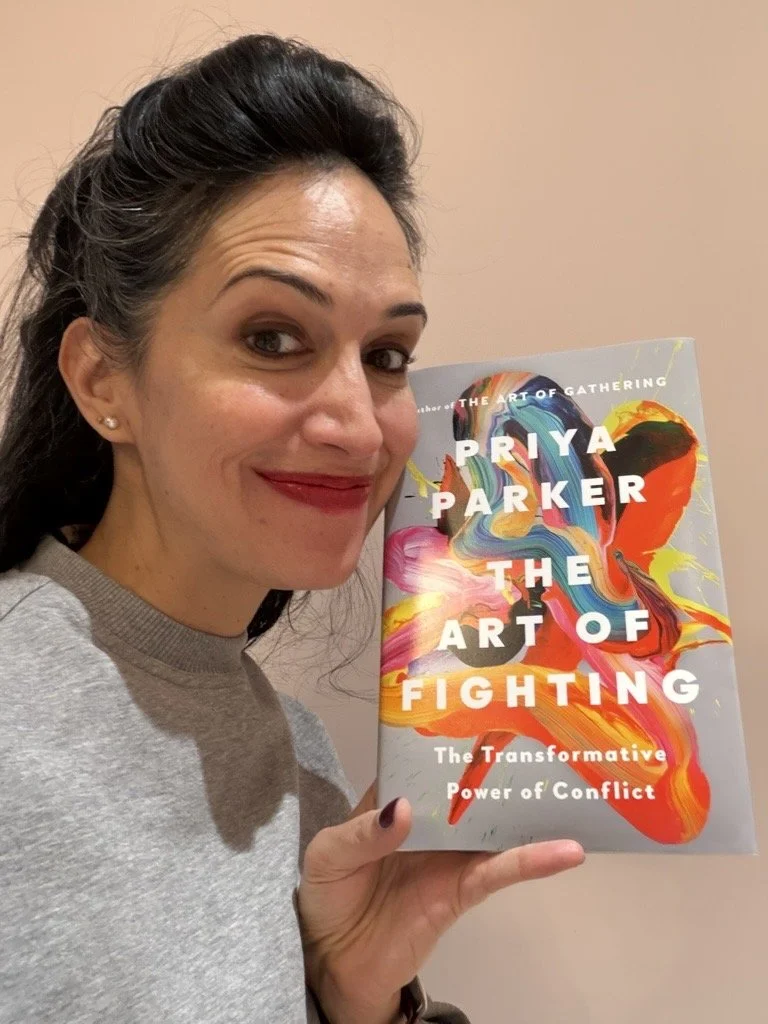
Today on The Stacks, we’re joined by facilitator, strategic advisor, and best-selling author Priya Parker to talk about her new book, The Art of Fighting: The Transformative Power of Conflict. In this book, Priya draws on research and her personal experience as a conflict facilitator to explore the ways that building healthy conflict can strengthen our friendships, relationships, and communities. We talk about how to build spaces that can thrive with conflict, why “renovation” is a powerful model for approaching fights, and why it’s important to prioritize both self-help and group help.
Our book club pick for September is Brother, I’m Dying by Edwidge Danticat. We will be discussing the book with Natalie Green on Wednesday, September 30th.
LISTEN NOW
Apple Podcasts | Spotify | Google Podcasts | Overcast | Stitcher | Transcript
Everything we talk about on today’s episode can be found below in the show notes and on Bookshop.org and Amazon.
The Art of Fighting by Priya Parker
The Art of Gathering by Priya Parker
The Culture Map by Erin Meyer
The Odyssey (Christopher Nolan, 2026)
Empty Space by Peter Brook
On Repentance and Repair by Danya Ruttenberg
If You Met My Family You’d Understand by Jack Shitama and McFadden Trinity
“I Will Always Love You” by Dolly Parton
Dolly Parton’s America (Radiolab)
Hanif Abdurraqib’s tribute to Dolly Parton (Instagram)
“There’s No Place Like Group Chats” (Hanif Abdurraqib, The Atlantic)
“Paulo Coelho — The Alchemy of Pilgrimage” (On Being with Krista Tippett)
Man in the Mirror by Anand Giridharadas
Fear and Fury by Heather Ann Thompson
Five Bullets by Elliot Williams
The Politics of Ritual by Molly Farneth
Good Talk by Mira Jacob
Siblings without Rivalry by Adele Faber and Kimberly Ann Coe
Getting Past No by William Ury
Getting to Yes by Roger Fisher, William Ury, and Bruce Patton
To support The Stacks and find out more from this week’s sponsors, click here.
Connect with Priya: Instagram | Website | Threads | Substack
Connect with The Stacks: Instagram | Threads | Shop | Patreon | Goodreads | Substack | Youtube | Subscribe
To contribute to The Stacks, join The Stacks Pack, and get exclusive perks, check out our Patreon page. If you prefer to support the show with a one-time contribution, go to paypal.me/thestackspod.
The Stacks participates in affiliate programs. We receive a small commission when products are purchased through links on this website.
TRANSCRIPT
*Due to the nature of podcast advertising, these timestamps are not 100% accurate and will vary.
Priya Parker 0:00
Self-help is-it's now become an industry and an ecosystem that is created and designed to help strengthen the individual. But there is a whole swath of questions that are actually about our shared life. When your group experiences some amount of conflict, is there somebody who has the skills to, first of all, not cancel each other, but second of all, hold it with care that you come through stronger on the other side. There's so many questions of our shared life, and we are an over-individualized society. Most of us are part of communities of difference, and we've thrown the baby out with the bathwater. We are a ritualist society.
Traci Thomas 0:46
Welcome to the Stacks, a podcast about books and the people who read them. I'm your host Traci Thomas, and today we are joined by facilitator, strategic advisor, and best-selling author Priya Parker to talk about her new book, The Art of Fighting: The Transformative Power of Conflict. Priya's latest book draws on research and her personal experience as a conflict facilitator to explore the ways that building healthy conflict can strengthen our friendships, relationships, and communities. Today, Priya and I talk about building that healthy heat that can sustain and build stronger relationships. Why we need something that Priya calls group help in addition to self help, and what to do about these pesky WhatsApp groups that so many of us are a part of. Our book club pick for September is "Brother, I'm Dying" by Edwidge Danticat, which we will discuss on Wednesday, september 30, with our guest Natalie Green. If you like this podcast and want even more bookish content? Please consider joining our community, the Stacks Pack, on Patreon and subscribing to my newsletter, Unstacked, on Substack. Each of these places has different perks. On Patreon, you can find community conversation, virtual book clubs, and exclusive bonus episodes every single month. On Substack, you'll find hot takes on everything from literary gossip to the latest pop culture and sports news, plus I rank my reads for you every month, and you also get that bonus episode. Your support makes it possible for me to make the stacks free every single week. So consider joining the stacks pack at Patreon.com/thestacks and subscribing to my newsletter Unstacked at Tracithomas.substack.com. All right, now it is time for my conversation with Priya Parker. All right, everybody, I am thrilled today. You have heard me talk about this author over the years so many times. I call her first book, The Art of Gathering, a book of my life. It is one of the most important books to me as a person. And she's back. She's got another book about maybe my second favorite topic besides gathering. It's a book about fighting. It's called The Art of Fighting: The Transformative Power of Conflict. And I'm thrilled to welcome back to the podcast Priya Parker.
Priya Parker 2:58
Thank you so much for having me.
Traci Thomas 3:00
I'm so excited. Okay, let's just dive right in because I have I wrote down way too many questions for a book that sort of explains everything very well. I was like, oh my god, we have to talk about this. We have to talk about this. So let's just start at the top. Can you tell people in like 30 seconds or so what is this book about?
Priya Parker 3:16
I am a conflict averse conflict resolution facilitator, and this book is about connection. The art of fighting is my observation that in the groups I work with, in the organizations I work with, in the friend groups that I see and I'm a part of, we tend to oscillate when the going gets tough between avoidance and what I call unhealthy peace, no one says the thing, no one's actually honest, important conversations never get had, and then swinging to the other side of what I call unhealthy conflict, which is dominance, manipulation, insulting, abuse, and actually, as a conflict resolution facilitator, I know that we don't fight about the things we don't care about, and fighting and conflict is really, really important to long-term community health. And so, this book is about how do we hold what I call healthy heat, and the core driving question of the art of fighting is how do you fight? How do we fight with those we want to belong to? Yeah. So, just from the top, I'm a I'm a healthy heated person.
Traci Thomas 4:36
I love heat. I'm the opposite of a conflict averse person. There are times.
Priya Parker 4:42
Well, hold on, hold on, hold on. I wouldn't say the opposite of conflict averse is healthy heat because you can do conflict seeking.
Traci Thomas 4:49
I'm not seeking. I just am comfortable with conflict. I like it. I think it's good. I'm like, okay, there's there's something here. Like, let's talk. Let's talk about it. Let's get into so many times. In the book, where I was like, "Oh yeah, sure, sure, yeah, yeah, yeah. That's I love this. I love this. And then there were times in the book where I was like, "How did I get this way? And so one of my first questions for you is, "How do we build people, communities, groups? I'm a parent. You're a parent, so I'm thinking about building people, like raising my kids. But also, you know, I have a book club. How do we create spaces where healthy heat is just like what we're creating? As opposed to a lot of the times in this book, you're dealing with people and groups who are in situations where maybe there wasn't a lot of healthy heat going, and now we've come to a head, and we've got to sort of figure out how to do this. I'm assuming my parents raised me in a way that I was like cool with healthy heat, right?
Priya Parker 5:48
Do you think they did?
Traci Thomas 5:49
I, I mean, my dad was very argumentative, so I think I think that when I was younger, maybe I didn't love it, but I it doesn't freak me out.
Priya Parker 5:59
Yeah, yeah. I mean, conflict. We all have our own conflict histories. We all have our own lineages and stories of whether or not the people in our families thought of conflict as wrong or healthy. We conflict is also deeply cultural.
Traci Thomas 6:20
Yeah,
Priya Parker 6:21
and you know, I opened the art of fighting by telling the story of one of the earliest memories I have. Well, as a teenager, I went to my my grandfather's funeral. So I'm I'm biracial, I'm half white, and this is the white Iowan side. And we went to a small church in Jessup, Iowa, and the minister rose to give his eulogy of my grandfather, and he saved his final at the pinnacle of his virtues, and he said, "In 50 years of marriage, Ruth and Lyle Parker never fought. And I was sitting on the pew in my black floral dress, my kitten heels. The dress was from Express. I don't even remember that story. And my stepmother, wise woman, leaned over to me and said, "Oh dear, that's not necessarily a good thing. Yeah. And I remembered so much her reaction, and I texted him, my father. I said, "Dad, do you think recently? I said, "Dad, is that true? Did your did your parents not fight? And he sent me back like the most dad text ever. I actually can I quote it?
Traci Thomas 7:32
Yeah,
Priya Parker 7:33
it's like you know, my like you know how dads sometimes like end their texts in like periods,
Traci Thomas 7:39
or they'll be like dad
Priya Parker 7:40
like yeah, dad. I'm like I know who you are. I know who you are. So I texted him to see if it was true, and he responded, "quote I think that is true. The last fight my dad had was in the South Pacific during World War II. He won that one and did not need to do it again, Dad
Traci Thomas 8:00
So dad,
Priya Parker 8:01
so dad, and and I I share that in part because I think conflict is something first of all that's totally normal. It's in every relationship. It's in every group. Groups can't form without a fight, and yet in many different cultures we have totally different stories about it. We have different beliefs about it, and in my line, and it's a mixed line. So on the Iowan side and on the Indian side, both of my parents and their parents were deeply conflict averse, and the only reason I think at some level I became interested in this is because, like, dear reader, my parents divorced,
Traci Thomas 8:41
right,
Priya Parker 8:42
right. Like they didn't. They never fought, right? They never exactly. When they announced, when they like share they were getting separated, people were shocked because they never fought.
Traci Thomas 8:52
Yeah.
Priya Parker 8:53
And so I learned from an early age that there's that there's great loss in avoidance.
Traci Thomas 8:58
Yeah.
Priya Parker 8:59
And so I I think the the first like I, the art of fighting is sort of my. Yeah, I think I think the best books are fiction or nonfiction are the books in which it's almost an excuse or a journey for the author's questions, and so these are my questions, right? How do we fight with those we want to belong to, and how do we do it well? And in many cultures, conflict. One of the books I read, and I'll stop talking. One of the books I read for this book is called The Culture Map by Erin Meyer, and she graphs which which cultures is now nations are more conflict seeking or conflict comfortable, and which cultures are conflict averse, and the can you guess the conflict averse ones? What would you or conflict?
Traci Thomas 9:45
This is in the book, so I know some
Priya Parker 9:47
Yeah, yeah. So, so conflict averse. She puts like on the far extreme, Japan, Thailand, definitely those two. Maybe Indonesia, and then on the conflict seeking was the Netherlands is. Israel, Germany, and then the U.S. and the U.K. were somewhere in the middle.
Traci Thomas 10:03
Spain, I think, was on there too, right? Wasn't Spain?
Priya Parker 10:05
Spain was on the conflict seeking,
Traci Thomas 10:07
conflict seeking, conflict seeking, yeah, yeah.
Priya Parker 10:08
And she said the difference between these are in the cultures in which conflict is, you know, when they're comfortable with conflict, are cultures in which they can separate the identity from the opinion, and in cultures where conflict is more conflict averse, the your opinion and your personhood are really tightly one one is the other.
Traci Thomas 10:33
Yeah,
Priya Parker 10:33
and so I thought that was super interesting in part because I think you can actually create subgroups or teams or book clubs where you can create a shared mini norm of healthy heat, but it needs to be created and designed and desired.
Traci Thomas 10:48
Yeah. So, like you said, as I was reading this book, there were a lot of moments where I was like, "Oh, and one of them was this section about the opinion versus the personhood, because as you know, my job is to talk about books and give my opinions on people's books, and what I've learned in this space is that unlike other forms of popular culture, like a movie or a play or a song, there is a really tight relationship between personhood and the art in a way that's just not there in a movie.
Priya Parker 11:23
Yeah, person and and and so what you're saying is personhood and authorship. The person itself as a medium.
Traci Thomas 11:30
exactly. Like that, if I say I don't like a memoir, I'm actually saying I don't like that person, and they lived a bad life, and I'm judging their life.
Priya Parker 11:39
Your is that what you think, or is that how you?
Traci Thomas 11:42
That's how people respond to my negative criticism. Like, like I'll say, well, I always talk about books I don't like, and people will say back to me, "Well, it's really hard to write a book, and you know, authors put a lot of work into their book. And I always say, "Well, every job is hard. It's hard to be a waiter, but you tell your waiter when you don't like the service you've had, right? And I think that that was something that was really hearing the difference between opinion, like how comfortable we are with opinion versus like associating the the the conflict with the personhood. And I thought like this is even shows up in subcultures within my life, right? Like when when you're with a group of friends and you're talking about a movie, it's much easier to be critical about a movie because you can say I didn't like The Odyssey, but you're not saying I think Christopher Nolan is a terrible person. You might be, you might you might think that, but that's not what you've said. Whereas if I say I don't like this book, it's often like, well, they're a really nice person, and I am like okay, but I didn't like their book,
Priya Parker 12:42
right? Right. I mean, at some level, what you're doing is you're elevating and practicing the role of the critic.
Traci Thomas 12:48
Yeah, I'm trying to.
Priya Parker 12:50
And the role of the critic. I remember reading this for the Art of Gathering, Peter Brooks' Empty Space. He has this like almost like manifesto paragraph of like why the critic deeply matters in society, and people think of criticism. This is what he was saying. I'm going to paraphrase criticism as like a hater, but actually, the the critic is the lover because it's calling us to to a art's highest form.
Traci Thomas 13:16
Yes, and like bringing attention to the thing
Priya Parker 13:19
Yes and saying there is a gap between the Platonic ideal of what a book could be and what this thing is, and and argue with me.
Traci Thomas 13:25
I mean, it's worthy of our time.
Priya Parker 13:27
It's worthy of our time. It's a worthy grapple. Like there's actually worth in what you're doing. It's coming, I think, from a from a perception of a perspective of love and and an importance of books. And so often, and this is true in our groups and our communities when we're not taught to critique, or we're not taught how to critique well, and it's not considered it's considered only like hating.
Traci Thomas 13:50
Yeah,
Priya Parker 13:51
we're actually not. It's like distorting the field because we're not getting better.
Traci Thomas 13:56
Right. Right. And I think in books also we have so many less and less critics that we're not even calling readers to engage in these spaces in the same way that other popular culture things are. But this this part of the book really I had to like stop and that's so interesting. This is feels so important to me, and it's something that I feel and talk about a lot. But you like the research that you pointed to, sort of articulated it in a way that, because I often say I'm like I don't I don't care about the person I don't care about the author like that's not my job I don't know them, so there's a lot of one of the things that I think you are just like spectacular at is you are so good at identifying an idea and then giving us do like bullet points and breaking it down. So like you have a part. You're like, why do we fight? These are three reasons we fight. Here are examples of each reason. This is a rift. This is what happens. And I think Priya, I'm sure this is because this is the job that you do. You have to explain things over and over, but like the. Level of clarity in this book is so incredible, but I read it. My listeners haven't yet. Can you just tell them why? What are the three things that you say? Like the reasons why we fight?
Priya Parker 15:13
We fight because we are longing to be heard. We fight because we are well. I will say in terms of groups. So, so the art of fighting is also. It's it's you know every person is going to read this as an individual. Sure. And I'm what I'm trying to do in the art of fighting is demystify what facilitators are taught, and I think should be regular everyday skills in in like human culture, I don't think these these should be specialized skills, and so part of what I try to lay out in the art of fighting, not unlike the art of gathering, is actually helping us become curious about why these fights are happening.
Traci Thomas 15:53
Yeah,
Priya Parker 15:53
and so one part of the book I look at almost like a weather vane when you can detect early storm early storms, like the likelihood that your group will head into a fight, headed into a storm. So there, there's sort of four common triggering events that will that that are disproportionately likely to create a conflict in your group. The first is the group is shrinking or losing relevance, we used to be this massive church, and now all of a sudden, like the pews are basically empty. Ah, right. At some point, something's got to give. The second, counterintuitively, is massive success. Right? We've we we did what we set out to do. Yeah. Now what? A third is an influx, a sudden influx of new members, both in terms of size, but also if there is difference. Right, new members don't necessarily know haven't drunk the Kool-Aid, and so there's a lot of friction when there's an influx of new members. And the fourth, and this one I find so interesting, is perceived hypocrisy.
Traci Thomas 17:00
Yeah,
Priya Parker 17:01
when a group says it's one thing, right? We are a magazine, we are a fashion magazine, and we are all about all type, all body shapes and sizes. And then it's revealed that thinner models are paid more.
Traci Thomas 17:15
Yeah,
Priya Parker 17:16
right. That is that is catnip for existential conflict, perceived hypocrisy. And so when you start part of the art of fighting is I'm trying to lay out and clarify, demystify that like fights don't like fall out of the sky,
Traci Thomas 17:30
right?
Priya Parker 17:31
And we can become actually more attuned and skilled and curious about if a group of people you love are in the midst of an internal fight or reckoning, to increase the likelihood that you can get through it with care and come out stronger the other side.
Traci Thomas 17:49
Yeah, you call this group help what you do. Like you talk about how there's self help and there's lots of self help out there, but like we don't have enough group help, and like we we need group help. Why why do you feel like we need group help? What do you feel like group help brings people? Why should why should we care about group help? I'm not a facilitator.
Priya Parker 18:12
You know we self help is first of all is a term that was created right 80 years ago. It was not a term, and self help is the the way I think about it is it's now become an industry and an ecosystem that is created and designed to help strengthen the individual,
Traci Thomas 18:30
right?
Priya Parker 18:30
Right, the I in society. How many steps we take, absent monitor that? What is our sugar intake? Where and how? You know, what is our? How do we want to give a better speech? And that is helpful for the individual. But there is a whole swath of questions that are actually about our shared life, the we. How do you host a meeting that doesn't suck?
Traci Thomas 18:54
Right. Right.
Priya Parker 18:55
When your group experiences some amount of conflict, is there somebody who has the skills to first of all not cancel each other, but second of all hold it with care that you come through stronger on the other side. There's so many questions of our shared life, and we are an over individualized society. And I part of the art of fighting, and so I think self help is deeply important. Right? Don't get me wrong. the The role of the individuals deeply important. The the the space. I mean, America, the U.S. is is is a country of you know majority immigrants, and they are people who chose to leave. Not everyone chose to leave. Obviously, some people were brought here against their will, but those who chose to leave are often leaving. My own family included because of the oppressiveness of the group, right? So, so groups can also be oppressive,
Traci Thomas 19:44
right?
Priya Parker 19:44
And when we don't have the skills to basically navigate our collective life, we are our communities are fractured and fragmented and weaker. And so, a facilitator is taught how to help hold group. Conversations had to host rituals that help mark and transition time together, and traditional communities had a ton of group help. It was in the water, but when you you know born on the same plot of earth and die in the same land and pray to the same God, these rituals get reified over time, and everyone knows what to do. But in modern life, most of us are part of communities of difference, and we've thrown the baby out with the bathwater. We are a ritualist society.
Traci Thomas 20:28
Yeah, I think one of the things also that you talk about to this point is like in past over time, there was a lot of lot more intergenerational conflicts that were happening, where there were people of different generations being part of the conflict, what maybe there's a leader in the community who helps facilitate, who has practiced this and studied
Priya Parker 20:49
holding iit in the sense that they're beefing with
Traci Thomas 20:52
yes sorry, part of the ritual.
Priya Parker 20:53
Yes, that that in so many of these communities, there's often an elder or a shaman in traditional communities, or a rabbi, or a priest, or an imam that is trained to, and also has the authority, the collective authority. Whether you go to the resident auntie, that everyone's like, okay, let's take it to you know auntie. There is there was common geographical boundaries, so you kind of know in many in many societies there were actually physical locations where if there was going to be a collective conflict ritual there there was only one place in the community or the village you would do it. I looked at traditional conflict rituals, and many of them hosted these these rituals near their graveyards, near the cemeteries, so that they were physically in proximity to their ancestors, and all of these rituals. Basically, no community wants to go to war with itself,
Traci Thomas 21:52
right?
Priya Parker 21:52
And so there were always release valves. I mean, including, by the way, I thought this was so interesting: the Vikings,
Traci Thomas 21:57
right?
Priya Parker 21:58
The Vikings were one of the first, and yes, terrible violence outside. I'm talking about just looking at their internal collective conflict rituals, and they they were the first group in in Europe where they had to find ways to bind the the soldiers together, and they weren't kin, meaning they weren't a bloodline. And so one of the things they did was every Monday, as I understand it, they hosted these rituals, conflict rituals called All Things, and there were pop-up rules, which were no spitting, no killing, and they would air their grievances with each other and get it out, and then that would form a public record so that they also had this like oral memoric record of all of the things that they had sort of they had cleared together, and and these are ways to strengthen and bind and almost like clear the. It's almost like an abscess in the bodies, right? How do you clear? How do you clear the energy that's stuck, so that the body can return to health,
Traci Thomas 23:03
right? And like making these clearings regular, so it doesn't have to be a thing. It's not a thing. It just doesn't need to be
Priya Parker 23:11
open heart surgery, yeah. Because you're regularly doing your stretches in the morning,
Traci Thomas 23:16
yeah, yeah. And you know the thing about hosting it near a graveyard is so interesting because one of the things I think people talk about a lot these days is how our families and our communities are spread out, or you know we're not living in homes with grandparents and aunties and uncles in the ways that we used to, and that you know by hosting these rituals near the ancestors, it is a reminder that like you actually do belong to this group. Like these are your people.
Priya Parker 23:45
Yeah, and I think the lineage, my love. Let's not forget it.
Traci Thomas 23:48
Yeah, like this is a fight, but also you are. We are part of a long river. Yes, we fight all the time. We're all here still. Yeah. Yes, and I do think to my parents' credit, that is the thing that they did instill in me about fighting is like you can fight, but like you're still a Thomas.
Priya Parker 24:06
yes,
Traci Thomas 24:08
that's unheard of. Like we can be mad at each other, but it has nothing to do with like who you are. You've made a mistake, or I've made a mistake, and we're mad. Yes, and I think like
Priya Parker 24:19
and explicitly saying that, I mean, it's so amazing your parents said that to you in part because you know when when conflict one heat arises for many people it is scary right it is it is a threat to the it can feel like a threat to the perceived bond yeah and so even as a parent to articulate just because we are arguing doesn't mean we love we don't we love each other any less in fact I'll say this to my kids. In part, I'm saying it to myself. It is it it is okay that you know your father and I are arguing. We are arguing about something that matters to us. We are trying to sort through it. I never saw my parents fight. This is part of healthy relationships. I say this even with them when they're arguing or fighting with their friends. Friends. Fight, and and you shouldn't be fighting all the time, But to not have that lexicon, it it you know it's easy in modern life to bounce rather than bother, right? We avoid, we ghost in part because we don't run into each other at the grocery store. Like there's so few forced men. It's not awkward, right? So many of us no longer belong to something like a church. You used to fight with somebody. You kind of had to deal with it because you're going to see them Sunday morning.
Traci Thomas 25:26
Yeah, I mean, one of the questions I had for you, and maybe you just answered it, is can you fight with someone, someone's who want to quit,
Priya Parker 25:38
who want to leave the group?
Traci Thomas 25:39
Yeah, like you want to fight about it, and they're like, "I don't care."
Priya Parker 25:47
So the center, one of the people I interviewed for the art of fighting is a conflict resolution facilitator named Setu Nair, and one of the things that she said, and she's a very seasoned and skilled facilitator who's brought into really complex group fights, and I said, you know, what do you look for when you go in? She one of the examples she shared with me was a local government agency in New York City that was basically the ACS is it's sort of dealing with with child services, so it's half social workers, half law enforcement, and during the during the summer of 2020, the the workplace broke open into a flag war, meaning half there was there was some staff were putting up Black Lives Matter flags on their desk, and other staff members were putting on Blue Lives Matters on their desk. Satunaire was brought in to sort of help help, and I said, you know, I know ah, and I said, you know, what do you do? What do you do? How, like, what can we learn from you? And she said, no matter what the conflict is, I'm always looking around and trying to tap into and find the relational longing that's still there, and if you can find that, there's always an avenue of possibility. And I think of relational longing. She said that to me on an interview, and I said, "What do you? And and and she and I think she sort of framed it out loud. And as I think about what relational longing in is, it is it's the residual desire underneath the fight, underneath the anger, underneath what's actually going on to still want to be part of it, and so if somebody is wanting to leave, the opportunity is if you can get in there to understand why. Like, are they just leaving because they're conflict averse, and they're they're like terrified of facing this thing, and so they just early exit, or are they leaving because they no longer have what I call in the book "mun", which is a Hindi word, desire for the for the group, and I'm of I'm of the you know I'm of the ilk that we often prolong things that need to end, and we often end things that actually still have life in them. Right, and so some of this is discernment: are they exiting because of conflict aversion, or are they exiting because they like don't feel it anymore, and it's really hard to keep someone in if they've if they sort of no longer have the mun, no longer have the desire, and in that case, it's good to have like a good goodbye.
Traci Thomas 28:13
Good goodbye. Okay, we're gonna pause here and take a quick break, and then come back. This weekend, I went to dinner with one of my very best girlfriends, and she was telling me a story about her job. How her boss did something not good, and she wrote an email being like, "This is not good. Like me and other people, we don't like it. And her boss called her up and chewed her out on the phone, and she was very offended by this. And then the next time they were at work together, the boss called her aside and was like, "You really shouldn't have done that. To her face, and she stood up for herself. And I said to her, "Did you cry? Because this is a friend that I know, and I knew she cried. And she said, "I did cry. And I said, "I knew you cried. And she said, "I know. What was I supposed to do? I was like, "I don't know. I'm just proud of you that you still said it, even though you were crying. And then I was like, I'm actually talking to this woman, Priya Parker, about fighting. And she said, "Will you ask her what I don't like to fight because I don't like to cry in these situations that are like about power? And this was a male boss, and she's a woman. And what do you? How do you deal with that piece of it-the crying piece that sort of we're told we're not supposed to?
Priya Parker 29:26
Yeah, I mean, the first thing I'd say is same girl, same. Like I often cry when I am trying to speak, and it's scaring me in my own personal relationships. It really-I wish I didn't. Yeah, and so you're not alone is the first thing. And I'd say a couple of things. The first is like as we begin to actually think about conflict as a skill, as a muscle. One of the freeing things about it is that you can actually work out to get better. And one of my favorite parts of the book is it's called preparing the body for a fight, and I actually lay out my my own and the facilitator Prentiss Hempel's pre-facilitation rituals of how we prepare our bodies for a fight. And so the first thing is, you know if you if we don't think of fights as like these like incredibly rare occurrences, and particularly in a case if she knew she was going to say something to her boss, if you know if you can predict it, to take five minutes beforehand and actually start preparing your body to relax it. There are all sorts of physical practices you can do to get your body into a more relaxed stage, including like shaking one right hand, left hand, right foot, left foot, breathing deeply. Prentice lays out a number of very specific steps, and one of the things Prentis says that I love is they say a relaxed body is the most powerful body we have, and so one element is to start practicing. And I'm not a doctor. I don't know, you know, if we can ever sort of like like get rid of that reaction. You know, I I don't know, but I do know in my own life that I if I practice five minutes before I do anything, hold a fight, speak on stage, I can. I've learned over 20 years how to really, really, even when I feel fear, get much more relaxed in my body, and then I don't have as strong physical reactions. The second might be counterintuitive, but I there's a woman I know who's a CEO, and she is a crier, and one of the things when when things get tense, she bursts into tears, and she's been surprising. Well, I shouldn't say surprisingly. She's been very effective over multiple decades. And one of the first things she tells her board of directors is, "When I get, when I am in a conflict or when things get heated, I sometimes burst into tears. I'm working on it. I have an executive coach, and also it is just something that happens. I don't want you to feel sorry for me. I don't want you to freak out. I don't want you to treat me differently. As we get to know each other, you will see that this happens, and I work through it. And I just want to let you know that this is happening. Of course, here she has some amount of power. But when she told me she was doing that, it reminded me of a a healer I once went to. Do you know cupping? It's like when you put the cups. And so I went. I went. This was decades ago. I went to a practitioner. Someone strongly recommended. I was in graduate school and I had sort of a crisis. I I I dropped out for a little bit, and I went to see this practitioner, and she said to me, "I'd never done it before. I didn't even know what it was. And she said to me, "So I have a I have a somatic effect, a physiological effect, which is I'm going to put my cup on your back in a certain location, and when I find the pressure point, I have a and I can feel it. I burp.
Traci Thomas 33:01
Oh,
Priya Parker 33:02
and I was like, "Excuse me. And she was like, "When I, you know, I've trained in Chinese medicine for 20 years, and when I find the right pressure spot, I'm going to put the cup there. And when I find it, I, meaning the practitioner, burps. And I was like, "Huh, right? Yeah. And and and she started, and she went, and she and every time she'd find it, she'd burp. And in the beginning, and she joked, she was like, "Is my blessing and my curse? You know, I found the right spot, and it's a physiological. I'm so responding to the energy. That's that's the that's the response. And in the first few times, I was like, oh my gosh! And then I literally didn't even notice it.
Traci Thomas 33:43
Yeah,
Priya Parker 33:44
and so that's sort of the inoculation theory. But but this is a question that I have heard from you know multiple people, usually you know often women, and I think so much of modern life, whether it's connection or fighting, and fighting is about power. It's figuring out how to build a bridge to another person, and there are many paths to do that.
Traci Thomas 34:07
Yeah, the end of her story was that her boss apologized, so I was like, the crying worked.
Priya Parker 34:13
I mean, that's interesting. The other part is like she helped him feel felt.
Traci Thomas 34:18
Yeah.
Priya Parker 34:19
So part of what she also was doing is sometimes we can intellectually argue and argue and argue, but when you can actually feel that you're affecting someone, there's an opening. Yeah, and so I mean, thank you for saying that. The other thing is, it's not, it's not, it's sort of like that masseuse.
Traci Thomas 34:33
Yeah,
Priya Parker 34:34
maybe it's a superpower.
Traci Thomas 34:35
Yeah, well, that's what I said to her because I was like, I would have just backed off because I wouldn't have wanted to cry, because I'm not really a crier. But I was like, well, obviously it worked. Like whatever you did, it worked because he he he went into the face to face being like, you shouldn't have done that. Was not going to apologize to her. And after she sort of like said her piece, whatever it was said, it obviously worked. Whatever, whether. The tears, or just that she was able to communicate clearly to him. But
Priya Parker 35:04
I mean, the center, good for her, and and maybe he'll think deeply about what she said. Hopefully, yeah. I mean, the core of the art of fighting is whether or not we are willing and able to alter each other.
Traci Thomas 35:18
Yeah, yes,
Priya Parker 35:19
and be altered by each other.
Traci Thomas 35:21
Yeah. So this sort of brings me. This is a little bit outside of the purview of the book. We want to leave some things for the listener, but I want to talk a little bit about the kinds of fights that happen in our lives that maybe like we don't have. We don't have time to like stop and plan for. They happen. Some you know someone's another parent at the school says something to you at drop off you know and you just react or you know you're at Thanksgiving and your dad says something about a politician or these moments that like it's almost like the fight just happens in that moment. How can we get better at those kind of fights, right? Because it's still a group that you probably want to be a part of. You still probably want to be a part of the family, maybe, and like you still probably want to send your kid to the school and be cool with the other parents. And but these things happen.
Priya Parker 36:16
These things happen. They're very normal. One of the books I read that I really loved for the art of fighting was is by the rabbi Danya Ruttenberg. It's called "On Repentance and Repair, and one of the things she says is, "We all cause harm, we all are harmed, and we all witness harm. And so part of this is also just normalizing. We are in relationship and community with lots of other people who have all sorts of stuff going on, and part of my hope with with the art of fighting is it's just it's an invitation, also like the art of gathering, to just grow our group intelligence and notice one of another book I love is it has a wonderful title. It's called "If You Met My Family, You'd Understand. I love that. It's a book by a minister called Jack Shatama, and one of the things he says he basically talks about how in every group he focuses on churches, but but in every group there's something that he calls surrounding togetherness pressure. That there's a way, and every group needs it. Like it's a culture. This is how we do things around here. Right. And when you are, for some reason, the odd one out, what he invites us to practice, and whether again it's dropping off someone at the school, or whether it's with your family at Thanksgiving, practicing what he calls non-anxious presence. And again, it's actually very physical, and it's not non-anxious absence. I don't need those people. I'm not coming to Thanksgiving, and it's not anxious presence. It's practicing non-anxious presence, and part of when you're able to do it, it goes back to Prentis Hempel, who talks about a relaxed body is a powerful body. Is it just expand our range of options? As somebody who tries to do this myself? It expands your range of options in the moment, and not every insult needs to be met or escalated with an insult. It's just practicing and becoming curious of like, huh, you know that uncle just said something totally inappropriate. Maybe I could shoot back, or maybe I could, you know, say something that makes the whole family laugh, and sort of takes the power out of it without becoming abusive myself. Like all of this is practice, but it begins with wanting to get better.
Traci Thomas 38:39
Yeah. So last week, Dolly Parton died, and I had read your book maybe like a week or two before, and you talk about the song "I Will Always Love You. Will you set up why you talked about that song and sort of the premise of that song and why it was why why it's meaningful, how it made its way into the book?
Priya Parker 38:59
I one of my favorite podcasts is called Dolly Parton's America, and I listened to it during the pandemic. And I was struck by the host story of of the behind the "I Will Always Love You. I never knew the story, and basically, Dolly Parton got her a break as a like a TV variety Co-host, and she she joined this show and had a male co-host who was much older than her and a total pro. And he taught her like everything she says. He taught everything she knew. And one day, and she was and she also was a star in her own right. And one, and she realized after a few years it was time to go. Like she'd learn what she's going to learn. It's gonna. It was time for her to you know go on her own, and he just wouldn't let her. He just didn't want to hear it. He was like, no, no, no, no, no, no, no, no, no, no, and she was. She thought to herself, well, I can't just. Run away,
Traci Thomas 40:01
right?
Priya Parker 40:01
Like I need to say goodbye. And she, as the story goes, she walked into his office one day with her guitar and sang "Bitter Sweet Memories. And she sang "I Will Always Love You" was her love song for what I call a connected goodbye, and love songs and breakup songs aren't unusual, but we usually sing it behind the person's back.
Traci Thomas 40:34
Yeah,
Priya Parker 40:35
she sang it to his face.
Traci Thomas 40:38
Right. Okay, carrying on the Dolly Parton thing. I don't. Do you know who Hanif Abdurrakib is? So he wrote this like amazing Instagram tribute to her, and it was like multiple slides and pictures and all of these things in the Hanifian way. And there was a section that made me think of you, where he says, and I'm going to quote him right now, he says there was a gift she had as both a writer and a translator of song to leave space for someone else to come in and renovate as they might see fit. She made songs and performed songs with such an inspiring lack of ego, and I was like, "Oh my gosh, that is what Priya was talking about in the book when it comes to renovation, yes. Will you explain to people? Because now I've I've done a home renovation. Now I'm thinking about renovation everywhere. I'm thinking about it all the time because of you and because of this post from Hanif. So I would love for you to talk about why renovation is such a powerful model and a useful model when it comes to fighting with groups,
Priya Parker 41:43
I think he also had this recent amazing piece about group chats in the New Yorker.
Traci Thomas 41:46
Yes, yeah, I haven't read it yet, but he did.
Priya Parker 41:48
I'm loving his like group intelligence, you know, on all of this stuff. Really amazing, really amazing. Yeah, beautiful, beautiful, beautiful writer, and and so holds the culture with such precision. And so this idea of renovation, basically, I the the the first third of the art of fighting. I've I've designed the book based on the life cycle that groups go through when they when they have an internal existential fight. And so the first third is called tear, the second third is called grapple, and the third third is called cleave, which means both to cut and to bind. And the second to last, the last two chapters are both cleave. One is if you're deciding to leave, how do you end? And the final chapter of the book is what happens if you decide to stay and change? And basically, what I've seen in so many different groups is there's two parts of the end of of when you've had a fight, when something has been revealed. It's not it's not a misunderstanding. There was bad shit going on, or you know whatever like this. The way we are doing this no longer works. We need to change, right? And people are willing to stay and change. There are two needs in that moment. One is repair. We need to, as a leader said to me that I was working with, I didn't realize that it was also a rupture in our belonging. We need to repair with each other and find ways to do that. But the second is to renovate, which is things got to change. right? It was revealed that hiring practices were actually unfair. We need to change them, right? Whatever it is. And one of the elements that I found through my work is that the groups that change, and particularly the companies that change, this was a study that found this, that are successfully undergo cultural change. Treat it like an architectural renovation, and the most important then to start with the question: What is still precious here?
Traci Thomas 43:54
Yeah.
Priya Parker 43:54
What is precious in this relationship? What is precious in this friend group? What is precious in this company? What is precious in this book club? Don't start with what do you want to get rid of. People flip out. There was this interview with Chrissa Tippett, the radio radio host, where she interviewed Paulo Coelho, and she said to him, "You know, you've been married to the same woman for 50 years. How how have you stayed married to the same woman? And he says, "But she's not the same woman; she's changed, and so have I. And he says, "We've been through all sorts of ordeals, all sorts of ordeals, and each time we had to look around and said, 'Do we do we want to tear down these walls and build a new house with each other? And as long as there was still love here. We decided to renovate.
Traci Thomas 44:45
Yeah, I just think it's like so. It's so good. It's so genius because there are things here.
Priya Parker 44:53
Yes, and also all groups change. Like at one point, I almost put change in the subtitle because conflict is also. Just a signal that things need to change. Yeah, but it's like we don't really like we we apply to groups, right? We apply sometimes. We apply to colleges. We apply to jobs. But there's not usually like a renewing of our vows in most of these places. We renew our vows through conflict.
Traci Thomas 45:19
Conflict. Another. This is these are groups that we're also part of that maybe conflict is hard because we are now part of groups that were never in person, where we're in a group chat or like I, you know, I have a parents WhatsApp. It's my my least favorite place in my life that I have to show up. I hate it so much.
Priya Parker 45:41
Is that school or association or neighborhood?
Traci Thomas 45:44
It's school. Like the first grade parents.
Priya Parker 45:47
Yep,
Traci Thomas 45:47
I avoid it like the plague. I try to just text one of the other moms who's like really involved and just ask her questions directly and hope that she doesn't say it's in the group chat. Like, but like for example, in our group chat, we had an incident at the school, and all the parents were saying crazy things in the group chat that were offensive to me. Like as who I am as a person, I was like, "This is really bad. It was it was about like police on campus during the early days of the ICE raids that were happening in Los Angeles at a public school, and you know I'm like trying to keep it cute, trying not to get involved. I'm barely in this chat. I just am reading what's going on. But like, how do we be there, Priya? Like, what do we do when we find ourselves in a situation where it's like, I don't even love this group, but this is the group I'm in. Like I'm here, we're in first grade. I plan to stay at this school, but these people are saying crazy things. How do we navigate that?
Priya Parker 46:51
Yeah, I mean, parent WhatsApp groups in schools, informally created parent WhatsApp groups in schools, are the wild, wild west.
Traci Thomas 46:59
The worst thing ever.
Priya Parker 47:01
They are under moderated. They're often informal, so the school doesn't actually have authority over them. So the in the formal authority that should be actually creating something doesn't actually have the capacity. It could ask. Most don't. It could say, "Please shut this down. I heard of a school recently in in Brooklyn where something happened. A group, you know, a thread was created, and the the artful gatherer head of school immediately text texted individually a number of the moderators and said, "I think please shut this down. This is not an appropriate place to discuss this conflict. We are going to create appropriate community based conflicts, but this is actually going to threaten it, and they shut it down. So part of it is this also higher trust, but the these informal WhatsApp groups and it doesn't have any WhatsApp group, group group group chats are usually incredibly bad at holding conflict group conflict well, and for so many reasons. Right, first, not everyone has the same information. Second, not everyone, particularly on a group chat, even understands that what they're creating, what they're typing in quickly with their thumb, particularly if they're angry or hurt or worried or triggered, is going out to like 700 other eyeballs. Yeah. Right. Like 40 years ago, there was a printed out phone directory. Yes. Right. And maybe you could do a family tree and spread stuff. So we're hyper hyper connected, and it's turbo charges conflict, and it's a problem in part because a lot of parents aren't in school all the time. They're not, and so it also literally it affects our perception of the community that we belong to, yeah, and what it is.
Traci Thomas 48:42
So, what do we do?
Priya Parker 48:45
Ideally, we. I think that the places I've seen that do this in a healthy way are places in which one there is formality in the in the chat. They're well moderated. There are group rules and norms, even if it's informal. They keep it broadly to like information and maybe some social stuff that's like warm, you know. But there's there's rules and at and some level, almost all groups that last that are informal at some level it goes through the storm. You got to set some structure, yeah. And but the second I interviewed a digital anthropologist called Rahaf Harfusch for this book, and I asked her, you know, what do we do with digital tools? And she said these tools were not designed to hold conflict well; they were designed, if anything, to exacerbate it. The best way to grow your followers online is to pick a beef with someone. and I said, what do you do in your group chats? And she said, I have a rule with my friends. We have a rule in our group chat that if things get tense, we pick up the phone.
Traci Thomas 49:47
This is good advice. My my new rule is just to tell everyone. For a while, I was just saying I don't have WhatsApp, but if I I had.
Priya Parker 49:55
But then you also miss a lot of information.
Traci Thomas 49:56
I know I had to get it.
Priya Parker 49:59
I actually do think we're in the wild, wild west of digital norms because all of this-we're the parent, we're the first parental generation that is not digital natives to have to figure out how to use this technology, including the school administrators. Like everyone's kind of flailing, and I see a difference in the intelligence of my of like the class of my younger child versus the class of my older child, only because the culture is changing and parents are starting to not have knee jerk, you know, give the kid a phone or give the kid social media, give the so even three years apart, the intelligence and I don't mean intelligence like they're smarter than the previous generation, just like the information we have, the data we have, the norms are changing, and so I think we're still in the wild, wild west of parental conflict and confusion.
Traci Thomas 50:47
Yeah, it's really it's very. This is this is where my conflict aversion shows up, and things like this, where I'm just like sometimes it's wise.
Priya Parker 50:55
Don't want to know, not putting things on the record, not saying something you can't hold back, finding way. This is. I mean, honestly, it's a where there's no in where there's no formal authority is some of the hardest places to rein in conflict and and have it be productive and useful.
Traci Thomas 51:12
I have to ask you this. This has been a burning question on my mind since I saw your book was coming, which you've started to address on social media. But you and your husband both have books coming out in September 2026. They're both on my TBR. I'm actually starting your husband's book later today.
Priya Parker 51:27
Yay!
Traci Thomas 51:28
I'm so excited. I'm so excited. I I did my full Bernie Goetz reading earlier this year. Now I get to fast forward to do. I read both the Bernie Goetz books. Now I'm doing this. Anyways, what's this like? What happened here? How did this happen?
Priya Parker 51:43
Oh man! Welcome to the mess. Welcome to the mess. Oh my goodness. Well, Anand's book. His name is Anand Girardas. He's written this incredible, incredible, riveting opera narrative nonfiction called Man in the Mirror. And basically, dear reader, he was on time, and I was two years late. Okay, is the honest truth. He he submitted everything on time. They set the pub date. I requested an extra year. That definitely created a little healthy heat. I was granted it. Actually, one of the things that happened, since you are interested in the writing process, was I got my notes back, and I also had three readers read the like an earlier draft of the Art of Fighting, and the and all three of my readers couldn't really remember the final third of the book, and I was like, "That's not good,"
Traci Thomas 52:35
not good,
Priya Parker 52:36
and I and I realized that it was technically great, but emotionally flat.
Traci Thomas 52:41
I see,
Priya Parker 52:42
and I needed to basically rewrite it. So anyway, here we are. My the Art of Fighting comes out september 8. Man in the Mirror comes out september 28, and it's a lot. It's a lot. And I we we actually originally the publishers, the two publishers, not I think not knowing that they're part of the same larger company, set it for the same date. they did, they did, and we we we raised the stink and tried to get them even further out. And they they so three weeks is now what we have, and it's a lot. It's a lot, and and we are we are a couple who is like deeply invested in each other's work, on and often he's a journalist and used to be a foreign correspondent. And man in the mirror is it's an amazing riveting story that he had to go you know for eight weeks to sit in a trial day in and day out. He would cook dinner for us. He's the cook, the primary cook in our family. He cooked dinner for me and my kids. He'd then take a nap from nine to 11 p.m. and then he would take the subway up to the to Inwood, sort of the the beginning of the A train, and follow city New York City social workers all night, watching where and how they're interpreting the law that Eric Adams, the mayor at the time, changed to see whether or not you can forcibly remove a person from the street if they're becoming a danger to themselves or not, and Anand would literally like watch where and how do they do this and how does the law get enforced, and so we've always been, you know, we've always we've always deeply supported and been really into each other's work, and it would be great if we had if it was not in the same month.
Traci Thomas 54:24
This was the first thought when I saw these pub dates. I was like, "Wait, what's happening?"
Priya Parker 54:29
We have so many things. My mom's coming in. We have, you know, he's he's he's holding on the fort for a few weeks, and I'm holding on the fort for a few weeks. We're doing a few joint episodes, joint podcasts together, which is sort of fun. And I would not recommend it.
Traci Thomas 54:43
Okay. People who are married to writers don't do this. You already mentioned a bunch of books, but are there any other books you'd recommend to people who love the art of fighting?
Priya Parker 54:56
The Politics of Ritual by Molly Farneth. Brilliant book, oh it's so good it looks at she's a theologian and she I think she teaches at Princeton and she basically says that we think of rituals as as as tools for tradition to reify tradition and groups but rituals are tools and they can as much be used to change and to create progress as they do for tradition. The opening scene of the book is looking at how a Jewish community in New York City use the Kaddish, their morning rituals and morning prayers, publicly in the street to honor Eric Garner's life and mourn his death, right? And so he she's looking at ritual and how it's being used in the public square and multiracial society so beautifully. That's a book on repentance and repair by Danya Ruttenberg. She deeply demystifies. She says we overfocus on forgiveness and this the Christian notion of forgiveness, and we underfocus on the Jewish notion of repair. It looks at demystifies the 12th century Jewish philosopher Maimonides. It is awesome. I use it for my children. Good talk by Mira Jacob. Just excellent, excellent, excellent. Just skills in so many ways, but it's this like delicious graphic novel. Oh my gosh, so many the siblings without rivalry.
Traci Thomas 56:27
Oh yes,
Priya Parker 56:28
excellent, excellent book. Actually, a lot of parenting books are. There are some that I actually deeply disagree with, and there are some that are very deeply helpful. There's so many. There actually are. We have a group help shelf growing.
Traci Thomas 56:40
Okay,
Priya Parker 56:42
but so many so many books that basically look at how do we actually hold the group, and then and so much. The last thing I'll just say is the art of fighting is I am trying to help us relook at what heat and conflict is in on our relationships, and I'm really looking at how do you hold group infrastructure, and there is an entire body of work in the conflict field about how to build skills one-on-one. Difficult conversations, crucial conversations, getting past no, getting to yes-like foundational books in my field. Those are all excellent, and they're they're skills that are helpful to then also use in a group.
Traci Thomas 57:18
Last one: if you could have one person, dead or alive, read this book. Who would you want it to be?
Priya Parker 57:22
Wow. Hmm. I mean, the Democratic Party.
Traci Thomas 57:28
Okay, I love great answer. Everybody, you can get the Art of Fighting out now wherever you get your books. It is fantastic. It has my big giant stamp of approval. I am such a Priya Parker fan. If you haven't read The Art of Gathering just please, just also read that. Okay, just do it, Priya. Thank you so much for being here. This was an absolute delight, and I'm so excited that you're back with this book.
Priya Parker 57:51
Thank you so much. Thank you for your work, Traci. Thank you for having me on. Thank you for seeing what I'm trying to do. It's always such a pleasure to be in conversation with you.
Traci Thomas 57:58
Yay! Everyone else, we will see you in the Stacks. All right, y'all. That does it for us today. Thank you so much for listening, and thank you again to Priya Parker for joining the show. I'd also like to say a huge thank you to Ashley Garland and Shailyn Tavella for your assistance in making this episode happen. Our book club pick for September is Brother I'm Dying by Edwidge Danticat, which we will discuss on Wednesday, September 30th, with our guest Natalie Green. If you love the stacks and you want inside access to it, head to Patreon.com/slash the stacks to join the Stacks pack and subscribe to my newsletter at Traci Thomas. Substack. com. Make sure you're subscribed to this podcast wherever you listen to your podcasts, and if you're listening through Apple Podcasts or Spotify, can you please take a moment right now and leave us a rating and a review? For more from the Stacks, you can follow us on social media at the Stacks Pod on Instagram, Threads, and YouTube, and you can also check out our website at thestaxpodcast.com. This episode of the Stacks was edited by Christian Duenas with production assistance from Sahara Clement, additional support was provided by Cherie Marquez, and our theme music is from Tagirigis. The stacks is created and produced by me, Traci Thomas.