

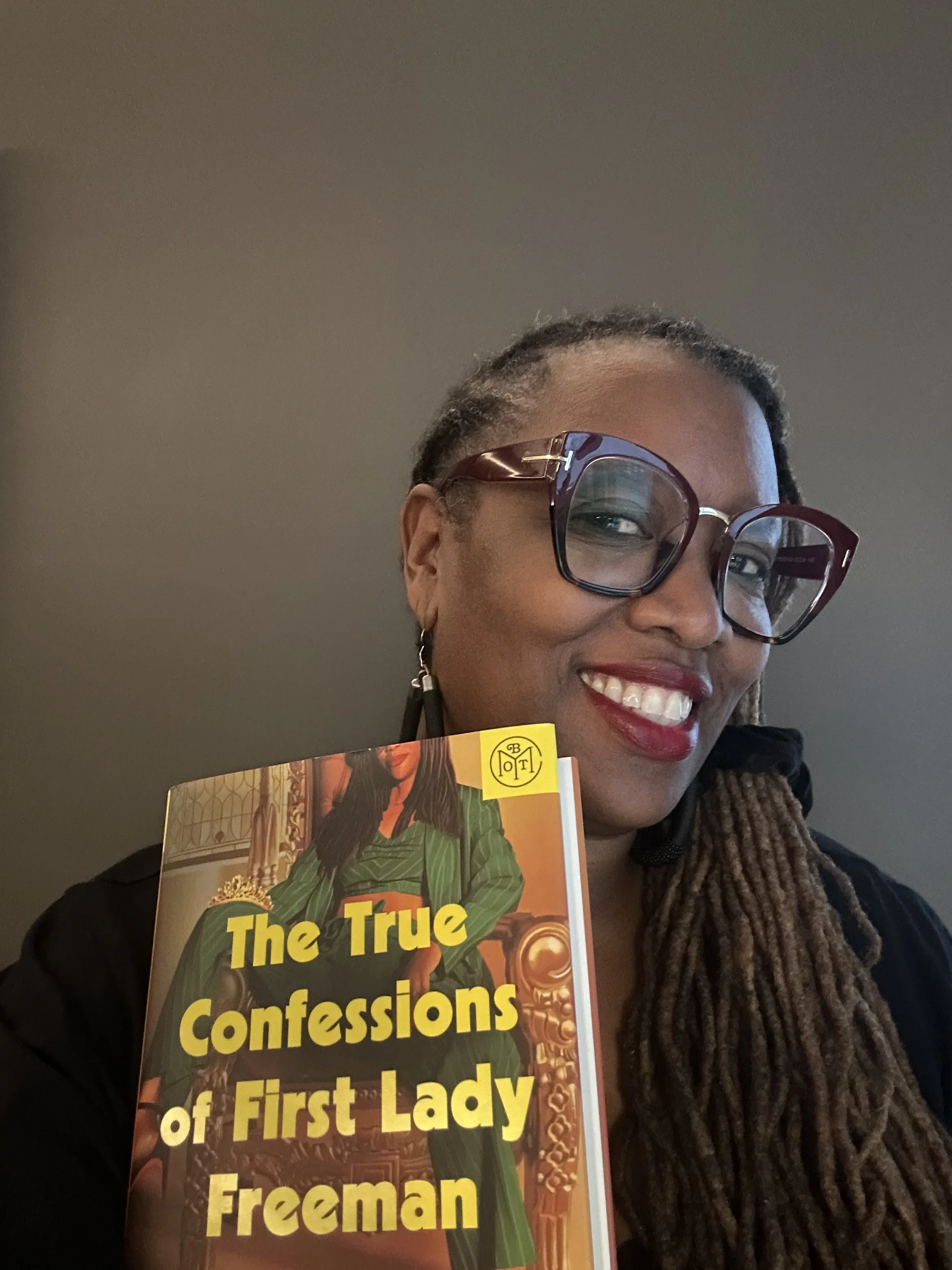
Today on The Stacks, we’re joined by author, speaker, and National Book Award finalist Deesha Philyaw to talk about her newest book, The True Confessions of First Lady Freeman. This novel follows Scharisse Freeman, the successful wife of a megachurch pastor, whose carefully curated life begins to unravel when her secret past comes to light. In this episode, we chat about Deesha’s 20-year journey of writing this novel, how she defines success, and why she wanted to write about hypocrisy in the church.
Our book club pick for October is Last Chance Live! by Helena Haywoode Henry. We will discuss the book with Jess Lee on Wednesday, October 28th.
LISTEN NOW
Apple Podcasts | Spotify | Google Podcasts | Overcast | Stitcher | Transcript
Everything we talk about on today’s episode can be found below in the show notes and on Bookshop.org and Amazon.
The True Confessions of First Lady Freeman by Deesha Philyaw
The Secret Lives of Church Ladies by Deesha Philyaw
“Ep. 118 Living the Revision with Kiese Laymon” (The Stacks)
The Disappearers by Marlon James
American Scoundrel by Kai Bird
Mama’s Gun by Erykah Badu
Hits by Joni Mitchell
Dominion by Addie Citchens
These Girls Out Here by Dawnie Walton
Backslide by Robert P. Jones
The True Confessions of First Lady Freeman by Deesha Philyaw (audiobook)
To support The Stacks and find out more from this week’s sponsors, click here.
Connect with Deesha: Website | Instagram | Threads | Bluesky | Facebook
Connect with The Stacks: Instagram | Threads | Shop | Patreon | Goodreads | Substack | Youtube | Subscribe
To contribute to The Stacks, join The Stacks Pack, and get exclusive perks, check out our Patreon page. If you prefer to support the show with a one-time contribution, go to paypal.me/thestackspod.
The Stacks participates in affiliate programs. We receive a small commission when products are purchased through links on this website.
TRANSCRIPT
*Due to the nature of podcast advertising, these timestamps are not 100% accurate and will vary.
Deesha Philyaw 0:00
I can't write anything other than exactly what I want to be writing, so I don't feel like writing about the church anymore right now. So I can't possibly make myself do it. So I'm following where my interest lies right now, but that's also not to say, oh, I'm never going to write about the church again. I might get a wild hair, and there may be something else I want to, you know, explore, and I might do it again. But I, I feel like I'll always definitely be writing about Black women and girls for sure.
Traci Thomas 0:34
Welcome to the Stacks, a podcast about books and the people who read them. I'm your host Traci Thomas, and today we are joined by author and National Book Award finalist Deesha Philyaw to talk about her newest book, The True Confessions of First Lady Freeman This novel follows Charisse Freeman, the ultra-successful wife of a megachurch pastor, whose carefully curated life begins to unravel when a secret from her past comes to life. Today, Disha and I talk about her unconventional path in publishing, how she defines success and hypocrisy in the church. Our book club pick for October is Last Chance Live by Helena Haywood Henry, which we will be discussing on Wednesday, october 28 with Jess Lee. If you like this podcast and want even more bookish content, please consider joining our community, the Stacks Pack on Patreon and subscribing to my newsletter Unstacked on Substack. Each place offers different tiers, both paid and free, and different perks. I like to think of our Patreon, the Stacks Pack, as our community space for readers. That's where you're going to have bookish conversations with other readers over on our Discord, and that's where we host our monthly virtual book club. Then, in my Substack newsletter, Unstacked, you can find my hot takes and opinions on pop culture, news, sports, all of the above. In both places, you'll also get a monthly bonus episode. Your support makes it possible for me to make the stacks and to make it free every single week with my incredible team. So, if you like this show, consider joining the Stacks Pack at Patreon.com/slash The Stacks and subscribing to my newsletter at Traci Thomas. Substack. com. All right, now it is time for my conversation with Deesha Philyaw. All right, everybody! I'm so excited. I feel like I've been waiting for this book for, I guess, like six years now, and I have the joy of my life, which is to have back on the podcast today to talk about her brand new book, a full-length novel, The True Confessions of First Lady Freeman Deesha, welcome back to the stacks.
Deesha Philyaw 2:43
Thank you, Traci. I'm so thrilled to be here.
Traci Thomas 2:46
I'm so happy to have you. I am obviously such a fan of yours. People will know back in 2020 when your first book came out, The Secret Lives of Church Ladies. Kiese Laymon brought it up on the podcast. I do whatever he tells me. So I immediately went to read it. I loved it. It became sort of a stacks community fave, and I'm just so thrilled to see you back with a novel like you're. We love you around here. So seeing you and all your success is just like a great joy for me.
Deesha Philyaw 3:17
Well, the love is mutual. Thank you so much.
Traci Thomas 3:20
Let's talk about the book. Let's start where we always start. 30 seconds or so. Can you tell folks about the novel?
Deesha Philyaw 3:25
Yes, the True Confessions of First Lady Freeman features Charisse, who is a pastor's wife, a first lady, and her husband is very powerful and very popular, and she has a very charmed life. But the one thing that she doesn't have is the acceptance of the other first ladies. They ice her out, and for nearly two decades, she's tried to be one of them, and they're not having it. But then she's invited to compete in the First Lady USA pageant, and that's her chance to win the pageant and win them over, but a scandal breaks, and it throws everything into chaos. And she has to decide how she's going to respond to that. And you know, will she live her truth?
Traci Thomas 4:15
Okay. First question, and I could have googled this, but I didn't. Is the first lady pageant real?
Deesha Philyaw 4:21
No, but what I've learned as I've been interviewing, doing interviews about this book, there are pastors' wives. There are past pageants for pastors' wives. I did not know that when I made this up.
Traci Thomas 4:34
Wait, there are?
Deesha Philyaw 4:35
They are real.
Traci Thomas 4:37
Have you since gone and like watched any videos? Like, what's the vibe? Like, because in the book, it's like this book is funny, obviously, if you can tell people. And you know, there's like, we're gonna not do spoilers, but I will mention a few things. Like, there's a woman who does like a full like baton routine, and I'm picturing like a 50 year old woman in the like shiny tights, you know, that I used to wear like as a child. Dancer and like the like socks that are all like scrunched up in the Reeboks or whatever, but like have you seen images from real ones? Like, are they doing talent competitions?
Deesha Philyaw 5:10
I like I haven't looked at. I really need to go down that rabbit hole, but I only found out recently, and the journalist was said something about the pageant, and I said, "Oh, that's fake. It's made up. And she's like, no, it's real. I was like, no, it's it's made up. She's like, no, it's real. I looked it up, and I was like, oh. And then I did a quick Google search, and I saw something pop up, and I could be wrong, but it seems like it's white women.
Traci Thomas 5:32
Okay,
Deesha Philyaw 5:32
but I don't know, so don't you know, don't don't hold me to that. There may be black women also doing this, but you know, I just imagine them being like, you know, the righteous gemstones, like that, like those, that kind of energy. But you know, who knows? Now I have to look it up. Oh, I do need. Yeah,
Traci Thomas 5:52
I, I need it. I like. I, I kind of thought it was real because it just sounds just crazy enough to be real. I just like done research and like found it and like no that if that was not the spark of the book, what was the spark of this book?
Deesha Philyaw 6:08
Well, I I feel like the book didn't get its spark until I thought about the pageant and the reason the way I came to the pageant was when you know I was working on this book. I started it 20 years ago, and when I decided, probably around 2018, 2019, to make it satirical, I was like, "What do I want to really lean into and sort of put on steroids? And it's the pomp and the pageantry and the performance of Black Church as embodied in the role of the First Lady. And what if, being very literal, there was an actual pageant? So that's how I arrived at the the the you know impetus for the for the pageant. But for the book itself, I had been trying to write a novel novel for a while in the early 2000s, and they were all very churchy because I was very churchy at that time. And so the original Charisse was named Rebecca. Like, what? Can I cuss? What the fuck was I thinking? Like, Rebecca?
Traci Thomas 7:07
Have you met me?
Deesha Philyaw 7:08
Well, you know, and and so like her name was Rebecca, and she had married this older pastor, and she had this really great life, but she was miserable. So this was again early 2000s, like the first mom blog era. So she had a secret, sexy, anonymous blog where she was snarky and talked shit about her husband and everybody at the church, which is what I would do if I had the misfortune of being married to a pastor. But I had written myself and written Rebecca into a corner because there was really no story there, right? She was just she was just miserable, and I didn't even like her. And so the first thing I had to do was like you know she got everything she wanted by marrying this pastor, and and she she sort of was like a come up. She married up, and so you know fiction for for the narrative to work, she had to want something else. Like what else could she want? And so over time, that's what eventually I got to making it satire. And what she wants is to win this pageant, and what she wants is to be embraced by the other first ladies who really don't fuck with her.
Traci Thomas 8:13
But doesn't she know nobody wants to be friends with the person who wants to be friends with them? It's like, come on, Charisse, girl, girl, I can help you out. Nobody wants to be friends with you. They don't like you, and they're not gonna like you because you're like, please like me.
Deesha Philyaw 8:30
Yeah, she's she's doing way too much.
Traci Thomas 8:32
She's doing way too much. I know in the beginning of the book when it starts out, and it's like she's like, I want them to like me. I was like, oh, honey, please.
Deesha Philyaw 8:39
And that was I kind of got in my way as a writer for many years, not just with this novel, but other stories. Because, and I think this is a Virgo thing. I couldn't write about characters who did dumb shit like that because it's like I wouldn't do that. You know, you would never. It's like I don't care. I don't. I wouldn't care if these women didn't like me. But like characters have to grow and have to have some sort of journey or something. They can't just know everything and be fully, you know, together.
Traci Thomas 9:05
What unlocked that for you? When when do you remember when you realized like I'm gonna have to write people who do shit that I would never do? Yeah.
Deesha Philyaw 9:14
Oh God, my agent was breaking it to me gradually over these 20 years in different ways. She's, you know, she's the reason that this book didn't just, you know, fall by the wayside. Like I, I like to say that it was on the back burner because I started it before Church Ladies, but Church Ladies came out first, so it was on the back burner. But Danielle made sure we kept it warm. She was always checking in with me, always asking me questions, and always reminding me: you have a novel that you need to, you know, finish writing, and and I'm here to help. You know, she's an editorial agent, and so one of the things she helped me identify when Charisse was Rebecca and she was unhappy, and then this there was a scandal. There's always been a scandal, but it was like. The scandal back then-I'm so embarrassed. She got doxed as the person behind the blog. Ooh, you know, and so you know it blows up her life. And is you know she going to stay with the pastor? Is he going to divorce her? What's she going to do? Who doxed her? There's a little mystery, and and so Danielle was like, "Here's what I think is happening. Let's just say being a first lady is her job, and if you have a character who hates their job and they're about to lose their that job, who cares? They'll just get another job. But if they love this job and then they stand to lose it, now something's at stake. And I was like, I see what you're saying. She has to love being a first lady, but I was still very much like I'm Charisse. I does not compute. I would hate this, so I had to free her from the confines of the you know the the good you know Girl Scout that I am, and have her want things I didn't want, believe shit I don't believe. Value things I don't value. She is a different kind of parent than I am. All the things you know. So once and she's a fashionista. That's the other thing. That's how I. That was my first thing. So I had to like take to my fainting couch to realize that this woman was gonna love being a first lady. And then I thought, okay, well, how can I connect with her because we're so different? Let's do the fashion, not because I love fashion like she does, because she's an absolute brand whore, but it's fun. Like there's the fun part of it. There was always a line in there about talking shit about people who wear kitten heels, even though I now have some kitten heels, but they're different. They're cute. They're better. And so I was like, "Yes, I have the superior kitten heels.
Traci Thomas 11:48
Your kitten heels are butt ugly, but mine?
Deesha Philyaw 11:50
Yes. Well, you know, they're just sort of like frumpish, you know, and they just don't flatter. But anyway
Traci Thomas 11:57
I have giant feet, so I never. I'm either wearing a flat or a heel. I will not do the in between because my feet are so big that they look even bigger in a kitten heel. You'll also never see me in a pointed toe shoe. Okay, I will never do it. Yeah, truly, I have like dogs as okay.
Deesha Philyaw 12:14
Now I'm going to be looking at your feet the next time I see you. Yeah, so you know, so I I was like, okay, if she's going to love all of the trappings of it. There was always this line about her Prada and stiletto stees or something like that. I need to know what that means. Like I, I know enough pop culture to know Prada's a big deal, and stilettos and Louboutin. So I actually started doing a lot of research about luxury and mid-luxury brands, not just clothing, but all kinds of things, and that's how she moves in the world, and that's how she is kind of overcompensating for feeling for these feelings of insecurity and not measuring up in the eyes of these other women, and so she judges people by what they wear, and so that was my entry point into this woman, who at that point I could not relate to, but then as I wrote her more deeply, and so she, of course, has a past because we all have pasts, and her background kind of mirrors mine in that we are both the daughters of teenage mothers who were not married. Losing your mother, you know, being a motherless daughter in the world and things like that. So eventually, I came to really adore Charisse, despite the fact that she. I want to shake her sometimes. Like
Traci Thomas 13:33
she's very shakable. She is not. I would not say she's unlikable.
Deesha Philyaw 13:39
Right.
Traci Thomas 13:40
Like she's not like being an asshole,
Deesha Philyaw 13:44
right?
Traci Thomas 13:44
From a place of sucking, do you know what I mean? Yes. Like there's some characters that are like, I would never do what she's doing, and she's making bad choices, and I hate her. Yes. And with Charisse, it's more like I'm nothing like this woman, but like I get it. It's awful, but like I get it, and it's like she's not awful, you know. Like she's vulnerable. You you can you can relate to her. You can follow her as a person. Yeah, I'm not gonna be friends with her probably, but it's not because she's like evil. It's just because it's like I'm I'm not going to church. Like where are we hanging out? You know, like
Deesha Philyaw 14:18
you're like her Petra, like her Petra, her best friend.
Traci Thomas 14:22
Yes, I'm much more like the Petra character. So this novel is mostly in first person. However, throughout the book, you have these sort of stylistic diversions. Like there's a play within the book. There is like there are these dossiers that come up. There are emails. There are like messages. How? Why? Where did those come from? What does that unlock for you?
Deesha Philyaw 14:48
It just. I hate to say, oh, it's so organic, but it really was organic, and it, you know, something like the play that dramatizes. A pivotal moment in the story, we hear about this big moment so many times as like something really pivotal in her relationship with another character, and I just thought it's so dramatic. Let's actually make it a drama, you know. Let's write it as as a as a stage play moment, and then the rest of it is just sort of-it's sort of just like in my head. I really, I I'm an organized like I'm a Virgo, and so I got spreadsheets on spreadsheets. I love a footnote. I may or may not have made dossiers before for you know situations, and so and then you know the emails and things. So, so, so it just happens sort of organically. And I just, I also like to play. Like I, I am just never going to be that writer who is sitting here as if somebody has chained me to my desk, and I'm just filled with you know dread and self importance. You know, I'm, I'm trying to have fun, even when I'm writing about things that are painful or whatever. I want to do it in a way where I'm holding. I have to hold my own interest first, and I get bored easily. And so, some of this is is just me trying to stave off my own boredom.
Traci Thomas 16:19
Okay, I'm sure people are thinking this, and I think maybe I am thinking this too. This is now your second book set around church ladies. Yes. Do we think this is where you're going to stay? Do you want to stay here, or as you mentioned, this book you sort of wrote before or started the seeds of this before church ladies. Do you feel like you've sort of done the church lady thing, and you have visions of doing like outer space or like like a gardener? I don't know. Like how? I mean, I'm sure that's something you also think about, thinking about like your career and like the arc of Deesha Philyaw as a writer. What are what are your thoughts about that?
Deesha Philyaw 16:59
So I have already left the church in terms of the my books. I have another short story collection that will come out next, and once again centers Black women and girls, but it doesn't center the church. So that so I've I've taken that departure. I'm also just starting to work in earnest on another novel, and there is a church in it. There is a pastor in it at this stage, at least. But it is not about the church in the way that my previous two books are. But I thought about that as I was turning my attention to you know what's next, and you know you think a bit about like what do people expect, and I think there's the expectation that I'm going to write about the church, and that's okay. I realize that like just because people have expectations of me doesn't mean that I have to actually meet them. Yeah, I can I can disappoint people. There's been a lot of that along these 20 years of you know disappointing people for various reasons. I can't write anything other than exactly what I want to be writing, so I don't feel like writing about the church anymore right now. So I can't possibly make myself do it. So I'm following where my interest lies right now, and so no, I don't feel wedded to it. But that's also not to say, oh, I'm never going to write about the church again, I might get a wild hair, and there may be something else I want to, you know, explore, and I might do it again. But I, I feel like I'll always definitely be writing about Black women and girls for sure.
Traci Thomas 18:32
Yeah, you mentioned the word expectation from your readers, and I do want to talk about this because you've had I don't know, like I can't speak to every author in the world. I don't know, but I've been doing the show for a while now, and your sort of journey through the book world is pretty unique. I feel so. For people who don't know, Deesha, you co-authored a book on parenting with your co-parent. That was your first book, right?
Deesha Philyaw 18:59
That was the first book,
Traci Thomas 19:01
and that was independently published.
Deesha Philyaw 19:04
Small publish. It was a small publisher, New Harbinger, New Harbinger Publications. They published mostly self-help books.
Traci Thomas 19:12
And then we fast forward to 2020. Well, we fast forward to like probably before 2020, and you're trying to sell Secret Lives of Church Ladies, and you're having a hard time, and eventually you get it to West Virginia University Press, which is for people who don't know, it's pretty rare for like a non-academic person to publish fiction at a university press. It just doesn't happen that often. The book comes out there. I think everyone is thrilled and also stunned that it ends up as a national book award finalist. This book that like nobody wanted is, of course, like becomes this darling of the 2020 literary year and also onward. I mean, this book has major legs. I see people up. Posting about it all the time. Every time I go into a bookstore, I still see it in bookstores. Like this book has had legs, and then you get the opportunity to sell True Confessions of First Lady Freeman, which you take to auction. And for people who don't know what that means, it means multiple publishers want the book, so there is a bidding war over this book, which is a total opposite of what happened with church ladies, so like you've had this crazy story. This just isn't usually how it goes, and certainly not like back to back like that. There are people who had a hard time selling their first book. They get to their eighth book, they win a Pulitzer. Like that has happened, but this sort of whiplash of going from nobody wants it, this short story collection about black women, nobody cares about us. To this book is a darling. To here's money, please come publish with us. Like we want you. So I'm wondering. With all of that being said, talk a little bit about expectation and pressure and what you felt and how you've managed it and maybe how it's shifted between West Virginia University Press and where we are now.
Deesha Philyaw 21:06
Yes, so I think the foundation for how I've kind of kept all of this together without losing myself and without having unrealistic expectations of myself or of the work, or putting that kind of pressure on the work, you know, predates church ladies coming out. I was still struggling with the novel. I hadn't really started writing the stories that became church ladies, and you know, I was in different circles with different writers who had, you know, in different fields, different Black women writers, different levels of success, and you know, seeing some writers who had a measure of success, like I'm in awe of these writers, and they are really unhappy. And it's and I'm like, how? Because I just want to finish. You know, like I'm trying to parent, and I'm freelancing, and I don't have any money, and I'm working like several freelance gigs to keep it together, and have no time really to work on my creative work except in little fits and starts. So I just like a lot of writers assume you know you get published and then that that changes your life and it makes everything better. But that's not the case. And I mean, Anne Lamott told us that, like, you know, success in publication is only going to exacerbate your mental illnesses. So that was kind of a clue. And then seeing writers who it wasn't enough to publish the book, it's like you've got to win things, and it's not enough to win things. You've got to win this particular thing. And I just thought, I don't want to be that. I don't. I want. I've been working so hard for so long that if I finish this book, I want to be happy. I want to enjoy just like I did it, you know. Yeah. And so that's what I made up my mind before. You know, church ladies was either even a glimmer in my eye. If I finish this book, and at the time I thought it was true confessions. When if I finish this book, I'm just going to be happy because that's success. I finished it against all of this, and if anything else happens, that's gravy, right? And so I think having that perspective helped immensely. And then some of it is just being a control freak as a Virgo. I don't want to give a lot of energy over to things that I can't control. So I can't control lists. I can't control awards. All I can control is the work, the stories, the writing. And so that's where I just focus my attention. And I want to try something really interesting, like my the novel I mentioned to you earlier that I'm just starting to work on. It's my most ambitious novel ever. I'm nerding out about that. That's the shit I care about, right? Because I can control that. And then the other thing that helped is having the kind of agent I have, where she is she's very grounded, and she is a person of integrity, and she really cares about stories and good writing, and she cares about people. Awards and things like that are great, but she she's not looking at me or her other clients as like cash cows, right? And so after the first accolade that church lady church ladies got was it was long listed for the national book award, and that's when everybody came calling and asking her, Danielle, what's next? What's Deesha doing? We I want to see it, which is great. It's a great position to be in, and I was like, "Oh wait, I-I mean, I'm just getting back to this novel. I-I don't know. And she was like, "Relax, and I said, "But don't we have to strike while the iron is hot? And she was like, "I mean, yeah. She's like, "But books get written when they get written, so I didn't have some agent breathing down my neck like you've got to churn something out now, so that's why we're here six years later. You know that's when the next book is coming out. So she never pressured me, but she also is. It was also to my benefit that she is a risk taker in ways that I'm not. So, for example, there are two cardinal rules in publishing that she broke twice with Church Ladies and True Confessions. You don't debut with a short story collection, and you don't go to market with a partial manuscript. She did that with Church Ladies, and then True Confessions. We went to market with a partial manuscript, so she just has this sort of insight that when I had written like 60,000 words, and it was 2023. She's like, I think that's enough. I think we can go out now. And so, having someone who isn't treating me like my accomplishments, but really engaging with me as a writer, and who is most concerned with my well-being and what it is I want to do, not what I can do for her, that has made a huge difference. So it's always about squad, right? It's like who you have around you. So having an agent like that, having writer friends who we can celebrate each other, like it helps keep a perspective of like we get to do something amazing. That's what's important. The stories are important. The work is important.
Traci Thomas 26:08
Okay, I'm going to ask you a follow up question that maybe feels like pushing back, but I'm going to ask it anyways. Which is, when you were writing the first thing and you were like, "I just want to finish it, and that's success. Does the success metric for you shift? Like, is just finishing a book enough for you now, or do you have different ways of like evaluating yourself as you grow and evolve as a woman and a writer?
Deesha Philyaw 26:38
Yeah, I would say the new metric, like with the short story collection that's going to come out next. It's called Girl Look, and for that one, I wanted to try my hand at writing, for example, like some Southern Gothic. And I mean, I don't think it's like as Southern or as Gothic as it could be, but it's like I tried. I wrote. There's a novella in this book. There's a trilogy that the novella is a part of. So that's the kind of thing where if I'm raising the bar at all, it's like that. This new novel that I mentioned, you know, it will be my most ambitious yet because it has three different points of view, but not three different characters. So it's it's hard to explain, but it's ambitious because it's going to be a heavier lift than than I've ever had. So now it's not just finishing; it is I'm trying to do something. I'm trying to figure out if my skill set can match. What is it that my my reach does it exceed my grasp or you know that yeah so yeah so I think about that but what I don't do is compare the two books and so you know of course people have already asked me if I'm going to be upset if True Confessions isn't as successful as church ladies, and by successful they mean in terms of awards and things like that. And the best way I can describe it, and you know this because you have two kids, but your kids are twins, so it's a little different. But having kids that are different ages, you never have a second child and be like, okay, your older sibling is awesome,
Traci Thomas 28:25
right?
Deesha Philyaw 28:26
So I'm expecting nothing less from you. They're just two different kids, right? You would just never put that kind of pressure on the second kid, and so I'm not putting that kind of pressure on true confessions or on myself or on any book, I think a lot of times when we expect books to save us or validate us or whatever, it's just too much. And I couldn't work if I thought like that. And so, you know, it's basically freeing the second book up to be whatever it's going to be.
Traci Thomas 28:57
Okay, you have seem to have healthy relationship with your own success and achievements. Which congratulations to you. Cannot relate. But I guess my question is like, what about do okay? Do that's your that's your thing. You're like, this is how I'm approaching it. This how I'm going to it. But do you ever feel like sometimes the pressure from the outside starts to get inside this like thing you've built for yourself. Like, do you ever all of a sudden look up and you're like, "I'm at HarperCollins today and they got hair and makeup and this and that and like, fuck if this book doesn't do great. Like, does that ever start to creep in on you, or you really are just like you graduated from therapy,
Deesha Philyaw 29:41
you know. I don't know. It's so if it's so much that I've graduated from therapy, though. I have. I'm 55, and I have been in therapy since I was like 21. So you know, off and on. But most of the time, I've been.
Traci Thomas 29:54
You're at least a therapy, like grad student.
Deesha Philyaw 29:56
Yeah,you know. And I, so I don't think it's so much. The therapy, though, it has helped. As it is, this is going to sound like very morbid, but like really bad things have happened. Like in 2005, my mother, my father, and my grandmother all died, and I've been divorced twice. I had two long marriages; both were unhappy. I mean, I'm just not stressed about a book. I'm not pushing back on you at all. I mean, it's a fair question, and it's not so much that I am so mature because I'm very immature in many ways. But I think, especially after my mom and my grandmother died, in particular, as women who and my mom was only 52 when she died of breast cancer, and at that point, part of my grief of like how to like just wake up every day and actually function, aside from the fact I got to take care of these kids, was like the worst thing has happened, other than something happening to my children, and so I'm I whatever else there is, I can survive it if I can survive this. And then my mother and my grandmother were two women who I can't even say they didn't get to live their dreams because I don't know what they dreamt. All I know is that they took care of people, including me, and then they were gone, and I was like, I know that that's not the kind of life they want for me, and so I have this very unique opportunity to do what I want to do, and so why would I be afraid and let that keep me from like really doing whatever the fuck I want to do, you know. Yeah. And and so it's for them, you know. They didn't get these kinds of of opportunities. But to circle back to what you said, and you gave the example of Harper Collins, that's the other benefit. I'm really fortunate in that I have a publisher that also does not breathe down my neck, like you know. I mean, we do talk about lists and things like that, and and the book has made you know it's been on some lists, and I've gotten a lot of press, and it's book of the month. So it's not like we don't talk about those things, but no one's talking to me about it in a way of like we gave you seven figures, so you know here are a list of X. It's nothing like that. I like Charisse has a very charmed life. I have a very charmed publishing life in that this is not typical for the the cut. My experience is not the norm.
Traci Thomas 32:35
Yeah. Okay. Let's take a quick break and come back and actually maybe talk about the book. I don't know. Okay. Sure. I think we should try it. Okay, we're back. As I teased 30 minutes into our interview, let's talk about the book, Traci. Maybe do your job. Okay, we're not going to spoil things. Okay, but a book about a first lady Inherently implies the first man, the pastor. Yeah, and for those of you who are listening to this podcast, I'm sure you can imagine that there is some conflict between the first lady and the first man of any relationship, any household. But it's specifically in this case, and one of the things that comes up-I mean, the book's about confessions-but one of the things that comes up is sort of like how the women have to sort of cover for the men. How the role of a first lady-I mean, it starts with this. What is it? Psalm 31. What's she called?
Deesha Philyaw 33:38
Proverbs 31.
Traci Thomas 33:39
Proverbs 31, you can tell I'm into the Bible.
Deesha Philyaw 33:42
Oh my God. You're such a heathen Traci
Traci Thomas 33:45
Big bible energy over here, that's what they call me. Big Bible girl, love the Bible. BBE, yeah. Me and King John, we go way back.
Deesha Philyaw 33:54
Not King John. Oh my God,
Traci Thomas 33:56
isn't that a Bible? Is that not a Bible?
Deesha Philyaw 34:01
King David, maybe
Traci Thomas 34:04
no King John's Bible, isn't it?
Deesha Philyaw 34:06
King James?
Traci Thomas 34:08
King James! John was his older brother, the previous king who didn't have time to write the Bible because he was ruling, and then King James came and was like, "Oh, I'm going to write down this Bible. Sorry, guys. That's the real history of the Bible. Didn't you know? King David is in the Old Testament, isn't he?
Deesha Philyaw 34:28
Yes. Look at you, okay!
Traci Thomas 34:31
So I know some of that stuff because I'm Jewish, so I know some of like I know about Solomon. Okay, I know. I know about Ruth. I know about Abraham. Oh, what's killing that baby? You're not supposed to kill your Baby Abraham, come on! I know a little
Deesha Philyaw 34:44
Traci.
Traci Thomas 34:45
I gotta. But once we get to Proverbs, once we get to Ecclesiasticals or whatever, I don't know, not a thing, not a fucking thing. There are Psalms, though. I know.
Deesha Philyaw 34:55
Yes, there are Psalms in the Psalm of Solomon. Song of Solomon. Songs. Oh, I don't know.
Traci Thomas 35:02
Wait, I don't know. Song of I don't know Solomon. I know Saul. I know King Saul. Saul. That's the first. That's first test. I mean, I don't first test. I don't fucking know anything. They raised me. They raised me on the streets. My parents. They didn't give me religion. They barely gave me food. They didn't even love me. They left me. The devil picked me up
Deesha Philyaw 35:21
Who is Jewish, your mom or your dad?
Traci Thomas 35:22
My mom is Jewish.
Deesha Philyaw 35:24
So it's matrilineal. Yeah. Okay.
Traci Thomas 35:25
And my dad was raised. My grandmother was Baptist. And like a good, like a good Baptist. Church. Like she was. You know, she actually was in the church with two famous women, two famous moms.
Deesha Philyaw 35:38
Okay.
Traci Thomas 35:39
O.J. Simpson's mom and Danny Glover's mom in San Francisco.
Deesha Philyaw 35:43
Wow, small world,
Traci Thomas 35:45
big big time Baptist ladies. But my dad was like, you know, he was like, why are we worshiping a white blonde haired dude? You know, he did the full. So he was like, by the time I was born, he was much older. By the time I was born, he was very out on religion. So we were sort of like a we're very culturally religious and very like culturally Jewish, but very not scripturally Jewish. Like I was not bat mitzvahed. My dad was not going to have us be up in any religious institution like that.
Deesha Philyaw 36:16
I didn''t know that about you.
Traci Thomas 36:18
Yeah. So like I can do like I can do all the holiday stuff, but no. But I did go to Catholic school, which is crazy. That's a whole other story. Anyways, back to the book. I want to talk a little bit about sort of like the world of the church because one of the things, as a person who's so outside of this world, I was like, sure, yes, these pastors do be fucking up all the time, and like even just like going into the book, that's not a spoiler for the book at all because like you know a book about a church,
Deesha Philyaw 36:45
yeah,
Traci Thomas 36:46
mega church is gonna have people fucking up. Yeah. So why this setting? Like, what was exciting to you about it? What did you want to dig into with this sort of feminist, I guess, like perspective?
Deesha Philyaw 36:58
So I had this this novel was my third attempt at writing a novel, and so I started writing about how unhappy I was having done everything right, like a good girl, and then living in the suburbs with my you know husband, and we're all heterosexual, and I've got a kid, and like I did everything that the church said, and yet I wasn't happy, and but I also wasn't bold enough to write that as nonfiction, so I started giving that dissatisfaction and these sort of secret desires to these church women, and I think I chose church women because the church women and black women in general were so foundational to my childhood and adolescence, because I was sent to church by my mother and my grandmother, and they didn't go themselves. So I'm watching women inside and outside of the church, trying to figure out, well, who am I supposed to be, and how do you navigate all of these rules? And I didn't have the words for like you know hypocrisy and double standards and patriarchy and misogyny, but I saw it happening. But we were supposed to you know not ask questions. We were just supposed to be good girls and all of that. And so when I got to the point of my own adulthood where I did all of that and I wasn't happy, I and I remember looking at those women when I was a kid and wondering like, how do they manage this? Like, you're not supposed to masturbate. You're not supposed to have sex outside of marriage. Like, how do they handle all of this? And so I gave those women my shit. When I started writing, so it started with those early novels. It continued with Charisse in True Confessions. It continued with church ladies. And even though I left the church 20 years ago when I was like 35, I think anybody who grew up in the church, or women at least will tell you you can physically leave, but it's still so much in you. There's, you know, everybody talks now about deconstruction, right? And I think so many of us started doing that when we didn't even have a name for it, which is unlearning it. Like people talk about how you can leave the church, but you still got to get your mother and the pastor out of your bedroom, in terms of you know feeling freer and things like that. So this idea of being dissatisfied when you're supposed to feel grateful when you've been raised in this very binary system of good and bad, Madonna whore, and you're trying to be like a fully realized human being. I feel like I can write about that forever. Like what that conflict looks like, what it does to us, what what does it look like to try and get free? What does it cost you to get free? That comes up, I think, over and over again in my stories, because that's what the church sets us up for. If we try to break free of that, which I think is the right thing to do. It it comes at a cost, and you and there's a lot you have to sort of you know puzzle out for yourself, and that's what my characters are often doing.
Traci Thomas 40:07
Yeah, I feel like the church provides such a rich backdrop, also because you, as you mentioned before, like the hypocrisy in the church. I just like again, I'm a real outsider to all of this, so I say this without like deep knowledge, but just sort of like an observer's eye. But you think about like the ways that certain things are talked about, like a healthy marriage or like treating someone well or kindness, and then you know the people on social media who are always like saying the most racist shit have like Christian in their bio, like without a doubt.
Deesha Philyaw 40:38
Fucking white supremacists, right? To us, is there some sort of dissonance or some sort of you know contradiction? But you know, it's steeped, even though it's black church traditions, it's still steeped in white supremacy at its roots. And so, any time if you have any kind of freedom-mindedness, if you have any interest in you know guilt-free sex, sexuality, or pleasure, because that was the opposite of what you're taught. For example, that's another reason I'm very interested in this topic. You know, sex is part of you know inherently part of who we are as human beings, whatever our relationship to sex is-sex and our bodies-and evangelical Christianity teaches you nothing about pleasure except in the confines of heterosexual marriage.
Traci Thomas 41:35
But even still, it doesn't actually teach you about pleasure. It just says you're allowed to have sex, and sex and pleasure are separate,
Deesha Philyaw 41:42
right? Because all of it is about control. It's about control, and so that's right. So the purity culture teaches all of these things you're not supposed to do, and then somehow you get married, and it's like somebody flips a switch, and like it's supposed to be on and popping, and it's like no, that doesn't happen. Now you've got two dysfunctional people trying to make this work, so that's endlessly fascinating to me because something that is so fundamental to to who we are, our bodies and sex has you know it's been stigmatized and demonized and controlled. And then what happens when we try and wrestle that control back? And it's been talked about in all of these ways, everything under the sun except pleasurable, and so that's why, for example, it was important for me that Charisse has a very healthy sex drive. You know, unlike the women who were raised right and in the church, she didn't grow up hearing about all the stuff she wasn't supposed to do and wasn't supposed to desire, and so that was important for me. One because I enjoy writing about her as a sexual being, but I also know from what people have told me who have read Church Ladies that just like I was watching women growing up, there are readers who look at my characters and they see them as possibility models. They see that like I can have these desires or not have these desires. I can you know it's up to me. I I get to be I get to have this agency, and I'm not going to be struck by lightning or whatever myth I've been told about what it means to be a good girl or a bad girl.
Traci Thomas 43:21
Yeah, I I mean, I think like sex is really the book is set in 2011, but there's like flashbacks in time. We go back in time to kind of like get Charisse's whole story, and some of the book happens in the 90s, and so AIDS is also a part of this story. And first, what I want to just make an observation is that there are so many books out this year that have AIDS as part of the book, and I'm just like, right? We are coming into this era where authors are now going back to the '80s and '90s to explore, and this is a thing that's here, and this is a thing that has shaped many of us who are either Gen X or elder millennials in like extreme ways. I mean, I think on top of like purity culture in like the church, which also like seeps out to all of us. Like we live, unfortunately, whether our founders said we should or not, in a Christian nation certainly. And so there's so much of that, like just in the culture, but also like the way that AIDS really changed how we were taught about these things, and like I, I mean, I was really young, but like I still think about Pedro from the real world.
Deesha Philyaw 44:28
Yeah,
Traci Thomas 44:28
you know, like these, these are like the boy Ryan White was that his name? The kid who got it like from the blood. Like, anyways, and so I just think it's really interesting, first and foremost, that this was in your book because I, I, I read this like on the backs of reading Marlon James's disappearers, and I assumed it would be there, right? Like I assumed a book about gay men in the 1980 s. I was like, sure. And then like it was in your book, and then it was also in the book I was reading about Roy Cohn, which obviously that's nonfiction. But I'm like, it's just coming up. Why did you want to have that? What was interesting about that for you,
Deesha Philyaw 45:02
for exactly the reason you said that AIDS in the '80s shaped us. You know, I'm Gen X, and so you know I'm going to the free clinic at 14 in 1985 to get birth control pills, and they're like, here's some condoms and and spermicidal foam, but you don't have to use those after whatever period in your cycle when you start taking the pill. At that point, 1000s of people had died of AIDS, but no one, no one even at that clinic was telling us as Black girls, no, you use a condom every time to protect yourself. I didn't know about the importance of that until I went to college four years later, and part of our freshman orientation was learning how to put a condom on a banana, and that you should use a condom every time. And so it shaped our relationship to our bodies. It shaped our relationship to sex. You know, it shaped. I mean, devastated queer folks because you know not only are they you know having to fight this disease without the help of the government for much of this time, but then the church, which has the power to help, instead capitalizes on the stigma and the fear fuels it by saying, "This is God's judgment. This is God's punishment for you know punishing homosexuals, punishing people who are drug addicts, punishing sex workers, and you know just did the most horrific thing they could have done. I and the church has not ever atoned for that. Yes, there are churches now who have AIDS ministries and who are welcoming, as they say, to you know to queer folks and whatnot. But there has never been, to in my view, an atoning for how the church turned its back on people, kicking people out of churches, leaving people to die alone, not visiting them, not being like like the church didn't act like Jesus when people were dying. So for Shar to grow up in the 80s, because Shar and I are the same age, there's no way her life could not have been shaped, in impacted in some way, influenced by AIDS, so it was just inherently part of her story.
Traci Thomas 47:26
Don't you think it's interesting that like Christianity is this religion that we think so much about like forgiveness, but like the church never apologizes. We have to pivot to some important questions that the people are going to make me ask you, and by the people I mean me. It's my show. How do you write? How many hours a day? How often? Music or no? Snacks or beverages? Rituals? Candles? Traditions? Pre-game, post-game? Talk about it.
Deesha Philyaw 47:52
Chaos. Just you know. Well, you know, it's interesting. You're asking me this question because I, as you and I have gotten to know each other, and I think about everything you do, and knowing that you have young children, you have twins, and I'm like, how how does she do it? And and because you seem very organized, right?
Traci Thomas 48:12
I am organized.
Deesha Philyaw 48:13
And see, for me, when my children were young and I was writing, there was every single day was different. You know, I had it was everything was dependent on which freelance jobs I had, so there was not like a rhythm or a routine. The routine was school and also having a co-parenting schedule, and so I learned from that how to pretty much write under any circumstances. Like as long as my kids weren't calling my name,
Traci Thomas 48:41
yeah.
Deesha Philyaw 48:42
I they could be, you know, they and my kids were not like the tear the house kind of kids or anything like that. But like they could be loud or they could be whatever, and I could still get work done. I can work in cafes. My favorite place to write is in the bed. I know it's terrible. I have a friend who says it's bad sleep hygiene. It's probably bad for my back, but sometimes it's just yeah, it's what it is. Now I don't listen to music as much, but there was a period when I was probably just starting this book when True Confessions, when I was listening to Erykah Badu's Mama's Gun and. Joni Mitchell's "The Hits" album, like on repeat, like constantly. I don't know what it was about that, but after that era, like now music distracts me. That's the one thing that, because then I'll start like listening to the lyrics or whatever,
Traci Thomas 49:38
yeah.
Deesha Philyaw 49:39
And then I'm going to say the opposite of what I just said, but there are times if I'm having a hard time sort of getting into a moment or a situation, I do make playlists for stories and my novels. And so, True Confessions has a playlist on Spotify, and I put a lot of 2010, 2011 songs on there, and then all. So just songs that thematically connect with the book, and that I would listen to that from time to time just to transition my brain a little bit, and then I'd have to turn it off because it's like wait, it's a distraction now. Snacks, I love popcorn made the old-fashioned way, like on a stove on the pot, and my thing now has been like a little truffle salt, a little nutritional yeast to like super savory. I don't really like sweet popcorn, so yeah, like popcorn is my favorite writing snack.
Traci Thomas 50:35
I want to just say something about myself because I think that I made it sound like I am organized, and that my days are organized, and that is not true. My days are all also very different. Like for example, today I'm talking to our interview started at noon my time, and my kids have soccer practice that starts this week, and it is later than normal, than it should like than our normal life. So, but for our interview after my 11 a.m. call. I went in the house and made air fryer chicken thighs because I needed to make dinner in advance. And I was like, if I don't like, so like my days are crazy, and I have to squeeze things in differently. Like that should have been work time, right? Because it's noon, I should be like working or whatever or 1130. So like, I am not organized in the sense like all my days line up the same. I am a work from anywhere person. Like the other night, like I have like my kids have like a monitor in their bedroom, so when they sleep, I can hear them. And the other night, my monitor ran out of batteries, so I did write from my bed. Like I will get the stuff done. I'm organized in the sense that like I am very clear on what needs to get done. I have a very intense to do list. I have all the spreadsheets. Like I have set myself up that when it comes time to sit down and work, like I know the order of operations. But that doesn't mean that I'm not reading, and that I'm not going to read 30 pages tonight at soccer practice. Like I'm going to fit it in on the field and like whatever. So I don't want people to think that like I have these young kids and I've like got my shit together and I like put a button down on every day and like go into my garage and go into the office. You know, like no, I am fully. You know, it is a chaos. It's an organized chaos that works for me. But like, it is very much piecemeal.
Deesha Philyaw 52:12
I have a question for you.
Traci Thomas 52:14
Yes,
Deesha Philyaw 52:14
I'm turning the tables. So I'm imagining you at the soccer practice, and you've got your book. Do the other parents get annoyed because you don't talk to them?
Traci Thomas 52:26
So it's interesting. It depends on the activity. So like soccer practice, because it's at dinner time. Usually, it's the dads who are bringing the children, not the moms. And so usually the dads don't talk to me at all. They leave me alone. So I sit off to the side and I have my book, and nobody really says much. However, this year for the first time, my kids are on the same team as one of their good friends, and I love those parents. And I'm actually nervous that I'm gonna have to do small or get to do like get to talk to them. But I'm like, I actually would love this hour to read
Deesha Philyaw 53:01
to read!
Traci Thomas 53:02
so I don't know. Tonight I'm gonna find out how it goes. But like during the games, I'm never reading. I'm always watching the games. I'm locked in during the games. I'm yelling. I'm cussing people out. Getting kicked out of the games of five year olds. I'm like, Raff, you suck. That was offside. They're like, we don't call offside for five year olds. Like I don't care. You should. You should handball. But no, I think mostly people are respectful. But I also try not to be like a total asshole about it. Or I'll warn people. Sometimes I might be like, if I have a like my kids were doing this thing over this class over the summer, and there was one other mom that I knew, and we would always go and get coffee. And like one week, I was like, "I'm on a serious deadline. Like it's a Sunday class, Monday morning, first thing I did, and had like 150 pages. And I text her, and I was like, "I'll walk with you to coffee, but like when we get there, I'm gonna read.
Deesha Philyaw 53:54
Yeah.
Traci Thomas 53:54
So you know, okay. I was curious, curious. Yeah, I think it's maybe a little bit rude, but I don't care.
Deesha Philyaw 54:00
I don't think it's rude at all, but I think it. You know, I just imagine that whole thing of people if they want your attention, they want your attention, and you know
Traci Thomas 54:08
yeah, and if they do, they'll just interrupt me and then force me to talk. And usually, like, kind of like say things, and then I'll be like, okay, like I got to get back to my book. I just, I have so little time.
Deesha Philyaw 54:17
Right, right. Yeah.
Traci Thomas 54:18
Okay, I just have a few more questions for you because we're like out of time almost, which is so.
Deesha Philyaw 54:22
I'm a yapper. I know
Traci Thomas 54:24
we both are. This is our problem. I love. What's the word you can never spell correctly on the first try?
Deesha Philyaw 54:29
Oh, well, okay. It's a proper noun, but like Juilliard. So Juilliard shows up in my book, and Rakia kept fixing it. I don't know how I kept rewriting it wrong, but there, there's got to be other words.
Traci Thomas 54:45
I'll tell you one of mine: confessions. What a nightmare!
Deesha Philyaw 54:49
Oh, I know. Embarrass and embarrass. I don't R's, S's
Traci Thomas 54:56
all derivatives of embarrass, embarrass, embarrass, embarrassing, embarrassingly just. Never, yeah, never gonna happen for me. Anything that could possibly have multiple consonants and does, like I like Marlon James's new book, The Disappearers. Disappearers is not a word, right? So first of all, it's a fucking nightmare. But second of all, disappear is really hard for me, and because it's not a word, every time I typed it right or wrong, I get the red squiggly line because this is your words. I'm like, well, but I know it's not a word. But is the s correct? I think it's 2s's. It's only 1s. I've had to like literally learn how to spell a word that doesn't even exist. Which is like, I'm like, why can't I learn how to spell any words that actually exist? It's my nightmare. Okay, for people who read and love True Confessions, what actually do you call it True Confessions or do you call it First Lady Freeman when you're
Deesha Philyaw 55:51
True Confessions
Traci Thomas 55:52
Yeah that feels right, but I feel like there's also a version. Sometimes I'll be like, oh, First Lady. Anyways, yeah. For people who have read and love True Confessions of her Sunny Freeman. What are some other books you'd recommend to them that are in conversation with what you're doing?
Deesha Philyaw 56:05
Oh, definitely Dominion by Addie Kitchens. This one's not out yet, but Donnie Walton's novel that's coming out next year is called These Girls Out Here. Totally in conversation. Like we were texting each other madly when she was reading my book, and then now I just finished reading her book, and we had we hadn't talked about this, like the ways that they connect and overlap. So that's a def. It's definitely in conversation there. I am so bad at this, mostly because of menopause.
Traci Thomas 56:42
No, go ahead.
Deesha Philyaw 56:46
I was going to say I know when we're done, I'll think of like three more books. You know,
Traci Thomas 56:51
I'm reading a book right now for my panel at the Mississippi Book Festival called Backslide, and it's nonfiction and it's about Christianity and like right wing politics, and it is in conversation. I mean, for listeners, like in a very subject matter way, like tonally extremely different. But I did keep thinking of your book, and even in this conversation today, I kept thinking of that book, and this one is geared, I think, more towards white, the white church, and like Trump, but it's just talking a lot about how like we are we can backslide in our beliefs and our and our morals because of the cover that like the church allows. So I that one is sort of like newly fresh in my mind. Okay, if you could have one person, dead or alive, read this book, who would you want it to be?
Deesha Philyaw 57:45
So my first thought is Toni Morrison, but then I thought she might hate it.
Traci Thomas 57:50
Oh,
Deesha Philyaw 57:52
and so I've already not impressed her once. I met her when I was 18 and absolutely embarrassed the fuck out of myself, and so, but so that's the first person that came to mind. Well, I think definitely like Viola Davis because I absolutely adore Viola Davis, and so I would love for her to to read it. And then, and I like celebrities. Like I remember one year, Mariah Carey like had a book stack. I'm like, what? So if my book was in Mariah Carey's book stack, that would be really awesome too. And I know there's somebody else obvious that I'm forgetting, but
Traci Thomas 58:30
I feel like Viola Davis could be a really good Sheila.
Deesha Philyaw 58:35
Oh, she would. She would.
Traci Thomas 58:37
She would eat that.
Deesha Philyaw 58:38
Yes, and we have not seen her do comedy, and so
Traci Thomas 58:41
in a long time she did. She did the Widows movie was sort of funny.
Deesha Philyaw 58:45
Oh, I didn't see that. Okay,
Traci Thomas 58:46
she's sort of funny in that. I feel like she has done comedy, but maybe not. But she would be, well, she would be sort of the straight man if she did. Yeah, she would make a great Sheila. Yeah,
Deesha Philyaw 58:57
Jennifer Lewis, Jennifer Lewis. I think she would have a lot of fun with this book, and I think she would be a good Sheila too. Especially, you know, as we learn more about Sheila later in the book. Yeah, I could totally see her rocking that.
Traci Thomas 59:13
Yeah, I also feel like okay, just just to throw this out here, I nobody's going to be like, it should be a movie or TV show. Can I give you a hot take of what I think adaptation should be? I think it should be a Broadway musical.
Deesha Philyaw 59:23
That would be so fun.
Traci Thomas 59:26
Wouldn't it be so fun? You could have like the big church numbers, the party, the birthday party, obviously the pageant stuff. But you could also have some like real like dream girls scenes. Like you lie, you lie. You could have like all like I just feel like it could be such a good broadway musical
Deesha Philyaw 59:44
The 12 first ladies too like that and the pageant
Traci Thomas 59:47
yes and like you'd have like the miss congeniality of it all they're going to Hawaii maybe there's a luau like I just feel like
Deesha Philyaw 59:53
okay no you know what I'm when we are done I'm texting my agent just to like put that in her ear because she has clients. Who have had their books adapted for the stage, and so
Traci Thomas 1:00:04
everybody's like, "Oh, movie, TV show, and like, yes, sure, but like, but this just has, you know, jazz hands. It has that vibe for me, and as you all know, that's high praise for me. Yes, not yes, not denigration.
Deesha Philyaw 1:00:20
You have made my day because I know you are like a huge theater person, and so I feel like this is the highest praise.
Traci Thomas 1:00:28
This is high praise. This is high praise. All right, everybody, as you're listening, the True Confessions of First Lady Freeman is out in the world. You can get it wherever you get your books. I have to tell you, we are recording this before the book came out, so I have not heard a single moment of the audio book. I cannot vouch for it. However, I am guessing this book is great on audio.
Deesha Philyaw 1:00:48
Oh my gosh, I can't wait. I haven't heard it myself, but it's Janina Edwards who narrated Church Ladies.
Traci Thomas 1:00:55
Okay,
Deesha Philyaw 1:00:56
so and she texted me and was she got to a certain part of the book, and she was like, "I just fell over laughing, and I'm like, "That's it. I, I, you know, I don't have to do anything else. I'm done. This is what I mean. So it's these things like that. That's that's my success. That's my award right there. You know
Traci Thomas 1:01:14
I love it. I love it. Well, everybody, get your book. Copy the book wherever you get your books. It is out in the world. Deisha, I adore you. Thank you so much for being here.
Deesha Philyaw 1:01:21
I adore you too, thank you.
Traci Thomas 1:01:21
Everybody, go get this book. You, if you have been reading through intense book fall, this is a book that will provide you a lot of laughs and a lot of fun, and just like it will feel different than everything else that I'm forcing you to read this fall. I promise you that it's a blast.
Deesha Philyaw 1:01:39
Thank you
Traci Thomas 1:01:40
And everyone else, we will see you in the snacks. Thank you all so much for listening, and thank you again to Deesha for joining the show. I'd also like to say a huge thank you to Eliza Rosenberry for her assistance in making this episode possible. Our book club pick for October is Last Chance Live by Helena Haywood Henry, which we will be discussing with Jess Lee on Wednesday, october 28. If you like the show, if you want more of it, head to Patreon.com/slash The Stacks and join the Stacks Pack, and check out my newsletter at Traci Thomas substack.com. Make sure you're subscribed to the Stacks wherever you listen to your podcasts, and if you're listening through Apple Podcasts or Spotify, please leave us a rating and a review. For more from the Stacks, you can follow us on social media at the Stacks Pod on Instagram, Threads, and YouTube, and you can check out our website@thestackspodcast.com. This episode of the Stacks was edited by Christian Duenas with production assistance from Sahara Clement. Additional support is provided by Cherie Marquez and Grace Barry. Our theme music is from Tagiragus. The stacks is created and produced by me, Traci Thomas.