

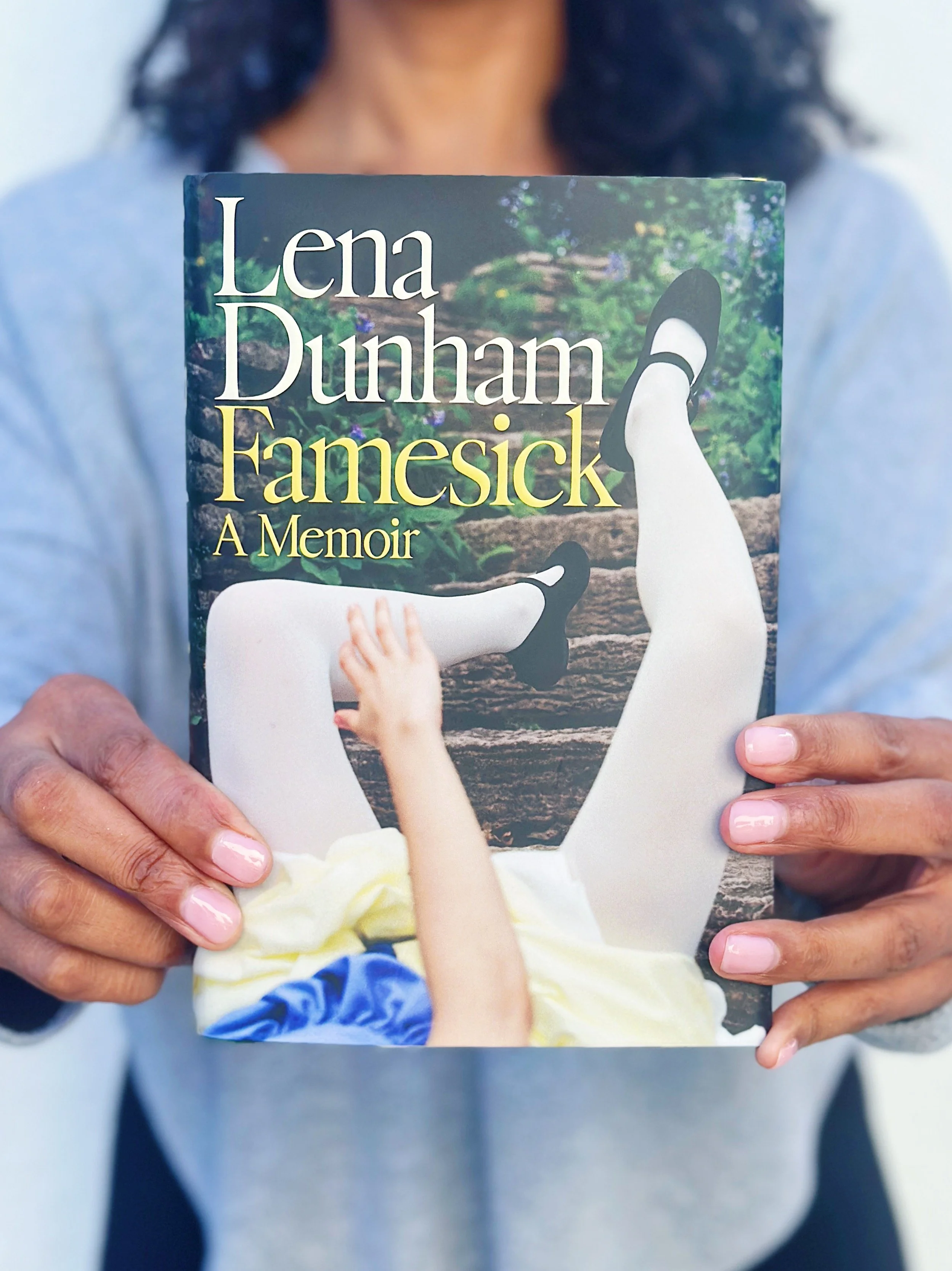
It’s The Stacks Book Club Day, and we’re once again joined by stand-up comedian, bestselling author, and Tiny Reparations publisher Phoebe Robinson to discuss our November pick, Famesick by Lena Dunham. In this memoir, the award-winning writer, actress, director, and producer reflects on the true cost of fame, revealing everything from her battles with chronic illness and addiction to her experiences losing both friends and her sense of self. Today, we’re talking about whether Dunham is a reliable narrator, the ways addiction shows up in the book, and how she does—and doesn’t—address the controversies in her life.
There are spoilers in this episode.
Stay tuned to the end of the episode to find out what our December book club pick will be!
LISTEN NOW
Apple Podcasts | Spotify | Google Podcasts | Overcast | Stitcher | Transcript
Everything we talk about on today’s episode can be found below in the show notes and on Bookshop.org and Amazon.
Famesick by Lena Dunham
sTORI Telling by Tori Spelling
Open Book by Jessica Simpson
Inside Out by Demi Moore
Girls (HBO)
New York University (New York, NY)
Ted Lasso (Apple TV)
Tiny Furniture (Lena Dunham, 2010)
Romeo + Juliet (Baz Luhrmann, 1996)
I Who Have Never Known Men by Jacqueline Harpman
To support The Stacks and find out more from this week’s sponsors, click here.
Connect with Phoebe: Website | Instagram | Threads | Tiny Reparations | Substack | Podcast
Connect with The Stacks: Instagram | Threads | Shop | Patreon | Goodreads | Substack | Youtube | Subscribe
To contribute to The Stacks, join The Stacks Pack, and get exclusive perks, check out our Patreon page. If you prefer to support the show with a one-time contribution, go to paypal.me/thestackspod.
The Stacks participates in affiliate programs. We receive a small commission when products are purchased through links on this website.
TRANSCRIPT
*Due to the nature of podcast advertising, these timestamps are not 100% accurate and will vary.
Phoebe Robinson 0:00
The relationship between Lena and Jenny, I think multiple things are true at once. I do think they weren't friends, and I tell people this all the time in this industry. I go, you have to stop assuming that because you work with someone, you guys are friends, and I say this because when the issue of money came up, we really saw what the dynamic was. There's an imbalance there, so there's never going to be a true friendship.
Traci Thomas 0:40
Welcome to the Stacks, a podcast about books and the people who read them. I'm your host Traci Thomas, and it is The Stacks Book Club Day. Today, stand-up comedian, best-selling author, and tiny reparations publisher Phoebe Robinson is back to chat about our November book club pick, Famesick, a memoir by Lena Dunham. In her book, the award-winning writer, actress, director, and producer reflects on the true cost of fame, revealing everything from her battles with chronic illness and addiction to her experiences losing both friends and her own sense of self. In this episode, Phoebe and I dig into the entire book from her relationships to fame, Hollywood, capitalism, medical industrial complex, and so much more. There are spoilers on this episode. Be sure to listen to the end of today's episode to find out what our December book club pick will be. Do you enjoy this podcast and want even more bookish content? Well, you're in luck. You can get more over on my Substack and my Patreon. On Patreon, you can join the Stacks Pack for community conversation, virtual book club discussions, and an exclusive bonus episode every month. Over on Substack, you can subscribe to my newsletter Unstacked, where you'll get to read all my hot takes on everything from books to pop culture and sports, and a whole lot more. You also get that bonus episode on Substack. This is an independent podcast, and your support allows me to bring the stacks to you for free every single week while supporting my team. So if you love the pod, join the stacks pack at Patreon.com/thestacks and subscribe to my newsletter Unstacked at Traci Thomas.substack.com. Now it's time for my conversation with Phoebe Robinson about Famesick by Lena Dunham. All right, everybody! It is the Stacks Book Club Day, and I am joined again by the wonderful Phoebe Robinson. Welcome back, Phoebe. Hi. Okay, we're talking about this book right here, Famesick by Lena Dunham, her second memoir. And people, we will spoil this book as far as spoiling goes for a memoir. You know, if you don't use our discretion advice, we always start here. Just broadly, overall, what did you think of this book?
Phoebe Robinson 2:55
You know, I have. I want to say I. I don't want to say I have complex feelings about Lena because that implies that I think about her more than I do, and I don't mean that in a you know what I mean, like in a douchy way. But I just I don't have kind of like parasocial relationships with people, so I I kind of block out a lot. But I think by the end of the book, I I felt a multitude of things. I will say I think that she is an interesting, unreliable narrator.
Traci Thomas 3:30
Yes.
Phoebe Robinson 3:32
Um, and this is not to say that she is necessarily lying or intentionally lying about anything, but I do think that writers can play with the truth, and I think especially someone who has addiction issues, the they can remember things in a way where it's like, well, that's not the totality of what happened. Does this this doesn't negate that someone maybe mistreated you or what have you? But it's like, are we also taking ownership of the parts that you played that led to that sort of reaction from a person? I do think that she is a good writer, but I do think there was an overall sense of sadness about her that I didn't really realize before, and her and I have had lunch before, and she's perfectly lovely and and funny and smart and nice in a lot of ways, but there was this self sabotaging element to her that I don't. Even though she's done a lot of work on herself, I was like, "Oh, you really have missed sort of addressing that."
Traci Thomas 4:57
Yeah,
Phoebe Robinson 4:58
and I think if she did address the self sabotagingness and where that stems from, and sort of reigning that in. I think her life would actually be drastically different.
Traci Thomas 5:10
Yeah, that's so interesting, self sabotage. Because I feel like I was picking up on some of that, but I wouldn't have necessarily used those words. For me, I like the book fine. I generally like. I can get into a celebrity memoir. That's a genre that I sort of like like. You know, like I'm like sort of into it. Not the really bad ones, but like a sort of good one.
Phoebe Robinson 5:31
We're not going to do like a Tory Spelling moment.
Traci Thomas 5:34
No, but like I like love Jessica Simpsons, and I don't care about her. And like I love Demi Moore's, and I don't really care about her either. But like if it's sort of a good, compelling story, there's enough gossip. Like I can be in. So I like this book fine. There are parts that I laughed. I do think she's like she's like a good writer. Like I don't like I don't think you can. She's a good storyteller. Yes, I was entertained, but by the time we got about halfway in, I was like, "Is she lying to me? Like, what? What am I missing here?" It was weirdly like oversharing without having any like honesty or accountability on the parts that needed it. So, like, she would tell us about like the positions she's having sex, but then it would be like this huge thing, and she'd be like, "Well, I'm not really going to go into it out of respect for other people." And I'm like, "Whoa, whoa, whoa, whoa, whoa! What are you? How about respect for my fucking time? Okay?" And and like, it's not even that I'm like, "Oh, I want all the gossip." It was more like you framed these things as important touchstones in your life, and then sort of glossed over the meat and potatoes of it, and so by the end, I was just getting annoyed with her. I was like, "Well, don't don't do this whole breakup and tell us you have this blowout fight, but only tell us what he said." Yeah, like, and then tell us how you cried. It's like, well, but you said you said horrible things, and you're going to tell us the horrible things he said. So, what are the horrible things you said, and why did you say that? You know, like why did you do that? So that was sort of my takeaway. Like, I enjoyed it. I read it quickly. I was locked in, but by the end, I was just like, okay, well,
Phoebe Robinson 7:17
yeah.
Traci Thomas 7:18
Why are we here for people at home who haven't read the book, though you should read it, I guess the main thesis of the book, which I think worked, it was a big metaphor. It's in the title, Famesick, where she basically says, "When you're famous, it's like being sick. It's it is the same kind of thing. No one feels sorry, or people feel sorry for you when you're sick, but nobody feels sorry for you when you're famous. It's hard to describe to other people. People don't understand it unless they've been in it. It's people blame you. You know, she kind of compares these two things, and she starts the book with this like insane list of celebrities, her dedication, and she says all of these celebrities: Jean Seberg, Jean Harlow, Marilyn Monroe, all the way through to Whitney Houston, Heath Ledger, and ends it with and anyone else who was too famesick to be cured. What did you make of this introduction into the book?
Phoebe Robinson 8:13
I honestly forgot that she did that, and then you pointed that out, and I was like, oh yeah, she did do it. You know, I I think again that is a way to provide a sort of shorthand to empathy. Like you know, I think everyone or most people certainly at this point would be like, yes, you know, Marilyn Monroe thrown to the wolves, Whitney Houston thrown to the wolves, Britney Spears thrown to the wolves. Like historically, we have seen that we want these sort of vessels of femininity to sort of you know revere and uphold, and then as soon as we like extract everything we get out of them, we discard them and they die. And I do think again as a writer. That's a clever move. You already are putting that in, you know, the reader's mind before they are even on page one. I, I would also say I think all those people are complicated, and I think she's trying to say I am also complicated as well. And so I get, I get, I get why she did that. It made sense.
Traci Thomas 9:22
Yeah, I get why she did it. I'm not sure. To me, I mean, here's the thing. I'll be really transparent. I don't really know a lot about Lena Dunham. She's not my celebrity. I never. I watched one episode of Girls ever. It's not my kind of humor. It's just not my thing. And so when I read that, I was like, "You're not Whitney Houston. Like it's not even the same stratosphere to me." But I thought that was also interesting that she thinks of her story on the same level of these like iconic, famous people who have these like tragic endings. And I was a little bit like, oh, okay,
Phoebe Robinson 10:02
yeah.
Traci Thomas 10:03
Is she that famous? I mean, maybe she is. It's just not. It's not my lens for fame. And I feel like obviously monoculture is so different now. Like when Whitney Houston was Whitney Houston, she was an undeniable star. Marilyn Monroe. Like there was just one, and now we have so many people. So I think maybe that's part of it too.
Phoebe Robinson 10:22
Yeah, I mean, I just think that is just more result of the times like you just don't have global stars like that anymore. But I will say, when Lena was at her height, like, like my dad, who like doesn't care about pop culture, like he, if I said like, oh, do you know who Lena Dunham is? He'd be like oh yeah he's never seen girls. So like she was everywhere. She admittedly was everywhere.
Traci Thomas 10:52
That's true because I knew her without knowing her work.
Phoebe Robinson 10:53
Yeah, yeah.
Traci Thomas 10:54
So the book starts. We get into her childhood. One of the things about Lena Dunham that I do know and I did know at the time is that she famously is called a nepo baby, and the cast of girls, which includes Allison Williams, daughter of Brian Williams, Zoshia Mamet, daughter of David Mamet, and then Jemima, what's her last name? Peck
Phoebe Robinson 11:16
Kirke
Traci Thomas 11:17
Kirke who's the daughter of like a rock star,
Phoebe Robinson 11:19
yeah,
Traci Thomas 11:20
and everybody called them all nepo babies. And I, I gotta be honest, Lena Dunham's parents are artists. I never heard of them. Had you heard of them?
Phoebe Robinson 11:30
I had not heard of them. But to me, nepo baby doesn't mean that your parents are super famous, and so that's how you get it. I mean, her mom called the head of UTA. That's Nepo baby. My parents don't have the head of UTA's phone number. Like, yeah. So to me, I'm like, yes, I know there. Some people want to have some pushback about that because they were just artists or blah blah blah. But she was set up in certain ways to have access, and that's really what the Nepo baby is: is that she had access to people and situations that you or I will never have.
Traci Thomas 12:11
Yeah, I think that's right. I do. I do think it's interesting, like the way she talks about money in this book. Like, there's parts where she'll be like, oh, my parents were like at the house, the cottage, and then she'll be like, my mom raised $20,000, which was like a million dollars to me, and I never under like, and I was living, you know, I didn't have enough money to do this or that, and I'm like, wait, what? Like,
Phoebe Robinson 12:37
yeah,
Traci Thomas 12:37
how could $20,000 mean nothing to you? But also, your family has a second home that you're going back and forth to, you know. And like, I thought that was really interesting because I, I don't know if you have a sense, but I still don't have a sense of like her family's wealth prior to her success.
Phoebe Robinson 12:55
Yeah, I, I, I didn't have a sense of that, and I do think again that's what I mean when I say unreliable narrator. Where it's like, depending on how she wants to frame herself in a particular situation, this is sort of kind of the story that she tells. And again, I'm also like that's nepo baby stuff to be like. My parents cannot just call their friends and get $20,000. What was it? 20 or $30,000? to like fund a movie. Like again, like that is advantage. That is opportunity. And so, do I think they were multimillionaires? No. But do I think they were comfortable enough? Certainly, to have more than one home, yes. Were they probably living maybe a hair above paycheck to paycheck? Yeah, but that's also New York living. Like everyone is kind of doing that.
Traci Thomas 13:54
I was going to say, like, I think part of it is that she didn't feel rich because she was running in these New York City rich kid circles, yes. And so, like, if your parents have a loft, you're not rich. But like, to everyone else, your parents have a Manhattan loft. Like, you're fucking rich. You got two houses. So I do think some of it is also skewed by the way that wealth is skewed by a city like New York and by a borough like Manhattan, specifically, and especially in the time of like the '90s and early 2000s. But I did. I found the way she talked about money. I mean, there's a part where she like talks about buying her apartment, that like shitty apartment that she was like, it's so great, and then everyone was like, it's horrible. And she talks about how she spent all of her money for the pilot on the apartment, and then in the next breath, she's like, "And then I did a gut renovation," and I'm like, "But how did you pay for that?"
Phoebe Robinson 14:49
Yeah,
Traci Thomas 14:50
like where did that money come from? And so, like, there were so many times in the book where she talked about money that I was just like, "I actually need an accountant to walk me through this." Like, I need X's and O's. Like I just, where is it coming from? Obviously, later she becomes super wealthy, and I care less about that because I just assume there's deals and there's that you know, like that makes sense. But in the early days, she tells us like I made this much money on the pilot or whatever, and then she still got all this money. She's got this smeg pink refrigerator. Like, yeah, where did that come from?
Phoebe Robinson 15:24
Well, what I will say, as someone who had their own show, so she created it, she starred in it, she got an EP credit, and then she wrote multiple episodes. So theoretically, she had
Traci Thomas 15:42
like a real income.
Phoebe Robinson 15:43
She had like four different revenue streams from.
Traci Thomas 15:46
And are you paid four different? Like, is it in your contract? Like, you have four different jobs, kind of thing.
Phoebe Robinson 15:53
Yes. So, like, I had like what I got per episode acting, what I got per episodes of EP, my script writing fee for any scripts that I wrote on myself that I wrote myself, and so what I will say is like I'm not gonna get into the nitty gritty of it, but that one season of television, like I made pretty good money, and it was on Freeform.
Traci Thomas 16:18
Got it,
Phoebe Robinson 16:18
which is a shit network.
Traci Thomas 16:20
Got it. So you're saying by the time she even bought the apartment and went to do the renovation, she had cash flow.
Phoebe Robinson 16:26
Yeah, yeah, yeah, yeah, yeah. So that that part of me, like that part of it, made sense. But I do think that sort of her kind of murky sort of talking around money, except when it's convenient to say like, oh, I was you know interning at this thing and like making no money and the Greta Gerwig of it all and like all that sort of like plucky underdog upcoming upcomer stuff. I do think that that sort of speaks that's sort of like a microcosm of how we talk about money societally, yeah, which is that we don't, and we're a lot of times we're hiding the truth of what a financial situation is because we are so aware of how people respond to those who have,
Traci Thomas 17:21
yeah, and there's like so much shame about having and not having.
Phoebe Robinson 17:24
Yes,
Traci Thomas 17:25
you mentioned the Greta Gerwig of it all. There's also the Safdie brothers of it all. She's like in her early days in New York City. She's like running around with all of these people who have Noah bombeck. All these people who blow up. Some of them even get married to each other. And I, I actually really loved that part because it totally felt like sure, of course, didn't it? Like, I feel like, I mean, you're a successful person, and I'm curious if you can relate. But like, I went to NYU, and so many of my friends now are super successful in the industry, and I feel like that is a true thing. If you're like a young artist, that like you become friends with people who are talented. If you are talented and you sort of like rise in the ranks together, yeah. Has that been that? Has that been your experience?
Phoebe Robinson 18:11
Yeah, for sure. I mean, I think that you know, I mean, Hollywood is so decimated at this point, but that is very much like what it is like. Like you know, I want to say maybe my second week, third week of doing stand up. I met my friend Jamie Lee, who is a writer, producer, and like two time Emmy winner of Ted Lasso. You know what I mean? And so it's like you're just in the trenches, and you all just like love it, and you're following your dreams, and we'll see what happens. And so that very much was like so fun. I was like, oh, you know, I always have nostalgia for those early days of when you're just like sort of grinding out, and there's there's really no stakes. You just like are hungry,
Traci Thomas 18:58
yeah. And there's like people who have hustle, they like come together. It's like you're attracted to that in other people.
Phoebe Robinson 19:06
Yeah, and like there is, there's no such thing as failure. You're just sort of like figuring it out. There's, there's nothing you're going to lose at that point, which is exciting.
Traci Thomas 19:15
Yeah. So she goes on to make this movie that her mom helps her fund and stars in, and they do in the loft, and it wins at South by Southwest, and this sort of like this one thing that she makes sort of catapults her career, which I thought that that's like the craziest thing in the whole book. I was like, wait, you made one thing, and then you became Lena Dunham. Yeah, like if you talk to anyone else with any success in the arts, it's like I've made 500,000 things. Like people who are like come from nowhere successes are like, yes, I've been doing this for 30 years.
Phoebe Robinson 19:52
Yeah, I mean, I watched Tiny Furniture again. I thought it was like good. Like again, my. I I think some of what I feel about Lena just sort of speaks to just in history the sort of instinct to over characterize talent and genius within white people. Like my my ultimate sort of feeling about Lena, even even with girls, I was like, "This is," I go, "This is good. It's not great."
Traci Thomas 20:30
Yeah,
Phoebe Robinson 20:30
I don't understand why she is like this voice, and you know, sort of like put everywhere other than the fact that she was white, she was pretty enough, and she's talent. Yeah, talented enough. Had the right connections. Had the right people backing her, and she became all of this thing. And so, you know, I reading that, I go, you know, some of it is luck, obviously, but I just black people just aren't afforded the luxury of doing one good thing, and then the world is handed to them.
Traci Thomas 21:06
Yeah, yeah. I mean, I yes, totally. So she goes on to get girls. She goes to a meeting with HBO, and they're like, "Great, here's a series." Basically, which I was just like, "Am I misunderstanding?" And they give her this mentor like person. They're like, "You've never made a show, so we're gonna give you this mentor." Her name is Jenny, and they become fast friends. Jenny is a big part of this story. What do you what do what do you make of Jenny? What do you make? I mean, I I think this is like a pretty common practice where like a studio or whoever will be like, you haven't actually cut your teeth in the industry, so here's sort of like a mentor guide person for you to help you to understand how things work. I I really struggled with this part of the book, with the Jenny thing, because this is one of the parts where her unreliability really started to like eat away at me. I just couldn't tell if Jenny was a horrible person or if we just weren't getting the story. Like, I just so struggled with this, like I don't know. What did you make of Jenny?
Phoebe Robinson 22:25
Yeah, so I've met Jenny before. Okay, I had a general with her, and you know she was nice. I, you know, every TV show has a showrunner, so that's effectively what you know Jenny was to like.
Traci Thomas 22:38
Oh, I thought Eileen was the showrunner.
Phoebe Robinson 22:40
No, no, no, no, no, no.
Traci Thomas 22:41
Okay, okay. Oh, Jenny was the showrunner?
Phoebe Robinson 22:44
Yeah, I mean, I, I, I would say she like her and Lena probably co show ran. Okay, but you know, Jenny would be like the buck stuff. Like, so every TV
Traci Thomas 22:54
Lena doesn't call her that in the book, does she?
Phoebe Robinson 22:57
I, I don't know. The way that I will look at as someone who had a show and did like you. Yeah, she was like the co-showrunner.
Traci Thomas 23:05
Okay, got it, got it, got it.
Phoebe Robinson 23:06
Um, and so you know this person, they do everything from like you know my showrunner for my show like budget meetings with the net. Like they are seeing everything. Yeah, and that sort of allows me to be like head writer, star in the show, EP, and like focus on other things. It's like it's just, it you can do all of it and be the showrunner, but usually those shows suffer, and you can kind of tell. So my takeaway From the relationship between Lena and and Jenny is, I think multiple things are true at once. I do think that one, they weren't friends, and I tell people this all the time in this industry. I go, you have to stop assuming that because you work with someone, you guys are friends. And I say this because when the issue of money came up, we really saw what the dynamic was. And I think because Lena was like so young, and Jenny was older, I think a lot of times young people go, "This is my friend. This is my friend. I met this person once. You're my friend." And it's just sort of like, yes, you can have those elements, but in a situation in which, like you know, Jenny's job essentially depends on you know the productivity of Lena. That that there's an imbalance there, so there's never going to be a true friendship. That's one. Two, I think that by the end of the book, I was like, Lena's pretty insufferable. Like I think it would. Be like, can I just say, like, truly, when she set herself on fire, I was like, "Girl, leave me alone." And I, I paid for the book, and I was like, "Leave me alone."
Traci Thomas 25:10
I gotta go. I when we got to the fire, I was like, "I." It's like we've done a lot. We've done a lot today,
Phoebe Robinson 25:16
and so I do think it's difficult to maintain a long friendship with someone like that,
Traci Thomas 25:23
yeah.
Phoebe Robinson 25:23
Unless you have the space to be like, I'm just going to allow certain things to happen. And I also think that there were not great moments, like when Jenny was, you know, on her about her appearance and her weight, and like you need to eat more and all these things, and like not caring that she was necessarily in the hospital or not understanding. I think now there is so much more kind of information and intelligence that people have about people who have chronic illness. And I think back then everyone was like, "Just suck it up and rally." You are like, "That's actually not how you treat a human being."
Traci Thomas 26:00
Yeah.
Phoebe Robinson 26:00
So I do think that Lena was like kind of, you know, had her not great points. Jenny had her not great points, and I think together I don't see their relationship ending up in any other way than the way that it did because it just required both of those people to not have their shit together in a way that would make this relationship healthy.
Traci Thomas 26:27
Yeah, and also like, like you said, when you have a friend who's sort of like a lot, you need to have space from them, and they had no space from each other.
Phoebe Robinson 26:36
No,
Traci Thomas 26:37
they were together all the time. They were working. They were texting. Like the way that Lena describes it, it was like, just like as my dad would say, white on rice.
Phoebe Robinson 26:46
It is very. I mean, my showrunner and I, we texted all the time he was pinned in my phone. Like, it just we were just like mom and dad together on the show. Like it, that's just what it is, and so we're still, you know, in touch and chat and all those things. But it's like when you're in it making a show, it is like a very close relationship.
Traci Thomas 27:10
And I think to your point, also her youth and her like first time doing all of this, I think she mistook closeness for like actual friendship, and like because when the show ended, they like continued to do things, and like they wanted to be business partners, and all of this stuff. And you're right, when the money came, it was like, oh. But also, even like the power dynamics were so interesting between the two of them, because in some ways, Jenny really had the upper hand. She was sort of the voice to the studio. She was older. She clearly like had her shit together more in a professional way. But then Lena was the star. She was the talent. She was the brains behind the operation. You don't get Lena to write. You don't get new stuff. Like she was. You there's no girls without her. And so it was like this really precarious balance, I think, of like Jenny trying to like extract from her,
Phoebe Robinson 28:06
yeah,
Traci Thomas 28:06
and also Lena feeling like neither of them really knowing who was in charge here. I feel like,
Phoebe Robinson 28:13
yeah, and I mean the whole negotiation thing. I was like, Jenny, in what fucking world are you on the same same level as Lena?
Traci Thomas 28:25
That's what I'm saying.
Phoebe Robinson 28:26
Lena has to go and do the press. Lena's writing, she's editing, she's doing all this stuff. I'm not saying that Jenny didn't play an important part in girls. Of course, she did. But to think that you deserve this pay parity when Lena is clearly doing more, yeah, I was just like, again, as someone who's 42, I can see. I go that shows you completely how Jenny views this relationship, and Lena cannot see that. But I just was like, I go, that takes balls. Yeah, that truly takes balls.
Traci Thomas 29:00
And all of Lena's agents and managers being like, "Hey, honey, so I don't, you know, I don't think this is like, you know, maybe not." And she's like, "No, you guys are money hungry." And they're like, "Well, you know, we are, but also we do this a lot."
Phoebe Robinson 29:17
Yeah, and they were right when they were like, "Do you think that if the roles were reversed, she would do this for you? And the answer is like, "Fuck no, she would."
Traci Thomas 29:24
Of course not. Of course not. Yeah. Nor should she. Like Lena shouldn't have done it for Jenny, and Jenny certainly wouldn't have done it for Lena. Okay, let's take a quick break and then talk about Jack. Okay, we're back. Lena Dunham and all her boyfriends. She has so many boyfriends in this book. Yeah, but the main one is, I guess, not all of them are boyfriends. Lots of them are just lovers. Some of them are abusive ones. Some of them are just like so weird, so dark. But Jack Antonoff, singer from Fun and producer. I had the same. I mean, this was the other relationship where I was like, I don't feel like I have a sense of this whole thing. Like, I really struggle to have perspective on this. Like I mentioned earlier, she talks about like fights they would have, but never really says like what she did or what happened. So it always just felt like he was like sort of the worst, kind of like sort of just like an aloof jerk, and like maybe he was, but that it was hard for me to really not not even just fall out, but even like their connection. Like I struggled to really understand the pull, and then like what happened with them, and then this week while I was reading the book, he and his current wife, now ex Margaret Qualley or whatever, they filed for divorce. Yeah, because I was like, "Who's Jack Antonoff?" Google him, and it was like Jack Antonoff, divorce, and I was like, "Whoa, oh my gosh, so much has happened here."
Phoebe Robinson 30:58
Yeah, he's a he's a big producer. I I mean, I just sort of, I think, I think my overall feeling. I I just feel this older that I get. I just go, men are so uninteresting. So uninteresting. Who gives a shit? Who cares? Who cares? Who cares? Who cares? Like I just was like, this man isn't, but when you're young, you just they take on this level of importance and everything they do that is is just like oh you just gotta you know overanalyze and pick apart and talk you know ad nauseum with your friends and then you get older you're like these men are boring they don't have hobbies. They're not emotionally developed. They are good at one thing. They are selfish. They are not interesting. They they are not emotionally regulated. So for me, I just was like, I was less interested actually in her relationship and it devolving with Jack than I was with Jenny. Like honestly, I and I understand that you know Lena wrote that she didn't want to like out of respect for Jenny, but then I was like, well, then you can't fucking write about it then. But I think to me that feels much more interesting. There's a much more kind of dynamic that a lot of women have gone through, and the death of a friendship, yes, is really destabilizing for women in the way that sometimes the death of a relationship is not. Because I do think that women to women, there is more sort of depth to the relationship that isn't contingent on romance or fucking, yeah. So it's like you have to like emotionally connect to that, connect, yeah, intellectually connect, and so that becomes much more intertwined. But what I will say with Jack, I do, I think the through line in this book, and I and I think Lena is sort of saying it without saying it is that she knows, even though she's not saying everything that she has said, she knows that in some way this sort of relentlessness of her energy and of her many traumas contributes to these relationships not standing the test of time. And I'm also like, you're dating a musician. You know, thoughts and prayers. He's not like truly these guys.
Traci Thomas 33:37
It's like dating a baseball player. I'm like, do you know how many trips they're going on?
Phoebe Robinson 33:42
Yes
Traci Thomas 33:43
182 games
Phoebe Robinson 33:45
All over. No athletes, no musicians, no any job where a man is traveling.
Traci Thomas 33:51
No pilots.
Phoebe Robinson 33:52
Yes, it is. Find yourself a dental assistant
Traci Thomas 33:57
An accountant.
Phoebe Robinson 33:58
Yes, someone who is here, boots on the ground every day. It's a low.
Traci Thomas 34:04
Think think globally, live locally.
Phoebe Robinson 34:06
Yes, 100%. So I think I understand why the relationship is very foundational, important, important to Lena. But I think as a reader, I was just sort of like you have to give us more meat on the bone. Like I think the way she set up them, like starting a date and all that stuff, the meet cutes and all the stuff, and the early dates, that was great. Great, she really established them, and then it was just not carried all the way through.
Traci Thomas 34:36
I agree. I also feel like we didn't talk about the breakup with Jenny, but yeah, when they go to therapy, ah, and they have like an hour, and like Lena's like so nervous about it, blah blah blah, and then Jenny's like, well, you know, and then Lena's like, oh, okay, and Jenny's like, okay, great, gotta go, and the therapist is like, okay, great, I can tell 43 minutes. That was also crazy. I was like, "Damn, ruthless."
Phoebe Robinson 35:03
Yeah, that you know, that did feel sad to me. I think that at the end of the day, it just felt like Jenny meant more to Lena than Lena meant to Jenny. Who hasn't been that? It sucks. Yeah, and I do think it was perhaps a little too late
Traci Thomas 35:29
To save the relationship.
Phoebe Robinson 35:30
To save the relationship, and I think you know when I say her lack of self awareness, I I think in the writing, Lena. Yes, we we get her in rehab, but it felt like throughout she really downplayed her being an addict.
Traci Thomas 35:49
Yeah,
Phoebe Robinson 35:49
which affects every fucking relationship you're in,
Traci Thomas 35:53
and I think also she downplays that she might also be an addict. Like she's a relationship addict as well, like the way that she talked about every single person in the book, and like all of the men that she was trying to save, all the animals she was trying to save, like her desire to save and help other people, you know. I'm not a therapist, but like my sense was like because she couldn't help herself, you know, like she wanted to fix everyone else because she knew she was like too big of a mess, or she couldn't figure out how to help herself or whatever. That's like an unkind way of saying it, but you know what I'm getting at is like she was so desperate to fix everyone around her. I mean, even her sibling, like she was so desperate for her sibling, who like has the greatest boundaries on the face of the earth. I'm like, how are you? Like, are you the most well-adjusted human to ever have existed? Yeah, but like, and I don't know. Also, again, the unreliability of her narration is like her family seems so well adjusted. Like her dad constantly being like, "You don't need this. Like, tell them you need a break. Is this what you want?" All of this stuff. And I just think like her addiction throughout the book, her addictive personality throughout the book is like really almost like backburnered for the majority of the book. But you can see it there throughout, like she's talking about the the man with the like cleft lip or whatever, and like the boyfriend who becomes Adam, and like all of these. I mean, even Adam Driver, who gets a terrible edit in this book. Oh my god! Was like, damn, she really is sick of you. Which, like, I don't know. He does strike me as a very intense person.
Phoebe Robinson 37:42
Yeah, he he fully fucking threw that chair, and I've been like recast, fired, recast, bitch. That's right.
Traci Thomas 37:50
But like, she's like, I can fix this man. Like, like she just has this like desperate energy about like fixing other people that I was like, it's so. And for me personally, like just the kind of person I am, that energy is one of my biggest turnoffs on the face of the earth. Like, if I meet a person who has that kind of desperation, I am instantly like, I mean, I joke, I'm like, I do not like to be desired. I never want to be around anyone who wants to be around me. I, I'm like, oh, you want to be friends? I'm like, sorry, gotta go. I'm like, oh, you want to go on a date? Never. Like, you think I'm pretty? I, sorry, don't look at me.
Phoebe Robinson 38:30
Oh, I wouldn't go that far, girl!
Traci Thomas 38:32
I'm like, I'm so crazy about it. I this is my own psychosis, but I'm just like her energy throughout this book. I was like, oh my god, I could not, I couldn't even do like a lunch, like not that I've been asked to, but I'm just saying like that kind of thing. And I feel like she really doesn't get into that part of it enough for me.
Phoebe Robinson 38:53
Yeah, and it's also just you know the way that her dad saves her throughout the book. I think infantilized her.
Traci Thomas 39:06
Yeah,
Phoebe Robinson 39:07
and
Traci Thomas 39:08
because she's a 40-year-old woman writing this book.
Phoebe Robinson 39:11
Yeah,
Traci Thomas 39:11
she is not the 26-year-old anymore, and I think she still feels like that a lot in this book.
Phoebe Robinson 39:20
Yeah. Well, I mean, I think a lot of that is contributed to the fact that I think when at whatever age someone gets famous, that's when they get frozen, and so a lot. That's why a lot of times you'll see child celebs, yeah, child stars. You just see celebs that, or even like you look at like a Taylor Swift. There's this like,
Traci Thomas 39:41
sure,
Phoebe Robinson 39:41
she acts like a 14-year-old
Traci Thomas 39:43
And that's her best friend or one of her good friends. She's in the acknowledgements and everything.
Phoebe Robinson 39:48
Yeah, and I was like, "You're an adult."
Traci Thomas 39:50
Yeah,
Phoebe Robinson 39:51
you keep acting like a child, and I think that you know, while Lena achieved like this incredible amount of success and like create this show that really captured zeitgeist for you know six seven season or six seasons. It in a lot of ways because she was not in a good place with herself when she got famous, it was kind of a recipe for disaster, and you know, as someone who is like I don't know C list at this point, if I ever reach the A list, it'll be like what in my 50s, and I think I just will know myself so much better that I am not going to be doing fuck shit.
Traci Thomas 40:37
Yeah, yeah
Phoebe Robinson 40:39
You know, and so there's a part of me that does have empathy for her because it's like, I mean, you can't control when you get famous. You can't control how people react to you,
Traci Thomas 40:49
right? But she also had this like energy throughout the book where she was sort of like, oh, like I didn't know I was going to be famous. Like I didn't see this coming or whatever. But she also has this thread throughout where she's like so desperately chasing it. She talks about putting her body to the side in pursuit of this thing that she wants so bad, and so I thought that was also sort of an interesting way to like be like, oh, I didn't actually want to be famous, but also she keeps telling us over and over that she did want to be famous.
Phoebe Robinson 41:21
I think she wanted to be famous. I think she had no idea what that was going to be like.
Traci Thomas 41:25
I agree. I think it was bigger than she thought, but I also think she. I felt like the way that it read was like, "Oops, this happened to me." As opposed, like it's like she she was pursuing fame. I felt like in her work, in her like in her persona, like I feel like she leaned into it. Yeah. Um. So one of the things that we have to talk about, which I didn't know anything about until someone DM'd me about it, which is the whole Aurora Perineau Murray Miller rape allegation situation in the book
Phoebe Robinson 42:03
that was a real low.
Traci Thomas 42:04
This was the worst part of the book, far and away. So what happened? I think it's 2017. After Lena has like been, you know, me tooing all across America, she's even said things along the lines of like, "Women don't lie about rape." An allegation comes out from an actress Aurora. I never know if I'm saying her name right. Perrineau, who's the daughter of the man who played Mercutio in Baz Luhrmann's
Phoebe Robinson 42:30
He's also a Lost, he was on Oz. Great, great actor.
Traci Thomas 42:34
She accuses him, Murray Miller, who's a producer on Girls, of rape when Aurora was 17 years old. Lena and Jenny put out a statement saying that they had quote insider knowledge of the situation and that it was one of the 3%. This is the direct quote: "Our insider knowledge of Murray's situation makes us confident that sadly this accusation is one of the 3% of assault cases that are misreported each year." Now we get to this section in the book, and Lena tells us it is in her post-operation. We will get to her chronic illness, but in her post-operation drug-induced, you know, recovery time that this statement is put out by Jenny, and her name is on it, and the way that she talks about this, I want to read it because I thought it was fucking crazy. She says, "That's why what happened next is so confusing. That at this moment, when I was not here, not there, not anywhere, when I had ostensibly died inside my own body, I would do the one thing in my career, in my life, about which I felt—feel still—genuine shame. Everything that had come before was child's play, either because it was false, or because it was ultimately silly, or because it didn't really affect anyone deeply. Since we know affecting people and irritating them just enough to get them to tweet are not really the same thing. Out of respect for the people involved, some of who I care about deeply, and some of whom I cared about deeply once, I will not describe this thing except to say that it happened on november 17, 2017. Which means, and I can only figure this out based on dates and hospital records and timestamps on the internet, that I had only gotten home from the hospital that morning. She goes on to say, a whole bunch of nothing,
Phoebe Robinson 44:23
yeah, it's a cop out. It's a cop out.
Traci Thomas 44:24
It's a total cop out. Yeah, it's a total non acknowledgement. It's just crazy. It's crazy. It's crazy. Don't if you're gonna do that, don't even bring it up. Like I would have preferred her to just ignore it and move on through. But to say this is a thing you feel deep shame about, and it's the worst thing you've ever done, and then to give it that treatment when you're a skilled writer and storyteller, right? Like we're supposed to believe that Lena Dunham is this great talent, and that's the best you can do in your book that you've had almost 10 years to come up with something, to say something, it's crazy.
Phoebe Robinson 45:00
Yeah, I mean, it's you know, it goes back to like you know, I I think she lacks self awareness, and more importantly, I think she lacks self analysis. Like, and I think everyone struggles with that on varying degrees because you know, no. Even if you feel the lowest self-esteem about yourself, you still view yourself as the hero of your own story.
Traci Thomas 45:38
Yeah,
Phoebe Robinson 45:38
and when you have to sort of reckon with something that you did that is unforgivable, and you can't sort of write your way around it to still kind of uphold this sort of perception you have of yourself. That's what you're going to end up with. And I honestly forgot she did that, and I was like, "What is she talking about?" And then I googled the date, and I go, "Oh yes, that's right." But I think that that is one of the things in which, like, it would have been, I, the 5% that I do think why she sort of wrote around this was for Aurora, and that she did not want to drag her through this again in her book for profit, and that I can respect.
Traci Thomas 46:35
But it's still in the book, and everyone is now googling it.
Phoebe Robinson 46:35
I know, but she should have just written been like out of respect for you know, you know
Traci Thomas 46:39
Say her name.
Phoebe Robinson 46:41
Yeah, yeah, say Aurora. Yeah, just be like, I'm not going to bring it up again because you know, last time I spoke about her, I was deeply incorrect, and it really brought a lot of chaos into her life. That's what she should have said if she wanted to even mention this at all. But I think, you know, again, she's just not in a place where she can really take accountability and ownership for her behavior because yes, I understand that she was coming on surgery. She was probably, you know, deep in addiction. But I go that doesn't make you say so that I know for a fact this person is lying about being sexually assaulted when you don't know.
Traci Thomas 47:21
You don't know.
Phoebe Robinson 47:21
Yeah, yeah.
Traci Thomas 47:23
Okay. So she. The other thing that's really important in this story is that she's the sick part. We've talked a lot about the fame part. We're going to talk a little bit about the sick part, which is that she's got these chronic illnesses that are invisible illnesses: endometriosis, and then another sort of like autoimmune disorder that contributes to a lot of her issues with her endometriosis and her body, and I think this to me was the best part of the book. I think it was also easy for it to be the best part of the book because she is not at fault for these things, right? Like she did not play a part in any of this. This happened to her. A lot of people I know talk about her privilege in her ability to get the care that she needed, and I think that she does have a lot of privilege. She has a lot of money. We've talked about that. However, for me, this part just felt like an indictment of the medical industrial complex. Like she, sure, she has privilege, but if you had it, you would do the same thing in this country. Like if you were suffering, you would go to as many doctors as you could. You would do like I can't imagine that if your child was suffering, you wouldn't. You know, so like I get why people are turned off by her privilege, but I also am just like, that's not her, man. That's how fucked up our shit is here.
Phoebe Robinson 48:35
Yeah, and I think it. You know, it speaks to sort of the lack of taking women seriously.
Traci Thomas 48:43
Yes,
Phoebe Robinson 48:43
when they go to the hospital and say, "I am in pain," and you're dealing with a lot of these male doctors who think they know best, yeah, and think they know women's bodies best, and they don't. And you know, I I I was like reading that. I was like, man, I am so grateful that I don't have these health issues. Like so many people, yes, she has privilege, but so many people in this country have chronic illness, have constant health issues, and it takes one year, five years, 10 years to really figure out what the fuck is going on, and it shouldn't take that long.
Traci Thomas 49:29
And she got that email from like a random person being like, "Hey, think you might have this thing?" Crazy,
Phoebe Robinson 49:35
I know. And so, to to me, I'm like, I don't think we should sort of indict her for like being able to have the means to like go to the doctor. That's just the way that it is, and I do like that she shared this part of her journey with her with us because I, you know, most of us didn't know that while she was going through it, and that doesn't excuse the way that. She behaved, but I'm just thinking. Okay, this is like a 25 year old chronic health issues. Clearly, does not have strong self esteem.
Traci Thomas 50:11
Yeah,
Phoebe Robinson 50:12
being given a lot of money, a lot of access, a lot like all of it, like the confluence of it all. I can go. I understand why she became what she became, like that. It doesn't happen in a vacuum. Like all these things happening together, you know.
Traci Thomas 50:29
Yeah, I think it's right. I think it gives like a good context for a lot of her behavior and also just like her demeanor, her personality. Like there are so many things, especially that a chronic illness like endometriosis can do to you, like it's just so can be so debilitating, and also because people can't see it, and men don't understand it and haven't experienced it. It's just so many ways that it gets erased. And she has this line where she says Hollywood has always been permissive to everything but human frailty, that I thought was so good because I mean that is so right on, and I think Hollywood certainly, but just like capitalism, yeah, right, like in general. And she says, you know, celebrity is no match for illness, and I do think that like these are the parts of the book that are the strongest when she's really like being clear and sort of has a point of view and a perspective that she is like relentless in, and again, I think that's because she's able to do that because she doesn't have to interrogate herself really in any way. And the ways that she maybe could interrogate herself around her illness, she doesn't do. But I think what she does do around the illness is like really quite well done. This ending of this book, this epilogue, where she goes back to the Sunset Tower in Hollywood and like uses her real name. What did you think of that?
Phoebe Robinson 51:47
I, you know, I felt like as a writer, I was like, oh, that's a good callback to to a neat and tidy way to end the book. I didn't mind it. It did like kind of like you know make me like chuckle a little bit. I just I think with the book not going as deep as it could have gone, that perhaps it will leave some people feeling like the ending wasn't earned, which I do think structurally with the book that is probably correct.
Traci Thomas 52:26
It wasn't earned for me. It gave me a major eye roll. I was like, "Oh, is this an episode of television?" It was just like it just felt so like I'm using. Is it under Lena Dunham? It is. Welcome to this hotel where you used to live. Like I don't know, it just it was too corny for me. Is there anything else that you wanted to talk about? I know we didn't talk about the like horrible addict boyfriend.
Phoebe Robinson 52:51
Yeah, I mean, I just there's so many parts of the book when I when I was reading it I was like, like, wow, I really don't date. I was like, I truly, I was just like it is so. It takes a lot for me to tolerate, especially at this age. But even when I was in my 20s and I was boy crazy, it would take a lot for me to tolerate and be like, oh, I really like this guy.
Traci Thomas 53:22
Yeah,
Phoebe Robinson 53:23
I I just was like, I'm funnier than him. I know how to carry conversation. Like, I just so the way that she just is finding all these guys, and I was just like, is this just like having low standards? I was like, I don't know what is going on. I was like, this is. I was like, I should get out there more.
Traci Thomas 53:45
This made you want to date more. This made me never want to speak to another man in my life.
Phoebe Robinson 53:48
I was like, I think she found the worst of the worst every time.
Traci Thomas 53:54
Yes, I mean, I think that's like her self esteem and her like need to be desired and all of those things we talked about. One of the things that did stick out to me in the acknowledgements. My favorite part of every book was how many men she's surrounded by that she acknowledged in the end. It was like she sort of has this persona of being like because of girls and like surrounded by women and like her and Jenny and all these people. But then you get to the acknowledgements and it's just like the first like 10. It's just like man after man after man after man, and I was like, "Ain't that the real fucking secret of all of this?"
Phoebe Robinson 54:25
Yeah, I also feel like I can't necessarily indict her for that just because, especially at that time the only way you
Traci Thomas 54:35
it's not even an indictment of her; it's more just like she doesn't present that as much in the book, right? Like in the book, it's like there's so many women. Everything's about like the women in her life and all of this. Like the boyfriends, yes, but it's like she's sort of. I feel like she is like girl boss energy, and I was sort of surprised by it. Is all.
Phoebe Robinson 54:57
I mean, I don't. I really don't know Judd Apatow that well. At all, but I don't feel like he would indulge in her in the way that Jenny did. So I think that's more maybe gender specific. That a lot of guys are just like not
Traci Thomas 55:12
I don't have time for this. Yeah, he's got a wife and two daughters. He's like sorry.
Phoebe Robinson 55:16
Yeah, so it's like I'll help you get this thing, but then I'm like not. I'm not going to be answering texts at two in the morning to suss out our relationship.
Traci Thomas 55:24
Yeah, yeah, yeah, yeah, totally. Last thing, cover and title. What did you think of them? Did you like them? Did you hate them?
Phoebe Robinson 55:34
I thought the cover was great,
Traci Thomas 55:35
but what is the cover? Is that her? Is it just a picture? Is she going to fall down a hill, or is she falling down those stairs and she's on her back?
Phoebe Robinson 55:44
I really think that's the whole point. It's supposed to make you. It's like you don't know what happened. You just see that a a girl is falling.
Traci Thomas 55:51
Yeah,
Phoebe Robinson 55:52
and I go, that's great. I kind of like not even like not necessarily like ambiguous, but it's just like it doesn't have to have one definitive answer. So I like that.
Traci Thomas 56:02
I love that her face is not on it.
Phoebe Robinson 56:03
Yeah, yeah. I think it's an interesting cover. Make sure you like if you were in the bookstore and you didn't know who she was. Yeah, you go, oh, that's an interesting cover.
Traci Thomas 56:12
Yeah, I'm gonna see what this is about.
Phoebe Robinson 56:13
Yeah,
Traci Thomas 56:14
yeah, I agree. I do think it's interesting cover. I think it's a good looking cover. I like the like way it's fonted and everything. I also think the title's great. I think it works. I think it's perfect. Like the double entendre of sick and sick. I just that that works for me. Yeah. Um. Anything else we want to say before we get out of here?
Phoebe Robinson 56:30
You know, I feel like while this would not have been my choice to read this book if it were not for the, I always feel like no matter how I feel about a book, I try to be like, okay, I learned something from that book, and so I'm glad that I read it.
Traci Thomas 56:51
Yeah,
Phoebe Robinson 56:51
I think for me, I just very much like if you're going to tell the truth about or a truth or your truth about something, you need to tell all of it.
Traci Thomas 57:02
Yeah,
Phoebe Robinson 57:02
and I think that she sidestepped a lot of it for whatever personal reasons we won't really ever know. And I think that this might be bold, but if she were not famous and she turned this manuscript into her editor. Her editor would be like, "You have to go back and fill in the blanks."
Traci Thomas 57:27
I think that's right. I think that's right. And I think she smartly blames Bruce Springsteen for this.
Phoebe Robinson 57:34
That was so. I love what he said to her.
Traci Thomas 57:37
I loved what he said to her. But I was like, when I read that, I was like, oh, this is her telling us she's not going to tell us the whole story at the end of the story because, well, because Bruce said it. It's not her. Bruce told her she didn't have to tell us the secrets. He seemed great though. I was like, can you guys hang out more? Would love more scenes with. I was like the scenes with Nora Ephron, the scenes with Bruce Springsteen. I was like, I need more of these.
Phoebe Robinson 58:00
Yeah, Nora Ephron, that was great. That was a great stuff. Yeah.
Traci Thomas 58:05
All right. Well, everyone, stay tuned till the end of this episode to find out what our December book club pick will be. And Phoebe, thank you so much for being here. Thank you for taking the time to read this book with me. I would never have read this either, but I feel like it was the right the right thing. I'm glad I did. I liked it. I had a fun time. Yeah, good for discussion. So thank you for coming with me on this Lena Dunham journey.
Phoebe Robinson 58:27
Of course, I love talking about books, and we should do it again. Yeah, but like do like a you know ways away so people aren't sick of me. Like I don't want to be back like on the podcast.
Traci Thomas 58:39
So when is the when is the rich auntie book coming.
Phoebe Robinson 58:41
Hopefully, spring 2028. I'm still writing it because I've been on tour
Traci Thomas 58:48
we'll do it then when the book comes.
Phoebe Robinson 58:49
Yes
Traci Thomas 58:50
when you come back and we'll read. You can pick anything you want.
Phoebe Robinson 58:53
Oh my god, I love that. That's so exciting.
Traci Thomas 58:55
Okay, all right, everybody. Well, we will see you in the stacks. All right, y'all. That does it for us today. Thank you so much for listening, and thank you again to Phoebe Robinson for joining the show. I'd also like to say a big thank you to Jamie Knapp, Sam Srinivasan, and Oma for your assistance making this episode possible, and now time for our book club pick. Drum roll, please! In December, we will be reading I Who Have Never Known Men by Jacqueline Hartman. This novel is a haunting, heartbreaking post-apocalyptic novel about female friendship, intimacy, and the lengths people will go to maintain their humanity in the face of devastation. We will be discussing this book on Wednesday, december 30, and you can tune in next week to find out who our guest will be. Make sure you're subscribed to the stacks wherever you listen to your podcasts, and if you're listening through Apple Podcasts or Spotify, please leave us a rating and a review. If you love the stacks and want even more. Head to Patreon.com/thestacks to join the Stacks pack, and check out my newsletter at Traci thomas.substack.com. For more from the Stacks, you can follow us on social media at the Stacks Pod on Instagram, Threads, and YouTube. You can also check out our website@thestaxpodcast.com. This episode of the Stacks was edited by Christian Duenas with production assistance from Sahara Clement. Additional support provided by Grace Berry and Cherie Marquez. And our theme music is from Taguigis. The stacks is created and produced by me, Traci Thomas.