

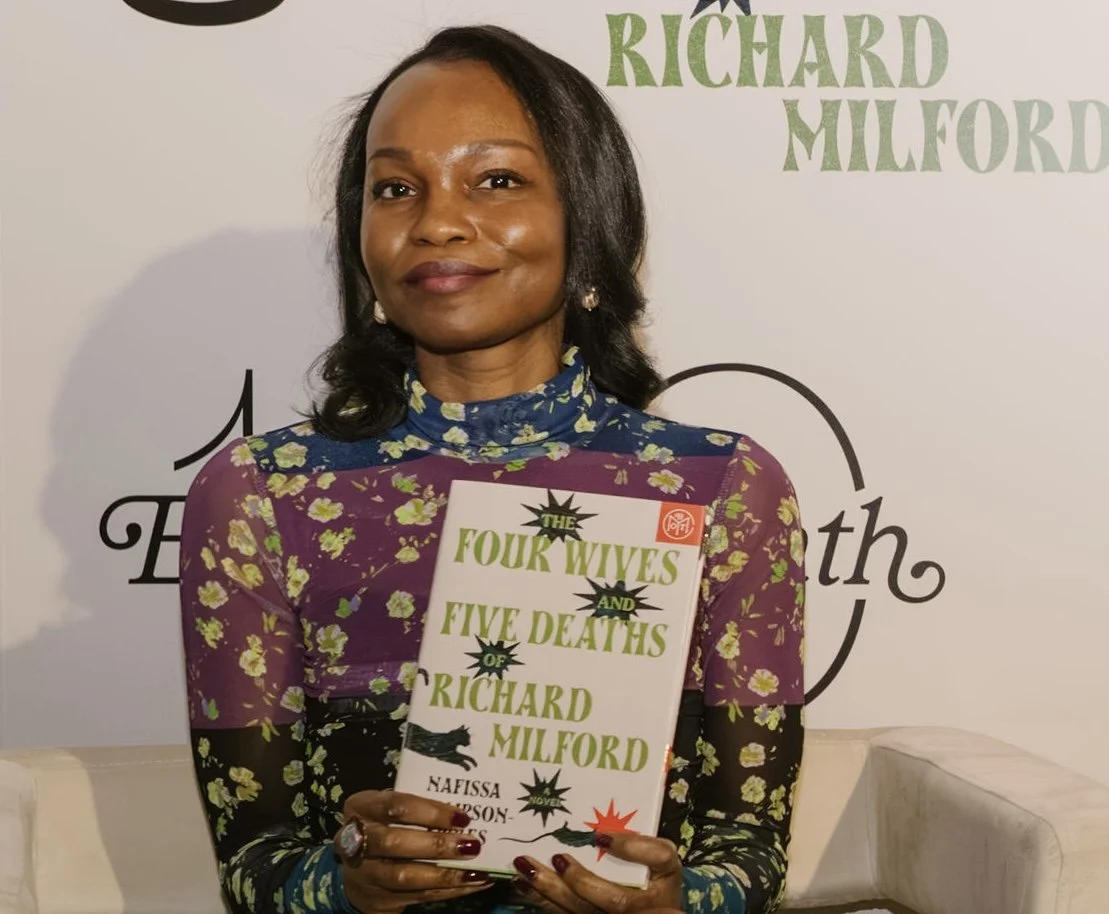
Today on The Stacks, we’re joined by award-winning author and academic, Nafissa Thompson-Spires to talk about her newest book, The Four Wives and Five Deaths of Richard Milford. Set in a small, all-black town in 1920s Oklahoma, this novel follows the death of notorious bootlegger and womanizer, Richard Milford, whose four wives are the top suspects in his murder. In this episode, Nafissa and I talk about the family lore that inspired the book, how chronic illness affects her writing practice, and using revenge as motivation.
Our book club pick for November is Famesick by Lena Dunham. We will be discussing the book with Phoebe Robinson on Wednesday, November 25.
LISTEN NOW
Apple Podcasts | Spotify | Google Podcasts | Overcast | Stitcher | Transcript
Everything we talk about on today’s episode can be found below in the show notes and on Bookshop.org and Amazon.
The Four Wives and Five Deaths of Richard Milford by Nafissa Thompson-Spires
Heads of the Colored People by Nafissa Thompson-Spires
Paradise by Toni Morrison
“Ep. 417 Paradise by Toni Morrison — The Stacks Book Club (Namwali Serpell)”
“A Wicked Little Letter: My Revenge against Mom” (Nafissa Thompson-Spires, Substack)
Kathy Belden (editor)
Rebekah Jett (editor)
"Four Women" by Nina Simone
Pretty Woman (Garry Marshall, 1990)
Paternity Court (MGM)
HIT ME HARD AND SOFT by Billie Eilish
“Ep. 89 Staying True to Yourself with Jason Reynolds” (The Stacks)
“Ep. 193 Betting on the Kids with Angelina Jolie and Tokata Iron Eyes” (The Stacks)
“Ep. 172 The Art vs. The Artist with Quentin Tarantino” (The Stacks)
Ridiculousness (MTV)
Give Us Each Day: The Diary of Alice Dunbar Nelson by Gloria T. Hull
New People by Danzy Senna
You Are Free by Danzy Senna
God Help the Child by Toni Morrison
Jazz by Toni Morrison
Blazing Saddles (Mel Brooks, 1974)
The Producers (Mel Brooks, 1968)
Spaceballs (Mel Brooks, 1987)
The Producers (Susan Stroman, 2005)
Anna Karenina by Leo Tolstoy
The Four Wives and Five Deaths of Richard Milford by Nafissa Thompson-Spires (audiobook)
To support The Stacks and find out more from this week’s sponsors, click here.
Connect with Nafissa: Instagram | Website | Substack
Connect with The Stacks: Instagram | Threads | Shop | Patreon | Goodreads | Substack | Youtube | Subscribe
To contribute to The Stacks, join The Stacks Pack, and get exclusive perks, check out our Patreon page. If you prefer to support the show with a one-time contribution, go to paypal.me/thestackspod.
The Stacks participates in affiliate programs. We receive a small commission when products are purchased through links on this website.
TRANSCRIPT
*Due to the nature of podcast advertising, these timestamps are not 100% accurate and will vary.
Nafissa Thompson-Spires 0:00
I started writing almost exclusively to Billie Eilish, and I spent two years straight listening to Hit Me Hard and Soft, and that became a ritual that I have to have Billie Eilish on in the background when I'm writing. A little paramore sometimes now I've introduced into the routine, but Hayley and I are playing it careful because I don't know if I can always write Paramore, right?
Traci Thomas 0:21
It's not official yet.
Nafissa Thompson-Spires 0:23
It's not official.
Traci Thomas 0:24
You're dating. You're you're like courting each other.
Nafissa Thompson-Spires 0:27
Yeah, for writing. We've been friends and dating for a long, long time.
Traci Thomas 0:36
Welcome to the Stacks, a podcast about books and the people who read them. I'm your host Traci Thomas, and today we are joined by award-winning author and academic Nafisa Thomas Spiers to talk about her newest book, The Four Wives and Five Deaths of Richard Milford. This novel is set in a small all-black town in 1920s Oklahoma, and it follows the murder of an infamous bootlegger and serial womanizer, Richard Milford through the stories of his four wives, who are also the top suspects in his untimely death. Today, Nafisa and I talk about writing the second book, how she finds the voices of her characters, and we flash back to her debut book, The Heads of the Colored People, to talk about one of my absolute favorite stories. Our book club pick for November is Famesick by Lena Dunham, and we will be discussing that book on Wednesday, november 25, with our guest Phoebe Robinson. If you like this podcast and want even more bookish content and community, come hang out with us on Patreon and Substack. On Patreon, you can join the Stacks Pack, which is our hub for community conversation. On our Discord. You can join our virtual book club. We've got a mega reading challenge every year, and then over on Substack, you can subscribe to my newsletter Unstacked, where I divulge everything from my hot takes on the literary world to my thoughts on the latest in pop culture and sports. Whether you sign up on Patreon or Substack, you get access to a bonus episode every single month, and by supporting my work on either or both of these platforms, you allow me and my incredible team to bring you the stacks for free every single week. So, if you love listening to the stacks, why don't you join us for a little more bookish fun? The Stacks Pack at Patreon.com/TheStacks and my newsletter Unstacked at Traci thomas.substack.com. All right, now it's time for my conversation with Nafisa Thompson Spires. All right, everybody, I am so excited today. I am joined by Nafisa Thompson Spires. She is the author of a brand new book called The Four Wives and Five Deaths of Richard Milford. She also was the author of the National Book Award finalist, heads of The Color People. She's never been on this podcast, but I have been wanting her to come on this podcast for eight years. So this feels like such a win. Welcome to the show, Nafissa.
Nafissa Thompson-Spires 3:02
Thank you, Traci. I'm so excited to be here
Traci Thomas 3:05
because your first book came out right when the show started, April 2018. Right, so we never like I was not having authors on the show yet. I was just like dicking around with my friends, being like, "What books do you like?" So it didn't really work out then, and I've been waiting patiently, and now we're all being rewarded with this book. Will you tell folks what it's about?
Nafissa Thompson-Spires 3:26
Yeah, it's a pseudo murder mystery about a womanizer and moonshiner named Richard Milford, who is the most hated man in this all-black town in the 1920s. The town's called Newville, and it's about how each of the women in his life attempts to kill him on the same day over a couple hours, and what ensues from that point on.
Traci Thomas 3:53
Yeah, I I know I've heard you mention in other places that this was inspired by some family lore got run amok, perhaps with your imagination. Will you tell us a little bit about what happened here?
Nafissa Thompson-Spires 4:07
Yeah, my mother is obsessed with ancestry research, as I think many people are at the moment, and she's had so many people take the tests, including me. And I, against my will, sort of gave my DNA to the government, but
Traci Thomas 4:24
we've all been there.
Nafissa Thompson-Spires 4:25
And in the process, yeah, we have been there in many ways, I suppose. But in the process of her doing all this research, she found out that her paternal grandfather was married to three women and had 40 children and beat them all with a riding prop or a horsewhip, and I was like, "Oh my gosh, that's enough for a novel!" And I thought it would be great to imagine what if these women in his life could get revenge on this man, and even if some of his children might get revenge on him. So I started imagining this novel with. And I talked to my mom again and clarified some things, and she said, "You know, he wasn't a polygamist, right?" And I said, "Oh, but I've already run with the idea that he's a polygamist." She was like, "No, he was married to the women in succession, not at the same time." And I was like, "Oh, well, too bad. This is what I want to write." And so that's where that's kind of the genesis of the novel is from that family story and my misunderstanding of that family story.
Traci Thomas 5:25
Wait, that's so funny. So she said he's married to three women, and you thought like obviously all at once. Like the it's whatever. What's that? What's the thing? Occam's razor or whatever. You're like, well, the most obvious answer is that it was all at once. It couldn't possibly have been. He had three different wives at three different times. Are your people from Oklahoma? Because that's where the book said
Nafissa Thompson-Spires 5:46
Some are from Oklahoma, going back, but they're originally from East Texas primarily, and that's where some of my family still lives. Like my extended family, my grandma's generation. My grandma moved to San Diego.
Traci Thomas 5:59
Yeah, you grew up in California. I was gonna say.
Nafissa Thompson-Spires 6:02
My grandma moved to San Diego when she was 18, and so my mom was raised in San Diego, and I was born there.
Traci Thomas 6:09
Where did you grow up?
Nafissa Thompson-Spires 6:10
We moved to the Inland Empire when I was a little bit older, like two or something, and then my parents moved back to San Diego County and are in Oceanside now.
Traci Thomas 6:19
Got it. But yeah, you were. I was like. I thought you were Californian, so you stayed in California. You just left San Diego. I see. I I love that it was. I just love that it's like a misunderstanding. It just feels like such a novelist or like writer cliche. It's like don't tell me anything. It might end up in my next book. Like, sorry, great grandpa, we've turned you into a polygamist. But he was still a. He was like still not a great dude. Your grand, great.
Nafissa Thompson-Spires 6:43
He wasn't. And one thing I've barely spoken about, I don't know why, but he was actually married to three cousins. All of those women were cousins. First, second cousins, second cousins, at least. But yeah, they were all each other's cousins, and everyone in that small town was pretty much related to each other, so I think maybe that wasn't so intentional. But with him, who knows?
Traci Thomas 7:08
Yeah, was it an all black town?
Nafissa Thompson-Spires 7:11
It wasn't an all black town, but it was a town that had a lot of black people in it.
Traci Thomas 7:15
Interesting, interesting. I earlier this year on this podcast we read Paradise by Toni Morrison for book club, and I was thinking a lot that this book sort of had tinges of that to me. Maybe just because that is a book that's on my mind this year. But were you inspired at all by Paradise?
Nafissa Thompson-Spires 7:32
It's interesting. I was trying so hard to finish Paradise while I was writing this book, while I was writing the early drafts of this book. And yes, like the tone at first was something that I was playing with the tone of paradise, and then even though my book has a very different tone than that, and the ideas of like an incident that happens really quickly, and then you're just suddenly thrown into this community, this black community. That's something that with lots of Morrison I've been influenced by, but with Paradise in particular, yeah,
Traci Thomas 8:03
yeah, I could totally feel that. Though one of the things that this book has that's so fun is this voice of the town. Newville is very much a collective voice character. It's written. Is that? Is it? It's the first. It's the collective first person. What do you call it when it's like the we voice?
Nafissa Thompson-Spires 8:23
First person plural.
Traci Thomas 8:24
First person plural. Can you tell that I'm a really good writer? It's in the first person plural. So it's like we did this, we saw that. Talk about that. Why did you want to write in the first person plural? Did you always know the town would have a voice?
Nafissa Thompson-Spires 8:39
Yeah, the town came to me even before the women really came to me. Even though I set out to write a revenge story about these women, I knew that I wanted the town to speak, and I knew that I wanted their voice to be in first person. So there were these little sections in my early drafts where the town would just say something, and especially toward the end, the town talked a lot about Rich and projected into the future about what happened to him and his family. So yeah, that came first, basically. And I really like the idea of like small town gossip and the ways that people relate stories in a small town and the way that storytelling becomes such a huge part of the community. I was also later in my drafting process and revision process reading Alice Dunbar Nelson's diaries, and they're so juicy. It's a really, really great book that I recommend for anyone who just wants to like learn more about history, but also maybe enjoy a less known figure because I think Paul Laurence Dunbar is the one that people really talk about, but Alice Dunbar Nelson was just such a figure in her own right, and she was a diarist and a poet, and also this society woman. She was involved in like every kind of civic engagement possible in her town, and I really wanted a town that was full of this kind of civic engagement. And I knew I wanted to pay tribute to the black towns of Oklahoma. There used to be 50, and now there are only 13. And so I really wanted to write about what it looked like for people to be involved so civically, but also be in such a small place.
Traci Thomas 10:16
There's only 13 left. Wow! And they're still black towns, or are they like
Nafissa Thompson-Spires 10:20
they're still
Traci Thomas 10:21
they are. That's so cool. I love I love that you're saying like the diary inspired you because it is like so the town is so gossipy. I love you know I love gossip. Gossip is like my favorite thing on the face of the earth, and I love a gossipy I love a gossipy narrator. But I didn't realize that I loved a gossipy town narration. I love that, like when you think of a town, you know that people have different opinions, but then you have this collective voice. It's like the one thing we agree on is like how much we hate this fucking guy, because there's all these like little kind of disagreements, like so and so said this. We don't exactly know this, but like Rich, the worst, hate him, hate his sister. Hate everybody. They're annoying. They're awful. It's dreadful. The wives are bad. So I really appreciated the way, like, the humor in that. And you're so good at tapping into that kind of like, this is funny, but it's not. It's not jokey. I don't know how. What do you call that kind of humor?
Nafissa Thompson-Spires 11:22
That's an interesting way to put it. I don't know what you call that kind of humor. I don't know what you call it either.
Traci Thomas 11:27
But you know, like jokey is like yeah jokes, but it's like just sort of like underlying, like snarky, funny, observationally funny. I don't know.
Nafissa Thompson-Spires 11:39
Yeah, I like observationally funny. I I like to think about pointing out the absurd, and also just trying to do my best at satire and dark comedy to the you know as much as I can. So those are kind of the ways that I was thinking about it while I was writing.
Traci Thomas 11:55
You still maintain one of the funniest reading experiences for me is like what is it, la belle lettres or whatever from the first book, the like moms writing the letters back and forth.
Nafissa Thompson-Spires 12:09
Oh, thank you.
Traci Thomas 12:10
I think about this all the time. If you haven't read Heads of the Color People, first of all, you must, and second of all, there's these letters between these two moms, and they're like so passive aggressive, and they're like so competitive, and they're just so they're just so spot on. I'm like, how did you know how to write those moms?
Nafissa Thompson-Spires 12:31
That's also a family story, if you believe it or not.
Traci Thomas 12:36
You kind of have such a rich family for novel writing.
Nafissa Thompson-Spires 12:39
Such a rich family. I have such a rich mother. That story is based on my real mother and my real childhood bully and her mother. So I went to this really tiny private Christian school that was predominantly white, and that story set in like 1991 or 1993. I can't remember which one, but I was in third grade, so it must have been 1991. And my childhood bully was the only other black girl in my grade, and she hated me on site, even though I really wanted to be her friend. And her mother also hated my mother on site, and so they were feuding through all these letters and in person that whole academic year. And my mom sent me something that she called a care package, but it just it it wasn't a care. There was no care put into it. She was just like, "There's a lot of stuff with your name on it in here," and sent me this box. And I was expecting like socks and cookies, and it wasn't any of that. It was my report card from third grade, in which my teacher said, "No one will care how brilliant the child was! They'll only care how well socially adjusted she was, and I was like, "Dang, that's harsh for a third grade teacher to say about me, little me." And then it also had a letter from the childhood bully's mother saying that I was a monster and her child was perfect, basically. And I was like, "Mom, I'm going to pay you back for sending me this stuff because one, it's hurtful, and two, I didn't want to see it. Um, so I wrote that story out of revenge against my mother. I guess I'm kind of motivated by revenge. Um, I want to not writing. Yeah, let's punk that revenge. But, um, but my mom loves that story. She really loves it. She, I had a Substack post recently called "Wicked Little Letters." That's about me getting revenge against my mom in that story. And I interviewed my mom for it, and she was like, "I love that story. I feel like it made me a star." So that's the kind of mother I have.
Traci Thomas 14:36
I might be that kind of mother because I was like, "This is this is iconic mother status, like that's my dream. I'm like, how come I don't have any mom enemies at my kid's school? Let's talk about revenge because one of the things every year I sort of like make stupid predictions about what I think the year in books is going to be, and usually they're very wrong. But this year, I got it right. This is the year of the revenge. Novel. I feel like so many books are talking about revenge this year. Why did you want to write a revenge book? What is it about revenge that is exciting to write about?
Nafissa Thompson-Spires 15:10
I used to say that I write out of spite. I don't think that's true anymore. I don't know if it was ever really true. It just seemed like something fun to say. But there is a lot you can do with revenge. I mean, you can imagine it so many different ways, and I like to say that like sometimes writing helps me tap into my darker self and like my shadow self, and to enact things that I can't do in real life because I'm like a pretty shy, quiet person, and I'm a little passive aggressive, but I'm not like aggressive, and so it's fun for me to imagine characters who are both passive aggressive, like at a much higher level than I am, and who are also sometimes aggressive. So I think that's what it is. It's like, you know, I'm one of those people who can never think of a comeback until like six months later or even years later. I'm still finding comebacks for my third grade bully, you know, at age 43, and so I think that characters can do all of that for you in much faster time. I can write them, even if I can't think of them in the moment.
Traci Thomas 16:12
Do you feel like it's easier for you to write characters that are like you or that are different from you?
Nafissa Thompson-Spires 16:19
I think sometimes there's a thread of me in him, but I in this book, you know, most of those characters are nothing like me, which is interesting. Valley, the first wife, who's the one who's based, she's a parody of Alice Dunbar Nelson. She's a diarist and a failed poet, and I think there's like a tiny bit of me in her in that she's really interested in writing, and but the otherwise are like things that I wish I could be in some ways. Not Vivian. Vivian is so unhinged. I love. But really, I I'm glad she's an interesting person. But Georgette in particular, someone who I kind of wished I could be. Like she, she's a taxidermist and she is really spunky, and she can do all of this stuff that I could never do. She can handle a dead body with no fear and no anxiety. And she grew up working in a funeral home alongside her dad, and she just she's like very able to handle things until she doesn't. And yeah, so I think sometimes it's aspirational what I'm writing in the characters.
Traci Thomas 17:22
Do you feel like it comes like easier to you, or like it's more fun to write like someone like a Georgette, or do you feel like that takes like more out of you? Because there's just so many different voices. So I'm curious about like which ones sort of just like come right away, and you're like boom, boom, boom, and which ones are like I don't know what to do with this person.
Nafissa Thompson-Spires 17:41
It was easy for me to write Lally in some ways because I was imagining someone who was like always putting on airs and who is just like very affected. But it was also harder to write Lally. Like she's the one who went through the most revisions. Besides maybe Sophronia, I didn't know Sophronia very well, and it took me a while to like discover her voice through listening to her better. I know I see that you do have to listen to the characters and let them kind of guide you and tell you what to do. And it's when you force it that it doesn't work as well. But I knew Georgette right away, and I knew Vivian right away.
Traci Thomas 18:15
When you say like listen to the characters, I'm not a writer, and I think a lot of my listeners are not writers. What does that mean? Like, does that mean that you're writing just like pages and pages of stuff, and like just trying to like write things in their voice and see what happens? Are you filling out like questionnaires? Like, what what is the actual? What does it actually mean to you in a more literal sense to listen to a character,
Nafissa Thompson-Spires 18:41
that's such a good question. You know, some people fill out those questionnaires and find them really helpful. I don't find that so helpful. What I find is like almost sometimes it is writing pages and pages and the voice that I think is theirs and throwing those pages out and being willing to throw the pages out and to start over, which is what I had to do with Lally and what I had to do with Sophronia, and in some ways, a little bit what I had to do with Vivienne. Finding Viviane's art was harder, but when I say listen to the characters, I mean it's almost like free writing and letting your hand move across the page in a way that it almost. I don't want to compare it to a Ouija board because I've never played with one, and I'm like very afraid of the occult. I grew up in a fundamentalist Christian household, and like we don't fool with the occult in any way.
Traci Thomas 19:26
Got it.
Nafissa Thompson-Spires 19:26
But I imagine it's almost like letting that little censor thing or whatever it's called on Ouija board like move your hand a little bit, and or move under your hand, and letting the pen sometimes do the work for you. And I find that free writing or just like low stakes writing in general, just dropping somebody into a scene and seeing how they would react in that scene teaches you a lot about a character, and that's what I mean by letting the character tell you, not dictating what they do, but dropping them into different circumstances and letting those circumstances unfold as they will.
Traci Thomas 20:00
Is that something that like feels like a click kind of moment when you when you get to them, like when you get to the character when you realize like oh this is the character?
Nafissa Thompson-Spires 20:13
Yes, it feels so good. It feels really rewarding. Like when you find out this is the character and this is also the character's arc potentially, I think that that I don't know. It's like everything starts to come together, and it's really fulfilling.
Traci Thomas 20:26
Yeah, one of the things that I noticed in this book, which is something that I don't normally notice, but I think it's because it's like so stylized. It's like there's so many commas in the Newville voice. I'm really curious about that. Was that something that you like? You were do like all the sort of like parenthetical da da da. Or I don't know. I'm just curious about the commas. There's so many. There's so many thoughts on thoughts on thoughts.
Nafissa Thompson-Spires 20:55
Yeah, I like thoughts on thoughts on thoughts on because that could be said another way. Like the women in the book are thoughts on thoughts on thoughts too, but no gh. Yeah, just thou t. Yeah, I think the newsville section I wanted to be really stylized, or the newslet section is plural. I wanted them to have a certain rhythm and like musicality, and music plays such a big role in the book as well. You know, they're the town barbs, and I I wanted them to be kind of like a Greek chorus, or at least I discovered afterward that they were kind of like a Greek chorus who were always interjecting. And I think those commas and those clauses are like little interjections. Like, and another thing, and another thing, we also hate Rich, but we hate him so much because, and we hate him even more because of this. And I think that that's what they are: is like lots of interjections.
Traci Thomas 21:49
And we never hear from Rich directly. He's not one of the narrators of this book. Did you ever consider it? Did you ever write him, or did you always know? No words for you, pal.
Nafissa Thompson-Spires 22:00
I wrote him like a single page, and ultimately felt like it was better for him to because Rich speaks, even though he doesn't
Traci Thomas 22:09
in other people's sections,
Nafissa Thompson-Spires 22:11
Right
Traci Thomas 22:12
Like he doesn't have his own section. I guess I should have said the way the book is structured is it's we start with the town Newville, and then every chapter is a one of the women in Rich's life, and then every every alternating chapter. So it's like Newville a woman, Newville a woman, Newville a woman, all the way. It's like 12 chapters or something, 15. I don't know. I think it's something like that. 13. It's 12 or 13. Anyways, but Rich never gets his own chapter. That's what I mean by he like never speaks. We're never let into his thinking,
Nafissa Thompson-Spires 22:44
exactly. And in this one draft, I did have one single page of Rich talking and and having a monologue, basically a long monologue. But it felt better ultimately to break that up by letting him just speak a little bit in each other person's chapter, or to let you see him in the past. I felt like his monologue was a little bit sentimental, and it involved him like fearing that he was going to hell. And it's all with the fire in the book, which plays a role and some admissions. But I don't want to spoil anything by talking too much about that.
Traci Thomas 23:19
We will not spoil anything, people. Also, we we're not spoiling anything. The I feel like the title does so much spoiling. Like we know there's four wives, we know there's five deaths, we know who's dying. Like it's like great, my job is easier today because I don't have to worry about keeping things a secret. So thank you for putting it on top. Let's take a quick break, and then I want to come back. All right, we're back. I want to ask you a little bit. This is your second book, and I'm always fascinated with second and third books, particularly. I think you know debuts are cute and great, and congratulations to you. You did it, but what does it mean to come back to into the world of publishing. What does it mean to go back to the writing? Go back to the process, and then to step into this space again, knowing so much of what you learned the first and or second time. So my question for you, first of all, is like, how has this book felt different for you compared to heads of the colored people?
Nafissa Thompson-Spires 24:19
Wow, it was so much more difficult to write, for sure. You know, I wrote Heads of the Colored People doing what I call naughty writing, which is when I'm writing something I'm not supposed to be writing. I'm supposed to be. I was supposed to be working on a YA book that I had queried a gazillion times, and it was only getting a couple of revises and resubmits. And I was supposed to be doing revisions for one of those agents when I wrote Heads of the Colored People, and I wrote it really quickly. And I wrote it as like a playfulness exercise for myself. And I mean, when I say quickly, I mean I had some of those stories that I had written in my MFA program, maybe like three, and then I I wrote for a story quarterly contest that matched up John. Was judging and the titular story won that contest, and I was like, "Oh, I can write around this theme. Like, why don't I try to build a collection around the themes of this story?" Which is like heads as leadership, heads as literal head injuries. I was writing back to another book that was called "The Heads of the Colored People," and I wanted to update the sketches. They were literary sketches in that book. That was my initial idea, and that became a little too rigid. So I was just like, I'll play with the themes more broadly and have touches of those original stories in my stories. And that was so much fun to do. It really was fun to do. I can't say that writing this novel was as fun. The ideas were fun to me, and once I really tapped into something that one of my editors said, I had two editors, Rebecca Jet and Kathy Belden.
Traci Thomas 25:50
Kathy Belden is the most famous editor on this podcast because she's my favorite editor, and I have met Rebecca through Kathy, and I'm a big fan of Rebecca too. So it's a stunning. It's a stunning combination over there at Scribner.
Nafissa Thompson-Spires 26:02
It is a stunning combination. Really, really great to work with them, and they're just they have such good eyes. But you know, it was Rebecca who said in one moment, I think I had written this goddess Rosemary for the novel, who's in Four Wives and Five Deaths, and she was like, "Wow, can we lean more into the whimsy?" And I know whimsy is like the word of the year, but I did, and that's when I started to feel like I I had found my voice for this novel. And it took a lot of drafts to get there. I knew what the premise was; that was easy because I had the family story. But I did not know, and I knew I wanted Newville, and I knew how many women I wanted to write, but I didn't know a lot of other things. So the whimsy, and then also I was talking to Aro Quan, who was my accountability partner at the time. We would just exchange an email with each other once a week, where we said what we did that week, and that was it. And once we were on the phone, and I said, "I really wish I could kill Rich like five times. That was so awful." She was like, "Why don't you?" And I was like, "It's that simple. Like, I can do that." And she was like, "Yeah, you could, and you could structure it so that each woman, you know, kills him one at a time." And I was like, "Oh my gosh!" And that opened up the structure of the book for me. So it was really those two things: the whimsy and you know, deciding to kill Rich five times that made me feel like, "Okay, this is a book that I can get down with. This is a book that I know how to write now.
Traci Thomas 27:24
Interesting. And then what about like coming back on the publicity side, being back in the world, talking about your book, like doing stuff like this, having to be a what Mitch Jackson calls an author versus a writer. He's like a writer is a person at home doing the writing, but an author is like the public person.
Nafissa Thompson-Spires 27:43
That's such an amazing distinction. I love being a writer and sitting on my couch in sweatpants and writing. And I love being an author. I really love doing the public-facing stuff so much. Like it's very fun to me. You get to pick outfits. You get to, you know, do your hair for a change. So I like like tidying myself up a little bit and going out on the road. It's fun.
Traci Thomas 28:06
Do you? One of the things I always think about, especially when we do like book club here, and I'll be like with the Stacks Pack, and we'll be on our Zoom, and we'll be talking about like the book, and someone will pop on and be like, "Did you notice like the fire was a symbol for blah blah blah. How do you feel about like when when readers come up to you and they like tell you about your novel and you're like, I literally never thought of that. Or do you feel like they tell you the things that you that you did think of?
Nafissa Thompson-Spires 28:32
It's a mix of both, and I love it either way. Sometimes they tell me things that I just absolutely never thought of. Like somebody told me once with Heads of the Colored people that there was a lot of purple in the book, and I was like, "Oh, I did not know." But that's cool. What I thought people would notice with that book was that every male character pretty much starts has a name that starts with the letter R, and then in this book, there's a character who starts with the letter R, and in my next book, which is a YA novel, there's a character, main character whose name starts with the letter R, and now that's like a gag for me. I just got to keep it up.
Traci Thomas 29:04
Are there enough names?
Nafissa Thompson-Spires 29:06
I think there are.
Traci Thomas 29:07
I guess it depends on what you plan to write. Yeah, yeah, you can make some up. Yeah, instead of like Daryl, it could be like Rel or whatever. Yeah,
Nafissa Thompson-Spires 29:14
or Rarel. Yeah, that's a good one.
Traci Thomas 29:17
You're welcome. You can have that for Ross. Ross. I think
Nafissa Thompson-Spires 29:20
I could have a Ross. I have a Roman. Roman, that's good, and that's a name that people actually have. Yeah,
Traci Thomas 29:27
yeah, Ronnie. Yeah, Ronnie, Ronald for sure.
Nafissa Thompson-Spires 29:29
I have Ronnie. Ronnie is that character in the next one.
Traci Thomas 29:33
Oh, okay, okay, okay. Sorry, spoiler alert. Ronnie and Bruce
Nafissa Thompson-Spires 29:36
has a child named Ronald, and then there's one of the street singers, the bars, is named Ronald too. So I use that.
Traci Thomas 29:42
So Ronald might be done. Well, maybe you just have to put a Ronald in every book.
Nafissa Thompson-Spires 29:45
Maybe that's what it is. He's like Waldo, but he's Ronald McDonald.
Traci Thomas 29:48
Yeah, exactly. It's where where's Ronald the Thompson-Spires edition? Speaking of names, how do you name your characters? Where did Sophronia come from?
Nafissa Thompson-Spires 29:58
Sophronia, I really. Liked the music of the name. I was thinking about that song for women. There's a Sophronia in that song, and I was kind of in conversation with that song a little bit at first when I was writing. But then I just loved the name and wanted to stick with it. I try to give many of the names a meaning, like those with the character. Lally, not so much. Vivian came from someone else telling me that they knew a Viviane once, and I was like, "Wow, Vivian just sounds like the kind of person you want to smack a little bit." And that's unfortunate for Vivian, but I was like, "That's a great name. That's such a cool name that I don't hear very often." And and then Georgette, Georgette's name used to be Sybil because I was thinking about that Sally Field movie Sybil and someone who had multiple personalities. But then I was like, no, Georgette makes so much more sense for her. Like she's kind of tough, and you know she's interesting. And she grew up with a man as a father who probably wanted a boy, and so Georgette as a form of George, made sense to me.
Traci Thomas 31:24
Yeah, I love Vivian. You're so mean to my girl, my sweet girl, and Vivian. You know
Nafissa Thompson-Spires 31:31
I love Vivian. I really do. But she's really problematic.
Traci Thomas 31:36
Yeah, she is, and she is annoying. She's great.
Nafissa Thompson-Spires 31:38
Well, now you're being mean to Vivian.
Traci Thomas 31:40
You said she was a. She had a name that made you want to smack her.
Nafissa Thompson-Spires 31:44
She does. She she's like a puppy, Vivian. Yeah, I mean I don't want to smack a puppy just to be clear, but
Traci Thomas 31:52
but you know yeah, she's the last wife.
Nafissa Thompson-Spires 31:56
Yeah,
Traci Thomas 31:56
she's the last one. She's like they bring. She's the young one, and she's maybe like sort of not as smart as the other ones, and she's like very. I thought she was sort of sweet, but she also has some issues, and I just really. She's a school teacher. We love teachers. How can we?
Nafissa Thompson-Spires 32:16
We do love teachers. I'm a teacher, but I just you know maybe I was projecting things onto Vivian, I don't know. I wanted her to be kind of pitiful.
Traci Thomas 32:24
Yeah, she is. She is. She is. Do you feel like since the book's been out for a little bit, have you heard from readers like is it mixed about who's whose favorite, or is there sort of a star in in the readers you've talked to?
Nafissa Thompson-Spires 32:37
Lally is interestingly the one that people seem to like the most, and Lally, like I love Vivian. To be clear, even though I've said some bad things about her, it's okay.
Traci Thomas 32:46
We won't tell her what you said.
Nafissa Thompson-Spires 32:48
Thank you. She might get you. Lally is the one to me who is like a little bit annoying, and
Traci Thomas 32:56
I found Lally annoying too.
Nafissa Thompson-Spires 32:58
Yeah, she's a she's so like put on and trying so hard to be someone that she isn't, and I wish that she would be more authentic. I think that I'd like her more, but I also really wanted to write about someone who was trying so hard to fit in and who just like couldn't. So I I think of her as like pretty woman when they won't let her shop, and the town of Newville just rejects her so aggressively in so many different ways.
Traci Thomas 33:25
She's so aggrieved.
Nafissa Thompson-Spires 33:27
She is aggrieved. That's a perfect word.
Traci Thomas 33:30
Speaking of the town and Lally and them not rejecting her, I'm really interested in this like sort of idea of like being the people who live away from the group, or like being an outsider, sort of by choice, sort of with a sense of disdain, but also maybe like with a feeling of being hurt because you're not there. I'm so curious about that piece of this book.
Nafissa Thompson-Spires 33:57
Yeah, I think Rich and his wives are such outcasts, in part because Newville represents not everybody in the town. Those Newville narrators, that we, that collective voice, really represents like the worst people in the town to me. When I think of them, I think of them as like the most self-righteous men who are like fake Christians and who think that they're better than everyone else. And they're really sexist. People haven't talked a lot about this, but they're really, really sexist, and so they hate rich for many, many reasons, which they catalog. But they hate the women because they're extensions of him, but also because they kind of hate women in general. Like when you get to the the chapter about the goddess, you can see how much they just really don't respect women, and so I wanted, I wanted Rich and his family to live in a place that kind of could be seen by Newville, but was far away and separated from from them enough that it also added to the lore and the mystery that made the town so interested in them.
Traci Thomas 34:57
Yeah, is there anything that's. Not in this book that you wish could have been?
Nafissa Thompson-Spires 35:03
You know, there was a lot more nature writing. I spent, you know, the book was originally set in upstate New York, and I spent a lot of time writing about and reading about cults in upstate New York, in the Oneida Colony in particular, which is this really weird place. And I thought more cult stuff would have made it into the book. Rich is kind of a cult-like figure, and has you know he has what he calls a community, not a commune. But there was also just so much nature writing. I was going hiking every day while I was in the early drafting process, and I was really just seeing all of this gorgeous, gorgeous landscape around me, and I wanted to write about the landscape. And the landscape of Oklahoma is also beautiful, but it's different. And so I tried to work in the natural habitat of that, but the natural habitat of New York is just so gorgeous. I was in Ithaca at the time, and there's just ways to be inspired every single day by nature, and that was something that I wish could have made it into the book more.
Traci Thomas 36:07
Yeah, the cult stuff is interesting because he it sort of gives cult vibe, but it's not like a real full fledged cult situation. Do you want to talk about that at all?
Nafissa Thompson-Spires 36:19
Yeah, I mean, I don't want to give too much away, but Rich is what he calls a stoic enterpriser, which you know doesn't work.
Traci Thomas 36:29
Sure, sure, sure. Yeah, Rich.
Nafissa Thompson-Spires 36:31
Yeah, he has a special diet that he follows and that the women follow that he believes will do things for him spiritually and financially. And in some ways, he's just cheap. I mean, he sells Angus cattle, but he only will eat eggs and only will feed his women eggs. And you know, they can have like a single piece of bacon every now and then, and two pieces of bacon if they're pregnant. And he's really stingy with everything: stingy with his money, stingy with his love, stingy in so many ways. But he has this vision of like he has literal visions that are a little bit maddening. But he also has this vision of having his family meet together in the astral plane one day, and that he has this huge number of children, and so he's like a lot of cult leaders in that he wants a lot of children that he can control and make do things for him later on in life. But there are only five, four women in the house besides Alberta the cook, and that's not really enough to me to make a cult. So it's like sister wives meets small cult.
Traci Thomas 37:40
Yeah, it's like if if Rich had if Rich had been given a chance to live to these horrible women, maybe we could have had a cult. You know, they nip it in. Also, he wears like white linen and like a cowboy hat, right? And like spurs. Just like very cult leader.
Nafissa Thompson-Spires 37:55
White boots with spurs. Yeah, yeah. He's been wearing those since he was a child.
Traci Thomas 38:00
Which I mean, I feel like I always think. I mean, I like really am into cults a little bit. It's not. It's not great, but it's who I am. And I do wonder about like, how did they dress as kids? Like, do you think that like Jim Jones at like nine was wearing like oversized sunglasses? You know what I mean? Like, like, were you always that guy, and it just became iconic because of the horrible things you did, or did you become like esthetically, like, sartorial, like the sartorial choices of young cult leaders before they've created their? Like, I just, I'm very fascinated by that idea.
Nafissa Thompson-Spires 38:36
That should be someone's dissertation: the sartorial choices of young cult leaders, yes,
Traci Thomas 38:42
yeah.
Nafissa Thompson-Spires 38:42
Because I think about like not to get, well, I won't bring up Columbine. It's not like like that was a cult, but think of the trench coat mafia and like all of these iconic negative figures who just had like a signature look. And I wonder at what point they started wearing it. And it's probably after something traumatic happened to them. With Rich, it's something that something traumatic that happened to him as a teenager that makes him start dressing that way. So, yeah
Traci Thomas 39:08
I'm curious about this. Like, I would just love to know. Like, I just want to go back to the like, like, what was Charles Manson wearing at like 10?
Nafissa Thompson-Spires 39:16
Yeah, probably something to make himself disappear before he became like the big extravagant figure,
Traci Thomas 39:24
right? But he's always like he's also like little, like he always seemed like sort of like a little hiding kind of guy. Okay, let's talk a little bit about your process. How do you like to write? How many hours a day? How often? Music or no? Are you in the home? Are you out at an office at a coffee shop? Are there snacks and beverages? That's important. Rituals. Tell us about it.
Nafissa Thompson-Spires 39:52
Yes, I have a very rigid writing process. Yes, it is frigid and it is rigid. I'm not one of those people who like. Gets up and writes with, you know, the birds in the morning. I have to write when I get up, and I get up late because I have chronic illnesses that cause me to have insomnia a lot of the time. So I start writing usually around like noon or 1130, sometimes one, and I write for like five to six hours a day on weekdays. That's my version of a nine to five is like I don't feel like you can write on a nine to five literally, but I feel like you know five to six hours is pushing it, and I forget to eat lunch usually until it's way too late in the day, and also my lunch is at like four, so I I'm like I need a matcha. Oh yeah, I should eat, and that's what prompts me to make a lunch. I write to music initially with Heads of the Colored People, and with the beginning drafts of this book, I was writing to my classic Judge Judy and Judge Mathis in Fraternity Court, which I've talked about writing to because they're just wild shows. Like you can get so much dialog and like a weird look or affectation from somebody, and they're really harsh and mean. And so I like writing to that kind of drama with it down very low. The volume's down very low, so I could just like happen to look up and see something absurd.
Traci Thomas 41:18
Okay, I was gonna say, isn't that so distracting? Like to think when there's someone else talking.
Nafissa Thompson-Spires 41:23
No, it had to be the volume down really low.
Traci Thomas 41:25
Got it.
Nafissa Thompson-Spires 41:26
But there's so much absurdity in those shows, and but then I I fell out with Judge Mathis, I fell out with Judge Judy, and paternity court just wasn't doing it for me anymore. So I started writing almost exclusively to Billie Eilish, and I I I spent two years straight listening to Hit Me Hard and Soft with a in addition to some other songs that were on a playlist I made on YouTube and I liked waking up and seeing a part of a beautiful music video that would inspire me or you know hearing a part of a song that I really love and that became a ritual that I have to have Billie Eilish on in the background when I'm writing a little paramore sometimes now I've introduced into the routine, but Haley and I are playing it careful because I don't know if I can always write to Paramore.
Traci Thomas 42:11
Right, it's not official yet. It's not official. You're dating. You're you're like courting each other.
Nafissa Thompson-Spires 42:16
Yeah, for writing. We've been friends and dating for a long, long time. But okay, but for like writing part, okay, yeah. So, yeah, and that's about it. I have to have.
Traci Thomas 42:28
Do you do it in the home? Like, do you have a specific place that you write?
Nafissa Thompson-Spires 42:30
I can't write at a table or on a desk. I have to write on the couch, cross-legged with a heated blanket on, and usually a space heater in front of me. No matter what
Traci Thomas 42:38
What if it's hot?
Nafissa Thompson-Spires 42:40
I don't like having the AC on because it's just I get cold so quickly. But if it's hot, there's a fan, and I do.
Traci Thomas 42:49
But you don't have it. You don't have the heated blanket on 365. It's heated blanket when weather appropriate.
Nafissa Thompson-Spires 42:53
It's heated blanket like 340.
Traci Thomas 42:56
Okay, okay, okay, okay, okay.
Nafissa Thompson-Spires 42:59
I mean, I love a heated blanket.
Traci Thomas 43:01
I love a heated blanket. Is yours? Is it a plug-in or is it one of the cordless ones?
Nafissa Thompson-Spires 43:06
Ooh, I don't have a cordless one.
Traci Thomas 43:07
Yeah, they have cordless.
Nafissa Thompson-Spires 43:08
I need to get one.
Traci Thomas 43:09
I think. Did I lie? Am I lying?
Nafissa Thompson-Spires 43:11
I don't know. That sounds amazing.
Traci Thomas 43:13
I feel like they do, but also this could be a lie. I'm not fact checking.
Nafissa Thompson-Spires 43:23
I'm going to fact check it. Because I want one.
Traci Thomas 43:24
I think they have cordless ones. Okay. We're around the same age. Do you remember like in the 90s when people would like burn their house down because of their like heated blanket or like catch on fire? So I have a little bit of anxiety about heated blankets for this reason that's like stuck with me in the same way that like children getting abducted from sleepovers because of Polly Klaas like is still something that I'm very concerned about. I have a heating pad that I will sleep with at night, just like because it turns off automatically, and so I'm not worried about it. Like I would be with a heated blanket.
Nafissa Thompson-Spires 43:59
Yeah, I am afraid of the heated blankets and the heating pads. I have both. I sleep with the heating pad every night, even sometimes in the summer.
Traci Thomas 44:07
I do too in the summer too.
Nafissa Thompson-Spires 44:08
Yeah, because the air is on, and like it's a nice contrast between the two.
Traci Thomas 44:11
It's also more about like sometimes it's like just like my muscles are tired. Like I like worked out, or like I just need the warmth. I don't know. I need to. You get it.
Nafissa Thompson-Spires 44:22
And I travel with it, but the heated blanket I do unplug before I leave for any trips because I'm like afraid that somehow it'll spontaneously combust.
Traci Thomas 44:31
It'll spark up. Yeah. Yeah. Are there any words that you can never spell correctly on the first try?
Nafissa Thompson-Spires 44:38
Oh my gosh! Restaurant.
Traci Thomas 44:41
Oh, you're in the restaurant club. Do you know that this is a very famous club on this podcast?
Nafissa Thompson-Spires 44:46
Really?
Traci Thomas 44:46
includes you now, Jason Reynolds, Angelina Jolie, and someone else. Now I think maybe Quentin Tarantino. I feel like it's like it's like such a random word. That like people have, and the reason I always remember the restaurant one is because, well, one of the reasons I remember it is because the first time I ever asked this question was to Jason Reynolds, and when he said it, I was like, "That's the only word I can spell," because I'm a notoriously horrific speller. But for some reason, restaurant I can do, and then when I started hearing other people say it, I was like, "Wait a second! Like this is a very particular restaurant. There's a club, and you're in it. Welcome.
Nafissa Thompson-Spires 45:27
Okay, cool. It's such a hard word. Like, where does the A U part go? Is it at the end? No, at the end, it's just an A N T, right?
Traci Thomas 45:35
It's yeah, it's R E S T A U R A N T. I don't know why I can do that one. I'm telling you, Nafissa. Every other word, it's constant. I realized recently that I don't know the difference between illicit and illicit. So I used to be putting both. I don't know. I know they're different, but like I don't know, and I don't care. And then I'll like put something, and then someone be like, "Do you mean this?" And I'm like, "Yeah, bitch. You know what I meant. You knew. You know what I meant."
Nafissa Thompson-Spires 46:00
Well, you can remember that one easily is I always have to have a mnemonic device for everything. Okay, and I was in the spelling bees a little bit.
Traci Thomas 46:08
I had a feeling you were going to be a good speller. I don't know. You have that energy.
Nafissa Thompson-Spires 46:11
Not anymore though. I can't spell because I type now. So, but I used to be able to spell really well. But illicit, just think of the ill, like
Traci Thomas 46:20
It's like that's like the bad one
Nafissa Thompson-Spires 46:22
Yeah,
Traci Thomas 46:22
got it. Okay. Do you know what I learned? Can I tell you something? I this is so stupid, but I'm going to tell you because we're here. I found some lady on the internet who is obsessed with phonics, and she talks about it for kids. I there is a rule about with C and with K at the start of words, do you know that it's not just something you have to memorize? Okay, any word that the k sound comes before a, o, u, or a consonant starts with a c. So cat, clear, cream, conâts a C. If it's a sound before an I, E, or Y, it's a K. And now you might be thinking, what about kangaroo? What about kayak? What she says is that this rule pertains to the Roman Romantic languages and whatever, and a lot of these other words have come from other languages that we were introduced to English later, and so they didn't colonize the words, so they don't fit the rules. So she says, you know, if your kid notices that, like it's fine, just let them know this is like from a different root word. But every word in English, like English word, fits that rule. There's no exceptions on that side. Isn't that crazy? I know. And apparently G for g and ja also follow. So g before an a, no g. I can't remember. Anyways, it follows the same. Apparently, c and g, those sounds are friends. She told me
Nafissa Thompson-Spires 48:00
that's cool. I didn't know anything about that.
Traci Thomas 48:02
So cool. I didn't either. I always was just like, gotta know. Just gotta like we just know these things. But apparently, there's been a pattern all along.
Nafissa Thompson-Spires 48:12
That's amazing. I love when there's a pattern all along.
Traci Thomas 48:15
Me too.
Nafissa Thompson-Spires 48:16
Except when it's a bad one, and you like find out too late,
Traci Thomas 48:18
like I before E except after C, literally is never there when I need it. It's never there when I need it, and now I always just question it. I'm like, I don't like receive. I don't know. I don't know. Just gotta wait and see. Gotta wait and find out.
Nafissa Thompson-Spires 48:30
Yeah,
Traci Thomas 48:31
this is really taking a turn. But thank you for being here for this. You mentioned before that you have chronic illness, and I've heard you talk about it a little bit in the past. How does that interact with your ability to write? Like, how what do you do if you are having flare-ups? Are you still pretty regimented about your writing, or do you have different ways that you balance those things?
Nafissa Thompson-Spires 48:57
Yeah. Thank you for making space for that in the conversation, I have to really listen to my body more and more. So there are certain medicines I take that I just can't totally write well on. I've learned that the hard way when I used to send people some funny messages or make weird Instagram videos that have since been deleted because I was on these meds. But Um. Yeah, or you know, you think it sounds brilliant in the moment, but then you go back and read it, and it's just like nonsense, gibberish. I found that I especially can't dictate because dictation is a big part of my writing. Like, no matter how I'm feeling, I can dictate, but that there are certain substances that like I can't dictate on because it will be gibberish. But for the most part, you know, I rest when I need to, and I just have to keep in mind that like there will be better days again, and that I can make up the difference, hopefully, on those better days. And my body doesn't take me out of writing that often, but when it does, it's sometimes for like a week. Long period. Like I was recently in hospital for eight days with a bowel obstruction, and that was really scary. I couldn't write, and I didn't have my laptop with me, and I was so bored. And I don't think I could have written anyway. Um. Oh my gosh! I watched horrible amounts of the Food Network, and I had a bowel obstruction, so I couldn't eat anything.
Traci Thomas 50:19
Yeah I was about to say that seems like torture.
Nafissa Thompson-Spires 50:20
It was torture, and now I don't ever want to see Guy Fieri again.
Traci Thomas 50:26
You didn't want to see him before either.
Nafissa Thompson-Spires 50:28
I didn't. I didn't need to see him before, but now I really don't want to see him. And I watched a lot of ridiculousness, literally the show, because that's all that's ever on TV on MTV, and I only had like a few channels as an option. Ridiculousness, I can still watch. Like that's funny, except it's hard to laugh with a bowel obstruction because it hurts your stomach.
Traci Thomas 50:46
Laugh.
Nafissa Thompson-Spires 50:47
Yeah, it's that show where Rob Dyrdek and like a couple of other people. It's like America's Funniest Home videos if it were extremely crass.
Traci Thomas 50:54
Okay, I don't think I've ever seen it, but
Nafissa Thompson-Spires 50:56
yeah,
Traci Thomas 50:57
sounds sounds great. Sounds like great hospital watching. Do you know? I mean, you mentioned the YA novel. Do you know what else comes next for you, or are you still just like, don't ask me that? I just put a book out into the world.
Nafissa Thompson-Spires 51:10
I have two books that will be announced soon. we hope, but yeah, on one of them is a ghost novel, and I'm really excited about.
Traci Thomas 51:20
Is it scary? Will I be able to read it?
Nafissa Thompson-Spires 51:22
It's not scary. I can't do scary, which is why like all the violence in Rich Milford pretty much cuts away from it because I like I'm not a person who does violence really, even though he gets killed five ways, and that sounds like a very violent premise. And then yeah, maybe there's another short story collection in the future.
Traci Thomas 51:42
Cool. For people who love Four Wives, Five Deaths of Richard Milford, what are some other books you might recommend to them that are in conversation with what you've done?
Nafissa Thompson-Spires 51:53
Well, the Alice Dunbar Nelson diaries are in conversation. I would read up on Oneida. I would read Pierrepont Noyes diaries because I was just reading a lot of diaries at the beginning. You know, they're not necessarily in conversation with this book, but I'm always going to say read Danzy Senna's New People. Like I aspire to write like that and to write endings like that.
Traci Thomas 52:20
Oh my gosh! And that book is wild. That book remains one of the single best novels I've ever read. That ending, I still think about Maria. I'm like, how's Maria doing? Where is Maria, and how is she doing?
Nafissa Thompson-Spires 52:31
I'm scared to know how Maria is doing, honestly, or if she's like under my bed or something.
Traci Thomas 52:36
Yeah,
Nafissa Thompson-Spires 52:36
that's that's true. Like it takes a horror turn almost.
Traci Thomas 52:40
I say, I feel that Danzy Senna, though she's not given credit credit for it, is one of our great thriller writers. Like her books feel like thrillers. They are so intense. They are so suspenseful. You're like, what is going to happen? I don't want to look. I don't want to know. Like, please stop making me go down this scary path, but like the path is like walking into a producer's office. But you're like, don't do it, don't go in there.
Nafissa Thompson-Spires 53:07
Exactly, they're so good. And admission, that's one of my favorite short stories ever. Her story, admission. It's also like new people and the absurdity and that that ending. And then I'm really into the southern gothicist, like you know Shirley Jackson and Flannery O'Connor had to name unfortunately name some white women but and then Toni Morrison like I said I was reading Paradise and I was rereading all this Toni Morrison um I was trying to go through all of her books one summer and I didn't finish Paradise I will admit, but and I didn't read "God Bless the Child," but everything else, I I reread and loved so much. So I I would like to be in conversation with Toni Morrison in some ways.
Traci Thomas 53:53
I definitely feel like this is in conversation with Paradise, and also a little bit with Jazz, with that like collective narrator. Um, I I definitely I I was feeling the Morrison vibes for sure. If you could have one person dead or alive read this book, who would you want it to be?
Nafissa Thompson-Spires 54:09
Oh wow, Mel Brooks. I know it's a weird answer
Traci Thomas 54:12
I think you're the first to ever say that on the show.
Nafissa Thompson-Spires 54:16
I'm in love with Mel Brooks. Like if I could marry that old man, I would marry that man. I think he's one of the funniest people who ever lived.
Traci Thomas 54:23
Is he still alive?
Nafissa Thompson-Spires 54:24
He is.
Traci Thomas 54:25
Okay.
Nafissa Thompson-Spires 54:26
I think he's 100 years old. There's like an HBO documentary on him.
Traci Thomas 54:29
Wow.
Nafissa Thompson-Spires 54:30
He's either 90 or 100.
Traci Thomas 54:31
100 feels so like, wow. You know? Yeah. That's crazy. Well, did you send it to him? You should send it to him. I should send it to him.
Nafissa Thompson-Spires 54:44
I will ask if they will send him a copy. I love that man. I seriously love so much of his work, like Blazing Saddles to me and the producers. I think the producers is the funniest movie ever made. The original producers.
Traci Thomas 54:55
I'm not. I don't know that I've ever seen a Mel Brooks movie before.
Nafissa Thompson-Spires 55:00
You gotta.
Traci Thomas 55:02
I've not seen the two mentioned. What else could I have seen of his?
Nafissa Thompson-Spires 55:06
Maybe like Spaceballs.
Traci Thomas 55:07
No,
Nafissa Thompson-Spires 55:08
I've never seen Spaceballs all the way. That's not my thing.
Traci Thomas 55:12
I don't know that Mel Brooks is my thing. Now that you're saying this, but I don't know because I don't know if I've ever seen a Mel Brooks.
Nafissa Thompson-Spires 55:18
You should see the producers.
Traci Thomas 55:19
I saw the musical.
Nafissa Thompson-Spires 55:21
Okay, then you should watch Blazing Saddles. It's wild, though. Like, it is wild. Just know, you might be like both offended and gobsmacked at the same time.
Traci Thomas 55:31
Oh, I can't wait! I love that. I love that combination. All right, people, you can get your copy of The Four Wives and Five Deaths of Richard Milford by Nafissa Thompson-Spires. Wherever you get your books now, it is a nice slim novel, so it's perfect for the end of the year when you're like, I I just can't possibly read Anna Karenina today, but you're like, I could read I could read 165 pages. You know that includes the acknowledgements, ladies and gentlemen. 165. That's it from start to finish, and the audio book is very fun. It's got two two readers. There's like a reader for Newville, and then there's a reader for all the women, and that's a blast too. So you can get your copy of this wherever you get your books. And Nafissa, we did it. Thank you so much for coming on the show.
Nafissa Thompson-Spires 56:13
Thank you for having me. It meant so much.
Traci Thomas 56:15
Of course. And everyone else, we will see you in the stacks. All right, y'all. That does it for us today. Thank you so much for listening, and thank you again to Nafisa for being a guest on the podcast. I'd also like to say a huge thank you to John Mark Bowling for helping make this episode possible. Our book club pick for November is Fame Sick by Lena Dunham, and we will be discussing the book on Wednesday, november 25, with Phoebe Robinson. Make sure you're subscribed to the Stacks wherever you listen to your podcasts, and if you're listening through Apple Podcasts or Spotify, please leave us a rating and a review. If you love the Stacks and you want more bookish content, head to patreon.com/the Stacks to join the Stacks pack, and check out my newsletter at Traci Thomas.substack.com. For more from the Stacks, follow us on social media at the Stacks Pod on Instagram, Threads, and YouTube, and you can check out our website at thestackspodcast.com. This episode of the Stacks was edited by Christian Duenez with production assistance from Sahara Clement. Additional support was provided by Grace Berry and Cherie Marquez, and our theme music is from Taguigis. The stacks is created and produced by me, Traci Thomas.