

Ep. 396 Frankenstein by Mary Shelley — The Stacks Book Club (Angela Flournoy)
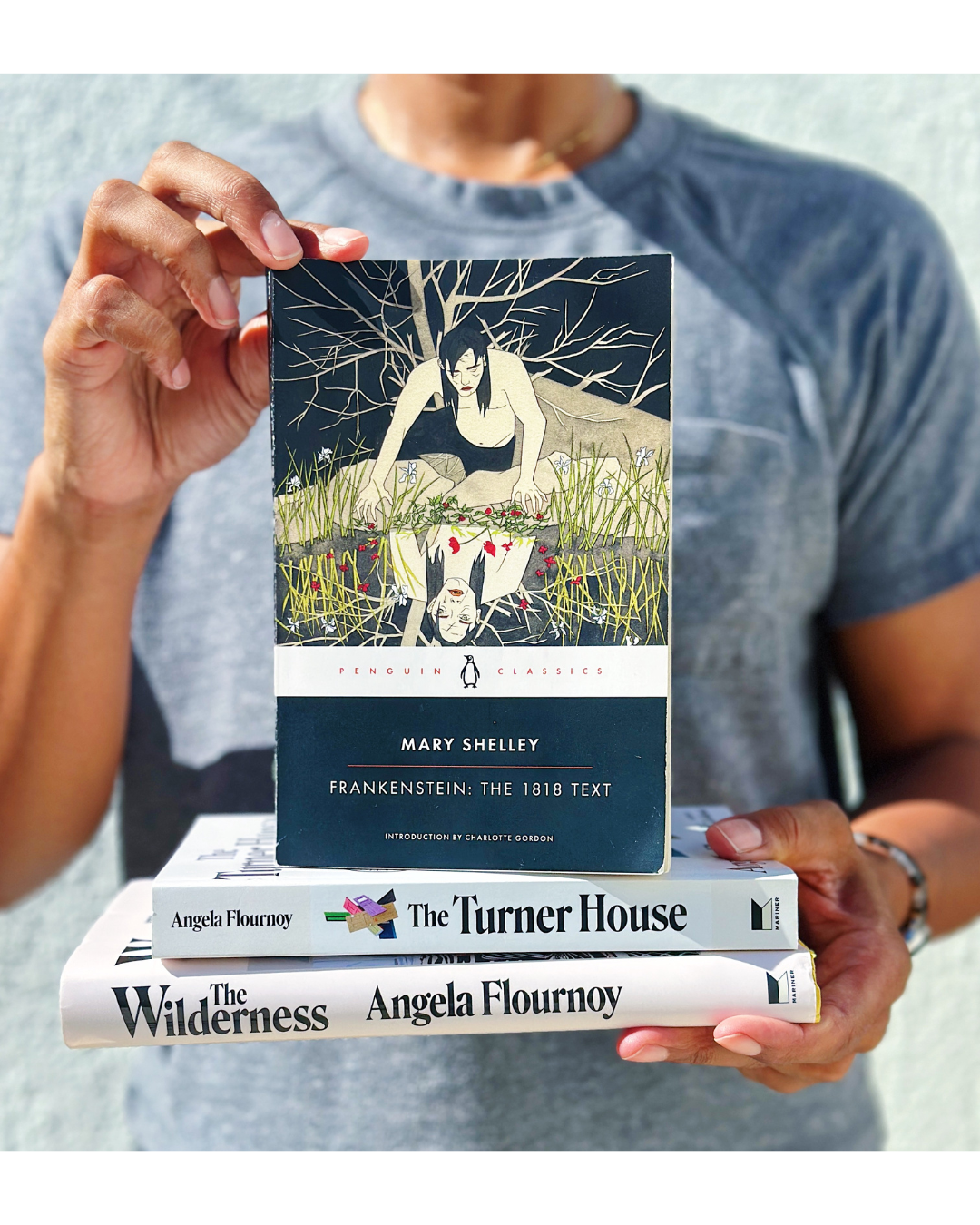
It is The Stacks Book Club day, and author Angela Flournoy is back to discuss Mary Shelley's Frankenstein. First published in 1818 and revised in 1831, this Gothic classic tells the tale of Victor Frankenstein, a young scientist who brings a monstrous creature to life, triggering a series of disastrous consequences. In our conversation, we explore our perceptions of Frankenstein’s monster, the significance of the nesting doll story structure, the book's ghost-story origins, and the novel's evolution from 1818 to 1831.
There are spoilers in this episode.
Listen to the end of today's episode to find out what our November Book Club pick will be!
LISTEN NOW
Apple Podcasts | Spotify | Google Podcasts | Overcast | Stitcher | Transcript
Everything we talk about on today’s episode can be found below in the show notes and on Bookshop.org and Amazon.
Frankenstein by Mary Shelley
The Wilderness by Angela Flournoy
“how can i tell the edition of this copy” r/FRANKENSTEIN” (Reddit)
Lord Byron: The Major Works by Lord Byron
The Shelley Papers by Percy Bysshe Shelley
Dracula by Bram Stoker
The Vampyre by George Gordon Byron Byron, John Mitford, and John William Polidori
Presumption; or, the Fate of Frankenstein (Richard Brinsley Peake, 1823)
A Vindication of the Rights of Woman by Mary Wollstonecraft
Narrative of the Life of Frederick Douglass, an American Slave by Frederick Douglass
Incidents in the Life of a Slave Girl by Harriet Jacobs
“The Strange and Twisted Life of ‘Frankenstein’” (Jill Lepore, The New Yorker)
Wicked (Jon M. Chu, 2024)
“Frankenstein and the Politics of Embodiment: A Disability Studies Perspective” (Debalina Banerjee, International Journal of Language, Literature and Culture)
Richard III (Shakespeare in the Park, 2023)
Frankenstein (James Whale, 1931)
Frankenstein (Guillermo del Toro, 2025)
We the Animals by Justin Torres
To support The Stacks and find out more from this week’s sponsors, click here.
Connect with Angela: Instagram | Website
Connect with The Stacks: Instagram | Threads | Shop | Patreon | Goodreads | Substack | Youtube | Subscribe
To contribute to The Stacks, join The Stacks Pack, and get exclusive perks, check out our Patreon page. If you prefer to support the show with a one time contribution go to paypal.me/thestackspod.
The Stacks participates in affiliate programs. We receive a small commission when products are purchased through links on this website.
TRANSCRIPT
*Due to the nature of podcast advertising, these timestamps are not 100% accurate and will vary.
Angela Flournoy 0:00
One of the reasons, in addition to, like, the sort of philosophical applications, the reason why the text has endured, is that also people have been just as immediately repulsed and grossed out and freaked out by the concept of this creation for 200 years, right? Like they have immediately decided we're going to dress up like that for Halloween, even though, if you read the text, the point is not the grotesque. They are going to have the Victor stance from the beginning, right? Like they're going to be on Team Frankenstein, meaning this guy is gross. I don't want him from the beginning. That has also been a thing that sort of shocked and titillated readers, even though the book is arguing like that, ain't his fault, you know, it's not his fault he's disgusting.
Traci Thomas 0:42
Welcome to The Stacks, a podcast about books and the people who read them. I'm your host, Traci Thomas, and today, we are finally doing it. We are giving you a spooky season edition of The Stacks book club. I am joined by author Angela Flournoy, who is back on the podcast to discuss our October book club pick Frankenstein by Mary Shelley. The book was first published in 1818, and this Gothic classic tells the tale of Victor Frankenstein, a young scientist who brings a monstrous creation to life, which leads to disastrous consequences. Today we talk about Frankenstein's allegory, whose side we were on, and the story of Mary Shelley and how this book came to be. There are spoilers in today's episode. Be sure to stay tuned to the end of our conversation to find out what our November book club pick will be. Everything we talk about on each episode of the stacks can be found in the link in the show notes. And if you like this podcast, if you want more bookish content and community, consider joining the stacks pack on Patreon and subscribing to my newsletter, unstacked over on substack. Each place offers you unique perks like community conversation, virtual book club and a whole lot of hot takes, plus you get to know by joining, you make it possible for me to make this show every single week. Head to patreon.com/thestacks to join The Stacks. Pack and go to TraciThomas.substack.com for my newsletter. Alright, now it's time for my conversation about Frankenstein with Angela Flournoy.
Alright, everybody, I've never been this excited for a book club episode. I don't think in the entire seven plus years of doing The Stacks, but today, we are talking about Mary Shelley's Frankenstein, a Modern Prometheus. I am joined by, I think, a super smart, wonderful person who I am so excited to hear talk about this book, Angela Flournoy, author of The Wilderness, welcome back.
Angela Flournoy 2:45
Happy to be back in the stacks.
Traci Thomas 2:48
You were right. It's not scary. I was worried Frankenstein was going to be too scary for me. I was never scared.
Angela Flournoy 2:54
Is it your first time reading it?
Traci Thomas 2:57
Yes, this was. I'm here for it all you know. Yes, this is why I'm so excited. Before we even dive in, though, I want to say to everybody listening spoilers, every spoiler ever in the history of spoilers we're going to do on this book club episode. So if you don't like spoilers, I think that you should know that about yourself, and you should pause this and read the book and then come back. Please don't complain to me after you listen to this episode and get spoiled.
Angela Flournoy 3:20
But I also feel like at a certain point that's like saying, like, the story of Noah's Ark, spoilers, like, this is Frankenstein.
Traci Thomas 3:37
I didn't know anything about Frankenstein. I didn't know anything. Really, I literally, I didn't know a thing. This whole book was a fresh and brand new reading experience for me. I feel like, because there's so much pop culture reference to Frankenstein that has nothing to do with what's in the book, you could think, you know the story of Frankenstein without, like
Angela Flournoy 3:57
It's like a game of telephone at this point.
Traci Thomas 3:59
Yeah, people think Frankenstein is the monster, right? Like, it's like the green, the green guy with the, like, studs in his ears and stuff
Angela Flournoy 4:08
He would have loved to have a name. He would have, yeah, he would have appreciated to be named anything.
Traci Thomas 4:15
Okay, before we even get to all of this, can you tell us just quickly, generally, how many times you've read this book and what your overall thoughts are upon reading it?
Angela Flournoy 4:32
I don't even know how many times I've read this book, probably at least, like four or five times over the course of my life, like my reading life, I don't but it's one of those books that I have a really bad book memory. So every time I'm like, Oh, I forgot that there was this kind of angle. Like, it's so many in this book, particularly, it's so slim. You know, a lot of the book. It's like appendix and introduction, like the book itself is what like less than 200 pages, or fewer than 200 pages, and the amount of kinds of like narratives that are in those 200 pages, I just forget, because there's this, there's the action, but then there's all these other things that happen in addition to the action.
Traci Thomas 5:22
Do you like the book?
Angela Flournoy 5:24
Yeah I mean, I feel like it is a I like it for a lot of different reasons, and including being like a time capsule for a particular kind of moment in 18th, 19th century, sort of like Western thought and literature.
Traci Thomas 5:45
Okay, here are my quick and general thoughts. This was my first read. Holy shit. I think this book is amazing. I think this book is like, this is one of the few classics I have ever read and been like, Canon for sure. No debate. Like, usually I read these books and I'm like, I'm like, I don't know, do we need that? I was like, Oh, babe, they we need this. This is, I just think to me, like, what makes a classic great is that it holds up and people can read it and project their own shit onto it. And if that is not this book, I don't know what this book is. This book is like, we're gonna talk about this later, but this book is basically an allegory for everything, like anything you want this to be an allegory for? I feel like we could, we could make it work. Mary Shelley said, yes, it's for you. My only like, my The only part of this book that I think, you know, I didn't like love is there were some sections where I was like, this is only a 200 page book, and it feels slow, like the way that information was delivered. There were times where I was like, what are what? What's happening. It does come together.
Angela Flournoy 7:02
You picked the right person to talk about this book with. Because you know I am going to defend those sections.
Traci Thomas 7:08
Of course, of course. But I'm just saying, like, for as a first time reader, I was a little bit like, like, she was like, I think she was doing it on purpose. She was like, slow playing me. And I didn't love that. And in the beginning, when I first started reading it, because the language is dense, and, you know, I read a ton of books, and I bounce between things that were written like that aren't even out yet, and then I go to something like Frankenstein. And so what I had to do for like the first 30 or 40 pages is I read the book out loud to myself, like I just, I had, I had, like an accent for Walton, like I was doing, like a full at home stage production, because I couldn't quite grasp the language at first, but then once I did, once I got like, once the creature was born, I didn't have to do that anymore, but I definitely had to take my time in the beginning and, like, read it, and not even that, like Soto voce, Like whisper, like full on, like my dearest sister, Margaret, I'm out to sea. So that being said, I love this book. I love this book. I love this book. I love this book. Now, what edition Did you read? Have you read 1818 and 1831? Do you know?
Angela Flournoy 8:16
Girl, I don't know. I mean, I've probably read them both over time
Traci Thomas 8:23
This is the 1818 one, but I also have this one, which is the 1831 I'm gonna tell you how, you know, go to the actual chapter one, kind of halfway down. It says he passed his younger days, perpetually occupied by the affairs of his country. And then what does your say
Angela Flournoy 8:41
he passes younger days, perpetually occupied by the affairs of his country a variety of circumstances.
Traci Thomas 8:47
Okay, so that's 1831 so you have 1831 if you have 1818 it goes he passes younger days, perpetually occupied by the affairs of his country, and it was not until the decline of life that he thought of marrying and bestowing on the state sons. So we read different editions, which I'm actually really excited about, but you probably have read both if you've read it four times, who knows? But for people who are at home listening, there are two different versions of Frankenstein. I didn't even know that until I picked this for Book Club and the stacks pack was like, which edition are people reading? And I was like, what does that mean? But the history is sort of that. Mary Shelley, well, let me give you guys the full history of the book. So Mary Shelley was on vacay in 1816 which was the summer, the summer or the year without summer, there was this volcanic eruption, a large climate change event, which meant that there was basically no summer. In 1816 she went on vacay with Lord Byron and her not yet, but soon to be husband Percy Shelley, her stepsister. They were just vacaying, but there was no summer, so it was very rainy and gloomy, and Lord Byron was like, Hey guys, let's all write ghost stories as a competition and see who can write the best one. Spoiler alert, Mary Shelley wrote Frankenstein and she won Lord Byron.
Angela Flournoy 9:58
Everyone else didn't even finish what they wrote.
Traci Thomas 10:01
Lord Byron wrote something that was that ends up being sort of like a precursor to Dracula, but it's called, like Vampyre or something. I don't know something, so he, he got something off but, but she wanted a landslide, like she wrote this, and they wrote things we've never heard of. So she wins. The book then comes out in 1818, it is edited. The 181 version is edited by her husband, Percy Shelley. He then goes on to die shortly thereafter, like in 1825 or something. And then there's a stage production of Frankenstein in 1823 I believe, which Mary Shelley sees. She maybe has some thoughts and feelings about it and decides to eventually go back and rewrite the book in 1831 she keeps some and takes out some of Percy Shelley's edits, but she changes some things. So for example, in the 1818 version, Elizabeth is the cousin by blood of Victor Frankenstein.
Angela Flournoy 11:07
That is something that I was like, what is all this extra lore? Because I recall her just being straight up cousin. So I think I must have read 1818 before.
Traci Thomas 11:16
Yeah, so in 1831 she is adopted into the family. They like, find her in the dirt. She's like a dirt child. And they're like, poor, poor, beautiful girl in the dirt. Like, come
Angela Flournoy 11:28
The dirt being all of the brunette siblings.
Traci Thomas 11:31
Mind you, yes, they're like, ew, you're perfect. And blonde, you cannot live this horrible life we will take you in. So, like, there's those kind of differences, but then there's this big, overreaching difference between the two, which is that in 1818, Victor Frankenstein is on his own expedition. This is he wants to figure this out. In the 1831 it's softened a little bit. It more like is faded to be he comes into the ability to create life. So it's sort of a bigger philosophical difference. It's not stated that way, but it's sort of my understanding is that it is rolled out in 1818, it's like, I'm going to create life, like I'm inspired to do this. This is my life calling. And in 1831 it's more like, Oh, I think I figured this out like Whoops, oh my gosh, look what I did. So there's all of that, which is a lot, but it will probably impact our readings of our conversation today, because it will impact how we think about some of the things that happened. That's not a question, it's just a lot of backstory. One of the things that I found really interesting about about Frankenstein is that it is, I think it's referred to as like a nesting doll story, where we have this narrative that starts with this sort of like preface. That's like this is like from from Percy Shelley writes this like preface, and then we get into these letters from Walton, who is a sailor who meets who sees a beast and then meets Victor Frankenstein, who then tells his story to Walton, and in the middle
Angela Flournoy 13:24
Who also, importantly, is thirsty for a friend.
Traci Thomas 13:28
Oh, thirsty
Angela Flournoy 13:29
Walton is he's like, I just need a buddy out here. You know, on this expedition,
Traci Thomas 13:36
He's like, sister. You might think it's giving gay, and it might be, but I need a friend. He said, It could be friendship. It could be fucking, I don't care. Judge me as you will, but like lonesome, lonesome, stuff. And then he meets Victor. Victor starts telling him his story. Then later we get the creature's story as told to Victor. And then inside that story. We get the story of these people. So it's like this layered, layered, layered, layered, layered, layered, layered thing. What do you make of this as just like structure?
Angela Flournoy 14:08
So what I make of it as structure, it has to do with this is I just every time I've read it before, I haven't had this thought. And I'm sure it's not an original thought. I'm sure there's like dissertations about it, but in its own way, when we think about how young Mary Shelley was when she wrote this, and we also think about the ways in which, and there's probably PhDs gonna get mad at me for saying this that, you know, she, she had a very famous mother, right? Mary Wollstonecraft, you know, nowadays, people would say she was a Nepo kid a little bit her mother was like a philosopher and like a woman's right advocate, women's rights advocate. So you're writing this thing that feels, you know, one of the sort of things that made it famous is that it was like a young woman from the mind of a young woman that this comes from. And it's not just that. It's like, because there's gore and there's. Action, but and, but also because it's like, concerned with, like science, kind of like alchemy and like that, like dark art, kind of science, but also like chemistry and things like that. So in the same ways, and this is where I'm saying somebody has probably written a dissertation about this that, like, older like slave narratives were like framed in this way to try to help the reader, the prejudiced reader, believe that this is a real account, and that an enslaved person had written this and you should you can trust it. There are ways that the structure of this helped to give Shelley like authority to be writing the story, right? So she, you know, whatever the like preface aside, so her husband's like preface aside,
Traci Thomas 15:51
which is so weird and bad, the preface was like, we don't need it, right?
Angela Flournoy 15:55
And but that is the thing that is like, used to be at the beginning of, or is still in the beginning of these narratives, right? Like these slave narratives is somebody, you know, some white person being like, I attest to that this person wrote it. You know, I am a real person. You should trust that they did it. Yeah. But these epistle, like the epistolary opening, is really trying to establish like, authority, right? So it's like, we have to have a few of Walton's letters where he's just like, I'm a guy. I'm a guy out here doing my thing
Traci Thomas 16:30
just lonely dude ready to fuck
Angela Flournoy 16:32
Just a dude. And then I, you know, you need to, like, ease into the the like, fantastic, by establishing in one ways, if you think about it, even now, it's fantastic. But like, he's, you know, in in the sort of unknown north, right? Like on an expedition. And then this, like, this speculative thing happens, right? Which is, like he sees a beast, yeah. And then from there you have to have, so it starts with, just like epistolary. This guy has nothing to admit. He has no stake in it. He is just like receiving it. But from there, you have, like, somebody who is beginning a confessional, but they're slow to confess it, right? Because they also are like, don't throw me out of this boat into the into the tundra, like, I need to be your friend. So part of the things that you probably thought were slow in the beginning of Frankenstein's like confessional is that he has to, obviously, like every good confessional, you're not going to just admit on like page one, like, I made a monster and then I ditched him. It's like I'm a good guy, like I am from like, a noble upbringing, or at least, like a pretty decent upbringing, before we can get to that and so and then within there you have another confessional, right? Which is yes, but that one is also a condemnation from the creature, right? It's like, I confess I did some shit, but it's actually your fault. So both of these things have to happen. And it's also in being a condemnation. It's also just like, straight up interpretive. I was like a rough lump of clay. Yeah, I was looking at the whole and that also, man, it reminds me of so many, like narratives of these, like enslaved people, like learning from by, you know, any means necessary, learning language and learning,
Traci Thomas 18:18
It's like Frederick Douglass
Angela Flournoy 18:20
Literally, or it's like Harriet Jacobs, right? Yeah, like narratives in the life of a slave, woman or girl, excuse me, and literally looking through a hole, right? And so the ways that like language and like Civilization reaches the creature, it has to be like both to bolster him and to condemn Frankenstein at the same time. So the structure really like primes you to get there and do you compare like you have to compare one person's confession that you got in the beginning, who nothing really ever happened to him. I mean, his mother did pass away, which is terrible. I'm not saying it's nothing, but there was no reason for him to just hop fully into necromancy. Like, that's just a thing he decided to do. Yes, and so the structure really, like, makes it more than just a creature story, right?
Traci Thomas 19:18
And not to jump to the end, but one of the things that I really appreciate it this kind of speaks to your point of like the authoritative voice is at the very end, Victor's dead. Spoilers, I told you, Victor's dead, and the monster and the lonely Walton are talking, and the monster's like, or the creature I don't know. I know it's like, whatever, the guy he's he's like, I mean, I know you got Victor's story, but like you're gonna believe in his story, like he's, for sure, manipulate, like the way that he just so casually is like, I mean, sure, but you think he told you the whole truth. I just love that, because I. There's so many times, like, throughout the story, where I kept being like, oh, okay, but I didn't quite like, put together like, of course, Victor is trying to persuade Walton like, I kept trying. I kept having to remember this is his persuasive account. He's trying to be taken in, to be taken care of he like he knows he needs help, and so he's not. It's not like a honest confession. It's a persuasive sort of narrative. And I love how at the very end the creature is like, I mean, you know he was lying to you, right?
Angela Flournoy 20:34
Right like he's a not a reliable narrator
Traci Thomas 20:39
Not at all. But it's so, so, oh, wait, okay, before we get to that, I do want to say a few more things about Mary Shelley, because I think what I want to say about her informs sort of the rest of the conversation. And then I do want to go back to some of the stuff around slavery, because I think it's really important. So I talked about this the summer with the year without summer, when she's writing the book in like 1816 she's like 17 or 18 years old when the book comes out, she's 19. She's just lost a baby. She's had a child who has died within like 10 days of being born. She is one of the only women writers of this era who is a sexual being at all. She has been married, she has had and lost children when her contemporaries are all sort of like spinsters and like single women. So in addition to this book being very interested about like knowledge and creation, it is very interested, or people are interested in it because it deals with sex and motherhood from a woman's perspective. So that is something like we cannot forget, even though this is like a book about men. Underneath all of that is like she's one of the only mothers who's writing at the time. Her husband is a ho. He's a womanizer. Lord Byron is also a hoe. They're all just fucking being crazy, as you said, She's raised by these radical parents. There's conversation about her perhaps being queer. She's has an unrequited or requited love of of a woman who is her stepsister, who is has a baby by Lord Byron. These people are having a great time in like Geneva, they are just, I can't reiterate this enough. They are sad, they are emotional, and they are having children
Angela Flournoy 22:30
And they didn't have a summer
Traci Thomas 22:32
And they had no summer. They were doing all of this without summer, like most people need summer to get the party Kraken, not them, after the book comes out in 1818 basically everybody dies. So Lord Byron dies shortly thereafter. Her husband dies shortly thereafter. I believe her father also dies shortly thereafter. So in between the 1818, writing and the 1831 revision, basically everybody dies, she's left all alone. And so for those of you who read the 1831 version, that might be something that comes up, perhaps more that feeling of like being the only one left. And then the last thing I sort of want to say about her biography, which I read a really great piece in The New Yorker from for like the 200th anniversary by Jill Lepore, where she talks about Mary Shelley's name, which is Mary Wollstonecraft Godwin Shelley, which, for those of you who missed what was said before, Mary Wollstonecraft was her mother. Godwin is her father's last name, and Shelley is her husband's last name. So Mary Shelley actually does not have her own name, and people have referred to it as a Frankenstein effect, that it's like she is pieced together from these other people, but is not herself named on on her own. And I thought that was really interesting.
Angela Flournoy 23:47
we need to bring back female juniors, though.
Traci Thomas 23:50
Yes, I love it. I love it. Um, I want to just ask you this sort of broad question after reading the book, where did you Where do you feel that your sympathies lie?
Angela Flournoy 24:02
You know, it's interesting because I don't necessarily know if the book is interested in a reader coming away with an ultimate sympathy
Traci Thomas 24:13
The reason I asked you this is because my first question is, where do your sympathies lies? And then I said, where do we feel like Mary Shelley's lies with where Mary Shelley comes down with our sympathies.
Angela Flournoy 24:25
I feel like, obviously, they're more than Frankenstein. They don't line with Frankenstein, mine, nor Mary Shelley's. As far as the creature, we can be kind and say their creation, He is not he's like a murderer, right? And a murderer often of innocence, right? So it's not even that these are justified. But when I think about when I rewrite it this time, I think, absolutely, the first time since, like, becoming a mother, I definitely. Felt more sympathy towards him, thinking like towards the creation. Thinking like you didn't ask to be born. You literally didn't ask to be born, and here you are, and you were given nothing, and you were not you did not ask to be born. But I think that it is, it's really a book that is interested in, it's like, interested in turning over all of these questions, more than it's interested in us coming away with, like, am I Team X or team y? And I felt like I, I really when I read it every time, I just again, come away with these questions, and not like, Oh man, I could see how I would need to kill a teenager to get back at my, you know, creator. I don't necessarily think that either.
Traci Thomas 25:54
sure. I actually this is probably very unflattering of me, but as I was reading it in the beginning, at the scene in which Victor and the creation meet, I kind of came away with it being like, the creation's sort of like an incel, like he's sort of being like a little bitch, like you just want a girlfriend so you can go off and be like, sad together, Because nobody likes you, or else you're gonna kill everybody. Like, I really was sort of like, I know Victor was a bad creator, but this feels really extreme. By the time I got to the end of the book, I was like, I don't know why this is not a revolutionary text for every oppressed group ever. Like, I don't know why this is not included in every like, Black Panther reader, or like, I just, I totally swung the other way, and was like, I am Ride or Die for the creation. Like, if you want to kill everybody, fuck Victor. He's the worst. So I definitely had this, like, major alliance swing. I wasn't ever like fully team Victor in the beginning, but I was much more anti the creation, like I was really against sort of his logic, and then I swung. And I'm probably wrong to be so, you know, binary, but that's just who I am, unfortunately for me and everyone who knows me, but I did, I did also think a lot about, like, is this reading? Is my reading a bit way too modern? Like, am I? Am I way too 2025? Too anachronistic? I mean, I can't help i and we'll talk about some of the allegories that you could like, or like some of the things you could put on map onto this story. But like, I could not help but think of Israel and Palestine in reading this book. Like I could not help but think about the ways that we talk about about, like, oppressed groups and their, you know, inability to be human, and all like, all of the like,
Angela Flournoy 28:06
There is so much made of darkness and light
Traci Thomas 28:08
Yes, yes. Like, I just couldn't help but think about those things. And obviously, I mean, the first place I went was slavery. That was the first place I went. But then, as I kept reading, I just couldn't stop thinking about sort of, you know what, what has happened in the last few years, and also hundreds of years in Israel and Palestine and the language and all of that, which we can get to later. But so I think some of my reading was just like extremely 2025 which maybe doesn't serve the text as well, but it served me.
Angela Flournoy 28:42
I think that's why the text endures. For sure, is that there are basic whether the oppressed is just straight up, like man and woman, there are basic relationships, like historical relationships, that can kind of graft on to the relationship between Victor and his creation. And there's also, there's also the question of, like, what does it mean to be civilized? Because something in Victor when I don't know if, maybe it's because it's the 1831 version, I don't know what I'd have to compare. Read again, but I remember there being more between the moment of the Creation becoming alive and Victor being disgusted. Like, no, it's instant. It's and I was like, did I like, maybe it was a film adaptation. I'm like, I feel like I had ascribed a little bit more like deliberation on Victor's part. But it is instant. He's just instant. This thing was ugly when you put it together, but it wasn't until it had life that you realized it was ugly. What's going on here?
Traci Thomas 29:50
I was, I was stunned at this moment, to the point that I thought, Oh, this first creation is not the creation, and that we're gonna get a second creation. Because I was like, goodbye, right? Is there no payoff? Do we get no the lack of curiosity on Victor's part about the thing that he's made? I was stunned, like, truly, I text everybody I know who read the book and was like, wait, wait, wait, wait, that's it, that like he falls into a fucking coma after this 20 second interaction, like I just what I mean to me, that bit was a real drag of men to me
Angela Flournoy 30:36
It reminded me I finally watched wicked, like, two weeks ago, and it reminded me, it's like, the baby comes out green, oh yeah. And they're like, goodbye, goodbye immediately.
Traci Thomas 30:50
Oh my god.
Angela Flournoy 30:51
But it also, I mean, I think one of the things that is interesting about the way you were talking about putting, like, a modern reading on the text, one of the reasons, in addition to like, the sort of philosophical applications, the reason why the text is endured, is that also people have been just as immediately repulsed and grossed out and freaked out by the concept of this creation for 200 years, right? Like they have immediately decided we're going to dress up like that for Halloween, like we are going to get a bride put an electric shock in her hair, and we're going to go with the grotesque, even though, if you read the text, the point is not the grotesque. They are going to have the victor stance from the beginning, right, like they're going to be on Team Frankenstein, meaning this guy is gross. I don't want him from the beginning. That has also been a thing that sort of shocked and titillated readers, was how disgusting the concept is, even though the book is arguing like that, ain't his fault, you know, it's not his fault.
Traci Thomas 31:55
And also arguing that, again, this person who's telling us how disgusting this thing is, is an unreliable narrator. It's in his best interest to say this is the most disgusting thing ever, right? No one else has seen it. Who he's talking to, he's talking to Walton. He's talking to the reader, you know, like we're the audience, and he's convincing him and us that this is the most disgusting thing. But we don't know that. We don't know. I mean, what we know is that he's large. That's all we know. That he's large. We know that he has like yellow, dull yellow eyes, that he breathed hard. I mean, oh, yeah. How can I describe my emotions at this catastrophe, or how delineate the wretch whom with such infinite pains and care I had endeavored to form his libs were in proportion, and I had selected his features as beautiful, beautiful, great God. His yellow skin scarcely covered the work of muscles and arteries. Beneath his hair was of a lustrous black and flowing his teeth of a pearly whiteness, but these luxuriances Only formed a more horrid contrast with his watery eyes that seemed almost of the same color as the dun white sockets in which they were set his shriveled complexion and straight black lips. Then he goes on to talk about like what it felt like, but that's what we know of this monster. Let's take a quick break and we'll be right back. Okay, we're back. Immediately after following this book, I just, I went on Google and typed Frankenstein disability, Frankenstein Gaza, Frankenstein slavery, Frankenstein climate change. Like I just
Angela Flournoy 33:32
Oh you were looking for those "in this essay, I will"
Traci Thomas 33:35
yeah because I was really curious. Because as I was reading, I was like, you could make this book about anything like I was so taken by the idea that you could make this book about anything, if you wanted to. And two things that I think were interesting about this particular section of like the monster being born and him deciding he was ugly and sort of throwing him away, is that there is some pretty strong writing about how this is about the creation of race, and that back in the time of this being done, oftentimes, Frankenstein was created to be black, like that. He like the way that he's described people interpreted, or, sorry, the monster, excuse me. Or the creation was black, like they talk about his large size, how he can survive in other climates, how he doesn't have to eat the same food, how he's not, how he's impervious to pain, and all of these things. And that oftentimes, at the time, it was interpreted his different color of skin, though it wasn't black skin, it was like an othering of skin color. And then the other thing that comes from this same moment is there is like this very strong disability lens through which this book is read, and it has to do with the fact that there is technically nothing, quote, unquote disabled about the creation. It is just that he is otherized through the eyes of other people, and that a lot of disability disability. Disability like activists and writers have talked about this, and I'm going to link to these pieces in the in the show notes, because I want to like there, there's stuff. But one of the things is that this is said by debalina Banerjee in a like abstract that I read that says the creation is not a monster by nature, but a disabled subject made monstrous by a society that equates difference with danger. They also say he becomes emblematic of the socially constructed nature of disability, where deviance is not innate but imposed through cultural norms of appearance and ability. And I thought that was really interesting. Like that, this creation, there is nothing like quote, unquote wrong with him, but it is just that Victor has told us he is unworthy, different otherized, and that society agrees that this ugly thing is less than or worse than, and I found that really, like fascinating.
Angela Flournoy 36:03
So one thing that I find interesting about that is that in all of the instances where the creation is sort of popping up on people in the book, their reaction is so quick that, again, it's up to he always is comparing them, but from Victor's first reaction so it we, I think I could see how I understand that interpretation, like when he's his, uh, his lovely villagers, like those poor people, he's like, in the hovel next to their house, Felix and Co, when they react like hysterically, immediately, it could just because there was a big man, like, hanging out with their feeble, blind, like dad, like Everything happened so quickly that there's definitely room for that interpretation that, like, Is he really that crazy looking even in the like it, what is it exactly?
Traci Thomas 36:58
Right? There's an argument to be made that there's a movie or play or whatever of this where the creation basically just is like an identical twin of Victor, right? Like that. There is a version of this story where it's all just societal interpretation and that, and that the creation is so scarred by Victor's response, by the response of his Creator, that all he can see is the people who respond to him as hating him for how he looks, and there's literally nothing wrong with him.
Angela Flournoy 37:34
I wish I had that. I had. I could easily find that part. But when like the conveniently, like the day the creation is made. Henry shows up, right? He shows up in town. And the way he describes how Victor looks, he's like your skin is so yellow, like you look, yes. He basically describes, like, a skinnier, shorter version of the creature.
Traci Thomas 37:56
Yes, yes. And I think, like, you know, I love Shakespeare, and there's a there was a production of Richard the Third a few years ago in New York where Richard the Third was played by Danai Gurira. Is that how you say her name? And she was like the only non disabled person in the cast, even though Richard the Third is famously like disabled in the text, like, he's got a grotesque arm, he's got a hunchback. And it's just like, such an interesting thing to flip this idea of like, the monster is so ugly and hideous. But I think, like, there's a version of this where the monster is the hottest person in the whole thing, right? Like, and that it doesn't matter. It's not actually about how ugly he is. It's about how people respond to him, how people treat him. Like, there is, I'm sure, an argument of, like, he goes to help the little girl from the water and they shoot him, and it's or they shoot at him, and it's because they think he's trying to steal a little girl. But then there's also the version that, like, he really is ugly and people just hate him for being ugly. And like, that's bad too. Like, there's, you could really read it both ways, and neither one is great.
Angela Flournoy 39:04
And that's one of the things that's also interesting about I was saying how this book has like, at this point in culture, sort of cultural understanding is like a game of telephone. There is no stitches across his face, described by Shelley. There is no obviously. There are no bolts outside of his neck, described by Shelley. He's not green. He's absolutely not green. The things that have become the sort of the cultural like short hands for Frankenstein, are not in the original text. The things that have made him more legibly grotesque are not actually in the original text at all.
Traci Thomas 39:41
That comes from, it comes from the 1931 movie apparently. I did a little bit of research on where our modern understanding of Frankenstein comes from, and those images come from the 1931 film. I don't know where they got that, but I also think. Don't you think it's fascinating Angela that, like this book that's endured, that people love. People who read the book love the book has created its own monster, which is this totally different interpretation of the text by all of these different artists, like so many artists have been drawn to this story to create their own version that they've tapped into whatever piece of it works for them. I saw the Guillermo del Toro movie. The plot is totally different. I did not like it. I personally do not like his esthetic. I think it's a little ugly and like, it's just not for me, like the shit that he does with color, and I don't know, and the acting is not great, but he's changed so much in in the story, like, for example, Victor's father is mean, and he has a wealthy benefactor who hires him to make the Monster. And William, the brother, is his basically his age. She's like, a few years younger, and his fiance is Elizabeth. Like, it's just like, you've just changed the entire story and that those aren't spoilers. You find that out all very early in the thing, in the movie. But I'm just like, oh, Guillermo del Toro was so inspired by this book that he wanted to do his own version and like, that's the story he wanted to tell. And I it's just there's not that many books that are adapted over and over where they're taken that far away from the original text. And so I'm also just fascinated by this as inspiration.
Angela Flournoy 41:37
I wonder. I mean, I know one book that has been adapted over and over. You know, the Bible, but again, there's a creation story
Traci Thomas 41:46
But it stays closer to the text. It's not like Noah's ark, and then it's like, we took nine of every animal, or like, there it was actually a heat wave, not a flood, like, the Bible has been adapted. But you know, Jesus dies most the time and comes back after three days, like they're not being like, Oh, actually, Jesus's mom was a total bitch and she was fucking everybody. They're like, No, she's a virgin.
Angela Flournoy 42:10
I think that there is, I mean, I brought up the Bible mostly because I think that, like, there's something about this being a creation text that people, I think, find, sure, really compelling. But I also wonder, I haven't read any of like Guillermo del Toro's like interviews about this movie. But I also wonder, as a filmmaker, when you decide, oh, I'm going to take on this thing that has been adapted so many times, at a certain point, are you even interested in the text as much as you're interested in what hasn't been done in a film about the about the text, which is, then again, like telephone, like we're very far from the text. And I also, you know, I haven't seen the movie yet, but like a mean dad, that is just like, you know, one of a few classic origin stories of like a fairy tale, when you want, like a hero, to be understandable or to be sympathetic. And quite frankly, Victor is not the most sympathetic. In the original text, he admits it like I just was really ambitious, like I wanted to do this thing, and I did it, but it's people desire, I think, more than that. And so this is how he has to become that's interesting, that it's like a rich guy put him up to it
Traci Thomas 43:28
Well, he was sort of doing it. And the rich guy's like, I'll give you all the money you want to make it happen. Like he was like, sort of futzing around with the science. And the rich guy's like, I'll, I'll, I'll bankroll you until you get it right kind of thing?
Angela Flournoy 43:41
Oh, okay, well, I mean, that seems like a an allegory of our time.
Traci Thomas 43:45
Yeah I mean, there's nothing wrong with the story that Guillermo del Toro tells. It's just not the story of Frankenstein. And so I'm just fascinated by being like, I want to tell this story, but I want to tell it in my way. And like, obviously, it's been done over and over to the point, like, to your telephone point that we have this green monster that everybody thinks is named Frankenstein, with bolts in his neck. And that's literally none of that's here, like, literally none of that's in this book. This is, like, an impossible, impossible task to talk about this whole book. I haven't even, we haven't even done the plot. We're not, probably not going to do the plot if you didn't read the book with us. Like, go back and read it. But I want to talk about Elizabeth. I want to talk about the women in this book because I think in a modern reading, or like a modern understanding, we think a book by woman is going to be about the women, and the women are going to be the center of the story. And in a lot of ways, the women in this book are kind of cast to the side, right, like, we've got Elizabeth, we've got Frankenstein's mother, who dies very early. We have Justine, who is the servant gal, who is wrongfully accused, convicted and killed for the death of William. And who also, like, confesses, she's like, I just. But I feel like it's probably easier if I just admit to this. And then they're like, did you really? And she's like, No, babe, I just, I gotta go bye. So weird. I'm like, Justine, fight girl, fight. And then we also have Margaret Wallace, who the letters are being written to. We have Agatha, who is the sister to Felix, and then Safi, who is the wife She is the Arabian wife
Angela Flournoy 45:23
She is the Christian Arab wife of Felix. A Felix.
Traci Thomas 45:27
And they're all sort of, in my favorite Shakespeare term, given short shrift. We barely get much of them. They Elizabeth Frankenstein's mother, Justine, are sort of all victims of of of something or another. Justine and Elizabeth of Frankenstein's actions the monster, Agatha and Safi just they run away scared, like it's just so I don't know. So what do you make? Make of this?
Angela Flournoy 45:56
Um, you know, I make of it. Obviously, Shelley was staying true to POV. You know, this is how she believed a lot of men thought about women. So if she's going to have this be from the POV of these various men, then this is how they're going to think. What's interesting is that the creation, who has he has not been socialized to believe anything, how quickly he also sort of takes on these patriarchal kind of assumptions about women's like innate goodness, but also their kind of plainness and simpleness when it's like you are plain and simple. My guy, you just learned how to read yesterday
Traci Thomas 46:37
Right? You're seven
Angela Flournoy 46:39
Exactly. And also, when you thought he was like an incel in the beginning, the ways that he's like, Well, I just need this companion to stay still and be next to me. Like, that's what a woman's role is. And it's like, where did you get this from, out in the woods?
Traci Thomas 46:54
And also, like, Why does he want a woman companion? Like, you know, Walton is just available for any friendship. Yeah, you know, Walton is just like single ready to mingle. One of the things that struck me very early in the book is after the mom dies and he go, and Victor goes to college at Ingolstadt, he talks about Elizabeth, and he says she consoled me amused her uncle instructed my brothers, and I never beheld her so enchanting as at this time, when she was continually endeavoring to contribute to the happiness of others, entirely forgetful of herself. I was like, drag them, because I think to your point, yes, she stays true to the text, but I also think she's saying, you know, in the book, like, I think I'm thinking about her audience, right? She's writing this ghost story for her group of friends who are these womenizing guys, her boyfriend, husband, his friend, Lord Byron. And I think she's literally being like, I'm gonna write a story about ambition and men who throw women away and don't think about women at all, and think we're fucking idiots, and our job is to serve them. And I'm just gonna slide that right across the table to this group of men who are assholes. Like, I think she's sort of like playfully dragging them. Like, I think you know this idea of these, these, they the enlightenment. And like, wanting to learn everything and wanting to create great art and create great things. I do think this book is sort of a bit a little bit like an inside joke that sort of takes off. And I think you get that in those kind of lines where she's like, she was never so amazing, as when she was doing everything for everyone else, like, how lovely.
Angela Flournoy 48:34
And the way that the women are, like, Elizabeth literally acts like there's nothing that can make her feel better than getting one word on a piece of paper from Victor. Like, nothing can console me except to see you're writing on a piece of paper
Traci Thomas 48:50
yes and like, then there's also, like, the two letters, one from Victor's dad and one from Elizabeth, that are like, Hey, we know why you're so sad, it's because, like, we want you to marry your cousin, right? And like, you're not that into that, right? Like, and Elizabeth's like, I know why you're sad. Like, do you like someone else? Like, he's just not that into me. And I just found that part so funny, because I'm like, this is such a weird plot point, but also that is, like, the most relatable thing that would be me, like, all this shit is going on with some guy I have a crush on, and I'm like, Hey, I noticed you're really sad. Like your brother is dead and your mom's dead, and like, you seem really preoccupied. But also like, do you still like me? Yes or no.
Angela Flournoy 49:41
Well, even his mom, though, on her deathbed, was like, Yeah, it sucks that I'm dying, but if you two would just get married, like, I could be so restful in the afterlife, there is something about it that does seem that Shelley is yeah, that she. It's, it's she is, like, aware of, like, fucking with these expectations that men have in her life, and then just in general, for women.
Traci Thomas 50:11
yeah, okay, I want to talk about, sort of, like, the big questions of this book, which are, to me, like, vengeance, yes or no. Compassion, yes or no, what do we owe each other? What do we owe to the things that we create, that we release into the world, whether that's a child or art, and then also like remorse, what do we do with the feelings we have about the things that we have done. Because, I think, like, ultimately, for me, that was, like the big question. Like, we might feel compelled to make decisions that are violent or harmful, or, you know, ambitious or created by ego, but in the end, like, what? What do we do with that? So I don't know if you have thoughts or feelings on sort of these bigger issues questions, and I think to your earlier point, this is where I feel like the book is really not clear, like, whose side we're supposed to be on or what we're supposed to make of it. And I think that is, like, why this book is so good,
Angela Flournoy 51:21
absolutely, I think, particularly thinking about, like, what do we owe our creations, our children? How much are we responsible for their actions? The book is really interested in presenting those questions and not necessarily having act like answers. I mean, there is the answer that like it's going to come back to bite you, obviously, in some way, how you treat your offspring or your creation. But as far as is Victor responsible for all of the creatures choices and behaviors in the sense that He created him? Yes, but it is not. The book is not saying unequivocally that, like, you know, Victor sometimes says, like, I, you know, I killed William. I'm the one, because I made this thing. But the book does not necessarily always agree with that, because the creation is also given enough agency for us to believe he has agency, you know, like he's right, speaking for himself, and he has his own logic. It's not like he's like, I don't know why I did it. Like he's like, this is exactly why I did it. So that is one of the many compelling questions to me, is like, at what point, obviously, this was really accelerated, because he did not raise this creation at all, but at what point is your it is not your responsibility, or does it remain your responsibility? What happens with a person under your care for whatever reason after they're no longer under your care?
Traci Thomas 52:56
To complicate or like to add to what you're saying, it would be one thing if the creation goes off and is like, continually doing bad things because he has not been taught or loved or parented or anything, and he like, just continues on this path. But there is this moment in his story where he learns to read and he like, there is this sort of awakening that he has, and then he still does choose to go back to the or, like, chooses to go towards this path of violence, right? And like, I think that's really interesting because, and I think this Okay, so this is what brings me to, sort of this conversation about, like the slave rebellion, about Palestine and Gaza and Hamas and all these things. Is like the question becomes, at what point are people expected to sit down and take it right like he learns, he understands, and so therefore, you know, does he make these choices to harm others and to, like, go on this path consciously as a tactic, or are we supposed to believe that this is just his nature, right? Like that, like, do you know? Do you know what I'm getting at? I don't know. I'm just struggling with like, like, Okay, let me do it this way. Nat Turner, famous slave rebellion. He was enslaved. He got a group of people together. They go in the house, they kill the owners. The slave owners, hit the kids, tear out of town. They kill a bunch of people at the time. It's like Nat Turner is the worst. They capture him. They kill him. Cautionary tale of just the fucking worst in black people. After time, Nat Turner becomes a hero. He becomes a hero for two black people. Someone who did not sit down and take it, who saw the injustice, who rose up, who fought back, who killed children and people, maybe who were innocent, but nobody is innocent in the system. And to me, I think the question becomes, there were plenty of enslaved people who did not do that right, who found other ways to non violently resist. There were some people who just stayed alive. Lived their lives like there were so many different ways to do it. And I think like when it comes to Frankenstein's creation, I am compelled by him as this figure of resistance. Because I do think that sometimes you gotta get buck wild. I don't know. I don't know that. I'm right. That's just like where I kind of was thinking about it, like, how long or is he supposed to take everyone hating him and like him being told that he's the fucking worst and being kept away from other people and having no chance to be a human
Angela Flournoy 55:58
Well, think about so. When this book was written and when it was published, it was 1807 when Britain, like outlined, outlawed, like the the trade of slaves. It wasn't until 1880 1833 that the slavery itself was abolished. But between those two periods of times like this conversation would have been very like, this is a conversation even you know, 1819, year old Mary Shelley would have been party to
Traci Thomas 56:31
very much so. So in the research I did, both she and Percy and her father were all abolitionists, to the point I believe that they did not eat sugar. That was, like a kind of protest that people had at the time, like, we don't eat sugar, or they only ate sugar. That was like slave free sugar
Angela Flournoy 56:49
Like conflict free diamonds.
Traci Thomas 56:51
Yes, exactly, exactly. That was their that was their thing. So, so she was party to it. But what I also found out in my research is that Percy Shelley was very concerned about the revenge of freed slaves. So, like, once they were freed, he had this argument of like, well, of course they'll be vengeful, don't you think? And so some people read Frankenstein as a cautionary tale against releasing slaves willy nilly, like, of total abolition. And then some people read it as a text in favor of the abolition of slavery. So sorry, back to your point.
Angela Flournoy 57:28
Well, I think that there's... It's interesting because the text, again, it does not suggest it was willy nilly vengeance. It wasn't.
Traci Thomas 57:41
It was targeted. It was extremely targeted
Angela Flournoy 57:44
And that's one of the most, again, rereading this, I don't know why I thought that Frankenstein and his creation that they reunite later, but they reunite like before more violence happens, right?
Traci Thomas 57:58
Yes, they have three meetings
Angela Flournoy 57:59
And he has an opportunity to take responsibility, and he decides, I'm not doing that right, right? And so to me, it seems like a text that is not about. It is not about, oh, you know, Woe unto thee that would free these slaves, as much as it's a text to like, what is your responsibility to people you have had in bondage? What is your responsibility to people who you've upended their lives and their children's lives? And Frankenstein is like, I don't owe him, nothing, right? That's basically his answer, and that's why, what happens happens.
Traci Thomas 58:35
Right. But then, do we judge the creation for that?
Angela Flournoy 58:40
No, I mean, he's only seven years old. He's a baby.
Traci Thomas 58:46
Because I don't, I don't, I applaud the creation for his targeted and specific violence and attacks on Frankenstein. I applaud him for his continued, just relentless destruction, and also, you know, at the very, very end. So now I'm finally gonna get to plot at the end of our conversation, but at the very end, after Franken, after Frankenstein Meets the monster, and the monster is like, build me a lady, and I'll leave you alone. And then Frankenstein goes to build the lady. He's at the very end, he's built the lady. He just hasn't, like, lit her up. He's like, You know what? I don't believe the monster. I don't believe the monster can change. The monster's fucked up. He is inherently fucked up. I hate you. I'm tearing up the lady. The monster's like, Okay, babe, see you on your wedding night, right?
Angela Flournoy 59:35
Again, reparations, I'm not saying you know the incels reparation is the right one. But yeah, he came looking to be repaired, right? Yes. And Frankenstein decided, not thinking about what was best for the creature, but thinking about his own interests or disinterest, etc. And was like he said, I don't need this.
Traci Thomas 59:55
Yeah, he said, well, do I do the selfish thing and protect myself and my family? Or do I wraught these two creatures onto humanity, which is sort of like, this fake
Angela Flournoy 1:00:05
All of a sudden, you care about humanity?
Traci Thomas 1:00:07
Yeah, yeah. It's giving it's giving bullshit. But then the monster is like, see you on your wedding night bet. And Frankenstein's like, Oh, he's gonna kill me on my wedding night. Obviously not Frankenstein. You're such a fucking idiot. What good would it do to kill you? He wants you around. He wants you to be miserable like him. He kills Elizabeth, duh, your hot cousin, dirt girl slash friend slash you're not that into her because you're gonna fuck Walton later. We don't know, but it could happen. Also this book is so fucking queer. But anyways, we don't have time for that, but it's there he then Frankenstein's like, Fine, you killed Elizabeth, I will hunt you down until I kill you. So they're both, like, seeking revenge on each other. But everywhere that the monster goes is different places that are, like, difficult climates for Frankenstein, and weirdly, there's just like a bed made up, or like a bowl of porridge waiting for him, or like a nice fire, and he's like, oh, all these kind of villagers, like, they want to support me in my efforts to cap like, for whatever I'm doing. I tell them the story. They believe me. They want to support me. Meanwhile, it's the creation who is keeping Frankenstein alive so that he has his attention. He's like, Oh, this is what it feels like to be loved. It's like, all press is good press, you know, deeply involved. He's like, I don't care. He's a five year old. He's literally like, I don't care. As long as mommy and daddy are yelling at me, that's better than mommy and daddy ignoring me absolutely. And he keeps this man alive. This is the thing that I think complicates all of it, right? Like, to me, it complicates a lot of the arguments, or, like, allegorical interpretations that, like Frankenstein could easily just have died. The monster could easily just be like, I will ruin you. But that, like, his survival, is tied to the survival of Frankenstein.
Angela Flournoy 1:02:13
And also, interestingly, for a creature who, again, this is why I feel like the idea of what, what is this, this creation, and like, what are his capabilities? He is just very smart and very methodical, right? Like, he's, he has a plan. He doesn't have emotional maturity. But the book does not suggest that he has this sort of grotesque aberration who is, like, uncivilized because he has figured out, like, he actually never really met this guy, because this guy ran away from him immediately, but he figures him out, like he figures him out, yes, the first thing with William is like, this is just luck, right? He's like, Yeah, my daddy's name is Frankenstein. And you're like, Oh, what are the odds?
Traci Thomas 1:03:00
I know him.
Angela Flournoy 1:03:01
Right. But after that, it is, like planning, and it is, it is, I think you're supposed to be endeared to him, but, and also, like, horrified, but, man, it's a really good book.
Traci Thomas 1:03:15
It's so good, okay, we have to go. We're, like, totally out of time. We did not. I just wanted to mention a few things that we did not talk about so that people know that we're at least thinking about them. We did not talk about this as the allegory for technology and the tech bro, which is like a very modern reading. Ai Mark Zuckerberg, Elon Musk, all of these people. I also want to just float this to you quickly. Donald Trump, Frankenstein, or the creation?
Angela Flournoy 1:03:44
Oh, I mean, obviously the creation, I think you could
Traci Thomas 1:03:48
do it both ways. I think Frankenstein, I think he could be both the Frankenstein who has created this fucking shit show, and he could also easily, easily be the creation of America. I mean, I think that is, like such a good one, but I was thinking about him a lot, unfortunately, as I want to do when I read about horrible people. But we didn't really talk about this as an allegory for climate change, either which it very much is, or can be read as there's also obviously the God and man conversation, which we didn't talk to, but that, that one, I feel like, is everywhere, right?
Angela Flournoy 1:04:26
I mean, that's, you know, modern day Prometheus.
Traci Thomas 1:04:28
Modern Prometheus, exactly. And then in the 1930s and for 1940s specifically, and 50s, this was read a lot to do with the atomic bomb. That was like the big technology of the time. I think anytime there's like, a big technology that ends up kind of getting out of control, they bring back Frankenstein. But is there anything else that we didn't get to that you're just like, dying to talk about?
Angela Flournoy 1:04:54
Let me see.
Traci Thomas 1:04:55
In the end, Victor dies, and then the monster rides off on a piece of ice. He says he gonna kill himself. But who knows?
Angela Flournoy 1:05:06
The thing that I would probably want to talk about more is like, you know, for craft workshops, not for a book club, which is just how this, how this novel is built. That's for a different time.
Traci Thomas 1:05:19
Okay, okay. I am so grateful to you for doing this with me. This was such just an amazing experience for me, from start to finish, reading the book, getting to talk to you about it. So thank you so much for being here. Everyone else, be sure to listen to the end of today's episode to find out our November book club pick, and we will see you in the stacks. All right.
Y'all thanks so much for listening, and thank you again to Angela Flournoy for joining the show. I'd also like to say a huge thank you to Eliza rosenberry for making this episode possible. All right, it's the moment you've been waiting for our November book club pick is We the Animals by Justin Torres. This novel is a coming of age story about three brothers growing up as white and Puerto Rican and upstate New York. We will be discussing the book on the podcast on Wednesday, November 26 and you can tune in next week to find out who our guest will be, and thanks to our friends at rep club, you can get 10% off. We the animals by using the code stacks 10 at checkout. Just head to rep dot club to order your copy. If you love the stacks and want inside access to it, head to patreon.com/the stacks and join the stacks pack and you can check out my newsletter at Traci Thomas, dot sub stack.com make sure you're subscribed to the stacks, wherever you listen to your podcasts, and if you're listening through Apple podcasts or Spotify, please leave us a rating and a review for more from the stacks. Follow us on social media at the stacks pod, on Instagram, threads and Tiktok, and now we're also on YouTube, and you can check out our website at the stacks podcast.com this episode of the stacks was edited by Christian Duenas, with production assistance from Sahara Clement. Our graphic designer is Robin macrite, and our theme music is from Tigirius. The stacks is created and produced by me, Traci Thomas.