

Ep. 402 A Reader First, a Cook Second with Samin Nosrat
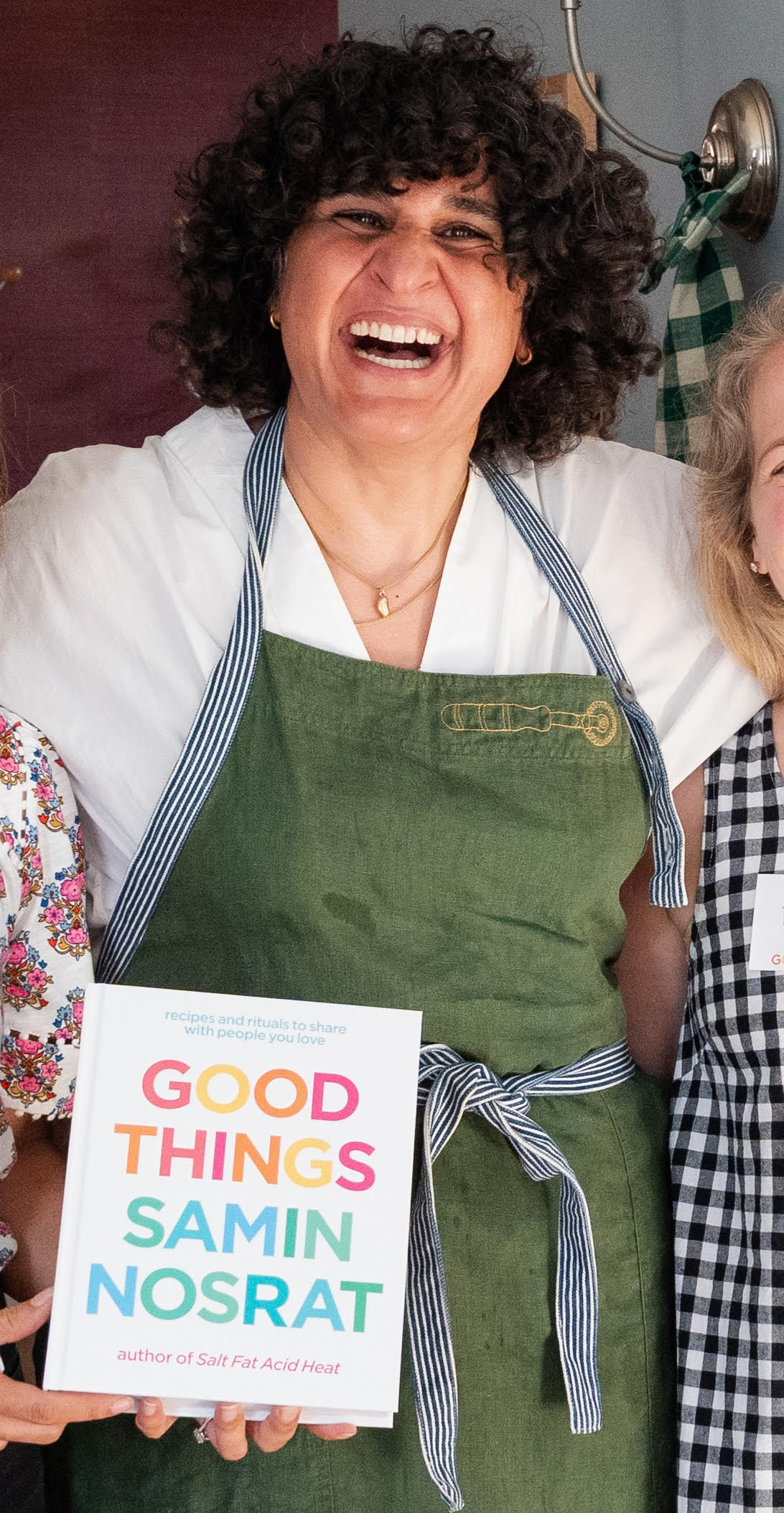
Today on The Stacks, we’re joined by James Beard Award-winning chef, TV host, and author Samin Nosrat to discuss her newest book, Good Things: Recipes and Rituals to Share with People You Love. In this cookbook, Samin shares over 125 of her favorite go-to recipes, including ricotta custard pancakes, saffron-burnished roast chicken, nostalgia-inducing yellow cake with chocolate frosting, and everything in between. We discuss her return to writing after the success of Salt, Fat, Acid, Heat: Mastering the Elements of Good Cooking, how she balances technique with improvisation in the kitchen, and the friction between her identities as a writer and a chef.
The Stacks Book Club pick for December is Friday Night Lights: A Town, a Team, and a Dream by H.G. Bissinger. We will discuss the book on Wednesday, December 31st, with Joel Anderson.
LISTEN NOW
Apple Podcasts | Spotify | Google Podcasts | Overcast | Stitcher | Transcript
Everything we talk about on today’s episode can be found below in the show notes and on Bookshop.org and Amazon.
Good Things: Recipes and Rituals to Share with People You Love: A Cookbook by Samin Nosrat
Salt, Fat, Acid, Heat: Mastering the Elements of Good Cooking by Samin Nosrat
Ep. 86 Salt, Fat, Acid, Heat by Samin Nosrat -- The Stacks Book Club (Hugh Garvey)
Coconut and Sambal by Lara Lee
Critics at Large (The New Yorker)
“Samin Nosrat: Do Dinner Parties Have Healing Powers?” (The Sam Sanders Show, KCRW)
“Ep. 383 Oakland’s Incredible Legacy with Alexis Madrigal” (The Stacks)
The Pacific Circuit by Alexis Madrigal
The Sabbath by Abraham Joshua Heschel
Awe by Dacher Keltner
The Center for the Greater Good (UC Berkeley)
Creole Feast by Nathaniel Burton and Rudy Lombard
To support The Stacks and find out more from this week’s sponsors, click here.
Connect with Samin: Instagram | Website | Substack
Connect with The Stacks: Instagram | Threads | Shop | Patreon | Goodreads | Substack | Youtube | Subscribe
To contribute to The Stacks, join The Stacks Pack, and get exclusive perks, check out our Patreon page. If you prefer to support the show with a one time contribution go to paypal.me/thestackspod.
The Stacks participates in affiliate programs. We receive a small commission when products are purchased through links on this website.
TRANSCRIPT
*Due to the nature of podcast advertising, these timestamps are not 100% accurate and will vary.
Samin Nosrat 0:00
You know, because I had this sort of overwhelming experience of writing salt, fat, acid, heat, making the show, putting them out in the world. It did overwhelm my life, and it uprooted me from whatever I was grounded in. And I kind of got like tumbled, tossed and tumbled like a tumbleweed. And so I, in order to even be able to think about making another book or cooking again, I had to sort of explore and understand the role that cooking could play in in my own life or in a good life.
Traci Thomas 0:33
Welcome to The Stacks, a podcast about books and the people who read them. I'm your host, Traci Thomas, and today we are joined by James Beard-award winning chef, TV host, and author Samin Nosrat to discuss her newest book, Good Things: Recipes and Rituals to Share with People You Love. In this cookbook, Samin shares over 125 of her favorite go-to recipes, including ricotta custard pancakes, saffron burnished roast chicken and a nostalgia inducing yellow cake with chocolate frosting that I am dying to make today. Samin and I talk about what it means to live a good life, and how that principle led her to writing this book. We also talk about holiday season do's and don'ts, and she shares about her struggle to write again after the success of her first cookbook, Salt, Fat, Acid, Heat. Our book club pick for December is Friday Night Lights: A town, a Team and a Dream by HG Bissinger. We will discuss that book on Wednesday, December 31 with Joel Anderson. Everything we talk about on each episode of The Stacks is linked in our show notes. If you like this podcast and you want more bookish content and community, consider joining the stacks pack on Patreon and subscribing to my newsletter, unstacked on sub stack, each place offers different perks like community conversations and virtual book clubs over on Patreon and my writing and hot takes on the latest literary and pop culture news on sub stack, plus on both platforms, you have access to monthly bonus episodes. Your support makes it possible for me to make The Stacks every single week and to make it free for all to join, go to patreon.com/the stacks to join the stacks pack and go to TraciThomas.substack.com, for my newsletter. All right now it is time for my conversation with Samin Nosrat.
Alright, everybody. I am so excited we're at the end of the year, but I couldn't finish 2025 without doing at least one cookbook episode, and I am thrilled to be joined by a legendary food person across all sorts of platforms. Their latest book is called Good Things: Recipes and Rituals to Share with People You Love. I am here today with Samin Nosrat. Welcome to The Stacks
Samin Nosrat 2:51
Nice to meet you. Thank you so much for having me.
Traci Thomas 2:53
I'm so happy to have you, I have to tell you. So I'm sure everyone's like, I love salt, fat, acid, heat, and I do. But that was the very first book club cookbook we ever did on this podcast, back in 2019. Yeah, so you, you started my real love of actually just sitting down and reading a cookbook, cover to cover.
Samin Nosrat 3:12
That's awesome. I'm so happy to hear that because that book I really wanted for people to read. I know that people, I mean, and many have, but yeah, so I'm so happy to hear that.
Traci Thomas 3:24
Yeah, it was such a great experience. So coming back to this book, I was thinking so much about that experience and how many cookbooks I've since read, and how I've changed as I think about because I love to cook. I've always loved to cook, but actually sitting with a cookbook and reading it was so different than how I used to use cookbooks. So I guess the question is, as a person who makes cookbooks, how are you thinking about these two kind of different types of cookbook consumers, if you will?
Samin Nosrat 3:54
I mean, those are just like two of many sort of variables that I'm always thinking of that the audience sort of comes just different in terms of types of audience and so, and I make myself sick, sort of trying to anticipate all of the possibilities and trying to to, like, prepare for them and respond to them in advance. So, yeah, I, you know, I myself, I would say, am a reader first and a cook second. And so I try to make things that are pleasurable to read, but also as a cook and as a cooking teacher, just as like a food person, I feel like my role is to teach and to serve and to be of service. And so I don't want to, it's just a juggle. It's like a juggling act to make sure that I'm balancing both the craft of writing and doing, you know, as well as I can as a writer on the page, and sort of being, you know, what, being funny with my words or whatever, and then also making rest. Recipes. You know, part of actually, I think what makes a recipe not intimidating is a is length. And so sometimes serving myself, or like serving my desires as a writer by saying everything I want to say, or being as funny or wordy actually doesn't serve the recipe or the reader as a cook. You know the cook kind of reader, and so I often have to sort of make a lot of choices about that, but it's funny, because I'm sure we'll talk about this, I'm sure you'll ask me about my sort of hesitancy in relationship to recipes, and I'm pretty open about that. But one thing that I've sort of learned about myself, both in the making of this book, but also in the talking about this book since it came out is that I think, I think of the format of the recipe and the structure and the constraints of a recipe, a lot like the format of a poem and the various sort of shapes and types of poems, and so in, you know, economy of language, or just like, like format and structure on the page the way it looks, all of those things in so many ways, I think, are informed by my own sort of love of writing and poetry and literature.
Traci Thomas 6:10
Yeah, okay, I have so many follow up questions. The first one is, you said a reader first, a cook second, where does writer fall?
Samin Nosrat 6:18
Probably I would. It's complicated. Like, like, I think in my identity, I still walk around being like, I'm a cook. I'm a cook. I look at the world like a cook, because the cook part of me is very much like the efficiency part of me and the, you know, it's the part of me that, like, when I'm on the freeway and people are going slowly, I'm like, What are you doing? Let's get organized here. People like, you know, we're just like, it's like, I want things to be orderly and make sense, yeah. And then the writer part of me is like, the dreamer part of me and the and the very inefficient part of me, and that was really something I had to come to terms with, and was very painful for me during salt, fat, acid heat, because as a cook, you're, you're really trained to search for efficiency and and, like, aim for it in every way and in and especially in the creation of everything, right? Like, let's figure out the sort of component steps of something, and then work backwards, figure out from where our desired result and put the steps in order so that we can get there in the like, tidiest, cleanest, fastest way possible. And maybe there are people who are able to write like that, but I am not. And so I have found that my writing process is, like, very disorganized, very inefficient, very sort of like, you know, the only thing I can control is just keep coming back and day after day. But I cannot control sort of the flow or the order of things, or I can often see in my mind's eye where I want to be, and I'm just often very frustrated about how I get there or don't get there, and so in the beginning, until, you know, at some point it occurred to me, Oh, I am causing myself so much pain by approaching writing as a cook and trying to sort of force this into, yeah, like in streamline it, you know, because there's so much wasted writing, or, quote, unquote wasted yeah writing, there's so much writing that that, like, doesn't ever appear in a book. Or there's so many times I have to write and rewrite something until it becomes the orderly, organized thing that I want it to be or say or feel like what I want it to say or feel. And I've all I had for a long time understood that to be wasted effort and wasted time, and now I just understand like, that's the road. That's the road. The road is really curvy and ugly and scary and so, and there's just two different roads so. But I also love story, and I like look at the world through a narrative lens and through, yeah, like everything I consume, I consume through a narrative lens. And so I probably am 50/50, cook and writer like, but my personality, yeah, I would say my, maybe my, my personality is cook and my like identity is writer, yeah
Traci Thomas 9:11
it's like, it's like, sun sign is cook, what I find really interesting about what you're saying, and it's something I talked About with a friend of this podcast, my friend Greta, is that I love to cook. I relate to a lot of the sort of perfectionist efficiency stuff that I've heard you talk about, but that also definitely comes up in this book. Like, there's early in the book you talk about how writing the recipes was like so much torture for you, and like, making sure everything was perfect. And there's a part where you're talking about flour, and you're like, This is how much this flour weighs. And it's like, I can feel you, I can feel myself in you as like, I need to get this right, because everyone's gonna be mad at me if this exact thing isn't perfect, and this and that, and there's like, this sort of expectation, and I need to deliver this, and I need to do that. And hearing you say that your cook identity is sort of this efficiency thing, which doesn't quite square for me. And I want you to kind of explain it to me with what I think about people who develop and create recipes, which is this really creative sort of, you're kind of futzing around you talk about this. I think it was al pastor that you couldn't quite get right. And you're doing it over and over. And in my mind, I'm thinking of it more in the way that you're describing writing, whereas when I cook, I love a recipe, and I don't think of cooking as being creative to me at all. I think of it as something that I do to sort of relax. It's something that I am creating, but I'm really just following. It's like paint by numbers. I'm just following what you tell me to do, and maybe I'll liven it up. Maybe I won't. After I read, salt, fat, acid, heat, I thought I'm gonna be a person who just emulsified this, like, drop in a little acid. Oh, whoops, put a little more of this. That never happened for me. I still I need a recipe. I love a recipe. So I guess it's sort of this distinction between a person who actually creates food from vibes, like, it sounds like you do a lot, versus like, how I think about it, because I think about it much more like, I guess, like, I'm trying to be efficient, I'm trying to do it right, but you can't be because you're making it up and it is actually truly creative for you, but not the way that you're describing writing. I don't know that's a lot, but do you see what I'm kind of getting at?
Samin Nosrat 11:26
Kind of I get where you're going, you know, I like to use like musical metaphors, I feel like are really helpful here. Okay, okay, so there's different types of cooking that I do. So there's the type of cooking, like when I go to the farmers market and or I pulled all the things out of the garden, and I'm so inspired, and I am going to be in that, like, totally creative, sort of free flowing mode that you're talking about, that I think is what you're imagining. Yes, and I do have that sometimes. I don't have that all the time. And when I'm deciding what to put in a book on the page, or when I'm trying to communicate something about cooking and how to cook and instruct another person, it's not really like that. So that's, I think, where, where the where the difference is. It's like when I'm doing it for my and so one might be described as like, like, when I'm going to the farmers market or the garden, or, like, just letting myself do whatever with whatever I have. You can think of that as like, jazz, right? Whereas the other stuff is like, practicing my chords and teaching somebody like little Mary had Mary had a little lamb got it, or whatever, you know, in music class, and they're related because both right involve technical proficiency. Both involve knowing very basic things, which in music might be notes and chords, right in cooking might be salt, fat, acid, heat might be like foundational sort of tenets of whatever cuisine you're you're working with, or just basic things like how to peel an onion and how to slice it, you know, just like basic skills. And so one is like being in in the creative flow mode, and one is more like, I'm gonna go to I'm going to work now, or I'm going to school now. And I don't really think of like, the professional cooking that I do from like when I'm and I say this as a person who hasn't worked in a restaurant over 10 years or longer, like, but the type of cooking that, if I went somewhere and I was given a dish to execute by a chef and I was told to make 100 or 500 of that thing, I would not be in my creative mode. I would be in my like, orderly efficiency. How much time do I have? How do I do this mode? And so I think that's where it can get a little confusing. And honestly, this is something I think about a lot, because cooking. I when I was a very young cook, I was sort of like a tyrannical figure in in any of my in any friend's home, you know? And so I would take the like energy with which I was being sort of trained at work into people's homes, and I'd be like, What are you doing? Like, you can't do that. That's not how you cook beans. That's how you make cornbread. What do you that's not how you use a cast iron pan. That's not how you hold a knife. You're doing it totally wrong. And someone would be like, Well, my mom, who's from Mexico, taught me to make beans, and this is how she does it. And I'd be like, Oh, well, she's wrong, you know, right, right, right, of course. And I would and and over time, I had to realize, like, Oh, I'm being taught these, like, very specific Western techniques from a very specific, you know, culture or two. And there are actually many, many ways across the world to do these things. So it's not my business to tell people they're doing stuff wrong if they're if their mom taught them how to do it. And And also, there is just, like, a different there's just a different way that you cook for work and you cook for home, like and in a lot of ways, that's a journey I'm still sort of unpacking and discovering. As I move further and further away from restaurants and become more of a home cook for myself,
Traci Thomas 15:06
do you feel like the two kind of different kinds of cook, Like, if you could, could you be totally free form, creative version Cook, Farmers Market version? And then, is there a world where you could be totally regimented version? Or do you feel like the two feed each other and like you need some of that intensity to be able to come back and, like, get loosey goosey?
Samin Nosrat 15:31
Yeah, I think the intensity I just like, let me return to the music metaphor. Like the great jazz musicians, you know, they were trained, yeah, in all of the foundations of music, right? Like, it's not like they couldn't play the standards. Sure, they could play the standards better than anyone. They just wanted to evolve, and they wanted to add their creativity into them. So of course, like understanding and being really good at like, the technical stuff only makes you a better improviser. And honestly, you kind of need to understand how things work together in order to be able to improvise well or to flow freely. But I also to me, if I was just throwing flowing freely all the time, then I'd end up my fridge would be filled with experiments, right? Like, some of which were good and some of which were not, and there wouldn't be that like, pleasure of returning to, I don't know, like, right now it's getting colder. I want to make all the, like, tomato saucey baked pasta things. Yeah, I want to make, like, you know, chicken soup. I want to make the things that I make at this time of year that I return to that are great. So if I was improvising all the time, I'd never get to, sort of like, revisit nostalgia. I'd never get to, you know or learn from somebody like, follow there. I always refer to this one Indonesian cookbook called coconut and sambal, but it was really, in a lot of ways, very transformative for me. The recipes are great. It's a great cookbook, but also it's one of the few times in sort of the last several years anyway, where I've really, like, loved a book enough to cook from the page, like, really off the page over and over, like, complete meals, which I don't typically do that, yeah. And part of why I have done that is because I don't know anything about Indonesian cooking, and I certainly didn't when I opened the book. So I really needed to follow the recipes to get that taste. And then as I followed more and more of them, I started to see patterns. I was like, oh, many of these recipes start with shallot ginger lemongrass. Shallot ginger lemongrass. They kind of all do this. You know, you treat the lemon, you tie a lemongrass in a knot, and you smash it. There's just these sort of like techniques that appear over and over and over again and over time. I'm like, Oh, I understand these are foundational to Indonesian cooking. So and now I guess if I wanted to go on and, you know, make an Indonesian inspired soup, I would sort of know where to start, because I followed that over and over and over again. But if I were only sort of doing my own, like, creativity, loosey goosey stuff, then I would never be doing any of this. So, yeah, yeah,
Traci Thomas 18:08
okay, so I jumped in, and I just now is dawning on me 15 minutes in that I never asked you to tell people what the book is about. So could you do in like 30 seconds or so, just we usually start there. That's the first thing we usually do. And I was like, let's go. I'm so excited.
Samin Nosrat 18:26
So my new book is called good things, and it's a book of the recipes that I cook at home, for myself and for my friends, but sort of, like, underneath that, it's a book exploring for myself and and maybe sort of for you, like, how cooking can be integral to living sort of meaningful and good life, and which was a question I have really been sort of turning over in my head for the last several years, and a big part of that is eating, like, with and for the people you love, yeah, so cooking for them, I would say eating with them
Traci Thomas 19:04
I loved this good life thought exercise I immediately started. So in the book, you talk about how you went through a lot of things, you were in a deep depression. And I think maybe with your therapist, you came up with this idea of, like, what does it mean to live a good life? Or maybe I took it to my therapist. I can't remember, because I know that I took it to my therapist.
Samin Nosrat 19:33
That's awesome, yeah, but I got it from a friend.
Traci Thomas 19:33
You got it from a friend, and it was like, what does it mean to live a good life? And you started sort of thinking about that. And could you talk a little bit about why that was important to you? What that like? How you know, if you're living in service of this idea of a good life. Do you revisit these ideas? How is it practical in your life?
Samin Nosrat 19:44
I feel like it's my responsibility to sort of check in with that, like as a barometer, sort of just to make sure I'm not like, veering off track and over. Even before, I had this language, I always had sort of a way. Of over time, literally, like, gut check, just being like, in my belly. Does this feel, you know, like overall positive or overall negative? Is it something I should be moving toward or away from? But sometimes I didn't do that check until I was, like, knee deep in a project or something. So I'm trying to do it a little bit earlier, so I don't cause myself and other people quite as much pain. But I do think you know, because I had this sort of overwhelming, I mean overwhelming experience of writing salt, fat, acid, heat, making the show, putting them out in the world, having them being responded to in such like positive and just truly, there's not another word, overwhelming ways. It did overwhelm my life, and it uprooted me from whatever I was grounded in, and I kind of got like, tumbled, tossed and tumbled like a tumbleweed, and I went along with this ride that I was on that was really mostly very fun and good, yeah, but it was just very disorienting and confusing. You know, for one thing, like, I put published salt, fat, acid heat when I was 37 and the show came out a year later. And that's like a, you know, by luckily, by that point, like, in a lot of ways, I knew who I was. So I think it's not like becoming sort of well known changed me in that way. But I think what it did for me was when I, like, sort of landed back on planet Earth. I felt really used up and confused. I felt really unsure of what to do next, because my whole life had been in so many ways, oriented toward, like, big achievement of some kind, whatever kind it would be, and here I was with like, the biggest achievement I could have imagined, and it didn't result in anything. You know, there was no like, now you've arrived here is the gold medal that you've always been seeking, and you can be happy and free now, in fact, like I was, in many ways, more lost and more confused and more alone than I had ever been. And so that made no sense to me, because I felt like I had just been doing a good job like a good student, and like putting my head down and working and trying to be good. And if that didn't like yield this sense of fulfillment and happiness, then what would? And I think, because I didn't, Well, I was like, Well, clearly I've been doing this wrong this whole time. So I had to start asking myself, like, what's a good life? Because I thought a good life meant like, work hard, you know, work hard to make the people around you happy and proud. And that didn't work, so I had to start looking for something else, and I did a lot of reading and a lot of sort of seeking in a variety of ways, but as I read and learned more, it seemed like that has been answered over time, often with like with things that religion offers people, but through like ritual and through community, and religion often offers this incredible scaffolding for both ritual and community in in our lives. And I don't practice religion, and I'm not particularly interested in practicing religion, and so I just started wondering, like, how could I create that for myself. And I may not practice religion, but I do think I have a sense of like, what's sacred, and, you know, like what is awe inspiring. And I think that, in a lot of ways, has guided me, and I tried to sort of almost become like a magnet for those things, and simultaneously, I had to reflect on like I'd built this life around food and cooking, and I was losing my appetite, and I, you know, it was the pandemic. I was alone. I wasn't really eating with anyone else, like I didn't really want to cook, and here I was on the hook to write a cookbook that I didn't feel really interested in writing, or like I had anything to say. In some ways, I felt like I'd said everything I have to say about cooking in the first book. And so I, in order to even be able to think about making another book or cooking again, I had to sort of explore and understand the role that cooking could play in in my own life or in a good life.
Traci Thomas 24:20
And once you sort of started to come to that, I have to imagine that, like actually coming back to write this book, there was a lot that would go on for you as a person who found so much success with salt, fat, acid, heat, knowing that there's expectations and there's you know, not just from maybe within, but also from without your publisher, your audience, your fans, there's also sort of this new, like, newer feeling that everyone is a cook online now everyone has a Tiktok and an Instagram and a this and a that. How did you actually, I guess, in a more literal sense, come back to writing the cookbook? Was there a process that you had to do to free yourself up? Were the early recipes? Did they make it in the book? Did you have to kind of scrap it and start over? Or did or once you kind of tapped into that good life feeling and like figuring out what you were working toward and finding that sort of religious element to it? Did it all kind of just fall into place for you?
Samin Nosrat 25:20
Absolutely not. No. I mean, I would say I'm so grateful to have a publisher who never puts pressure on me and never put pressure on me. So almost all of the pressure and standards and expectations came from myself, and I sort of did a like a bamboozled myself, because I was telling myself I wasn't doing that, but I absolutely, but I absolutely was part of it is I am friends with many writers like I just I came up in a writing community. I still have a really strong sort of most of my friends are writers, and so I know all sorts of different writers of all sorts of different things who have had varying levels of sort of commercial success, but some of the people have had a lot of commercial success, and I have watched some people really be destroyed creatively by that. And you know, there's one person I know who wrote a incredibly successful first book that still sells gajillions of copies a year, like, you know, and it's been, I think, 18 or 20 years since her book came out, and she's still working on number two, and it's been really painful to watch, let alone, I'm sure, for her, very painful to do, yeah, and, and so there was sort of this way where I was like, Don't do that, you know. I was like, just make something like, do not, because I could very much see my like, perfectionist, obsessive self never making another thing because it wasn't going to be another salt, fat, acid, heat. But in some ways, I knew I was never going to be able to do that like, you can't just like, recreate that, but I had to figure out what I was going to make. Yeah, and in some ways, yes, I think this like sort of other, let's say, more spiritual thing that I was going through, or just profound, more profound thing that I was going through, absolutely informed the creative process, only in that, like, not in my most sort of, in my head beating myself up on the page moment. But in between, I was able to sort of zoom out far enough to see the pressure and the like obsessiveness and the perfectionism and everything that had created, salt, fat, acid, heat was not unrelated to so much like deep early sort of childhood sadness and pain in a way that I had sort of learned, maybe instinctively, but also from forces outside of me very early in my life, that the way to make the people around me happy was to perform and to achieve really well. And so since I have been doing, trying to undo that in my own self, I was also trying to undo what I was expecting myself to deliver on the page. And so, like, the way I thought about it was, I've only made one thing in life. I'd only made salt, fat, acid, heat, and in so many ways, because I had worked on that for so long. I mean, I had the idea for it when I was 19 or 20, and the book came out when I was 37 so it was in my head, and my whole sort of adult life was on an arc moving toward the making of that book. And so it was in in some ways, even when it wasn't like front and center in my mind, it was a focus of my life, my whole life. It was the thing I was making. And so now that I had only made like one thing, and it was the thing, like, I needed to make something else. And so this time I was like, make, just make a thing. It doesn't need to be like the center of your life, the center. It can just be a document of a time and a place. It can be a piece of yourself that you're sharing. So that was a way that I sort of tried to think about it was like, just make a thing and make it as nice as you can.
Traci Thomas 29:04
Yeah, that's so interesting. It's also like, as a person who obviously reads a lot of books but also likes pop culture in general, I think when there's like public figures or people that you come to through their work, their first thing defines them completely for you, right? So it's like, I have all these expectations about who you are based on salt, fat, acid, heat, but then when you have this second entry into the world, it's like, Oh, there's another plot point
Samin Nosrat 29:29
Yeah, another like facet
Traci Thomas 29:31
Yeah, exactly. And I feel like, kind of like what I'm hearing you say, and also kind of what I felt like the tension in this book is like you were writing towards these other parts of yourself, and I have a much more complex understanding of who you are, not just like as a person, but also as a cook. Like, there's recipes in here that I was like, oh, like putting putting a can of condensed milk in a pressure cooker. Like, that's so not what I would think that Samin would tell me to do based on what I know of her, right? So it's like, you sort of got to reinvent yourself, I think in some interesting ways, or like, yeah, not even reinvent, but just like, show us a different side of yourself that was always there. And, I mean, I even took a note that was like, same. It's like, keeps telling me she's really intense, but she kind of seems chill too.
Samin Nosrat 30:19
I'm kind of both
Traci Thomas 30:20
I love that for me as a reader. And I was like, oh, now I'm like, I can't wait to see what, like, book three turns out to be. Like, what other piece of you shows up, and what other styles of cooking show up, or not cooking, or whatever, yeah, whatever it is, like that there's I am actually more intrigued and, like, drawn to you as a person like, who makes things in the world because of the complexity that this book added to, sort of the understanding that I had from you, from the show and from from the previous book. So, I think that's kind of cool.
Samin Nosrat 30:55
That's cool. Thank you. Yeah. I mean, I do feel like I don't really engage with, like, anything that's written about me or show, no, I just can't. I can't for my own sanity. But there was a podcast like, and it's funny because I listened to this podcast separately, for me, The New Yorker Critics. And then one day, I, like, opened it and in the description was me. And I was like, Okay, I will not be listening to this episode. And then I was like, crap, they're talking about me. And so I asked my girlfriend to listen. She listened, and she was like, Oh, yeah. Honestly, like, it was really interesting. Helen sort of had this point that was that was really thoughtful about, like, with salt, fat, acid, heat, in a lot of ways, you were trying to translate the restaurant cooking, the professional cooking, sort of how we think about it, for people at home. And in a way, the idea was, do this and, like, elevate your own cooking to professional standards, which is not, that's a that's not exactly the summary. It's more like, let me unlock for you, like, what we do in kitchens. But also Yes, like I was saying, I was trying to translate and sort of bring that stuff into the home kitchen. And in the years since, I have sort of gotten further and further away from restaurant kitchens, and so much of my own process at home as a cook is unlearning and untethering myself from those standards, because they make sense in a restaurant. In a restaurant, you're making something you want it to be at the highest level. You're charging top dollar for it. People are coming in there expecting consistency. But also, you have things available to you, like deliveries from farmers markets and farms and fisheries, like at your doorstep. You have a team of dishwashers to wash all your dishes. You have prep cooks and storage. There's all these resources that we have in restaurants that we don't have at home. So it doesn't make sense to hold ourselves to these same standards. And then also, there's just like life, yeah, you know, like food doesn't have to like food, I understand it being the center of one's life when that's their career and they're going to work, but in my life, and in many of I'm guessing my readers, lives, it is just a part of life. You have children, you have other things you have to do, you have people to take care of. You have just there's all sorts of other priorities, and food is sort of integral to that, but not the the only the be all and end all of it. And so then, as for me to then say, well, if you're going to make this recipe, you need to go to these three different like international markets or whatever seems more and more insane, like just more and more unreasonable for the goal that I have for myself or for you, and I think that is my own evolution. You know, I think I didn't, not that. I don't think I've held people to some truly crazy standards. I think I've like undone a lot of the stuff, even by the time I came to the first book. But I think I just keep undoing, and part of the undoing is like being a kinder to myself, and so in some ways, on, like, on the page, with the book, with the message in the recipes, so much of what I'm trying to say to you is the same thing I'm trying to model for myself, which is like, like, it's okay to lower your standards, because I think our standards have been artificially raised for For a lot, like, for reasons that are not healthy, and so it's okay to do less. It's okay, I don't know, to buy pre grated cheese. It's okay to just, like, if you can't make it to the fancy store to buy the fancy ingredient, to use the thing from the corner store. It's okay to even just have dinner and invite people over and order pizza. Like, yeah, I think, like, there's just a different why for me now, and that's what I'm both trying to sort of convince myself of and to convince you of
Traci Thomas 34:52
That's very relatable. Yeah, okay, we're gonna take a quick break and be right back. We're back. Okay, so I want to ask you this. I want you to give me permission for something I know at the top we kind of alluded that we would talk about your relationship to recipes, but I know you've talked about that with a lot of other people, and I have some other questions.
Samin Nosrat 35:15
Oh, we don't have to, you do not have to ask me that.
Traci Thomas 35:18
Great. I mean, say you did a great interview with Sam Sanders. Sam is a friend of this show, so go listen to the conversation on the Sam Sanders Show. If you want more.
Samin Nosrat 35:26
I'll summarize it in like 20 seconds. I have a conflicted relationship to recipes. There we go.
Traci Thomas 35:31
And maybe it will come up, but I want to talk people will be listening to this kind of going into the holiday the end of the holiday season, we're approaching Christmas time, Hanukkah, whatever, your end of your Solstice, whatever. First and foremost, I want to talk about a piece of gossip I heard about you, which is that back in the day, you used to host holidays, and you would make a spreadsheet, and you would assign out dishes, including the recipe.
Samin Nosrat 36:00
Okay, this has gone through a little bit through a game of telephone, because I never really hosted holidays, because I did not grow up like with any of the sort of American holidays. However, in the past year, in like the last several years, when I have had Thanksgivings with friends, there have been spreadsheets, and I actually don't super do okay, well, I think this came from when my I was just on stage saying something about this in like Chicago. I don't know if someone was there, like Chicago. So I was more saying, if you want to be a control freak about it, the very best way I see to do it is to have a spreadsheet and to, like, have, you know, you allow people to sign up, but you've already pre assigned the dish, or pre as and, or pre assigned the recipe for them to follow. And honestly, I think that's freeing for some people, because they don't know what to do. So like, you know, it's interesting, a thing that somebody had said to me in in one of these many interviews that sort of blew my mind, was you're so you're belly aching over all these recipes because, like, you're trying to give people, you know, all of these options and ideas and variations, but like, sometimes people just want you to tell them what to do. And I was like, I was like, what?
Traci Thomas 37:18
That's how I feel about recipes.
Samin Nosrat 37:19
Yeah, on Tuesday night. Like, I don't want to, like, in reinvent the world. I just want to make dinner and get it on the table and get the kids fed
Traci Thomas 37:28
I want it to taste good when I'm done. I'm happy to spend the hour, but I want you to tell me what to do so that at the end of the hour, I'm happy eating the food.
Samin Nosrat 37:32
Totally so I think, like, I think that is, you know, I was, I was being sort of tongue in cheek about it, because I was being silly of, like, I think that night in particular, I was referring a lot to my own inner control freak. Got it, and because there were a lot of questions in the audience about how to make the how do you like, you know, get the best possible holiday meal in the in all these different circumstances, and people are really stressed about it, yes. And I was like, Well, if you don't want, you know, so and so to show up with her grandma Sally's whatever jello, Marshmallow, whatever thing that you don't want at your table, then you have to tell her what to do.
Traci Thomas 38:08
Yes, I personally love this idea. I've never done it. I host almost all the holidays with my sister in law. We're obsessive. We write on our yellow pad. We write a whole schedule. We put in when we're gonna shower, we if we're gonna who's gonna buy? What? What stores Exactly? I'm headed to Costco right after this. Yeah. And then what we do is we say, well, what are things we don't care about? And then we say, great, appetizers! So, like, that's how we do it. And we just say we're gonna cook everything else. We have a whole planning meeting. And then we say, Great, I this year. I'm not there's no dessert I'm dying to make this year. Let's assign that out. Yeah, I think that's great. I feel like if I was assigning out specific recipes, I could do even less and still get what I wanted back in.
Samin Nosrat 38:55
Yeah, I've done this definitely for other like gatherings, and I also think it's a helpful thing for any sort of gathering, like, if you're having, I don't know, like, a monthly book group, or whatever it is that you do, you could, you could even do, you don't have to do it this insane. You could just have, like, I don't know, however many rows available to as many people there are. And then, you know, make sure you have four salads four, you know, mains four desserts or whatever, so that you don't end up with like 20 things of pre bagged lettuce from Costco, or like 14 quiches from Whole Foods or something.
Traci Thomas 39:35
Right. Right, right. Do you have any sneaky good tips for hosts or attendees?
Samin Nosrat 39:43
I mean, I think so much of it, is like, not stressing out. I think so so so much of it is just organizing your time, and, like, working backward from whatever time it is that you want to set the table. I mean, sit down at the table, and then also from whatever time it is that people arrive. I think working in advance and getting stuff done in advance. I do think delegating is important, which is why. But you like, I think you have the right sensibility. If you don't, if you do want to be really controlling about it, delegate the stuff you don't care about. Like, let people bring vanilla ice cream. Let people bring, you know, a loaf of crusty bread. Let people tell them to do you know. You can even be specific and say, like, can you get a loaf of bread from this place? Or can you make a cheese platter? And I really like this cheese on there to be be there, but people only want to make you happy. They only want to do a good job. So yeah, but I think you can absolutely delegate, and that honestly, like the Google Doc, in a way, has, like the Google spreadsheet has been a gift, because, because it is in real time, there's a way where a lot of times I would have just made the whole spreadsheet, made the whole list for myself, and just gone and done it, and because other people are in there, if I pre fill it with, like, I need five heads of radicchio from this store, people are like, I can go do that for you. Yeah. So I think, I think there's a way where if people do want to help, and they do want to make your dreams come true. You just have to let them.
Traci Thomas 41:06
That's true. I feel like, I do feel like people want to do the right thing, so I delegate things I like. Also, like my mom get the flowers. I hate doing flower arrangements. I'm just like, Please, someone else. Okay, let me ask you about, well, for so I had a very exciting experience reading this book. I'm actually from Oakland. Oh, I grew up in Oakland, and I was excited to, you know, hear you talk about some restaurants I know, and all these things. And as I'm reading the book, I'm getting to this scene about fish tacos, and there's a child's birthday, and the child's name's Orion. And I said, My God, I know that child.
Samin Nosrat 41:47
You do?
Traci Thomas 41:48
I said, is that Alexis Madrigals, child? So I immediately take a screenshot, and I send it to Alexis, and I say, Alexis, is this your Orion? And Alexis is like, of course it is. And I said, this is incredible. I'm going to be talking to Samin next week. And Alexis said, Well, you know, Monday dinner is at our house. I said, I haven't gotten to that part of the book yet. And then I was like, Well, I'm coming now, but I know Alexis, because Alexis did this podcast this year for his book Pacific circuit, and I always try to have at least one Oakland person on the show. When I can some years, I get lucky and I can have three or four some years, it's just one. So I guess this year I got at least two, because you're an Oakland Oaklander now. But it was so exciting to me to have this connection that feels so outside of books and a lot of ways. But will you tell us about these Monday dinners.
Samin Nosrat 42:44
Sure, yeah, so I mean actually Sarah and Alexis, this couple who I'm friends with. They're part of this larger sort of writing community that I was referring to, and I've been friends with them through sort of writing and just like, Yeah, we have many, many mutual friends. We've known each other for probably at least 15 years now, I think. And I wouldn't say we were the closest of friends, but we're, like, we're friends, colleagues, yeah, collegial and like, would see, bump into each other and stuff. I'd been to their house. They'd been my house, but we were, they were not, like, in my, like, Favorites list on my phone or something. And they one day after, sort of in the months after vaccines, after the pandemic, Sarah texted to say, like, can I come over? The kids want to come see you and fava, we're nearby at the farmers market. I said, Sure, I'm just here ruining this pork, like, whatever. I'm just knocking my head against the wall. So they came over, and Sarah's like, what's the deal with the pork? And I was like, Oh, I'm just trying to perfect this recipe, and I already know it's not gonna work, and I'm just actually at the beginning, like I was just about to put it in the oven, which meant it still had four hours to cook and then it would come out. And I live by myself. So, like, the dinners, like, you know, every time you're developing a recipe and it's a failure, you know, you don't really want to waste the food, right? So it means you have to eat it. And I live by myself, which meant I would have to eat like, 27 portions, or whatever, of this, of this braised pork every time my own failure, yeah, like, you're just like, oh God. And so I, I sort of just was like, ah. And she was like, well, we'll help you eat it. It just kind of felt like a lifeline being thrown to me because I was not in the, you know, because I was still sort of in pandemic mindset. It was not, really did not occur to me to, like, go to someone's house and have a meal with them, right? And so I was like, really? And she said, Yeah, what about Tuesday? And I was like, okay, so I came over on Tuesday and I brought the pork, and it was perfectly good pork. It just wasn't the thing that I was trying to make, right? So we had a totally nice dinner of, like, tacos, and it was just they have. Two kids, and they sort of live in community with another friend and her kid, and they call themselves like an anti nuclear family. And so it was just like kids running around. We were eating tacos. It was just very comforting and normal and the and the opposite of, sort of the loneliness that had been very, sort of central to my life for several years at that point. And I was like, Oh, can we do this again? They're like, yeah, you want to come back next Tuesday. I was like, okay, so we just kept doing it, and it just sort of kept happening. For the first several weeks. It was tacos, and then we started making other things. And we were, you know, they're good cooks and everyone you know. And I was working on things for the book, so we would just text and cobble it together, and it was always pretty good. And we were probably doing it for close to eight months before I realized that this was a manifestation of this thing that I had wanted to do, which was to create a weekly dinner for myself at home. But in my mind's eye, I had been the host of it. I was going to cook and make everything people would come over. It would be this sort of grand, mini grand thing that would happen once a week at my house. And I had always sort of thought about creating it, and then stopped myself, because, well, if I do it on Sunday, which seems like the natural night to do it, like nobody who has kids is going to get in their car and, like, drive across a bridge or come here. On a Sunday when there's a school night the next it's just, like, too chaotic. But almost all my friends have kids, and if people don't come, like, I knew that having it be consistent and people showing up would be really, really important, and I just kind of could never get it off the ground, even just out of my own head, yeah, and so in this way, this other thing had appeared that was was not. It didn't look like what I had imagined. It wasn't at my house. I didn't do everything by myself. It wasn't necessarily the group of people that I thought would be the core group of people that I would do it with. But it happened like I did this thing, and it shifted something really fundamental for me in my in just in my weeks in my life, but in my weeks like it gave me something to look forward to. I live by myself and and I also love cooking as an expression of like love. And also, there are just things selfishly that I really love making once in a while, but I don't have occasion to do it when it's just for me, right? And so when, now, I kind of had a built in reason to, like, buy the side of salmon, or to make the whatever, and it became this kind of i that slowly I realized it became the sort of language for what it was that I was trying to communicate in this book. And so the Monday dinner really is at the heart of the book, in a way, yeah, in a way, that's the primary way that I share food with other people. And yeah, it's, it's really, it's really wonderful.
Traci Thomas 47:53
I love it so much. So it turns out that that pork was actually maybe the most successful recipe. Okay, this is sort of a lightning round. I want to know what's the one recipe in this book that you hear the most back from people about?
Samin Nosrat 48:09
Oh, I don't know that it's been out enough for me to hear like out long enough for me to get into that type of like feedback. But there's a yellow cake that, like, people are really loving that, I hoped they would.
Traci Thomas 48:23
Yeah, can't wait to get that. What about what's, is there anything that you've been hearing back about the book that's been surprising to you?
Samin Nosrat 48:30
The most surprising thing was this real, like, the like, I will say this is not lightning answer, but a gift of, like, putting out a book, is that for so long, it's been only in your own head, and you've only been having the conversations about what it is and what it means with yourself, and like, what how it will land with people, and then it goes out into the world, and it lands with them, sometimes in the ways you think. And another way is like, leads to conversations and thoughts I never would have had. And so one of them is this idea that, like, everybody doesn't want every possibility. And I thought, I thought I was like, trying to give you the gift of, you know, freedom. And sometimes people don't want freedom, they want constraint. And so that was sort of like a, like a revelation. And so, yeah,
Traci Thomas 49:14
what about what's the one recipe in here that you think everybody should try to cook?
Samin Nosrat 49:18
Ooh, um, oh my god, oh my god, oh my god. The lemon, creamy lemon miso dressing. It's like my favorite of the dressings, and it's sort of revelatory. And it's everybody I know who's tasted it. It's been like life changing to them. People are like, my I put it on everything. Now, my kids eat salad every day. Now, like, that's how I felt about it. I felt like a kid who wanted to eat salad every day.
Traci Thomas 49:40
Okay, I need this because I hate vegetables, so I'm very excited. What about do you have a sneaky favorite for yourself?
Samin Nosrat 49:47
The sort of sneaky thing is that there's this preserved Meyer lemon paste that I worked on in the book and I but what's interesting is, like, the book is really an accurate reflection of, like, what's in my fridge and what I actually cook and eat, and so I have continued sort of using this ingredient in various ways since I turned the book in. And there are so many things that I like have continued to do and make. And I'm like, dang it, like, If only I hadn't turned it in, I could have told them, like I made frozen yogurt with just like agave syrup and yogurt, and preserved Meyer lemon paste and it was so good. Or, like, I made a fizzy soda and it was so good. Or I made, you could actually use the preserved Meyer lemon paste in the lemon miso dressing. If you don't have lemons, and it'll make a really thick, delicious, creamy, yellow dressing. So there are all these things where, like, it just continues, yeah, that's my sneaky favorite.
Traci Thomas 50:38
I made the French onion dip. So good. I took it to Friendsgiving, and people were like, ah. And I was like, Oh, just this cookbook I'm reading. Is there anything that didn't make it in the book that you wish could have or would have?
Samin Nosrat 50:55
Um, there were a lot of things that we cut for a variety of reasons. So sometimes it's the reason is as boring as that food doesn't look good, like, just picture wise, like, photo wise, or picture wise. Sometimes, there's only so many ways that you can take a photo of chicken. Yeah, you know, yeah. And so I'm pretty sure, did I Yeah? There was, like, for a long time, I would say, since that sort of, like coming home time, I really sort of got into making rice porridge, like kanji. And I have a super simple kanji, and I really wanted that was in here, and at some point I had to cut it for space. So that was one I was really sad about. And I have found other ways like to include these things. But, yeah,
Traci Thomas 51:45
okay, I always ask people this about how they write. How do you write? Where are you how often music or No, snacks and beverages set the scene. It's really not glamorous, but no one is glamorous. Everybody does that precursor, they're like, Well, yeah, I what I do is weird.
Samin Nosrat 52:04
It's, I mean, I have an, actually an office in a building that I share with many, many writers. I don't go there as often as I used to. I usually just right now at this desk here in my house. And it's usually like a panic. I've waited too long, and the thing is due soon, if I don't start, you know, and I have to sort of silence everything I put on freedom, you know, that app freedom, that, like, turns everything off on your whole computer and phone. And so that's different than the re- the recipe work happens in the kitchen. And I am, like, meticulous with just documenting everything. So I take photos, but I take just I have a legal pad, so I'm constantly like, writing down what time I started a step, what time I finish a step. I weigh everything.
Traci Thomas 52:50
Are you alone when you're doing this?
Samin Nosrat 52:52
Yeah. And I actually that requires a lot of focus, because if I forget to write down one measurement or one time, then then I have to do the whole thing over again. So I can't have people around. I can't be talking. I sometimes will have music playing in the background when I'm doing that stuff. But and then the other thing I've learned is that that stuff, I wish I had one of the pads right here to show you, but, like, I truly just use yellow legal pads. I can't be precious about them. I have to just because there's like, food and stuff being dripped everywhere, and so they're so messy, and sometimes the notes are so insane and in such crazy shorthand, that if I don't come upstairs and type them immediately, then I've later when I'm trying to decipher it, I have no idea what I was doing. So that I've learned, sort of by trial and error, I have to transcribe pretty immediately onto the computer what it is that I did, and then I print that out, and I go back and I cook from that. So I do that multiple times, and then that goes to another person somewhere else to test, you know, as sort of like a impartial person, to see what she gets. And but all of that like, as much as it takes so much labor and time and cost and grocery shopping, I find that to be less stressful and anxiety making then even, like, when people are like, could you just write one paragraph to introduce this thing and I'm like, What am I gonna say? How do I Yes, you know, so that often is the much harder stuff is anything narrative is just much trickier for me than anything instructional, and that usually I have to go really deep, sort of into my own memory or my sensory memory, and try to find, like a little trigger, something that is the thing that I am drawn to in this food or in this, I don't know, whatever it is I'm trying to talk to you about, and it's not even that that trigger becomes the thing that I end up writing about, but it has to be where I start from, and then, and then it's really messy. There's, there's like, untold number of untitled document, Google Docs saved in my Google Drive. But most of that, yeah, I mostly just work like that, and then sometimes I need to change it up. So I go to, like, someplace. Case that has no Internet, and I write by hand, longhand,
Traci Thomas 55:03
but when you're doing the more narrative writing, not the recipe stuff. Do you have snacks and beverages with you?
Samin Nosrat 55:09
I more use snacks and beverages as like a treat, like getting up and going to make tea. I would say I drink like ungodly amounts of tea, when I mean writing, because there's something about like going to boil the water and brew the tea? Is the like? Is the like? The break, yeah, break, yeah. But yeah, I don't have any, like, standardized snacks, okay, yeah, I wish I did.
Traci Thomas 55:32
People are gonna be disappointed.
Samin Nosrat 55:33
I know it's not that I don't snack. I just don't have, like, part of it is I have no self control, so I don't let myself keep snacks in the house. Because if I just buy snacks, I'll eat the whole bag, and that'll be my breakfast and lunch and dinner one day, and then it'll all be gone. So I have, it's like I'm an ingredients house, not a not a snacks house, by design to keep myself from, like, eating 40 million Cheez Its or whatever.
Traci Thomas 56:03
I get it okay. If people read good things, they love it. What are some other books you might recommend that are sort of in conversation with what you've done here?
Samin Nosrat 56:14
I mean, non food wise, I would say two books that were really sort of just foundational for me. One is called the Sabbath. It's by Abraham Joshua Heschel, who was a rabbi philosopher. He was a contemporary of Martin Luther King's. He was really, like a radical guy. And it's just a little book about sort of the value of keeping in Judaism, specifically the Sabbath. But like for me, I sort of interpret that into our Monday dinner, and what it is that that, like brings to your life and how to do it. And then another book that was really important to me, and I think maybe only shows up, sort of in a really distilled way, is I read, I loved awe, by Dr Keltner. He's a social scientist at UC Berkeley. He runs something called the Center for the greater good. He's basically like a happiness scientist. And he this is, like a really personal sort of look at this concept of awe, which scientists have sort of figured out, that if you can figure out how to experience awe, even just like on a small scale, a little bit on a regular basis, even daily, you will just be a happier person. And awe is this thing, you know, it's this feeling of like being connected to something bigger, basically. And so he has this sort of handful of, like, guaranteed ways that are proven to experience awe, and that felt, in a lot of ways, like what I was looking for in so much of was when I was looking for meaning, when I was looking for a sense of belonging. In a way, like the things that make me feel like I'm okay are when I have that. And for me, it's often through nature, and in very small ways, it's sometimes, sometimes it's like taking a hike and being at the top of a mountain, feeling my relative smallness. But often it's like, oh my God, look at this, like, incredibly beautiful leaf that this plant grew, you know, and how crazy that nature can make this shape. And it happens a lot when I'm cooking, too, where I'm like, I just see the patterns in a like, starting to develop as I slice something, and as they piling up on the counter or whatever. And it's just so, so, so, so beautiful for a moment. And you realize, like, this is something I made, or this is something I'm part of, and that feels really sort of amazing. So those books are the sort of, I think, non food books. And then let me see, like, in terms of food books, Nigel, anything written by Nigel Slater is very, sort of important to me, and he's, like, a huge inspiration to me, sort of on the page. He writes so simply and so beautifully, but also literally. Like I told my publisher, I was like, I want the paper Nigel Slater has in his books. And they got me the same paper like, I was like, I want the Nigel Slater paper, and then I have a little list at the back.
Traci Thomas 58:59
So, yeah, there's a bunch of books. I mean, that was one of the things I noticed as I was reading the book, is how many authors and and, like, creative people that you're in conversation with throughout the book. I mean, there's like, Rebecca Solnit, there's Robin wall kimmerer, ross gay, Audre Lorde. Like, I was just like, okay, Samin, go off.
Samin Nosrat 59:21
It's really funny too, because my editor was like, this was like, after we cut out a lot of quotes, he's like, You got to stop quoting people. And I was like, but people need to know I'm smart.
Traci Thomas 59:30
Yeah, you're smart, but you're a writer. Like, I after, like, the second or third person. I was like, Oh, Samin, like, she's like, a writer, like, she's interested in the craft of writing and, like, the thinking about the words. And I don't know, I guess I could have maybe figured that out on my own, but it was really instructive when, as I was reading the book, I was like, Okay, go. There's, like, so many of them.
Samin Nosrat 59:54
Yeah. I mean, I also think that's the nice thing about cooking too. Is like, or just trying to look at cooking. As a as it fits into a larger life is then it allows connecting to these other people and their ideas, even if they weren't cooks, and even like because it's just about life and so
Traci Thomas 1:00:11
But many writers are. Like Toni Morrison famously was like, could throw down in the kitchen. She was the editor on a cookbook, a Creole cookbook, and she was like, giving notes like, and I think there's a story when she was like, maybe it was Tony Katie bombard, somebody she was editing where she had, or maybe it's Angela Davis. She had her over at her house and would like, make her food as she was working out. Like, there's these stories of Toni Morrison cooking, yeah, Creole feast, yes, yes. It was like a bunch of different Creole shops, and she, and she, like, helped them to to, I guess, something you probably relate to make recipes, because they would be like, a dash of this, and she'd be like, tablespoons, babe, like, we need a teaspoon.
Samin Nosrat 1:01:03
This is so cool. Edited by Toni Morrison, this is so cool. Yeah, I gotta get that.
Traci Thomas 1:01:09
Okay, last question, and then we're out of here. We went over time, but if you could have one person dead or alive read this book, who would you want it to be?
Samin Nosrat 1:01:17
My sister who died when I was at we were both babies. I was I was one and a half. She was three. And I think that loss has been sort of formative, yeah, in my life and my personality and all these things. And so I think a big part of what I've been going through in the last 10 years is unpacking that loss and like developing a relationship with her 40 years belated. And so she's a character in my life now. And so I think in a lot of ways, like I would really like to talk to her, yeah,
Traci Thomas 1:01:49
so beautiful. All right, everybody, you can get Samin's book good things. It's really it is a good thing. It is a good thing. I needed it at this time in my year. I love it. I'm so excited to cook more from it. I am just so grateful you could do this with us. Thank you so much for being here.
Samin Nosrat 1:02:06
Oh, thank you so much for having me.
Traci Thomas 1:02:09
And everyone else we will see you in the stacks. Thank you all so much for listening, and thank you again to Samin for joining the show. I'd also like to say a big thank you to Emily Isayeff and Marnie Folkman for making this episode possible. Our book club pick for December is Friday Night Lights a town, a team and a dream by HG Bissinger. We will be discussing the book on Wednesday, December 31 with Joel Anderson. If you love the stacks and want inside access to it, head to patreon.com/the stacks to join the stacks. Pack and check out my newsletter at Traci thomas.substack.com, make sure you're subscribed to the stacks wherever you listen to your podcasts, and if you're listening through Apple podcasts or Spotify, please leave us a rating and a review for more from the stacks. Follow us on social media at the stacks pod, on Instagram, threads, Tiktok and now YouTube, and you can check out our website at the stacks podcast.com this episode of the stacks was edited by Christian Duenas, with production assistance from Sahara Clement. Our graphic designer is Robin mccreight, and our theme music is from Tagirijus. The stacks is created and produced by me. Traci Thomas.