

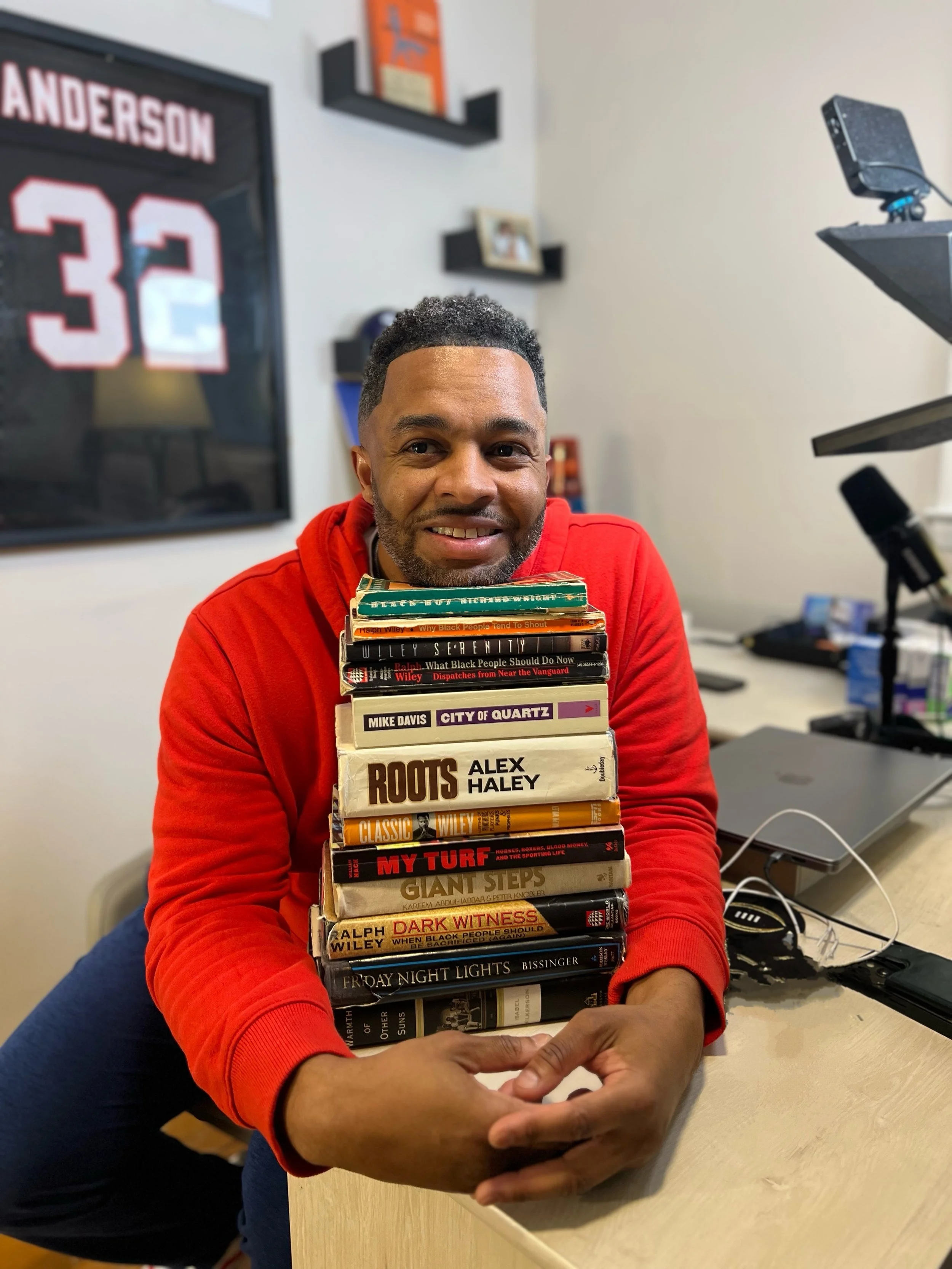
Today on The Stacks, we’re joined by Joel Anderson, senior staff writer at The Ringer and co-host of sports & media podcast The Press Box. We discuss his transition from athlete to sports journalist, how his relationship with his audience has changed alongside public perceptions of the media, whether we’re freaking out enough about the state of media, and why he loves books on place.
The Stacks Book Club pick for December is Friday Night Lights: A Town, a Team, and a Dream by H.G. Bissinger. We will discuss the book on Wednesday, December 31st, with Joel Anderson returning as our guest.
LISTEN NOW
Apple Podcasts | Spotify | Google Podcasts | Overcast | Stitcher | Transcript
Everything we talk about on today’s episode can be found below in the show notes and on Bookshop.org and Amazon.
The Press Box (podcast)
“Ep. 392 The Ebbs and Flows of Friendship with Angela Flournoy” (The Stacks)
New York University (New York, NY)
University of California, Berkeley (Berkeley, CA)
“Malcolm-Jamal Warner and the Other Side of the Climb” (Joel Anderson, The Ringer)
Corpus Christi Caller-Times (Corpus Christi, TX)
The Baltimore Sun (Baltimore, MD)
Slow Burn Season 6 (Slate Podcasts)
Slow Burn Season 3 (Slate Podcasts)
Slow Burn Season 8 (Slate Podcasts)
Slow Burn Season 1 (Slate Podcasts)
Slow Burn Season 2 (Slate Podcasts)
The Dan Le Batard Show with Stugotz (Lebatard and Friends)
Tony Kornheiser Show (This Show Stinks Productions, LLC)
“Rickey Won’t Quit” (30 for 30, ESPN)
Making Obama (Making: Stories Without End Season 2, WBEZ Chicago)
Making Oprah (Making: Stories Without End Season 1, WBEZ Chicago)
Rising for the Ashes by Paula Yoo
“Ep. 318 Compassion, Justice, and Anger Are Not Mutually Exclusive with Paula Yoo” (The Stacks)
Official Negligence: How Rodney King and the Riots Changed Los Angeles and the LAPD by Lou Cannon
The Contested Murder of Latasha Harlins by Brenda E Stevenson
“Honeymoon in L.A. (Part 1)” and “Honeymoon in L.A. (Part 2)” (A Different World, Season 6, NBC)
Charlie Hustle: The Rise and Fall of Pete Rose, and the Last Glory Days of Baseball by Keith O’Brien
The Sixth Man by Andre Iguodala
Misunderstood by Allen Iverson
The Man Nobody Killed: Life, Death, and Art in Michael Stewart's New York by Elon Green
Heartland: A Forgotten Place, an Impossible Dream, and the Miracle of Larry Bird by Keith O’Brien
Namath by Mark Kriegel
Pistol by Mark Kriegel
Baddest Man by Mark Kriegel
Ladies and Gentlemen, the Bronx Is Burning: 1977, Baseball, Politics, and the Battle for the Soul of a City by Jonathan Mahler
The Gods of New York: Egotists, Idealists, Opportunists, and the Birth of the Modern City: 1986-1990 by Jonathan Mahler
The Warmth of Other Suns: The Epic Story of America's Great Migration by Isabel Wilkerson
Black Boy by Richard Wright
Friday Night Lights: A Town, a Team, and a Dream by H.G. Bissinger
Friday Night Lights (NBC)
Friday Night Lights (Peter Berg, 2004)
God Save Texas: A Journey into the Soul of the Lone Star State by Lawrence Wright
Boom Town by Sam Anderson
City of Quartz by Mike Davis
What Black People Should Do Now: Dispatches from Near the Vanguard by Ralph Wiley
The New New Thing by Michael Lewis
Keppler’s Books (Palo Alto, CA)
The Cat in the Hat by Dr. Seuss
One Fish Two Fish Red Fish Blue Fish by Dr. Seuss
Fox in Sox by Dr. Seuss
Caps for Sale by Esphyr Slobodkina
Green Eggs and Ham by Dr. Seuss
Ghetto: The Invention of a Place, the History of an Idea by Mitchell Duneier
Frankenstein by Mary Shelley
Behind the Beautiful Forevers by Katherine Boo
When Crack Was King by Donovan X. Ramsey
Roots: The Saga of an American Family by Alex Haley
Roots (ABC)
Reading Rainbow (PBS)
Sesame Street (PBS)
The Electric Company (Sesame Workshop)
To support The Stacks and find out more from this week’s sponsors, click here.
Connect with Joel: Instagram | Twitter | Bluesky
Connect with The Stacks: Instagram | Threads | Shop | Patreon | Goodreads | Substack | Youtube | Subscribe
To contribute to The Stacks, join The Stacks Pack, and get exclusive perks, check out our Patreon page. If you prefer to support the show with a one time contribution go to paypal.me/thestackspod.
The Stacks participates in affiliate programs. We receive a small commission when products are purchased through links on this website.
TRANSCRIPT
*Due to the nature of podcast advertising, these timestamps are not 100% accurate and will vary.
Joel Anderson 0:00
You know, I've had to start reading books to my kids now, man. And so the Cat in the Hat, it made me laugh. I was like, bro, this dude is ridiculous, man. Like, he's just coming into your house doing all this shit. Just like all these kids are like, man, what is, you know, just like, what gives you the right to come and invade our house and do all this stuff in here? It doesn't make any sense. And I just, the thing about Dr Seuss is like, I wish I had the mind to do the kind of writing that he does. Like, I just as I'm reading Dr Seuss books, like, you know, one red fish, blue fish, One Fish, Two Fish, that kind of, I'm just like, Oh, I wish I had the mind to do that. It's just, it's just amazing stuff.
Traci Thomas 0:38
Welcome to The Stacks, a podcast about books and the people who read them. I'm your host, Traci Thomas, and today we are joined by Joel Anderson, a senior staff writer at the sports and pop culture website The Ringer, and co host of their media podcast The Press Box. Today, Joel and I talk about being a sports journalist, the state of media today and the many non fiction books that shaped his life, Joel will be returning on Wednesday, December 31 for The Stacks Book Club conversation around Friday Night Lights: A Town, a Team, and a Dream by H G Bissinger. Everything we talk about on each episode of the stacks can be found in the link in our show notes. If you like this podcast, if you want more bookish content and community, consider joining the stacks pack on patreon at patreon.com/thestacks and subscribing to my newsletter unstacked at TraciThomas.substack.com each of these places is going to give you some amazing perks, like bonus episodes, community conversations, virtual book club, hot takes on a lot more. And you get to know that by supporting the work that I do on these platforms, you make it possible for me to make this very podcast, the stacks free every single week to join, go to patreon.com/thestacks for the stacks pack and Traci Thomas.substack.com, for my newsletter. All right, now it is time for my conversation with Joel Anderson.
Alright, y'all, I'm so excited. I'm talking to journalist, sports person I don't even know, writer, just like extraordinary person that I've been a fan of on the internet for years that I finally convinced to come on this show the wonderful Joel Anderson, welcome to The Stacks.
Joel Anderson 2:19
Oh, Traci, you're much too kind. Thank you. I feel like this is, like, getting called up or something. You know, I saw Angela Flournoy on here. I was like, oh, okay, you know, I mean, this is, these are the big dogs for real.
Traci Thomas 2:29
So I gotta say, I have been very lucky to have some extremely cool, wonderful, smart, brilliant people on the podcast. And I'm gonna consider you within that fold, because I wouldn't ask you if I thought you were a dumb dumb
Joel Anderson 2:41
Well, I appreciate that. And like attracts like, right? They're not. They not, they not showing up to be talked to, talk to stupidly about things. So thank you.
Traci Thomas 2:51
Okay, so we're gonna start sort of where we always start, which is, like, can you just tell us a little bit about yourself? Like, where are you from? How did you get to be a journalist, maybe a little bit about your relationship to books?
Joel Anderson 3:04
Yeah, sure. So, yeah. Well, again, I'm from Houston, Texas originally, or a little suburb right outside of it called Missouri City, for people that know that area pretty well, and that was an area that I think when my parents moved into that neighborhood, it was like, We were, like, the second black family in there. And then by the time we and then, you know, by the end of the 80s, our whole neighborhood was black, you know, I mean, so there goes the neighborhood, there goes the neighborhood. We helped turn that over. And so, yeah, so I'm from there, and right now, you know, I've been in journalism now almost 25 years. Well, I almost said 20 but it's 25 and the funny thing is, I've always kind of known that this is what I was going to do. Like the long and short of it is that I grew up wanting to be a football player. I was really good at sports through high school, went to college, tried to play football at TCU, and I just realized, oh, man, this is not exactly what I need to be doing or want to be doing. And not long after that, like, I went, you know, I took about a week to grieve
Traci Thomas 4:10
your Heisman. And your superbowl victory
Joel Anderson 4:13
yeah, so I'm not gonna play in the league. I can't believe it, you know? And and then I presented myself over to the campus newspaper, and they were like, Oh, can you cover the football team? Which is not a thing that usually happens at college newspapers, because the football team is probably the most desired beat showing a campus newspaper. But because they thought, you know, oh, I'll be able to have sources or whatever. But that's not, that's not how I went about it, but that's that
Traci Thomas 4:38
Oh, so you didn't go in for the hot Goss angle. You were like, Oh, hey, Bob, so I know you've been like, how's that ankle?
Joel Anderson 4:45
Yeah, no, remember, no. And, you know, because, if anything, it was sort of humiliating to me to like to go back over there. And yeah, because they like, oh, you quit, you know, right. So why are you back over here?
Traci Thomas 4:59
How many years did you play?
Joel Anderson 5:01
Two, and then it was going into the spring of my junior year, and I was just like, we had a coaching change. They wanted me to change positions. I was like, I just don't want to do that. And actually don't want to do this anymore. It just wasn't the same, right? And so, yeah, so that was and so then right after that, I started working at the school newspaper. And, you know, I worked at the school newspaper long enough that my final semester, I was the editor in chief, okay, and, but I mean, again, Traci, I knew that. I knew that even from the time I was like, five years old, I liked writing. I had done stuff like that. I was a prolific reader as a kid. You know, with them Pizza Hut things. I killed that, like I had so many personal pan pizzas so and I read, I read the I read the newspaper every day when I was a kid, like, I would read the sports section and the funnies. Or, I guess they call them the funnies, yeah. So anyway, so all that stuff. So that's, that's kind of how it all came to be for me. And so I, the thing you always say is that if I couldn't play in a Super Bowl, I wanted to cover a Super Bowl, right?
Traci Thomas 6:04
Did you? When did you cover your first Super Bowl?
Joel Anderson 6:06
Well, so that's the funny thing. I hadn't done that either, but I have covered the college.
Traci Thomas 6:11
You never done it. You never covered the Super Bowl.
Joel Anderson 6:13
I've never been to a Super Bowl.
Traci Thomas 6:14
Me neither. That's one of the few sporting events I've never been to
Joel Anderson 6:17
Really? Okay, do you really want to go?
Traci Thomas 6:21
So yes and no, I'm a 49ers fan, and my brother went to two of the last 3 49ers Super Bowls that we lost, obviously. And his sorrow was so upsetting to me from my home that I don't know that I want to feel that publicly, however, I would like to go to a Super Bowl, because I want, like, I've been to the World Series, I've been to NBA Finals, many NBA Finals games, and I've been to the Euro Cup in Germany, like I've done a lot of Sports things, and I feel like I got a notch. That's like, a notch I got to have, you know what I mean?
Joel Anderson 7:04
You got to complete the circle.
Traci Thomas 7:06
Yeah, I got to do it. Like, I want to go to Wimbledon really bad, like there's just a lot
Joel Anderson 7:11
US Open?
Traci Thomas 7:11
I've never done the US Open. Can you believe that I got into tennis right before I left New York? And it just never felt like, oh, I need to go to New York for that. But in 2026 I think I'm going to go to Indian Wells, because it's right here in Palm Springs, and I've never done it. And apparently it's amazing, okay, but I'm, I am always like, oh, tickets to a sporting event. Let's go. Like, this year we're going to go to the World Series, or the world classic of baseball or whatever in Miami. Just to go
Joel Anderson 7:41
yeah, why not? I mean, just because I feel like international competitions are the best, yeah, and I've never, like, just, and that's just from TV, like, I've never, I don't even know, yeah, they look so fun. And the crowds are just really the people that do this stuff. They are so into the sport, right? Yeah? They are really there to get into that and support their team. And like, yeah, it's just such a celebratory atmosphere. I can't see how it wouldn't be great. So, yeah, I have that kind of dream too. Like, I don't, I don't think I would want to do the World Cup here, domestically, yeah? But like, if they ever hold the World Cup somewhere else, cool again, you know, I would like to be in on that, you know,
Traci Thomas 8:15
I want to go to the World Cup here, because it's just going to be here. And, LA, I think is going to be the home base for the US team. I think they have two games here. So I'm like, if I can get a ticket and group play like, I'd love to go. But I after going to the Euro Cup in Germany, and that being like, that was hands down, the best sporting experience of my life. It was the opening game. It was like at the Allianz Stadium in Munich. It was verse Scotland. I became a die hard Scotland fan. Now I watch all their, like, international games. It was unreal. Like, unlike anything I'd ever experienced in my life. Like I was crying. I was so moved by the whole thing.
Joel Anderson 8:52
Oh, wow. I mean, what is it? Just the, I guess the intensity,
Traci Thomas 8:55
The intensity, like the excitement, just the vibes are so good. Like, it's just like, inexplicable good vibes. We don't have that in the States with like sports, because we don't have, we don't do like national sports in the same way, you know, like, there are people who are just like, a fan of LeBron James and, like, no, like, you can't just be a Lakers fan and then just be a heat fan and then be a Cavs fan. Or that's the opposite order. But you know
Joel Anderson 9:29
Okay. Well, hold on, then, Traci, are you a college football fan?
Traci Thomas 9:31
Okay, no, I think college football is the closest thing
Joel Anderson 9:34
you would get that I think if you were into college football
Traci Thomas 9:39
when I went to college, I went to NYU, so not gonna happen, but I had a lot of friends who went and played at Cal. So I was a Cal fan when I was in college, and I, like, went to some bowl games, and that was fun, but Cal wasn't. It was like, when Cal was number one for like, 30 minutes, and then they would lose, you know, like they have, like, the late game.
Joel Anderson 10:01
Was Aaron Rodgers, the quarterback then?
Traci Thomas 10:01
it was in that timeframe. But it would be like, I'd lived in New York, and it would be the late game was about to start, and LSU would have lost, and like, Cal is number one, and then they immediately lose, and then it's like, okay, Cal is 15, but they were better than they are now. What is the best sporting event you've ever covered
Joel Anderson 10:21
Oklahoma vs Georgia in the Rose Bowl in 2018 so Baker Mayfield had won the Heisman and he played against the Georgia team that went on to lose in the final to Alabama.
Traci Thomas 10:33
Oh, was that the was that like the New Year's Eve game that went on forever and ever?
Joel Anderson 10:37
Well, it ended. I don't know if that's the one, but they lost. I'll tell you how they lost. They lost in overtime, yeah, and they lost on a last second, second and 26 completion from tua to Devonte Smith, and I was in, I was in the press box for that game, okay, and so I'm just like, I just remember it just kind of came out of nowhere, because tua had just taken a terrible sack on first down. We were like, oh, hell, they about to lose. And then he just throws it. He hits Devonte Smith in stride running into the end zone. And it was just, it was like we screamed, like it was just so shocking the game, it ended like that. And it was just such a dramatic game. So and Atlanta is my, one of my favorite cities in the country, so it just everything, everything that I wanted was right there. It was a lot of fun. So that probably was my favorite one.
Traci Thomas 11:23
Okay, so basically, the reason you're here is that I just wanted someone to talk sports with, and I never get to do that. Yeah, we have other things to talk about. But I do want to ask you this, when you're covering sports, obviously, sometimes you're covering some, like, real stinkers and boring games or whatever. But when you're covering like, a good game, are you into it, or are you sitting there being, like, I gotta file soon, like, I hope this game ends. It's getting late. Like, what's the actual vibe for you as a professional sports journalist?
Joel Anderson 11:55
If you're at a game and you have to cover it, that's the best way to not enjoy it, yeah, because you're totally for me at least. And part of this is, like, an anxiety thing, like, I've got a deadline, right? And so I'm like, All right, I got to make sure that my story is lined up. I don't want to keep my editor waiting too long as I'm watching the game, I'm not really watching it for the beauty and the contest. I'm looking for story lines, right, right? So I'm like, Alright, should I write about this person? Sorry about this. And so I'm constantly trying to figure out things, instead of actually getting to enjoy the experience. Like, well, I'll enjoy the things around the game, especially if it's a big one. Yeah, I like the experience of walking into the stadium, right? And just feeling the buzz of energy from the fans. You know, you go through the media will call line, and and they're all in the concourse hanging out. But like, once the game starts, it's not a lot of fun for me, to be honest. But I mean, you know, like there is some excitement, there is some thrill in writing on deadlines like that. It just taps into something that I did a lot more earlier in my career, like that was as a rule, kind of the way that I was covering sports, and now I kind of do it, you know, I just come in to do, you know, the fun game or the big game. But even then, it's just not the same as sitting at home and watching it and eating my own food, you know?
Traci Thomas 11:56
Right, right, right. Do you now you get to pick what you write about, or do you still get assigned things?
Joel Anderson 12:42
Yeah, well, you know, it's funny because it's probably 80% me, 20% assignment, it feels tough to say this in a time when so many journalists are struggling and, like, the business is hemorrhaging jobs, you know, all good, good, good journalists, all that stuff. But like, I have a great job, right? And so I really have things where it's like, okay, I want to do this. Like, I'm just, you know, I want to do this. This is something I've been thinking about, and if I can sell it, and for the most part, it's not hard to sell. They want me to write, yeah, then I can do it. And then every now and again, they're like, Hey, do you want to write this? An example, I was kind of prepared for it is when Malcolm Jamal Warner passed, sure, right? And I was like, I actually have something to say about this. I want to write about this. And they, but they, as I was saying that, they were asking me, Hey, can you write up something about that? Yeah, so boom. But yeah, for the most part, I have a lot of latitude. And I, you know, talking with my editors all the time about, like, what I see down the line, what I think I might want to write about, and what would be a good fit. So, yeah,
Traci Thomas 14:20
as you're sort of in the same way that, like, as you're watching a game, if you're covering a game, you're thinking about story. And I always love that, like, when I'm watching sports, and the commentators are like, Oh, this is gonna change the narrative, and I'm sitting there thinking like all the people in the sports in the press box are getting so annoyed that, like, you know, I'm thinking about the World Series, the 18 inning game. I was thinking about all of those journalists, like they're so mad right now. Like when Clayton Kershaw walked out bases loaded, I was like, they're gonna have this great story. He's gonna give up the game. This is his legacy. It's gonna be amazing. And then he gets the out. And I'm like, this is a different story all of a sudden. But in the same way that you feel that, like in moment to moment, are you thinking about the Year in sports or like, are you thinking about, like, bigger picture things? Are you trying to connect bigger picture things to write pieces that maybe say more about what's going on in sports or politics, because you also write about culture and politics and sort of media broadly. So how do you come up with these ideas?
Joel Anderson 15:17
That's a good question. I mean, it really the thing is, is, I'm always just kind of writing a little, I'm doing a little bit of everything in every bucket, if I can help it, right? But the thing is, if I'm going to be covering an event, I'm probably not going to have that much latitude, right? Just because, yeah, unless I've, like, done a lot of prep work, and I could kind of say with within a reasonable amount of certitude, what's going to happen, I kind of just got to write what I see right, or like, whatever is accessible to me. But for the most part, and especially at the ringer, we're like, a day after. so we do the day after story, and so that requires you to sort of think ahead a little bit about what might be interesting. What would people who are not following this so closely that they already know what the score is, right? Like, what would, what would they take away from this? Like, what would be the thing that would really sum up this event in the context of whatever is going on in the sport in the world, regionally, whatever, right? And so that's what I'm always trying to think about. Like, I, you know, early in my life, I'm trying to remember who it was. It was a friend. Maybe it was a girlfriend anyway, but she was like, she didn't she wasn't a sports fan, but she was like, I like the idea that you write about sports in a way that is accessible to me. I'm trying to try to think about, I want to write stories for people that don't necessarily follow sports, like I went to it should be as accessible to you is entertaining to that person, and it is the person that already cares. That's sort of my goal.
Traci Thomas 16:45
Sure, Yeah, okay, I want to ask you so you host a podcast called the press box on the ringer. You co host it, and it's really interesting show, because you guys are talking about sports and politics and pop culture, but you're talking about how it's covered by the media. So like, the sort of entry point into it is, like, two journalists talking about the journalism angle of these stories, more or less, is that how you pitch it?
Joel Anderson 17:11
Yeah, that's about right.
Traci Thomas 17:13
Okay, that's the best I could do. But my question for you, then, as a person who covers the media essentially, what do you make of this moment in the media? Like, what is the fuck is going on? Should we be as worried as I think some of us are, or are we overreacting? Are we under reacting? Like, what? What's your take on media?
Joel Anderson 17:38
Oh, we're under reacting. I feel really scared about the future of the industry and like where it's going to go. I mean, just from the like, the loss of local outlets, for instance. I mean, when I a quarter century ago, when I'm coming out of college, it would be the most likely path that you took to in your careers that you'd start at, like the Corpus Christi caller times, or, you know, the Flagstaff, you know, union or whatever. And you would beat that local newspaper or that local TV or radio station, and then you would go to work your way up. You do regional work, then you may get to the national level or whatever. And like, that whole level of of media is kind of like hemorrhaging and dying off, yeah, and so whenever I even talk to kids, like I talked to, you know, they'll send me to, you know, college classes to talk. And I like, I feel bad because I'm like, what worked for me doesn't necessarily mean that that's going to be the path for you. But yeah, I mean, I think people should be concerned, and I think on both sides, because I think that, like, you know, I would like it if citizens felt invested in the future of their media, right? If they trusted us enough and believed in us enough to want to pay for our work and want us to hold people accountable. But the flip side of that is that media hasn't done a great job of maintaining that trust, re earning that trust. And also, just like, in terms of, like, just bad business practices, like, just given the way the work away early, early on. And like, you people got used to seeing stuff on the internet now you want to charge them, and it's like, well, I'm not going to do that. I've, I've gotten used to get my information for free. So this has been so many things that have gone wrong along the way, and then, sort of the consolidation of media, the radicalization, you know, the politicization of what is objectively supposed to be, you know, objective journalism, or fair journalism, or whatever. Like, you know, the right wing influences that have come in and started buying up these properties. Like, I mean, the, I think the Baltimore Sun is owned, oh, my God, is it owned by one of the guys that owns Sinclair TV groups or something like that? It's something like that. But anyway, but it's just like that kind of stuff doesn't help, because they're not really and I, you know, I don't mean to criticize this person too much, because I don't, I don't know enough to speak about it intelligently. But at a top down level, it's just like most people have not cared enough to maintain these properties and to, you know, reinforce them, give them more resources, give them more people. The only way it seems that most people feel when they take over a newspaper, and I care about newspapers, because that's what I came up in they're like, Oh, we got to cut it. Like we just got to do more with less. And I just don't. I mean, my parents used to be newspaper consumers, and every they would always complain, like, man, the papers are terrible now. They're just so skinny, there's nothing in there. Why would I pay for that? And so it's like it's on both ends. It's like we need the public to care, but also like we need to make the public care, and that's the two things are just not aligning right now.
Traci Thomas 20:41
As a journalist, do you feel like your relationship to your readers or to the audience is has changed because there's less trust of the media in the last 10, 5-10, years? Can you sense that?
Joel Anderson 20:55
Yeah, I mean, it's interesting, because whereas there's two things that have really changed one I've worked it now I've only worked at national outlets, so like, since 2015 I've worked at BuzzFeed. Like, 2015 I'm at BuzzFeed, then I go to ESPN, then I go to Slate, then I come to the ringer. And I think one of the things that has happened is that people, like, get more familiar with writers now, like, they follow, right? How you were talking about, like basketball, how people follow LeBron or whatever, and in no means am I comparing myself to an NBA player
Traci Thomas 21:27
On this podcast, writers are celebrities, so I feel like you are the Lebron of sports journalism.
Joel Anderson 21:36
I appreciate you saying, but I refuse to accept that, but that being said there are people that follow me from place to place. Like, some of that is through social media. Like they, you know, they follow up my tweets, or they'll see my work on Twitter, or blue sky or whatever, and they just started following me and like, every now and again. You know, every few days or weeks, a writer, a reader, will write in and say, Hey, I've been following your work since you were at ESPN. I came across you on Bomani Jones's show, and I'm a, you know, I'm a fan. And I was like, oh, like, that's crazy. And I did not get into journalism to be a person to anybody recognized, right? Like, my hope was that my work would be the bigger thing that, like my byline would just, you know, I didn't. There were a few writers in journalism that I followed, but, like, that's not what I wanted to do. I didn't want people to know who I was. I didn't want people to know anything about my life. But that's just not how it is. Now, like, if you're going to if you're going to succeed at this business, you kind of got to be able to prove to your bosses, your editors, managers, that like people follow you and they follow your work and they care about you when you when you say things, and that's kind of the way that you have to distinguish yourself. Now, it's just, it's not, that's not how I came into this business. That's not what I came in here intending to do. But it's just like, in some ways, where you're sort of required to do if you want to make a career out of this.
Traci Thomas 22:55
Yeah, that makes sense. I mean, I definitely follow writers, yeah, like, like journalists a lot, for sure. I mean, I was going to ask, we're sort of running out of time in this portion of the episode. But one of the things that I love of your work is the slow burn podcast you hosted. I have, in addition to having an obsession with sports, I also have a slight obsession with the LA riots, and you hosted that season, along with the Tupac Biggie season and one other season.
Joel Anderson 23:24
Clarence Thomas.
Traci Thomas 23:25
The Clarence Thomas season, of course. Did they tell you what to do? Do you pitch your ideas? How did that come about? I mean, you obviously got the best seasons.
Joel Anderson 23:39
Well I really appreciate you saying that, those were great seasons. So the way it happened is I was at ESPN, and I just then started getting into podcasts, just listening to them.
Traci Thomas 23:46
Okay? And what year is this?
Joel Anderson 23:48
This is 2019
Traci Thomas 23:50
oh, you're a late, late adopter.
Joel Anderson 23:52
I'm a very late adopter. The only podcast I listened to prior to like 2019 was the Dan levitar Show. It every day.
Traci Thomas 23:59
I listen to the Tony Kornheiser show every day, two hours a day.
Joel Anderson 24:01
Oh, man, what's okay? I started listening to Dan Lemoine 2010, right? And there's like, three hours a day, and that's what, just that doesn't give you time to listen to anything else for the most part.
Traci Thomas 24:14
Yeah, I listened to it. I lived in New York at the time, so I listened to it on my commute, just like everywhere I went. I listened to every day.
Joel Anderson 24:21
New York is so great for that. That was one thing I missed. Is one thing I miss about New York, just being on the train and like being able to catch up on all your podcasts. So yeah, so slate calls me and they're like, Hey, we're doing a season on Tupac and Biggie. Would you be interested in doing it? And this is like, hell, yeah. Like, that sounds amazing. Like, I mean, you know, I wouldn't even thinking that my career was going to go in that direction. Like, I just started listening to podcasts. I listened to, want to the two that really changed things for me. ESPN 30 for 30 did an episode on Ricky Henderson's last year in professional baseball playing. He's 46 years old, playing for a team in San Diego. And then there was becoming Obama that came out of WBEZ, and I listened to those, and I was just captivated. I was like, Oh, what a fun, fascinating way to do this work
Traci Thomas 25:11
That becoming one, did they do up? Did they do becoming Oprah? That's the one I remember. I don't remember becoming Obama. I remember becoming Oprah.
Joel Anderson 25:21
I can't remember which one came first. Oprah might have been the first one. I'm not sure, but it was, I mean, they were both fantastic. And just totally changed the way that I thought about telling stories. And so when they called me about the Biggie and Tupac one, I was like, great. Now I would not have probably chosen Biggie and Tupac off the top. Like, I mean, that is my era of hip hop. I love both of those guys, but I knew going in with the challenges were going to be right, right? Like, so many people have fed at that trough, so many people try to tell that story. People don't want to talk to you. I'm not no Hip Hop journalist. Like, I mean, I love hip hop, and I came up in the culture, but like, that's just not what I, you know, I've done. So the next year 2020 I had, I always wanted to do the LA riots. Traci, let me tell you, I went and saw a documentary, and it ended up winning the Oscar on Latasha Harlan, oh yeah, I saw it. Yeah, yeah. So they, they first previewed it, or they were running it during when pop up magazine was going. And so I saw it at the pop up magazine, and I'm sitting in the audience, like, oh shit, this is great. I want to do something about this. Like, I'm just in there just like, Okay, I got to do it. And so I pitched it to slate. They said no a few times, and then I got a job offer for somebody else. And the way they got me to stay was that they let me do the LA riots.
We love leverage.
Yeah, love leverage and so, then I did it, and it probably is, I would say, in my life, if you asked me, the most important work I've ever done, it probably was that that's the thing that I most wanted to do, the thing I was most interested in. And I got to talk to a bunch of just great, fascinating people, right? And, yeah, like, I also had just wanted to tell the story of Rodney King. Like Rodney King had just sort of been a punchline to me my whole life. Like nobody had ever thought about like him as a human being, as like a person, yeah, and, and so I that was, like, one of my goals for that season was to, like, humanize him and say, Hey, man, no, this guy went through something. I know that, like, you showed up and we made jokes about him getting his ass beat by the cops, but also, like, the struggles he had in the years after, and like, I just wanted to do something different. And so, yeah, man, that's how I got into it. I pitched that one, and then again, I pitched Clarence Thomas, and they said no, and it took a while. It took a while. It took a while for me to get the green light on that. But thankfully, they did, and it worked out, this will be a time I took my horn and ended up winning podcasts of the year, the podcast Academy, the Clarence Thomas one did, yeah,
Traci Thomas 27:50
they're so good. They're all so good. I just as a, I mean, I just have, like, a deep obsession with the LA riots, and so for me, like that was so good, because I also feel like a book came out last year, like a young adult book about, it's called rising from the ashes, and I obviously had that author on the podcast, like the moment it came out. But there is not really, like a comprehensive book for adults on the riots. And I can't believe it, because I'm like, these people are mostly still alive for a little bit longer, like we're gonna start losing more and more of the people who were there, right? Like, Darrell gates is gone. Not that, like we want him, but like he's a key thing.
Joel Anderson 28:33
Like Tom Bradley, you know, I would love to talk to him
Traci Thomas 28:35
Yeah. And so I'm just like, we gotta get this, like, definitive book done, because it just feels like, you know, we're coming up on 40 years, and what 32 32 will be 40 years, yeah, and so I'm just like, we got to do it. We got to do it. I guess, I guess next year is 35 or two years, 35 but anyways, I just, I love that season, and I love, I just, I could, I'd read it. I mean, there's like those little Latasha Harlands book, like, there's books about each of them, but there's not like the book, you know.
Joel Anderson 29:08
So I have, and so there was a book that came out in the 90s, and a guy from The Washington Post wrote it, and it was sort of a comprehensive book, but it was very dense
Traci Thomas 29:19
And it was too soon to the time
Joel Anderson 29:21
It needed some time to cook. There's some time for people to come back to it. And I would, you know, there was a time when people were talking to me about trying to do something with it, and I was just ready, you know, man, I spent a whole year, you do the thing. The crazy thing about those podcasts is that people have told me that the thing that it's most like is, like, writing a book. And so, like, I spent a year on that, and I was ready to, I didn't want to do no more. I was like, I think I've cleared it up here. But yeah, man, to your point, you're absolutely right. Because, for instance, the our season of the podcast starts off with the video. The guy videoing it, George holiday, the guy, He died months after we interviewed him. Yeah, just a few months he was, like, in his 60s, yeah. And so it's like, that kind of stuff happens all the time. So, no, you're right. Like, we it's if it's going to happen, it's going to have to happen here in the next five years, yeah, because that, I mean, just think, think about how old the Watts riots seemed when we were kids, right?
Traci Thomas 30:17
I mean, I didn't even really know about them, they seemed too old, you know? But I'm, I mean, I think we're similarly aged, like, I remember the vibes in the house when the LA riots were happening. Like, I remember, you know, I've got a black dad and a white mom. I remember what, like, I it was tense, is all, you know. And like, I just it was such a formative thing in my life that I just never could let it go. So anytime anyone does something, I'm like, I gotta read it. I gotta watch it. I gotta hear it like, I just love it.
Joel Anderson 30:48
Did you remember the different world episode? I think it was the season premiere.
Traci Thomas 30:53
I didn't watch a different world. How old are you?
Joel Anderson 30:57
Oh Traci, I'm an old man, I'm 47
Traci Thomas 31:00
Okay, well, I'll be 40 next year, so I might, I might have been a little bit too young, I have an older brother, though, so I feel like I got a lot of, like, elder millennial stuff that trickled from him, but I missed a lot of things too.
Joel Anderson 31:16
I don't know how much that would, it would resonate, but as a moment in time. Like, you know, it was like, oh, man, they're talking about the LA riots on a different world. It was just for the people Dwayne and Whitley, they went on a honeymoon in LA, and they're in LA when the riots break out and they get split up from each other. And the funny thing is, is that a couple of the looters that show up in this, in the in this episode are Roseanne Barr and Tom Arnold, and they're like it was supposed to, you know, like, hey, white people out there looting too. That was supposed to be in the story. It's just funny to think that Roseanne was on that side of it at that time. Once more time, things change. Things change.
Traci Thomas 31:54
Okay, we are gonna take a quick break and then we're gonna come back. All right. I did not prepare you for this. This is the one surprise thing that I make all of my guests do. It's called Ask the stacks someone has written in they're looking for a book recommendation. Lucky for you, I do think that this particular recommendation is tailored extremely well. It came in last week and I had just booked you, and I was like, Oh, I gotta give this one to Joel, so okay, this comes from Marley, and Marley says, I got I got my dad. Charlie hustle for Christmas last year. That's the book about Pete Rose and it was a huge hit, so I wanted to turn back to the dad book expert. He is a big Philly sports guy, and love the Pete Rose Deep Dive. He is a self described nerd, and has been a reader throughout my life, but hasn't read a lot in recent years. He can also be quite picky. The book really gripped him, and he finished it in a few days over his winter break, and I felt like I won Christmas. Another non fiction book feels more likely to be a winner than something fiction. In addition to sports, he also loves music and he likes getting down. He likes going down history, rabbit holes dad stuff. He can get through a denser text, but he won't tolerate pretension. A Philly based book would be the cherry on top. Any guidance would be much appreciated. So we need to give the dad at least one book recommendation. If you want to think for a second, I have come up with a few. Okay, but I don't, I don't feel super strong about this, more like, got to be honest.
Joel Anderson 33:22
So how, how tight are they to Philly? Are they pretty?
Traci Thomas 33:24
I mean, I have, I have one sort of Philly recommendation. Okay, okay, I don't. I don't know a ton about Philly. So Well, first and foremost, one of my all time sports book recommendations is the sixth man, which is Andre Iguodala's memoir. I think it's fantastic. And he did play in Philadelphia, so that's a small, small pseudo rec. But there is a new book that I have not read called misunderstood, and it's Allen Iverson's memoir. So if your dad is into basketball, that might also be a Philly moment. The book that I actually think he might like that I just read is called the man nobody killed, and it's about Michael Stewart, who was murdered by the New York City like Transit Police in 1983 I believe it's sort of the first and only definitive book on this murder that ends up becoming sort of this precursor to a lot of Police murders, and I think for a lot of people, they've maybe seen Michael Stewart's name in the last five years on signs or whatever, but I don't think he's gotten quite like the due diligence of other people. And so this book, I thought, was really good, and if your dad sort of likes history, and it's told sort of in a similar way to the Charlie hustle story. And then the other one is, it's not out. It's not out till March. So this might be a pre order for your dad's birthday, but it's called heartland, and it's by Keith O'Brien, who wrote the Charlie hustle book, and it's about Larry Bird. So it's a similar framing sports story, but it's about Larry Bird, and I think similarly. I don't think he's really gotten a book treatment yet.
Joel Anderson 35:03
Man, that's a good point. I'm trying to think if I've ever heard or read of a Larry Bird book
Traci Thomas 35:09
There's books about like him and magic, or like the Celtics and the Lakers, but not like Larry Bird
Joel Anderson 35:16
I know I read a Larry Bird book as a kid, and I can't remember if it was an autobiography. Okay? My mom got me a bunch of sports autobiography interested. And so I know I read something about Larry Bird, but, yeah, but that that that sounds like the exact right place they need to go.
Traci Thomas 35:31
Yeah, okay. Do you have anything that you can think of?
Joel Anderson 35:34
Yeah absolutely. So I'm actually going to recommend two books from the same author, Mark Kriegel, okay? And a quick they said, Charlie hustle. So then all of a sudden, I started to, like, build the image of the kind of person this is. so I may not be fair.
Traci Thomas 35:53
I love it. I love it,
Joel Anderson 35:54
all right. I assume this is a as a middle aged, white guy, maybe older, you know, remembers a certain time in sports, and the connection to sort of like, you know, Vietnam era, guys things like that, before sport, when sports was still a big deal, but not the billion dollar enterprise, yeah. So Mark Kriegel is the writer, and there's biographies about Joe Namath called name it. Oh, yeah, yeah. And the other one is Pistol Pete, and it's about Pistol Pete Maravich, okay. And I mean, in a lot of ways, what you're reading when you read those two books, is about, like the founding days of the NFL for Joe Namath, and the founding days of the NBA with Pete Maravich, and how, like, these white superstars helped to grow the game in the country, and like, they were the face of the sport for a very long time. And it's just like, Mark Kriegel does a fantastic job with this stuff. He just actually did a biography on Mike Tyson.
Traci Thomas 36:52
Oh yeah, I saw Did you read it? It was good.
Joel Anderson 36:55
I have it. I started it, but I'm way behind
Traci Thomas 36:59
Don't worry. No, there's no shame here.
Joel Anderson 37:01
Okay, yeah, I have a lot of book shame. So I was looking at my stats there. But anyway, those two books, I mean, I always go back to them, because I just learned so much. Like, if you don't, if you've never really studied or read up on the origins of the NBA, or even just Pete Maravich, and like, what he went through, I did not know that his father was, like, a great college basketball coach, and that he had played for his father at LSU and all this stuff, and he had to bounce around the ABA and the NBA, just, it's just fantastic. And the same thing with Joe Namath, which is he's kind of become a punchline as I've gotten older, because, you know, he had the very public, like, misstep with alcohol, yeah, I don't know if you remember, yeah. And then he also, you know, just, I mean, I don't know, people throw up his stats from 1973 and like, Joe Namath sucked, yeah, but that's not, that's not, that is not the story of Joe Namath. Like, really got to read up on him. So anyway, those two books, I think you'll be, your father will be very, very happy.
Traci Thomas 37:57
Those are great recommendations. I just thought of another book that I'm just gonna throw out, which is, ladies and gentlemen, the Bronx is burning, which is about the Yankees and New York City in the 70s. I just, I've never read it, but I just read that guy's new book, which is called the kings of New York, no, the gods of New York. And it's about the 1980s in New York. And it's so good, it's probably, it's not the best book I've read this year, but I think it's one of my favorite books I've read this year. And so I want to go back and read, ladies and gentlemen, the Bronx is burning, but it sounds like your dad would probably like, it's 1970s baseball, which is in that same era
Joel Anderson 38:32
oh yeah. You're trying to I just get when you said Charlie hustle, I just got, like, an image of, like, an old, yeah, shitty public stadium. A concrete bowl with, you know, yes, stacks, smoke stacks all around them. So yeah.
Traci Thomas 38:49
Marley, if you get any of these, if your dad reads them, please report back to us and folks who want recommendations right on the air. You can email ask the stacks at the stacks podcast.com. Okay. Joel, you are now officially in the hot seat. Two books you love, one book you hate.
Joel Anderson 39:03
Oh my god, two books I love. One book I hate The Warmth of Other Suns.
Traci Thomas 39:08
All timer.
Joel Anderson 39:09
Favorite book. I'm not going to pick the one that we're going to talk about. So black boy. Richard Wright,
Traci Thomas 39:19
okay, we and the one that we're going to talk about. So people know, in case you missed the announcement, is that we're talking about Friday Night Lights, which I have never read, and is one of your all timers.
Joel Anderson 39:28
It's top three. Those are, those are my three of my top five.
Traci Thomas 39:32
And without giving anything away, not without saying too much, because we're gonna spend a whole hour on Friday nights, can you just say why you wanted to pick it like, What? What? What What is it about that book that may think makes you think that people should read it and would like it, or,
Joel Anderson 39:45
well, first of all, I think that because, okay, and I should say this, off top, never seen the TV show. I saw the movie, and I did not like it.
Traci Thomas 39:54
I didn't see the movie. I love the TV show, and I just started the book last week. So I'm very excited.
Joel Anderson 40:00
Okay, yeah. So the if you read the book, it has nothing to do with any of those things, right? Like, the movie is sort of close to what you get in the book, in the book, but it's a totally different thing, because it's not just really about football. It's sort of about, like, Reagan's America and the oil bust in Texas, like, so it's a part of the country that is sort of having to redefine itself a bit like all this economic and cultural and social turmoil, and the one thing that they've got in Odessa Texas is football, right? And it's high school football, and you just think about, like, how much anyway, I don't want to go too far, because I was starting to wind up
Traci Thomas 40:37
Don't go too far, I just wanted you to tell people why? Because I just, I'm, I'm super excited as a sports person. But what I can say so far, what I'm, I'm on chapter two, is that even if you don't give a flying fuck about sports or high school football, this is this. I can see how this book has been so formative for so many of the journalists that I love, because it came out in like, 1988 it's covering 1988 football season. And just like the way that sort of investigative journalism where you're tying culture and sports and it's like, Oh, I see what's happened here, this book is like a text that other texts are born out of. Okay, what's your book you hate?
Joel Anderson 41:20
I It's tough because, you know, I'm not a person that can really stick through a book that I don't like. But I did have to read Darryl Gates's memoir, Chief
Traci Thomas 41:31
And you hated it.
Joel Anderson 41:33
I had to read it for slow burn to get familiar. And I was like, Okay, this is what it would be like to read like a rush limbaugh text. Sure, you know what I mean, Bill O'Reilly or something like that. Okay? He's like, the, you can see he's sort of like the forefather that to their style, right?
Traci Thomas 41:48
He was them. He was like, yeah, their God. What kind of reader Are you?
Joel Anderson 41:54
Um, I'm always reading something. Okay, so I need, I do need to give myself credit for that. But the reason I'm reading is usually before work. All right, I don't want to give it away right now, but I'm working on something that is going to come out probably in a few weeks, unfortunately. And I'm reading a biography on this person right now, right? And so that's usually how I come across a book. And I'll just get what is the best book on this person, on this city, on this thing, and I would dig in and so, like, that's usually what I have going when I'm reading. I very rarely get to read for pleasure anymore.
Traci Thomas 42:28
But if you do, what would you read?
Joel Anderson 42:31
Oh, if I got to read
Traci Thomas 42:32
for pleasure, yeah. Like, if you if it's like, Joel's going on vacation, what I want to read most in the world is this kind of book, this book.
Joel Anderson 42:41
People tell me that reading books about like places. So hear about this one. There's one, God save Texas, by Lawrence Wright, for instance. Oh, yeah, right, Texas Monthly. Like, I've not read that book. I've had that book, I've moved it from place to place, and eventually I'm going to read it. But yeah, like, I love to read and learn about why places become the places that they are another like boom like, boom town. I don't know if people have read that, like, reading that kind of stuff is just totally, you know, opens my whole mind up, because I just, I tell this to people. I did not go on vacations as a kid. My parents didn't take us nowhere. So when we left out of town, we just went to visit family in Arkansas. So I have, like, an insane curiosity about every part of this country, and so, like, besides Arkansas, and I still haven't read the great book on Arkansas yet, so I'm on the market for that, but, but so that's so that's kind of like what I would like to read about places if I could.
Traci Thomas 43:35
I love that. What is the last really great book you've read?
Joel Anderson 43:40
Oh, man, it's a good question. Um, oh, city of quartz by Mike Davis.
Traci Thomas 43:46
Oh, okay, is that the city book you were saying before that you couldn't think of or different one.
Joel Anderson 43:50
It was a different one, okay, but this one helped me with slow burn the LA season. And I finally got around to finishing it up, like I just kind of skimmed it. And I was like, I want to finish Mike Davis died. I think you Yeah, a couple, a couple years ago, and I was like, I owe it to him to finish this book, because he's so it just, it's just every that book is everything
Traci Thomas 44:12
I need to read it. I I, for some reason, I just am not. I've never been that curious about LA as a city, but I know that I would, once I open that door, maybe that I'm gonna put that on my top of my list for next year to make sure I get to it
Joel Anderson 44:28
I mean, yeah. I mean, it's just I find because, maybe because I'm not from there or whatever, yeah, I find LA to be just the most fascinating place in the world.
Traci Thomas 44:37
I feel that way about New York. Like I'll read any book about, like, recent New York history. Anything about New York from like 1960 forward I'm obsessed with
oh man, I have to tell you about my idea for a book one day
okay, we can do it off air. Okay, what's like a book? What's your go to recommendation?
Joel Anderson 44:55
Friday Night Lights. Obviously, I recommend. It's Ralph Wiley. What should Black what black people should do now dispatch this from the event. So Ralph Wiley is the most influential writer in my life. Like he's the reason why I want to do what I want to do. And so if I ever get to that point with that person, I'm just like, read this. Like, this is just, you know, it's basically a collection of essays. And I just, I have not met anybody that thinks like that or right like that anymore in life. And so that is one of the books. Another one is called the new new thing, by Michael Lewis and Mike, oh yeah. And it's actually about, sort of the foundation of Silicon Valley, and, like, the people that were that founded it and built that industry up in the bay. And, yeah, I mean, I just I learned so much, like, that's not, I'm not really of that world. And when I moved there, I was like, I want to get my hands around, like, how all this happened. And I think it's just good for understanding, like, how the economy has been shaped and the people that shaped it. So, yeah, probably those two.
Traci Thomas 45:57
Do you have any like? Or, how do you like to read, snacks and beverages. What's the temperature? Where are you? What's like your ideal reading situation?
Joel Anderson 46:05
So let me explain that I cannot do it now because I have a three year old and a one year old, and so what I'm usually doing is I'm listening to an audio book in bed, or I'm reading my Kindle in the dark, you know, as my kids are sleeping, right? Yeah. But the way that I used to like to do it is that, yeah, it's kind of that, like I would just get in bed, you know, maybe a little early, or on the weekend, and, yeah, maybe I have a little snack, or, you know, something.
Traci Thomas 46:33
What kind of snack?
Joel Anderson 46:34
Oh, man, well, apple chips. I love apple chips. Oh, is that bad?
Traci Thomas 46:41
Healthy snack? I know a lot of people like healthy snacks, and I just have to get over that. I'm the only person who still eats like your three year old.
Joel Anderson 46:50
Oh, no, trust me, I eat terrible, you know, saying, like I'm, you know, I'm hiding snacks in this office right now, you know, I mean, it's legal now I like, a little gummy, you know, saying, Get myself feeling right, you know, something to drink. And, yeah, man. And I'll just sit down in a nice on a nice, comfy couch and curl up next to the light with the, you know, maybe it's a little cloudy outside or whatever. And, like, that is my, that's my vibe. Like, that's, that's that, if I could get back to that at any point in my life, I'll look forward to that.
Traci Thomas 47:23
I love that. Do you have a favorite bookstore?
Joel Anderson 47:27
Man, so my favorite bookstores don't exist anymore. Yeah, they closed. You know, I've moved so it's things change. But when I was in Palo Alto, Kepler's, which is down the street from Stanford,
Traci Thomas 47:39
Kepler's isn't closed, though, is it?
Joel Anderson 47:41
No, Kepler's is open. Oh yeah, Kepler's is still there. But my two favorite bookstores were in Houston, and people from Houston at least will know this, that used to be the book stop, and it was in a book stop on shepherd in the Montrose area. And it used to be like an old movie theater, and so like, you would descend down and walked down, and there were books on on either side, and I just, I love it. And then there was a Half Price Books near Rice University in rice village, and it shut down, and I'm so hurt by it, but I would always just go through there and just take my time like I used to. I used to have my buddy, man, and I'm gonna shout out my boy ed, and he's the only person in the world I would do this with. We went on book dates. Man, like, we would just be like, yo, let's just go to the bookstore, and we'd be there for two hours and just kind of post up, get a couple books, figure out which ones we're gonna buy and whatever. And so we would go to those two in particular and just make our time. So I miss that.
Traci Thomas 48:35
So good. Yeah, sounds so good. Okay, what's the last book that made you laugh?
Joel Anderson 48:40
Oh, man. The last book that made me laugh. Oh, you know what? You know, I've had to start reading books to my kids now, man. And so the Cat in the Hat, it made me laugh. I was like, bro, this dude is ridiculous, man. Like, he's just coming into your house doing all this shit. It's like all these kids are like, man, what is you know, just like, why? What gives you the right to come and invade our house and do all this stuff in here? It doesn't make any sense. And I just the thing about Dr Seuss is like, I wish I had the mind to do the kind of writing that he does. Like, I just as I'm reading Dr Seuss books, like, you know, one red fish, blue fish, One Fish, Two Fish, that kind of, I'm just like, Oh, I wish I had the mind to do that.
Traci Thomas 49:30
It's just like, all the made up words and stuff. Have you read Fox socks and fox, fox and socks? Oh, my God. Oh, that one is like, that is I have them. I experience extreme joy when I read that book to my kids, because it's so hard. It's like, such a tongue twister. It's like, No sir, you sir Mr. Fox
Joel Anderson 49:50
He says, like, don't be dumb, sir.
Traci Thomas 49:54
I can't do this jibber jabber.
Joel Anderson 49:58
I was like, Man, I just so. So that's off. And there's another book that I read to my kids called caps for sale. It's, it's apparently an old school book, but it's about a peddler, a hat peddler, and he goes for a walk one day and gets tired, sits down and monkeys take all the caps off of his head. And so it's just, I was just like, oh, man, I just love the way I've kind of re fallen in love with kids books. Like, one of the good things about having kids, I was like, Oh, this is, like, it doesn't have to be a joke. Like, these are books that are, like, really thoughtful, really smart, really creative, and it's just kind of, it just taps into something else in your mind that, like, it was like, Oh, I could use that as an adult, like, I'm happy for that. So yeah
Traci Thomas 50:41
Some of them are really good. Some of them hit home. Sometimes I'll be reading them, and I'll be like, Whoa, okay, message.
Joel Anderson 50:47
Oh, I mean, Green Eggs and Ham. I'm just like, there's a real message in there. And I try to remind my kid. I was like, you say you don't like this. You don't know. Try it. You don't know. And you'll see, try it.
Traci Thomas 50:59
And you may see that one's also written. It's not iambic pentameter, but it's like iambic octameter. It's like, perfect I am, but I taught a Shakespeare class this year, and I use that because it's like, basically Shakespeare. It's like, perfect analysis. Anyways, I love green eggs and ham. Okay, what about the last book that made you cry?
Joel Anderson 51:21
Oh, um, what Warmth of Other suns? Yeah, I got to the end. And, I mean, that might be, yeah, I mean, I just, I bawled. I was just like, man, like, I just the idea that these people went through that. And I think it was the woman in Chicago. I can't remember her name off the top of my head. It ends with her. And like, she's in her 90s, and she's living in Chicago, and she got a chance to go back to Mississippi briefly too. And I just, yeah, my heart just went out to them. I was just like, Man, those people, this country owes those people so much more than they ever got from it, yeah, um, but yeah. Like, at the end of it. And it could also, like it reflected my parents' story, and I just, it just really touched me. And so, yeah, like I cried at the end of that book, for sure.
Traci Thomas 52:10
I call that book a book of my life. It's like, one of the most important books to me that I've ever read, really, okay, yeah, my dad basically took the exact same journey as the doctor, oh man who goes from like Louisiana through, yeah, through Texas, and then he goes up to the bay and then comes back down to LA, yeah, my dad went from Louisiana to LA, I mean, to Oakland or the Bay Area. But it's like, there's so many pieces of that life that like match around the same time.
Joel Anderson 52:39
Where's your father from Louisiana?
Traci Thomas 52:40
Baton Rouge
Joel Anderson 52:40
Okay, all right. My mom is from West Monroe, and so she's actually, I think the doctor is from Monroe. I think so too. Yeah, right. So like that, you know, I'm locked in now
Traci Thomas 52:50
You're like, Oh, hello, yeah. I was definitely like, wait a second, yeah.
Joel Anderson 52:54
And then it just makes it. I was like, Oh, I've got family in California, in Oakland, in LA, yeah, that you barely, like, you don't know, right? At least for me, so anyway, I was like, Okay, it's all coming together. So yeah, to your point. I, I mean, I wish I could hug Isabel Wilkerson, man, that book was so emotional to me.
Traci Thomas 53:12
That book is so good. Is there a book that you feel proud to have read?
Joel Anderson 53:17
you know what? So there is a book that I read called ghetto, and it's about the history of the word, and, like, sort of the etymology of it. And, you know, from, you know, ancient times to, like, how Jewish folk were cordoned off into these areas, they're called ghetto. And I just thought I wanted to write something about it, and I didn't quite know what, but, like, I just thought it was important. It was just something that was sort of way out of my I guess the only reason I bought that book is because it said ghetto, sure, and it just caught my eye. Yeah, you know. So that's how I buy books. Often I'm like, what's that about? What is this?
Traci Thomas 53:52
What is this? Yeah, I feel like you and I have very similar reading tastes, really, as you're talking about. Because I love non fiction. I love, like, books that do, like, deep dives into places or people, and it's like, it's about one thing, but it's really about the bigger context of the thing. So I just feel like we have, I'm, like, taking a lot of notes.
Joel Anderson 54:11
Oh, well, you know what, yeah, because you know what. And I don't know if you're like, this, well, first of all, I wasn't a good student. Like, I was just kind of
Traci Thomas 54:17
I was a good student.
Joel Anderson 54:18
Okay, I wasn't bad. I had a 2.7
Traci Thomas 54:22
You were a football player, you could have just
Joel Anderson 54:24
Yeah, that's not an excuse
Traci Thomas 54:26
Yeah but that's why you didn't have to be a good student. You probably could have been a good student, but you didn't have to be because you were a football player.
Joel Anderson 54:31
You know what else? I was at eight. I also had ADHD, and I didn't know that until, like, very recently, and I was like, oh, that's why I didn't study. Like, no wonder that was so difficult. But because of that, because of, like, my my study habits, or whatever, I feel like I need to catch up on everything, like I want to learn everything I want to know about, everything that I can and so like i don't i. People have told me, even Kisa has told me you should read fiction. You know, like it, you know which it, you know it would just open my mind up. And I know that it would, but I felt like I don't have time, because I got to read all this other stuff that I don't know about. And so, like, that's, that's how I'm sorted. My book choices are governed.
Traci Thomas 55:12
I read more fiction than I would like because of this podcast, more up to me. Like, before I started the show, yeah, I started tracking my reading when I got back into reading in 2016 and I was reading I was reading 80% nonfiction and 20% fiction. Now it's more like 65% nonfiction, okay, but if it were up to me, I would read investigative journalism all day, every day, for the rest of my life, just like a journalist doing doing their thing
Joel Anderson 55:38
So you don't feel the fiction doing anything to yourself then, huh?
Traci Thomas 55:41
No. I mean, there are some amazing novels, like, I just read Frankenstein for the first time, and it is un fucking real. It is so good. And I was like, this book is amazing, okay? But I don't know that. I mean, I'm glad I read that, and that probably would be part of the 20% of fiction that I would like to read. But a lot of fiction I don't like, I just It doesn't do for me. What nonfiction does. It doesn't like make me feel and a lot of people say the opposite. A lot of people think nonfiction is so boring and blah, blah, blah. So I get it. I just if I didn't have, like, a podcast to program for my reading would probably look even more nonfiction, and I'd have more time, like a book that I've been wanting to read for years that I own that's right behind me on the bookshelf. Is that behind the Beautiful Forevers by Catherine boo, which I know you love, right? She's like, one of your favorite people, but like, I just have never gotten to it. And like, that's a book that if I didn't do this show, I probably would be reading tonight, you know? So I obviously love the show. Grateful thanks for listening. But if I were left to my own devices, it would, I would read even more nonfiction and even more like of the same kind of nonfiction. The hard part is that, and maybe you can change this, there's not enough black writers writing those kinds of books. There's not enough black writers writing Friday night lights style, deep embed books, you know, like when crack was King. I don't know if you got to read that, but that was amazing. And was sort of like one of the closest books to do that in a long time. A lot of black writers books end up being like memoir, which I like memoir, fine, but I'm just like, what about all these amazing Black Journalists who could be doing John Krakaeur, or Patrick Radden Keefe or whatever, like my faves
Joel Anderson 57:29
well, because that's really the opportunities that are given to us as a writer, right? Like, I know that, like, they want you to write about, they want you to emote about racism, right for the audiences. And I'm just kind of like, all right, I'm not that. I'm beyond that at all. I can do that, but I want to do that on all time. Like, also, like, part of this is, I'm mission minded about my work, man, you know, and there's only, there's things that I think need our perspective, need us to I need our side of to tell that tale. And so, yeah, so to your point, like, that's exactly like, where I go about doing what I do. And I hope I can do that with a book someday.
Traci Thomas 58:02
We'll see. I hope so too. I'll read it, I promise.
Joel Anderson 58:06
I'm gonna talk to you about the other one. We'll see.
Traci Thomas 58:09
Yeah, I can't wait. Let me just ask you, like, two more. One is, if you were a high school teacher, what is a book that you would assign to your students?
Joel Anderson 58:20
I mean, they would never allow me to do it now because of the climate of this country, roots. I read roots when I was in high school. Man and I was one of the more formative books I've ever read in my life.
Traci Thomas 58:32
I never read roots. I saw the movie,
Joel Anderson 58:34
of course, yeah, times, yeah, yeah. Younger like it was on TV. Yeah, yeah, no, the book is fascinating. Like, I mean, if I know that people have, like, kind of like, you know, there's sort of the history of Alex Haley and some of the stuff behind the book. Like, you know, there's some questions around it, right, okay, but if you read the book in and of itself, like it is just a fantastic storytelling the characters in the book, I mean, I just, and I think it does a really good job of like laying bare, not only the horror of slavery, but like, the humanity of the enslaved, right? Like you get to see them as something other than, like, figures getting beaten to death or whatever, right? And so maybe that, but, yeah, I don't know. Maybe Black boy. I mean, black boy is just, like, just king for me, man like that. Yeah, that book changed my life.
Traci Thomas 59:32
I love that you'll appreciate this. When I was pregnant with my twins, I was at a book event, and I got to meet LeVar Burton and everybody there. Was like, Oh, my God, Reading Rainbow. And I was not a Reading Rainbow kid, but he came up to me and he was like, Oh, are you pregnant? And I was like, yeah. I mean, I was, I was huge. He was literally December 9. And my kids were born, December 22 like, it was right there. I was like, Yeah, I'm pregnant with twins. And he was like, may I, may I. Bless. Bless you. And he, like, put his hand on my stomach and then said things. I don't remember what he said, but I immediately call my brother and I go, Kunta Kinte, bless the twins. Everyone else like Reading Rainbow. I'm like, Kunta Kinte. I don't, I don't know
Joel Anderson 1:00:15
That's a beautiful thing. I mean, some people, my mom would probably would come to him as the Star Trek guy, you know
Traci Thomas 1:00:22
Yeah a lot of people know him as Star Trek. He's Kunta to me
Joel Anderson 1:00:25
Yeah I can get that. I'm probably, I'm probably in between, you know. But I watched Reading Rainbow a lot. I mean, that was my joint, you know.
Traci Thomas 1:00:33
I never watched. I watched it like as an adult, to know what people were talking about
Joel Anderson 1:00:37
Well, you are young again. You're just young enough.
Traci Thomas 1:00:40
But I feel like people younger than me talk about it, but I can't tell if that's just the internet and people being like, oh my god, reading rainbow.
Joel Anderson 1:00:47
I think because I just, I don't know, maybe it was on then, I guess
Traci Thomas 1:00:52
I was PBS kid, like, I watched Sesame Street. So I was too young for electric company, because I think electric company wasn't that like early 80s, late 70s,
Joel Anderson 1:01:02
yeah, yeah. I mean, actually, I'm pretty sure I caught the tail end of electric company.
Traci Thomas 1:01:07
Yeah, I think that's right. Okay, last question for you, everybody has to answer it. So if you could require the current president of the United States to read one book, what would it be?
Joel Anderson 1:01:20
The Quran.
Traci Thomas 1:01:24
Okay, we love it. We love it. I actually don't think anyone's ever suggested that to him on the show, I could be wrong, but I like it.
Joel Anderson 1:01:31
He should try to read it would help him. I don't know. I love that. You'll give him a little spirit.
Traci Thomas 1:01:36
Yeah. Well, everybody, this has been Joel Anderson. Joel will be back on Wednesday, December 31 to discuss Friday Night Lights by Buzz Bissinger, even though it's not buzz, it's HG bissinger, he decided later in life to go back to his like nickname. He's a character man. Got it. He's got to look him up. But we'll be discussing that the last day of the year, December 31 so make sure you read with us and Joel, this was amazing. Thank you so much. This was such a delight.
Joel Anderson 1:02:08
Thanks for making me feel smart for afternoon. I appreciate it. I was a pleasure. Thanks for having me on.
Traci Thomas 1:02:21
Alright yall that does it for us today. Thank you so much for listening, and thank you again to Joel Anderson for joining the show. Our book club pick for December is Friday Night Lights a town a team and a dream by HG Bissinger, which we will discuss with Joel Anderson on Wednesday, December 31 if you love the stacks, if you want inside access to it, head to patreon.com/the stacks to join the stacks. Pack and check out my newsletter at Traci thomas.substack.com make sure you're subscribed to the stacks wherever you listen to your podcasts, and if you're listening through Apple podcasts or Spotify, please leave us a rating and a review for more from the stacks. Follow us on social media. We are at the stacks pod on Instagram, threads, Tiktok and now YouTube, and you can check out our website at the stacks podcast.com this episode of the stacks was edited by Christian Duenas, with production assistance from Sahara Clement. Our graphic designer is Robin mccreight, and our theme music is from tajiragis. The stacks is created and produced by me Traci Thomas.