

Ep. 406 A Consumer of Pop Culture First with Christiana Mbakwe Medina
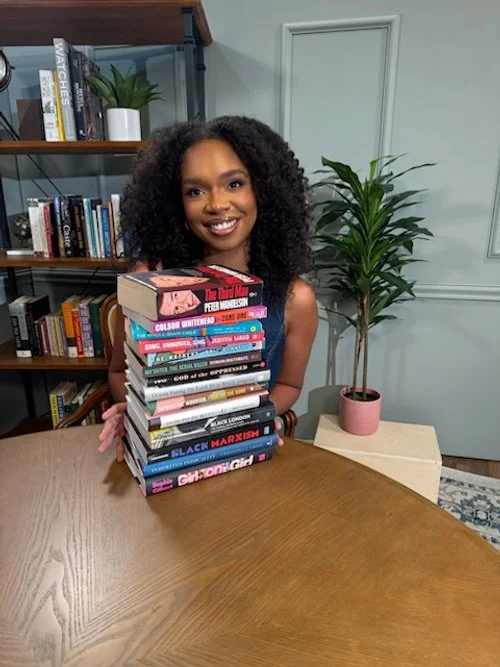
Today on The Stacks, we are joined by Emmy-nominated TV writer, former co-host of What Now? with Trevor Noah, and creator of the Pop Syllabus newsletter and podcast, Christiana Mbakwe Medina. We talk about how Christiana became a comedy writer and culture critic, the intersections of wealth and access in celebrity culture, and what we can get out of taking pop culture seriously.
The Stacks Book Club pick for January is Girl on Girl: How Pop Culture Turned a Generation of Women Against Themselves by Sophie Gilbert. We will discuss the book on Wednesday, January 28th, with Christiana Mbakwe Medina returning as our guest.
LISTEN NOW
Apple Podcasts | Spotify | Google Podcasts | Overcast | Stitcher | Transcript
Everything we talk about on today’s episode can be found below in the show notes and on Bookshop.org and Amazon.
What Now? with Trevor Noah (SiriusXM Podcasts)
“American Amnesia with Tressie McMillan Cottom” (What Now? with Trevor Noah, SiriusXM Podcasts)
The Daily Show with Trevor Noah (Comedy Central)
The Morning Show Season 4 (Apple TV)
Pop Syllabus (Substack)
There’s Always This Year: On Basketball and Ascension by Hanif Abdurraqib
Homicide by David Simon
The Wire (HBO)
Girl on Girl: How Pop Culture Turned a Generation of Women Against Themselves by Sophie Gilbert
The Big Breakfast (Channel 4)
“Ep. 366 The Evolution of “Girl Power” with Geri Halliwell-Horner” (The Stacks)
War and Peace by Leo Tolstoy
Lemonade by Beyoncé
COWBOY CARTER by Beyoncé
“Three Black Soccer Players Are Facing Racist Abuse After England's Euro 2020 Defeat” (Becky Sullivan, NPR)
The Game of Our Lives: The English Premier League and the Making of Modern Britain by David Goldblatt
“Ep. 370 Between Oprah and Obama with Kara Brown” (The Stacks)
Sum by David Eagleman
North Woods by Daniel Mason
There There by Tommy Orange
Homegoing by Yaa Gyasi
Martyr! by Kaveh Akbar
James by Percival Everett
Healing Resistance by Kazu Haga
The Things They Carried by Tim O’Brien
Friday Black by Nana Kwame Adjei-Brenyah
There Is No Place for Us: Working and Homeless in America by Brian Goldstone
Evicted: Poverty and Profit in the American City by Matthew Desmond
The Thing Around Your Neck by Chimamanda Ngozi Adichie
The Family Dynamic by Susan Dominus
The God of Small Things by Arundhati Roy
The Warmth of Other Suns: The Epic Story of America's Great Migration by Isabel Wilkerson
Fates and Furies by Lauren Groff
Joseph and the Amazing Technicolor Dream Coat (Andrew Lloyd Webber)
Twilight by Stephanie Meyer
The Fourth Wing by Rebecca Yarros
The Empire of Normality: Neurodiversity and Capitalism by Robert Chapman
How to Be Well: Navigating Our Self-Care Epidemic, One Dubious Cure at a Time by Amy Larocca
Foyles (London, UK)
Café Con Libros (Brooklyn, NY)
Actress of a Certain Age: My Twenty-Year Trail to Overnight Success by Jeff Hiller
Sing, Unburied, Sing by Jesmyn Ward
The Twittering Machine by Richard Seymour
To support The Stacks and find out more from this week’s sponsors, click here.
Connect with Christiana: Instagram | Pop Syllabus Instagram | Substack | Threads
Connect with The Stacks: Instagram | Threads | Shop | Patreon | Goodreads | Substack | Youtube | Subscribe
To contribute to The Stacks, join The Stacks Pack, and get exclusive perks, check out our Patreon page. If you prefer to support the show with a one-time contribution go to paypal.me/thestackspod.
The Stacks participates in affiliate programs. We receive a small commission when products are purchased through links on this website.
TRANSCRIPT
*Due to the nature of podcast advertising, these timestamps are not 100% accurate and will vary.
Christiana Mbakwe Medina 0:00
In England, it's a country where the expectation is that the class you were born into is a class you will die in. In the sense that if a lord dies penniless, he's still a part of the aristocracy. You are who you are. It doesn't matter what you accomplish. Ambition is frowned on it's seen as nasty. Whereas in America, you say to someone, I'm gonna build the biggest tech company that ever existed, they're like, oh, wow, you know, I need to connect you with so and so. Let me like, it's a people really believe. And unfortunately, that's kind of like the tragedy at the heart of the nation, because everybody believes that maybe they'll be a billionaire one day. And it's, you know, yeah, it just means you get a Kim Kardashian, you get Trump, you get Mamdani.
Traci Thomas 0:49
Welcome to The Stacks, a podcast about books and the people who read them. I'm your host, Traci Thomas, and today we are joined by Emmy-nominated TV writer, journalist and host of the Pop Syllabus podcast, Christiana Mbakwe Medina. Today, we talk about how Christiana became such a critical reader and thinker of pop culture, the ways that celebrities perform themselves, and how we think critically about them, and some of her all time favorite books. Our book club pick for January is Girl on Girl: How Pop Culture Turned a Generation of Women Against Themselves by Sophie Gilbert. Christiana will be back on Wednesday, January 28 to discuss this book with us. Everything we talk about on each episode of the stacks can be found in the link in the show notes. If you like this podcast, if you want some more bookish content and community, consider joining the stacks pack on patreon@patreon.com/thestacks and subscribing to my newsletter, Unstacked at TraciThomas.substack.com, both of these places offer different perks, including bonus episodes, community conversation, virtual book clubs, hot takes and more. Plus your support makes it possible for me to make this podcast every single week. So head to Patreon and Substack to join. Alright, now it is time for my conversation with Christiana Mbakwe Medina.
Alright, everybody. I'm really excited today because I have a person on the show who I'm just, like, a fan of. I just, you know, discovered her on the internet, and was like, oh, this person should come on the stacks. And that is Christiana Mbakwe Medina. Welcome to the stacks.
Christiana Mbakwe Medina 2:29
Oh, my God, Traci, thank you for having me.
Traci Thomas 2:31
I have to tell people so I am a die hard lifelong fan of Tressie McMillan Cottom
Christiana Mbakwe Medina 2:38
Tressie the queen
Traci Thomas 2:40
The queen, right, like the perfect human. And she did this podcast in 2019 when Thick came out, and I just fell in love with her, and have been in love with her ever since. And I came to you because she did the Trevor Noah podcast. And anything she does, I listen to, and I've never listened to the Trevor Noah podcast, and then I hear this woman on the show, and I'm like, That's not Trevor Noah, it was you. And I was like, this, Christiana woman is outstanding. I immediately DM Traci, and I'm like, Hey, sorry to be weird, but could you connect me to Christiana? And she was like, I am waiting for this episode to come out. She was so excited. So we finally did it. You you had to, like, go have a child in between
Christiana Mbakwe Medina 3:27
I had a baby, I was immediately in I was sold. But when we initially connected, I was like, I think that was eight months pregnant, yeah. I was like, let's do this after I have the baby, and my brain is like somewhat normal, and my third baby, I'm done with the babies, and I'm happy to be here today.
Traci Thomas 3:46
I'm so happy you're here. I'm happy you're done with the babies. I'm happy that I get your attention now, move over. Babies, move over. So let's sort of start where we always start, which is everyone's least favorite question, but is important for the listeners. Can you kind of tell folks about yourself, where you're from, what do you do, and then, sort of, what's your relationship to books?
Christiana Mbakwe Medina 4:08
So my name is Christiana Mbakwe Medina. I grew up in South London, England, the children of Nigerian immigrants, Igbo heritage, but very much black, British, Nigerian and all the things that come with that. Moved to the States about 10 years ago to break it into the wonderful world of writing. Worked at, didn't work at, I attended Columbia Journalism School, and then after that, somehow found my way into late night TV, and was a writer for The Daily Show with Trevor Noah. I wrote in the most recent season of the Morning Show and somehow became a somewhat podcaster. Now have my own substack and a podcast. It may be out when you guys listen to this. It should be January 15, but don't hold me to that, because my brain is mush. So early Jan, early, mid January, in the new year.
Traci Thomas 5:05
This episode will come out on January 7, so
Christiana Mbakwe Medina 5:09
oh, so it won't be out yet, but the trailer will be out.
Traci Thomas 5:10
You can still subscribe. Yeah, you go subscribe, so that whenever it comes, you'll get it in your ears.
Christiana Mbakwe Medina 5:20
I'm a lover of pop culture, just obsessed with it, and I like to just deconstruct it and find out more about it and what it says about us in the world. So it's a podcast about pop culture, my relationship with books. Oh, my God, that's such a good question. I come from the tradition of how stories are passed in my culture is the oral tradition. And so my memories as a child, I think a lot about my dad telling us about his experience as a child in the Biafra war, and about my grandparents, and just like our family story. So I come from a culture of like storytellers. It's kind of just baked in Igbos, especially in Nigeria, known for kind of being part of this. I don't know what's the intelligentsia, but you know, Chinua Achebe comes to mind, and Chimamanda, and, you know, like storytelling and chronicling our histories, and the way of understanding our world in that way is just very germane to us, so part of that oral tradition, and my parents love to read. And I think those things are connected just the oral tradition, and then you know where it's documented. So my parents love to read. They're reading all the time. So I was always reading, and it was newspapers, the Sunday Times. This is a British newspaper. They used to have this kid section. I don't know if they still have it. I think it was the fun day times, and that was the insert I'd go for. And then when I got a bit older, it was a style insert. And I just remember the Sunday paper being a thing my dad would get on our drive to church, and we'd come back, and we'd be this big, broad sheet, and everyone would take the bit of the paper that they wanted, like my mum would read the Sunday Times magazine. And, you know, so it was, I was always being read to or reading, and obviously, growing up in church, the central text the Bible book that was read. You might have heard of it, best seller. I'm not sure about the writer's room, but basically it would a lot of our reading as a family would be really nightly reading the Bible together, and like just memorizing Scripture and discussing it, they were very interested in us knowing the word and understanding the word and talking about the word. So reading was just a thing that we did. And then, of course, there was, like, the academic piece of you have to do well in school, and a big part of that is studying. And how do you study? You read books. Well, back then, now I don't know it's chat GPT, but they don't study. But, yeah.
Traci Thomas 7:48
Okay, I love this idea of, like, your whole family reading the newspaper, and you all reading the Bible and like talking about it, because I think the thing that I've always really liked about your work, both your substack now and like hearing you talk about things on the podcast is that you clearly have such a strong ability to analyze culture in the same way that I think people analyze books. So I'm always drawn to the way that you look at something and you're like, did you notice this one little thing? Let's extrapolate that out. Do you think that comes from kind of these, like Family Bible Study moments?
Christiana Mbakwe Medina 8:28
So I will say credit to my father. Like, if anyone who knows my dad, like his congregants, will call him pastor Mbakwe. He's known for using very big words and like and enjoying a debate. And my dad is someone, I was calling him my, like, intellectual sparring partner. And he would always just kind of be, he's like the polemicist. He would always occupy the opposite position, even if it was to provoke. So I was just, I had this debater, and then I had my mother who, who really is the one who bought most of the books. My mom is always buying a book. She used to be into this guy called Derek Prince. I don't know if he's alive, but like, he one of these preacher people, but like, she'd have all these books, and she'd be at bookstores, and so she'd take me to places, and I'd be like, I want a book too. And so I learned to read from my mother, and really to question from my father. And then just being an outsider, just being a young black girl in London, you're you're just kind of, you're on the fringes, really, of the mainstream culture in England, especially at the 80s, in the 80s, in the 90s. So I think the being an outsider means I look at the world from a different point of view, but only when I have that point of view is because I read it somewhere.
Traci Thomas 9:37
Yeah, I love this. I love I'm obsessed. Okay, so how did you get into comedy writing or writing and comedy, I guess
Christiana Mbakwe Medina 9:46
That's a, you know, that's a really good question, because I like, I don't see myself as a funny person, because I say to my husband all the time, I'm like, what I'll be like to my friend, I'm so depressed, like, and it's so I'm like, depression is so mundane. Mean, like, not fabulous, like, and I'm friends are laughing. I'm telling you, I'm depressed.
Traci Thomas 10:04
Do you know Hanif Abdurraqib? Do you know who that is? He wrote, like, there's always this year and he talks about this. He talks about being he's like, shout out to all my depressed people who are the funniest person in their friend group. He's like, it's a burden we have to carry,
Christiana Mbakwe Medina 10:20
I'd be like, I'm depressed or I'm anxious. I just leave, like, I have just, I don't even have to have a thing to be depressed about. I just think I have a baseline level of pessimism that has followed me since I, like, joined this earth. But I say to him, I'm like, Why are you laughing? It would be a thing as a kid, or even, like, now in my life, I'm like, I'm telling people, like, something very serious, and they're laughing. My husband is just like, you have, like, a funny way of putting things, or maybe a funny read on the world. But I actually thought I would just be a feature writer and kind of do journalism and maybe do the David Simon thing of you have a great story, and it becomes a book, and that book becomes a TV show, which, you know, becomes the wire. You know, I had very small ambitions, but it I was found on twitter and ended up at The Daily Show, initially as a researcher, which involves a lot of reading, and then made my way to the writers room. And, you know, it's a show that tries to find the comedy in the darkness and the horrors in the of the world. So it just became comedy writing became part of my career, kind of like, found me in that way, and in hindsight, it kind of makes sense.
Traci Thomas 11:24
I mean, if you are a depressed person who's funny, finding the comedy in the horrors of the world
Christiana Mbakwe Medina 11:30
I'm more anxious than depressed, like anxiety is my brand more than depression
Traci Thomas 11:35
Well, I got the sense that you were a little anxious, because when we first got on and you pulled out all your notes for book club. I was like, Oh, this is my kind of person, this level of stress and anxiety and over preparation. Are you a perfectionist?
Christiana Mbakwe Medina 11:48
Used to be, but now I have like, three kids, so I can't be that's actually not driven by anxiety. That's driven by, like, a relentless need to be excellent, but that's more like, I also need to have it to hand. I don't know. I'm very like, need to feel the quote. Some people are the highlight people, yeah. More like, fold the page, people. But then my husband judges me for how I fold the page, because he's a bookmark person, and I can't deal with his judgment. So I've become this person who like,
Traci Thomas 12:15
okay, so I fold the bottom of the page. This is my new thing. So you can't, like, when you look at the book, it doesn't really look messed up. But then down there, there's all the nightmares
Christiana Mbakwe Medina 12:24
Yeah, you've got, like, the colored
Traci Thomas 12:26
This is just, this is just for the chapters, because I knew when we would talk about the book for also for people listening. We're talking about girl on girl, which is our book club pick, which we'll read at the end of the month.
Christiana Mbakwe Medina 12:35
And I have, I have my copy here too.
Traci Thomas 12:36
I'm very excited. But this is for next time. This is for next time. You love pop culture. Do you remember the first, like pop culture thing where, like, young Christiana was just, this is it? This is being alive?
Christiana Mbakwe Medina 12:51
My god, that is such a good question. I would say the most like visceral memory, because I have so many because, like, you know, Spice Girls, all of that. It was when I saw a girl band called Cleopatra on TV
Traci Thomas 13:07
Cleopatra coming at ya
Christiana Mbakwe Medina 13:11
And they were three beautiful, brown skinned girls with these gorgeous big braids, and they had the style and the swag. And I just remember being like, Oh, that. I was like, agog, yeah, that was I was like, That's me. I love this. And I think they were on a show called The Big Breakfast or something. And I was just like, wow. I remember that very pointedly,
Traci Thomas 13:36
yeah, I also love pop culture, but I'm not as good as you at seeing pop culture like I don't know there's just like something magical that you do with pop culture that I just It blows me away every single time. So I'm curious, are you consciously thinking of it in a specific way, or is this just like how your brain works?
Christiana Mbakwe Medina 14:02
The first thing is, like, I'm a consumer of pop culture first, yeah, and like, I love it, like it's what I come to, whether it's television, music, fashion, like, in all art, in all the myriad of ways it shows up. I am a consumer first, even if I'm not necessarily purchasing Sure thing from pop culture. I'm probably watching a reality TV show, or I'm like, I just got off Hollywood unlocked because I'm like, so what's Ray J saying? You know, like, I'm just like, that's the drama of the day. So I'm a consumer first, a fan first. But I think as you grow, maybe just because of my temperament and my personality and just how I'm intellectually inclined, it gets to a point where you're like you're interrogating your consumer, what you're consuming. For me, I had to think about what I desired, what I wasn't listening to, what I was listening to, not just as an expression of my politics, because I think that's. It like, very pretentious, but like, is this good for me? If it's not good for me, why isn't it good for me? The people creating it, do they know they're making a thing that's not good for me? They probably don't. So why is that? What are the forces acting on pop culture itself that pop culture is not aware of? And basically, what are the forces acting on me. I think that was in my 30s. I started to think more carefully about who I was standing and why I was standing, and why I stand that person and not that person. And I think it's been an evolution into this way of kind of deconstructing pop culture. But ultimately, I'm just a fan first. Do you?
Traci Thomas 15:38
Is there anyone you can think of specifically that you used to love, that you used to love, that you had to like, reevaluate, and you now are out on
Christiana Mbakwe Medina 15:51
you know, me and Beyonce have a very prickly relationship in my mind, but it's always love. It's based in love. She was my first concert. Oh, I went with a good friend, yeah, Destiny's Child, London arena, 1990 something.
Traci Thomas 16:00
Do you know my first concert? Spice Girls. It was the first show, or one of the first shows after ginger spice left.
Christiana Mbakwe Medina 16:08
So you got four of them.
Traci Thomas 16:09
I got four. And you know the song where they're like, scary, baby, ginger, posh, they did it. They did scary, baby. And then it just played the background track, like, posh. And I was like boo, because she's my favorite. But in a turn, a life changing turn on the show, last year, Jerry Hallowell Horner came on this very podcast
And she is, like, so sophisticated, I stan her.
so I was, I wasn't sure what to expect. Yeah, obviously, because she's such a lady now, she was reading war and peace. Of course, she was reading, she's like, Oh, this old thing. She was so kind and so lovely. And she was like, What are your goals in life? But anyway, sorry, you were talking about Beyonce.
Christiana Mbakwe Medina 17:00
Yeah. So it was my, it was my first concert, and it was actually a funny concert. Not funny. Kelly had a broken foot, so she sat in a chair, and Solange was like the third member. So, yeah, it was, it was just a very, I remember it very clearly. And I went with a childhood friend play cousin of mine, and so she's somebody I've watched grow and I was like, super beyhive, like I was in it, like, spend my last pound on Beyonce. That was how in I was. And then I think it was actually around lemonade. I was like, hmm, you know, I started to see the layers in the text. And then cowboy Carter, I think. And then I think I left the fold for a bit, even though I go to every show. And then cowboy Carter, I came back in in a significant way, because I just saw it as such a feat of artistic growth, like, I'm always interested in people who don't plateau, who expand and do another level. And I was like, wow, she took a big swing and it paid off, and then I went and saw the show, and I was like, Oh, this feels like a farewell, like there's only so many more arena tours she can do like this, just as a function of time. So that is a pop culture icon that, like, my friends are like, you're so obsessed. I'm in a group chat with two friends. They're like, you're so obsessed, you're such a hater. And I'm like, No, it's love, but it's something I reflect on a lot.
Traci Thomas 18:23
I love this. I am excited for whatever you write or talk about when part three comes out.
Christiana Mbakwe Medina 18:31
Oh my god, right, act three. I think I'm i have i I'm excited too. I'm excited too.
Traci Thomas 18:37
What do you think it's gonna be? Do you think it's gonna be rock?
Christiana Mbakwe Medina 18:40
I think it's gonna be rock or maybe blues. Maybe.
Traci Thomas 18:45
I've heard some people say gospel.
Christiana Mbakwe Medina 18:48
Hmm, I don't see Beyonce doing a straight up gospel album. The reason why that's my contention is because they'd always do those when she was in Destiny's Child. They do those kind of gospel outros, like amazing grace and that they, I think they cover total praise. So I think she's kind of done that, you know, like, that's been, like, the kind of the church has been resonant in a lot of her work. And it wouldn't be, we'd be like, Okay, be honest. I mean, we know you can sing gospel, right? Whereas I think doing, like, a straight rock album, and she's kind of remembers she has that Alanis Morrisette cover. I think she's always kind of been in a sad girl, gothy vibe.
Traci Thomas 19:46
I want the rock. I want it to rock is what I want. People are like, we want an R&B Album. We have those
Christiana Mbakwe Medina 19:47
I want to see her channel Tina Turner and all the greats. Yeah. I want her to reclaim that legacy. So, yeah, I want to see rock.
Traci Thomas 19:58
Plus, if she takes that. On an arena tour, the choreography she'll be able to pull off, no problem, because that was the big thing between renaissance and cowboy Carter is like, Oh, she's dancing less, but if she does a rock album, she can just like Mick Jagger strut for three hours.
Christiana Mbakwe Medina 20:13
to the dancing less thing. It's like being an athlete and expecting them to do a sprint every like, no, it's like, she's an athlete. And sometimes, some shows you dance less, she needs to take care of her instrument, her body. So I actually, I prefer it when there's less dancing, because it's, it's a more imaginative show.
Traci Thomas 20:30
She was vocally better at cowboy Carter because she was dancing less.
Christiana Mbakwe Medina 20:35
I like the low end that was a thing that I was like, Oh, my God. She's using her lower register, and she sounds really beautiful, because some starlets, they always want to sing how they sang at 21 which is not, like women's, our voices deepened with time. So I loved hearing that part of her voice, oh yeah. She was so many you know, I swing back and forth, but I came around with cowboy Carter.
Traci Thomas 20:57
I too have swung back and forth, but I'm sort of feeling out on her right now.
Christiana Mbakwe Medina 21:00
Tell me why.
Traci Thomas 21:02
Because a lot of this stuff, like all these appearances with the Kardashians, just like I just, I don't, I just have this thing about really rich people who are beloved, which is, go away. Like, I have a real issue with Meghan Markle a lot interesting, because I'm mixed. I'm a mixed California American. What's your role? Which one? What's your mix? So I have a black dad and a white mom, so I have the opposite mix as her. But I find a lot of her conversation on race of like, Oh, I didn't know about race to just be so disingenuous that it just drives me absolutely crazy, like your mom has fucking dreadlocks. Don't tell me. You don't know, especially in California, very she, and she grew up in LA she would have been like 10 or 11 during the watts or during the LA riots, yeah, don't tell me. Race didn't come up because I was like six, and I remember being like, racism and also, OJ, all of that would have been in the most formative time in her life. So I just don't buy it. Yeah, but I feel this way about the Obamas. I feel this way about Oprah sometimes.
Christiana Mbakwe Medina 22:11
You know, it's the black rich people. Traci!
Traci Thomas 22:14
Well I don't like other rich people, especially like, I'm not, like, really worried. I mean, this applies to Prince Harry, which is just like, go be rich. Don't hang out with people that fucking suck and go be fabulous. I don't want you to be relatable. I want you to be rich. I want you to be on a yacht. I don't want you to be selling me a Netflix show and rebranding Trader Joe's. I don't care you're rich like I want to be I want to be like you, and I want to be really rich one day, and I want to only buy the most expensive pretzels filled with peanut butter
Christiana Mbakwe Medina 22:44
You'd have the dignity to be like, be rich and away
Traci Thomas 22:48
You might get a long lens photo of me on a beach.
Christiana Mbakwe Medina 22:52
I love it private. I'm like, I'm with you.
Traci Thomas 22:56
Beyonce, you don't need to go to this dinner and sit with the Kardashians. Just donate the money and go away, like, just appear at the Met Gala, only appear at places that I could never be. You know, like, why are you sitting with a Kushner? No, thank you. So that's my feeling. It's like, if you have a $200 million home, yeah, stay there.
Christiana Mbakwe Medina 23:16
Well, the funny thing is, like most, most people are, like, anonymously wealthy. Most wealthy people go to great pains to make sure we don't know who they are, because they know we'll eat them if we can or we want to be them. But I think pop culture is what one of these worlds where it's quite interesting, where you see people who could otherwise be anonymously wealthy try and buy access or kind of flaunt their wealth with Meghan Markle. I think Meghan Markle is a character that she plays. The Meghan Markle that the public consume for good or for bad, is kind of a character. Yeah, Meghan, the person subcontracts herself to play this character of Meghan Markle, and you make up some fictions, like you talk about the fact like I was never aware of race, or I didn't know who this man was, and that's not to cast aspersions at all. I think all public figures in pop culture are doing this delicate dance, and often you do it to protect yourself, because if the world knew the true you, how would they treat the true you? Does the world even deserve to know the true you? Right? These are more, bigger, grander pop culture or philosophical questions. So I think Meghan Markle, the character has in public, has to play innocent about race, and that's actually to be palatable to I think both sides, the sides side that hate her and the side that love her, I think the sides that love her really want to buy into this kind of post racial fantasy that the union of her and Harry means that the world is more progressive than it seems, and then the other side want this idea of race not existing to justify why they despise it. It's not because of her race, it's because of something else, even though we know that's not true, like her racial background informs so. Much of this vitriol. And also being an American, I think that there's just like people don't like Americans. So she has to say that as this character, she's manufactured how it is in her personal life, she deals with being a biracial woman all the time. She has to press her hair right. Her friends don't have to do that. There's these little things that she has to do. That means race is omnipresent, even if she pushes it to the corner. So I see that as just the character she plays in public, which all everyone in pop culture is doing.
Traci Thomas 25:33
I hate her character. Yeah, I don't like the character, but I am rooting for her always. Do you know what I mean? Like, I'm like, I'm like, I don't hate her. I just get so annoyed because I'm like, Why are you lying to me? Like, Yeah, girl, I am you. I know, you know.
Christiana Mbakwe Medina 25:48
But I also think that like her, her and her visual ambiguity informs why she can do that dance. Nobody, honestly, I think for sure, yeah, it's like, you clearly, coders, it depends you're ambiguous in a different way. Like, kind of like, when I say ethnic ambiguity, some people be like, are you Ethiopian? Are you Guyanese? Are you African American? You know, like that. When I straighten my hair, people think I'm Indian, Indian, right? Like my mother in law, it's pretty similar to you, and she's Dominican. And my mother in law, really beautiful, and she can pass for a ton of things. Like someone was like, that Indian woman, that Indian doctor, she was like, I'm not Indian I'm Dominican. But, you know, that's, you know, she, she has a ethnic and racial ambiguity there. And I think the way that Megan codes for some groups, you know, black people like, well, we saw her edges. We knew where she was, you know, like, tons of black people like what she doesn't but then some people see and be like, Oh, is she Sicilian? Right? So I think because of that, and how she's maybe coped with that, I don't know that experience. I have a husband that's ethnically ambiguous, but I think it's a different experience when you're a man, because of that, you can maybe play innocent, or you may have been shielded from certain things, but I also think that means you are more privy to conversations that people say things about minorities that they may not say around somebody like myself, who is clearly, unambiguously of African descent, so that, I think she's seen behind the curtain a bit, and maybe she doesn't want to say what she sees, or maybe it's the fact that she feels guilty about being behind The curtain. I think she's a very complicated person. I actually really enjoy her, because I think she tells us so much more about ourselves than we're willing to look at like you know, I hate the fact that she has to work and she's married to this prince.
Traci Thomas 27:36
Can you guys go be royal? Away from me?
Christiana Mbakwe Medina 27:40
There's no money. They've left the country.
Speaker 1 27:43
Go get the louvre jewels. Okay, just walk into the louvre.
Christiana Mbakwe Medina 27:49
I'm just, well, the way the work world works now, old money doesn't have that much money. It's the working rich. It's the Bezos. Is the tech magnets. They are the people that are like, flush with cash in ways everyone else kind of has to work or steal, depends, or both, right?
Traci Thomas 28:06
5050, okay, we are gonna leave Meghan Markle alone for now.
Christiana Mbakwe Medina 28:11
Yeah, well, I enjoy her
Traci Thomas 28:18
I think, yes, I think she's like a such a fascinating person of this era, like, she's gonna end up being the definitive person of, like, the mid 2010 to now, like, this decade is sort of the Meghan Markle decade, even if there's definitely a piece to be written about her and Trump and, like, the Whole thing, and Kim Kardashian
Christiana Mbakwe Medina 28:41
there's Yes. But I think what they all have, in a way, is this very American gumption of like, you know, say in London, I'm going to try a ting like, Megan was like, you know, I'm gonna get that Prince. Kim was like, I'm gonna build a billion dollar empire. Trump was like, I'm gonna be president, right? And you look at Trump, you know, like, why does he gets on with mandani? Because he's like, he sees that hustle of like, Oh, I'm gonna be mayor, and Trump's like, you know, I actually respect it. He's like, I don't agree with anything. Like he was like, I don't agree with his politics. But he bet on himself, and I think it's that betting on yourself, and it's very it's actually like, politically neutral, like we see it in the mamdanis and the AOCs were very left, but we see it on the people on the right with like JD Vance and Donald Trump. And then we see it with our pop cultural figures of like a Kim Kardashian or Meghan Markle or these people just like, No, I'm gonna try Ting and it works.
Traci Thomas 29:35
Do you think it's uniquely American?
Oh, yeah, yeah, of course, of course.
I don't know, because I am an American, no, I think that so, like, I think your perspective is
Christiana Mbakwe Medina 29:46
absolutely like, I in England, it's a country where, because it's such a class based culture, you know, just having the monarchy aside, but it's a country where the expectation is that the class you were born into, is a class you will die in, and you can't really drop or transcend your class. In the sense that if a lord dies penniless, he's still a part of the aristocracy, aristocracy, right? It's like he's still a lord. It's like he still has blue blood, right? Whereas I always talk about Michael Caine, who is like one of the most famous actors of all time, millions of dollars, millions of pounds, but he's still considered working class because of his roots and his background, despite the fact what of what he's achieved. So that's really in the psyche of the country. Like you are who you are. It doesn't matter what you accomplish. Your birth is so definitive of how people read you socially. And so what that does is, kind of, you frown on ambition is frowned on. It's seen as nasty, right? It's just because you, you know, and there's a different social systems, there's NHS, there's a welfare there's all of these things that kind of not aid that, but reflect that, right? And so part of why I left was because I was like, you know, I want, you know, I was, I'm very Nigerian and aspirational. And somebody I remember was once this English friend of mine who went to Eton, then Oxford, and then I actually met them at Columbia Journalism School. And he was, he said to me, you're very aspirational. I was like, What do you mean? Like, that? He's like, Yeah, you know, you're Nigerian. You guys are very aspirational. He's a very posh boy. And I was like, um, loaded, but he was right. But then it being from a country that unless you're from a subculture. So my friends who were like, Indian and Bangladeshi and Ghanaian and Jamaican, like, they came from backgrounds where it's like, hey, try and have hunger and transcend this, whereas the general consensus is just like, to have to bet on yourself and have that gumption. Is not it's kind of frowned upon. And that's why, if you ever see, if you're ever on Tiktok on Twitter, you see people saying, UK has bad vibes. That's what they're talking about. They're talking about that the idea of like people want to break out and do something different. And you're like, Oh, why you want to do that? Whereas, in America, if you say to someone, I'm going to build the biggest tech company that ever existed, they'll be like, Oh, wow. You know, I need to connect you with so and so let me like it's a people really believe. And unfortunately, that's kind of like the Traci at the heart of the nation, because everybody believes that maybe they'll be a billionaire one day. And it's, you know, yeah, it's why there's no fight for this real universal health care and all of these things that would make life easier for the masses. But it just means you get a Kim Kardashian, you get Trump, you get Mamdani, you get Meghan Markle.
Traci Thomas 32:43
Because these people just don't exist in the UK
Christiana Mbakwe Medina 32:47
Well because they're A the systems aren't there to make it happen, right? So like, right for our UK stars to be really exploded, they our pop culture icons, all have to come here. And there's a legacy of that from the Beatles with Beatlemania. And then we can trace it to the Spice Girls. And we can say, like, Adele and an Ed Sheeran, right? If they stay in Europe, they become like a Robbie Williams, who, I love things like great music, but most Americans are like, Who the heck is Robbie Williams? Right, right? But to get to that level of like, infamy and be known, you have to come and make it in America. There's something to that. And so this place, country, for all of its faults, kind of has some pathway, and it's encouraged, like, parents want a star. Oh, yeah. It's like, whereas I grew up in a country is like, why are you drawing attention to yourself? Whereas the parents here are, like, more attention for my kid. My kid is special My kid is gonna play baseball in MLB. And I'm like, why are you wasting your time? Right? But these parents really believe so it's very they're very different places, and they create these characters for good or for bad. I mean, I think whatever you feel about President Trump, he's been this truth serum, like he's like, America's Id. He's revealed so much about the countries in ways that wouldn't have happened if Hillary had won, or Kamala had won, right? Harris had won. Sorry, they I get in trouble for that when I use her first name
Traci Thomas 34:12
Oh, for saying their first first name.
Christiana Mbakwe Medina 34:16
Yeah. So, yeah,
Traci Thomas 34:16
I'm so, I'm now, now I've got a new obsession, but I'm thinking, Okay, I know we got to talk about books, but let me just ask you this last ask you this last part, and then we'll move on. Do you watch football? Soccer, football?
Christiana Mbakwe Medina 34:28
I do. I do.
Traci Thomas 34:29
Who's your team?
Christiana Mbakwe Medina 34:29
Manchester United
Traci Thomas 34:31
Oh, I'm a city girl myself, sorry about that. But here's my question. So these soccer players, the British ones, the ones like, you know, who play for the national team, they sort of transcend this hierarchy or no because, like, do you think that people like soccer so much because they get to root for like, underclasslings? Like, is there something tied to this?
Christiana Mbakwe Medina 34:58
No, I just think. Football, as we call it, is a working class sport. Now there's an insane amount of money in it, so it's like a path to riches and global fame, but it is still predominantly those are working class lads. You've seen some Nepo babies. I have a good friend of mine. Her son is in the academy system, so really brilliant young football player, and he's been signed to a team, and she tells me about the inner workings of it. She's just like, yeah, so and so's kid showed up, whose dad's a big football player and plays for England. But she's like, like, you know, most of the parents here, they're investing a lot in this child, because they like, this is our ticket out of right, you know, the hood. And so I think it's just the national sport, and people love it. But you know, in terms of, like, the class of it, rowing and rugby attract a kind of different profile of person, as does crooked whereas football is still, I would see, I'd say, a game that disproportionately attracts working class lads, and I don't think people root for them because of their class background. They root for them because it's their team and they love the sport. And unfortunately, we've had moments where, you know, every World Cup or euros black players aren't treated like everyone else. So it was like, you never try, you know?
Traci Thomas 36:19
What was that 2022, it was like the 2020 whatever year that was when all the black players missed,
Christiana Mbakwe Medina 36:25
I was like, Why did they volunteer? I wouldn't have volunteered, but then maybe
Traci Thomas 36:29
that's why, for the race. How about Jack Grealish? Do it for just for the culture, you know?
Christiana Mbakwe Medina 36:35
Yeah, go ahead, leave soccer and Rashford out of it. But no, I don't think that. But, and I also and I also think a friend of mine actually recommended a book, and I got it from my dad, but I can't remember it now, but it talks about how the corporatization and the amount of capital that entered the Premier League, how it actually changed the game from the ground up, and not a good way. And they kind of linked it to like Thatcherism and deregulation, etc.
Traci Thomas 37:03
Oh, my God, I need this book.
Christiana Mbakwe Medina 37:04
Yeah, I'll find I bought it for my dad. I can't remember. I never, I was like, Oh, this is a book. I order a lot of books for my dad and make it read them.
Traci Thomas 37:12
When you tell me it will link it to it in the show notes. Yeah, too. Okay, we do have to take a break, and we have to come back and talk about books. Okay, we're back. I didn't prep you for this, so sorry. I know you like to prepare, but we do a thing here called Ask the stacks, where somebody writes in and we give them a book recommendation. Okay, so this is actually kind of a good one for you, because it's about a family, a family reading. So this comes from em, and they say on your episode with Kara Brown, she recommended reading a book called some 40 Tales from the afterlife. Every single member of my family enjoyed it and spent a lot of time stealing my library book so they could read the stories. It is rare to find a book that both my mom, dad and sister all enjoy. My dad is almost exclusively non fiction. Still talks about the writing in a little devil in America. My mom reads a lot of fiction, historical fiction or mysteries. Recent Reads include Northwoods and anything by Louise Penny. She has read and enjoyed there, there and homegoing. My sister will read almost anything she loved martyr and James, but also reads nonfiction. Think Miriam Kaba or healing resistance by Kazu haga. I'm thinking maybe another collection of stories is the way to go. I'm open to any and all recs. It's kind of hard. It's like a very broad thing. So I can go first, because I prepared, obviously. And if you want a few seconds to think about. You can just come up with one. I'm gonna get three recommendations. So my first recommendation is a sort of story collection that feels like non fiction, but also is maybe a novel. It's very famous. It's Things They Carried by Tim O'Brien, which is about he was a he served in Vietnam. And then this book is sort of his, like, fictionalization of what that was like. It's taught in schools a lot. I am really am caught, like, thinking a lot about your dad in this, because I feel like dads are often the sticking point. Yeah, and I feel like this is such a dad book, but I remember reading in high school and loving it, and there's a lot to talk about. So that's my first pick. My second pick is a short story collection that I just love. We did it here on the podcast. I love this author. It's Friday black by Nana Kwame Ajay brenya, which is sort of a dystopian story collection about race and capitalism in the world. And like there's the first story is called The Finkelstein five, and it's about this guy who kills five children with five black children with a chainsaw, and it's like this whole, there's, it's just, it's fantastic. And then my third pick is nothing that you asked for. But I think this would be a good family book, which is, there is no place for us, by Brian Goldstone, which is about the working homeless and the United States. It's a class of people who work full time jobs. Jobs, but are still unable to secure and afford housing in the United States. It's so good, it's so depressing, but like worth reading. If you've read evicted, it sort of falls in that world. And I love the book. So those are my three recs. How can you got for us Christiana?
Christiana Mbakwe Medina 40:15
In terms of a story collection that I think the family will enjoy, based on the vibe I'm getting this thing around my neck. By Chimamanda Adichie, I think it'd be great for everyone. Secondly, I'd say the family dynamic, by Susan Dominus, which is a story of sibling success. It's just it's a great work of journalism, and she profiles a few families with siblings who are successful and in different ways. And there's an Asian family as a black family as a white family, like different racial background, and she, just like, has a lot of data and journalism and research and talks about, how do parents manage to have siblings who are successful, but then also in all of these stories, as normally, a man, a brother who, like, is really successful, and something happens to him, and it kind of unends, like, unravels a story the family is telling themselves. And I think it's a good book for families to read, especially intergenerational, because it will impact how you look at your sibling, how your sibling looks at you, and how your parents looks at how they raise you. And it goes beyond like, oh, you know, sibling rivalry. There's lots of books about that, but yeah, it was a book I really enjoyed as you can as a mother who wants to have children who get on as adults, but are hopefully successful. So that's the book I would recommend. And then I'd say the God of small things. I think it's a type of meditation that maybe the more woo, woo parts of this family might enjoy.
Traci Thomas 41:48
I love that that's so good. people at home. If you want to have a book recommendation, read on air, email, ask the stacks at the stacks podcast.com, all right, Christiana, you are now officially in the stacks. Book Hot Seat, two books you love, one book you hate.
Christiana Mbakwe Medina 42:01
Okay, I've got my thing here.
Traci Thomas 42:04
Got her notes. Love a prepared person.
Christiana Mbakwe Medina 42:07
The Warmth of Other Songs, by Isabel Wilkerson, I think, is probably one of the most important books of the last century. Like, oh my gosh, incredible.
Traci Thomas 42:17
Preaching to the choir, faith. Love that book.
Christiana Mbakwe Medina 42:19
Fates and Furies by Lauren Goff, oh, have you read that one?
Traci Thomas 42:24
I've never read it. I haven't I got it somewhere in the blue section. head
Christiana Mbakwe Medina 42:28
My head spun in the Furies portion. Anyway, yeah, it's just, it's a great book, and it's a novel that I think about a lot. I reference it. I think about a lot when I'm writing a script and I want a twist and a subtle twist and a twist that people will go back and watch the episode and be like, Oh, that was the clue. So, yeah, those are the two. Hate is a really strong word.
Traci Thomas 42:56
Lean into it.
Christiana Mbakwe Medina 42:58
I think the books of the Bible attributed to Paul because I think Pauline theology has been really bad for women.
Traci Thomas 43:08
Oh, say more. I know nothing about the Bible.
Christiana Mbakwe Medina 43:12
Oh, that's, you know what? My husband, who's an atheist, considered it, considers it one of the classical texts. So it's good.
Traci Thomas 43:20
I think it is. Yeah, I went to Catholic school, but I was raised Jewish, okay, and so I know a little bit, but I don't
Christiana Mbakwe Medina 43:29
Do you know more about the Talmud and the Torah.
Traci Thomas 43:32
No, we weren't really religious. I'm from the Bay Area. I'm from Oakland, and, you know, my dad was a lot older than my mom, and so he kind of was like, he was, you know, he was like, woke. Before woke was a thing. He would always talk about how his mom was a Baptist and you have to go to church. And he'd look up there and see a blonde haired, blue eyed Jesus, like this. Just can't be it. He was all. He was always on some shit. And my mom was, like, sort of culturally Jewish, and we went to Catholic school because that's like, what was affordable. But our Catholic school was more non Catholic than Catholic. So like, I'm familiar with the broad strokes of the text, yeah, I know there's an old and a New Testament. Like, there's, you know, I know Joseph and the Amazing Technicolor Dreamcoat the musical. So like, if there's a musical about it, if there's, like, been something I know, but I couldn't tell you what is Paul versus, yeah, like, so
Christiana Mbakwe Medina 44:23
I would say, I wouldn't say, I know hate is not the the that's why I don't like my mom's gonna be like, How can you say you hate the Bible? Because I actually, like one of my other questions, actually bigging up something Paul said. So, like, I just, I think so much of a book, the experience of writing a book is like this kind of there's living in the mind of the author, and then it exists on the page. And it's the life The book takes when it's in the world which the author has no control over. And I think some of the Pauline theology I have, you know, I wrestle with it a lot.
Traci Thomas 44:59
What is Pauline theology?
Christiana Mbakwe Medina 45:02
A lot of self aggregation. There's a lot of self loathing. There's always a lot like, you know, the man's ahead, women be silent. And I just, I didn't like, I don't like how it's I don't like how the text is deconstructed and how it's wielded. And I went, so I'm just like, Oh, I hate it rather than, you know, but it's also a sign of good books that 1000s of years later, we're sitting on a podcast talking about it, or some bloke wrote. So, yeah.
Traci Thomas 45:30
Okay, so what kind of reader Are you now and then? Do you have like, types of genres that you love or that you avoid?
Christiana Mbakwe Medina 45:38
Oh, my God, I read constantly. I like, wake up reading. One of my best friends, she always says, you read, so I don't have to. I'm the person that people kind of outsource their reading to. I think, yes. So yeah, I read every day. And it may be a book, but it may be a piece of feature writing. You know, I'm constantly reading. I read a lot.
Traci Thomas 46:04
And where do you read? Like, do you read in bed? Do you read on the couch? Do you have snacks and beverages? Like, what is if you were gonna have your ideal day your kids are away, you get to just sit down and read. What does that look like for you?
Christiana Mbakwe Medina 46:16
Oh, my God. Well, if my kids are away, I'm probably gonna go and get, like, my chin laser.
Traci Thomas 46:22
Okay, well, your kids are away, but the deal is you have to read
Christiana Mbakwe Medina 46:28
while they're on. So my husband is very much like he likes the physical book in his hand. I move across mediums, so especially when I'm prepping for an episode of the podcast or something I'm going to write on substack. Sometimes I'll have the audio book in my car. I'll have the Kindle highlights on my laptop, on my phone, and then I'll have the physical book as well. But I think because of I read so much in bed on my side, instead of doom scrolling, I jump to the Kindle app, it'd probably be like me laying, laying in the bed. There's a cup of tea or coffee next to me, and I'm like highlighting and like swiping. That sounds like a great day to me.
Traci Thomas 47:11
Okay, I love this. And what about genres? Are there any kinds of books that you don't read?
Christiana Mbakwe Medina 47:16
Or, yeah, Smut. What am I? I'm in this group chat with my politics friends. I'm gonna big them up Yewende shrina and Abby, right? I'm not going to say which one of them it is, but people listening figure it out. One of us reads all these smut books and their premises are insane. It's like a demon dragon with a big dick has a threesome with it. What is this? Smut's the thing I just can't do. But I love that my friend reads all the smut because she always, she's like, I'm reading this smut novella. And then there's a really big book this year. I can't remember the name. I think it was like a version of, not Twilight, but one of these
Traci Thomas 47:55
Fourth Wing?
Christiana Mbakwe Medina 47:57
I think it's that it started off as fan fiction. The authors, the No, the author's non binary, Asian, and it's like, it's a mega hit. And then and my friend was reading it, and I think it started as smut anyway, she she's crying all the time. I'm like, What are these books? I won't read them, but they're really important, because millennial women are really into smut
Traci Thomas 48:23
they're so into it. I can't get into it either, but there's so many people who listen to this podcast who are very into smut. And I just, I can't
Christiana Mbakwe Medina 48:31
it's important, it's culturally it's pop culturally important. And my friend is like, you need to do a smut episode. And I'm like, Yeah, but then I would have to read the stuff.
Traci Thomas 48:42
You have to read it. I'm like, but you should do one. If anyone's gonna take on smut, I feel like it should be you. What if it, like, converted you and you became like a smuthead or whatever?
Christiana Mbakwe Medina 48:48
Oh my God, I just the thought of it is so far. I actually love the fact that my friend, like, reads all this smut because she is very, very proper English girl. So it's just, it's it's unexpected, it's like a twist. But I think I'm more curious about why women are in too smut outside of, like, the sexual desire and the fantasy. Because I think women consume smut in is, like, in an analog way to like men consuming porn like I'd be interested in, like the overlap. And then I actually admire the fact that men women would rather read about their sexual fantasy than just, like, I'm gonna go on PornHub and like, just get whatever I get. I feel like reading takes more effort, but, you know, yeah, I just can't get into it myself. I've just, there's other things to read.
Traci Thomas 49:34
I'm with you, yeah, what's the last great book you read?
Christiana Mbakwe Medina 49:39
Oh, what's the last great book? Obviously, I think Girl on Girl is a great book, and it's one of the last ones I read. But I really enjoyed the empire of normality, neurodiversity and capitalism, by Robert Chapman, and it talks about the history of like, the psychiatric not just system. But the it's trying to justify itself, to be seen as real medicine, and what happens when that happens, and our loss of asylums, and how we treat autism and neuro divergence and the kind of definitional creep that we have. Like, you know, everyone seems to have ADHD, everyone seems to have autism. And like, why that is, I don't want to spoil it, but it's such a thoughtful book. And Robert he he speaks about his limitations of analysis. He's like, I'm white, but also neurodivergent himself, but grew up working class, and talks about contending with those medical systems that make it harder for some populations to receive diagnosis and but he doesn't have the blind spots. He's like, it's harder for black women, it's hard. And I just it's, it's a great reading, because it's like, how much of it is new neuro divergence, and how much of this is just capitalism outside of, like, the, you know, there is a spectrum outside of, like severe disability, where you're kind of, like non verbal and have real sensory processing difficulties, there's kind of this, this middle, amorphous area that has become highly medicalized, even though these drugs, whether they treat depression or anxiety or ADHD, they have real limitations. And medicine in any situation can only do so much, and it's about we're trying to fix the individual, but really, we need to maybe look at our a wider world where so many people have these maladaptive responses, and it's the problem, isn't the people, often, the problem is the world. So that's a that's so good, yeah.
Traci Thomas 51:40
How do you how do you pick your next book? Like do you? Are you online? Are you reading reviews? Are you asking friends? Are you just going to the bookstore or the library?
Christiana Mbakwe Medina 51:49
Um, I don't like I don't take book recommendations, because if I don't like it, I'm going to be annoyed with you. So everyone knows not. Sometimes people tell me to read books on their behalf, because they like outside opinions, like can you read it and tell me if it's worth it? And being the eldest daughter that I am, I'm like, Sure, I'll do that for you. Like, I don't have anything else to do, so I don't, I don't like recommendations. I love reading books written by women. I read a lot of books written by women, so I'm always curious about I'll read like, you know, New York Times reviews and New Yorker reviews. And I'm always looking on my timeline for the people I follow like to read as well. And sometimes people will DM me and say, like, check this out. Or so and so's books coming out, so, but I kind of just find things myself. So, yeah,
Traci Thomas 52:40
do you set any reading goals for yourself?
Christiana Mbakwe Medina 52:43
No, I probably should read less. Honestly, my husband look always reading. My mom is always like, you've learned this thing from me, always reading. I read all the time. So no, I'm happy. I think I could probably read less, because I think if I read less, I could sit with the books I do enjoy more. Does that make sense? I always going through and I'm like, oh, but that was great. I wish I could have savored it a bit more.
Traci Thomas 53:08
Yeah, that's I feel this. I mean, obviously, if reading is your job, it's like,
Christiana Mbakwe Medina 53:13
yeah, of course, it's completely different for you. But like, yeah, right.
Traci Thomas 53:16
But I think it's a similar thing where it's like, I wish I had more time to, like, sit like I'm at the, you know, it's the end of the year as we're recording this, and all these end of year lists are coming out. And I'm like, can I, like, I should be reading 2026 books already.
Christiana Mbakwe Medina 53:29
Yeah, get the galley copies and all, yes.
Traci Thomas 53:31
But now I'm like, I gotta go back and read, like, was that book actually that good? Like, I need to know, because I need to have an opinion about this book, because it's the best book of the year.
Christiana Mbakwe Medina 53:41
I know it's hard. It seems like there's always books coming out It's so many books.
Traci Thomas 53:48
I mean, can you see this? These are all my 2025, books. So nothing on my shelf. Very few things on my shelf behind me are actually from this year, all older. But it's like, just, it's like, I have to keep them in these little piles. What's a book that you like? What's like a go to recommendation that you like to give?
Christiana Mbakwe Medina 54:09
I mean, I always like, I always come back to Warmth of Other Suns. I always come back to that book and but right now I'm recommending a lot. Amy larocca's How to be well, recommending that. Oh yeah, you need to read that. She actually comes on my show. But I actually invited on the show after reading the book. And it's like, I'm a real wellness girly. I'm very crunchy and very woo, woo. You know, do all the cleanses and there is not a supplement I don't have, I do all okay, like, is, it gets a bit crazy. And that book, I felt really seen, and it was, it's a real interrogation of this kind of bill, multi billion dollar wellness Empire, and how it's targeting women, and why women get pulled into it. And it's because it like. You know, we're not well, and the doctors aren't responding to us. And I felt, especially as a black woman, you know, black community, we had Dr SEBI like we have a real antagonistic relationship with the medicalist, mainstream medical establishment, because of how it treats us, historically and currently. And my grandparents were very much, like, on my father's side, we don't touch the medicine. I know you're pretty long, but they were just very like, you know, into their brews. And, like, a lot of what I'd call, like, they'd call herbal medicine, but it was just, you know, being in Nigeria, there's just, there's plant medicine, you know, it's just like, people know what to use, and so that was already in my family and but reading that book, I saw how I'd been sucked into the capitalism of it all, but I can't get out. I'm stuck, but I'm recommended to all my friends.
Traci Thomas 55:53
Okay, I'm now I'm gonna read it, yeah, well, because I've just decided we're friends. Do you have a favorite bookstore?
Christiana Mbakwe Medina 56:03
Mhm. I think it's the biggest bookstore in the world if I'm not mistaken. The one on Charing Cross Road. I love Foyles. Reminds me of my father, some of like the best days of my dad. I used to go to chapels on Bond Street for my keyboard classes, and then we'd walk over to we'd go to Foyles afterwards, and I get to pick a book, and whenever I needed a textbook or something like that, we go to Foyles. And it's just so idiosyncratic. I love Foyles, and it makes me full of hope. Like home and like, there's people like, grabbing books in the corner and just sitting and reading and the stairs up, yeah, Foyles in my favorite bookstore. But also want to shout out cafe con Libros in Brooklyn
Traci Thomas 56:45
Yes we love them. Okay, what's the what's the last book that made you laugh?
Christiana Mbakwe Medina 56:52
Oh, Jeff Hiller's memoir, actress of a certain age that that is like, it's funny, it's funny.
Traci Thomas 57:02
What's the last book that made you cry?
Christiana Mbakwe Medina 57:05
Jeff Hiller's memoir. There's a section when he talks about his experiences in church and how he's come to understand God and faith and it. I felt it, and he's come to a lot of peace about it, that the peace that maybe I don't have. But I was like, Oh, wow. Like it was, it was great. And before that, it was sing, unburied. Sing. It just, I don't know, I just was, like it was, I was just, I can't even remember the part, but it was just, it was something very moving about that book and how you're taken on this journey. And I cried.
Traci Thomas 57:40
Yeah, what about the last book that made you angry?
Christiana Mbakwe Medina 57:44
Oh, I don't read anything that makes me angry,
Traci Thomas 57:47
really, for no for no reason. Like, sometimes I read something and I hate it and it makes me angry. Sometimes I read something and like the information and it makes me like, hate the system.
Christiana Mbakwe Medina 57:56
I'm generally, like, an angry person, so I can't, like, I can't exploit that with books. Yes, I'm like, I'm like, oh, click off.
Traci Thomas 58:04
No. What's the last book you read where you felt like you learned a lot,
Christiana Mbakwe Medina 58:13
the family dynamic? I'd say that Susan Drummond's book, I learned a lot in that book.
Traci Thomas 58:18
What's a book that brings you joy
Christiana Mbakwe Medina 58:20
so you know, I was interesting because I don't rock with Paul, and it was linked to the book I books I kind of hated, but the book of Philippians always gives me joy. It's got some of my favorite like meditations and scriptures in there, like the things I use to like, encourage myself and encourage my children, and the things that my parents used to encourage me. So, yeah, you know, Paul, I said I book I don't like that much, but also the book I like.
Traci Thomas 58:51
Is Philippians in the book of Paul?
Christiana Mbakwe Medina 58:54
No, the Philippians is in the New Testament. Now I'm being Sunday school teacher.
Traci Thomas 58:58
I'm like, really, like, Is this a new language that I'm learning?
Christiana Mbakwe Medina 59:03
No, so there's the Old Testament and the New Testament. Okay, Philippians is one of the books in the New Testament. And yeah, it's a book that I return to. And I often, whenever something scripture comes to mind, it tends to be from Philippians. So yeah, gives me joy.
Traci Thomas 59:21
Is there any book that you're embarrassed that you like?
Christiana Mbakwe Medina 59:25
No, no, I'm not. I'm actually very anti that kind of like elitism when it comes to like being like I'm embarrassed, because, first and foremost, I think it when somebody writes a book, they have devoted a portion of their life and their time to doing it. And you know, my dad is very big on time. My parents are like, if someone gives you your time or they waste their time, time is a thing you can never get back. So I think you're honoring that time. And that is a very noble thing to, like, sit and read a book. You're like, that's really noble thing. And whatever the material I just I'm just, like, should be embarrassed. Like, why is reading embarrassing? Like, I. Yeah, I can't.
Traci Thomas 1:00:01
No, is there any book that you're sort of embarrassed that you still haven't read?
Christiana Mbakwe Medina 1:00:06
No, I don't buy into that white people thing of a canon. There is no canon, just, you know, it's like everyone has different lived experiences. Like, yeah, because it's just like the reason for somebody not have having read a book that is seen as culturally important sometimes is because of nothing they did. Maybe you didn't go to a school where you you know the education system is what it wasn't what people consider as good. Or maybe you don't have the time. Maybe you were sick like so no, there's it just when it's supposed to happen. I believe in like, Divine Alignment and time and timing when the book is supposed to be in my life and in my spirit. It will come to me if I haven't read it yet. I'm not supposed to have it. So no, no embarrassment.
Traci Thomas 1:00:52
Okay, what about the book you would assign if you were a high school teacher?
Christiana Mbakwe Medina 1:00:56
So it's a book called The twittering machine by Richard Seymour, and it got mixed reviews. I think the reviews were being they were hating. I really enjoyed it because after I read the twittering machine, it really did change my relationship with the internet, even though I still use it too much. But I think that will teach high school students who I think spend a lot of time on their phones and are using, you know, laptops and things way more than we ever did when we were in school, that there are big tech companies behind this technology and these websites and these apps that you use, and their incentive is to keep you there as long as possible. And they are actually morally neutral in the sense that they do not care if what you consume is good or bad, they just want to keep you there. And I think high school students really need to understand that, because they're about to go out into the world, whether go to college, whether work, and they're probably going to spend less time reading after you leave high school, right? Like, there's lots of data that shows that, like, reading plummets even if you go to college the amount of reading you do in college in comparison to what you've done between five and 80, like just shrinks. And so most of what you are going to read is going to be on your phone. And I think the twittering machine is a book that did change my relationship with my phone. And so I think it'll be good for students.
Traci Thomas 1:02:17
Yeah, Okay, last one, if you could require the current president of the United States to read one book. What would you want it to be?
Christiana Mbakwe Medina 1:02:24
The Warmth of Other Suns. I think reading that book, there's a line in there where it said that I'm going to like quote it really badly, but Wilkerson talks about how African Americans are the only people that had to become immigrants in their own country in order to, like, achieve success, and you know, the story of the great migration. And I think there is a way that we conceive of not just immigrants, but people that have to travel for work. And there's a way that the black American contribution to America has been diminished, and they are so foundational. Without them, none of this exists, and I assign it to every president. I think every president needs to have a deep respect for black Americans and their contributions and their sacrifice and their courage like the story of the great The reason I was just taken by the book was because of the courage shown by everybody in that book that went on that journey from the south elsewhere.
Traci Thomas 1:03:26
I love that book so much. Yes, okay, we're done today, but everyone, I want to remind you that Christiana will be back on Wednesday, January 28 for our discussion of Girl on Girl by Sophie Gilbert. So read the book with us, and you're gonna we're in for a treat. You're in for a treat. Christiana, thank you so much for being here.
Christiana Mbakwe Medina 1:03:45
Oh my god, this has been so good. Thank you for having me.
Traci Thomas 1:03:49
Yay, and everyone else, we will see you in the stacks. All right. Y'all, thank you so much for listening, and thank you again to Christiana for joining the show. I'd also like to say a huge thank you to Kalia Tyson for helping to make this episode possible. Our book club pick for January is girl on girl. How pop culture turned a generation of girls against themselves, by Sophie Gilbert. Christiana will be back on Wednesday, January 28 to discuss this book with us. If you love the stacks, if you want inside access to it, head to patreon.com/the stacks to join the stacks. Pack and check out my newsletter at Traci Thomas, dot sub stack.com make sure you're subscribed to the stacks. Wherever you listen to your podcasts, and if you're listening through Apple podcasts or Spotify, please leave us a rating and a review for more from the stacks. Follow us on social media at the stacks. Pod on Instagram, threads and tick tock. And now you can also find us on YouTube, and you can check out our website at the stacks podcast.com this episode of the stacks was edited by Christian Duenas, with production assistance from Sahara Clement and Cherie Marquez. Our theme music is from tagirajis. The stacks is created and produced by me, Traci Thomas.