

Ep. 407 The Fires of the Future with Jacob Soboroff
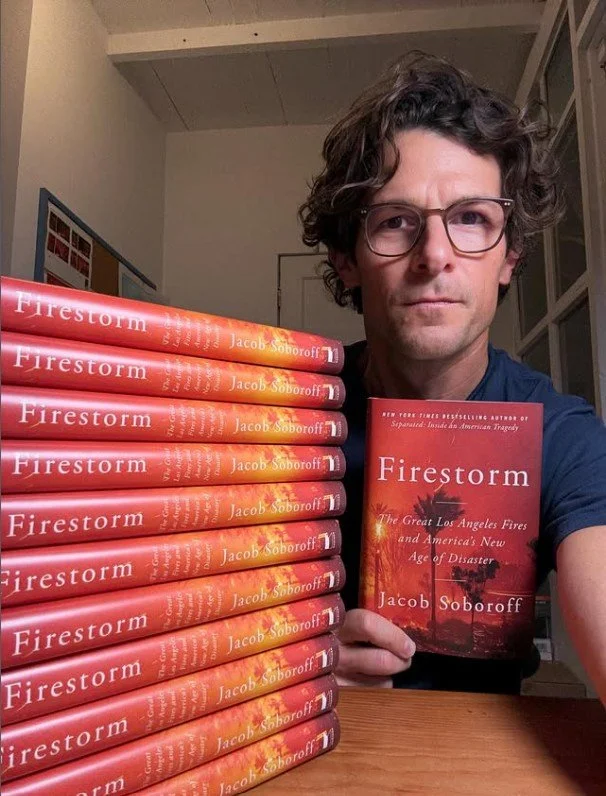
Today on The Stacks, we’re joined by award-winning journalist and New York Times best-selling author, Jacob Soboroff, to discuss his newest book, Firestorm: The Great Los Angeles Fires and America’s New Age of Disaster. In this book, Jacob takes us to the frontlines of the January 2025 L.A. Fires to offer a deeply personal, firsthand account of one of the most destructive fires in the city’s history. We discuss why he chose to write about what he calls “the fires of the future,” how his childhood in the Palisades shaped his reporting, and the politics behind this environmental disaster.
The Stacks Book Club pick for January is Girl on Girl: How Pop Culture Turned a Generation of Women Against Themselves by Sophie Gilbert. We will discuss the book on Wednesday, January 28th, with Christiana Mbakwe Medina.
LISTEN NOW
Apple Podcasts | Spotify | Google Podcasts | Overcast | Stitcher | Transcript
Everything we talk about on today’s episode can be found below in the show notes and on Bookshop.org and Amazon.
Firestorm: The Great Los Angeles Fires and America’s New Age of Disaster by Jacob Soboroff
The Time Machine by H.G. Wells
“Where Is the Suspect Accused of Starting the Palisades Fire — and What Do Authorities Say He Did?” (Christine Pelisek, People)
“Will L.A. Ever Forgive Its Mayor for Being Abroad When the Wildfires Hit?” (Shawn Hubler, New York Times)
“Trump, Musk unleash on California Democrats over wildfires” (Camille von Kaenel, Politico)
New York University (New York, NY)
“LA billionaire Rick Caruso’s private fire crews the target of California bill” (Lindsay Holden, Politico
“‘We want to serve this country’ Forced out federal workers share their stories at MSNBC town hall” (MSNBC)
Separated: Inside an American Tragedy by Jacob Soboroff
Fire Weather: On the Front Lines of a Burning World by John Vaillant
The Big Burn: Teddy Roosevelt and the Fire that Saved America by Timothy Egan
Ecology of Fear: Los Angeles and the Imagination of Disaster by Mike Davis
The Lost Bus (Paul Greengrass, 2025)
Paradise by Lizzie Johnson
Firestorm: The Great Los Angeles Fires and America’s New Age of Disaster by Jacob Soboroff (audiobook)
To support The Stacks and find out more from this week’s sponsors, click here.
Connect with Jacob: Instagram | Threads | Bluesky | Website | TikTok | Facebook
Connect with The Stacks: Instagram | Threads | Shop | Patreon | Goodreads | Substack | Youtube | Subscribe
To contribute to The Stacks, join The Stacks Pack, and get exclusive perks, check out our Patreon page. If you prefer to support the show with a one-time contribution, go to paypal.me/thestackspod.
The Stacks participates in affiliate programs. We receive a small commission when products are purchased through links on this website.
TRANSCRIPT
*Due to the nature of podcast advertising, these timestamps are not 100% accurate and will vary.
Jacob Soboroff 0:00
We all experienced together, the fire of the future. And to me, this felt like I had seen what our kids lives are going to be like, and not just in LA, but all around, you know, all around the country and all around the world. And it's not, I'm not here to say nobody's to blame. There are many things that could have been different, that perhaps could have changed the outcome of the fire, but the magnitude of the fire that we experienced, what it was, what it felt like. We're not the only ones to experienced this. Talk to people in Lahaina or in paradise. It's not a secret that more and more of this kind of stuff is happening. And so talking about it, writing about it, finding ways to sort of explore all of this stuff is so important, and that's that's what I hope people get out of the book, too.
Traci Thomas 0:49
Welcome to the stacks, a podcast about books and the people who read them. I'm your host, Traci Thomas, and today we are joined by award winning journalist and New York Times best selling author Jacob sobarov to discuss his new book, Firestorm, the great Los Angeles fires and America's new age of disasters. In this book, Jacob takes us to the front lines of the fires in Los Angeles in January 2025 offering a deeply personal first hand account of one of the most destructive fires in the city's history. We also talk about why Jacob wanted to write this book so quickly, what he hopes readers will get out of it and how he balanced the politics and personal in his account. Our book club pick for January is girl on girl, how pop culture turned a generation of women against themselves, by Sophie Gilbert. We will be discussing the book on Wednesday, January 28 with Christiana mbakwe Medina. Everything we talk about on each episode of the stacks can be found in the link in the show notes. If you like this podcast, if you want more content, community and conversation around books, consider joining the stacks pack on patreon@patreon.com, slash the stacks and subscribing to my newsletter. Unstacked. At Traci thomas.substack.com, each of these places offer different perks, like bonus episodes, community conversations, virtual book clubs, hot takes, non fiction reading racks, and now in both places, you can also join as a free member. Plus, when you do join on a paid tier, it makes it possible for me to make this podcast every single week. So go to patreon.com/the stacks and or Traci Thomas dot sub stack.com to join. All right, now it is time for my conversation with Jacob soboroff
Alright, everybody. I am joined today by Jacob Soboroff. I am very excited. I'm a fan. I was a fan of yours for a long time, I gotta say, one of my favorite NBC guys. So I'm thrilled that you're here. We're gonna talk about your brand new book, Firestorm, the great Los Angeles fires and America's new age of disaster. We always start here, in about 30 seconds or so, can you tell folks about the book?
Jacob Soboroff 2:58
Well, I covered the fires in real time. And I grew up in Pacific Palisades, one of the two places that was devastated by the fires, and it was impossible for me to process in real time, to see my childhood home burned down, to see the homes of so many of my friends, to watch my city carbonize before my eyes. And so the book for me is, has been and is a cathartic sort of opportunity and experience to look back and to dig deeper and to learn more about what it was that I went through live on national television, and it's been I'm so grateful to have had the opportunity to do it.
Traci Thomas 3:36
Do you feel like you got out of writing the book what you were hoping for? As far as that cathartic experience goes?
Jacob Soboroff 3:43
I don't even think I knew what I was looking for when I started writing the book, but I think in the end, what I realized I was looking for was a deep connection with other people, and that's what the book gave me. I think that it's the favorite, my favorite part of my job as a reporter for MS Now formerly MSNBC. It's okay, and at the time I was working for NBC, but that's what I think I've taken away from it. I mean, I obviously I've learned a lot, and we can talk about all of it, and it's all in the book, about our planet, about our city, about our fellow human beings, about what actually happened and how I ended up in the middle of it. But more than anything, I feel like I learned about other people and and I got from other people, um, what so often happens in these types of tragedies, which is, um, hope. And that's what I walked away from all of this with.
Traci Thomas 4:30
I think I have a question that everyone is going to have, which is, like, this book is coming out really soon. Yeah, right. It comes out a day before the anniversary of the fire starting. And I think everyone has questions about that, and so I'm curious why you wanted to write the book so quickly, why you wanted it to come out so quickly. Well, let's start there.
Jacob Soboroff 4:54
I think that I sort of knew right away, almost when I was in the fire, that what I was experiencing was. Something that I don't think any human could wrap their head around. And in fact, my my former neighbors and my my brother who lost the home that he was living with my sister in law and friends and stuff, nobody was there. Everybody left, you know. So I was there in the middle of it, alone with the first responders, extraordinary first responders, other journalists who were there. And I really did know right away, like, I wanted to start exploring whatever that meant, what this thing was, frankly, covering fires was the last thing that I wanted to do, and I write about that in the book, like, I don't want to put on that cosplay in the yellow jacket that we'd wear as reporters in the middle of fire so often, because I frankly, didn't see the value in it at the time. And as soon as I was there, and as soon as I started to experience all that, I wanted to, I wanted to dig in and in terms of why, I sort of put it to bed so soon. I don't see the book as sort of some deep dive piece of investigative journalism. I see it as my version of the facts on the facts on the ground as I learned them at the time, which is what sort of what I always do, both on TV and in my first book, separated and about what I've learned since. And so there will be, first of all, there will be, hopefully, 1000s and 1000s of stories written about the fires and the personal experiences that people had. There are millions of versions of the story actually based on how many people live in the area and experienced it and experienced it and watched it live on television, on the internet. But this is my version of the story, and it'll continue to evolve. That's what I guess a paperback is for, yeah, and what talking about it with, with people like you is for but I wanted to the first anniversary is approaching, and I think for me, it's been a crazy year. I will never forget 2025 and I sort of wanted to get it down as wanted to get it down as fast as I could
Traci Thomas 6:46
Yeah, that makes sense. I think. What's I think for me as a reader going into this book, I think I thought it was going to be much more like research, and I think the book is really much more of a memoir, which shifted, sort of how, as I started reading it, it really shifted. Really shifted how I was reading it, like what I was reading, I think because you are a journalist, and I think so often, you know, journalists come, you know, into writing things from that sort of removed perspective, I was really fascinated by how much of you is in the book. Because, I mean, I was watching you on TV on Sunset and Amalfi on the night of the fire. No, but I like so reading about you, how you were experiencing it in this memoir form. I think a lot of people maybe aren't going to expect that, and I think that's what makes this book sort of special and and worthy of of time is because you are both the person we're looking to for answers, as the journalist on TV, and then also we're reading about your own sort of chaos and insecurity and sort of emotional turmoil. Because even though you've covered things, it's not always your hometown, it's not always your community. You're probably not usually driving from side of the disaster back to your home crazy. No, you're definitely not. You're out in the world. And so I think, like the memoir, aspects of this book are really powerful, and I wasn't expecting that.
Jacob Soboroff 8:20
Thanks, Yeah, I it's sort of how I was always approached in my 10 years here at at Ms Now, when I first started MSNBC, I came in, and it was never really for me about I didn't I never even thought I wouldn't even use the word journalist to describe myself, actually, when I first started here, and I was very insecure about it, and only through the experiences of being able to go places and see things with my own eyes and report back to facts on the ground like I was saying to you, did I develop even the confidence that that was what I was doing? And it was my first book separated and reporting on family separation that made me understand that like a couple things, one is, I don't feel comfortable pretending like I'm not in these places and having reactions and feelings that I do when I go to cover stuff, whether it was the family separation crisis or the fires, or going to Ukraine and covering the war there, or going to Haiti and watching Biden deport people or whatever. I'm a human being too, and I think what I've learned about myself and what I like to write about. I use the experience both to reflect internally and also to grow by meeting other people and sharing what stories I can but yeah, you're right. There are plenty of amazing books, and I read a lot of them about fires and about climate change and about the causes and fire history, and I spoke to so many of those people and and it's not that there isn't, I mean, original reporting in the book, there's plenty of it, but I think that that's how I process reporting always, which is to not pretend like I wasn't there. That's what people expect from me now, whether they're watching on TV or they're or they're picking up a book
Traci Thomas 10:01
yeah, so as an Angelino and a person, you know, I one of the things I'm most curious about, and I can't wait for the book to come out. I'm really curious to see how people will respond to it, who are not Angelinos.
Jacob Soboroff 10:15
Me too
Traci Thomas 10:16
Right? Because I think, like, there's so much in this book that I'm like, Oh, I was watching that. I remember that I remember that moment. I remember that, like, the smell that this, that that, like, when the sunset fire broke out. That's sort of in my neighborhood, we evacuated.
Jacob Soboroff 10:31
So how was your fire experience? Like? What was it like for you?
Traci Thomas 10:35
So it was, I mean, very stressful. I have to, I have at the time brand new. They were five year olds, they'd just turned five, twins, and the Tuesday night. So I'm gonna tell you my whole story. So Tuesdays, I have a meeting with a woman who I work with, named Cherie, who does, like, a lot of marketing stuff with me. She does the website, whatever she lives in the Palisades. We had our Tuesday morning call. And she's like, my mom will not stop messaging me about these fires. And I'm like, Mom, chill out. We get off our call. Our calls from 11, from 10 to 11. Every Tuesday, we get off for our
Jacob Soboroff 11:14
So this is in the morning. This is in the morning, right as it's happening starting?
Traci Thomas 11:19
Yeah, right as it's happening. Her mom is like bugging her, as moms, do we get off the phone? Honestly, don't even think about it. You know, the way, if you live in LA or in California, I'm from Oakland originally, when I was a kid, was the 1991 Oakland Hills fire. So, like, I'm petrified of fire, but in the ways that you get these alerts, or it's like, oh, fire burning in the Palisades, to me means, like in the mountains, everything's fine, no big deal.
Jacob Soboroff 11:44
That was my life growing up. Same thing.
Traci Thomas 11:46
Yeah, so it's like, it's not, it's not a real thing in a lot of ways, get off the phone, whatever. Do my whole day, pick my kids up from school, go home. I see the sky. I'm like, oh, I should turn on the news. It's kind of fiery. Watch the news all night. Stay up so late, watching you, watching the people in Altadena freaking out, starting to be like triggered, because again, Oakland Hills fire, then the next day, no school for kids. I think home with my kids, and then watching very stressed thinking, maybe we should just leave, because the sky is gross, the air is gross, like, let's just go. We're probably fine, whatever. Then the fire breaks out at like in the sunset fire, and I it's right at bedtime. You know, it's like, my kids go to bed at seven. It's probably like five something.
Jacob Soboroff 12:32
I was driving back, I remember I wrote in the book I'm driving back on the 10 towards my house, and I could see off to the left, exactly, probably what your experience probably what you experienced from much closer up.
Traci Thomas 12:43
Well, I we don't live that close, but we live close enough that I was like, You know what? My anxiety is so high right now, let's just go to my sisters in Long Beach. Let's just go. So we pack everything up and we leave. And it's so much traffic trying to get down, because everyone in Hollywood is having the same thing of like we just watched for the last 24 hours, people waiting too long, people not preparing. And I said, if we have to evacuate and my kids are already asleep, it's gonna be so much worse. So let's just go now, while they're still awake, we just had dinner. We'll go to Lisa's, whatever. So we drive down. My mom lives in Santa Monica, her area got evacuated. She was coming to our house. I said, just meet us at Lisa meet us at Lisa's. So we all go down there. Everything was fine for us, but it was this real, like, I mean, just so stressful.
Jacob Soboroff 13:28
You see what I'm saying. Everyone has one of these stories. Everybody has one of these stories. Everybody and so there are millions of people that knew what it was like to be on a text thread living what really was the disaster movie about Los Angeles. And you, you asked, like, what are people outside LA? This is what people think about LA, when they think about the disaster movies or whatever. And this is the one time that it really happened. People think about the big one earthquake, but this is what it was, yeah. And so you made it to Long Beach. Okay? We made
Traci Thomas 13:57
it to Long Beach. Everything was fine. But I so I get to Long Beach, and all of a sudden I think, oh my gosh, what's up with Cherie? So I text her, I say, Cherie, like, is everything okay with you? And she goes, No, our whole my house burned down. We lost Oh my gosh. And I was like, oh like, because in those moments, I just, like Tuesday morning, pre fires felt like seven years ago, so I'd completely forgotten. And you know, sadly, she lost everything. Another woman that I work with in Altadena, who I had worked with, she also lost her home. And you know, the kind of like happy ending to the story, or like the update to the story, is that in May, Cherie and I worked together to do a huge fire event for people who'd lost their homes, where we did a pop up bookstore in Hollywood, people could come and they could get their books. And you know, it was so meaningful, not only because it was something that, you know, I could do for the community, but also because Cherie had lost her home, and my friend Becca, who also showed up and got books, had lost her home. And you know, a lot. People that I know through the books things I did, they came, and so many people said that it was like the best fire relief event they went to. And not that I'm competitive or anything, but I am, and it just was, like, so nice. But I have to say that the only reason it was the best one is because Cherie was helping plan it with me, and she was like, I've been to so many of these. This is what I need. This is what we need. This is what it should feel like.
Jacob Soboroff 15:19
This is exactly what at the end of writing the book, meeting people, learning these stories, I got to experience some of that stuff in real time. And I saw you were out early on too, doing stuff. Yeah, it's what I'll always hold with me from this experience, you know?
Traci Thomas 15:35
Yeah, yeah. And I think, yeah. I think that, like the human aspects of ice, I mean, people will, people who listen to show and who follow will remember that, like, for two months after the event, I couldn't even talk about it without crying, yeah? Like, I couldn't even, like, Cherie and I would have our meetings, and I would just be like, I'm not ready to talk about it.
Jacob Soboroff 15:54
We all went through a trauma together, you know?
Traci Thomas 15:56
Yeah, yeah. So enough about me. This supposed to be about you see, you're the real journalist, you flipped it on me.
Jacob Soboroff 16:01
But this reminds me, this reminds me of why I did it, and I think that, yeah, ultimately what I learned from, from the experts, and then this is reporting about, you know, the science of it and and what it is that we experienced in the confluence of events that created this is we all experience together the fire of the future in a way, yeah, and to me, this felt like I went and picked up HG, wells, the time machine after the fires. Because I did feel some way, in some way, like I had seen what our kids lives are going to be like, and not just in LA, but all around, you know, all around the country and all around the world. And it is the confluence of all of these things, which all are storylines in the book. You know, obviously climate change, the disintegration of our infrastructure, changes in the way that we live, and frankly, politics, misinformation and disinformation that made so much of this worse. And it's not, I'm not here to say nobody's to blame. There are many things that could have been different that different that perhaps could have changed the outcome of the fire, but the magnitude of the fire that we experienced, what it was, what it felt like. We're not the only ones to experience this. Talk to people in Lahaina or in paradise or in North Carolina have experienced tornadoes or natural excuse me, hurricanes or natural disasters or or, you know, whatever the case may be, it's not a secret that more and more of this kind of stuff is happening. And so I always just feel like, as someone with a couple service and individual therapist, I feel like talking about it, writing about it, finding ways to sort of explore all of this stuff, is so important. And that's, that's what I hope people get out of the book, too.
Traci Thomas 17:42
I want to come back to the politics of it, but I want to stick right now for sort of, like, this new, new age of disaster, these like new fires. What is it to you? I mean, I know, I know you write about it in the book, the like, the moment with, like the x that was really powerful little bit. But what? What is it to you that makes these fires feel different, or like these disasters? What is it that is defines the New Age?
Jacob Soboroff 18:09
Well, I think, I think it'd be really easy to say, Oh, well, Donald Trump became the president, and was the president elect during this and was with Elon Musk and Katie Miller, Stephen miller's wife, who comes up in the book, and have some reporting about that, you know, we're spreading, you know, misinformation and disinformation about the fires, and that didn't make anything any easier. But the reality is that there has been some version of that story before Donald Trump, and I think that the scale and the scope of the disasters in my time as a journalist have all been, you know, as big as this, or approaching, sort of, the magnitude of this. This was the costliest wildfire event in American history. But when you look at that billion dollar disaster registry, there have only been more and more and more of these. So what is the new age of disaster? It's an age that sort of, I think, in our lifetimes, we've been living through that climate change, which I don't think any of us are disputing, was a factor here. Yeah, no, I'm sure my emails will be lighting up momentarily. But all of these things about that, the way in which we live, as I was saying, you know, our infrastructure is worse when I say the changes in the way we live. 1000s of electric car batteries were exploding. I heard them in real time as I was out there. The literally, the fuels for the fire are different today, and so it's in real time how the fire promulgates and explodes, but also the aftermath of the fire too, that I think collectively and our reactions to it, as citizens, politicians, the first responders, etc, make it uniquely in this sort of moment in time and and I'm not, I'm not scientist, I'm not a wildlife biologist. You know, I talk to all of these types of people, meteorologists, federal government employees, but I've learned from them and listen to them about what these things are like for them, and they're as bad as they've ever been for all of them,
Traci Thomas 20:04
yeah, I think something that is really present in the book, which is sort of the like disinformation, the politics of the moment. But also, even if you sort of remove the politics for a moment, it's just the real time information feels really different to me from previous Not, not specifically this, but just in general, the way that, like, I can know about a disaster five minutes after it's happened, from around the world, and that we're getting constant updates. And, you know, and I think people know this and remember this from other from other previous things, of like, the early news isn't always the true news, like, you know, police officers lie, or like someone heard something and it's not confirmed and all of that, but with social media, where everyone is reporting and the videos and all of this, I feel like it enhances a type of like, personal anxiety around a disaster that is really compounds with the feelings of danger.
Jacob Soboroff 21:03
That's what I wanted to capture, and I hope I did in the book, sort of the immediacy of the feeling of being there that all of us in some way experienced. And I happen to be in it in the Palisades there, there. But in Altadena, people experienced it. And everybody in all corners of the city was was having family text threads light up. Some people had apps that were telling them where the fire was and how it was approaching. Other people didn't get alerts from the city or the county or from other governmental organizations that should have been alerting them, and resulted, I think it's fair to say, in the deaths of some people who didn't get those types of alerts. And so, yeah, that's why I wrote the book, kind of so I tried to reflect what it was like for me to be so present and so in the moment. Because that, too, is what the new age of disaster feels like. It's like. We are living these things, not just in real time, but almost second by second, minute by minute. And so the book starts with me sitting in the bureau in LA at the NBC offices, and walking to the bureau chief's office and saying, I'm sitting here watching it on television at my desk, saying I grew up on I know that street in that neighborhood. I'm able to watch it in real time as this is unfolding. I need to go. And she said, Okay, um, we don't have a crew ready to go, but if you want to, like, get geared up, or head out or whatever, and and from there, it's like, I close my eyes and I can remember every Hallmark. And I think so many people can too. But if you weren't here and you were just watching on TV or just following online or just read some newspaper article, you don't get it. And that's, I think that that too, is what's in the pages of the book. It's the intersection of all the and that's why I wanted to meet all these people who, in real time, I didn't really get to spend a ton of time with, but go back, especially with people in Altadena, to learn what it was like for them to have a similar experience with a different cause of the fire. Palisades was the now we know was this arson, allegedly, that was set with this Lockman fire that became the Palisades fire seven days later, and in Altadena, it was the the old and faulty equipment that caused the fire. And everybody experienced it in a different way, but everybody did share, which is, I think, such an important point you make this profound sort of immediacy of it. That's how I will always remember it, and I hope people will remember it that way too when they read the book.
Traci Thomas 23:21
This is maybe an indelicate question, but I think it's important, which is, how are you feeling about people who've lost their homes in the fires? Reading this book, I know I've seen it online a little bit, and I'm sure you have to that people are like, it's too soon. You know, he didn't lose his home. Who is he to say this? So how do you how are you thinking about that? What are, I guess, just, I don't know. Can you talk about that?
Jacob Soboroff 23:43
Of course, I think that everyone's going to experience this differently. And am I in a position of privilege where I get to it's my profession to report on things? I mean, you can look at it both ways. It is my it's a privilege, and it's my profession, and I'm in this position that so many other people don't get to have and do to reflect on these types of things for a living, but the amount of pain and grief that I went through is not of someone who has lost a family member or lost my own home in real time, but my family members did. I watched literally the hallmarks of my entire formative years and childhood. This is not defense of it. That's just my reality of why I wanted to do it burn up in front of my eyeballs. And I think that this has been honestly a hard year for me, after this was were the ICE raids in LA and it really tore apart our city, and I spent months, you know, covering that, and I think for me, you know, my answer is, you don't have to want to read my account of this, but maybe we can find some shared sort of community in it, if that is helpful to people that went through this, or for people on the outside, certainly, what. Where we can find a way to learn from each other, and that's what I wanted to do. And I hope in some way, I mean, I've heard from people who experience fires all over the country or other disasters, who said, I'm looking forward to reading this to sort of see how you all in California, and you Jacob as a journalist, but also as an Angeleno, the book is dedicated to my fellow Angelinos are processing all of this, and I think it's sort of a, I think it's sort of a hopefully the book will even be like an evolving document, and we'll have more to say and more things to share. But the thing I'm actually really looking forward to most is taking the book to people that I met along the way and giving them, you know, their own copies, because they, they too, in a way, I hope I'm doing what all the people that I've met, whether it was herb and Lloyd Wilson on McNally Avenue, or Kate Hennigan, the JPL engineer, or the firefighters and Altadena and the Palisades, they, they opened up to me, you know. And I so appreciate it. Will never forget it. And I and I, that's what I want. I hope that people will see about this book is that that's what I'm trying to do with everybody else. Get to know me a little better. Get to know not only what I experienced, but what I learned about what other people experienced, and how the big forces in our lives that shape our lives every day played a part in this too.
Traci Thomas 26:20
Yeah, okay, we're gonna take a quick break and we'll be right back. Okay, we are back. I teased this earlier. I want to talk about the politics of this. So for people who don't know LA city politics, they they were not part of the Caruso bass election they are not privy to Gavin Newsom in a way that many Californians are. Politics is baked into the fabric of these fires, into the fabric of this book, into the fabric of this city. You cannot avoid politics. My question was for you, how did you know how much you wanted to put in? Because there are definitely pieces of sort of the political conversation that are not in this book or are briefly mentioned. So I'm curious.
Jacob Soboroff 27:16
It's a great question a couple things. One is, I think it's unavoidable to say, and I make it clear in the book, I grew up in civic life in LA, yes, from, from, from the time I was a little kid. My dad worked for many mayors and was a part of LA city politics. And, you know, for a time, he was appointed the chief recovery officer of the city by Mayor bass. And it was sort of messy. And there was politics involved in all that. As a journalist, you know, I don't think it's appropriate for me to cover that part of the story. I acknowledge it, and it's there, but I'll leave it to other people to cover that. I also didn't want to get too granular on the on the city, county politics of the story, because I do think everybody has their own self interest in coming to the table as Paul. Table as politicians and pointing fingers about about what happened. For me, it's like if I can report on the facts as I knew them at the time I put the book to bed about what caused the fire, what potentially could have made it worse or could have made it better. That's my role as a as an observer of of the facts on the ground, I think more on the state level. You know, I got to spend a lot and by the way, there's no secret. Karen Bass wasn't here. The mayor of La wasn't here. She was absent. She was in Ghana on a trip representing the Biden administration. She missed the beginning of the fire. She's gotten a lot of flack for it. None of that is hidden from the book. That's all in the story. But I didn't want to get into who's gonna be the next mayor of La. That's not what this book is about. This book is about people, not about politics. Ultimately, politics comes into it. Donald Trump made it unavoidable, because even though he wasn't even the president, he and Elon and all these people are on true social all day long, talking about the water flowing down from the Pacific North, all these things that just make absolutely no sense. And it was very interesting. Was very interesting for me to spend time with Gavin Newsom, the governor who you want to point a finger at him, feel free, but it was interesting for me to understand what the dynamic was between him and the President Elect, what it was like for him to hear those things, knowing what he knew, and having the relationship that they had in the first term around some of these very same issues and exploiting, frankly, tragedy for for political gain. So that's why there's some of it in there. But the book is not entirely about that, if that makes sense, yeah.
Traci Thomas 29:38
I mean, one of the things speaking of exploiting tragedy for political gain, one of the things I was truly like, what is going on here about was all of the posturing between these men, like, are you going to come here? Are you going to come to my house? Who's going to come down these stairs? And I just thought like, what is this about? Is this? Does this happen with every disaster that it's all of this like, Oh, now I need to go. It's like you actually don't need to go right now. Like you could just stay home for a few more days while the firefighters do their fucking job. It was so weird.
Jacob Soboroff 30:16
How crazy is the story? That is a little spoiler, but like, you know, towards the end of the book and tell the story about how Donald Trump and Gavin Newsom have this weird interaction on the tarmac at LAX when Trump shows up. And Trump's basically like, you're gonna come on marine one with me to go to the Palisades and Newsome's like, nobody invited me to go, but, you know, there's back and forth. They might kidnap me. He thought to himself, yes, exactly. It's absurd. And I think that that, too is part of this new age of disasters, that all of this, in some measure, becomes a show for television, yes, or social media for particular people's political benefit. And I felt like I couldn't write this book without telling that part of the story. You know, there was the first trip that Donald Trump took when he became president again, he went to North Carolina, and then he came here on the same day and had this absolutely bizarre exchange in the Palisades at the fire station, by the way, didn't go to Altadena, didn't, didn't, didn't land there, didn't fly over it, didn't take a look at it. Why? There's political considerations behind all of it. And after that was Doge and the firing of all these federal workers and the decimation of all of these agencies, NOAA, I talked about NASA and firefighters being the scientists, being the firefighters of the future, and the earth sciences program, potentially, you know, being on the chopping block the firefighter safety programs at NIOSH in West Virginia, where I went. I mean, that was a real privilege to get to spend time with a lot of those people in writing and researching this book to understand the Forest Service. I went to the Pacific Northwest and was hanging out with firefighters in the forest service when they were all in a hiring freeze at the beginning of the administration. They come and put on the show in real time. But then the policy decisions reflect a profound misunderstanding of what it actually takes to put a fire like this out the fire of the future. And I thought it was really important to include that
Traci Thomas 31:02
Yeah, on a I think maybe people are familiar with this a little bit, who aren't from LA, but on a more intimate la level, this conversation about the water and the water pressure, and was there water, or wasn't there water, and all of this in the book, it's talked about, so we don't have to spend too much time on it. But I guess my question for you is, like, what do you make of the ways in which Karen Bass was blamed for this, for not being here? Like my understanding from people who are on the grounds in both communities is that there's been some sort of, like, a lot of political shifting in these communities and and so I'm kind of curious what you make of that from the from the stuff you've been doing on the ground, talking to people, what you've noticed about the political climate since the fire and now
Jacob Soboroff 30:16
Well don't take it for me. I mean, I think the best way to understand, by the way, if it was just that the reservoir, which is 117 million gallons and the Palisades, was empty for repair issues, then why did Altadena burn? Also, you know, the then have the same issue in Altadena. This was a mountain wave, wind event that the National Weather Service predicted. You can read the entire predictive alert in the book, the entire thing, I went to visit those guys in Oxnard, Dr Ariel Cohen and Dave Gomberg, the two meteorologists that literally laid this out for everybody, saying this was coming, if there's a spark anywhere, something like this is going to happen. Look, are there legitimate questions about, should there have been more firefighters pre positioned in the Palisades? Did the mop up of the Lockman fire by the Los Angeles Fire Department not go on as long as it should, or were people sent home early. All of that is going to be the subject of investigative reporting, I think, for years and years and years to come. But could Karen Bass have personally stopped the explosion of the fire in the Palisades to result in no deaths, no devastation? That's not what the firefighters say. That's not what the firefighter who was talking to Elon Musk during his live stream down in Zuma beach in Malibu said to him, when Elon was pressing in the live stream about the water pressure and why there was no water. He said we were just flowing, I'm paraphrasing, but we were just flowing so much water at one time it wasn't possible to have the amount of water that we needed to put it out. And that was the same situation, low to no pressure in Altadena because of the amount of water that was needed to flow to stop what's an urban conflagration, an absolutely disastrous situation where in this wildland urban interface, coming down from the Angeles National Forest or coming from the Santa Monica Mountains the minute, Monica Mountains, the minute like that, it gets into the Palisades, or it gets into Altadena. There's no stop in it when there were winds like there there were, and I'm not you know, people want to nitpick about, were they unprecedented wins? If we ever had winds as strong as that, just look at the wind speeds and and what was happening on the ground, or what you felt like, or what it looked like outside your window. I will never forget, and it's in the book My nine year old son, at the time, saying to me, we'd had his birthday party in Altadena like three weeks before dad look out the window, look how windy it is down that Tuesday morning as I walked out the door to go to work, there was no question that it was an unusual, if not unprecedented, set of weather circumstances that contributed to this that no one politician could have stopped on their own. Give me a break
Traci Thomas 35:25
for people who don't know, can you explain a little bit what the criticism of Karen Bass is? Because I feel like that's sort of not really in the book of like, why? Because, like, if you go to the Palisades now, there's like signs that are like fire Karen Bass, like there's a real vitriol against her, but for people who aren't as familiar, could you kind of like lay out what the argument is.
Jacob Soboroff 35:47
Karen Bass is the mayor of Los Angeles. She was a congresswoman here from the Los Angeles area for many years, and she was a community organizer and local official before that. And again, she was out of the country in Ghana, on a on a on a mission for the Biden administration to attend a diplomatic event at the time. And the criticism is that despite warnings from local officials that went, certainly to her staff, and some of that is in the book, she didn't come back in time and wasn't here to basically honcho the response. And I understand I was in New York on 911 it was my seventh day of school at college, and I remember
Traci Thomas 36:29
We both went to NYU, by the way
Jacob Soboroff 36:31
Were you there?
Traci Thomas 36:32
No, I'm younger than you, sorry.
Jacob Soboroff 36:34
Gosh darn it.
Traci Thomas 36:35
I was a freshman when you were a senior, so
Jacob Soboroff 36:37
gosh darn it. But you know the feeling, and whether or not you like Rudy Giuliani in that moment, people look to Him because they believe we needed a leader in crisis. And I think that you know, was she the right person to be the leader in that moment? That's the criticism in some regard, and it has the rebuilding happened fast enough. Are are do people feel like she understands what it's like to live, and by the way, she's not responsible for Altadena. She's only responsible for the Palisades. The Palisades in Altadena are in different jurisdictions. One thing I hope people take away from this book is that it's a love letter to La which is hundreds and hundreds of square miles with many different localities and jurisdictions within it. LA City is just one of them. LA County is much bigger, and there's millions of more people that live in LA County, and Altadena is an unincorporated part of LA County that's not governed by the mayor of Los Angeles. People in the Palisades are talk about privilege. Have a lot of privilege, and I think that they are trying to exercise political power against the mayor because they're unhappy, and understandably so, with how awful the circumstances were. This is my community that I grew up in when you go there, it looks like there was a war. There's nothing left, you know, and people want to get back up on their feet. I understand in any circumstance, whether I'm covering an election or covering immigration at the border or abroad, doing a foreign assignment, people will assign blame to anyone they can to feel better about the pain that they're going through, and she, as the mayor of the second largest city in the country, is an easy target, and I'm not saying that she doesn't deserve scrutiny. She, of course, she does, but whether, but was she responsible for this? And is that the reason that, if it's the reason that people in the Palisades want to vote against her when she's up for reelection. That's their political decision to make, you know
Traci Thomas 38:24
I gotta say when her memoir comes out, I cannot wait to read this section because she really hasn't had a lot to say. But I know. I mean, I can only imagine what it feels like
Jacob Soboroff 38:36
Being the mayor of LA is a wild job, because it is a gig in which actually the city council. There's 15 city council people, and they actually have as much, if not more, power than than the mayor. I'm not saying that the mayor, who runs and hires and fires the general managers of the departments, including the fire department and the police department, all this doesn't have an outsized role in the public safety of the people here, but I think you're right. You know, anybody who's in a leadership, leadership position like this, in a moment of crisis like this, it will go down in history as one of the worst natural disasters in the country, has a story to tell, and we haven't, and we haven't heard the story. Yeah, I didn't have the opportunity to speak with her at length about this, but I did with Gavin Newsom, and you can see it in the book. It's really extraordinary to see the vantage point from which these leaders experience this stuff. And you can see how in the middle of it, Gavin Newsom, at times, was literally this close. I'm holding up my fingers, real tiny, if you're listening to himself igniting in flames, being out there in the middle of all of this, I think that's what people wanted to see. You know, they want to see her out there, and at the beginning, they didn't, and that sort of set the ball rolling. And for the criticism I think that she's received,
Traci Thomas 39:49
yeah, I am very curious to see how this all plays out. I personally my political beliefs are not a secret. I voted for Karen Bass. I do it again. I'll do it again if I have another opportunity to and I think, personally, it's it's not my place to have a real opinion and what not my I, you know, I didn't, my house didn't burn down, but I think it's a pretty unfair, a pretty unfair level of like, vitriol that she's received however I get it blame in these moments. It's like we people, we all want something to hold on to. And wouldn't it be so great if it was her fault? And we could just say, if Karen Bass had been here
Jacob Soboroff 40:30
Everywhere I go, people look for people to blame when they are in pain. And again, that's why, part of the reason I want to write the book is that it is a book politics is unavoidable and all around it, but really it's a book about people in pain and grieving, and what it's like to grieve in real time, and what it's like to grieve after the fact, and what it's like to process that sometimes you can't control these things when they happen to you. And is it the best thing to do to try to find one person and say they deserve all my scorn, or they should be the recipient of all of my pain. That's not what I took away from being a journalist covering this fire. I took it as we all have a lot to learn about ourselves and about each other
Traci Thomas 41:12
yeah, yeah, okay. I do want to come off this. I think, though I have a lot of things I want to say about Rick Caruso but I'm not gonna, I want to come off it. Well unless you have something you wanna say about the private firefighters.
Jacob Soboroff 41:25
Oh, you can tell I don't really. I mean, I acknowledge it in the book, when I drove to the Palisades and I looked over and there was literally one shopping center standing I didn't understand how that was possible until later I learned that this billionaire developer, Rick Caruso, who was, I think, in the book, once or twice, maybe only, hired his own private firefighting force. But it does go to show I should have said this earlier. I find when I'm in these big events that are are collectively traumatizing, whether it was family separation or being in this fire or whatever the case may be, it gives you a sort of X ray vision into the the real underlying issues that we face as a society, including inequality, and this is one of them to look to my side and see that big shopping center standing but the skate shop across the street burnt down, or to go to Altadena and see the level of attention they were getting in a more working class, more diverse community than the mostly white, mostly affluent Palisades. It makes very clear, by the way, Mike Davis wrote about this, Octavia Butler wrote about this. These are not new things. This is not a secret. We just got to experience it actually and visualize it in real time. And it was, it actually became very clear to me very quickly that that's what I was seeing.
Traci Thomas 42:40
Yeah, okay. I want to shift totally up to you being a journalist. People listen to the show will know that my dream job is to be a journalist. So I want to be like an invest I want to be like Carl Bernstein back in the 70s, like I want to expose something that's like, what I that's like, my dream not gonna happen. But that's my dream. And I have two journalistic questions, like inside baseball questions. One is kind of early in the book, you and your producer are sort of out. You're you're setting up, and your producer's like, are they even gonna put us on air? And you're like, true, they super are. What's that about you guys? Didn't think they were gonna put you like, what? What's the jockeying there?
Jacob Soboroff 43:16
There's only so much real estate. I think there's only, especially being a television journalist, there's only so much real estate. You know, the fire. By the time I got out there, the nightly news, NBC, nightly news was already, I think, off the air, and I knew that the Today Show was happening the following morning. And MSNBC, remember it was the funeral of Jimmy Carter. It was the anniversary of January 6, the day before. I think people were waiting to hear from Kamala Harris. You know, in the run up to the inauguration, there was lots of politics happening on on cable news. And so I was wondering, are we going to is there going to be interest in this? Like you said, fires happen all the time in LA, and people don't really think much of it. But I wrote a note to, it's in the book, to Rashida Jones, Greg Kordick and Rebecca Cutler, who is now the president of MS now, and said, This is a big deal, and I'm on my way there, and almost immediately I started hearing from the show saying, Okay, we're going to break into our coverage. We're going to put you on the air. But yeah, there's a lot of that behind the scenes where you sort of have to wave your arms to say, Hey, this is what's happening out here, especially on the other side of the country, where so much of television news is based out of New York and Washington, to let them know we got a really big situation on our hands. Same thing happened to me during the ice protests. I think I texted the first person I went on with that night, too was Chris Hayes both nights, just because 5pm local happens to be sort of when these things get popping off on the West Coast, and Chris, both times put me on the air, and that started, you know, a night of coverage of this stuff.
Traci Thomas 44:47
Yeah, I think that's so interesting. Okay, and then here's my other question, also, maybe indelicate. I don't understand the positioning. You're a correspondent, so you're like out on the street. Is your job, are you at the pinnacle of your job, or do correspondents want to be at a desk? Like, is there a hierarchy there?
Jacob Soboroff 45:08
That's a good question. I don't think I'm a particularly good anchor.
Traci Thomas 45:13
Okay, that's like a totally different job.
Jacob Soboroff 45:15
Yeah. I mean, I love it. I love talking to people. If I can be in a position. I write in the book about my idol. My television idol is a guy, Huell Houser, who was a public television legend in LA and probably did 1000s and 1000s of episodes of this century, is on public access, but his PBS local KCET show where he would walk around with a stick microphone. Look, I keep one at my desk. This is my favorite thing in all of journalism, it's like a magic wand. Got a microphone that allows people, yeah, I'm holding a microphone up my hand that allows people to open up to you and share their story. And that's my favorite whether I was filming on the Today Show and being out on the plaza talking to people who had come from all over the country, or I get to talk to people on long lines on election day, or to be out at a fire and meet all these people in the aftermath. To me, that's the biggest blessing of having this job. I think I got. I think I am. You know, this is where, exactly where I want to be. This is the, this is the best job, I think, in the world. And we have this new marketing campaign at ms now called We the People. It's so perfect for me, and why I love doing this. I love spending time around other humans. And so, yeah. I mean, are there people who are out there that want to be on the desk? Maybe? You know, one thing I want to say about this is local television news, I think, performed a public service in the most definitional sense of it during the fires. You could watch the local channel four or seven or 11 or two or nine or whatever, and get minute by minute updates up street by street about what was happening all throughout the Southland, from the Palisades to Altadena and all the other fires, by the way, that were burning at the time, and I have so much admiration for my colleagues who did this on a local level, both in print media and in radio and digital. But really local television is it was pretty extraordinary, and that's the stuff I love the most, to be out there and watch things happen and then unfold in in real time. One day, will I sit behind a desk? Who knows? I don't know. I got kids. I can't travel forever.
Traci Thomas 47:27
If you want to sit behind the desk, let us know. We'll start a letter writing campaign for you. Just let us know we're very it's this community is very active. Okay, I want to shift totally to your writing process quickly before we get out. Okay, okay, okay. How did you make time to start to write this book? And when did you start? And when did you finish the actual writing part?
Jacob Soboroff 47:46
I could tell you exactly. April of this year. I was in Washington for the White House Correspondents Dinner, and we were going to do a town hall. We did do a town hall fired federal workers on MSNBC and primetime at 9pm and that was the weekend that I started writing. My wife was home here in LA and with my kid, with our kids, and I finished in, like, in the fall. I mean, I think I really put it to bed, I don't know, a month ago, and my process was I would come in, by the way, when I did my first book, too, same thing. I wake up in the middle of night and I write myself notes about things that I like dream before I write is weird. And I write about stories and scenes and people I met and things that I want to go back and explore. Like there's a whole thing about the the free flying parrots and parakeets that one night in my sleep, came to me about there was the first sign of life I had seen anywhere during the fires. And I wrote it down, and I went to Occidental and I met with the wildlife biologist. I learned about it was just the best part about this. But I would come into the office every day on the weekend, and made a deal with, with Nicole, with my wife, that I could write for like 12 hours, at least one day on the weekends. And I did that.
Traci Thomas 49:04
What about writing? Snacks and beverages, rituals, music?
Jacob Soboroff 49:09
Oh, where is it, I have, I would get, like, little, I still do it. There's like a thing from there's a little creation. You ever go to creation? There's like a one right here by the office. So I grab, like, a little, a little lunch pack. I have to, I did eat a lot of crap also, but I would stop on the way here and, like, stack the stuff on my desk. Lots hydration, lot of hydration.
Traci Thomas 49:34
Just water, pure water, sparkling water?
Jacob Soboroff 49:36
No sparkling water. No sparkling water. I would do coffee in the morning. I would really not get up from the desk much at all. I would get up and I would walk around, and I would stretch, and then eventually I would tap out. My brain would feel very fried, sort of by the end of the day, and I would know and it was time to pack it up and go home. But I loved it. I love that feeling. I love the feeling of a phone here next to the desk in the office, and I'd pick it up. And I call people, and I'd get sources on the line. The other thing I did was that I went and met a lot of these sources in person, and I would audio record on my phone and then transcribe and go back and read the transcripts. And that's what I would do on the weekends, is I would go through the transcripts and then find sort of the stories and the scenes that emerged, also in sort of geeky journalism world, I would go look for the other stuff that other people had found. ABC, the local ABC affiliate, got all the text messages between all the fire chiefs early on, and I was so like, literally, I think, hundreds and hundreds of pages of text messages. And I read through all of that and just tried to find the stuff that, you know, I thought would add to the story. The interviews were my I think the interviews with the firefighters were some of my favorite things to do, to go back to the fire stations in Altadena and in the Palisades and actually in Manhattan Beach. Also, I like to retrace my steps. So the people that I profile in Altadena are the people who lived on McNally Avenue, the street that I interviewed Gavin Newsom on for Meet the Press. And I there when we did the interview on the Saturday after the fire. And I said, Well, who are these people that lived here, up and down the street? And I went and tracked them down. Same deal for one of the firefighters I met live on television at the time, and I went back to Manhattan Beach to meet him. It was a lot a lot of digging, and a lot of, you know, tracking people down. I love that stuff.
Traci Thomas 51:21
How did you take care of yourself during this process? Like reliving this is not nothing, and you were witnessing these things in a really intimate way, and you were breathing the air, and your eyes were red, and all of these things. So coming back to this over and over, how were you making sure that, like you were okay?
Jacob Soboroff 51:39
I wasn't, actually, is the truth. I sort of got into, like, the worst shape of my life that I've ever been in, mentally and physically. I had in November of 2024 I had trained and I ran the New York Marathon, and the fires happened in January, and I really started a downhill, emotional, mental slide for a while after the fires, and I was feeling really disconnected, even from my own family, is the truth. It was really hard. And eventually I sort of put together a program where I started exercising again. I told you, I go to therapy, all of that stuff. This stuff isn't a joke, it's, it's, there's a lot of trauma involved in all of this, and my trauma is pales in comparison to the trauma of the people who lost loved ones, like I said, or lost their own personal home. But I don't think I was really going there or acknowledging it. And when I started to and actually when I started to write in April is when I started to turn
Traci Thomas 52:36
things around. Okay, I have three really quick questions. One is, what's a word you can never spell correctly on the first try?
Jacob Soboroff 52:43
Oh, man, no. Preposterous. I like to say and write preposterous, but I could barely say it, and I definitely can't spell it.
Traci Thomas 52:54
Okay, for people who like Firestorm, what are some other books you might recommend to them that are in conversation with what you've done here.
Jacob Soboroff 53:03
In a way, it's a well not to plug my own first book, but in a way, it's a sequel to separated because the guy who sort of gave me the intellectual framework to think about the fires, Commander Jonathan white, is went from working in with immigrant children to working in disaster relief and recovery. And to me, he's a real through line, if you want to understand sort of the caliber of people that come to people's aid in moments like this, he's one of them. I read fire weather during this. I read the big burn during this. I told you. I read Octavia Butler. I read a lot of Mike Davis, ecology of fear in particular. And I think I opened the book with a quote from him about the Malibu fires, about how nothing could have stopped them. There are so many good books about about fire and fire history and about climate change. The film that Jamie Lee Curtis just made about what happened in Paradise was based on a book. I feel like I need to make a whole list of the things that I read during all this, but it was all it was. One of the things is it made me understand that I needed to sort of have my own voice, and this book needed to be different, because those books are all so distinct. But, man, there's such good writing about fires out there.
Traci Thomas 54:15
There really is. Okay last one. And I, I think I know what you're gonna say, but I'm gonna ask you anyways, because I ask everybody this, if you could have one person dead or alive read this book, who would you want it to be?
Jacob Soboroff 54:27
Oh, wow. What do you think I was gonna say?
Traci Thomas 54:30
I think you were gonna cheat and say, I want everyone who is impacted by the fires to read this book.
Jacob Soboroff 54:35
No, only if you want to be in community with me and share our experiences. Do I want you to read this book? If you're not ready, don't read it. I would love 18 year old me, who was at NYU on 911 to read the book, because I learned so much about processing tragedy and grief and trauma. Um, it's crazy to look back on what I went through as a freshman in college then, and all of these types of experiences I've had now, and I think this book shows a version of myself so different from even who I was five years ago when I wrote my my first book, I've learned so much about myself as much as I've learned about the people and the places and the events that transpired in January of 2025
Traci Thomas 55:24
that's a better answer than mine. All right, everybody, as you're listening to this now, you can get Firestorm out in the world, wherever you got your books. Do you narrate the audio book? I sure do. I wish I could have listened. I'll listen when the book actually comes out.
Jacob Soboroff 55:39
I've been told I talk too slow.
Traci Thomas 55:42
I speed everybody up. Don't worry. That's why that's there. It's it's 1.5 to two for me, no matter what
Jacob Soboroff 55:48
Two is fine for me. Don't worry, I won't take it personally.
Traci Thomas 55:51
Yeah, no, it's great. It's how you really talk in real life.
Jacob Soboroff 55:53
I love talking with you. Thank you for having me, Traci
Traci Thomas 55:56
Thank you so much. This was such a treat. And everyone else, we will see you in the stacks. Alright. Y'all thank you so much for listening, and thank you again to Jacob for joining the show. I'd also like to say a huge thank you to Maureen Cole for making this episode possible. Our book club pick for January is Girl on Girl How pop culture turned a generation of girls against themselves, by Sophie Gilbert, we will be discussing the book on Wednesday, January 28 with Christiana MBA Medina. If you love the stacks, if you want inside access to it, head to patreon.com/the stacks to join the stacks. Pack and check out my newsletter at Traci Thomas, dot sub stack.com make sure you're subscribed to the stacks. Wherever you listen to your podcasts, and if you're listening through Apple podcasts or Spotify, please leave us a rating and a review for more from the stacks. You can follow us on social media at the stacks pod, on Instagram, threads, Tiktok and now YouTube, and you can check out our website at the stacks podcast.com this episode of the stacks was edited by Christian buenas, with production assistance from Sahara Clement, additional assistance from Cherie Marquez and the music from taggiergis the stacks is created and produced by me, Traci Thomas.