

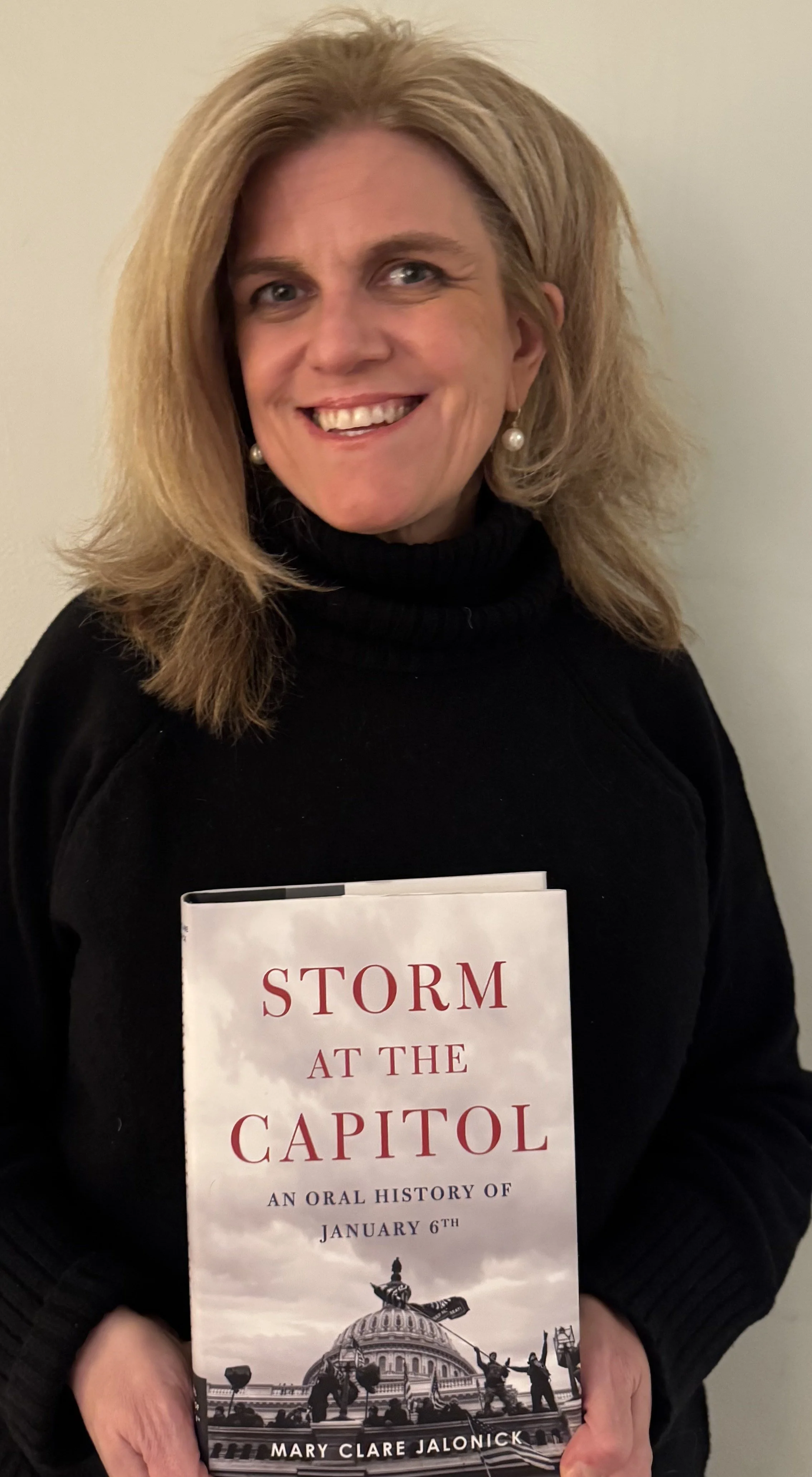
Today on The Stacks, we are joined by Associated Press reporter Mary Clare Jalonick to discuss her new book Storm at the Capitol: An Oral History of January 6th. In this book, Mary Clare offers a comprehensive retelling of the January 6th insurrection through firsthand accounts from the people who were there, from rioters to police officers to lawmakers and more. We talk about why she thought this story was best told through oral history, why it was important that she capture the violence of that day, and how the narrative surrounding January 6th has evolved over the past five years.
The Stacks Book Club pick for January is Girl on Girl: How Pop Culture Turned a Generation of Women Against Themselves by Sophie Gilbert. We will discuss the book on Wednesday, January 28th, with Christiana Mbakwe Medina.
LISTEN NOW
Apple Podcasts | Spotify | Google Podcasts | Overcast | Stitcher | Transcript
Everything we talk about on today’s episode can be found below in the show notes and on Bookshop.org and Amazon.
Storm at the Capitol by Mary Clare Jalonick
“Unabridged: The Art of Oral History with Garrett M. Graff” (The Stacks)
“Day of Rage: How Trump Supporters Took the U.S. Capitol” (By Dmitriy Khavin, Haley Willis, Evan Hill, Natalie Reneau, Drew Jordan, Cora Engelbrecht, Christiaan Triebert, Stella Cooper, Malachy Browne and David Botti, The New York Times)
Those Guys Have All the Fun by Tom Shales and James Andrew Miller
“Convicted US Capitol rioter turns down Trump pardon” (Robert Plummer, BBC)
Frankenstein by Mary Shelley
“Ep. 396 Frankenstein by Mary Shelley” — The Stacks Book Club (Angela Flournoy)”
The Count of Monte Cristo by Alexandre Dumas
Fear and Fury by Heather Ann Thompson
The Only Plane in the Sky by Garrett M. Graff
The Devil Reached Toward the Sky by Garret M. Graff
Unthinkable by Jamie Raskin
To support The Stacks and find out more from this week’s sponsors, click here.
Connect with Mary Clare: Website
Connect with The Stacks: Instagram | Threads | Shop | Patreon | Goodreads | Substack | Youtube | Subscribe
To contribute to The Stacks, join The Stacks Pack, and get exclusive perks, check out our Patreon page. If you prefer to support the show with a one-time contribution, go to paypal.me/thestackspod.
The Stacks participates in affiliate programs. We receive a small commission when products are purchased through links on this website.
TRANSCRIPT
*Due to the nature of podcast advertising, these timestamps are not 100% accurate and will vary.
Traci Thomas 0:00
And why did you want to do it as an oral history? As you said, You are a reporter. You tend to write your own stuff. You use your own words. So what was it about this day that you felt like I gotta change the form.
Mary Clare Jalonick 0:13
I think this is obviously a story that's had a lot of changing narratives, and a lot of people who are sort of trying to create narratives around it. And so for me, it's kind of almost like a bit of a foolproof way to get that history out there in the words of the people who were there and witnessed it without, you know, it's not my narrative, it's not somebody else's narrative. It's not partisan. It's really just like the words of the, you know more than 150 people who were there.
Traci Thomas 0:49
Welcome to The Stacks, a podcast about books and the people who read them. I'm your host, Traci Thomas, and today I am joined by Associated Press reporter Mary Claire Jalonick to discuss her new book. Storm at the Capitol, an oral history of January 6 in this book, Mary Clare Jalonick, who was on the scene that day, offers a comprehensive retelling of the January 6 2021 insurrection through the first hand accounts of rioters, police officers, lawmakers and those who were forced to flee the violence. Mary Clare shares with me why she wanted to tell this story via oral history, what details she was hoping to bring to light, and how her experience on the ground informed this story. Our book club pick for January is Girl on Girl How pop culture turned a generation of women against themselves, by Sophie Gilbert with Christiana Mbakwe Medina returning as our guest on January 28 everything we talk about on each episode of the stacks is linked in our show notes. If you like what you hear today, if you want more bookish content or a community of readers to help you stay on track with all your reading goals this year, consider joining The Stacks Pack on Patreon and subscribing to my newsletter. Unstacked on Substack. Each of these places offer different perks, like bonus episodes, community conversations, hot takes on the latest literary and pop culture news, plus more, and your support makes it possible for me to make this podcast every single week. Head to patreon.com/thestacks to join The Stacks Pack and check out my newsletter at TraciThomas.substack.com. All right, now it is time for my conversation about January 6 with Mary Clare Jalonick.
All right, everybody. I am absolutely thrilled to be here today with Mary Clare Jalonick, she is the author of a brand new oral history called Storm at the Capitol: An Oral History of January 6. I think the subtitle sort of gives away what the book is about. Mary Clare, welcome to The Stacks.
Mary Clare Jalonick 2:42
Thanks so much for having me.
Traci Thomas 2:43
I am just I personally am a big fan of oral history. I feel like there could be so many more in the world. And last year, we did a bonus episode with friend of the show, Garrett M Graff, who is great oral historian, and he just casually mentioned, oh, you know, there's this, like oral history of January 6, coming out next year. And I said, Excuse me, what? And from that moment, I was committed to having this conversation today. So I am so happy that you're here.
Mary Clare Jalonick 3:15
Well, thank you so much. I heard that actually and I found it somewhere. And I was so honored that he mentioned that, because he's obviously so good at it, kind of the master, the sort of modern master at doing that.
Traci Thomas 3:30
Let's sort of before we even, I have so many questions for you before we dive in. For people who aren't familiar, will you sort of explain in 30 seconds or so what Storm at the Capitol is about?
Mary Clare Jalonick 3:39
Sure it is a it's sort of a collective history. It's an oral history of January 6, 2021 and it's really sort of inside the building and outside the building that day includes lawmakers, police, workers, staff, journalists and the rioters themselves around you know, little less than half of the interviews are my own interviews. I'm a reporter for the Associated Press. I work in the Capitol. I was there that day, and I've been covering it pretty much ever since. So a lot of the interviews are my own. But then I also there's just like, such a rich archive of interviews from court and congressional testimony and everything else FBI interviews. So I use some of that as well to sort of fill it out and try to get as many perspectives as possible.
Traci Thomas 4:28
And why did you want to do it as an oral history? As you said, You are a reporter. You tend to write your own stuff. You use your own words. So what was it about this day that you felt like I got to change the form.
Mary Clare Jalonick 4:41
Well, a couple of things. I mean, I think this is obviously a story that's had a lot of changing narratives, and a lot of people who are sort of trying to create narratives around it. And so for me, it's kind of almost like a bit of a foolproof way to get that history out there in the words of the people. Who were there and witnessed it without, you know, it's not my narrative. It's not somebody else's narrative. It's not partisan. It's really just like the words of the, you know, more than 150 people who were there. So it just seemed like a really good way to tell this story. Also, I had a lot of I just been doing so many interviews because I'd been covering it. And, you know, a lot of the coverage centered around what was happening in the White House and Trump. But when I was doing those interviews, and you know, even when I'm talking sometimes to people who nothing to do with January 6, just anything else that I happen to be covering, I had just asked a lot of lawmakers about their experience on that day. And I always sort of tried to do that. And so I just had a lot of really good, you know, we always, we sort of call it like in our notebooks, you know, I had a lot of stuff that I wasn't able to use, just because it, you know, you can only use so much. But so I really, you know, I felt like there was, there was a lot more that people didn't know, and a lot of little stories and a lot of anecdotes and just, you know, things to sort of shed light on, on what happened.
Traci Thomas 6:06
How did you find the craft of oral history? How did you find this sort of form for yourself?
Mary Clare Jalonick 6:12
I loved it. I mean, I always have loved oral histories, too. I have, like, you know, my husband is a big reader, and he's kind of funny. He was like, I don't really like oral histories. I think he liked mine. He's been very complimentary of it, but I but, you know, just when I was starting this process, he was sort of, you know, kind of wasn't, as, you know, interested in that, that kind of reading, that kind of book. But I have always really liked oral histories. I think they're really I just, I love reading them. And I just felt like I really liked that, like organizational process of sort of putting everything together. I really, I really enjoyed it. And, you know, I wanted, I didn't want to stop when I had to stop because we had to get the book out. But I, you know, I feel like it's also, it's different writing process, because it's not like you write a chapter and you're done. The way the book came together was not at all like chronological in terms of the pages of the book. It's like, you know, just sort of putting things in where they went in the timeline. So, I mean, I could add, I could have added to it forever. So I just really, you know, I really enjoyed it, and I could double the size of the book if I had the chance, right?
Traci Thomas 7:26
So I think that's what's so interesting, is it's like, and I think Garrett said this to me, that it's a sort of a, really a task of editing in a lot of ways, of like you are shaping and crafting this narrative. And I think while you're using people's words, you also, as the author, have a lot of control about what kind of story you're telling, and so I'm curious, like, what kind of story did you want to tell? What was important to you to make sure that people understood about this day five years later?
Mary Clare Jalonick 7:55
Well, I really wanted to, I mean, a lot of the details of the violence were important to me, because that's something that's been disputed. And, you know, a lot of these stories, if you go through the police officers when they're speaking in a very matter of fact way, whether it was in an interview or, you know, in a court proceeding, in court proceedings can be pretty dry. You know, I have colleagues who are covering the court cases, and they have these amazing databases of all of the cases that I really that helped me a lot. But one of my colleagues said, when I was sort of starting talking to him about it, he was like, you know, a lot of this is really dry in court, like when they're, you know, it's like legal language and that kind of thing. But when I got into the cases, I really didn't feel like that was the case. I mean, there was a lot of really dramatic things that that these people were describing, and often, whether prompted by lawyers or not, we're talking about how they felt in the moment and how stressful it was. And in some cases, you know, they brought in police officers in these trials, they brought in Secret Service. You know, I could probably not get access to one of Mike Pence is Secret Service agents to interview, and that would be hard, that I would be really hard for me to get that interview. So the fact that they like had that in the court case, it was a lot of people that I might not have been able to talk to, or police officers who wouldn't have maybe done a personal interview, or who wouldn't have been authorized to do an interview. That was an issue in a lot of cases. But then they, of course, were, you know, telling their stories in court. So I think those are stories that we might not have had access to if there hadn't been all those records. So that was, I thought that that what I found, I mean, and there's so many, there hundreds of cases, so I, you know, I could still find more. I'm sure, you know, there's, there was just so much material,
Traci Thomas 9:45
yeah, do you feel like, I mean, you were there that day, and you mentioned that in the introduction, you sort of mentioned that again, like you have your own section at the end called, like, my story, where you sort of share your experience of the day. And I. Wondering, like, what do you make of the way that January 6th was covered has been covered, you know, as we've just passed this five year anniversary,
Mary Clare Jalonick 10:10
yeah, I mean, you know, I work for AP, and we're very straightforward. So it's like, hard, but it's also really easy, because, you know, what we do is we just report the facts and what we know to be true. And so, you know, we've sort of gone through covering it in that way, but it's definitely been interesting to see. I mean, the people that we're talking to in the Capitol, some definitely downplay it, or, you know, try to distort the facts of what happened, or, in more cases, like, just ignore it like it didn't happen. So, you know, one thing that we found, and that I think is interesting, is, while a lot of people do try to downplay it, I think there's a lot of interest in the subject. And, you know, I think we saw that in the last week, on the fifth anniversary, there was a lot of coverage of it, and a lot of interest in it, and not also on Capitol Hill, where they, you know, they just the Senate approved a plaque that the house was, you know, trying to, sort of not put up, even though they were supposed to, by law, was a plaque that was going to honor the police who fought there that day. And it's been sitting in a basement, I think, for the last few years, because Republicans in the House did not want to approve it. And I think that it shows that there is, like, a continuing interest in this story. There are, I do find that, like, people are kind of hungry for details about it.
Traci Thomas 11:33
I mean, I think one of the things that you do so well in the book, that I really appreciated is, you know, I'm here in California, and at the time my I have twins, and they were born in December 2019. So in January 2021, you know, as you talk about in the book, sort of deep covid. I was trying to be a mom. And I remember that that day because it was kind of morning ish, for me, it was like, after their morning nap, and I had was on the phone with my brother, and I was like, Oh, I might take the boys to the park. And my brother was like, Are you watching the news? And I was like, Well, I turned it on. I saw that they were like, doing stuff, like they were, you know, like they were out, out protesting. And he was like, You need to turn on the news. And I was like, okay, and by the time I finally, like, sat down to turn on the news, we did not go to the park that day. I think that, like, I was so confused and like, didn't really, I don't know when, like, the images I was seeing didn't feel like what I read in your book, like what you were talking about the details and the violence. Like, if you had asked me a week ago, before I finished your book, how violent on a scale of one to 10 that day was, I probably would have been like, I don't know, four or five. Like, they definitely were, like, breaking the building and they were climbing and like, I know there was a lot of like, tear gas going on, but some of the like descriptions of the hand to hand combat, and like how much that came up. I have no memory of that whatsoever, even watching live on television, like I remember the qanon shamans picture, like I remember some of those still images and some of the you know, video clips you talk about in the book that journalists in the building had captured, like, I remember some of that, but so much of what was happening outside the capitol felt completely, sort of fresh to me in a lot of ways, or like the details felt so new. And so I think one of the things that's really like incredible about this book is you have captured that day in a way that I think you know, many people maybe have forgotten, because I did. I went out to dinner with some friends after I started the book, and I asked them on a scale of one to 10, and one person said seven, and one person said five, and I think I said three, maybe I don't three or four, like, I just didn't remember that. So I'm curious, like, if you were sort of hoping to, kind of like, if there were things you were hoping to make sure were entered kind of in the public memory again, about this day?
Mary Clare Jalonick 14:14
No, I think that's so true. I think that's a really common experience. I had another reporter on Capitol Hill who is actually younger, and who wasn't around then, and someone who's extremely plugged in and extremely smart and works in in the capital, and said to me, I had no idea how violent it was. I think that that's true of a lot of people, and for lots of reasons, I think because a lot of people haven't, you know, a lot of people still find it really painful to talk about who were sort of involved in that. And I think just a combination of, you know, people not feeling comfortable speaking out for political reasons, there has been a lot of backlash to the officers who have spoken out. And, you know, they get called buyers, and they get, you know, targeted in all sorts of ways. So I think a lot of other officers have no interest. Interested in becoming public like that, or maybe aren't authorized to. So I think a lot of those stories did come out in court. But you know, there's only so much, there's so many cases. There's only so much that, you know detail that's going to come out in just in the public sphere without, like, going and reading all those court records. So yeah, I mean, and I think also, when you're talking about that day, I mean, we didn't know how violent it was either. I didn't, I didn't know how violent it was. I would say, a couple days later, I knew it was bad, obviously, but really, the videos of all the violence outside and I guess what I would say to anyone who is surprised at how violent it was too, is one other way to, sort of, you know, read the book for sure, not to, not to downplay that, but also, you know, Google, or, you know, search on the internet, some of the videos from that day they, you know, there's so many, so many videos. There's a huge video archive, a lot of it filmed by the rioters themselves, of what happened in so many different places, there really is a lot of evidence of that, but I'm not sure how often that's being, you know, aired, or if people have seen it, so I think that's a really common experience. And for me, I didn't realize it for, you know, a couple days until that stuff sort of slowly started coming out, and then Congressional investigations brought a lot of it out as well.
Traci Thomas 16:21
Yeah, I think that. I think that was really something to me. And then also, and I want to get your take on this, because one of the things that I felt was so shocking in this book was, like, how long the House and the Senate and everybody, like, stayed in the building? What I think I'm naive in some ways, even though I'm pretty cynical in general, that, like, I just assume that people in charge have more information than me. Like that, people in charge just know, like, I just assume that the Capitol Police, and like, the DC like Metro Police, they just like, we're prepared for this day. And I assume that as people are marching towards the Capitol and, like pushing through barriers that they're like, Hey guys, we should go. But that very much is not what happened that day. And you we get this harrowing scene of which you know you were a part of, though you're not a part of the book, which I do want to talk about later. But like that you experienced where they have the House of Representatives and everyone in that chamber, like putting on gas masks and like ushering them out as people are banging down the doors and just, why was everyone in there for so long? Why didn't they say, Hey, let's just evacuate. We have these tunnels. Like, better safe than sorry.
Mary Clare Jalonick 17:38
Yeah I mean, extremely good question. Um, there were a lot of security failures that day, obviously, yeah, no, it's, it's, you're not naive. I mean, it's crazy, like It's so wild that they were still in session, you know, when, when the rioters had already gotten in, they were right outside the Senate, and, like, almost the entire senate was still in the building, I mean, in the chamber, listening to it right on the other side of the doors, people screaming and yelling and hoping to get in. And that's actually really unusual, because the two sides had split to debate the Arizona electoral votes and that so that was, like, part of the process, because there had been objections. But usually, like, the entire senate is not in the Senate and the entire house is not in the house. Like, that's pretty just the way a normal day goes. Votes take a while. People go in and out, and when there's not a vote, there's almost no one in there. So for, like, the entire Senate to be in the Senate, it was all but like, maybe 10 of them is wild and like that. For that to be happening in that moment the Senate got out, moved a little more quickly because they but, you know, they were already in the building on the Senate side, but yeah, the house actually went back into session at one point when there was, like, our reason in the building, yeah, and we had no idea. But, I mean, yeah, it's really it was a lot of just confusion, and a lot of it was because of a massive security failure. But also, I think you know what they would say too, is just that they would never imagine that something of that level would happen with that many people getting into the building so violently. It was definitely a failure of imagination as well. Yeah, it is a pretty wild timeline. And yeah, it is. It's hard to believe that it happened that way.
Traci Thomas 19:14
And the other piece of that that I guess I have questions about, and I don't know, maybe you don't have the answer, but one of the things that really stuck with me was like, the police start putting out these calls to like, hey, more we need more police. Like, if you're around, you know, come in or whatever. And then in the book, we get these quotes from different officers that sort of like, we showed up and we just, like, went to work. But was there not like, an overreaching person in charge, being like, hey, now that you're here, this is where you need to go. It just felt like people were just showing up and just like hopping into the fray. Is that really what was happening?
Mary Clare Jalonick 19:53
Yes, absolutely not, especially on the Capitol Police side of things, you know, there were. Were, a lot of people describe just total chaos on the radio. There really weren't people giving commands. They locked down the building and they told them that, but people just Yeah, went where they thought people needed help. There were some some people would call for help on their radio, and then people would hear that and go to that place. But it was all sort of up to each individual officer for the most part, and then they called, and that's the Capitol Police, and then they called in the Metropolitan Police, which is DC police, was there within like 10 minutes of that call, and they really took over in a lot of places. Capitol Police was just understaffed. They hadn't had the intelligence to really warn their officers that all this was going to happen. Equipment was failing. We wrote about, you know, not too long afterward, there were, you know, there were shields that were just breaking on impact because they were old people didn't have the training for a lot of this. There were, you know, one officer was saying her, she was like, part of, like, the hard unit that was on the front lines. But her her gear was like in a van somewhere, so she couldn't access it. So, you know, there were all sorts of failures like that, which they have spent the last five years, you know, trying to improve, certainly. But yeah, they've done a lot, you know. And also a lot of them, you know, some of their testimony was that that a lot of these people seem to know what they were doing, and they seem to have sort of a planned route. And there's a really good New York Times video essay that came out in 2021 at some point, and that, I think, is worth watching. They did a lot of really good they did a lot of really good, like video essays that year, sort of showing video essay might not be the right word, video packages showing a lot of the footage that had been compiled and how people got in, and you know how some of it seemed to be planned from some of the extremist groups sort of knew where to go and exploited some of the holes in those police lines.
Traci Thomas 21:55
I'm going to find that New York Times video piece, and I'll link to it in the show notes as well. With everything we talked about, let's take a quick break, and then I want to talk more about these rioters. Okay, we're back. And you mentioned before that, and this comes up in the book a lot, that the police sort of felt like this was a coordinated attack, or these people knew what they were doing, whether they were former military or police themselves, just that they had a sense, and in reading the book, it felt pretty difficult for me to believe that this is like a spontaneous event that happened just because Donald Trump said we're gonna go to the capitol and that all of a sudden all of these people go and they're like, pushing through barriers and attacking the capitol in this way. Is there like, legitimate evidence, or, like, is there anything that points to like this being a much more coordinated attack, that these groups were working together, had a plan, and that, obviously, some people get swept up in the moment. You think you're just going with everybody else, but that there were people on the ground there who were like, we're gonna go into the Capitol, we're gonna try to fuck shit up. Like, what was the real who was in charge here? I guess is the question.
Mary Clare Jalonick 23:12
I don't think anyone was in charge, but I think that that's true. I think there was a real diver. And, like, one thing that I found definitely, and, you know, I think that we've seen in terms of the riders who have talked about about their experiences, and there was such a diversity of people there, of motivations there. I mean, there were definitely, like, the extremist groups who had, like, guns in Virginia in a hotel room, just in case, like civil war broke out. There were people who brought weapons. There were people who, you know, as we were saying, like, definitely appeared to, like, be really tactically looking at how to get into this building so, and there was tons of people planning this openly online, like that they were going to get into the building and stop it. And that was, like, part of the security failure is that they should have, you know better, yeah, prepared and seeing all of that, some did, but there just wasn't enough coordination on that. So yeah, I mean that that definitely, but I do think there were some people that it was spontaneous. So I think that was really interesting to me, that there were so many different types of experiences there. From the rioter standpoint, there's one man I interviewed for the book who I just found super interesting, Jason riddle, who he actually tried to reject his pardon earlier this year. And he has spoken about, you know, his experience. And he went into the building, he was just like he said, he thought about like a party. It was like euphoria for him, you know, he was a Trump supporter, and he was going to rallies all the time. It was like, what he did, and he said, I don't even think I believed in the lie, but it was just like, you know, something that I did is go to these rallies and and he, you know, ended up at the Capitol, and his friends said, I'm I'm not going past this barrier. You. Know. But he was like, Okay, I'm going to do it, you know? And so he just sort of went in by himself, and he ended up in the Senate parliamentarian's office, which was being ransacked. And I don't really think he ransacked it, except for that, he like, went and stole some wine, and then he started drinking. He stole a book, and he went outside, and he actually sold the book called Senate procedure book, to another writer, and the other writer told him that there was he should he just seen someone taken out of the out of the building who appeared to be shot, which I assume was Ashley Babbitt, who was shot trying to get into the house side. And he said, after he said that, you know, he realized he what he was doing was wrong, that he could get in a lot of trouble for it, and he said he just ran until he was in, like, looked like a different place. And so I thought that his experience was, like, his interview was really interesting, because he, like, sort of described what he was feeling in the moment and why he did it, and also sort of like, had some perspective on it.
Traci Thomas 26:00
I think so, as I mentioned, I was reading this kind of over the holidays, so I was talking about it with my family a lot, which I don't always do when I'm, you know, reading for the show. Like, I don't always have an audience where I'm sitting in a room and they're like, What are you reading? What do you think? You know, but we there was conversation coming up about this book, and one of the questions that my brother asked, that my mom asked, was, like, I thought that these people Trump supporters were pro police. I thought that these people, you know, supported law and order. How could they have been the ones who were so aggressively violent with the police? And you definitely talk about that in the book, but I'm sure listeners today are probably have, kind of have that same lingering question, Would you be able to sort of address that?
Mary Clare Jalonick 26:50
Yeah I mean, I think it's such an amazing contradiction, right? And it was like, even to the point that some of the officers were saying, you know, I think it was, they were like bringing it up in the moment, saying, We support you. You just have to let us through. You know you you should be on our side. You know you should agree with us. You should, you know, we know you are on our side, you know. And some of them probably were in terms of, like, maybe thinking that the election had been stolen or whatever, not that they weren't still fighting, you know, trying to push them away from the building. There certainly is, like, a conservative bent in a lot of police departments. And some of the officers I've interviewed have talked about that, that some of the, you know, some of the officers who they were fighting with that day still do support Trump, but at the same time, yeah, it is such an interesting contradiction. And I think it really some of the officers I wrote a story a week ago for AP, you know, they're really still having a hard time with this, and we'll talk about it. That people talk about how they support law enforcement, but then at the same time, sort of just conveniently leave off this part. And one of the officers I interviewed in the book. It was interesting because I interviewed two MPD officers who actually, kind of like, told me the same story separately. I didn't mention either one to either of them, but sort of said they were comparing and contrasting fighting right wing people and fighting people who are aligned with Antifa, and saying, like, you know, a lot of times, the left wing protesters will, like, throw something at you and then try to film you and say that you know you're you're trying to attack people that they said, that the right wing protesters will get in your face and really aren't scared. That's not anything indirect. It's like very much face to face, and that they're really, really nice to police until police get in the way of something that they want to do, and then it kind of goes out the window, but, but, you know, they have talked to about how, like, you know, a lot of these protests, they're getting a lot of love, you know, the right wing protests, because people are supporting them. So, yeah, that, like, it's like, such a wild contradiction that I think a lot of people are still reckoning with,
Traci Thomas 29:01
yeah, one of the things you just touched on was something that also was, like, so clear in the book, was the entitlement of so many of the rioters, right? It's like, when the police get in your way what you want to do, all of a sudden it's a problem. Like, I love the police, on the police, then you get in my way, and it's like, No, babe, gotta go. This is what I want. And I think that that like sense of entitlement, of like, this is like, I think I can't remember who said it, but someone that you know is quoted as saying something along the lines of, like, they wouldn't even let like, I can't believe they were hitting us or spraying gas at us. They wouldn't even let us talk. And it's like, okay, but you're not talking like, let's be real. You're in the middle of a mob, and you're breaking into the Capitol, and you know you did talk your your guy just had a big speech. You guys have been talking about stop the steal for months. At this point, few months, and you have been allowed to talk, but the idea that, like just some of the contortions of logic. Yeah. I mean, I think that's like, one of the things that is so special about oral history in general is like, you get to understand how a person can justify almost anything to themselves, whether it's an oral history of like, ESPN or an oral history like, it's just the way that people reason with themselves and then reason with whoever they're talking to, whether it's you, the interviewer, or in court or whatever. But I found that to be just spectacular in this book.
Mary Clare Jalonick 30:32
Yeah, well, I was, like, really excited when I would find anything like that that was sort of explaining those motivations of people. Especially, it was great to talk to people like Jason riddle, who were, you know, regretted it, and had that perspective. But I also really wanted to have the perspective of people who were trying to explain what they were feeling in the moment and why. And I thought, yeah, that was really helpful. When people would say things like me, they were like, well, we're trying to get in the building, and they're keeping us from doing that right, and we have the right to be in the building because we're American citizens. Obviously, no one has the right to break into a building like they did, especially violently and beating police. But, you know, I think there was like this real sense people really, really believed that the election had been stolen, and there was this sense that they had every right, you know, as American citizens, to be in there and to try to, you know, overturn this result that they really, truly felt was, you know, illegal, right?
Traci Thomas 31:30
Some of, like you said, Jason riddle, sort of has changed, changed his tune, almost like immediately, you know, in his telling in the book, what has, what have you seen over the five years, from people who are there, who either have, like, doubled down, or people who maybe have changed their tune and then maybe come back after the pardons. Like, have you seen any movement from, you know, 2021 2022 to where we are now, 2025 2026 about, about what happened? Yeah.
Mary Clare Jalonick 32:00
I mean, it's kind of all over the place. I mean, I think a lot of people were, you know, sort of emboldened by their pardons. Another writer who I interviewed, Pamela Hemphill, also had tried to reject her pardon, but she she didn't really.
Traci Thomas 32:12
What does it mean to reject a pardon? They want to keep it on their record?
Mary Clare Jalonick 32:15
Yeah, they said they wanted to reject it. I think they were just trying to make a point. Yeah, I don't think you can reject a pardon.
Traci Thomas 32:25
The point is, like we did something bad and we own up to it.
Mary Clare Jalonick 32:28
We shouldn't be excused for it because, because we did do something wrong. But she was interesting because she didn't really come around for a few years. She was really defiant for several years, and it was only, like a year or two ago that she, I'm trying to remember the exact story, and I don't think it's in the book, but I think maybe it was through therapy, or I don't want to, I don't want to say it wrong, so I'm not sure, but she, you know, sort of came to it a little later and sort of realized what she done was wrong. But then there's other people who are, like, contrite in court, but then clearly not contrite afterward. So, you know, and I think there has been, like so much political movement on this, you know, this sort of effort to defend the rioters and to downplay the violence has gained steam and really culminating right after Trump was elected. So I think people might have been, you know, I can't speak to anyone specifically on that, but it does seem like, you know, people have been sort of emboldened by that, and have a lot of support from people who think that they were truly wronged for, you know, being put in prison or being convicted, or whatever, you know, might have been their consequence.
Traci Thomas 33:38
Something, this is sort of going to be a weird tangent, but I think I can thread the needle. Something that I've noticed as a person who reads books online is that every year there's sort of like a classic book that I see a lot on the internet. Last year it was Frankenstein. Everybody was like Frankenstein this Frankenstein that, myself included, we did it for book club. It was the best book I read last year. I just loved it. And this year I keep seeing the Count of Monte Cristo. And as I've been thinking about, like, what's going on? Why are people talking about this book? What could it be? And a friend of mine was like, I think revenge is going to be really big in 2026 and as soon as they said that to me, you know, I was in the middle of your book. The next book I read was Fear and Fury by Heather Ann Thompson, which is about the Bernard Goetz subway shooting in 1984 and I just can't help but think like, maybe there's something to this idea of like we are hungry as a country for revenge. And I don't know if that like speaks to you at all, but I just sort of want to bring it to you and open the floor.
Mary Clare Jalonick 34:52
I mean, Trump certainly said in his campaign that's what he wanted to do. And if he was reelected, and we've seen him do that, yeah. On many levels. So, you know, that's sort of what I think of when you're saying revenge, and that's totally fascinating. And yeah, no, I mean, I think we're seeing that in in so many ways, from him this year. And you know how that all plays out, I'm not sure. But yeah, no, I think that's super fascinating. And yeah, I mean, that's, you know, to an extent, sort of what we saw with the pardons and everything is, you know, and also, just like defending people who obviously were supporting him, but that's that's super interesting, yeah, I think keep an eye on it. Yeah, we're trying to figure stuff out right now. I think there's things happening so quickly. And one of my favorite quotes in the whole book is from Manu Raju, who's a anchor and congressional correspondent for CNN, and I don't have it right in front of me, and I can get it and read it if you want, but it's basically talking about how we're still reckoning with this, and we're still finding out so many details about what happened that day and that we didn't realize in the moment, like, how big this was going To be, and just like that sort of idea of it being kind of a dynamic thing that everyone is still figuring out. I think that's really interesting, because, like, something like, and I don't want to compare this 911 obviously, so many people died on 911 huge, you know? I mean, it's a different situation. But just talking about something big like that that happened, like a big political thing that happens to our country. You know, there certainly, there were investigations, and we did learn a lot as the years went on. But, you know, the basic facts were not in dispute. People understood what happened on that day. And I think a lot of people have a lot of dispute over the very most basic facts of the event. And that's, that's, like, an unusual situation,
Traci Thomas 36:44
that's right, that comes up in the book of, like, you know, there's a moment in the House chamber where this is all going on, and one of the congressmen is, like, you guys did this, like, they're like, fighting in the moment over, sort of like the rhetoric, and, you know, I think someone's like your guy, this is your guy, or something like that, in reference to Trump. And I think like that part of this is also really fascinating, of like, the spin and the media interpretation and the ways I mean Ted Cruz has this fascinating leap of logic at the end of the book, when they're back. You know, the Senate has reconvened, and he's giving like a pep talk to the other people in his camp, because his camp was like, we're gonna we're gonna dispute this, and then we're gonna have to go to a debate, whatever. And he's like, this is what the protesters would want, is for us to not do this, so we've got to do it. And I'm like, No, babe, the protesters want you to do what you're doing. Like, it's just the ways that this story has been spun and how, you know, sort of like, activist different people have been in this story is really an interesting thing to kind of watch in real time, as you know, an adult who is paying attention even a little bit of like, whoa Trump called them tourists, like, what are we doing here and that and that? You know, you're a journalist that, like, he gets away with it, right? Like that. It's reported as such.
Mary Clare Jalonick 38:18
I think people are testing, like every day the boundaries of what people will believe. And I think sometimes they find that people will believe it. So I included at the end, sort of some of the things that people have been saying about it. And one was just a year ago, on January 6, 2025 a Congressman Mike Collins put on Twitter, you know, it was, like, it was peaceful grandmothers who came and, you know, and, and, you know, I'll be an unauthorized visit, you know. And, you know, really sort of like, it's almost like a troll, you know, I don't, I don't know what his motivation was, but it is really interesting, like, just this sort of effort to say no, this really was peaceful, and you've been completely misled on this. And there's a lot of people who are willing to believe that, and they're not necessarily seeing the video or hearing stories of the police officers or whatever. So, you know, I really, it's really important to me that this book was like, straight down the line, and it didn't, it really seemed, you know, that's my job too. Is like not to be have a partisan narrative or have a bias or a dramatic narrative that makes it seem like, you know, I have a point of view. My point of view is, like, I just want the facts to be out there. And so that's really important to me, that people who might not believe this or might support Trump or whatever can read this and find it to be straightforward, and you know, not feel like you know this is some sort of narrative that they're being fed.
Traci Thomas 39:54
I sort of brought this up earlier, and I do want to ask you this quickly, which is, did you ever consider. Are including your own story, your own voice, as one of the voices in the book, and if so, what made you take it out?
Mary Clare Jalonick 40:07
I wasn't totally sure how to deal with that. I don't think I was ever going to like, have it as like a blurb, and with the other blurbs would just be weird. I don't know, like Tom I would do that. I think originally we were thinking about maybe having more sections that have my story, like, interspersed, but it just seems like that was too focused on me. Not only was that, I'm like, I'm an Associated Press reporter, I am not like, I am not a I don't I'm not used to having, like, my name out there, or my like, that's not, you know, we're sort of about like, staying in the background and, you know, you know, having the story be the most important part. And so it is, like, weird for me, but also I just thought, like, narratively, and that's something that we discussed, like, discussed my editor was, like, trying to break it up with that was just like, totally get in the way of the story. So we kind of, and I actually cut it quite a bit at the end too, because there I had, I think it was a little bit longer than it was, but it was just sort of like, okay, we already know all the facts of what happened. We don't need, like, a whole nother long story about somebody's day. So, you know, it was, we sort of made it shorter in the end, which I think worked better. So, yeah, I just it was, it was, I was trying to reconcile too. Like, I didn't, I didn't have an interesting experience, but I didn't, you know, I wanted to focus more on, like, the police officers and, you know, lawmakers and people who were not me, but yeah, so that was, really, was a discussion, and I wasn't sure how to do that. My husband was also there that day
I was curious if he was gonna be in the book too.
Yeah, I was, you know, do I put him in as, like, a, you know, as, like, one of the voices and like, we didn't really end up doing it because thought it would be strange, but I did mention him, you know, I talked about his experience in in my narrative. So, yeah, that was definitely a discussion about like, but I, I'm always most comfortable taking myself out of it as much as possible. But I also felt like it was important to like have that, you know, at least, you know, tell my story a little bit.
Traci Thomas 40:11
Yeah. So something I always ask folks about here is, how do you like to write, how many hours a day, how often music or no in the home, out of the home, snacks, beverages, rituals kind of set the scene for us.
Mary Clare Jalonick 40:11
This is such a fun question because it's like, I mean, like, it seems like chaos. I mean, yeah, I Well, I have, I'm really busy. I have my job. My day job is extremely busy. I have two kids who are now teenagers. It is, like, it's, I wrote a lot of or, you know, compiled and wrote a lot of this book in the middle of the night. Basically, a lot of it was really late. And when I was on book leave, which I took for a few months and was not long enough. I was literally like, I was like, how little sleep can I get and survive? And that's what I'm going to do. So I am, which I've always been able to sort of not sleep. That's just how I am. I can function on little sleep. I'm really looking forward to getting more sleep this year, but I but, yeah, I know. I mean, it's very much like, sort of like at my kitchen counter, you know, just just really, like, I, and I was talking to the friend of mine the other day too, like, how different people are when they're writing. And for me, it's very much like, just burst and like, then I just go into like, total focus. And sometimes I'm not really even thinking about what I'm doing. I'm just doing it and music. Yes, I love listening to it. That's actually something we discuss with my colleagues too. Is, I don't know, since I was a teenager doing homework, I've always like, I can get more motivated when I'm listening to music. It just sort of like, keeps me what kind of focused? Oh, I don't know. Well, I sometimes classical like, when I'm really in the zone, like, classical music is, you can't have anything that's going to distract you, okay, so, but, but generally, also, just like, like, energetic music, like, you know, like, sometimes, like pop, like, just anything that's like, getting me, like, I don't know, it's so weird, it's funny. Like, some people can't even imagine doing that, but, yeah, just like, I don't know, it's like, it gives me adrenaline or something, I don't know, but, like, I definitely listen. I had some late nights listening to, like class. I think when you see your Spotify rap, yeah, there were a couple of like, classical pieces that were on there because I listened and, oh, that's what it was on Spotify rap. There were like, this one day, and it was a night that I think I had stayed up all night writing, and it was like, you listened to this one piece of music, which was a classical piece of music, like, 17 times in a row. It was like, so and it was like, Oh, that is, like, just like, traumatic, right? Yeah, it was, it was really interesting, but, but also doing this, I was able to listen to music a little bit less, because so much of it was, like listening to recordings of interviews and trying to transcribe so that, you know, got in the way a little bit of of the music part.
Traci Thomas 44:44
And you didn't answer this part of the question, but I have to follow up, which is snacks and beverages.
Mary Clare Jalonick 44:48
Oh, um, I drink a lot of Diet Coke.
Traci Thomas 44:51
Me too!
Mary Clare Jalonick 44:52
Not that proud of it, but
Traci Thomas 44:54
Oh no. We're very Diet Coke friendly here at The Stacks.
Mary Clare Jalonick 44:58
Sporadically, yes, but nothing that is like that I would remember or say one thing I did do, especially in this this period finishing, it was, like, just a lot of coffee
Traci Thomas 45:09
Black coffee?
Mary Clare Jalonick 45:12
It was like a latte that I would get, I dropped my son off at school in the morning and get a venti from Starbucks
Traci Thomas 45:18
It's not that. I just want you to know I've gotten way more intense answers
Mary Clare Jalonick 45:25
And then just like, drink it all day, and, like, save some of it until, like, the evening, because I knew if I had the rest of it in the evening and I would help me stay up.
Traci Thomas 45:34
That's amazing.
Mary Clare Jalonick 45:35
That wasn't like, the real crunch period. I don't do that anymore.
Traci Thomas 45:39
There's no shame. There's no shame.
Mary Clare Jalonick 45:41
What can you do to, like, stay up as long as I can? Because I just, I knew, you know, again, like, with the oral history format, it was, like, the more stuff I can get in there, the better it's gonna be. And I only have this much time to finish. You know, I've been working on it for years, but I, you know, when I was really just finishing it, there was always just, like, so much more I wanted to tell, like, so many more stories I wanted to tell. And so, you know, just the more time I was awake and working on it, the more voices I could get in the book. And the more, you know, and I that was just, like, really important to me, to just get as many, you know, good. You know, some things didn't end up staying in there. But, but many voices.
Traci Thomas 46:20
Is there anything that you remember specifically, like, that's not in the book that you wish could have been?
Mary Clare Jalonick 46:27
Well, yeah, there's, there's definitely, like, workers and Capitol Police in the building that I would have loved to have talked to, but are not authorized to talk about that, and I didn't want anyone to lose their job. So that that was, I think that there, I think there's definitely, I think there's a lot of stories that, and I don't want to, you know, I think there's a lot of stories that are being told and, and I was pleasantly surprised at how many people would talk about it. But I do think that there are still a lot of stories that haven't been told from, maybe from people who, you know, janitorial staff, or, you know, people like that, who, you know, really their supervisors in the Capitol, especially who now answer Republicans are never going to authorize them, and they don't have a lot of power in that situation, right? And so I certainly am in the Capitol. I could walk up and interview people and just ask them stories, and maybe they would talk to me, but I really was important to me not to get anybody fire trouble. But I know, I know story, you know, there's a lot of stories that I've heard off the record from a variety of people, you know, you know, up to many lawmakers that you know that I'm not able to tell because it's off the record. So, um, it just, I'm whole. I sort of have, like a dream of coming back to this at some point when people are talking about it more. I hope that people will talk about it more over
Traci Thomas 47:47
10 year anniversary.
Mary Clare Jalonick 47:48
Yeah, maybe, yeah. When, when people feel politically that they can if that does happen, of course, memories get shorter in that time too. So it's not ideal, but I hope that more people do speak out about their experiences as time goes on.
Traci Thomas 48:03
I have a specific journalistic question for you, because I'm sure people listening also have this question. There is off the record, and then there is background, and then there is deep background. Can you just distinguish those things for us, since I have a real AP journalist right here in front of me
Mary Clare Jalonick 48:19
Deep background doesn't mean anything. Like, that's not, I don't. I mean, people will say that, background or off the record, there's no like, different, there's no different grades of background. Like, usually it's like, whatever you work it out with the person. Like, what would you like me to do and say? And at AP, we have a lot of standards around that. Not everybody does, but we have really strict standards about you have to say why the person wouldn't talk. And you could never have a person on background and on the record and a story. So like, if you see a person's I mean, maybe in some publications, but in an AP story, if you see a person quoted the person, and then there's another person whose background that's not going to be that person who was quoted in the background quotes. So, you know, we try to only do that. It's definitely part of reporting, but we try to do it as responsibly as possible.
But what is background for people who don't understand the difference between those two things?
Okay. That means that someone is allowing you to use what they're saying, but you can't use their name, so it might be, you know, a person familiar with the meeting, or whatever. It might have been a person who was there. And there was some discussion about doing that in the book with like workers, or like you know, people who, who, or people who just generally felt like that, they might be targeted if they talked out about it. And I didn't end up doing that. But there's a lot of people who didn't want their names associated with that. And we've we certainly find that in a lot of a lot of cases, on the hill, just because the politics are so tense, right?
Traci Thomas 49:50
What's a word you can never spell correctly on the first try?
Mary Clare Jalonick 49:53
I know that there are words, I'm going to think of it afterward. Um, but I will tell you that I always, I still, I feel like in some sort was maybe middle school, I misspelled the word system in a spelling bee and got eliminated on the first round. And I always, every time I see that word, feel a little confronted by it. Yeah, yeah. I know there's many words in that category that I just am drawing a blank right now. But yeah, I'm not a great speller, and my kids are, unfortunately following in my they're both really like to write, and they're both really nice writers. But yeah, they're both at a lot of conferences about parent teacher conferences where spelling was brought up.
Traci Thomas 50:37
They'll be fine. You turned out they know they can still work out for people who love storm at the Capitol. What are some other books that you might recommend to them that are in conversation with what you've done here?
Mary Clare Jalonick 50:47
Yeah, I mean, certainly all of Garrett graffs oral histories are just so inspirational to me. You know, reading the only plane in the sky, I read it and I listened to it. And there's also an audio book of storm at the Capitol, which is really cool, actors doing the voices, which his did as well. And I, I read and listened to only playing in the sky. And it is so powerful. It's different than this, because it's, it's it's also 911 was so huge, right? Like it happened in so many different places. It's like, it's like the opposite, right, where this is all about what happened in one, yeah, one place, and there's so many different theaters. And like, he and there's so much archival materials, so much and he went through all of it. And I know you know all this because you've interviewed him, but I'm just for listeners. Like, it is such a powerful book, and it was something that so I did listen to it. And I remember I listened to it after I read it, but I was listening to different parts, I think, and I was on a road trip, and I listened to it for like, several hours in a row, and there was just a point where I was like, Oh, I have to stop for a minute, because it was so powerful. And, you know, I lived through 911 I was, you know, I was that was a just starting out as a journalist in Washington, and, you know, just, it's such a powerful and similar to, like, what we're talking about here, like, there's so much I didn't remember or didn't know, and just, like, getting all those voices, and just, it's just so bleak. And just, you know, hearing the things that people went through, and we know, and I think in a lot of ways, haven't thought about because we didn't want to, yeah, because it was so awful, like hearing just like having it there on paper, I think is so important, but it's also just like, it's hard, it's important to listen to, but it's also really hard. So I mean, that would certainly be the most inspirational. And I have just bought his most recent oral history about the making of the atomic bomb, but I have not totally dug into it yet. I've been busy
Traci Thomas 52:48
There's no there's no pressure to read anything around here. We're all busy.
Mary Clare Jalonick 52:54
I'll give you one more. Jamie raskins book. I was just sort of like thinking about the books that I've used sort of his research and inspiration, Jamie raskins book, unthinkable about it's also about January 6, and about his, his son died a week before by suicide. And he sort of talks about all of that, and he's a really, he's sorry. He's a Democratic Congressman Maryland. It's actually my congressman, and he, it's a really, he's a really good writer, and it's another really good look at January 6, because he was one of the people who was sort of devising with Democrats how they might fight some of these challenges. So I would recommend that too.
Traci Thomas 53:32
He's a really, he was one of my favorite figures in the book. Actually, last question, if you could have one person dead or alive read this book? Who would you want it to be?
Mary Clare Jalonick 53:42
It's really hard question. Can I dodge it a little bit and to say like, I really would like I think of people I know who are don't believe that it was violent, and think police officers are lying, or whatever. I would like those people to read the book. And I would really hope that they would read it. I already know of at least one person in my life who has who is, and I would hope that they would read it and find it to be a straightforward account that they can believe and that it sheds light and is also balanced enough that they don't feel like they're being, you know, fed anything partisan or anything like that. And that would be my, my wish.
Traci Thomas 54:22
I love it so much. Everyone. This has been a wonderful conversation with Mary Clare Jalonick, the author of storm at the Capitol and oral history of January 6. Thank you so much for being here today.
Mary Clare Jalonick 54:33
Thank you so much. Thanks for having me.
Traci Thomas 54:35
And everyone else we will see you in the stacks. Thank you all so much for listening today, and thank you again to Mary Clare Jalonick for joining the show. And I'd like to say a huge thank you to Angie Messina for helping to make this episode possible. Our book club pick for January is girl on girl, how pop culture turned a generation of women against themselves, by Sophie Gilbert, and we will discuss the book on. Wednesday, January 28 with Christiana and beckway Medina. If you love the stacks and you want inside access to it, head to patreon.com/the stacks to join the stacks. Pack and check out my newsletter at Traci Thomas, dot sub stack.com make sure you are subscribed to the stacks. Wherever you listen to your podcasts, and if you're listening through Apple podcasts or Spotify, please leave us a rating and a review for more from the stacks. You can follow us on social media at the stacks pod, on Instagram, threads, Tiktok and now YouTube, and you can check out our website at the stacks podcast.com this episode of the stacks was edited by Christian Duenas, with production assistance from Sahara Clement. Additional support is provided by Cherie Marquez, and our theme music is from tajirigis. The stacks is created and produced by me, Traci Thomas.
.