

Ep. 411 I Don’t Believe Any Moment in History Is Dry with Heather Ann Thompson
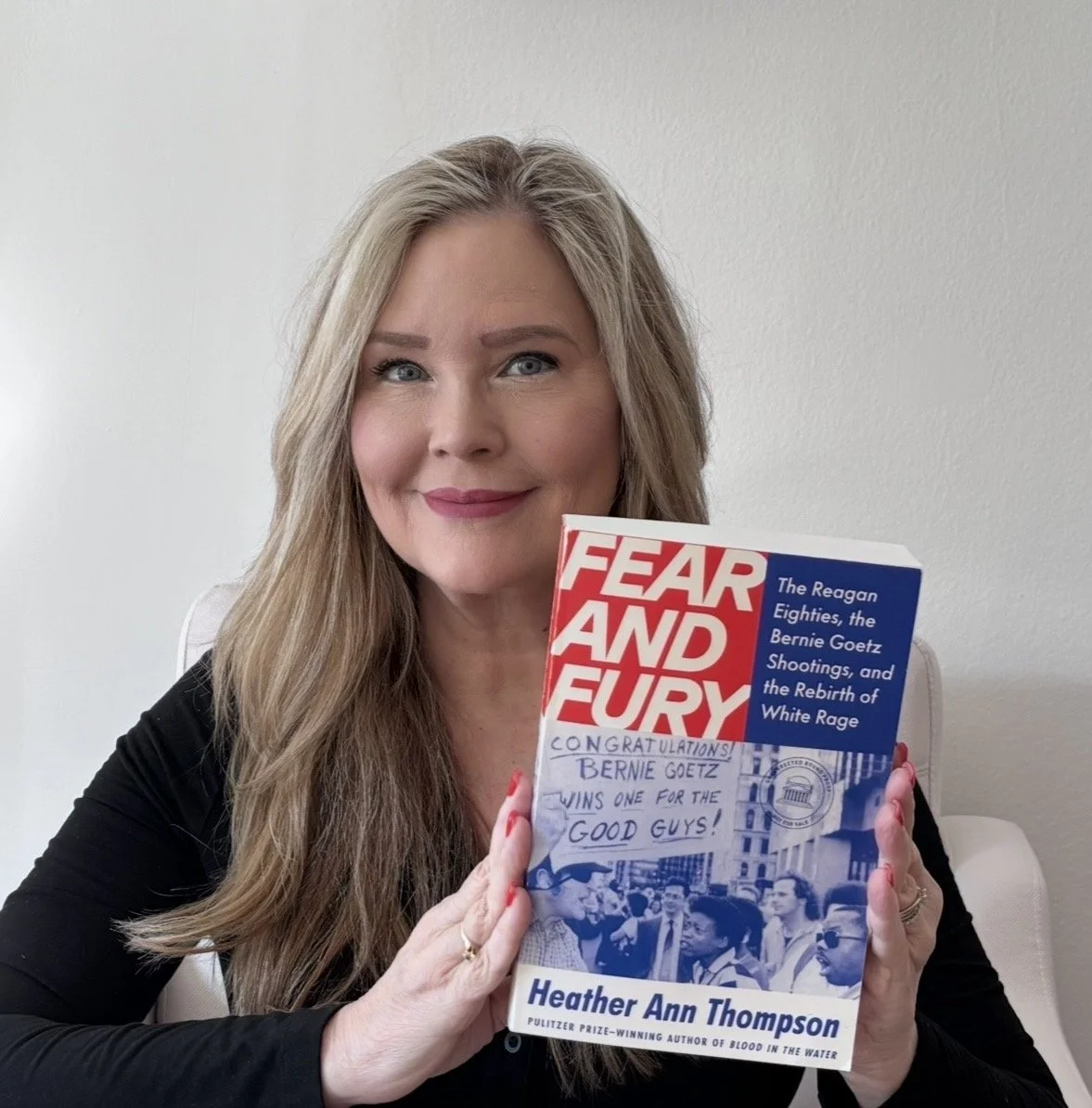
Today on The Stacks, we’re joined by Pulitzer Prize-winning author, historian, activist, and professor, Heather Ann Thompson, to discuss her new book Fear and Fury: The Reagan Eighties, the Bernie Goetz Shootings, and the Rebirth of White Rage. This book explores the ways that Bernhard Goetz's 1984 shooting of four Black teenagers on the New York City subway exposed the deep racial tensions of the Reagan era and set the tone for the politics of white rage we see today. In our conversation, Heather reveals why she wanted to tell this story right now, how the media’s role in this case mirrors the fear and power of the media landscape today, and how she transforms dense historical documents into accessible nonfiction.
The Stacks Book Club pick for February is Indigo by Beverly Jenkins. We’ll be discussing the book with Jasmine Guillory on February 25th.
LISTEN NOW
Apple Podcasts | Spotify | Google Podcasts | Overcast | Stitcher | Transcript
Everything we talk about on today’s episode can be found below in the show notes and on Bookshop.org and Amazon.
Fear and Fury by Heather Ann Thompson
Blood in the Water by Heather Ann Thompson
The Gods of New York by Jonathan Mahler
“Angered by Attack, Trump Urges Return Of the Death Penalty” (Lisa W. Foderaro, The New York Times Archive)
Five Bullets by Elliot Williams
Princeton University (Princeton, NJ)
“The largely forgotten history of Philadelphia's police bombing of Black organization MOVE” (PBS)
Tell Her Story by LaShawn Harris
Born in Flames by Bench Ansfield
Cool Machine by Colson Whitehead
The Man Nobody Killed by Michael Stewart
Bonfire of the Murdochs by Gabriel Sherman
Man in the Mirror by Anand Giridharadas
To support The Stacks and find out more from this week’s sponsors, click here.
Connect with Heather: Website | Instagram | Threads | Bluesky | X/Twitter
Connect with The Stacks: Instagram | Threads | Shop | Patreon | Goodreads | Substack | Youtube | Subscribe
To contribute to The Stacks, join The Stacks Pack, and get exclusive perks, check out our Patreon page. If you prefer to support the show with a one-time contribution, go to paypal.me/thestackspod.
The Stacks participates in affiliate programs. We receive a small commission when products are purchased through links on this website.
TRANSCRIPT
*Due to the nature of podcast advertising, these timestamps are not 100% accurate and will vary.
Heather Ann Thompson 0:00
So even at the time, of course, while Bernie Goetz is being celebrated, and he's being lauded as the celebrity, particularly in the black community, but also the progressive white community and the Latinx community, people are outraged. And they are trying to get some justice for his victims, and they are trying to speak up, and they're trying to turn the needle in toward the arc of justice, right, right? And they lose, because the people who had the most to gain by pitting people against each other are at it, and they still are today, right now, today, if somebody did this on a New York City Subway, I'm pretty sure that the media would be trying to figure out exactly what those people on that Subway did to deserve it and celebrate the shooter.
Traci Thomas 0:54
Welcome to the stacks, a podcast about books and the people who read them. I'm your host, Traci Thomas, and today I am joined again by author, historian, Professor, activist and Pulitzer Prize winner, Heather Ann Thompson. She is here today to discuss her new book, fear and fury the Reagan 80s, the Bernie gets shootings and the rebirth of white rage. This book takes us back to December 1984 to explore the ways that the Bernard Getz shooting of four black teenagers on the New York City subway exposed the deep racial tensions of the Reagan era and set the tone for the politics of white rage we are seeing right now today, on today's episode, Heather and I talk about why it is important for her to recenter the victims In her storytelling, how this book is in conversation with her Pulitzer Prize winning book blood in the water, about the Attica prison uprising of 1971 and what she hopes people will take away from fear and fury. Our book club pick for February is the romance classic Indigo, by Beverly Jenkins. We will be discussing the book with Jasmine Guillory on Wednesday, February 25 everything we talk about on each episode of the stacks is linked in our show notes. If you like this podcast, if you want more bookish content and community, consider joining the stacks pack on Patreon and subscribing to my newsletter, unstacked on sub stack and each of these places, you are going to earn different perks, including bonus episodes, access to our Discord community, virtual book club, writing hot takes and a lot more. Plus Your support makes it possible for me to make the podcast every single week and to make it free to all to join, go to patreon.com/the stacks for the stacks, pack and check out my newsletter at Traci Thomas, dot sub stack.com. All right, now it is time for my conversation with Heather. Ann Thompson,
All right, everybody, it is always a good day here at the stacks when we get to talk to the patron saint of the stacks, Heather Ann Thompson, she is back today to talk about her brand new book, fear and fury, the Reagan 80s, the Bernie gets shootings and the rebirth of white rage.Heather, welcome back.
Heather Ann Thompson 3:11
I'm so excited to be here.
Traci Thomas 3:14
It's been five years since we last spoke.
Heather Ann Thompson 3:16
Gosh it's crazy, I know, but but the most important podcast, so I'm so excited to be here
Traci Thomas 3:21
I'm honored the most important guest I call, for those of you don't know, I call Heather Ann Thompson the patron saint of the stacks, because it was her previous book, blood in the water that sort of inspired me to start the show. So you get to be the patron saint because you wrote the book that really kicked this whole thing off. Even though it took us, like three and a half years to cover the book on the show it happened, and now we're back. Okay, you've got a new book. Tell the people what fear and fury is about in about 30 seconds or so.
Heather Ann Thompson 3:49
Okay, so the new book is probably to a lot of younger folks, a news story, which is about a pretty brutal subway shooting that happened in New York City in 1984 in kind of the heart of the gritty 80s. And it is a story that older people will remember, because it immediately made headlines, in that sense, kind of a true crime story, a guy shoots down for a white guy, loner shoots down for black teenagers, and then he escapes in the tunnels of the New York City subway system. There's a manhunt. He finally, you know, come turns himself in, there's going to be all kinds of trials. It's just a crazy story, and I wanted to go back and dig into it, because I suspected that it had a lot to say about where we are today, with this kind of present day unleashing of rage and violence and serious racial tensions, and I also really wanted to rescue the story of the victims in this. A book, which were the four black teenagers that I have to, you know, say, with a degree of embarrassment, you know, I, I didn't know who they were. If you I knew who this guy was. His name was Bernie Goetz, and I was of the generation I remember the event, but, but I had no I couldn't have named his victims for anything. And that really troubled me and kind of brought me to the story
Traci Thomas 5:25
Same, same. I would not have been able to tell you that I was born a few years after this happened, but because this is the kind of thing that I become deeply obsessed with, I think I found out about this story. I want to say in the wake of Trayvon Martin or the wake of Michael Brown. And I can't quite remember, but I do remember someone sort of off handedly saying, like Bernie Getz, and me being totally like that is new information. And then a few years ago, with the with the like suffocation strangulation on the subway train by Daniel penny. I remember saying to so many people like, oh my god, it's Bernie Getz, and so many of my friends being like, What are you talking about? And me, Google it. How do you not know this? Everybody knows this. And being like, on such a high horse. But I guess the question is, like, it's not an anniversary year. This happened in 1984 this book is coming out in 2026 generally, these things sort of happen on an anniversary here. So why this story right now? Why did why was it like not only am I going to write this book now, but I want it to come out immediately.
Heather Ann Thompson 6:33
Yeah, that's a great question, especially because for me, I was in the middle of writing another book
Traci Thomas 6:37
Which I want to talk about
Heather Ann Thompson 6:41
Which of course I still do, but I felt like that there's just kind of this emergency moment internally, like, what is going on in the world that we live in? I mean, no matter what someone's political point of view is, it feels like everything is coming apart at the seams. It feels like decorum has gone out the window. We have just seen so many cases where someone can, random citizen can just gun down their fellow citizens and not just be celebrated for it, but actually be legally vindicated when they do it. So I'm thinking here of like Kyle Rittenhouse, or, you know, the not even just police killings. I mean, I just ordinary citizens. Daniel Penny, right, yeah. And you mentioned Daniel penny on the New York City subway most recently. And so I just was feeling like between that and between kind of the escalation of really just ordinary citizen rage at, you know, people who had it worse than they do, many respects and no respect for government and all of this stuff. So I'm like, I feel like I got to go back to the 80s and I got to really revisit what unleash this. Because I'm a historian. I don't believe that these things just come you know, we didn't just elect a new president and then all sudden, the political landscape changes. There are predecessors to this, and so that's what I was digging into. And literally dropped everything and did this kind of deep dive. And like with the Attica book, wanted to deep dive into the story we didn't know, tell it, hopefully more like a novel, like more like you're you're there, you're in it, and to do that, find sources that hadn't really been looked at before.
Traci Thomas 8:26
I want to talk about all of those things. It's funny because you said we get this new president, and it's like it came out of nowhere. But of course, in this case, our current president is, you know, he's around during this this is his This is also his origin story. Last year, people will know I was sort of obsessed with the gods of New York by Jonathan Meyer and and that is like, you can't read that book, and not that book talks about this, about this trial. But you know, Trump is like such a character in that book, and he his origin story up until this moment, is so tied to 1980s New York, and I think people remember, or have been told about the Central Park Five and his ads that he took out, but it goes way beyond that and his behavior in the 80s. And so I think you don't always have a situation where it's such a direct line from like 1980s New York to the White House. But in this case you, I mean, you do.
Heather Ann Thompson 9:29
Well, and not just Trump. I mean Rudy Giuliani comes straight out of this case. We have a situation where the current media landscape of today, Fox News, the entire frankly misinformation, media that has really taken over our landscape today is rooted in this brain gets story. So I, you know, I was myself really kind of intrigued to see the way these puzzle pieces were fitting together. And as you say, I mean Donald Trump, he was always a master at reading the room. And reading the room in 1984 meant, Wow, here is some kind of unhinged guy who is taking the law in his old hand, in his own hands. And lo and behold, a whole lot of white people love what he just did, hmm, that's an interesting theme to run with. And don't forget, like, this is a moment when we still have a quite liberal New York, at least in terms of the political apparatus, right? So we have to kind of ask ourselves, like, what were the levers that were able to be pulled to take this country, really, from a quite liberal 60s, you know, for all of its warts and problems, but nevertheless, a liberal 60s to the moment we live in right now. And this story, to me, felt like ground 01, that happened before, the story of the now exonerated Central Park Five, and one that we just we thought we understood.
Traci Thomas 11:01
So, speaking of the media, the New York Post is sort of a large character in this book, as as a newspaper can be a person, but Rupert Murdoch buys the post in the late 70s and as institutions who change ownership, sort of change identities, he really pushes the the newspaper from a more liberal daily that's sort of not doing great to becoming this conservative rag that we know now, and This case is a huge part of it. But my question for you is, like, since we are drawing parallels from this time to the present, do you think that this case was instructive for the media? Do you because other outlets, as you highlight in the book, like the New York Times, they covered the case in somewhat sensational fashion, but the post was really out front. So do you think that that the post, the post coverage of the Bernie Getz case is instructive, and is how we got here? Or do you think it's more complicated?
Heather Ann Thompson 12:21
No, I mean, I you know, of course, every bit of history is so complicated, sure, I think it's absolutely fair to say that the thing about the Goetz case is it happens right at this very pivotal moment when Rupert Murdoch, who's just arrived in New York, he really wants his his his tabloid, the New York Post, to dominate the New York media scene. And then ultimately, of course, he has sites on dominating the entire US media market. And he is watching this case very closely and and watches that there is this appetite for not only supporting Goetz, but to portraying him as this heroic vigilante, and that part of the deal in doing that is you got to villainize the people that he shot. And so the post it's, they're not the only ones. I mean, they're competing with the Daily News. So the Daily News is right there pretty quickly. They're, they're neck and neck in terms of the misinformation and the sensationalization, but, but to your point, they actually, I think, set the tone for, frankly, the mainstream press in really important ways. The New York Times, for example, first reports that these kids on this train are happened to be carrying screwdrivers, which they were, they were zipped up in their pockets because they were on their way to Jimmy open some coin receptacles to just get a little bit cash. They are in terrible shape in the 80s, but the New York Post and The Daily News report that they were sharpened screwdrivers that they were threatening this, this white guy with them, Bernie. Guess none of that was true, but lo and behold, the sharp and screwdriver story makes its way into the mainstream press. And frankly, even today, that idea that that's what they were carrying has just survived, as has the idea that they were a criminal element. They sort of got what they deserved.
Traci Thomas 14:20
I do want to spend some time on the boys, but I have a few more questions. Sure about how you approach writing something like this. Obviously, you're a historian. We know this about you, I guess, like, how are you? Because you do recent history, right? Like you're writing history about things that have happened in your lifetime, that have happened in many of your readers' lifetimes. So what is the sort of approach in that case? Right? You're not writing about George Washington, right? Like, it's not like someone could read this book, someone could read your books and be like, that's not what happened. I remember, like, you know, I read it in the New York Post. She's lying. So how? How do you or does that matter? Or does that change how you approach,
Heather Ann Thompson 15:04
I think the approach, whether you're, if you're, if you're a historian, and you're trying to do justice to your profession, you begin in the same way, which is that you take nothing for granted. You assume that you might know the story, but you don't know anything until you have combed every possible source that there might be out there, and part of that, part of that source base are newspapers, but we already know, I certainly knew from Attica that you couldn't trust 80% of what you know, particularly when it came to racial conflict, because they always immediately took the story of whoever the you know perpetrator was, meaning the state of New York, in the case of Attica, or in this case, Bernie gets, they took the case, they took that side. So I, you know, you couldn't really trust that, but you still had to read every single Right, Right View. And then for me, it was a matter of just going and figuring out, like, who has the story of the victims? And that was a journey. It always is, because you can't go to just whatever the archives and say, Can I have box 30 and folder 12 and get the story of these people, they didn't leave their records. So I was digging in court files. And, you know, one of the most interesting things I actually found was this, this crime victims bureau in New York City, which was this incredible moment doing this research, when I realized that this this bureau has been set up to take care of people who are victims of crime in New York City. And the 80s was brutal. It was really ugly in terms of crime Reagan we are in the Reagan 80s actually puts more money into this fund for crime victims. But of course, everyone has a very specific idea about what a crime victim is, and they are not poor black teenagers from the South Bronx. So even though one of these kids is a very, very badly wounded another one, they're all in the ICU right when they apply to get some funding, because they are basically, one of them is permanently disabled, they are denied. Why? Because they're, quote, unquote, not really the victims. They are the villains. And to me, that was a source that I couldn't really you know, if you don't see that, you don't really understand what's happening here,
Traci Thomas 17:22
right, right, speaking of your sources, obviously the newspapers, obviously these, these, like contemporaneous documents. What did you conduct your own interviews? Did you find new things? Who did you talk to? Where? What were you looking for?
Heather Ann Thompson 17:38
Yeah. So I mean, because I'm not a journalist, I'm actually usually pretty loath to have conversations with contemporary figures, and it's not because I will have conversations, and to the extent in my books, when I talk to people, you'll see them actually cited as conversations, not interviews, because, you know, I understand that we all remember our own past in very specific ways in this case, I actually did think I want to talk to the victims, and I want to talk to Bernie Goetz, and I sort of sent this spate of letters out to try to talk to everybody, and then I got to learn more about the case, and I realized, wait a minute, I can't talk to the victims of this case. Two of them are dead. One of them is now brain damage, and the other one has finally had some modicum of peace and doesn't want to talk to the media for very understandable, yeah, and I realized I don't want to even talk to Getz if I can't talk to his victims, so I just pulled back from wanting to actually talk to anybody. And that was actually kind of liberatory, because it allowed me to go back to what was everybody saying in the moment, including the shooter, but also the trial transcripts, the witnesses, the everybody, and I was able to reconstruct it, I feel like more in real time, rather than in sort of a glowing retrospective.
Traci Thomas 18:59
Yeah, so there's, there are all these witnesses on the train. And you mentioned earlier that you sort of write your books in this, like, novelistic style, which you do, I have to say you are one of the best at making history feel like, so readable and like, unput downable. But you have these, this cast of characters. And as I was reading the scene, as you're setting up, like, who's on the train, I was like, wow, this is a story, right? Like, it just feels that way. How do you inter like? Because there's so many moments where you say, like, So and so was feeling this, or they had a look of this on their face. What are you using to capture those moments? It's like their face looked like this in the trial, or they, you know, what are you using and how are you interpreting it, and how are you making sure that you are not projecting what you see in a picture and, like, ascribing an intent behind it?
Heather Ann Thompson 19:55
Yeah, so that's a really great question. I mean, actually, if you if you look. Kind of carefully at the book. I'm pretty careful about those moments, like, if I don't feel like I have a verifiable source, I'll say I do have words like likely, or you know, or you know, as any mother would, you know likely feel, or something like that. And it isn't because I'm just trying to hedge it's because I'm basing it on a whole lot of things at once. So when I say something, I'm usually not just flying by the seat of my fans. I'm trying to did someone else observe it this way? So for example, you know, there's times when Bernie gets this talking, and and a reporter will say, and he was looking, you know, whatever, forlornly down at his notepad. And so I will actually quote like someone else is observing him. And I'll, and I'll redo that, but you know, this guy gives, for example, a two hour confession. It's extraordinary. I mean, it's just, it's a chilling, chilling thing, and I have to treat that as a source as I would anything I'm interpreting right I am. I have my own eyes. I have my own context. And when, for example, he is really hostile to the only female in that room who is the, you know that she's the main assistant district attorney, I mean, it just comes through. And I kind of feel an obligation to give the reader a sense of who this guy is, and his hostility is palpable. And so I kind of in it is a mix of all those things. But with the with the train, it was so fascinating because, I mean, I'm literally in there in the trenches with my own diagram, like, where are people sitting, and how could they be looking and could they have looked left or right? And, you know, it becomes one of these crazy moments in my own office with
Traci Thomas 21:55
right you needed the tape on the floor in the courtroom. Slot Nick moment, yeah, yeah. Slotnick was the defense attorney for Bernie Getz. Because I'm sure most of you probably don't know his name. I certainly did it, but I had heard of him when it when he popped up in the book. I was like, shoot, I know this guy from somewhere, and I guess, I guess, because he did the mafia trials,
Heather Ann Thompson 22:17
yeah, like, when people get to that part of the book, I mean, the thing that's so extraordinary about the trials is it's like, as they said at the time, it's like a piece of theater, like his attorney is on bully. Bullies was a former attorney of the mob boss John Gotti. I mean, he's got his $3,000 suits, and he's Natalie dressed, and he is ruthless in this courtroom. So, so, yeah, I think you might have heard of him from that
Traci Thomas 22:43
I felt like I'd heard of him. I guess that's my other question. When you're writing a book, when you're picking a subject, how much are you thinking this has to be an entertaining story, versus I want to tell this story because, I mean, I've said this many times I've read blood on the water twice. It is I was like, having nightmares. I couldn't put it down. I read it the first time. I think in like five days. It's a like, 600 page book. I just couldn't stop. And similarly, with this, I read this one in about three or four sittings. And so are you going in saying, like, I'd like to tell this story, and then looking around and being like, Ooh, there's nothing there. It's not going to be entertaining enough. Or are you just like, I want to tell this story, and I have to make it entertaining if it's not
Heather Ann Thompson 23:28
No I mean, I think that the kind of sad truth is that when we are trained as historians, we are trained to frankly, write rather dryly. And, you know, with all due respect to myself and everyone else
Traci Thomas 23:43
In your entire industry
Heather Ann Thompson 23:47
Doing this work and I look back on my own dissertation, you know, I look like, Oh, dear, right. We're kind of trained that way. And there is this idea that somehow there is a greater sense of, you know, gravitas and truth and objectivity or something, if it's written in a rather relatively dry fashion. To me, I don't believe that any moment in history. It doesn't matter what it is is dry, right? I mean, if we just simply walk to the corner store and we're buying, you know, a loaf of bread, our interactions in those 10 minutes it takes us. We've met people, we've seen people, we've observed people. It's part of the richness of our lives. So for me, when I decided to write blood in the water, it was critical to me that I kind had to narrate places where most Americans had never been, which was the prison. In this case, you know, I could have just said, you know, there were the crime rate was really high in New York City in 1980 in my case, I really wanted you to feel it and to understand it and to experience it, because then perhaps we can better understand what happens on that train. So, so to me, it's not a false dichotomy or even really a choice, I think pretty. Much anything I'd put maybe, if I was doing a book on, you know, the formation of the stock market, I don't know, maybe it'd be more well, but even then, right, I can only imagine, right, it's in a certain building and it's a certain vibe, so it's just kind of the way I prefer to write, because it's the way I prefer to read, right? Yeah, I love reading books where I want to turn the page and find out what happens next.
Traci Thomas 25:21
Well, we thank you very much, because we do have to read these books, and yours are banging. I even hate to ask this question, because I feel that I know the answer, but I just kind of want to hear what you have to say, which is, if this case happens today, is it different? And I think it is different, like it'll be, it would be handled differently, but like, what do you what do you think?
Heather Ann Thompson 25:47
You know, this is such a great question, because, on the one hand, I, right now I'm in New York City and I live in Detroit, but right now I'm in New York City, and there's a great excitement on the ground in New York City, because New York City has just elected this mayor that feels like we're turning the corner like the American people are tired of the, you know, flying in the face of the constitution. We are tired of the violence. We are tired of the poverty and the high prices and all these things where we've ended up, and that gives me some degree of hope. So then I want to say, well, if this happened today, there'd be a public outcry. There'd be a, you know, people wouldn't tolerate it. They would rise up. There's a part of me wants to say that, on the other hand, the thing that this book shows is that even at the time, of course, while Bernie Getz is being celebrated, and he's being lauded as the celebrity, particularly in the black community, but also the progressive white community and the Latinx community, people are outraged, right? And they are trying to get some justice for his victims, and they are trying to speak up, and they're trying to turn the needle in, you know, toward the the arc of justice, right, right? And they lose, because the people who had the most to gain by pitting people against each other are are at it, and they still are today. And in fact, after the Bernie gets case, things are actually much worse. His trial will will empower the National Rifle Rifle Association, by the way, who funds him, whose funds his defense, to come to New York to to make hunting, to make guns no longer just about sportsmanship and hunting, but actually about every American's right to carry it in self defense, the standard Ground laws that made it possible for George Zimmerman to murder Trayvon Martin come out of this case and this moment, Supreme Court decisions come out of this case in this moment. So I'm really afraid that, just like the Daniel Penny case of only a few years ago, shows us that if, right now today, if somebody did this on a New York City subway? I'm pretty sure that the media would be trying to figure out exactly what those people on that Subway did to deserve it and celebrate the shooter.
Traci Thomas 28:12
Yeah, I tend to agree with that. I think, I think the way, like a big way, that I think this case would be different, is a what probably wouldn't have risen to the to the size and like national, like the Daniel Penny case, ends up becoming like a big deal. But I think there's probably people who are listening now who are like, Wait, who was that again, which got like, in a way that I think at the time, everybody knew who Bernie Getz was. But I also think that race would have been would be even more explicitly talked about now, in a way that it was sort of like black people were talking about, but white people were sort of like, oh, I don't crime like, I think now you would have it at least be discussed. And I think that that might change the way the trial shakes out, like how the jurors the pressures that they might feel in a would add a context to that is my Yeah, I don't know that it changes any outcomes. I don't know that it changes anything, but I do think you would have more people like I think the defense would probably use it more. I think that the prosecution would use it more. Like, I think it would have become a bigger piece in the story.
Heather Ann Thompson 29:30
Yeah, I mean, it's, it's entirely possible, and frankly, for all the really kind of horrifying reasons, which is that this, this case, has become so normalized by now, or I should say, cases like it have become so normalized by now. You know, we can storm the entire US Capitol and, you know, everyone is pardoned. I mean, the rule of law now is out the window, yeah. And race is, you know, from. White House on down, people are absolutely unchecked in their racist remarks. But in this is this matters, and I think it's your right to actually really elevate this. It is also the case that there is a much louder and, you know, really vocal presence coming from the other direction that says, This is racist, this is unjust, and we can't run a society like this. And and so I do feel like this is a we are perhaps in that kind of changing moment. And I think in order to be in that moment, we've got to figure out how we got here. And to me, that was why the political context of this book, which I will admit, there are times when I'm sure it feels a bit bogging down to people reading it. But the reason I felt like it was so important to rethink that Reagan 80s is because prior to that moment that what we call the Reagan Revolution, we as a society had for many decades, kind of been elevating the rule of law, and, you know, with the Warren Court and with the civil rights movement, and there was a lot of backlash, but there was a kind of a public sense that this is the direction the Country has to move, yeah, and the Reagan administration just kind of turns this all on its head, and as it literally takes, you know, resources out of the public. Its genius was to say, Yeah, you are suffering badly, but not because we have taken the tax base and made it much more favorable to rich people. You're suffering because of those lazy, undeserving, criminal, black and brown people. And it was, in some respects, it was genius. Genius. It has, it is, it has led us here, but it is also led us, like I said to this New York moment where people are, it's wearing thin. People like, you know, really, you know, really, the reason why we're in such bad financial shape is because of those people over in the South Bronx that are even worse shape than I am. Really, it's right, it's wearing thin, I hope.
Traci Thomas 32:17
Yeah, okay, let's take a quick break, and then I want to talk about the title. Okay, we're back. I want to talk about the title. The title is fear and fury, the Reagan 80s, the Bernie Goetz shootings and the rebirth of white rage. So let's just start with the main title. Why fear and fury? Where did that come from? What sparked it?
Heather Ann Thompson 32:41
Ah, play on words, right? I mean fear as fear as something that is curated and cultivated and particularly to make white people fearful and so angry and rage filled, and, you know, willing to explode with, you know, much less provocation than they had, probably since, you know, the era of Jim Crow, but also fear, because if you are black or brown in America, you have come from a moment where the President of the United States, you know, again, with all the warts, with all the flaws, someone like like Lyndon Johnson is essentially saying, Yeah, we have a Civil Rights Act of 1965 people have the right to vote. Racial Discrimination is something this, this country cannot abide or stand behind. And then the 80s comes and people are terrified. There is this unleashed violence against black and brown people across America. And this book, and that's more painful parts of it. I mean, I walk us, unfortunately, through a lot of this. Bernie Getz is the signature of it, but it is by no means the only one. And it touches off, for example, in New York, brutal mob violence, really, mob violence against black teenagers in Howard Beach in Bensonhurst. And of course, you know, go to the other side of the country, you can't make sense of something like the Rodney King case, you can't make sense of the level of absolute unleashed rage on black people, which creates fear. So it is a play on words of at all levels.
Traci Thomas 34:29
And I feel like one of the things that I started thinking about a lot with the fear piece is also the way that our media functions through using fear. It's like fear and disgust are like the two big touchstones. I felt like that the out like the media outlets were using, and I feel like that's the same now, right? Like there are so many ways to report on what's going on in this country, but it feels like every headline is trying to just make me have a nervous breakdown. Like, it's just wants me to be stressed out. It wants me to feel scared and closed off and like worried in a way that I I just don't believe that that's how it has to be like, I don't believe that that's how things need to be reported on, but that it's a choice that American media outlets have have decided is the most useful for them to make money.
Heather Ann Thompson 35:19
Well, they saw that. They saw this case. That's, that's one of the reasons why this is so instructive. I mean, this is, this is media gold, right? You can stand behind that kind of another man's ostensible fear, even though Bernie Goetz himself said, Look, this had nothing to do with the robbery. I didn't like the gleam in this kid's eyes, yeah, but, but it's his fear that that kind of become celebrated, and it's, yeah, it's media, it's media gold. It's also a broader problem, I think, with the with the media in general, which is there's this idea that if you only have whatever, a few lines, if you don't have a lot of space, you got no room for context. And it just, it's, just simply isn't true. I can't tell you how many times, both during doing Attica, but also doing this book, when people will say to me, they'll ask me, you know, well, do you know? Do you I feel like, you know, I'd like to bring in like, Bernie gets like, what is his side of the story? Like, you know, we'd like to hear from him. Okay, great. Do that. But I have yet to hear anyone say, I really feel like we need to take, you know, talk to the four boys that he shot and get their side of the story. That's just, you know, that's just journalism, 101, but the assumption is that he's already the center of the story,
Traci Thomas 36:36
right, that it's his story and his reasoning is, like, important? Well, you won't get that question from me. I can promise you that I have a lot of thoughts and feelings about Bernie Goetz, but none of them is wanting to know his side of the story, because, for one reason, we actually do have his side of the story multiple times, very consistently, like, that's the thing that is confusing to me when I read about this case and, like, obviously it's in the news now because your book is out, there's another book out on the topic. I just feel like it feels very Zeit geisty Right now, and I just, I don't have questions about that part. Like he said it at the time. He's been saying the same thing since, like, his story has not changed. So I'm not. I'm gonna assume my dad used to always say that when people lie, the story changes, but when you tell the truth, it doesn't. So I'm gonna just assume that what he's been saying for the last 40 plus years is the truth, because he keeps saying the same thing. I don't, I don't, maybe I'm maybe I'm dumb. I don't know.
Heather Ann Thompson 37:37
It's just not very interesting to only tell that one side of it, you know, I know and like, dug into this book like one of the main victims. In this case, the reason he ends up in public housing is because he's living with his mom and dad as a kid in rockaway queens, he is normal American kid living in a in a house, his dad goes out to work every day. His mom is taking care of the kids, and his dad has his truck basically car jacked, and his dad is killed trying to hold on to this car, because he understands that's how he makes his family a living. The reason they end up in public housing is because suddenly, in here, her early 30s. His mother is a widow, raising these four boys. So those stories matter if then fast forward, you know, 15 years the media is saying, or gets is saying, Actually, after all, he all of this gets says, you know, Shirley, KB, darrell's mother, he should have just had an abortion. He should never have been born. Like, what? Right? But that doesn't even hit until he's like, who was Darrell Cavey,
Traci Thomas 38:50
right, right? You frame this book through the story of the Kaby family, like, that's kind of where we start, and that's definitely where we end. And and I think you know, having read blood in the water, I know that that is you know what you do. And listening to you talk, I know that you you are interested in telling these stories that have been either misconstrued over time or untold. There have been, I mean, in the case of Attica, even when we spoke there, you were there were waiting for documents to be released, right? Like that. You were telling this history that's 50 plus years old, and yet was still, is still coming out. But I want, I mean, I guess the question is like, what? Why is it important to you to tell the stories and rescue, the stories of people who have been erased by like horrible violence that has been done to them.
Heather Ann Thompson 39:49
You know, I had, I hesitate to make this about my own biography, but, but that's really the truth. I grew up as a kid in the city. Detroit in the 70s and into the early 80s. And you know, Detroit was in serious, serious trouble. Financially. It had been absolutely abandoned because of white flight out of the city. The tax base had completely disappeared. This city was suffering. I was one of the few remaining white families in the city, but that became my city. That was my place. And yet, at the time the media, everybody was like, Detroit, the murder capital of the world, the worst place in the world. Why would anyone go Detroit? I would see white people that I knew outside of the city, and they would say, and oh, my God, how do you live there? Do you carry a weapon? Like, how do you how do you survive that? And yet, to me, this was my community. This was my home. This was the school, the high school I went to. This was my neighborhood, everybody that I knew, everybody that was smarter than me, everybody that I wanted to be like was not white. So to me, it was always this kind of baseline, like I don't, I don't want to tell the story that people want to hear. I want to tell the story that nobody knows, that matters so consequentially to the way that this history actually unfolded. So my first book was actually about Detroit and and, you know, and then it's just kind of evolved from there. But my my inclination internally is, you know, there is a dominant story, and it's always going to be told by the people with the most power. But that doesn't make it the story, and it doesn't certainly explain very much, in the end of the day, how, how we all have moved to the place where we are.
Traci Thomas 41:41
Do you know why your family stayed in Detroit?
Heather Ann Thompson 41:45
You know, because my my parents were their own kind of rebel, radical selves. They came from a tiny, small town in Kansas. Yeah, you know, I had a dad who was trying to, you know, help desegregate the Iola city pool, way, way back in the 50s. And so I'm sure I came out of a tradition of, you know, I can remember being driving in Detroit as a kid and my and seeing, you know, homeless people by the side of the road. And my dad was always someone that, you know, sort of said, you know. Why does that, you know, to the when we were kids like, you know? Why? Why does that have to happen? You know? Why? Why are some people sitting there with nothing to eat, and so I'm sure it came from my own family, but at the end of the day, it also just simply came because racism is so so present in America. And I frankly, never felt that that white people just told the truth about the way in which it actually worked, and so I'm sure that's the biography. But at the end of the day, I also think you can't be a good historian or storyteller or journalist or whatever if you don't always ask, what is the other side of the story? Like, what's the story? We don't know. So sorry. That was very long.
Traci Thomas 43:01
It's great. And it actually leads me to this other going back to the title, going back to the subtitle, the last little comma section is, and the rebirth of white rage. And I know, when I first saw the book, I said, that's like, such an interesting rebirth is such an interesting choice. Because, like, if you'd asked me, I would say, like, I don't think it ever died. And in the book, in the book, you do sort of explain that. And so for people who are listening, who haven't read the book yet, who are sort of like, what's this lady talking about, do you want to tell them why you call it a rebirth?
Heather Ann Thompson 43:32
Oh gosh. Well, let me just say that there was lots and lots and lots of discussion and thought, I'm sure, should it be rebirth? Should it be re legitimization? Should it be just plain old legitimization or normalization, like we just want you know, it was so much thought that went into that the ultimate answer is this country, foundationally and persistently and consistently, is about a story about white rage. Yes. So that's a given to me, and I hope I really established that in the book. But it is also true that this history has gone through very, very distinct political moments when either that is celebrated and unleashed, legally and absolutely seen as the norm and the way we should be as a country and identify as a country, and other moments where it is unbefitting of us as a country, even while it still exists, and even while it still is there, is unleashed, is ugly, and so one of the critical things that starts to happen in no small part because of pressure From the people who experience that rage and that racism. Is it? We began to move the needle. I mean, that was the power of the civil rights movement. Was to say, you know, it was the power of Dr King, it was the power of Fannie Lou Hamer. It was the power of these activists to say, look, we this is not liberty and justice for all. This is. Not true equality under the law, so let's make it so, and it creates a moment of possibility. It's one of the reasons why there's so much that happens in the 60s and 70s, things like, for example, the American with Disabilities Act. There's this idea that you may be disabled, but that doesn't mean you're less of an American. It doesn't mean you should be picked on. It doesn't mean you should be isolated. That moment of possibility was the moment that begins that is really under attack and begins to erode. That's the racial piece of it. But if I might just jump ahead, the other part of the title is about the Reagan 80s, sure, and that's because, why do we do it in this moment? Because it's during the Reagan 80s that there is a sea change in the way we actually run this country, not just culturally, not just kind of unleashing this rage and saying it's okay, but actually economically, we start to chip away at this notion that the government should be there for people, that we need a safety net, that, you know, rich people should pay substantially into this body politic that we all need, and it was deliberate, and I don't and it's not a conspiracy. It's just they were very clear that that's what they wanted to do, but they also knew that to do that, a lot of people were going to lose a lot, including just ordinary white working class voters, and rage became a distracting way for them to get this stuff passed, and it was very, very effective.
Traci Thomas 46:37
And I honestly can't believe I haven't said this yet in today's conversation, but Ronald Reagan, one of the greatest villains of American history. I mean truly, truly a monster. I think that we should continue to say that despite the fact that we also have a current monster in the White House like that, just because Trump is awful doesn't mean that Reagan also wasn't just a fucking nightmare. Your book really lays that out early and often. But I just want to make sure we're on mic, at least I'm on mic saying it. You don't have to say it, but you can just, you know, you well.
Heather Ann Thompson 47:15
And again, this is why I began when in the program, and I was saying, Look, you know, no matter what your political sensibilities are, I think that you'll find something really hopeful and helpful and interesting about learning this, because it actually isn't if it were only Reagan and if it were only Trump. The truth is, what happens in the 80s is there's such an assault on this idea that we should take care of each other. There was such an assault on this idea that there should be public schools and public health clinics and public roads and public anything. And we've all, all of us, have paid a huge price for that. And unfortunately, every president after Reagan just doubled down on that. Every Democrat, that's right. And there's a bit of a reprieve when we get Obama, and certainly that's because he's responding to this grounds, well, on, you know, of activism, but we've been doing this now for 50 years, and so Trump just, he just signed the check. I mean, he just, you know, sealed the deal if you will
Traci Thomas 48:21
right, is there anything that's not in this book that you wish could have been?
Heather Ann Thompson 48:29
You know, I really wish that I could have learned even more, actually, about those, those young men that ended up on that train that day. And I wish I would have also had a better sense of, I don't know, like, I don't want to give away the trial. It's wanted to meet the most dramatic parts of the book, but I wish I would have known a little bit more, like, about why the jury makes the decision it does. I mean, it's just kind of the whole thing is just mind blowing at the end so that. But really, I'd say the victims, you know, one of them ends up killing himself on the anniversary of this event. The other one is now, you know, still remains brain damaged and paralyzed. Another one died very young after becoming extremely drug addicted after this horror show. I mean, the only surviving one who you know, I'm sure to all of the people he meet would never even know this had happened to him. I'm sure is still traumatized, and he doesn't want to talk to anybody because he doesn't trust the media. So I wish I could have rescued even more of that story. To be honest, it's a it is terrible to have had to have dug so So kind of in every crack to find their story. And I think you're you know that your listeners will see that if they pick up the book. But there are and. Amazing Stories, nevertheless. I mean, yes, for example, the hate mail that pours into these, these, oh my God, there's so much. It was just really something.
Traci Thomas 50:09
And so that moment, those moments when you're like, talking about the hate mail, what made me be like, See, people think it's just social media. It's like, no, the way it's being delivered nowadays through social media, but it's the same stuff, if not even worse, oh my gosh
Heather Ann Thompson 50:24
yes, because they have to know your, your home address, which, by the way, why do they even know the home address of these kids that he has shot? Because the media newspaper shooting their, their home address, and so these horrific, threatening and, by the way, overtly racist, every single one of them. Messages come to these families, not just to the not just to the victims, but to their sisters and their brothers and their mothers and so, yeah, I would have loved to have been able to talk to them. Actually, that's the one that's that I do wish for that.
Traci Thomas 51:01
Yeah, I feel that. Um, I guess you mentioned the jury. I know we have to wrap up in a second, but, um, you mentioned the jury. And I, as I was reading the book, I just wanted to ask you, because, again, in blood, in the water, there's a lot of legal stuff. How did you get comfortable understanding all of the legal stuff? Did you turn to lawyers, like, it's just a lot, you know, and you're explaining, like, reasonableness, and obviously, like, the idea of, like, what would a reasonable person do in this situation, reasonably to be reasonable is like, a big, big part of the case. I You explain it, and I think I get it, but it's hard when you're using the same word, reasonable in like, 15 different ways of all. Yeah, explain reasonable. But I'm just wondering, like, how do how comfortable? How do you know that you're comfortable? What's the process for you to get, like, the legal stuff?
Heather Ann Thompson 51:55
Well, that, that, that, I have to say, is it, both in Attica and in this book, I never feel completely comfortable, so I'm always leaning on people who know the law far better than I do to try to make sure that I understand it. And this is just my colleagues and and, you know, in this case, you know, one of the lawyers in this case, I did have some very specific questions for but weples, no in this case, it was actually KB because I that this KBS lawyer, this is kind of later in the book. Oh, the civil, yeah. But the, but the the good news is that there was actually, at the time, quite a bit of discussion of what the jury would have to consider. So I was able to actually go in and see quite a bit of that. But most importantly, I had the transcripts, and I could see this being hammered out in real time, but by both sides the judge, I could see the appeals, I could see the the arguments being made by both sides. So it was just, it was very time consuming, but very much worth it, because at the end of the day, it just left me even more, actually, bazzled by the jury's ultimate decision. We'll see what your what your readers think, but I feel like it is a fascinating case of what your eyes are seeing and what you are hearing, and what people are deciding they just heard and saw are completely out of sync, and that was interesting for me, right? Because it wasn't just a matter like today, with others the body cam footage doing one thing, and yet people are seeing something. No, no, this. There is a long history of this, seeing what you want to see.
Traci Thomas 53:38
Okay, so last time we talked, I asked you the famous question of what word you can't spell correctly. You told me tomorrow, is there any word you'd like to add to the public record, or would you like to stick with it
Heather Ann Thompson 53:48
Substantitive
Traci Thomas 53:49
Oh my gosh, okay, wow, we're stepping up.
Heather Ann Thompson 53:52
How many T's are in substantitive?
Traci Thomas 53:56
I have not a clue. I wasn't even sure that was a word until just now. Okay. And then my other question is, I asked you last time about about your writing process, how you like to write, how often, and you told me many things about how you can write in chaos, because when you started your PhD, I believe at Princeton, you had a five month old baby, and it was just get it done. But what you didn't tell me when I went back to the tapes from last time was if you have any writing snacks or beverages, so you are back five years later to answer this question, this is really why you're here.
Heather Ann Thompson 54:32
I am a terrible coffee a Holic, so I've got the brand new cup of coffee that gets Stone Cold as I get into the middle of everything I write so there's always the ubiquitous cup of coffee, okay? And I have to say I'm a candy snacker, like I need the whatever the the Mike and Ike's the Raisinets a little something sweet by the side to distract me
Traci Thomas 54:56
knew I liked you, Heather, I knew I liked you, okay? And then this. Is, this is sort of where we ended last time, which is, we're getting a MOVE book about the move bombings. We're still getting the book. You're still working on it.
Heather Ann Thompson 55:08
Absolutely all the research is done for that book. I am knee deep into writing it, actually. So I'm looking forward to returning to that book, because that book, to me, feels like it's going to be maybe more akin to the Attica book in the sense that it is kind of this grand saga of a pretty extraordinary event that happens in Philadelphia in 1985 and like all of my books, I think it will try to complicate what we think we know. So hopefully, hopefully I can get back now to that.
Traci Thomas 55:41
Okay, can't wait whenever that's done. You just let me know you come back here. And then for people who love fear and fury, what other books might you recommend to them that are in conversation with it?
Heather Ann Thompson 55:54
One of my favorite, or actually, two of my favorite books. One of them is a new book by LaShawn Harris, and it's about the story of Eleanor bumpers, who is a woman who lives in the South Bronx who is killed by the police. She's actually evicted from one of these buildings, like the ones that the boys live in, and then killed incredible story that lashaun Harris wrote. And the other one is Ben shansfield's book Born in flames, which is also about the role that businesses and insurance companies and really capital played in creating all that horror in the South Bronx that the boys lived with.
Traci Thomas 56:31
This is I have, like, a little side Reading project going on right now, which is 1980s New York. Yeah, after I read Gods of New York, it made me want to read like everything. And so both of I started the bench, Enfield, and hunts POSIX had to read something else for work. But I will go back to that. And then I have LaShawn's, what's it called, though
Heather Ann Thompson 56:49
Tell her story. Tell her story. I think is what it is.
Traci Thomas 56:55
You're right.
Heather Ann Thompson 56:57
And the other one that I'm looking forward to is Colson Whitehead has got a book coming out on the 80s as well.
Traci Thomas 57:03
So that's this new one. Is, yes, but did you read the Michael Stewart one, the man nobody killed? I read that last year, and I really liked that.
Heather Ann Thompson 57:11
It's just so, you know, I write those hard books. But I also, I was just sort of kind of amazed at how much there is out there on this horror, these horrible moment, and that is one of them, actually, absolutely worth reading as well.
Traci Thomas 57:27
Yeah, and so now I'm like, I gotta find a Howard Beach book. I gotta find a Yusef Hawkins book, right? Like, there's, like, all of these, yeah, anyways, but there's but another book that's coming out this year, I think February 3 it's out is Bonfire of the Murdochs, which is about the Murdoch family, which now I want to read, because it feels like that's in conversation with this, like I just have him kind of carving out this new obsession point for me, which is like 1980s New York madness.
Heather Ann Thompson 57:59
Yes, yes. Well, and that's, I think, why I was so drawn to lashawn's teller story, and, yeah, which is born in flames. Because the thing about New York, I mean, I know that not everything is New York, but it is really interesting that this current moment we're in so many of the players, the economic players, the political players, the cultural players, are really that's where they are in this moment. And so if you're interested, there's definitely, we need a, we need a Traci reading list on the 80s.
Traci Thomas 58:27
You know, I think I've got, I think in my non fiction reading guide, there will be one. But also coming out later this year is a book called Man in the Mirror. And that's about, that's from, I can never say his name correctly, Adnan girahides, and that's about the Jordan Neely. Yes, that's subway situation that comes out in September. So I will, I will be reading my third book about vigilante violence on the subway this year. Because, you know, I gotta, I love a theme, yeah. Okay. Last question for you, if you could have one person dead or alive, read fear and fury, who would you want it to be?
Heather Ann Thompson 59:05
Shirley Kaby, yeah, just to make a just to center the story of her son. Because from the very beginning, she just kept at the battle for justice. Because, as she kept saying, I just want people to see who my boy really was, or who we really, you know, tell his story
Traci Thomas 59:25
And that she and she was so incredulous to how it was all playing out, which I found, like, so relatable. Right as I'm reading the story, I keep being like, yes, somebody listened to this woman like she is very she seems to be correct here, yeah, yeah. And she passed away.
Heather Ann Thompson 59:47
She did. She ended up pretty much, but her the entire rest of her life had to be devoted to taking care of her son, who was subsequently paralyzed and brain damaged, but at her greatest fear, of course. This was that, you know, what would, what would happen to him when she was no longer alive, but it, but it seems that he has, you know, obviously sisters and brothers, or a sister and brothers and so he has a community. But, yeah, I wish that, I wish that, I wish that there was, I always wish this, right when I read these books and you see the whole trauma and pain that people go through in the moment. I always kind of wish for them that they could kind of step back later and see that, that, you know, the history does ultimately get told
Traci Thomas 1:00:30
yeah, thank you. Well, everyone. The book is called fear and fury the Reagan 80s, the Bernie gets shootings and the rebirth of white rage. This has been a conversation with Heather. Ann Thompson, Heather, thank you so much for being there, for having me back. This is great, of course, and everyone else, we will see you in the stacks. Thank you all so much for listening. And thank you again to Heather Ann Thompson for joining the show and a huge thank you to Suzanne Williams for helping to make this episode possible. Our book club pick for February is Indigo by Beverly Jenkins, and we will be discussing the book on Wednesday, February 25 with Jasmine Guillory. If you love the stacks and want inside access to it, head to patreon.com/the stacks to join the stacks. Pack and check out my newsletter at Traci thomas.substack.com make sure you are subscribed to the stacks, wherever you listen to your podcasts, and if you're listening through Apple podcasts or Spotify, please take a moment to leave us a rating and a review for more from the stacks. Follow us on social media at the stacks pod on Instagram, threads and Tiktok, and you can check out our website at the stacks podcast.com this episode of the stacks was edited by Christian Duenas, with production assistance from Sahara Clement. Additional support was provided by Cherie Marquez, and our theme music is from tagirigus. The stacks is created and produced by me, Traci Thomas.