

Ep. 412 The Racial Caste System of America with Dorothy Roberts
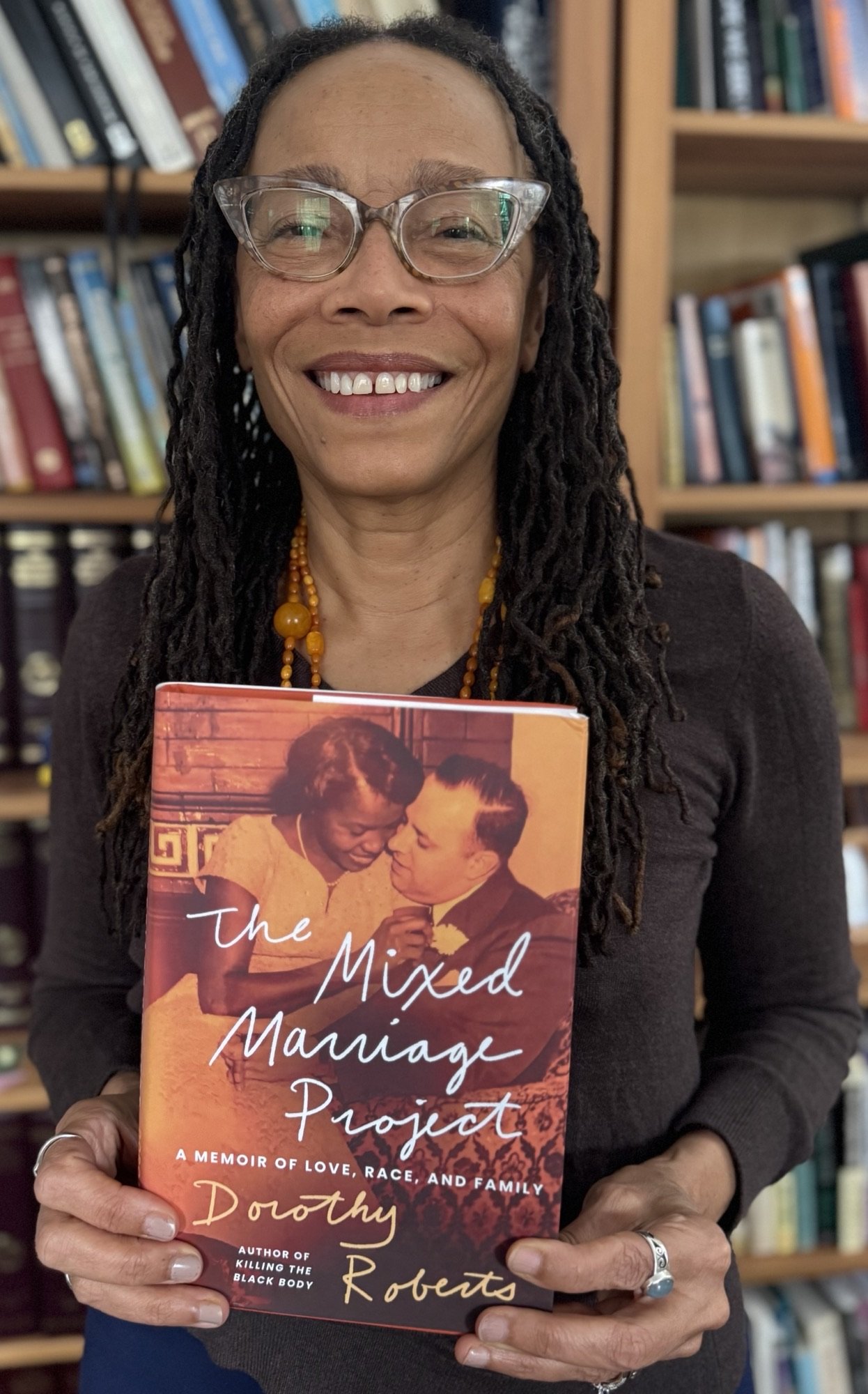
Today on The Stacks, we’re joined by author, sociologist, law professor, and social justice advocate Dorothy E. Roberts to discuss her newest book, The Mixed Marriage Project: A Memoir of Love, Race, and Family. In this powerful memoir, Dorothy recounts her experiences growing up in an interracial family in 1960s Chicago, exploring how her parents’ marriage—and their dedicated research on interracial relationships—shaped her understanding of her own identity. We talk about why she identifies as a Black woman with a white father, how her parents’ work has shaped her work in the family policing system, and the myth of mixed kids saving the world.
The Stacks Book Club pick for February is Indigo by Beverly Jenkins. We’ll be discussing the book with Jasmine Guillory on February 25th.
LISTEN NOW
Apple Podcasts | Spotify | Google Podcasts | Overcast | Stitcher | Transcript
Everything we talk about on today’s episode can be found below in the show notes and on Bookshop.org and Amazon.
The Mixed Marriage Project by Dorothy Roberts
University of Pennsylvania (Philadelphia, PA)
Killing the Black Body by Dorothy Roberts
Torn Apart by Dorothy Roberts
The Mixed Marriage Project by Dorothy Roberts (Audiobook)
South to America by Imani Perry
Caste by Isabel Wilkerson
The Warmth of Other Suns by Isabel Wilkerson
Heavy by Kiese Laymon
The Yellow House by Sarah M. Broom
Negroland by Margo Jefferson
To support The Stacks and find out more from this week’s sponsors, click here.
Connect with Dorothy: Website | Instagram | Threads | X/Twitter
Connect with The Stacks: Instagram | Threads | Shop | Patreon | Goodreads | Substack | Youtube | Subscribe
To contribute to The Stacks, join The Stacks Pack, and get exclusive perks, check out our Patreon page. If you prefer to support the show with a one-time contribution, go to paypal.me/thestackspod.
The Stacks participates in affiliate programs. We receive a small commission when products are purchased through links on this website.
TRANSCRIPT
*Due to the nature of podcast advertising, these timestamps are not 100% accurate and will vary.
Dorothy Roberts 0:00
You know, as I write about in in the mixed marriage project, all these couples of with rare exception, lived in the black belt, the segregated black neighborhood, or neighborhoods, the corridor in Chicago, where black people were forced to live. You know, if a white person married a black person, they had to move into the black belt. And I was fascinated by this 21 year old who went into the black belt not just to walk around, but to go up to people's homes and knock on the door and ask if he could interview them and and the success he had at a time when their marriages were taboo, where many of them had to hide their marriages to keep their jobs.
Traci Thomas 0:51
Welcome to the stacks, a podcast about books and the people who read them. I'm your host, Traci Thomas, and today I am joined by sociologist, law professor and award winning author, Dorothy Roberts, she is here to discuss her brand new book, The mixed marriage project, a memoir of love, race and family. In this powerful memoir, Dorothy recounts her experiences growing up in an interracial family in 1960 Chicago, and explores the ways her parents' marriage and their dedicated research on interracial relationships helped to shape her understanding of her own identity today, Dorothy and I talked about how discovering her parents' research helped change her relationship to them, about the language of interracial relationships and the ways they have changed over time. Our book club pick for February is Indigo by Beverly Jenkins. We will be discussing the book on Wednesday, February 25 with Jasmine Guillory. Everything we talk about on each episode of the stacks is linked in our show notes. And if you like this podcast, if you want more bookish content and community, consider joining the stacks pack on Patreon and subscribing to my newsletter, unstacked over on sub stack, each place offers different perks like community conversation and virtual book clubs. On the Patreon, my writing and hot takes over on the sub stack, plus in both spaces, you get access to a monthly bonus episode, and your support makes it possible for me to make the stacks every single week and to make it free to all. So to join, go to patreon.com/the stacks and check out my newsletter at Traci Thomas, dot sub stack.com. Now it's time for my conversation with Dorothy Roberts.
Hi everyone. I am so excited today I am joined by a legend in her very own right. I will put it this way, I have had many incredible writers on the show, and so many of them have mentioned today's guest as an influence and inspiration, someone whose work they turn to in creating their own work. I am talking about none other than Professor, writer, activist, lawyer, anthropologist, all sorts of things. I'm talking about Dorothy Roberts, Dorothy, welcome to the stacks.
Dorothy Roberts 3:00
Oh, my goodness. Thank you for that very, very generous, beautiful introduction. I really appreciate it, and thanks for having me on the stacks.
Traci Thomas 3:08
I'm so excited to have you on I would not say it if it were not true. I love nonfiction, and so many of the writers whose work I love, they talk about you. It comes up, in fact, one of the one of my favorite guests we've had who wrote one of my favorite books, she DMed me last week and said, Have you tried to get Dorothy Roberts on the show? I said it's happening. It's happening. But Dorothy, you're here today to talk about your latest book. It's called the mixed marriage project, a memoir of love, race and family. In about 30 seconds or so. Can you just kind of tell folks what the book is about?
Dorothy Roberts 3:41
Well, the book is about my discovery about my father's research on interracial marriage. What I discover is also my mother's research and what it means for my understanding of my family, my parents' marriage, my own identity as a black girl with a white father, and how it relates to my whole career and life, really exploring the meaning of racism in America and how to love in a racist society.
Traci Thomas 4:15
Yeah, I love that. You talk about being a black woman with a white father, can you say more about that?
Dorothy Roberts 4:22
Yes. Well, when I was very, very, very young in a kindergarten age, my parents taught me that there was only one human race, and our family was an expression of the potential for racial harmony, a white father, black mother, and I used to be proud to walk down the street in between them and share with the world that this it was possible for black and white people to get along with each other, and integration would work. And all of that that I grew up in the 1960s but pretty soon after. After that, still in elementary school, I began to identify as a black girl, and by the time I was in high school, I really wanted to identify solely as black. In fact, I began, by the time I was in college, to hide the fact that I had a white father, so I I really don't identify as being part white, you know, in terms of my soul, my heart, my identity, I identify as being black. But I also recognize that I have a I had, he's passed away, a white father, and this is something that I really came to grapple with as I was writing my memoir, that he is an important part of who I am. He helped to make me the black woman I am today. And so I want to acknowledge that I have a white father, but my identity is as a black woman.
Traci Thomas 6:02
Yeah, I think that's really interesting. I also have a have a white parent. Mine is my mom, which I do want to talk about the dynamics they're in of which parent is white, because I think that's like a whole thing.
Dorothy Roberts 6:16
It sure is. I broached the topic, but I didn't want to speak for black people who have a white mother, right? You know, I know that it is very important to me that I have a black mother. I'm positive that that helped to shape my identity, and I think it would be different if I had a white mother instead. But I really, I'd be interested in discussing that.
Traci Thomas 6:40
Yeah, well, let's, let's get into it, yeah. But what I was gonna say is that I find it really interesting the language of a black woman with a white father, because there is so much conversation around, you know, the language for which people who have mixed race, especially black and white parentage, how they describe themselves, whether it's biracial or mixed or black with a white parent, or I'm just human, or, you know, there's all these different things that people say to kind of grapple with this difficult To define, though also pretty straightforward parentage, and so I'm wondering, like, what you learned, or what you think is at a foot when it comes to the difficulty of sort of defining or using language to define mixed people?
Dorothy Roberts 7:39
Yeah, well, first of all, I think we have to go back to and I go back to this in so much of what I write, the very meaning of race. You know, the very fact that race is an invented categorization of human beings. It is not a natural division of people. It's not a biological distinction. It's a completely invented way of classifying and governing people. So we start from the basic that it is a matter of making up identity. It's not it's not written in our genes. And if anything, if you have parents of a different race, it's already a problem for categorizing people into races. So that whole history of the meaning of race and the significance of race is the backdrop to figuring out how to identify if you have parents of different races, and, you know, and it's also interesting that most black people probably have mixed, you know, in America, I should say, have mixed ancestry. So it's, you know, but there's something that's considered different if you have a parent of different races. So, so there's that, and then there's just all the baggage and politics that goes along with what it means to have this combination of races in your ancestry. Because, you know, partly because black people in America are defined as black if they have any discernible African ancestry. So then you have this, you know, this option of identifying as black as the society defines you or as something else. There's also the fact that you are very often, if you have parents of two different races, raised by them, you love both of them. They both contributed to your to who you are, to your values, to your experiences, to your memories. And so how do you account. For that, that personal connection in the midst of all of this politics, and so it gets it gets complicated. I mean, there's also the question of, how are people of mixed ancestry viewed? And that's changed across the centuries. It's different in different communities. It's different for different people. You know, for some people, there's something special about having some European ancestry, you know, something I write the book, I really can't stand that. I think it's part of the reason why I've been so averse to identifying as having European ancestry is part of my identity, because I'm so I so hate this idea that somehow whiteness improves on blackness. There's that, and then there's the long history of white supremacists not wanting people who could pass as white but were really black. You know, in those terms to get white privileges or white entitlements or the rights of white people, there's and then there's the whole tragic mulatto trope of, you know, the the idea that children who have parents of different races won't fit into one or the other, and they'll be banished or exiled or demeaned by both white people and black people, and they'll have psychological and social problems because they they don't fit. And I'm again, I'm not, I'm not trying to put down people who feel that way, or people who feel they want to identify as mixed or biracial. That just hasn't been my experience. I I never had the experience, maybe because to me, I look so black. To me, I don't think you could tell that I have a white father and so and here we go again with this question. My mother is a dark skinned, black woman, and I have always very closely identified with her, even the way I think about myself. It's kind of weird, but that's that's how I think I have an image much closer to my mother than my father. Of myself, right? I just have never felt torn between being black and white, you know. As you know, there's a Langston Hughes poem that's about that, you know, and of course, the tragic mulatto who can't really identify with either race, and that was the dominant view, even into the 1960s
Traci Thomas 12:45
What I find so fascinating about this book and the story, as it sort of unfolds, is you start us off with these boxes that have your father's documents that you've sort of carried with you you didn't know what was in them. You open these boxes and you discover these interviews. I think the first one is 1937 and it sort of hits you as so many things do. I think when we grow up from our parents, where we're like, I remember talking about this a lot, but I had no idea the scope, right? You sort of think this, this interview from 1937 can't possibly be an interview from 1937 it has to be that's when they got married, because that would make sense to me. But as you dig in, you realize that your father had Robert, Robert Roberts, which I love, Bob, as he's called, but also Robert Roberts, what a great name. He's been doing this research for years and years before you're born, for years and years before your mother and all of a sudden, you sort of have this moment of like, I think I misunderstood the information as it had been told to me, and you decide just to read through it all. When you sit down, you do not decide to write this book. You just say, you know, I I'm curious, and also maybe a little bit of like, I sort of owe it to myself and my family to know what dad was up to. Yeah. So at what point do you realize I am Dorothy Roberts, writer extraordinaire. I'm gonna write my own project, because your father, I guess I should say your father, was planning to write a book with all of this, and he never did. He had a book deal with Simon and Schuster fell through. He had a book deal with Putnam fell through. He had some interest from some publishers, some academic publishers. It never happened, never. So you Dorothy Roberts say, Okay, I'm gonna write this. When did you know you had a book?
Dorothy Roberts 14:53
Yeah, well, when did I know I had a book and when did I know I had this book are two different times
Traci Thomas 14:59
Would love both answers. Would love both answers.
Dorothy Roberts 15:02
Yeah, so when I discovered that my father began these interviews, not in the 1960s when I was growing up, and when I knew him to be writing the book and going out to interview mixed race couples, becoming friends with them, inviting them to our home, you know by that that really dominated my childhood in the 1960s but when I took out that first document out of the boxes that been in my basement for a decade, you know, and looked at the date, and then realized, oh, he was conducting all these interviews in, you know, one of these boxes, beginning in February 1937 when he was only 21 years old, a master's student at University of Chicago. And as I, you know, flipped through them and saw, my goodness, I have over 500 interviews here going from the 1930s to the 1980s was marriages that spanned the late 1800s to the late 1900s so 100 years worth of interracial marriages in Chicago. So, of course, you know, I'm now at Penn. I'm a full faculty member of the sociology department, you know, and I've had a career writing about race and sex and family relationships, right? So I wanted to write the book he never finished. That was my first thought. But then, when I started reading the interviews and saw my father's and then learned that my mother was involved also in the 1950s and saw their notes that accompanied the transcripts. I started to get fascinated with their relationship. All these questions, How did my father, a white kid, basically from a segregated white neighborhood in Chicago, raised during the time of the race riots in Chicago. He was born in 1915 the big red summer race right in Chicago was in 1919 he he was interviewing black and white people, black and white couples during that period, so that alone, you know, not just the how fascinating those interviews were but my fascination with how he got interested in this, and then I start to read about him dating black women, you know, again, long before he even met my mother, I thought he got interested in this topic after he met my mother,
Traci Thomas 17:35
because of your mother, essentially because of their relationship
Dorothy Roberts 17:38
He falls in love with a black woman and he becomes interested in interracial intimacy and interracial marriage. No, I find out in his 20s, he was already, you know, I write about a party he went to where he brought two black people like, Whoa, this is not the man I knew. And then my mother, my mother, gets involved as his student and research assistant in the 1950s I didn't know my mother was involved in this project, other than supporting him while I was growing up, and I was just fascinated by her as well. This she's she was born in Jamaica. She left Jamaica to go to Liberia in her 20s, and then she comes to the United States. I don't know how she did it, but she was like this elegant, glamorous woman who fit perfectly into my father's academic circle. So I was fascinated with her story as well, which comes out in her notes, in the interviews. And so as I'm reading this, I'm thinking, Oh, my goodness, I have to write about their project. And the challenge was, how do I write about them and the interviews, the couples that they interviewed, and myself all in one book? But that's, that's what I decided to do to write more of a memoir that also tells the stories of these couples in the 1930s 50s and 60s.
Traci Thomas 19:10
One of the things that happens early in the book, one of it's maybe like in the first quarter, your dad is interviewing his first couple, and the husband says, when you write this book, can you make sure it's not boring and dry? Can you make can you kind of, like, amp it up. Can you make it fun? Can you make it for the people don't make an academic book, right? He's like, keep it loose, keep it fresh. And you know, it made me think about you and your other books, because you killing the black body torn apart. These are books that I have read, that I have appreciated, that I have sort of struggled through, thought through, that I know are so important for people who are in academia. I know that the work that you have done has changed. The way that we talk about race, class, you know, child, the child. I don't want to call it welfare system.
Dorothy Roberts 20:07
We call it family policing system.
Traci Thomas 20:11
And also, I am not an academic, and I could read and understand your books, and they are compelling pieces of writing, in addition to being important texts for you know, all sorts of people on different sides of these issues. So I guess the question is, how did you approach writing this book that is very much not an academic text, that is very much a personal text, that is very much a book that doesn't do that does not have the aspirations, I don't think, to do the same kinds of things that your other researched work does now.
Dorothy Roberts 20:51
So first of all, as you're saying, I always try to be to write in an understandable, approachable, passionate way, so it wasn't as if I had to now completely change the way that I write, you know, and I also try to be clear in my writing. I don't like a lot of jargon and that kind of thing, but I knew that it, this was a different kind of book that I asked right the you know, the main way that I wrote. It was just to try to be honest about my feelings. So I took notes as I was reading the transcripts all the time about my feelings about reading them, the memories they elicited, the struggles they elicited, you know, the complexities for me that they elicited. So it wasn't just describing the interviews or the information in the interviews, it was just as much my emotions about them. I have to say, I enjoyed doing it. You did. Yes, I really enjoyed doing it. It was it was difficult. Sometimes it's difficult. Sometimes to think about, how far am I going to go? There's some passages in there that I'm a little embarrassed about my reactions. You know, some memories, some things, my my the way I treated my father, I'm I think was shameful, actually, now when I tried to hide him. And there's also parts of my father's story that, you know, I mentioned one that that wild party where he brought black girls has like, you know, women. They use the word girls at the time, actually, they used Negro and Colored Girls at the time, my sisters did not want me to include that chapter. I sent my sisters the chapters as I finished them, so they would know, because it's their story too. Yeah, their story too, and I didn't want them to be surprised. Plus, we still have our as I mentioned in the book, Are we our monthly zoom meetings, and a lot of our meetings are fond memories of our childhood. We loved our childhood. We loved our parents, we loved the fascinating life that they gave us, and we often reminisce about it, so it was a treat for them to see a lot of these memories written up in, you know, in text that they could read and we could talk about. So that was part of the reason I sent them the chapters. But that one chapter, The Bachelor, especially, one of my sisters, objected to my including it, and we talked about it, and came to an understanding that I would include it, even though one of my sisters disapproved. The other sister ended up saying, Well, you know, you can try to hide the truth, but it's the truth. And she decided it was fine, you know, I said to them, daddy included all of this information in his notes. It wasn't a diary that he wanted to keep private, although a lot of what he wrote sounded like a diary, I couldn't tell you know, where does the interview end and the diary begin? But he did put it in with his research notes and connected to the interview. So it was his research. My parents have passed away. It's not like this is going to hurt them in some way. And I also even that part, you know, I reflect on it. Why did daddy? Why do I think Daddy did this? You know, maybe it's this, maybe it's that, and if anything, it just made me even more fascinated with him, to discover this aspect of him that I never knew about. I wouldn't have even suspected it. I it. It. It added to the kind of free spirit he had that comes out in, you know, his his conversations with members of the Communist Party, and his even his willingness to go into the black belt, you know, as I write about in in the mixed marriage project, all these couples of with rare exception, lived in the black belt, the segregated black neighborhood, or neighborhoods, the corridor, the area in Chicago, where black people were forced to live by restrictive covenants and other real estate practices, housing policies and mob violence. And so if you married a black person, you know, if a white person married a black person, they had to move into the black belt. And that kind of blew my mind, because I never thought about white people living in the black belt. But there were these hundreds of couples over the years living there, and I was fascinated by this 21 year old who white, you know, guy, kid, really, who went into the black belt not just to walk around, but to go up to people's homes and knock On the door and ask if he could interview them and and the success he had, of all all these couples letting him in and telling him these extremely private, intimate aspects of their lives, at a time when their marriages were taboo, where many of them had to hide their marriages to keep their jobs just be safe in the street, and that was just fascinating. And so these other aspects of his experience in his life that maybe my sisters got my mother as my sister said, she'd be mortified to know that we knew about it. I think that's just to me, part of the kind of experimental and exploratory, free spirited personality that he had, and of course, which, you know, he shared with me, that's, I think, part of why I've been able to challenge the status quo, why I've felt free to write about the violation of black women's childbearing, for example, and their black women's resistance to it. You know, where did that came partly from him, yeah, and I want to acknowledge that. I don't want to hide that. I don't want to dismiss it. It's, it's an important part of me.
Traci Thomas 27:52
Yeah, two things just that you said that I want to touch on. One is that I was so surprised that people answered the door and, like, talk to him. I was like, this white guy's just walking up to these like, as you said, these marriages were sort of taboo. And like, you know, they were, it was, it could have been a dangerous thing for some of these people. People were passing people like, there was a lot going on, and your dad just shows up, and he's like, Hi, I'm Bob. Do you want to talk? Like Michelle told me about you. Do you want to chat? And they were like, Yeah, for sure, I do. These are my kids. Let's hang out. So I thought that was really, like, interesting, especially in the earlier, earlier interviews. But the other thing that you touch on that, that, of course, I think, is, like, such an interesting question is, how much do you think this work, that your dad and your mom did, this project that they had worked on together and separately. How much do you think that inspired you to take on the work that you take on? And obviously there's other pieces. You talk about how your mom was, like, get your degree, get your higher degree before you get married. And you said, Okay, I'm gonna be a lawyer and like, there's, obviously, it's not just this. But how much do you think, like watching your dad toil over this? Yeah, informed you becoming you.
Dorothy Roberts 29:12
Yeah, I think in so many ways. And again, writing my memoir brought out ways I hadn't fully recognized. Well, one, one that I that I do recognize, and have always recognized, is just the basic message that my parents taught me and my sisters all the time. They hammered it into us through speeches to us as well as our activities, was there is only one human race. We share a common humanity, and we have to respect everyone equally. Everyone is equally capable if they're if they don't succeed in the racial caste system of America. It's because of the racial caste system of America. So that that was something that I knew, and I also think heavily influenced my work, but one thing I didn't recognize was how my father's work on interracial marriage was to promote that idea. So I have always shied away from the topic of interracial marriage, race, mixed race, identity, that kind of thing. I don't really write about it in my work, I've focused mostly on black women, yes. And so I came to realize that, at bottom, even though I disagreed with my father about what interracial marriage could do, you know, he thought it was the answer to racism in America. And you know, from the time I was maybe 10 or so, as I said, when I was in kindergarten, I used to believe in it, but by the time I could read for myself, you know, and think more critically, I disagreed with it. But that disagreement is not as important, I think, to me, as what we agreed upon, which was our shared humanity, our the importance of equal respect. The lie about racial biological differences, or innate biological, innate racial differences. You know that I now see how that was connected to his interracial marriage project. Also, I hadn't really focused much on the way he did his research, because, you know, again, I thought he started in the 1960s I knew he was doing these interviews, I knew he was writing this book, that I really didn't know how he went about it, and I didn't think a lot about how he connected his personal life with his research. I mean, again, I knew that was happening because I knew that all these interracial couples that my family was friends with, and my piano teacher, the plumber, we had so many interracial couples and their children involved in our lives growing up. So I knew that, but it just never sunk in how that related to the way I conduct my research, and I have always, from the very beginning, connected my research to engagement with the people I'm writing about that's always been important to me. And where did you know that's not a traditional way of doing research when I started doing it in the 1980s and so you know, where did I get that from? I can now see I probably got it from my parents and who, who connected their research to their personal lives, right? Every single you know, inseparably, in every single way, and, well, there's that also that they talk,
Traci Thomas 33:13
I love that. Okay, we're gonna take a quick break, and then we'll be right back. Okay, we're back. I want to talk. So I was born in the mid 1980s in the Bay Area in Oakland, which, you know, it didn't I've always known that being from being mixed in the Bay Area in the 80s was like a thing, right? That that was like very in vogue at the time in the place, all of my friends are mixed, almost all of them, all of my parents' friends were mixed Marriage project could have been mixed marriage project participants, yeah. But what I was thinking a lot about as I was reading your book is, like this book is so firmly rooted in Chicago. That's where your dad grew up, that's where you grew up, that's where everyone is from. And it made me think a lot about sort of the ideas that a place might tell us about ourselves and a time. Because, you know, by the time I'm born, these interviews have pretty much stopped. It's done. And one of the things that you've talked about, that your dad talked about, was sort of this idea that, like interracial marriages are he was optimistic about them, optimistic about what they would do, what the children could be. And that is the world in which I was raised, right? That like that, my dad didn't buy into that. But that was sort of the idea of, there's enough mixed kids in the world, like we'll have racial harmony, we'll get along. And I was definitely older than you were when you realized that maybe that wasn't true. But at the same point, I don't think I ever fully bought into it. I don't think I really understood. Understood what it was even saying. And I think, like, I don't know, as I was reading this book, I was thinking a lot about, well, what do I believe? Do I believe that mixed kids can save the world? I certainly do not at my big age now, but I think there was a period where that felt like a real concept that made logical sense. That's how I'll phrase it. I don't think it ever made emotional sense, right, like, I don't think it ever felt right, but I think I could follow the strands, and I think this sort of ties back into the parent that is black. Yeah, yeah. And I don't know exactly why, but like, to me, there's something tied about the like, mythology of the Savior of a mixed child that is tied to the white parent. I don't know. Does that feel like
Dorothy Roberts 35:57
It does. Now, all of the things you're talking about, I can relate to in one way, but also or another, let's say, because in my case, sure, again, with raised by a dark skinned black mother who I closely identified with. She was my role model for a girl and a woman, you know, so I, I think that that makes a difference to how I identify also, you know, I my hair was always kinky. You know that? I think that, and she would, she refused to straighten our hair, mine or my sisters. My sisters, by the way, are twins who are only a year younger than I am,
Traci Thomas 36:45
and I'm a twin mom.
Dorothy Roberts 36:46
Oh, wow, wow. Well, someone in one of my children or grandchildren will probably have twins. Yeah, so that that made a difference. But you know, there's the underlying question, though, about what can interracial marriage or interracial intimacy, more broadly and mixed race children, what can they do by themselves to contest racism? And I think I realized it earlier than you, I think so that in terms of age, that it wouldn't work, but partly because of where I was. I was growing up in Chicago in the 1960s I grew up in a neighborhood, Hyde Park, Kenwood, where there was lots of civil rights activism and and my father also, again, was studying racial caste in America and specifically proving that the racial caste system existed in the North, including cities like Chicago. So even though he believed that interracial marriage could solve the problem of racism. He was very much aware of the racial caste system in America, so he didn't he never presented this rosy view that it would be easy to end racism, or that, you know, a biracial or mixed race child in and of herself could transcend racism or love, transcended it. No he understood it would take work to do it, that this was a powerful system that divided people, but he thought that because it was just a made up system, it could be overcome by people getting to understand that this was a false division between them. I think San Francisco is probably an example that my father would use with me to prove that if people were thrown together, they would start to realize that these racial divisions weren't that important, and marry each other, you know, and have children together. Yeah, Chicago was a deeply segregated neighborhood, city. It still is. But at the time I was growing up, you know, the black belt was still there. It was still there, it was still being enforced. When ml Martin Luther King came to Chicago, he was set upon by white mobs, you know, in the 60s. So San Francisco is different because it has a different kind of vibe. It's not I you know, it's not seg, it's segregated, but not in the same way.
Traci Thomas 39:43
It's not as, like, rigid. It's it feels more like, oh, we just happen to be in the same neighborhood, as opposed to like, you're gonna stay
Dorothy Roberts 39:52
And I think also, you know, my father used to give me the example of Vermont in the 60s. Vermont had the highest rate of interracial marriage in the country. And he said that's because if you're a black person in Vermont, you don't have a lot of options. And I think that monk mirrors somewhat the situation in San Francisco, at least, compared to Chicago. Sure, you know, Chicago has a large black population, right? So all of these things, you know, demographic factors, yeah, politics of the time, right, as well as the you know, who, what your parents are telling you, yeah, yeah. There's research that's been done about white mothers of black children. That I'm sure this is doesn't apply to all white mothers of black children, but
Traci Thomas 40:47
Mom, we're not talking about you, if you're listening
Dorothy Roberts 40:49
Exactly, some of this research is that white mothers want to tell their children not to pay attention to race and that they're, you know, that some of them learn to about racism and teach their children about it. But there's also, you know, I don't want to put percentages, but a significant number of white mothers who whose message to their daughters is, especially is you're like me, you know, I'm not going to I don't notice that we're we have a racial difference, right? And there's an article, I believe it's France wind dance twine, who, as an anthropologist, who wrote an article about black girls who have white mothers and their experiences when they go to college and discover that white boys don't treat them like white girls and how you know, hurtful it is to them.
Traci Thomas 41:56
Yeah, it's so interesting. So my dad was much older than my mom. He was born in 1935 in Louisiana. Yeah, so and his family's part of the great migration, as I'm sure I know you know about you. And one of the things that I thought was really interesting, I mean, not that it was interesting, but that I remember so specifically, is my dad would always sit me and my brother down and be like, You guys aren't white. Just want to let you know you're not like those other white kids and like, that was his refrain. And my mom, to her credit, she is white. She is Jewish. She was raised in an extremely progressive family. Her sister was appointed by Clinton and Obama, and we were a political family. And so I think, I think by also by nature of you know, they both my mom and my aunt went to Cal and by nature of the time and the place like that, she is different in some ways. But also my dad took very seriously the job of reminding us at all times you know you're you're black, yeah, you know you you're mixed, but like, you're black. You know, like, I remember learning about the one drop rule so young, in a way that when I think back on it, I'm just like, This is crazy, that, like, we live in a world where you need to tell a five year old about like laws from from slavery time for them to understand themselves in the world. Which, of course you do, like apply people, right? They still apply No, of course you do. But it is crazy to sort of think about being like this law from 1662 is relevant to you in 1992 as we sit down at the dinner table. But I do think, like the it's so easy and comfortable to believe that mixed marriages or mixed children are a solution in and of themselves, that that parents in those situations have to actively engage with the opposing view, right? Like, and I think, you know, to my parents credit, and obviously, to your parents credit, they did do that work. But, you know, I think that's why a lot of people are sick of mixed people. I think that's why Drake gets dragged every day, because they're sick of our shit.
Dorothy Roberts 44:20
Well, that's true, because there are, you know, oh boy, this is so touchy. But come on, we've all been around those mixed children. Yes, act as if there's act as if they're special, yes.
Traci Thomas 44:34
And I think when I was younger, I was one of those kids, yeah. Like, I think it takes, it takes an effort to fight it, because they're like, I mean, to your point earlier, to the talk, you're talking about history, yeah, the history needs us to believe that we are better, because that reinforces the white supremacy that is in our blood. Quote, unquote, right? Like, so, like, if you don't fight it, if you don't learn about. It, it's easy to believe it, because who doesn't want to be special for whatever reason?
Dorothy Roberts 45:05
You know that's so true, and that's such an important message for this day, that if you don't teach children certain things correct, you're going to have the wrong understanding of race and racism in America, correct. That's why it's so I know this is a different topic, but it's all kind of so important to continue to teach everyone, every child you know, with different emphases for different children, about the history of the long history of racism and white supremacy in America. Otherwise, you cannot understand why our society is structured the way it is today. And you might get the wrong impression, right? That the reason why there's so many powerful white people is because there's something special about them, right? And so it's super important. I just wanted to emphasize also that, you know, throughout the interviews, from the 1930s to the 1960s which I cover in my memoir, there were a lot of different approaches to this, you know. So there's no I even in each decade, there were some white women who ended up saying, I wish I never married this negro man, because I didn't realize, you know, these are immigrants from Europe. I didn't realize I'd be discriminated against like this. I didn't know I'd have to live in a black community. You know, I love my husband, but I didn't mean to live around black people. You know, many of them were like that. There were other white women who immigrated, who said, I'm now part of this black community. Yeah. This is this. These are my people, right? And we, you know, and that was the same in the 50s, and then in the 60s, also, you know, there were some people who said, I'm married up someone of another race, because I'm part of the civil rights movement, and I want to this is I was one wife said they want to integrate their marriages to show that you can integrate America. And then there were some civil rights leaders, which I was so surprised that my father and his students were interviewing these major civil rights leaders in Chicago, married to black men, married to white women, who talked about how there were people like Malcolm X who criticized them for marrying a white person. So, you know, they're just so many different ways of approaching this question of interracial intimacy and marriage and identity. And there's, there's just it's not uniform at all.
Traci Thomas 47:42
No, can I ask you one like legal question, it's really small. But in the book, you talk about the way that it was codified into law, that the race of the child went through the mother, yeah, because of white enslavers raping black enslaved women, and that it logistically. The only way to make this work is that if these kids remain property, right, my question is, was that ever challenged by a black man and a white woman having a child like Did that ever come up in the courts?
Dorothy Roberts 48:20
Well, there were challenges to classifications of black people as black.
Traci Thomas 48:32
Certainly, that's kind of what I mean. Like black men have children with white women and try to say, Oh, our kid is white.
Dorothy Roberts 48:40
There were. Now, I'm not, I I'm not a complete expert on this.
Traci Thomas 48:44
It's okay. I know this is sort of a random really. It's like a teeny tiny question in the context of the book.
Dorothy Roberts 48:49
But there, there have been multiple cases throughout US history about the you know that go to trial that a jury has to decide what is the race of this person, and typically it's someone who has been identified as black who wants to identify as white, or I mentioned in the book Rhinelander versus Rhinelander a case out of New York in the 1920s where a white husband sues for marriage fraud because he says he he was tricked into believing his wife was white when she's actually black, right? So this question of what is your actual race is just a long standing one, and why, you know? Why does it go to trial? Why do people challenge us? Because they know that if you're classified as white, that comes along with all sorts of privileges and benefits and entree into space. Faces that are denied and opportunities that are denied to black people. And so, yes, there's a whole history of challenging that.
Traci Thomas 50:10
So something that I ask everybody who comes on the show is, how do you like to write, how often? Where are you? Do you have snacks and beverages? Do you listen to music? Can you set the scene for us?
Dorothy Roberts 50:21
Yeah, well, I'll tell you, I don't listen to music. I need absolute peace of quiet, so I write in the room I'm sitting in right now. I have my own study, something I learned from my father, also interesting now that okay, we had a study up on the third floor of our big house at Hyde Park Kenwood, and he actually locked the door and he would go in there, close the door. We weren't to disturb him. You know, as I mentioned, I would sneak in when he wasn't there. But I'd like to have my own private sanctum. I'm surrounded by books. Let's see books everywhere. Books everywhere. There's piles behind me too, with, you know, books that are related to what I'm writing about. I have a whole section of memoirs over to the side. And these are mostly my child welfare books, you know, and abolition books. And I don't have a particular time when I write, but I do carve out every day in my calendar a time to write. It may not necessarily, you know, I'm not. I'll be honest, I don't get up at five in the morning and write till seven like something I could not do that, I have to have my tea or coffee and a little bit to eat, read the paper. I like to say, I like to, if I can, I like to ease into the morning and then, but some I'll have a block of several hours. I try, sometimes I don't succeed, but to to write, and I like to write in this room, in in my my study, and I keep the door closed. My husband says, Why do you always keep the door closed? I don't know. I like to feel enveloped
Traci Thomas 52:10
Like set the boundaries of your space.
Dorothy Roberts 52:13
Yeah, yeah. Just surrounded by books and
Traci Thomas 52:17
what about snacks and beverages?
Dorothy Roberts 52:19
I mean, I'm now into seltzer water, fizzy water, so I'll probably have a can of fizzy water. I ran out. I have a glass of water, but I ran out because of the snowstorm. Oh, right, of course, yeah. But I usually have some fizzy water. And I suppose at some point, if I get hungry, I like to eat almonds. Okay, I always have a bag of almonds in my kitchen, and I'll go down and get a bag of almonds, and you're digging deep into my I love it. I've just discovered pitted dates, which I know are too sweet to eat a lot of, so I might cut up a couple of them. Like to mix them with the almonds. And then my other guilty pleasure is blue cheese.
Traci Thomas 53:09
Now you're talking my language,
Dorothy Roberts 53:11
I'd crumble some pieces of that in there and that, that would be my snack.
Traci Thomas 53:17
And then you are a MacArthur Genius. So this question is going to hit extra hard. What is a word you can never spell correctly on the first try, Genius?
Dorothy Roberts 53:27
What is it I don't know.
Traci Thomas 53:31
Or are you a good speller?
Dorothy Roberts 53:33
I'm a pretty good speller. I knew it. That goes for my Jamaican mother, my Jamaican mother, who went to a British school in Jamaica. But, you know, British themed school, and she, oh my gosh, she was great at spelling and Scrabble and all of that. But I'll tell you. Okay, so here's something. Okay, I narrated the audio book, yes, and at the very end, the last page of the book. So here I've gone through five days, 10am to 6:30pm you know, long hours of narrating this book, and we're on the last page. Got the director in the next room, and I say that the biological concept of racism like that has caused incalculable harm. But every time I said it incalculable
Traci Thomas 54:20
like you couldn't get it out.
Dorothy Roberts 54:23
We only have, you know, five more minutes audio book, who you police. So finally she said, Just stop. Dorothy, stop say the word. I want you to understand that you are capable of saying this word in calcula bull, but it's very hard, incalculable.
Traci Thomas 54:44
Okay, we'll count it, and then I just have two more questions for you. One is that for people who read and love the mixed marriage project, what are some other books you might recommend to them that are in conversation with your work?
Dorothy Roberts 54:57
Oh, Imani. P. Mary's south to America, Isabel Wilkerson, I probably quoted her more than anybody else in this book. Isabel Wilkerson's both cast and but more so the warmth of other sons, Keyes, a layman's heavy I relate to that because it's such an honest, open memoir about growing up and about race and identity, the yellow house by Sarah broom, how it's so connected to a house in a particular place and her family and her family history that connects to my memoir, which is also so connected to Chicago and and during my childhood, this particular neighborhood of Kenwood in Chicago. So those are those are some others. But, oh, let me Negro land by Margot Jefferson, also, because it's about racial identity and growing up and those kinds of themes in, you know, in a particular location, all of that is another one.
Traci Thomas 56:17
Okay, last one I think, I think I know you're gonna say, but I'm gonna let you do it anyways, because I asked everybody this one. So this is like a signature question, yeah, if you could have one person dead or alive read this book, who would you want it to be?
Dorothy Roberts 56:32
Well, I'll tell you the name that just comes to mind, and probably so many people. Maybe you guessed Toni Morrison.
Traci Thomas 56:38
Oh no, I was gonna say your dad, but Toni Morrison does come up all the time.
Dorothy Roberts 56:44
You know what? Authors? I'm thinking authors, and she's the author. You know, I admire the most of anybody dead or alive. But Oh, absolutely. Oh, thank you. You must include this in my answer too.
Traci Thomas 57:00
I will you misunderstood the question you thought narrow version.
Dorothy Roberts 57:04
My mind was on authors. Yeah, because you just asked me a question about books. But, oh, absolutely, my father, yes. Oh, I you know so much of the book, I'm guessing at what my father thought, even though he left so many notes, thank goodness he left the transcripts, you know, he left 25 boxes of papers that I haven't even finished going through, right? But so much of it just raised more questions for me. I would just, I'd like to know like, Daddy, when did you first meet a black person? And right? Tell me more about how you got interested in dating black women, like who was how did that happen? And how did you feel when you read that essay I wrote where I said I hid you, you know, from my college classmates. And, yeah, how did that make you feel? How did you still be so tender and nice to me after that? You know, just so many questions I'd have for him and I I just want him also to read the book to see how much I appreciate him. I think he knew that, yeah, but I appreciate him even more having read his papers and writing this memoir, so I'd want to make sure he knew that.
Traci Thomas 58:28
Yeah, I love that so much. I think you know, just as a as an outside reader, I do think it comes across in the book like that you are rediscovering appreciation for both of your parents at like, you can feel that it's like the book starts and you love them so much and you admire them so much. But by the end of the book, I was like, Oh my God. It's like, you've had this love affair with your parents and, like, their minds and their and like, I don't know, it's a really special sort of journey that the reader gets to go on with you in the relationship with your parents. And I think for those of us who have lost parents, it's also a reminder that, like though they may have died, there's still more to your relationship with them, that it can still grow and evolve and change. And I think that's like one of the more sort of subtle beauties in this book.
Dorothy Roberts 59:22
Oh, thank you. That's that's a beautiful way of saying it. Yes, absolutely. That was my experience. I thought I loved my parents completely, and I couldn't love them anymore, as I mentioned, when I was next to my mother and also my sister Evelyn, when she passed away and took her last breath, and I had this feeling of total love that just enveloped me. I could, I could, you know, feel it a bit now. And I've, you know, I have four children. I love them so much. But this was. Feeling I never experienced, you know, being in love with I love my husband, you know, but this was something unique, a unique, deep, deep, profound love that just washed over me. And yet, when I read the interview she conducted and her notes, you know, discovered them having no idea that she had conducted these interviews. I had no idea she had notes on interviews. You know, it just deepened my love for her and made me feel closer to her. That's the other thing, so many things that I discovered in the interviews and notes drew me closer to my parents. You know that because I didn't know these aspects of them, that I could then see how they related to me even in adulthood, things I do, things i i write about, things I've read, things I say that I found in the transcripts and notes, and realize, oh my goodness, I got that from them. Or we have this tie across, you know, the universe that I didn't know we had it's it was wonderful. I, I really, I, you know, I loved writing all of my books, but this one was just the different dimension of love for the writing as well as for my parents and my sisters.
Traci Thomas 1:01:41
Yeah, I love that so much. Well, everyone, you can get the mixed marriage project now wherever you get your books. I read it from the page. I also listened to the audio book. Dorothy, you do a beautiful job narrating. Very good. It's very good. And thank you so much for being here.
Dorothy Roberts 1:02:00
Oh, thank you. This was a pleasure, and I really enjoyed talking with you about our common experience. That was very cool. Thank you.
Traci Thomas 1:02:10
Thank you and everyone else, we will see you in the stacks. Thank you all so much for listening, and thank you again to Dorothy Roberts for being my guest. I'd also like to say a huge thank you to Joanna Pinsker for helping make this episode possible. Our book club pick for February is Indigo by Beverly Jenkins, and we will discuss the book with Jasmine Guillory on Wednesday, February 25 if you love the stacks, if you want inside access to it, head to patreon.com/the stacks to join the stacks pack and subscribe to my newsletter, unstacked at Traci Thomas, dot sub stack.com make sure you're subscribed to the stacks, wherever you get your podcasts, and if you're listening through Apple podcasts or Spotify, please leave us a rating and a review for more from the stacks. You can follow us on social media at the stacks pod on Instagram, threads, and now we are on YouTube, and you can check out our website at the stacks podcast.com Today's episode of the stacks was edited by Christian Duenas, with production assistance from Sahara Clement. Additional support was provided by Cherie Marquez, and our theme music is from taggiergis. The stacks is created and produced by me. Traci Thomas