

Ep. 422 Room Swept Home by Remica Bingham-Risher — The Stacks Book Club (Mahogany L. Browne)
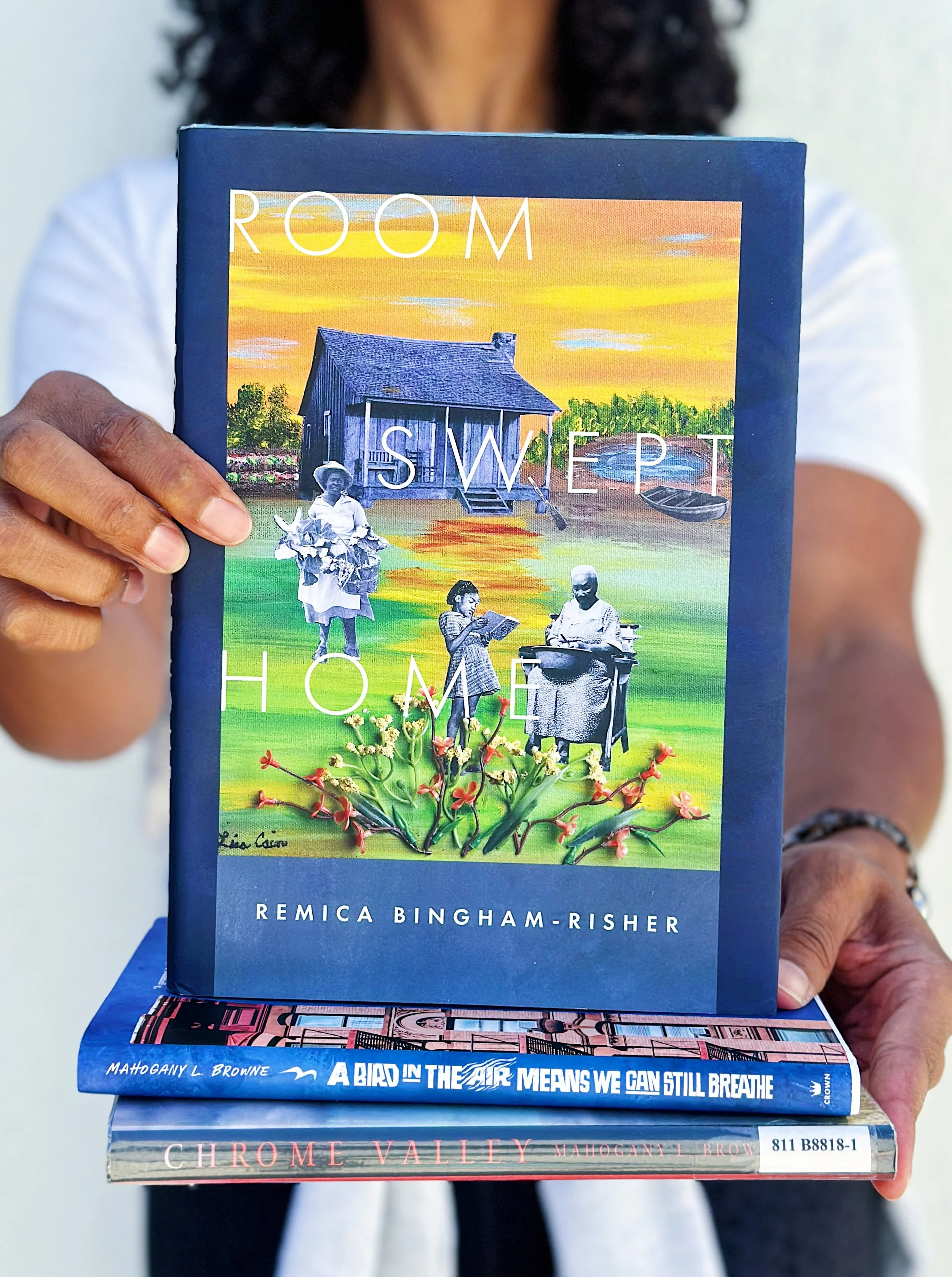
It’s The Stacks Book Club Day, and we’re joined by Mahogany L. Browne to discuss our April pick, Room Swept Home by Remica Bingham-Risher. In this beautiful poetry collection, Remica explores themes of race, lineage, faith, and mental health through the lens of her own family history. Today, we talk about what makes this collection so unique, how her poems capture historical context, and the ways this collection subverts form and tradition.
Listen to the end of the episode to hear what our May book club pick will be!
LISTEN NOW
Apple Podcasts | Spotify | Google Podcasts | Overcast | Stitcher | Transcript
Everything we talk about on today’s episode can be found below in the show notes and on Bookshop.org and Amazon.
Room Swept Home by Remica Bingham-Risher
South to America by Imani Perry
Richard III by William Shakespeare
“Flawless Remix” (Beyoncé feat. Nicki Minaj, 2014)
The Last Lynching by Lawrence Leamer
The January Children by Safia Elhillo
“Ep. 316 The January Children by Safia Elhillo” (The Stacks)
“Unabridged: Poetry Therapy 2.0” (The Stacks)
“If We Must Die” by Claude McKay
The Age of Phillis by Honorée Fanonne Jeffers
Load in Nine Times by Frank X Walker
Lose Your Mother by Saidiya Hartman
The Moon That Turns You Back by Hala Alyan
Felon by Reginald Dwayne Betts
Room Swept Home by Remica Bingham-Risher (audiobook)
Lonely Crowds by Stephanie Wambugu
“Ep. 404 The Best Books of 2025 with MJ Franklin and Greta Johnsen” (The Stacks)
Luster by Raven Leilani
To support The Stacks and find out more from this week’s sponsors, click here.
Connect with Mahogany: Website | Instagram | Facebook
Connect with The Stacks: Instagram | Threads | Shop | Patreon | Goodreads | Substack | Youtube | Subscribe
To contribute to The Stacks, join The Stacks Pack, and get exclusive perks, check out our Patreon page. If you prefer to support the show with a one-time contribution, go to paypal.me/thestackspod.
The Stacks participates in affiliate programs. We receive a small commission when products are purchased through links on this website.
TRANSCRIPT
*Due to the nature of podcast advertising, these timestamps are not 100% accurate and will vary.
Mahogany L. Browne 0:00
Even though this is a book of memoir and a book of imagination, she doesn't romanticize the past. She examines it with care. In that examination, she reveals the returning to one's origin as an act of returning to self. So it also feels like while she's unearthing all of these small, little trivial things that we just write off as, you was born on Christmas, like all those moments, she's like, let's think about this in this way. And she just turns it a little bit so that, that romanticism, it's dying on the vine. It really is. She's trying to give us a different bounty of fruit.
Traci Thomas 0:42
Welcome to the stacks, a podcast about books and the people who read them. I'm your host, Traci Thomas, and today is the stacks book club day. We are joined by mahogany l browne to discuss our April book club pick in honor of National Poetry Month, the book is room swept home by Remica Bingham Risher. This is the 2025 Los Angeles Book Prize winning poetry collection that explores the themes of race, maternal lineage, faith and mental health through the lens of Remica's own family history. Today, Mo and I talk all about these poems. We talk about what they mean. We talk about how and why Remica would want to tell this story in this way we talk about the archive, the lineage of poetry, we get into it all. And be sure you stay tuned till the end of today's episode to find out what our May book club pick will be. Everything we talk about on each episode of the stacks is linked in our show notes. If you want more bookish community, more hot takes and content from me, consider joining the stacks pack on Patreon and subscribing to my newsletter unstacked on sub stack. These are two different spaces to lean a little further into the stacks universe, if you will. You get different perks at both places. If you're looking for community and conversation and virtual book clubs, head to Patreon, and if you want more of my writings on culture, on nonfiction book recommendations, head to sub stack, and know that in both places, you get bonus episodes each month, and you get to make it possible for me to make this podcast every single week to join head to patreon.com/the stacks for the stacks pack and you can subscribe to my newsletter at Traci thomas.substack.com, all right, now it is time for my conversation with mahogany l brown about room swept home by Remica Bingham Risher, hi everybody. It is the sax book club day, and it's Poetry Month, which means we're discussing a poetry collection. We're discussing room swept home by Remica Bingham Risher, and we are joined again by the absolutely wonderful, stunning, amazing, almost birthday girl, but will have been birthday girl by the time you guys listen to this mahogany l Brown. Welcome back, my dear.
Mahogany L. Browne 3:00
Thank you for having me, boo.
Traci Thomas 3:02
I'm so excited. Oh, we're diving right in. We're diving right in. Here we go. Room swept home. We always start here. What generally, broadly did you think of this collection, and if you've read it more than once, did anything change on later readings?
Mahogany L. Browne 3:24
My first thoughts because, you know, I had to write it down. No one plays with Remica Bingham Risher without studying the letters. Remica takes both commonplace and the sacred, infuses them within the care of a particular action, which is to tend, to tend to. Remica illustrates with her poetry the actions that tend to all we know through hands moving over a familiar surface, a table or another piece of furniture, by clearing the surface, arranging it and remembering what was previously neglected, as those things come forward, and they're worthy of being passed from one generation to the next. So for the poet, home can be represented through fixed structures, living altars and living history, and through the layers of history formed by genetic connection, movement around the Earth and the private negotiation of being a black woman in this world, Remica put together a deeply reflective body of work, braiding memory migration and womanhood into textured poetic archive. That's what I wrote when I first read it, right? Because you have to, like, put it in summation. And then I went back and I had one extra word that I had to add, and that was church,
Traci Thomas 4:42
oooh
Mahogany L. Browne 4:44
Praise. Church. Remica gave us a sanctuary for black women to sit still in. And what I realized is I need to write better poems. Okay?
Traci Thomas 4:58
That's hilarious.
Mahogany L. Browne 4:58
That's when you know it's good, when the poet writes so good that you like, what have I been doing?
Traci Thomas 5:03
What am I doing?
Mahogany L. Browne 5:04
Let me wake up. Let me, let me dig into the archives. Let me remember who was here before they told me nothing was here. Let me, let me go home to church. Yeah,
Traci Thomas 5:18
I love that.
Mahogany L. Browne 5:19
I love this book. I love it so much.
Traci Thomas 5:21
Okay, I'm gonna tell you my sort of initial thoughts. I did not write them down like that. I took notes because I'm not a poet or a writer, and I hope to never be. So here's what I said. What I really appreciated about this poetry collection is that it did things that I didn't know, that poets could do like I didn't, it had never occurred to me that you could write a family memoir as a collection of poems, which is essentially what this book is, right? Like it's a matrilineal family memoir. We get the story. And I should have said this at the beginning, for people who didn't read it, this collection is inspired by the author Remica's her paternal great great grandmother Minnie, and then her maternal great grandmother Mary, no excuse me, her maternal grandmother Mary
Mahogany L. Browne 6:13
Her paternal great great great grandmother Minnie
Traci Thomas 6:17
Minnie and her maternal grandmother Mary,
Mahogany L. Browne 6:20
Correct
Traci Thomas 6:20
And they both intersected in a town in Virginia, and that sort of inspired for like a few years, and that inspired at the end of minnie's life, and sort of right after Mary had had a child, she was, what we would now say, had, like postpartum depression. They called it water on the brain, which is also like a poem. Is that not a poem? Water on the brain?
Mahogany L. Browne 6:47
That's our anthology
Traci Thomas 6:48
Yeah, that's it. Water on the brain, the story of black woman madness, about the story of crazy black women
Mahogany L. Browne 6:56
yes.
Traci Thomas 6:57
And so that inspired her to go into the archive and look around. And she sort of says in her introduction, she imagined that from across town, they might have passed or had like and so I just didn't, I didn't know you could do that with poetry. Of course, I know that you can, but it had never occurred to me that you could and then, just like, from a personal level, the second half of the poems, the second half of the book, really spoke to me like those were the poems. That's where the majority of my like, favorite poems in the collection came from. But I was the most excited about like, the archival, non fictiony piece of the first half. Like, there's a moment where you see the ledger where Mary is signed into
Mahogany L. Browne 7:48
Yes,
Traci Thomas 7:48
the like, insane asylum, basically. And you see that picture, and then on the next page you get this poem that imagines her intake,
Mahogany L. Browne 7:59
yes.
Traci Thomas 8:00
And it's so powerful,
Mahogany L. Browne 8:01
yes,
Traci Thomas 8:02
that poem isn't necessarily like my favorite poem, but that moment will stick with me, you know
Mahogany L. Browne 8:10
Right, it's the [inaudible] of this really intense moment of like, first they say that we didn't belong here, and then they say they have no record of what was happening when we were here. Not only did we belong here, we know that, but she gives us place. And then she shows how erasure happens.
Traci Thomas 8:27
Yeah.
Mahogany L. Browne 8:28
And then, she unerases her people with the poem that comes like that kickstand moment of juxtapositioning what you know to be true versus what you've been taught is truth becomes barreling forward. And it is some of the most sad parts of the of the book for me that was the that was the saddest part where I was like, Oh, y'all just gonna say anything. Oh, you'll just say anything.
Traci Thomas 8:55
You'll just say anything.
Mahogany L. Browne 8:56
And that becomes the artifact of our life, that becomes the memory that we keep of our people, and the fact that she took those histories, the inadequacy of it, and she rounded it back into a human form, into these loving pieces of of poetic snapshots for for her people to thrive in, and then, therefore, for us to thrive in.
Traci Thomas 9:23
Yeah, I get, every time I see a family tree in the book about black people, I get so jealous, right? I'm just like, I gotta, I gotta figure out how to make time to go to the archive and like, I gotta have, I just, I want to know so bad. I tried to do like, all the ancestry.com blah, blah, blah. I couldn't get very far. But every time I see it, I'm just like, I want this so bad.
Mahogany L. Browne 9:46
Just to know where you to know who you're from,
Traci Thomas 9:51
yeah, and like to know that I to know that we were here. That's right for sure, like, for sure. My people were here. I know they were here, but I want to know for sure. Like, I want to be able to say I know this piece of information, yeah, like in Imani Perry's book south to America, she's able to go really far back in her family tree. I can't remember how far, because I read the book years ago, but I remember when I first met her after reading that book, I was like, how did you, how did you do it? Like it was something, maybe it's not actually, but in my memory, it was like she got back to the 1700s
Mahogany L. Browne 10:33
It's something that I didn't think was possible. My partner does, like, a lot of genealogy work, just as an artist. So all of the stories that I had coming to New York from Oakland, California, were stories that were passed on to us from Paw Paw. And then to come to New York and meet someone who does this, like, rigorously,
Traci Thomas 10:55
right?
Mahogany L. Browne 10:56
I gave him the a couple of the, you know, the timestamps, the stories, and he came back with, like, actually, that's not what happened. I found some documents. So it's possible you just have to have that, that that tool, that niche. He has it. I don't have it. I'm not. I'm I'm literally still walking around in my memory the story that paw paw told me, right, how we got our last name.
Traci Thomas 11:19
I could do it. I just need someone to point me to the right place.
Mahogany L. Browne 11:22
Yeah, okay,
Traci Thomas 11:23
okay. But anyways, so I like that picture in the beginning of the book, I was just like, I'm so jealous already. I hate her. I hate her so much. But the book starts with this epigraph from Minnie Lee folks, who is, who is the family member from 1937 and she says, I just know I could, if I knowed how to write and had a little learning, I could put off a book on this here situation.
Mahogany L. Browne 11:48
She already knew she was an author baby remica came from an author
Traci Thomas 11:51
she came from it, yeah, but like, when, I mean, I mean, I'm just want to do, like, a little fantasy moment, imagine being ramika and finding that, like, don't you feel like that's got to validate your whole because I'm sure there were times in her life where she was like, I really want to write. I want to be a poet. And people were like, okay, but like, how are how? You know you have no business, right? And then you find this from your great, great, great grandmother,
Mahogany L. Browne 12:19
powerful. Not only are you designed to do this work, but who's to say she wasn't guiding that pen? Come on now,
Traci Thomas 12:27
that's right. It's like you're, you were this was always there, yet the universe has been conspiring for your success as a writer in every possible way. It's just, it's chilling.
Mahogany L. Browne 12:39
Yes,
Traci Thomas 12:39
it's chilling.
Mahogany L. Browne 12:40
It's also can be known as ancestral technology.
Traci Thomas 12:45
Oooh
Mahogany L. Browne 12:45
ancestral technology, something that is passed through the DNA, right? Also, I think it that note that's like a nod at Toni Morrison. Ancestral technology, obviously, is ancient, but Toni Morrison said the remembering, right? The remembering, it doesn't mean that you went through something to have your body remember the thing. And most of that, more times than not, is is spiritual that's coming from who made it possible for you to be here. So that ancestral technology of needing to write, of knowing that this is your place to write, and seeing that her great, great, great grandmother said, I got a story to tell, and now here Remica is putting out great, great, great grandmother's story. That ain't nothing but divinity. That's that is ancestral technology. She said, yes, the stars have aligned.
Traci Thomas 13:31
It's amazing. It's amazing.
Mahogany L. Browne 13:33
And then for her to have that tree, that tree!
Traci Thomas 13:37
The tree! and in between the epigraph and the tree we get the lost friends notice,
Mahogany L. Browne 13:44
ooh.
Traci Thomas 13:46
I mean, this book starts off with a fucking bang, yeah, like the way she situates her reader in the world. I mean, the cover is doing a lot of work.
Mahogany L. Browne 13:58
Yes,
Traci Thomas 13:59
the cover is like this blue with the yellow and the green, and it's got these plants, and then it's got what I assume is Minnie Mary and Remica as sort of collaged on this painting with the home that looks like one of the homes from the pictures. And you're just like, Okay, I see where we are, right? And then you go in, you get this epigraph from many you get this lost friend notice, which is basically it's in these publications. Black people would write to the publication saying, I'm looking for this friend or this family member because we've been separated, and this is their name, or this is where I last saw them, or this is where they were. And in the hopes, I mean, it's sort of like a, you know, missed connection, or whatever,
Mahogany L. Browne 14:47
the original missed connection.
Traci Thomas 14:49
Yeah, exactly. And people wrote for years and years, and so she writes her own poem. Paragraph. It's prose, but it's very poetic and she names her family members and and, you know, I just want to read this little bit. My parents names are here, holding uncle's names are sprightly, long gone, whisper and road bed. Aunts, hunger, child free, child many, want and wanting. Come on,
Mahogany L. Browne 15:18
yes,
Traci Thomas 15:19
I love child free and child many,
Mahogany L. Browne 15:22
Child child free, child many, want and wanting, whisper, road, bed, long gone, sprightly, like her ability to talk about displacement, memory, intergenerational care, all the while, with an attention to lyric is masterful
Traci Thomas 15:41
and also archetype. Everyone knows the child free and the child many auntie. Everyone knows the want and the wanting auntie. Everybody knows uncle, long gone, right? Like, it's like, these are archetypal black family members. You might not have all of them in your family, but you know, all of them you they are within your communities. Yeah, it's just, it's an incredible, incredible place to launch a collection from. And then we sort of get her introduction, where she explains the project. And then we start with Minnie,
Mahogany L. Browne 16:16
yes.
Traci Thomas 16:18
And this, I want to ask you this as a poet,
Mahogany L. Browne 16:20
okay
Traci Thomas 16:20
As a person who has put together poetry collections, how do you know where to start? What is the first poem? And do you I know sometimes people like write a collection and they reorganize it, and then I know maybe some people write a collection and they know they don't have the first poem, but I guess not so much. How do you know which one it is? But what are you hoping to do with the first poem in your collection,
Mahogany L. Browne 16:44
right? That's a great question. I think I always, I returned to Terrence Hayes's notes. He was, you know, OG poet Guggenheim genius, all of the MacArthur Genius, whatever he's that dude, and he writes like nobody's business. He's also like a painter. But I remember something he said when he was teaching at Kaveh, and he said, You got to remember that that first poem may be the only time you get that reader's attention. So the first poem is the hook, right? You can, you can dwaddle on. You can do a whole bunch of languishing and lush language later. But if that does not, if that's not the first nail that is hammering into the foundation a place for the structure to remain, then you might not get page two reader, you might not get chapter three reader. so I always think of that that's in the forefront of my mind when creating the book. I'll just put it all together. The editor will look at it. They'll say, Well, I think these three poems could do it right, and I have to trust myself. How have I seen this poem work in the in the room? And because I have the luxury of having most of my performance in poetry life be in very large spaces, large stages, I know exactly, like sonically, what this poem is going to do. So that's how I choose. I choose, what is the hammer, the nail in the hammer, what's going to make them stay and want to turn the page.
Traci Thomas 18:22
Yeah, I wanted to say one little thing about the introduction. At the very end of the introduction, she this is what she says, the poet's job is the poet's job, ie, the poet As historian, as opposed to other undertakings, such as, poet as soothsayer, poet as family arbiter, poet as line dancer and the like, is to make the dead become the living. And she does that in this I mean, she uses persona poems for the first, I mean, throughout the whole thing, but especially in those first two sections, because she is embodying Minnie and Mary. So, I mean, I don't, I guess I don't know if that is considered a persona poem, if it's like the whole thing, but that's how I read it.
Mahogany L. Browne 19:04
I mean, if you're writing from the voice of someone, that is the persona, yeah,
Traci Thomas 19:09
yeah. So she does it like that, and then, like I said before she she makes the dead become living, also in the ways that she makes this feel like memoir,
Mahogany L. Browne 19:16
yeah,
Traci Thomas 19:17
like these little moments in memory that she sort of pieces together and imagines, I think it's, I mean, I think it's quite remarkable, because obviously she never met Minnie. I never met Minnie, but I feel like I know Minnie, like I have thoughts and feelings about Minnie. Maybe they are not totally accurate to who the woman was, but there is a woman in my imagination to whom I feel like I have learned something. So I do feel like she has made her become living.
Mahogany L. Browne 19:49
I think she does a really complex job, a complicated job by putting voice to someone she may never have met. It. But I think also what we tend to forget is that we are living those great, great, great grandparents dreams now, and so some more times than not, their voices with us. They voice carries with us. How many times over a dinner table with your family has someone say you remind me of your auntie? And you may have never met her, and you just like, Huh? I think that she lean leans on that in a really, like inspiring way, where breath is meeting memory, but memory is not sitting silently. Memory is not waiting to be found. Memory is willing to dance with her, and she does a really good job of starting that with minnie's voice. First that epigraph, that's Minnie. We know she got, she got something to say, and then she comes in with the lost friends, which is, like, that's a hammer. Because, wait, poems can be an ad? poems can be a footnote? Poems can be in three different columns and then become another. Like, what? She does the thing where you like, oh, I need to know more.
Traci Thomas 21:06
Yeah. And her first poem, birth story, is about the birth of Minnie which I think obviously, in addition to what you said about grabbing the reader, feels obvious in this case, because we are going through time, so to start at the beginning of someone's life, feels like, you know, I get it.
Mahogany L. Browne 21:25
And there was a question that I put in there to that specific poem, what do we inherit when trauma is at the core of our fractured living? She wrote that, and I just kept told I kept spinning that around in my head, like, what do we inherit like it's fascinating, because I want to believe that I know what I know, but we don't know. We don't know very much. I'm still learning. I'm still learning. And so that birth story became I need to ask my mom about her birth story, right? I know my own and I know my brother's, but I don't know hers.
Traci Thomas 22:01
Yeah, I don't know my mom's either. This poem has a refrain that comes up later, but is also sort of the, I think maybe one of the spirits of the collection, which is God brought you here. God made you free. And that comes up later as something that's sort of like repeated and repeated in minnie's life. In the poem, it says, and I remember what my mother said, The woman told her, told me, God brought you here. God made you free. Jesus was born outdoors on a night when the shepherd slept in the field free from frost, no snow. Christmas wasn't his day either, but someone saw, somewhere saw fit to give him what they thought he deserved, what suited them saved the truth for later. And that's a tie in to the beginning of the poem that says, I wasn't born on Christmas. So that is what some folks will tell you. I thought that was I think this is a very good first poem. I think the tie in to Christmas and and like that sort of history of black people, everyone being born on Christmas. I think it's really, it's catchy, and I also think it's something that any reader can sort of relate to. And I think that ending of like, okay, when you think about it, Jesus was not born in the winter, perhaps, perhaps,
Mahogany L. Browne 23:19
yeah,
Traci Thomas 23:20
though I don't know, because if Jesus is born in the Middle East, it might be warm there in the winter, like, you might be okay, you might catch a nice day. But I just love the idea of, like, she sets it up like that, and then she ends it. She has a lot of sort of Voltas in her poems, where she twists the ending and you're sort of like, Ah, okay. And that's a personal favorite for me
Mahogany L. Browne 23:40
Yes, she doesn't land where you think she's going to
Traci Thomas 23:43
Yes, she's she's journeyed somewhere for many of them
Mahogany L. Browne 23:47
I can appreciate the birth story also not romanticizing the past.
Traci Thomas 23:52
Yeah,
Mahogany L. Browne 23:52
I love that. Even though this is a book of memoir and a book of imagination, reimagining, she doesn't romanticize the past. She examines it with care and compassion. In that examination, she reveals the returning to one's origin as an act of returning to self. So it also feels like while she's unearthing all of these small, little trivial things that we just write off as you was born on Christmas, like all those moments. She's like, let's think about this in this way. And she just turns it a little bit so that, that romanticism, it's dying on the vine. It really is.
Traci Thomas 24:34
Yeah,
Mahogany L. Browne 24:34
she's trying to give us a different bounty of fruit.
Traci Thomas 24:38
You're so right. I would never have thought to articulate, articulate. It like that. But this doesn't feel like it's romanticizing the past. What a good observation. Gold star for you.
Mahogany L. Browne 24:49
Thank you.
Traci Thomas 24:49
Okay, can I ask you another question about a poem?
Mahogany L. Browne 24:52
Yeah?
Traci Thomas 24:53
On page five, on the plantation. It's the next one we get. Or, as some say, down home, do you see the shape of this poem?
Mahogany L. Browne 25:00
yes,
Traci Thomas 25:01
Like how it looks on the page. What do you what do you make of the shape of a poem, the shape of a thing? Like, what does that signal to you?
Mahogany L. Browne 25:11
So usually I think of it as movement, like the fluidity of the page. It becomes a score, and what she does differently here than most, is that she she breaks that first tercit, the first three lines is broken, and it's only the two lines
Traci Thomas 25:34
and then the one
Mahogany L. Browne 25:34
and then the one by itself. Children were everywhere, which deserves to be on its own line, right? Because now you need to see the vastness of all the families, the blood, the straw, the leaves, the iron, because children are a part of that
Traci Thomas 25:50
Right, right
Mahogany L. Browne 25:52
But when I look at it, it felt like a tilling, like tilling of land, and because it starts off with on the plantation, or some would say, down home, I instantly saw crops. I instantly saw rows of harvest.
Traci Thomas 26:10
Does it change the way in which you read the poem? Is there something that you do differently with those what do you call it? A tercet?
Mahogany L. Browne 26:19
Tercent lines, uh huh. I think, all right, so, who was it? Couplets. Natalie Diaz had this great workshop also with Kaveh, where she talked about the couplet. You can't hide any language in couplets. They're so sparse, they're very you know, two lines, every word matters. And I think with tercets, they also work with that same idea in mind. However, there's a little more musicality, because there's longer lines to work with. And so in that sense, I definitely feel like we belong to all the families, period. But you jump right back fast, because we belonged to all the families is in the middle of we the blood and straw, the leaves and I am so it's telling me that the pace is picking up. And then that big break from the couplet to the one line, children were everywhere, definitive, stand alone. Say, say it mighty. So it serves as a score for me, for like, if I'm running over a line if I'm going to catch up faster, how do I think the author wants me to read it?
Traci Thomas 27:25
Okay, and then one more question on the shape of this, because a lot of these poems have interesting shapes, so I sort of wanted to spend time on one of them. On this, do you see when the first line is the most indented? Then it goes towards the left? In the second poem, we get the first line, we go to the left, and then we come back to the right, and then the rest of them, until the last one, are diagonally moving towards the right. Does that mean something to you? Does that signal anything in how you read it? Or, I guess the reason I'm asking this is because I talk about this every year we do poetry is like, I'm I'm a, I'm a slave to the line ending?
Mahogany L. Browne 28:01
Yeah,
Traci Thomas 28:02
I believe in the line ending more than I believe in any other punctuation or anything. Obviously a period at the end of a line is a true stop. I believe in that, right? Like I feel that strongly. But what I don't have a lot of, and that's because I studied Shakespeare, and so in Shakespeare, you have to honor the line ending because it's an iambic pentameter, and you fuck up the whole thing, if you're just if you're just reading through, you ruin, you ruin it. Okay, you can't do now is winter of our discontent mid glorious summer, by the sunny York you got to stop.
Mahogany L. Browne 28:31
Stop.
Traci Thomas 28:32
Now is the winter of our discontent
Mahogany L. Browne 28:34
period?
Traci Thomas 28:35
Yes. Then now it's been made. It's been made. Anyways,
Mahogany L. Browne 28:39
I love your alchemy. I see you going, Oh, right.
Traci Thomas 28:42
Listen, don't get me started on Shakespeare. I'll do I could I taught a class on it. I love it so much. It's the joy of my life. I love Shakespeare. I love iambic pentameter. Anyways, that being said, there's not a lot of shape differential in there,
Mahogany L. Browne 28:58
right?
Traci Thomas 28:58
Especially indenting the other way, right? And so I'm just curious. The reason I ask is because, also with Shakespeare, like if you have a short line, you have to fill those, the rest of those iambic pentameter, the meter, the feet, with something as an actor. So if a line is just Oh, you have nine other syllables that you're waiting for. So when I see something like this, they look almost all to be the same length, but the indentation is I feel like it's telling me something as a reader, but I'm not sure what it's telling me. So I'm curious what you might feel like it's telling you.
Mahogany L. Browne 29:39
I wonder I didn't think of it in that way when I looked at it, I did look at we belong to all the families, because it's so far indented right, that it was about not belonging to self in the moment. Like, this is an old thing. We belong to all the families, which means we all care for one another. And I feel like they had to center. She centered that line to show the centering of we and then for it to go all the way down to the last, last of page, five children. It matches up with children were everywhere again,
Traci Thomas 30:21
yeah,
Mahogany L. Browne 30:22
oh, it's, it's the first, the first on the left, or the l7 Yeah. Otherwise, I didn't, it didn't stick with me in that same way. I just looked at it like, Oh, these are rows, rows and rows. Okay, I know. I know where we are in the south. We belonged all the way over there. That means domain and, yeah,
Traci Thomas 30:49
can I tell you what I what it made me think of this is the only thing I can kind of come up with, is that the we belonged is almost halfway through the thought, like, it's like, you're jumping in, in the middle of a story. They've been talking about this thing, and it's like, oh yeah. And we belong to all the family, like, you know, and then, and then, it's sort of like these memories are sort of like little almost fragments, or like fractal pieces of the story, which is why they either get shorter or they sort of move to the right. But I you know, that's just like, that's some, that's something
Mahogany L. Browne 31:24
I like that. What I love about poetry is it's yes and
Traci Thomas 31:29
yeah, totally,
Mahogany L. Browne 31:30
totally, I love that.
Traci Thomas 31:32
Okay, wait, let's take a quick break, and then we're gonna come back and do more. Okay, we are back. Can we? Is there anything in this next little section that you really wanted to discuss? Otherwise, I'm gonna have us jump ahead a bit.
Mahogany L. Browne 31:47
I was thinking of page 16, strict tobacco, like greens.
Traci Thomas 31:52
I have notes on this poem. Go ahead.
Mahogany L. Browne 31:54
Okay. Again, we are softened by our tercet collection. Those three lines.
Traci Thomas 32:02
And these are very short ones.
Mahogany L. Browne 32:03
These are very short ones. I love that we start with. Ain't much difference, right? So we're already in the kitchen,
Traci Thomas 32:13
that's right, and we're also in the middle of a thought, for sure. they all start with lowercase letters, which, to me, signals like we're in it
Mahogany L. Browne 32:21
because the poem, the first line of the poem is also the first line is also the title. So strip tobacco like greens, ain't much difference. Soak them in water to ease the leaves and pull the largest ones to wrap the bundle. These called the hands, we the stemmers, all women on the line rose filled with traveling songs I sang as a child at the feet of my mother. She bound the leaves packed in Hogshead, some found bodies in the large drums put there for punishment or fun. What? One, I didn't even know about tobacco. Let's start there. I know about greens, but I don't know about tobacco.
Traci Thomas 32:59
And this is Virginia. And so Virginia was a big tobacco economy
Mahogany L. Browne 33:03
huge tobacco plants yes, but for her to start there and just in the playing field, what you know, what you don't know, and how all of it is connected, all of it is relative, I thought was really stunning. And then to have the children and be playing around tobacco like joy will find us wherever children are,
Traci Thomas 33:29
Yeah yeah
Mahogany L. Browne 33:30
And she always does this thing where she does the the POV of out, in out, in, it feels like a pulse,
Traci Thomas 33:38
yeah,
Mahogany L. Browne 33:38
Right when it gets to be a little overwhelming, because if you really think about somebody stripping tobacco like greens, and then you think of a child sitting right there watching that, you then have to go back into your head like, whoa. How long the baby been watching? Was the baby outside with them while they were picking and then you historically, right? There's no more innocence,
Traci Thomas 34:00
right?
Mahogany L. Browne 34:00
So, by the fourth line during the war, the factory was a hospital already, I'm like, that baby didn't even get to be a baby singing at the feet of mother already had to consider really bittersweet poem,
Traci Thomas 34:17
yeah, what, what I actually have is in the last, the last three stanzas. Because, you know, I read every poem out loud.
Mahogany L. Browne 34:24
Oh I'm so proud of you. I gotta attend this poetry show you be doing.
Traci Thomas 34:28
It's very private, but it's loud, like I I always say I don't read it so te voce, like I'm not whispering, I'm fully saying the poems out loud. So I got to wait till everyone's out of the house, you know. But what I was really struck by is the last three stanzas, the rhythm of these three they start with our mothers upended, invented inventors, our fathers a secret or kept under the tally thread woven through throat, groin and spine, bitter stem, bitter greens. Means yellow leaves, little soothes the busy hand, the flying mind. It's like the consonants and vows and the way she like that first one, the upended, invented, invented, and then the next one has like these, like, really, like, what do you call it? Dip, diphthong vowels, but also the when the consonants, consonants are together, two of them, there's a word for it. My kids always say it. I can't. Anyways, it's like, die, something or whatever. But it's like the thread, throat, groin, you have these, like, spine, they're all two consonants to start the word through. And that's like, that's, that's work for the tongue, right, to do throat you have all this. Or, like, it's like, really, you're working. And then the last one with the bitter stem, bitter greens. It's like, very like, dot, dot, dot, dot, dot. And she puts them all back to back, so quick, yes. Like, as I was reading it, I was legitimately like that, but I was like, This is awesome.
Mahogany L. Browne 36:06
Music,
Traci Thomas 36:07
music. I wasn't really paying attention to the words at all, but I was like, vibing it. I was vibing it because I feel like when you're speaking out loud, you have to contend with what your mouth is actually doing, right, whereas when you're read, so like something that you would just read and not pay attention to,
Mahogany L. Browne 36:23
yes,
Traci Thomas 36:24
but like when you put two consonants together, or three consonants together, that's usually a lot of work. It's why, like a word, I'm trying to think of like a good word, but there's certain words that are just like difficult to say because there's so many consonants backed up, and it makes its staccato and it like does things. So I don't know, I just, I really, I really enjoyed that.
Mahogany L. Browne 36:46
I love, I love your articulation of sound, it's really special, but also you're absolutely right. I felt like she became my favorite battle rapper in those
Traci Thomas 37:00
Yes, yes. It's such a shift,
Mahogany L. Browne 37:04
and it's still spot on. It's still on point. Just in case you forgot who she was,
Traci Thomas 37:10
yes.
Mahogany L. Browne 37:11
First of her name, Remica
Traci Thomas 37:12
Do you know what it is? It's not even a not even a battle rapper. To me, it's when Beyonce is singing and then raps in the middle of the song, and she's like, and you're like, Hello, yeah. Like, what the fuck you're like, this was already a bop, like I was already vibing. And then she just is like, yes, Beyonce, get it. I'm doing flawless, in case you can't tell,
Mahogany L. Browne 37:37
I can tell
Traci Thomas 37:38
Thank you. But I'm just like, yes, of course, of course. It's so good because it's such like, it's just like a little flex, like, it's just like a little like
Mahogany L. Browne 37:48
It's just to remind you, she contains multitudes
Traci Thomas 37:52
yeah, yeah. It was really good. I also think it's, I always love whenever we do these episodes and the guest calls out a poem that I'm like, Oh, I have notes on this one, like this one also hit me, because I feel like, with the poem, any one poem can mean anything to any one person. But I feel like when multiple people think about a poem, you're like, oh, okay, there's something here, either between you and I, or between the poem in the world, or whatever. You know,
Mahogany L. Browne 38:20
I love that so much.
Traci Thomas 38:22
On page 20, we get the questions that still need answering,
Mahogany L. Browne 38:28
Yeah
Traci Thomas 38:28
which are questions from the WPA and I'm going to do like a little history lesson really
Mahogany L. Browne 38:33
quickly.
Traci Thomas 38:34
So for people who are not familiar it from 1936 to 1938 the federal government did something called the Works Progress Administration, and a lot of white people went into, I think it was like 15 southern states, and interviewed black people who were alive during slavery, who had lived through slavery. Sometimes they also spoke to people who were the direct descendants, but these were often people who were children, because we're talking about 1936 to 1938 so it's many years after the end of slavery. And they interviewed them, and they got the stories. And so, so, so, so much of the history that we understand about what happened during the centuries of enslavement in this country came from these interviews, and they are flawed, and they are because a lot a lot of it is because they sent White people in, and these are into communities that were not comfortable with white people, that did not have, did not necessarily have, like, great relationships with white people for, you know, obvious reasons, I think it's fair to say, and also because people were saying what they thought they were supposed to say. There was all sorts of reasons why these interviews are maybe. Not totally reliable. However, there is so much amazing stuff. There are photographs in these archives. And, you know, there are historians who have since done other work. There are other records, whatever. But this project was a huge deal, and I think, like, shapes the rest of American history in a way that without it, it's like, it makes me terrified to think of how little we would have if this had not happened. I wish it had happened sooner. You know all of these things, but that is what the Works Progress Administration is,
Mahogany L. Browne 40:38
yes.
Traci Thomas 40:38
And so this poem on page 20 is questions that still need answering. And, you know, in the notes in this collection, she says, These are questions from the Works Progress Administration interview, I can't remember which I think it was in, obviously, in Virginia,
Mahogany L. Browne 40:56
For the ex slaves
Traci Thomas 40:57
Yeah the questions are for the ex slaves.
Mahogany L. Browne 40:59
What [?] me out was the amount of questions.
Traci Thomas 41:04
What about question 94 was it pretty?
Mahogany L. Browne 41:08
what is it?
Traci Thomas 41:10
What is what? What's the just like, I mean, I love it. I love it as a question, because, like, obviously you're going to ask name, age, where are you from? What are your parents names, whatever. But if you really want to get a sense of what this time was like, You do sort of have to ask, Was it pretty
Mahogany L. Browne 41:29
right?
Traci Thomas 41:30
Like? It's a crazy question,
Mahogany L. Browne 41:32
what was the easiest and the hardest work for slaves?
Traci Thomas 41:36
Yeah.
Mahogany L. Browne 41:37
What?
Traci Thomas 41:38
What about 242? Did you see the stars fall?
Mahogany L. Browne 41:42
How about we're at 242?
Traci Thomas 41:45
Right, right? But also, like, who wrote that question? Yeah, it's like, okay, what was the house like? What crops Did you tend? What? What do you remember from this time? Oh, by the way, did you see the stars fall? Also, did slaves ever own watches, rings or false teeth, like, it's just like from 242 to 258 I'm like, how? it's incredible.
Mahogany L. Browne 42:06
Yes, it's so far gone from it's so out of touch. It's so far gone. Yeah, it's so out of touch.
Traci Thomas 42:16
Yeah.
Mahogany L. Browne 42:16
Did slaves ever practice contraception? Describe the way slaves danced. Did slaves assemble at times just to sing? Did you see the stars fall, knock it off? These questions are
Traci Thomas 42:36
One of my favorite questions is, Did you ever hear of Nat Turner, Gabriel Vessey? And then it says writers seem to have confused Gabriel Prosser and Denmark vesti.
Mahogany L. Browne 42:43
Isn't that funny?
Traci Thomas 42:44
It's hilarious. But I also love that question, because I do, I feel like, you know, the story of of these slave rebellions was that if this happens, everyone will revolt. And so thinking about how preoccupied like this idea, like Did, did people actually even know about this? Like, did it actually catch fire in the way that everyone was feared that it would because, because the men who led these rebellions were brutally publicly desecrated, decimated, murdered, lynched, in a way to sort of prevent people from doing it again, to dissuade people from doing it. And I do sort of love this idea that the question was, like, in the end, like, did you, did you even know about that?
Mahogany L. Browne 43:34
Right?
Traci Thomas 43:34
Like, it wasn't like Twitter, where we all are like threads, where we all would know immediately, it's like, did this actually make it to Virginia. Did this news make it here? Did it matter?
Mahogany L. Browne 43:44
Or how much do you know? So we know whether to keep our eye on you. That's what it really feels like. It feels like interesting love. How much information do you have? Because it's asking all of that after war, patrollers, slave owners or poor whites, that's well after do you know about the Klan
Traci Thomas 44:02
Right? Was your former master in the Klan?
Mahogany L. Browne 44:05
And of course, it's not answered like the things that remained unanswered or still need answering also were poetic, right? So to have these questions was one thing, but the poetry that is happening just in the absolute ridiculousness of the question. It's it's half inquiry. It feels like half inquiry, half threat,
Traci Thomas 44:32
yeah, yeah.
Mahogany L. Browne 44:34
It doesn't feel like and that's why it's left unanswered. That's
Traci Thomas 44:37
and that's also why these questionnaires, as valuable as they are, were also skewed,
Mahogany L. Browne 44:44
yes, absolutely, because
Traci Thomas 44:46
you have this outsider from the federal government coming to your town asking, What do you know? Where were you when the war started? Yeah, exactly. But
Mahogany L. Browne 44:57
Where did your people buy a home after freedom. Why? So you can come?
Traci Thomas 45:06
but yes, as a non fiction lover and a person who you know cares deeply about how we collect history, that was a really special,
Mahogany L. Browne 45:17
so good
Traci Thomas 45:18
But that almost that one is like, sort of the bridge between, like, the archival images and things and then the poems,
Mahogany L. Browne 45:25
yeah,
Traci Thomas 45:26
like that feels like almost a hybrid moment in the book.
Mahogany L. Browne 45:31
I like that. I think you're right, but she does a great job, right, of reminding us that poetry as archive is possible. There are ways to demonstrate mastery and restraint and musicality. She showed us musicality with the Beyonce dadadada that, right? Yeah, that. But also now she's showing us the mastery of restraint. She didn't answer the questions,
Traci Thomas 45:54
right? She didn't share anyone's answers she easily could have
Mahogany L. Browne 45:57
easily. Instead, she let the lines be precise and spare. And the pulse in the undercurrent of that rhythm was was as much of inheritance as it was pure craftsmanship.
Traci Thomas 46:10
Yeah, I want to jump ahead a little bit to in each section towards the end we get to Remica's section, yes, but in each section there's a lynch they're lynching poems, poems about historical events that involve the murder of black people. In many section, it's about, it's, it's on page 42 in Mary's section, there's a few actually, but
Mahogany L. Browne 46:38
Minnie ends at 36 so 42 is Mary Etta, but
Traci Thomas 46:43
it's sorry, but it's during minnie's lifetime. Excuse me, during minnie's lifetime.
Mahogany L. Browne 46:47
In 29 is the riot. So I think that's Oh
Traci Thomas 46:49
yes, yes, yes. Oh, that's what I'm thinking of. Yes, yes, yes. Okay, so Minnie has the riots in 1919 right? And then in Mary we get Mary has a few. Mary has the 1922 and it's this long poem title that comes from an excerpt from a newspaper, but it's victims killed in 1922 were burned at the stake in the form of a torture that most people today associate with the so called Dark Ages. It goes on and on, and then we get the remains of the stained glass window poem on page 67 that's about the little girls in the church in Alabama, and then in when we get to ramika, it's on page 84 her poem is 25 days after I am born, a man is killed in Mobile, Alabama. And this is, this is like, there, I read a whole book on this. It's actually called the last lynching by Lawrence lemur, and it's all about this man who was killed and that his mother sued the KKK, and she won
Mahogany L. Browne 47:52
and won.
Traci Thomas 47:53
She won. They call it the last lynching.
Mahogany L. Browne 47:56
We know better.
Traci Thomas 47:57
We know better, yeah, but I was struck by the by this. I mean, obviously I know this thread of lynching black people sort of cuts through our history, like duh. But I was struck by how she kind of dropped these poems in to situate some of the more like internal familial with the broader historical context. Loved I loved that.
Mahogany L. Browne 48:24
Yeah, she never overpowered us with, she never overpowered us with the poems like why it's here now more so than embedding, embedding it into the integrity of this quilt, right? Which is to say it's always been happening. I love that she didn't shy away from it. She was very deliberate with her gesture, but she wasn't in a sense that she's like, delicate and acting like this happens. It's so infrequently. But let me say she's very like, this is an everyday occurrence, and look how Joy still lives this is and
Traci Thomas 49:03
because, like, we all, we all deal with it,
Mahogany L. Browne 49:06
yeah,
Traci Thomas 49:06
and like all of this other stuff, the personal is just like how it is for us is in relationship to the broader experience like that. Her people were connected to the events in the same way that, like, if your children were to write or your grandchildren, your great grandchildren, were to write about you, they could write about you,
Mahogany L. Browne 49:30
yes,
Traci Thomas 49:30
but you are so informed now by the events of the world. And to sort of not include that I don't think I would have noticed if it wasn't included, but I think including it added a layer, because like in the poem about 25 days after I am born, she writes about how her her own mother those weeks after spiriting me into the world, my mother watches the news, looks over at my father too frequently, calls his name each time he. Heads to another room, Delirious in her exhaustion and fear, where was he? Would he disappear? It's like our parents and our grandparents and our great great grandparents were living, doing normal things, having babies in the midst of this in the same ways that we are. And I just love that she brought that into the collection.
Mahogany L. Browne 50:22
She does a beautiful job of sturdying the tenant of witnessing.
Traci Thomas 50:29
Yes, you say it's so much better than me sturdying The tenant of witnessing.
Mahogany L. Browne 50:35
You said it, I just summarized
Traci Thomas 50:37
You poeted it. I prosed it. You versed it, you know,
Mahogany L. Browne 50:41
we can go on tour with this. I'm in,
Traci Thomas 50:43
yeah, I just talked, talk, talk, talk, talk, and then you're like, four words.
Mahogany L. Browne 50:50
I'm in, absolutely, but yeah, she did a good job of that where we're not, we're not scattered in a way that feels like, Oh, you took my head away from this memoir, episodic journey. We're like, No, this is a part of the framework,
Traci Thomas 51:10
right? And she didn't do everything. She didn't do Martin Luther King or Malcolm, like, she didn't do every, you know? She just was like, she didn't do all red summer. She just said, like, 1919, by the way, just
Mahogany L. Browne 51:22
That's right. Because, remember, that's right, remember, yeah,
Traci Thomas 51:26
okay, we have to, we have to spend some time on the lose your mother suite.
Mahogany L. Browne 51:32
Okay, let's go.
Traci Thomas 51:33
Because that's, that's the, the third that this is sort of the Remica's section, begins here, right?
Mahogany L. Browne 51:41
Yep, okay, yeah, I'm here,
Traci Thomas 51:43
and it's this. This is when
Mahogany L. Browne 51:45
contrapuntals.
Traci Thomas 51:47
Yes, this is the first contrapuntal. Okay, let me just ask you, okay, for people who don't know the contrapuntals, those are the poems that have the really thick spine right through the middle. And it's, there's like two, looks like two poems on either side. If you've been reading with the stacks for poetry every year, we saw a lot of these in Safia Elhillos collection the January children, but we've got two of them in this book. The first one is right here. That's number one. Unlike my grandparents, I thought the past was a country to which I could return. How do you mo read a contrapuntal
Mahogany L. Browne 52:25
so reading a contrapuntal it is positioned as two columns on a page. You read the left column, first, top to bottom, you read the right column, second, top to bottom, and then in the third read. You read from line, the first line, first column left all the way through the right, left to right. So that becomes your third poem. First line, first column is a poem. Second column is a poem. And when you read them together, starting on your left all the way through the line, that is the third poem.
Traci Thomas 53:00
Got it.
Mahogany L. Browne 53:01
And it's usually to signify two voices happening at, one is saying something, or one is responding. And then what happens when those two voices are combined? IE, they knew better. Going back was like salting broken skin, resetting bones. Second column, a wound opening, chasing some impossible American dream, and then left to right. They knew better. Going back was like a wound opening salt and broken skin, resetting bones, chasing some impossible American Dream.
Traci Thomas 53:39
Very good. I decided to add my own twist. I read the title each time, almost like a like a song, like you hit the chorus, so I would read the title, left, the title, right, the title, everything. But with this first one, because there's two lines, I did it a fourth way I did I did it kind of how you just did it, which was the title, left, left, stanza one, right, stanza one, then down to left, stanza two, right, stanza two. Because I feel like you could also read that it like that, in a way where there's only one line. You can't really do it like that,
Mahogany L. Browne 54:19
right? I think if I was to add the title, I believe she wrote it in a way where, unlike my grandparents, to which I could return, is the first columns titled poem,
Traci Thomas 54:34
yeah,
Mahogany L. Browne 54:34
the title of the first column,
Traci Thomas 54:36
yeah.
Mahogany L. Browne 54:36
Then I thought the past was a country. Is a title of the second column, do you see what I'm saying?
Traci Thomas 54:45
Ohhhh
Mahogany L. Browne 54:45
you go straight down the middle with that space,
Traci Thomas 54:45
Oh, I see, oh, yeah, yeah, yeah, oh, I didn't occur to me so that I love this as well.
Mahogany L. Browne 54:50
Country, a wound opening, chasing some impossible American dream, playing in the dirt, drumming up the body, an anchored the bite, a sharp misery. Or, unlike my grandparents. To which I could return. They knew better. Going back was like salting skin, setting bones as God, I insisted on time, like a hanging tooth.
Traci Thomas 55:09
Okay? Gold Star again. I want to talk about one other thing, okay, there is a word in this poem,
Mahogany L. Browne 55:16
yes,
Traci Thomas 55:17
wound, wound. It shows up in a ton of these poems, especially in the back half. Yeah, I had fun reading it.
Mahogany L. Browne 55:27
Yeah,
Traci Thomas 55:28
a wound opening. I don't know there's something there. It sounds different. I know in some of them it's obvious that it's wound, but in some of them it's wound or wound. I felt
Mahogany L. Browne 55:39
right, right, right.
Traci Thomas 55:40
I felt like it was a choice, because that's one of those words. Read, read, wound, wound, wind, wind,
Mahogany L. Browne 55:46
yes.
Traci Thomas 55:47
I feel like you poets love that shit
Mahogany L. Browne 55:49
we do
Traci Thomas 55:50
because that gives you guys, it gives you double meaning without any extra work.
Mahogany L. Browne 55:54
Yeah, I had to do nothing but find that word, right?
Traci Thomas 55:56
Yeah, yes. All I had to do was find a word that worked and wound and wound are the sound. Again, it's the sound wound. You get those double consonants.
Mahogany L. Browne 56:08
There it is.
Traci Thomas 56:09
I love
Mahogany L. Browne 56:10
a little bit deeper.
Traci Thomas 56:12
Yeah, and you can't say wound or wound fast. You can't, you can't rush it.
Mahogany L. Browne 56:17
Yeah,
Traci Thomas 56:18
not possible. You
Mahogany L. Browne 56:19
got to sit in the pocket with it.
Traci Thomas 56:20
Yeah. So anyways,
Mahogany L. Browne 56:22
like wound only because the salting yes,
Traci Thomas 56:25
this one felt like wound. But there's other ones. I wish
Mahogany L. Browne 56:27
other ones. I'm with you for sure, because it definitely I kept being like,
Traci Thomas 56:33
there's a poem that ends like with wound. I should have taken a note on it. Maybe I did. Oh, in 71 Oh, I loved this poem. Oh, my gosh. Okay, sorry to jump back everyone but the poem on page 71 the two white women I cleaned for send checks until the day I die, or until they do, whichever comes first. And then this poem, she works through one way. And then she like in order, A, B, C, D, E, F, G, and then she works backwards, G, D, V, with FA. That's not the order, but, but it says a reminder we live comma wound, or a reminder we live comma wound, I live wound,
Mahogany L. Browne 57:18
I live wound.
Traci Thomas 57:19
I live I don't live wound. Some people live wound, though,
Mahogany L. Browne 57:23
yeah, yeah. I think because of the title, it made me think wound.
Traci Thomas 57:30
I mean, I think I think wound is the correct answer. But I think the choice of that word is, if she if she wanted it to be sure, for us to be sure, she would have said wound up, wound tight, right? Like, if she wanted it to be wound, she would have said wounded,
Mahogany L. Browne 57:48
wounded. She wants us to play with both. And
Traci Thomas 57:51
I think that's correct.
Mahogany L. Browne 57:53
I don't think you're wrong about that.
Traci Thomas 57:54
I love it. Okay, sorry. Back to the back to the you lose your mother's feet. Okay, the last line in all of these poems lead to a version of the first line of the next poem. So
Mahogany L. Browne 58:10
say more.
Traci Thomas 58:11
Well, in the end of poem number two, it says the last lines are little things we possess. We possess left here in ruins. The first line on poem three is left here in ruins. I believe any yarn someone's woven is fact, then that last line is the girl holding the girl holding me. The next line of the first line of the next poem is the girl scolding me. The last line of that poem is, or was I? The world changing daughter come apart. The next line of the poem. Next. First line is, was I the world? Strange daughter, some part so she's every poem is connected to the poem before by some sort of twist on the line ending of the poem before,
Mahogany L. Browne 58:56
yeah, it's also, it's given like a crown of sonnets. The crown of sonnets is a sequence of seven lines, seven interlocking sonnet lines, where the last line of each sonnet serves as the first line of the next sonnet, 123, and, I think, and it's not written as sonnets, because we have these, you know,
Traci Thomas 59:21
yeah,
Mahogany L. Browne 59:21
some are tercets, some are couplets. But she uses that rule. She uses that rule to take the last line and put it at the top
Traci Thomas 59:29
right. And I feel like, I mean, I think that I know this, but maybe I made this up. But a suite is its own musical thing. So like, these poems are meant to go together, and then we get to the end the last two poems in this section. The first one is, there's no title, it's just x, v, so 15 and it's all let me make sure I get this right. And this one is the second till i. Is all the is, the poem is made of lines, all of the lines that were the last lines, that were the repeated lines. So going, that's poem on 106, okay, going back was like a wound opening. What can we make clean left here in ruins, holding the girl, holding me. So it's all of those lines,
Mahogany L. Browne 1:00:19
yeah.
Traci Thomas 1:00:20
And then the next poem, Sadia cento,
Mahogany L. Browne 1:00:24
yeah,
Traci Thomas 1:00:24
is all the titles are made into a poem
Mahogany L. Browne 1:00:29
correct.
Traci Thomas 1:00:30
And that's what a cento is, right? You use lines that are other poems to make a poem
Mahogany L. Browne 1:00:36
correct.
Traci Thomas 1:00:36
And so, the way that I was excited about this formal, formal I like, I like the structure and the rhythm and all of that of poetry. I know that like the meaning of poetry is not something that I like as much. But this was thrilling. This was I felt like Christopher Columbus. I said I invented this book like I really felt like ownership over her work. Of like, I figured it out I did it like a real colonizer to this work. I was like, I did this. My brain connected this. Congratulations to me. It's true. It's true. I just
Mahogany L. Browne 1:01:19
I discovered this. And you may not know,
Traci Thomas 1:01:22
yes, I'm like, Oh, sure, she wrote the poems, but I figured it out.
Mahogany L. Browne 1:01:25
Yeah,
Traci Thomas 1:01:26
I knew to Google the word cento. I knew that meant something. Yes, she did. I'm so dumb, but I love it. No,
Mahogany L. Browne 1:01:33
I love that she does something that I think specifically writers of color might be afraid of doing, which is, you learn the form and then you break it. She's really good at that. She's like, No, I know form. I know a whole bunch of forms. Here's a contrapuntal. Here's a suite. Here is me using the methodology of sonnet, a crown of sonnets. And then here's me creating a cento. All in this one section, you're welcome. I did that. Like, this is a whole new form.
Traci Thomas 1:02:07
Yeah,
Mahogany L. Browne 1:02:07
right.
Traci Thomas 1:02:08
And I feel like, okay, I love that you're saying this. Because one of the things I really appreciate about this is we just did an episode called poetry therapy, where different poets take pick different poems, and Camonghne picked Claude McKay's, if we must die, which is a Shakespearean sonnet. It is truly an iambic. It is truly the thing. He did not break the thing. He did the thing. And I love that, because, as Camonghne said in that episode, we are in this too. Like this is a plate. Like this is not just for them.
Mahogany L. Browne 1:02:34
That's right.
Traci Thomas 1:02:40
We can do this too. And I felt like this section was sort of her flexing like I'm an academic, I am a scholar, I am an award winning poet, like I am. I can do all the shit that you guys think that we should do to be real poets, you guys being white people, real poets and air quotes. And I love that about this section, because I could tell without knowing anything else, that these poems were in a lineage of quote, unquote, legitimate poetry, and that she had entered the conversation. Like, I feel like this section feels very much it has like a chestiness to it, of like, this is ramika section. I'm gonna take all this stuff I've learned, all this stuff I know, and probably, like, I bet she likes a lot of the forms that she's playing with, and I bet she likes being able to write into the history of and the tradition of poetry broadly, and so I just felt like there was a joy in this and like a whimsy in this, but also very clearly, like I know my shit, right? Like I'm not just writing poems at home because I like words. It's like, I'm a scholar, I'm here,
Mahogany L. Browne 1:03:55
I'm a part of the canon. So I think she definitely said, I does this.
Traci Thomas 1:03:59
Yes, I totally
Mahogany L. Browne 1:04:01
I does this while you playing. I do this for real, for real. And when I talked to remica, I asked, like, what do you what do you think this book, when you wrote this book, like, where did you want it to sit beside? What are the titles I always think about, who are you in conversation with when you were writing it? And she sent me an email. She said, this book specifically is in conversation with The Age of Phillis by Honorée Fanonne Jeffers, Load in Nine Times by Frank X Walker, Think he was a poet laureate of Kentucky, and lose your mother a journey along the Atlantic route. By Saidiya Hartman, so she's doing what you're feeling is what she did on purpose. Yeah, not only am I creating centos from the canon that exists that you're studying outside of this book, but also I does this. Don't play with me.
Traci Thomas 1:04:53
Yeah,
Mahogany L. Browne 1:04:54
I studied your form and I raise you.
Traci Thomas 1:04:57
Yeah, It's great. And you can feel like I could feel that without this section feels so different from the rest of the collection. And I will say that almost all of my favorite poems do come up in this section because there was a joy of reading this section out loud. I don't know that if each of these poems lived separately, they would have all been that. But like, reading these poems together was a joy. I mean, there are other poems in the collection I really love, but this section for me was just like, yeah, give it to me. Like, I just,
Mahogany L. Browne 1:05:31
It was a workout.
Traci Thomas 1:05:32
Yeah, yes, for sure, before we go, because we're we are at time, obviously
Mahogany L. Browne 1:05:43
It was fun.
Traci Thomas 1:05:44
It's fun. This is a good one. I'm glad we did this.
Mahogany L. Browne 1:05:46
I love hearing you read poems, and I love hearing you wax poetic about sound. We should definitely do a workshop.
Traci Thomas 1:05:53
I love sound. Sound is my kink
Mahogany L. Browne 1:05:55
my kid. You're gonna tell me the word that the babies were saying when all the consonants are so close together, right?
Traci Thomas 1:06:01
I gotta find it.
Mahogany L. Browne 1:06:02
Diagraph.
Traci Thomas 1:06:03
Diagraph, diagraph, yes, a diagraph. The one thing I want to talk about before we get out of here is the final poem. Is our title poem, yes, room swept home.
Mahogany L. Browne 1:06:15
It's the last
Traci Thomas 1:06:16
it's the last one. Will you do us the honor of reading it?
Mahogany L. Browne 1:06:19
Oh, yes, my honor. Room swept home. Mama say, ja, Holy House holy, both clean. Keep things in their places. Is disorder ever clean, preserve the skin alive by soaking, bathe and lather. High end, low clean this water in the Chesapeake the bay, body full and green, all tied, swept by heavy row. Clean the needle's eye and day's work both seamless hem and stitching. Knife edge sharp, sewn clean gristle bones sucked and crushed teeth, mincing meat to red marrow, Clean Sweep, porch steps, no steps. Dirt path, pristine any small patch of earth were given God struck bare, but so clean. Come on huzzle.
Traci Thomas 1:07:31
What do you make of this poem? Why do you think this is our title poem? What do you think this poem tells us about everything we've just read?
Mahogany L. Browne 1:07:40
I think this poem tells us about the ancestral memory, the gestures of silencing and static, the navigation of beauty, trauma and lineage, and to create such poetry that is preserved in something that is considered beneath us, right, not enough to end with God struck bare, but clean, but so clean like clean Being the engine that runs this motor of black life, Joy. Lineage, I love it. One, hustles are hard, or gozzle Hustle, it's hard, it's hard to do, and it not sound like a workshop poem,
Traci Thomas 1:08:34
right
Mahogany L. Browne 1:08:35
She does it in a way that you keep being reminded of all the ways in which her people remained, and how sharp they remained, how beautiful, how pristine. And yeah, I love it. I think it was the perfect poem to close rather than open.
Traci Thomas 1:08:56
Yeah, yeah, for people who don't know the guzzle or because I don't know, every poet I've ever had on the show we've talked about these poems, and everyone says it differently. So you guys need to have a little conference all the poets in the world and decide, you guys don't know, but those are poems where the last word is the same in every line, and they're I think this feels like maybe, like a, like a riff on one, because I feel like, if I remember, it's usually more than just the word, right? I can't, I can't remember. I know Hala Alyan has a bunch in her book, and I know Reginald Dwayne Betts had a bunch in his book, and I feel like maybe they were longer. I feel like there was more to it in those No, it's just the last one?
Mahogany L. Browne 1:09:43
[?] consisting of rhyming couplets between five to 15, usually.
Traci Thomas 1:09:48
But it's not. These aren't rhyming couplets. These are just the repeated the last word,
Mahogany L. Browne 1:09:52
right? Repeated.
Traci Thomas 1:09:53
So I feel like did okay. I don't know I felt
Mahogany L. Browne 1:09:55
like couplets, though, because we have
Traci Thomas 1:09:57
they are couplets. Yeah,
Mahogany L. Browne 1:09:59
they are couplets. Yes, and there is rhyming that happens internally.
Traci Thomas 1:10:02
Internal rhyme. Okay, got it? Yeah. So I was, I definitely was like, Oh, I know what this is, but for some reason it felt like a slightly shifted one. It didn't feel
Mahogany L. Browne 1:10:13
it's yeah,
Traci Thomas 1:10:14
it didn't feel as obviously that to me. But it's also because she doesn't call it one. And I feel like a lot of times poets are like a gozzle. And I'm like, oh, okay, thank you. Yeah. I mean, I think it's a lovely place to end. I also think it's just like she's done so much work, and this one sort of feels in the way that you might sweep just sort of breezy, just like she just kind of it has, it has, again, like a sort of calm, relaxed, almost like maybe an offering.
Mahogany L. Browne 1:10:47
It's like the sweeping is symbolic now, right? It's an attempt to impose order.
Traci Thomas 1:10:54
Yeah,
Mahogany L. Browne 1:10:56
it's also revealed in the remembering and the reclamation of this refugee space,
Traci Thomas 1:11:02
yeah
Mahogany L. Browne 1:11:02
That displacement and belonging, they can coexist, and that's how it feel. It feels like just coming to terms with it, but also like holding it up to the light. Reverence.
Traci Thomas 1:11:21
Yeah, yeah. Well, okay, we're done. This was great. This was great. I just know that if we kept going, we could keep going for a long time. This was great.
Mahogany L. Browne 1:11:33
But it's very hard to have a bite sized moment with such a bountiful book.
Traci Thomas 1:11:37
Yeah I mean, there I'm looking as I said, like, oh, all my favorite poems came from that section. And then I looked at the list I wrote. Looked at the list I wrote, and literally, the poems are all over. We didn't even talk about perhaps Minnie sees Mary and prays for her safe keeping the one about the unruly tufts of hair, I love that one. There's so many. There's so many good poems in here. And for those of you who read this book with us. Thank you. For those of you who are listening, who maybe haven't read or haven't finished, may I just offer to you if you can get the audio book? Remica reads it. It's very beautiful. Oh, she's giving a performance. I listened to only some of the poems because I didn't want her reading to affect me too much in my thinking about them, because I knew we had to talk about it, and I feel like it's sort of like a cheat,
Mahogany L. Browne 1:12:28
no,
Traci Thomas 1:12:29
like she gives you answers. So sometimes I would read them and then take my notes and then listen and then add to my notes. But if you are a person who's maybe not sure about poems, you're feeling nervous, I highly recommend getting the book and then listening to the audio book as you read them, because she offers, she's giving you more information in her reading, in a way that's so wonderful. Because, you know, I believe poems should be read out loud.
Mahogany L. Browne 1:12:56
I love immersive reading experiences.
Traci Thomas 1:12:58
I do too, and this is a really good one. So if you are sort of like I didn't finish it, or I'm partway through. I This is, that is the way that I would read this book. When I read it again, that's how I will Mo, you're the absolute best. Thank you so much. Next year, I'm gonna make you come do poetry therapy with us. You can pick a poem
Mahogany L. Browne 1:13:19
I would love it.
Traci Thomas 1:13:20
Poetry therapy is the best. And everyone else, stay tuned to the end of this episode to find out what our May book club pick will be, and we'll see you in the stacks. All right, y'all that does it for us today. Thank you so much for listening, and thank you again to mahogany l Brown for being a spectacular guest on this show, our book club pick for May is lonely crowds by Stephanie wambugu, this book you may remember because it was on our best books of 2025 list, as picked by New York Times editor MJ Franklin. The book has been compared to luster. It is a debut novel about a volatile friendship between two outsiders. They escape their childhoods and enter into the 90s art world in New York City. It's a friendship novel. It's a messy 20 somethings novel, and it is a good novel, so we will be reading that book on Wednesday, May 27 and you can tune in next week to find out who our guest will be. If you love the stacks and you want inside access to it, head to patreon.com/thestacks to join The Stacks Pack and check out my newsletter at Tracithomas.substack.com, make sure you're subscribed to the stacks, wherever you listen to your podcasts, and if you're listening through Apple podcasts or Spotify, please leave us a rating and a review for more from the stacks. Follow us on social media at the stacks pod, on Instagram, threads and now YouTube, and you can check out our website at thestackspodcast.com this episode of the stacks was edited. Christian Duenas, with production assistance from Sahara Clement, Additional support provided by Cherie Marquez, and our theme music is from tagirijus. the stacks is created and produced by me, Traci Thomas.