

Ep. 424 Why Kim Kardashian Is the Icon of Our Time with MJ Corey
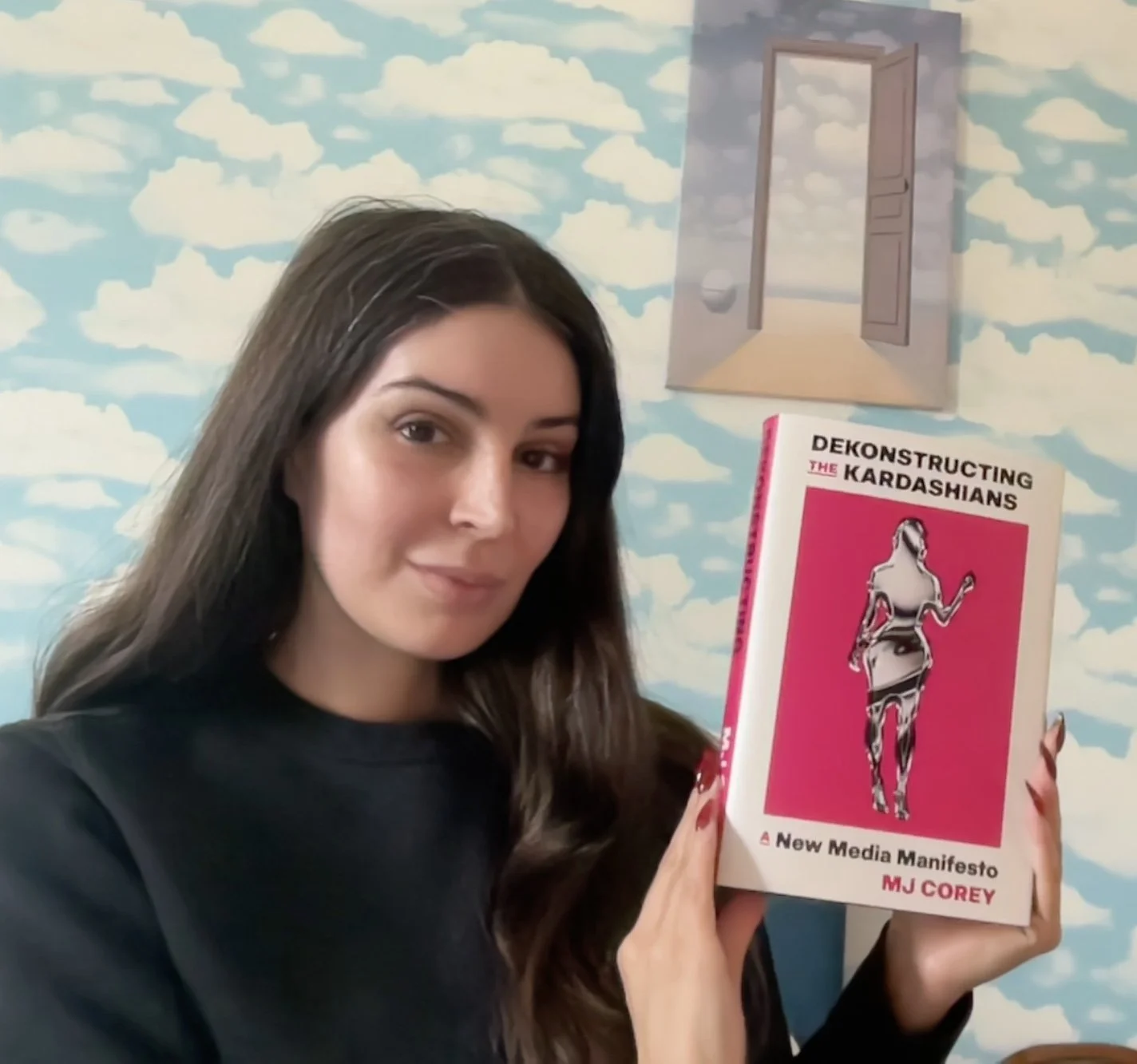
Today on The Stacks, we’re joined by writer, psychotherapist, podcast host, and creator of The Kardashian Kolloquium, MJ Corey, to discuss her debut book, Dekonstructing the Kardashians: A New Media Manifesto. In this book, MJ uses the rise of the Kardashians to analyze the evolution of media and celebrity culture in the internet age. We talk about how MJ began studying the Kardashians through a postmodern lens, whether the family shapes or responds to trends, and the factors that make an American icon.
The Stacks Book Club pick for May is Lonely Crowds by Stephanie Wambugu. We’ll be discussing the book with Chanda Prescod-Weinstein on Wednesday, May 27.
LISTEN NOW
Apple Podcasts | Spotify | Google Podcasts | Overcast | Stitcher | Transcript
Everything we talk about on today’s episode can be found below in the show notes and on Bookshop.org and Amazon.
Dekonstructing the Kardashians by MJ Corey
Kardashian Kolloquium (Instagram)
Kardashian Kolloquium (TikTok)
The Kardashians (Hulu)
“I’m Watching You” (Keeping Up With the Kardashians, 2007)
“Why Solo Apps Just Don’t Work: A Kardashian Case Study” (Falon Fatemi, Forbes)
“A Star. A Celebrity. A Famous Person” (Christiana Mbakwe Medina, Pop Syllabus)
“Ep. 406 A Consumer of Pop Culture First with Christiana Mbakwe Medina” (The Stacks)
“'Grandpa robbers' guilty: 8 convicted in Kim Kardashian Paris heist trial” (Eleanor Beardsley, 2025)
“Kris Jenner on the O.J. Simpson Trial” (Dateline, 2014)
Michael (Antoine Fuqua, 2026)
“Kardashian Sisters' Nightmare Bikini Photoshoot in Mexico | KUWTK | E!” (YouTube)
All’s Fair (Hulu)
The Truman Show (Peter Weir, 1998)
The Apprentice (NBC)
“Donald Trump Trashed Khloe Kardashian On 'Apprentice' Set, Staffers Say” (Jason Cherkis and Sam Stein, HuffPost)
American Icons by Dennis R. Hall (Editor), Susan Grove Hall
Love Is Blind (Netflix)
The Traitors (NBC)
WWE Unreal (Netflix)
Dream Facades by Jack Balderrama Morley
On Michael Jackson by Margo Jefferson
Dead Elvis by Greil Marcus
American Monroe by S. Paige Baty
Dekonstructing the Kardashians by MJ Core (Audiobook)
To support The Stacks and find out more from this week’s sponsors, click here.
Connect with MJ: Website | Instagram | Substack | TikTok
Connect with The Stacks: Instagram | Threads | Shop | Patreon | Goodreads | Substack | Youtube | Subscribe
To contribute to The Stacks, join The Stacks Pack, and get exclusive perks, check out our Patreon page. If you prefer to support the show with a one-time contribution, go to paypal.me/thestackspod.
The Stacks participates in affiliate programs. We receive a small commission when products are purchased through links on this website.
TRANSCRIPT
*Due to the nature of podcast advertising, these timestamps are not 100% accurate and will vary.
MJ Corey 0:00
I think that's one of the most compelling things about the Kardashians, the fact that it's been, as Khloe once put it, blood in blood out to be a bunch of women trying to make something happen, working together and with business too. Business partnerships fall apart really easily. Yeah, it's spectacle in and of itself. I don't know how they do it, but Kourtney plays a really important role, because being this like reluctant Kardashian, but the performativity of her reluctance is really good, because even haters of the Kardashian family can identify with a Kardashian.
Traci Thomas 0:36
Welcome to The Stacks, a podcast about books and the people who read them. I'm your host, Traci Thomas, and today we are joined by writer, psychotherapist, podcast host and creator of the Kardashian Kolloquium. MJ Corey, she's here to discuss her debut book, dekonstructing the Kardashians, a new media manifesto. In this book, MJ uses the rise of the Kardashians to analyze the evolution of media and celebrity culture and the Internet age today, MJ and I talk about why it is the Kardashians have kept us captivated for all of these years, what their fame and our obsession with it says about us, and how the OJ Simpson trial has impacted the ability of the Kardashians to soar to new heights. Our book club pick for May is lonely crowds by Stephanie wambugu. We will be discussing this book with Chanda prescod Weinstein on Wednesday, May 27 everything we talk about on each episode of the stacks is linked in our show notes. If you like this podcast, if you want more bookish content and community, consider joining the stacks pack on Patreon and subscribing to my newsletter, unstacked on sub stack, each place offers a slew of different perks, where you can find community conversation, join our virtual book club, get bonus episodes, see all of my bookish and pop culture hot takes, plus, you get to know that your support makes it possible for me and the stacks team to make this podcast every single week. To join, go to patreon.com/the stacks, and subscribe to my newsletter at Traci thomas.substack.com, all right, now it is time for my conversation with MJ Corey. All right, everybody. I am so excited today we are going to do a little pop culture in the stacks. I am joined by MJ Corey. She is known for all sorts of things. Maybe you know her from the internet, from her videos. Maybe you're just know her because you care about books and you saw her brand new book, dekonstructing the Kardashians, which is out now. Either way we're doing it, we're going all in on Kim K and CO, CO with K, obviously. Welcome to The Stacks, MJ Corey.
MJ Corey 2:41
thank you so much for having me. I'm excited to get into it.
Traci Thomas 2:44
I'm so excited. First and foremost, did you ever consider changing your last name to Corey with a K, so it could just, like, really be on brand?
MJ Corey 2:54
We'll put it this way, my real last name and real life does start with a K. So is
Traci Thomas 3:00
MJ Corey is your pen name, because you have, like, a whole other professional career that you do that is not caring about the Kardashians
MJ Corey 3:08
100% yes, I'm also a psychotherapist by trade. I got into this project of the Kardashians and post modern theory as a kind of fun outlet while I was studying to become a psychotherapist. So I kinda wear these two hats and it's really useful, because then my patients can't find my pop culture life online,
Traci Thomas 3:27
and your online enemies can't, like, sink your practice on Yelp.
MJ Corey 3:31
100%
Traci Thomas 3:33
okay, for people who have not read the book yet, can you give us like a 30 second pitch? What is deconstructing the Kardashians?
MJ Corey 3:40
Yes. So my core argument is that Kim Kardashian is the perfect emblem of the moment that we live in right now, which is a post modern moment of social media and incredibly fractured media landscape, and she's made it her business to reflect the structures of media as it is now. So my belief is that in a time when it's harder and harder to be remembered, Kim and her family are doing everything they can do to ensure that they're remembered. And my book is kind of built to say that she's the icon of our moment.
Traci Thomas 4:11
Yeah. How did you can you give people who maybe aren't familiar with you sort of a backstory? How did you come to the Kardashians? It's one thing to be like, Oh, I watched the Kardashians and like, talk shit or whatever with your friends on a group chat. And it's a totally different thing to be like, I'm gonna analyze them and sort of contextualize them publicly for an audience. So how did you becoming like the Kardashian person happen?
MJ Corey 4:36
Yeah, it happened really organically. I was very late to keeping up with a family. Actually, of course, I'd been inundated with their images and their stories and the media like everyone else as soon as they hit the scene in 2007 but I didn't start actively keeping up until 2018 a friend had the TV show on. I was one of those people that didn't really like reality TV. I felt like it was sort of junk food for the brain kind of thing, and I just was so struck by how the show made me feel, like, really, this project started with a weird feeling like this episode. It was the Bora Bora episode where Kim is being a diva all over the resort, and her brother Rob is not having it. And it was this hyper produced, perfectly narrativized episode, as we experience of Keeping Up With The Kardashians often. But then in this moment where Rob tells her, mom raised you better than that, dad raised you better than that, Kim looks genuinely embarrassed. And it was this collision of something super staged, super produced and formulaic, and then something very real, and it provoked what really felt like uncanny valley in me. And uncanny valley is a sensation that scientists have coined for when humans feel like a robot looks too familiar and too human. And so I called my sister, who was a media studies major at the time, and I said, this show really It struck me like, What is this feeling? And she said, You need to start reading Jean Baudrillard and French theory, and that launched a larger study of media theory expansively. And it was just a fun outlet, like I said, I was studying to become a therapist at the time, and it was really nice to get into, like, an analysis of something totally outside of what I was doing. And the more inspired I was by the work, I started to document my self study, and then people were inspired by it, and it kind of built on itself.
Traci Thomas 6:24
That's so interesting. Yeah, did you then go back to the beginning and watch the whole show from the beginning? Or how? Like, it's one thing to be like, Oh, I saw this one moment, and it sparked something in me. And then it's another thing to be like, I'm gonna talk. Like, so at what point your sister suggests, like, Okay, go read this theory. You go read the theory. When do you then decide to go back and, like, take this whole family through this, like, theoretical analysis.
MJ Corey 6:51
That's a great question. I'm trying to remember now what I did, because the truth is, and this sometimes bothers the faction of my readership, that is that are fans of the Kardashians. I haven't seen everything. I have to. I'm just going to admit to it. I did go back. I watched season one and early seasons. There's a few seasons in the later seasons that I just have fully not seen. But because for me, the gist of the show and the gist of what they do is enough to make the theory make sense to me, and I really appreciate the interplay that started to form between the Kardashians and the post modernists, because the post the Kardashians really made the post modernists easier for me to understand, and then the post modernists made the Kardashians and their impact so much easier for me to understand. So this relationship was really gratifying, and it didn't require me to keep up with everything the Kardashians did. So yeah, I don't, I don't really remember the sequence of how I did it, but I was, at the time, I was making memes that were very cut and dry, like there was a trend back then, of, like, a very simple, kind of, like, postable meme image from the show, and then, like, adapting whatever the subtitle from that moment in the show was, yeah, quote. And so I was kind of, like jumping on that bandwagon a bit. And then I found from audience response, like they wanted more they wanted more explanation. And I just went with it
Traci Thomas 8:08
And for people who haven't read the book and who are like me, I am a, I am a pop culture person. I'm not like a die hard like, I'm not like a crazy, crazy pop culture person, but I also like, think it's valuable and important. I watched the Kardashians basically every time I would go on vacation and you'd watch, like, the vacation television, they always, like, had E or whatever. So like, I distinctly remember the stripper pole episode, like watching that on vacation, but then, like, not watching for years. However, I have sort of kept up with the family through social media, through events like, what are they wearing to the Met Gala, the gossip, the boyfriends, but I don't watch the show. So if you're listening and you're like, you know, I'm familiar with the Kardashians but I'm not like a die hard Kardashian person or a hater or a lover. You don't have to be for the book, nor do you have to be for this conversation, like you can sort of, if you are familiar, that there's like, a bunch of them, and then there's like, totally the dad who you know was OJ related. Like, if you kind of have the gist of the thing, you can go with it, which I think is helpful, because I sometimes think, like, when a book is about a topic, you feel like, oh, I have to really know or care. And you don't have to care about them, to care about sort of the points that you're making.
MJ Corey 9:24
Oh my gosh, I love hearing that. Thank you for saying that. That's what, that's what I was hoping to do. That was my goal for the book, that it would kind of have a good equilibrium of both to bring in, because it was a challenge to figure out. All right. My task here is to tell a story of American media history, to explain how we got to this moment of the Kardashians. And I also want to explain the philosophies to help us understand history of media and the Kardashians, and then even the history of those philosophies. And then, of course, the Kardashians as this lens to understand it all. And so there was a careful balance that I found I had to strike throughout and it was really satisfying to kind of figure out how to articulate these things, but there's a lot of density to every single angle.
Traci Thomas 10:04
Yeah definitely, I was surprised by the density in the book, to be honest. Like, you see the cover,
MJ Corey 10:10
yes,
Traci Thomas 10:10
and like, it's much more theory. It's much more like, context, history, especially like, in that first half then I and the way that I would describe how it's broken down is like, the first half is a lot of history, context theory, and then the second half is like, you kind of walk us through the Kardashians and say, like, remember that thing we talked about before?
MJ Corey 10:28
Yes,
Traci Thomas 10:28
you can see that in the stripper pole moment, and that's tied to Marilyn Monroe or whatever.
MJ Corey 10:33
Yes.
Traci Thomas 10:34
So for people who are sort of like trying to figure out how to situate themselves in the book, that's, that's how I would describe it as as a reader, how were you thinking about audience? Because I'm sure there are people who are coming to this book who are who know every bit of Kardashian trivia knowledge moment, they're like this happened in 2018 This happened in 2000 like this happened before there was ever a show like this happened last week. So how are you thinking about that?
MJ Corey 11:00
That's been a thing for me, really from the start. Like, it's interesting, kind of who, like, locks into the work, my work, there's Kardashian fans, there's Kardashian haters. There's people that are into the philosophy thing. There's people that are really into the pop culture thing. Like, it's really cool to see the way people are responding to it. And I don't know, in that sense, there's like, almost like, a meta thing with my work, of being someone that's promoted writing through the internet and has accumulated a community using these forms. Like, sometimes it can be divisive. Sometimes people are looking for something in my work that they're not finding or and that is when they I've, like, left out, like a Kardashian moment that maybe they know about that, like I've overlooked because it was a season I didn't see, but I felt like another example was good enough. You know,
Traci Thomas 11:46
yeah,
MJ Corey 11:47
but no, with audience, it's, it's still a surprise to me, like every, every day. And that's the cool thing about having, like, a relationship with your audience, from the internet to kind of find out what the responses are. It's a good question, but it evolves every day. Honestly, the more the work gets out there.
Traci Thomas 12:03
Do your patients know that you've written this book?
MJ Corey 12:07
I hope not.
Traci Thomas 12:09
you really keep this separate?
MJ Corey 12:11
Oh yes, yes. I'm a really boundary therapist. I'm a psychoanalytically trained therapist, which is like the classic, like blank slate. I'm more dynamic, like I am interactive, but I really keep it separate.
Traci Thomas 12:20
But have you ever had a client be like, hey, MJ, or your real name, like, hey, you were viral and like, I saw it.
MJ Corey 12:30
I know I should really prepare myself for that possibility. I have wondered before, like there was a little era on the Tiktok page where the videos seem to be going everywhere, like it was just a viral moment for the Kardashians. It was Kim and Kanye breaking up. Those were those videos were getting so many views, and the odds just seemed like if I had a client that was at all engaged with pop culture, it would probably be popping up on their feed, and no one said anything. I've had a lot of the same patients because I do psychoanalytically informed work. It's usually longer term work, since I was a young, you know, student therapist. So I think that they're so used to me that they don't feel the need to Google me, you know, because a lot of people do Google their therapist right away, you know. And it's hard. I think it's if you you look hard enough, you might be able to find my real name and my stuff. But being a therapist has been an interesting vantage point for this work. Like I always say, I'm doing psychoanalyze the Kardashians. People think I do as a therapist sometimes, but if anything, I'm psychoanalyzing the audience, the public, all of us.
Traci Thomas 12:31
Yeah, I want to come back to this. I want to talk a little bit about them, because I do have a question about this later. But before we do that, I want to talk about the Kardashians. Yeah. I want to set this all up.
MJ Corey 13:37
Perfect.
Traci Thomas 13:38
We get Kim K. She's Paris Hilton's friend. She's sort of like the, I mean, not the ugly one, but she's sort of like, not the hot one,
MJ Corey 13:47
right, right
Traci Thomas 13:48
She has, eventually, she has the sex tape that sort of really is like, what puts her on the map? They make the show. It's Kim and her sisters. Why is it Kim? What is it about Kim that makes us care at all in the first place. There's a lot of people with sex tapes, especially people who aren't that famous.
MJ Corey 14:08
Yes, yes. So that's a great way to kind of start it. The Paris Hilton chapter is a lot about Kim playing this underdog figure next to Paris. And I, my research kind of showed me at the time. I mean, I remember too I was, I was, like a preteen during this era. Paris Hilton represented this kind of like Bush era beauty ideal. And next to her, Kim was quite a contrast. And Kim had this more exotic beauty that was kind of resonant in a post 911 landscape. And with Obama Presidency coming in. And they were this multiracial family, the Kardashians were an interesting arrival to the pop culture landscape, the sex tape also, I kind of talk about in the OJ Simpson chapter, evoked, and I quote a psychoanalyst actually named Manuel harpin in that chapter about how there. Kind of it evokes the memories of controversy around race in America. And so Kim had a sex tape that was with a black man, and there was a kind of, like, multiracial anxiety in the country, I think, around this and the fact that there was questioning around, what were the terms of this leakage like, did they want this? so between the race factor and kind of the money factor, the capitalistic drive of it, I think there was something unique about the sex tape, and that is something I came across in my larger work, in my research of American icons, because the book is structured to kind of approximate Kim to every different American Icon she's referenced or dressed up. As I started to see a common theme in the icons themselves. American icons often evoke anxieties around sex, death, race or money. Actually, all of them like, yeah, Elvis, Marilyn, any, anyone in the book that's referenced, you can find that. So the sex tape kind of contains those things, and that's why I think him, that was her Genesis myth that set her on this path,
Traci Thomas 16:02
and why is Kim the one in the family? I know that, like, there's allegedly the younger girls are, like, more famous or whatever, to the kids,
MJ Corey 16:11
yeah.
Traci Thomas 16:11
But I feel like, if you say Kardashian to a boomer,
MJ Corey 16:15
yeah,
Traci Thomas 16:15
they're gonna know Kim. They're not gonna know Kendall or Kylie. I honestly still cannot keep Kendall and Kylie separate. I'm like, Wait, which one is with Tim and which one was with Bad Bunny
MJ Corey 16:25
Totally.
Traci Thomas 16:25
To me, they're all the same.
MJ Corey 16:26
Totally
Traci Thomas 16:27
So, like, what is it about Kim that makes her the one? Because, like, so much of your book is about Kim. Like, Kim is the focal point of the family. Why her?
MJ Corey 16:38
Kim holds back the rest of the family members are able to kind of play these caricatured archetypal roles. Kim is this, like, has this very incredibly self restrained neutrality and ambiguity. And so she Yes, Khloe's into fitness, and she's changed her face a million times, and we know that with Khloe. But like, Kim is this kind of like middle child, the she's focused a lot on her silhouette, her branding is incredibly controlled, like, if the argument is that the Kardashians are cultural fractals of all these different things all around, ever flattening, like a historical culture. Kim is that within the family, she just, she goes between the family members. She has made a brand about her grit and her hard work. The most like Kourtney's performance, is that she doesn't want to be part of the system. Khloe's is that she is the glue of the family, and goes between everybody in a more of an emotional, relational way. Kim is this ambiguous figure. She just, she endorses this idea of American dream, grit, Protestant work ethic, yeah. And that's really the engine of the family. I would say it's all about Kim in terms of like, her use of her body as a medium to like she's, she's the one that was branding herself. I was talking to someone the other day about how I was talking to a writer who worked on the Kardashian apps, and she was saying that the Kardashian apps, as early as the 2010s were about these foundational archetypes, like Kourtney's the organic girly, Kim's the fashion girly. And Kim has used fashion also as storytelling, to kind of treat her body as this canvas for different visual stories through her evolution. So that's also been a big thing. Her message gets across further and faster.
Traci Thomas 18:18
I think what's interesting to me about Kim, and as I was reading the book, and like, thinking about her is, it's almost like she doesn't have anything, almost like she's an actor. Like, in the way that you want an actor to be, sort of like, have no personality. Like, what is Leonardo DiCaprio? Like, handsome and talented, but, like, we don't know a lot about him, yes. And I feel like she, in a lot of ways, is always like, wearing a costume. Like, it's really hard to get a sense of, like, who she is,
MJ Corey 18:46
yep.
Traci Thomas 18:46
But I just wonder, like, obviously she's a famous person, obviously she's a celebrity. One of my favorite pop culture analysts, Christiana Mbakwe Medina, who's been on this show, she talks about, like, the celebrity, the star and the famous person, yes. And I wonder like, Is Kim Kardashian actually a star? Like, does she have that quality about her where you're like, I can't take my eyes off of you, or is it more her grit and her hard work, and she won't let us turn our heads away because she commands? She's demanding of attention as opposed to commanding?
MJ Corey 19:18
Yes, no, totally. One thing I write about in the Marilyn Monroe chapter is there's more of like an enjoyment of the iconizing of Marilyn Monroe, because she was this tragic figure. She lost everything. She died young, where Kim's consent is, like part of the problem, her desire for fame, her lust for fame. There's kind of like a there's and there's something that's kind of unappealing about that for people. And people felt, you know, through like over a decade, that the what they knew about the Kardashians was not consensual, like that. They were just flooded by media with the images and stories. So it's true, Kim works hard. At the image production and at upholding this feedback loop of attention with the public. But she does get our attention. She does she does demand that we react, knowing that we will react. They have such an understanding. I think the Kardashians of the human like these human drives that will a mirror to what we crave and what we engage with, and they throw that stuff at us. And I will say, like I was in the courtroom when Kim testified at her Paris robbery trial. I was in Paris to talk on a documentary about the meaning of that whole event in her life and its impact. And when she and Kris Jenner entered the room, there was like a hush that came over the entire room. The real life presence was pretty intense to see them beyond the screens. It was kind of, they're very upright. Their faces are very, very, you know, formulaic. And it was quite a presence. But it wasn't glamor. It was power. I kept telling my partner that I was there with or it was more power than glamor.
Traci Thomas 21:00
I have an IRL Kim K story as well. In 2011 maybe early 2011 or late 1010 the one time in my life I ever sat courtside at a basketball game was when I lived in New York. I had courtside tickets to warriors versus, well, they weren't the nets. Then were they? They were in New Jersey, though, okay, they weren't in Brooklyn, And I'm in the, like, you know, courtside suite, and I like, look over and I'm like, Oh my God, that woman is so beautiful. She looks like Kim Kardashian, and I was, but literally, Kim Kardashian would never be at a New Jersey Nets game, like there's no reason for her to be here. And then I'm like, but she's really, like, that's a really beautiful woman. Like, I like, and I never, I usually don't stare, like I'm usually, and I was like, wow, yeah. And then the next day, or, like, a week later, the news broke about her and Chris Humphreys, and it was her, and she had been there, but it was before people really knew or, like, it was early days, and like, media was different than it was, like, you still went through TMZ or whatever, and that's the only time I've ever seen her. She was much shorter than I thought, yeah, but I remember genuinely being like, Oh, she's really beautiful,
MJ Corey 22:18
yes, oh my gosh, I love that your IRL encounter is so uncanny, you know, like, the fact that was like, it looked like her, but it's not her, but then it was her, like, those layers,
Traci Thomas 22:27
Like why would she be at an like, in Brooklyn, I get why people are there, but it was like, Yeah, to go to New Jersey and like, she lives in Cal like, it was just like, why would she? And this was like, the nets were so bad that it was just like, this makes no sense
MJ Corey 22:40
I love that
Traci Thomas 22:42
she was as pretty as they say that she is. So, you know, there's some celebrities who I feel like are more beautiful in person, and there's some people who like the camera loves and I think, in my experience, she was more beautiful in person. Yeah, okay, I want to ask another question, though. So you said she's like, she's the driving force, but there's a lot of conversation about Kris, and Kris is really the brains behind the whole operation? Is that the sense that you have given the information? Obviously you're not like in the rooms with them, yes. But is Kris really the driving force? Is she really the stage mom? Is she the momager?
MJ Corey 23:17
So yes, you know the answer to that question is a more it's a it's I can give you a better answer to that question than I can even give about Kim. Because I think the short answer on the Kim question is really it is kind of like Kim can be everything and nothing, this blank slate of that's what makes her powerful. I kind of wish I'd said that with Kris. Kris is a very willing, like tribute to the spectacle of the family. Kris is down to dress up. She's down to get a tramp stamp of her daughter's names on her lower back. She is willing to be in comedy sketches with comedians that satirize her as the actual devil like Kris participates in the myth making, and I think she has exhibited this savvy with the media even before the machinery of the Kardashian was really starting to make itself like or as early as and I write about this in the OJ chapter, the 90s, she showed up at the OJ trial with Caitlin, pregnant with Kendall, and made sure she got, you know, a moment on the mic for dateline just outside the courthouse, saying we lost Nicole, but we also lost OJ. And I just think that's such a, you know, prophetic Kardashian esque media approach to say both things, we lost our friend, but we also lost him. It's just that ambiguity, that dialectic. It's so Kardashian, and so she had that media savvy so early on, when it there wasn't really much at stake besides maybe having a good moment on the news. And so I just, I don't know, Kris Jenner, people will sometimes ask me to like, who intrigues you the most in a parasocial way, and if I had to, had to say, it would be Kris Jenner, I can say that much.
Traci Thomas 24:57
I'm also fascinated by her. I also just think. Like, their connection to the OJ Simpson trial. I know that, like, for a lot of people, especially younger people, that might, like, not mean anything to them, but to me, it's like, so important in my mind, yeah, like, it's, it's like, something that I don't know, you can never say, but like, I don't know that without it, they become the Kardashians, like I don't know without being tied to that, because that was such a thing.
MJ Corey 25:29
Yes, it was like the trial of the century, and it's so essential to media history. It was the beginning of the 24 hour news cycle. It was, I thought I came across a theorist. I wish I could remember his name, but I write in the book that there was such it was not only is this, like sensational thing of this, like, really appealing American family, this, like, really cool sports star and his beautiful wife, like this, this, like slasher thing that come that changes everything, but, and it was so divisive for the country, but there was also a lot with, like consumerism, like, there was a theorist that was saying between the glove and the luxury cars, and it was a way for Americans to talk about shopping without shopping. And I thought that was really interesting. Because I think sometimes, more than sometimes, the Kardashians give us similar fodder, you know,
Traci Thomas 26:18
yeah, yeah, yeah. One of the, one of the chapters is about the Spice Girls. Yeah, my faves. And we talk so much about, like, groups that break up. And, you know, there's this new Michael Jackson movie, The Jacksons broke up. Like, it's not uncommon for families to break up, yep. Why haven't they? Why hasn't Kourtney finally been like, I'm sick of you. I'm sick of this shit. Like, why? What is it about them that makes them stick together?
MJ Corey 26:47
I think that's one of the most compelling things about the Kardashians, the fact that it's been, as Khloe once put it, blood in, blood out, and this and matriarchies, sisterhoods. It's to be a bunch of women trying to make something happen, working together and sustain it this long with business too. Business partnerships fall apart really easily. Yeah, it's a spectacle in and of itself. I don't know how they do it. Besides, to say that, I think that's, yeah, that's what strikes people so much. But Kourtney plays a really important role, because being this, like reluctant Kardashian, which apparently, to some extent, is really true for her, like, when I came across really early research about the family signing on to their contract, apparently people just even riffing like said, Kourtney didn't want to do it, so it's kind of so there's that back to that, the combination of like a real and a stage thing With this family, Kourtney probably does have a real reluctance, but the performativity of her reluctance is really good, because even haters of the Kardashian family can identify with a Kardashian. It keeps it at the self contained circuit, where they can still be packaged in that way. And there's something for everyone, even the haters, like the I hate Elvis buttons that were apparently really big sellers back in Elvis's heyday.
Traci Thomas 28:01
You know, I want to talk about the haters, and then we're gonna take a break. Why are we as a broad cultural group of humans, collectively, so obsessed with hating them. What is it about them that makes them so hateable? Because even people who are fans kind of like to hate them
MJ Corey 28:22
totally.
Traci Thomas 28:22
It's not like Beyonce fans, where it's like, you don't say shit about the Queen, or like Taylor fans, like people who watch every Kardashian episode. I've never met someone who's been like, I love them, and they're the best.
MJ Corey 28:33
Totally, totally they and they know that that's the role they play in culture. They know it. And it's like, they're they're dolls in that way where there's a lot that can be projected upon them. And that's, again, Kim's power as being this, like willing mannequin, this neutral figure. But what I found was, Okay, so first of all, I think with celebrity in general, that it operates as this, this canvas or stage where we can work out our own stuff. So, like, there's this concept that Aristotle kind of the concept of catharsis, is like Aristotle talked about, where people needed the Greek dramas and tragedies to release their their emotions, whether it's pity or sympathy or anger or lust or whatever. And the Kardashians, I think, are the ultimate figures of catharsis culturally. And when they hit the scene, they were really like, what? Like I said earlier, American icons tend to evoke a lot of feelings around sex, death, race or money. When the Kardashians hit the scene, they were doing a lot around sexuality and sex work. So the first season of Keeping Up With The Kardashians is a lot of like the sex tape doing a partnership with Joe Francis, or Girls Gone Wild, like bikini line, the Playboy shoot and the stripper pole in the bedroom. Then over time when cultural appropriation became a much larger topic of conversation, what do you know? They start ramping up the kind of volume on that in their brand and it. Was I encountered a sociologist that I really loved named musel Garbi, who talked about how the Trump era evoked even greater, more frequent conversations around culture appropriation, so headlines that had identity cues in them and garnered greater engagement. And so it's interesting that the Kardashians were ramping up their imagery around that time, and then in the 2020s when class rage and class consciousness was really at a high, then they start really talking about Marie Antoinette again, and Kim is showing us crazy house tours of Her Skims office, and there's like a tanning bed in there or something, or maybe it was a red light thing. But either way, it's they. They do mirror what's feeling really urgent and pertinent in culture at that time, anxiety wise, strong emotion wise. And that's why I think they develop this strange parasocial thing with the audience, where we're pulled in. They're demanding attention, even if they can't, you know, they don't. They're not commanding it.
Traci Thomas 30:57
Yeah, okay, I want to say on this, but let's take a quick break, and then we'll be right back.
MJ Corey 31:01
Perfect, yeah.
Traci Thomas 31:08
Okay, we're back, and we actually just, like, left something that I do want to talk about because hearing what you just said makes me sort of change the question. My original question was like, Are they a bellwether for for American culture in some way, but hearing what you just said makes me think that they're actually just responding. They're not setting the tone. They're just responding. What feels more true to you?
MJ Corey 31:31
That's a great question. I would say it's a feedback loop. This is like my theory on the Kardashians after the research I've done. When it started, I think that there was they were living authentically to some extent, within the context, like of the, you know, Beverly Hills girls, this matriarchal family, doing whatever they were doing, and then they saw what worked. And I think that what makes them also so successful is really being clear with themselves about what is working, strategy wise, what is engaging people, and then doing more of it. And over time, there's been this interplay between the real and the staged, and what they can turn into infrastructure and kind of industrialized to put out to the public as product, as story, as images. And they've only gone on to scale and scale and scale and scale. So now they're at this point where, like, they have such a like, a well running apparatus, I think that they have kind of become it. And so that's, that's we're essential to that. We're essential to that apparatus, like our engagement. And now, I think data is part of the question, like when they were viral and central to in the Instagram era, I think we were all figuring out how these tools worked, and surveillance capitalism kind of came into the social media tools that there's just, there's an opportunity with social media to watch us as we watch it. And so the Kardashians were first centralized to virality on this on Instagram, because we were clicking, we were watching, we were commenting. And then Kim became too expensive to ignore from Vogue and the legacy media publications, but now they're so big, and this has all gotten so institutionalized that I think the Kardashians can see us with data. They see us watch they're watching us watch them, that we can assume. And so what they there's the theorists that I talk about in the Marie Antoinette, either the Marie Antoinette chapter or the Barbie chapter, or maybe both. And this media theorist Kevin Munger, writes about how audiences, people talk about audiences being radicalized on YouTube, for example, politically on, you know, extremes on both sides or whatever. But the truth is, there's a feedback loop between the audience and the content maker. So the audience's desires are also pushing the content producer to do certain things. So there's a feedback I think the Kardashians are basically in that feedback loop with us. Long story short
Traci Thomas 33:46
Yeah well, I mean, I think, like, something that I've seen online about them has to do with their boyfriends, right? Like, when it was Obama era, it was giving interracial it was giving lots of black men, and then Trump, and all of a sudden we've got all these white boys in the mix. Yeah, and now, you know, Kim's dating a black guy again, is that response, or is that? Is that an indicator that, like, Okay, I can't remember there, you know, there's cultural and, like, someone says, like that, vampire movies are a recession indicator. Are Kardashians dating black men? Like, it's gonna be a good era for black folks, or is it her and them just responding to the moment? Obviously, the real option can't be that it's like they like who they like, that's not on the table obviously. But I think I always sort of thought that they were driving the conversation, yeah, but after reading your book and talking to now, I'm like, maybe they are just like, they know that if they do these things, it'll garner our attention.
MJ Corey 34:47
I think they react to us. I mean, I remember when there was a lot of virality, and it's hard to measure such a centralized virality as it was before, I think, with the Tiktok algorithm, but there was a really. Huge tidal wave of conversation about just their responsibility to speaking to their impact on beauty standards like that. Was a huge, huge, huge conversation for a while on Tiktok, and then the think pieces were reporting on that virality. And then what do you know the Kardashians have Kylie talking about her boob job and her regrets, so they will give us little nuggets, I think, speak to viral discourses, as far as the entrance of Lewis Hamilton to the story, I think he makes a ton of sense for Kim in this sense that he is, well, what Kanye once said, like he won when she was dating Pete. He was like, I don't think this is real. It's not gonna last. He's not he's a white guy. She's not gonna fall in love with him. I think Kanye said that, and so Lewis Hamilton seems aligned with what Kim has been interested in a few different ways. He he's excellent at what he does. I've learned a lot more about f1 since he's kind of entered the story. And he's global. He's associated with luxury. He has a like, kind of an American Dream style story, even though his story is in England, it's, you know, he was working class and made his way up in this incredibly hierarchical old money type of world.
Traci Thomas 36:11
Yeah.
MJ Corey 36:11
So that suits where she's at with what she What kind of story she's trying to tell. He's a Met Gala icon. And so the
Traci Thomas 36:19
crazy thing it's like, on your dating list, it's like is he nice, is he rich, is he a Met Gala icon?
MJ Corey 36:27
It tells us a lot about where she is. And I think you know, Pete Davidson was really important for her post Kanye to like, seem youthful, seem fun, be relatable again. And he had this like boyish thing that was it made so much sense for the purposes of that time, whether it was real or staged or whatever. But this, especially the way they're kind of drawing it out and breadcrumbing it, is reminding me a bit more of how they drew out the arrival of Timothee with Kylie, and that has proven to have some posterity or some staying power. And I just feel like we might Lewis Hamilton will be here to stay for a while. So, yeah, I don't know what it will indicate about any cultural shifts. Trump is still, you know, in the middle of his term, basically. But I just do have this, this gut feeling that we're going to be seeing Lewis Hamilton more and more.
Traci Thomas 37:16
do you think, like, obviously, the way that we're talking about it is very removed, it's not our lives,
MJ Corey 37:21
yes
Traci Thomas 37:21
But do you think that they're having sit downs that are like, Okay, here's some eligible bachelors. Like, Lewis Hamilton's a Met Gala icon. Like, do you think they're really talking, like, okay, Pete Davidson, He's younger. He's gonna make you seem young. Or do you think there is some like, organicness to them?
MJ Corey 37:39
I I think it goes back to that, like Interplay that they've gotten very they've likely, I feel like perhaps they've gotten very comfortable with of there's a vibe here. This kind of makes sense for these reasons, but I'm into it or but it's so the same way Kris Jenner knew what to say at the OJ trial in front of the courthouse, which was, I think, real for her. But then I was also just really savvy. I think they probably live their lives in ways that kind of like move between instinct and strategy. That said, I find myself really fascinated by what their calendars must look like. Because what is true is that they layer stories and like major ways like they they when Kim was doing her testimony at the Paris robbery trial. Inside the courtroom, she was declaring, live in real time, I'm here because I want to be a lawyer. Outside the courtroom, the All's Fair trailer had just dropped where she's playing a lawyer on TV. And so that's like intentional layering, you know
Traci Thomas 38:35
The content calendar must be insane,
MJ Corey 38:38
Yes, no like, years out, years out, you know, right?
Traci Thomas 38:41
Because, like, on the show, they sometimes like, oh, I have this idea. Like, I thought about, like, I want to do this thing, but, you know, there's like, a staff, like, it's not just them. Like, there are social media people at different levels. There are marketing like, there's a whole team and like, that is the episode I want to see. I want to see like them, like, legitimately, what does it look like when they sit down to plan a year? This is where we are. Q1 this is where we're going to be. Q4 we want to make sure we have at least one romantic storyline, like, like, who are like, I so desperately want to see that, because I I don't buy the organic ness of it. Nor am I interested in that. I think organic is like, fine for everyone else, but it's like, no, you guys are supposed to be business geniuses. Like, I want to see what the meeting who is, who is on your social media team. How old are they? How long have they been there? Like, I'm so curious about team. Kardashian Jenner core, like, I wanna know.
MJ Corey 39:43
It's like, what the scaffolding is. It's like, like, what's it would be equivalent to, like in The Truman Show, when like, the lights start falling from the like set and like the door, he sees the door and he sees there's a backstage to his world. Like, I totally feel you. Yeah, that's where the story is.
Traci Thomas 39:58
Yeah. And like, so one of the things. That you do throughout the book a lot, especially towards the sort of, like, middle to the back. Yeah, is we Trump is brought up a lot. He's compared to them a lot. There's obviously, like, you talk about when, when Khloe was on The Apprentice, and how he, like, called her a fat cow or whatever. Like, charming surprise.
MJ Corey 40:16
Yeah.
Traci Thomas 40:17
And I feel like, in some ways, with Trump, because of the nature of his job and his current job as the president, and also his previous jobs, we've always sort of gotten to see a lot of the scaffolding.
MJ Corey 40:27
Yes,
Traci Thomas 40:28
he's been sort of proud of that part of his work, like we we've He not only wants us to know who works for him, but he wants us to know them. Like Pete hegseth is a pick, not only because he's a will do whatever Trump says, but because he's a known quantity, yes, and so I'm sort of just interested in like, where you see what you can draw between Kim. I think it's mostly Kim that you compare to Trump, not the whole family so much, but Kim and Trump and like, is there a reason why they're both where they are right now. She's the icon of our time, according to you, and He is the president of our country for the second time. Like, what is that?
MJ Corey 41:10
They're so aligned. I really wish there had been more time and space to explore the Kim Trump parallels they are really
Traci Thomas 41:21
I feel like that's a whole book
MJ Corey 41:22
Totally, no, it might be the next book. Honestly, there might be a Trump book on his own to come, to be honest. But, um, yeah, I think some of the key, some of the things we can talk about are, like, their ability to simplify their messaging in incredibly compressed ways that maximize reach and reception. So like, apparently Trump speaks, it's in the book, it's a fourth grade level or a second grade level or something like that.
Traci Thomas 41:46
Yeah it's fourth grade and other presidents were like, sixth and seventh,
MJ Corey 41:50
exactly, exactly. And so no matter what it's and people like to clown on that, but it's actually essential to getting the message out there to as many people as possible. It's about simplifying it, and it's about repetition. And the Kardashians also do this. They speak in incredibly media trained ways. They compress their messaging to make sure it gets across. They do the same thing with imagery. Trump and the Kardashians both play with memes and highly memorable images to make iconic moments, and they understand the power of a photo op. So it's like you could call, you know, Kim in dripping in diamonds in front of the Paris courthouse. You know, a photo op that could have been iconic at a different time in media, the same way Trump raising his fists with the American flag behind him after the assassination attempt was a real photo op. They have a real sensibility for the outcome, for the headline, how it will be represented in media. And that's just a few things there that their use of repetition and compression is major.
Traci Thomas 42:46
I feel like also they're sort of, I don't know you're the genius here. I'm just, I'm just spit balling, but I do feel like there's something in both of them that allows people who will never be them to feel like it's possible to be them
MJ Corey 42:59
absolutely
Traci Thomas 43:00
like that. There's a real accessibility about both of them. Yep, and that also that like that they are the rest of us,
MJ Corey 43:08
yes, yes,
Traci Thomas 43:09
even though, like, they're so fucking rich and they're so from upper echelon communities, like, they were just born on third base in a lot of ways, but people really believe that they're like a true bootstrap narrative. And I think that's really interesting, because they they do allow people to believe in the American dream in a lot of ways.
MJ Corey 43:28
Yes, yes, they do, totally
Traci Thomas 43:29
but it's like, not true, like they're real. Neither of them are really American Dream stories. like at all.
MJ Corey 43:35
Yeah, they're total, they're total populous. And I think they do, you know, it's an every man thing that they try to evoke. And Kim does it by being this blank slate and very proudly performing her function as a mannequin to Kanye at the time of their power coupledom, and then to an ongoing series of Fashion Designers and presumably plastic surgeons. And we know that Kim is constantly under construction, and Trump does this in a much more overt spectacle of a way where he's talking to, you know, like high brow political people, and then he's talking to the WWE fans at the event, you know, where he was. And what was kind of funny is, what I uncovered in my research also, is that, like Trump did, I think it was a record breaking appearance at WWE in in the or aughts, like 2007 or something like that. And then Kim was right the year after him doing the WWE appearance. And I, like, really found that useful, because WWE is a great comparison to the Trump brand, the Kardashian brand. It's this, you know, really elaborate storytelling that collapses this line between the real and staged and gets across the audiences and gets them riled up.
Traci Thomas 44:45
Yeah,
MJ Corey 44:45
yeah.
Traci Thomas 44:46
Okay, I teased this way earlier. This question I've been saving,
MJ Corey 44:49
yeah,
Traci Thomas 44:50
combining your two jobs as Kardashian cultural media philosophy expert and psychotherapist. What do you think their impact has been on our mental health as a country, as individuals. Have you noticed a shift in your clientele, in the people in your life, like, what is? What is the mental health impact of all of this?
MJ Corey 45:17
I think the same way that I think the Kardashians represent new media and social media. So the same way that I'm situating Kim as the icon of this form of media, I think social media and new media have been extremely stressful for all of us, and so when people resist the Kardashians, they are also resisting and reacting to the direction it feels that things are going, and we're all out here writing and thinking and talking about how dystopian everything feels things. And so my book really looks at how one of the underlying messages in my book is that media started in one place, which is cinema, these big screens, we're looking up at the objects of our consumption, and they feel distant from us and almost God like but it's gone, gotten closer and closer and closer to us and faster and faster and faster. So from cinema to television, TVs in our living rooms, parasocial figures like JFK looking at us through the screen to us, embed our phones in our hands, consuming the Kardashians. You know that hasn't in my opinion, like I will share this. I don't like to share my opinions too often. I like to have restraint with my analyses but, but I will say I don't love that, like I'm on the side of like social media has been really harmful to us. So in that sense, I think my my goal with the book is to encourage people to knowing the history that hopefully I present in a way that's effective enough encourage people to consume media more actively, rather than passively, and that the Kardashians are essential to that. You know, they're, they're massive amounts of media content. So that is my hope. I don't love what the direction it's been going, it's done to us.
Traci Thomas 46:55
Yeah, we're gonna now. We're gonna talk a little bit more about you and your opinions,
MJ Corey 46:59
cool,
Traci Thomas 47:00
which is first and foremost, how did, how did you write this book? Where were you how often? How many hours a day, snacks or beverages, music or no did you have rituals? How did you fit it in with your clients and your other work and your social media? Like, how did you actually write this book?
MJ Corey 47:18
So the book was in my head for a while before I signed the deal, I really felt good even about the process of figuring out the proposal and the pitch with my agent, going back and forth. Like I wanted to write like this, like thing that surfed through the philosophy and the history and the family, but when the time came to actually write it, I had writer's block for about a month, like it felt it felt suddenly it was real. And I once I looked at an encyclopedia called American icons. I'm looking at it right now. It was a, it's a three, three part like old, out of print edition of American icons. And it was these just little passages on different icons that constitute American culture or have impacted it, and that really helped me break it down, like Kim herself has made herself this amalgamation of these images and stories. I'll I'll have that be the through line. And so that made things unlock. But then it became a real tidal wave. So I was writing, like 12-14, hour days. Sometimes I wrote on a treadmill, like a walking desk in my kitchen. I live in New York, so it's tiny, tiny like treadmill in the kitchen, and I lived on allergy safe protein shakes that my ex found like I just lived on those and wrote at my treadmill most of the time or in bed, actually, for about a year and a half, and I had a year to write it. I extended it for six months. I felt very conscious of the deadline, so I wrote as fast as I could, and that's how I wrote it. It was a harrowing experience. It changed me as a person. I learned so much about media that I felt never the same again, and I'm really grateful, and just so grateful I had this opportunity. Truly, I sound like a Kardashian, but it's true.
Traci Thomas 48:59
Do you watch other reality TV?
MJ Corey 49:02
not really. I do watch Love is blind sometimes, like, I watched a few early seasons of it, then I kind of fell off, and then I watched the most recent one. But not, not so much. I=
Traci Thomas 49:10
I feel like that is like, fodder for a therapist. Yeah, I feel like you could really be doing like, I don't feel like you could shut your brain off. Because I feel like, for most people, it's like, oh, I watch reality to, like, shut my brain off. But love is blind of all the shows I watch is the one where I'm like, I am diagnosing these people, and I know nothing. I'm diagnosing this city. What culture of this place?
MJ Corey 49:30
Yes, totally.
Traci Thomas 49:32
Do you ever watch the traders?
MJ Corey 49:33
No, I've never seen that one.
Traci Thomas 49:35
Its so good, you need to watch it, it's great, And you could, like, do like, a little but it's also really fun. It's, that's my favorite.
MJ Corey 49:42
I've heard it's good, no, I've heard it's really good.
Traci Thomas 49:45
It's really good. And it's a game show. So it's like, there's other there's like, a lot of there's a lot at play and like, about dynamics, like, racial dynamics and like, and, you know, who do we trust, and how do we trust them? And what does that look like? And, well, anyways, it's really good.
MJ Corey 49:59
Yes. Yes, I'm curious about it. My my partner's sister loves it. She she's wanted to theme her bachelorette party around it, actually. So I will check it out. I do love actually, I think this counts as a reality show, kind of the Netflix is Netflix propaganda for WWE, because they just bought WWE or did some partnership with them. But it's this, the show called Unreal, and it's like fake behind the scenes on professional wrestling, but it's really just an ad, but it's, it kind of like unlocks my brain, a bit like the Kardashians. Do I find it is entertaining? I do enjoy watching it.
Traci Thomas 50:29
Well, I feel like wrestling, is, there's so much in totally I don't watch wrestling because, you know, I have boundaries. What's a word you can never spell correctly on the first try?
MJ Corey 50:40
Oh, you know, it's scaring me. And this is to my point about my concern about how social media is impacting us, and just AI and everything that is happening, I've become a worst speller. And I was always good. I was always bound to be a writer. I always like, love to read and write, and I was a kid, I was great at spelling, and I've noticing I'm messing words up. So
Traci Thomas 51:03
Are you messing words up, or is it the keyboard change on Apple, because my texts have been worse. how are you when you type, versus if you say it out loud, versus on your phone?
MJ Corey 51:12
True, true, true, true. And I actually am notorious for mispronouncing words, because I get my vocabulary through reading, especially with the self study of the post modernism, like I was calling John Berger, John Berger and Walter Benjamin. Walter Benjamin for such a long time. So in videos, hey, yeah, so yeah, I'd have to think on the word thing. But I do, I want to be more rigorous lately with that.
Traci Thomas 51:32
okay, what's not in the book that you wish could have been?
MJ Corey 51:38
We cut we cut, we cut it down a lot because I wrote like, double what it is. But there's a few chapters that I'm really fond of that we put into a pre order campaign as, like a little chap book. One is about, it's a little bit like me, waxy and poetic about the role that the backyards play in the family's stories. It's like these, like Garden of Eden type spaces where there's kids running around like cherubs and and also, they use them as as blank canvases for whatever they want their worlds to be. So they up, they put parties up, you know, they install parties of like, now they're in Hawaii. Now they're in Cuba. So the backyards chapter was kind of fun. There's a wax figures chapter that we didn't include, where I talk about, you know, the history of Madame tuss and their relationships with wax figures. There's one with roller skating, the idea of the roller rink as a medium, because the Kardashians kind of hopped in on that trend for a second after the pandemic interest in roller skating. So those were darlings I had to cut. But I think more thematically, I do wish there was even more rigorous unpacking of the Trump stuff, like I did it, I touched on it, but it's, it's fascinating. And I, I would, that's probably book number two.
Traci Thomas 52:47
Do you know about this book, Dream facades?
MJ Corey 52:47
I do that writer reached out to me, and I can't wait to read his book.
Traci Thomas 52:50
I haven't read it yet when you were talking about the backyards, it made me think dream facades is all about like reality TV and like the architecture and the spaces and what that says about us
MJ Corey 53:04
So cool
Traci Thomas 53:06
Wait, I should have asked you this before. Have you ever interacted with the Kardashians? Have they ever reached out to you? Have you ever heard from their camp about anything?
MJ Corey 53:14
once I posted this years ago, I posted something that was anticipating a collaboration when Kim was really early on starting to do luxury collabs with skims. I think it was skims and Fendi, someone on their team, reached out and asked me to take down a video because it was too soon. It was like, ruining the, I think, surprise of this, and I don't know, yeah, I should go with, look that up again and see, like, what the eye, because I kind of was like, I don't want to get sued. I'll take it down. But I did tell everyone that they'd asked me to take it down to
Traci Thomas 53:40
get your points exactly,
MJ Corey 53:42
exactly. But besides that, no, they've watched my stories before, but I have not heard from them. The closest was that courtroom moment, and it was very fascinating.
Traci Thomas 53:53
But they know about the book
MJ Corey 53:54
they I think so. I mean, I would have to think so. I'm sure they've got antenna out there.
Traci Thomas 53:58
Yeah, I think so do they must. Yeah, for people who love the book, what are some other books you'd recommend to them that are in conversation with it?
MJ Corey 54:07
Ooh, well, I just was made aware of a book by Margo Jefferson called on Michael Jackson. I think so yes, and so I have to read that. That's my plan to I'm going to read it when I'm done with this book rollout. There was another one called Dead Elvis or something by a culture critic named greel Marcus, or Marcus greel That was quite, I think, similar. And then there was one about Marilyn Monroe that's important to me to like highlight here, actually, because I felt this like the writer is a was a academic in her 30s, who actually died young in New York City, and she wrote this amazing post modern analysis of Marilyn Monroe, American Monroe the making of a body politic as Paige Beatty. And so I just have the soft spot for that writer in particular, because she had a passion for applying post modernism to an American icon. She did it so well. I quote her a lot in the Marilyn chapter, and she's very mysterious to me. I tried looking her up. I don't know much about her. And so those are the books that I would I would suggest, I guess.
Traci Thomas 55:05
Okay. And then one last question, if you could have one person dead or alive read this book, who would you want it to be?
MJ Corey 55:11
Kris Jenner.
Traci Thomas 55:12
okay,
MJ Corey 55:14
no, no hesitation. I want to know if it resonates and if it's feels true for her.
Traci Thomas 55:18
Yeah. I love that so much. All right, everybody, you can get your copy of dekonstructing the Kardashians wherever you get your books. I listen to some of the audiobook. It's fantastic. You do the introduction. You have a real narrator, not that you're not real, but you have a professional Narrator do the rest of the book. And MJ, thank you so much for being here.
MJ Corey 55:36
Thank you so much for having me. This was a blast.
Traci Thomas 55:38
And everyone else, we will see you in the stacks. All right, y'all thank you so much for listening. And thank you again to MJ Corey for being my guest, and a special thank you to Rose Cronin Jackman and Julia partreau for your assistance and making this episode possible. Our book club pick for May is lonely crowds by Stephanie wambugu, which we will discuss with chanta Prescott Weinstein on Wednesday, May 27 if you love the show, if you want inside access and bonus content, go to patreon.com/the stacks. Join the stacks pack, and then you can also check out my newsletter at Traci thomas.substack.com, please take a moment to just look at your phone and double check that you are subscribed to the stacks, wherever it is that you're listening to my voice right now, and if you listen through Apple podcasts or Spotify, leave us a rating and a review for more from the stacks. You can always follow us on social media at the stacks pod, on Instagram, threads and now YouTube, and you can check out our website at the stacks podcast.com Today's episode of the stacks was edited by Christian Duenas, with production assistance from Sahara Clement. Additional support was provided by Cherie Marquez, and our theme music is from tagirijus. the stacks is created and produced by me. Traci Thomas.