

Ep. 423 Normalize Bringing Up Quantum Field Theory with Chanda Prescod-Weinstein
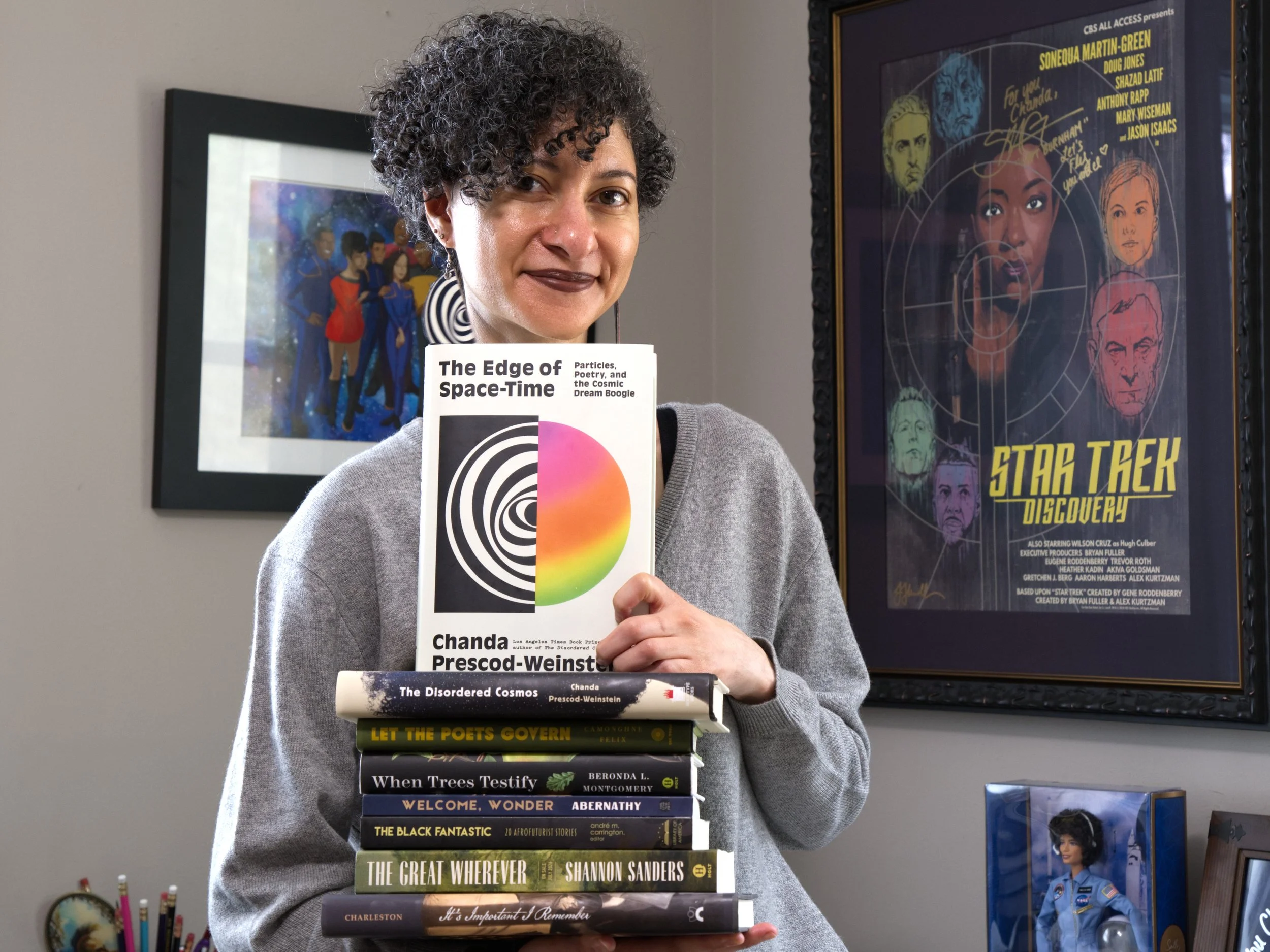
Today on The Stacks, we’re joined by award-winning theoretical physicist and cosmologist, Chanda Prescod-Weinstein, to discuss her newest book, The Edge of Space-Time: Particles, Poetry, and the Cosmic Dream Boogie. In it, Chanda uses poetry, pop culture, and Black feminism to explore some of the most abstract concepts and mysteries of the universe, from black holes to dark matter. We talk about why she wants us all to know about advanced scientific concepts, how she simplifies these topics for lay readers, and how all this high-level science relates to the social and political issues of our time.
The Stacks Book Club pick for May is Lonely Crowds by Stephanie Wambugu. We’ll be discussing the book with Chanda Prescod-Weinstein on Wednesday, May 27.
LISTEN NOW
Apple Podcasts | Spotify | Google Podcasts | Overcast | Stitcher | Transcript
Everything we talk about on today’s episode can be found below in the show notes and on Bookshop.org and Amazon.
The Edge of Space-Time by Chanda Prescod-Weinstein
The Disordered Cosmos by Chanda Prescod-Weinstein
“Ep. 163 Pushing the Boundaries of Understanding with Chanda Prescod-Weinstein” (The Stacks)
Roots by Alex Haley
“Ep. 418 I Write and Speak Unlawfully with Mahogany L. Browne” (The Stacks)
Roots (ABC)
Alex Haley’s Queen (CBS)
Alice in Wonderland by Lewis Carroll
A Brief History of Time (Errol Morris, 1991)
Cadillactica by Big K.R.I.T.
“My Sub Pt. 3 (Big Bang)” (Big K.R.I.T., 2014)
“Life” (Big K.R.I.T., 2014)
Sankofa (Haile Gerima, 1993)
The Country of the Blind by Andrew Leland
A Little Less Broken by Marian Schembari
Disability Visibility by Alice Wong
Hunchback by Saou Ichikawa, translated by Polly Barton
What Doesn’t Kill You by Tessa Miller
Death of the Author by Nnedi Okafor
Dyscalculia by Camonghne Felix
Deaf Republic by Ilya Kaminski
Against Technoableism by Ashley Shew
True Biz by Sara Nović
“Ep. 247 True Biz by Sara Nović -- The Stacks Book Club (Greta Johnsen)”
Mother Tongue by Sara Nović
Mansfield Park by Jane Austen
Long Division by Kiese Laymon
The Corrections by Jonathan Franzen
Freedom by Jonathan Franzen
Kin by Tayari Jones
Lonely Crowds by Stephanie Wambugu
The Great Wherever by Shannon Sanders
Company by Shannon Sanders
Cat Love by Tomás Q. Morín
Moby-Dick by Herman Melville
Legendborn Cycle by Tracy Deeon
The Lord of the Rings by J.R.R. Tolkien
Loyalty Bookstores (Washington D.C.)
Careless People by Sarah Wynn-Williams
Careless People by Sarah Wynn-Williams (Audiobook)
Invisible Man by Ralph Ellison
On Morrison by Namwali Serpell
How to Be Alone by Jonathan Franzen
Twilight by Stephenie Meyer
Turf by Elizabeth Crane
Los Angeles Center for Enriched Studies (LACES) (Los Angeles, CA)
Heavy by Kiese Laymon
How to Slowly Kill Yourself and Others in America by Kiese Laymon
“Ep. 404 The Best Books of 2025 with MJ Franklin and Greta Johnsen” (The Stacks)
To support The Stacks and find out more from this week’s sponsors, click here.
Connect with Chanda: Instagram | Website | Bluesky
Connect with The Stacks: Instagram | Threads | Shop | Patreon | Goodreads | Substack | Youtube | Subscribe
To contribute to The Stacks, join The Stacks Pack, and get exclusive perks, check out our Patreon page. If you prefer to support the show with a one-time contribution, go to paypal.me/thestackspod.
The Stacks participates in affiliate programs. We receive a small commission when products are purchased through links on this website.
TRANSCRIPT
*Due to the nature of podcast advertising, these timestamps are not 100% accurate and will vary.
Chanda Prescod-Weinstein 0:00
The story that I want to tell people in this book, in the edge of space time, is that if we're serious about going back and getting black history, that going back and getting black history means also going back and getting the story of the Big Bang. It is the story of space time. It is the story of this cosmos that our ancestors witnessed for generations under a dark night sky. We're really among the first generations that have not grown up with dark night skies and all of our environments. I actually want you to have this experience of something that's totally disconnected from your material concerns, because your brain needs, that your spirit needs, that people need to know the universe is bigger than the bad things that are happening to us.
Traci Thomas 0:46
Welcome to the stacks, a podcast about books and the people who read them. I'm your host, Traci Thomas, and today I am joined by award winning theoretical physicist and cosmologist Chanda prescod Weinstein. She's here to discuss her book, the edge of space, time, particles, poetry and the cosmic dream boogie. In this mind bending book, Chanda uses poetry, pop culture and black feminist theory to explore some of the most abstract concepts and mysteries of the universe, from black holes to dark matter. Today, Chanda and I talk about the connections between poetry and physics. Why she thinks it's important for a book like this to exist for non scientists, and of course, the books that have shaped her as a scientist, reader and human being. Our book club pick for May is lonely crowds by Stephanie wambugu, and we will be discussing that book on Wednesday, May 27 when Chanda prescod Weinstein returns to the podcast. Everything we talk about on each episode of the stacks can be found in the link in our show notes. If you like this podcast and you want more bookish content and community, consider joining the stacks pack on Patreon and subscribing to my newsletter, unstacked on sub stack. This is not complicated. You all already know how this works. You subscribe, you support the show. You make it possible for me to make the podcast every week, and you earn perks for yourself, like our virtual book club, access to our Discord conversations, the non fiction reading guide, all sorts of good stuff. So head to patreon.com/the stacks to join the stacks pack and check out my newsletter at Traci Thomas, dot sub stack.com. All right, now it is time for my conversation with Chanda prescod Weinstein. All right, everybody, welcome back to the stacks. I am joined today again by friend of the podcast, and also, I would say resident and only science expert on the show the wonderful Dr Chanda. Prescod Weinstein, Chanda, welcome back to the stacks.
Chanda Prescod-Weinstein 2:53
Thank you for having me.
Traci Thomas 2:54
I'm so excited you're here. Last time you came, we talked about the disordered cosmos. This time you're back not only to talk about your new book the edge of space time, but you're coming back for a two parter. So we're book clubbing, and we're talking about the books you love. So this is going to be like a little more, you know, intimate. Look at at Chanda. So let's start where I kind of always like to start with these episodes. Will you tell us a little bit like, your background, where you come from, and then how you got to books, what your what your relationship to books is.
Chanda Prescod-Weinstein 3:25
So I'm originally from Los Angeles. I'm from East LA and my mom was a reading teacher. She was actually also a professor in the SEEK program at Queens College. So she taught with Audre Lorde and Adrienne Rich. And so I come from a reading focused family. My mom's parents were both teachers, so in some level, as a professor, I'm like a third generation teacher. So I can't remember a time when books weren't part of my life, when I didn't have my head stuck in a book. I actually, I think my favorite book story from my childhood is I got in trouble for pulling out roots in a meeting my mom had with Hillary Clinton at the White House. I was bored, and I was reading roots, and my mom was like, she's gonna think I was sending her a message. And I was like, it's an issue that you didn't realize. Like, that was what I was reading right now, so, but I was like, that I was reading roots at like, 1112 Yeah.
Traci Thomas 4:25
So funny. This is the second you you won't know this now, but people listening will know that we talked about roots last month with mahogany brown. So it's like, that's right, I've, I've still never read, I've still never read roots. I I've seen the movie many times, but I've or the series, but I've never read the book.
Chanda Prescod-Weinstein 4:45
You know, I'm not sure I've actually seen the entire series, and now that I think about it, I
Traci Thomas 4:50
interesting.
Chanda Prescod-Weinstein 4:50
I saw the follow on one that aired when we were kids about one of his ancestors. There's one called queen, or queen, I can't remember
Traci Thomas 5:00
yeah,
Chanda Prescod-Weinstein 5:01
with Halle Berry, right? I think Halle Berry was in it? I remember we watched that when it aired, because obviously it was like a big black media moment. So like all the black households were just watching it. We didn't know if it was gonna be good, but we were gonna watch it, right?
Traci Thomas 5:15
Okay. Okay, back to you. Back to you. So you grow up in this teachery, bookish world and family, you are a bookish child. When did science become something like? When did you get into science? And then, when did you think science is something you could do professionally?
Chanda Prescod-Weinstein 5:37
I guess, to bring it back to books and reading one thing that was big in my family with my father. My father had grown up mostly in the Commonwealth, in Trinidad and then in England, and his stepfather was a very bookish classic British literature person, so reading out loud was a big thing in my household, and reading, we read poetry out loud. We read Alice in Wonderland out loud. And my dad, I knew him as a union man. He was a gas man, and he was president of his union local when I was born. So I just knew him as a political organizer. But there is a version of his life where, for four years he went to university and did a degree in maths and philosophy. And so I did have kind of a consciousness that someone in my family had done something like this. And so when I started first grade and discovered there was a girl in my class who was a year younger than me and already knew something called times tables, and I didn't know what they were, I immediately went home and demanded that he teach me times tables, because nobody in the class was going to know something that I didn't know that wasn't even that like I needed other people to not know things. I just needed to know what everybody else knew, which maybe explains some of the text messages people get from me where I'm like, what's going on. I need to know what's going on. I can't have anybody. And so, like, in connection to that, I showed an early interest. Once I learned the times tables. I just loved them. But for me, it was, like, very connected to I had the experience of learning that within a family where it was books and math, so there was never any of this feeling of these are two separate worlds and they shall never meet, or anything like that. And then I kept showing interest in this. I got really excited about physical science and a little elective my school was offering when I was 10, and my teacher was like, told my mom, who is the main custodial parent, you have to give her more enrichment. Take her like, figure it out. And so my mom saw that there is an Errol Morris documentary called A Brief History of Time about Stephen Hawking that was showing at the Lemley theater on the west side in LA and could only afford to take me to an early showing, and so dragged me on a Saturday morning when I was 10 years old, when I wanted to be watching my X Men cartoons to see A Brief History of Time. And that was the moment where I was like, Wait a minute. You can get paid to do math all day. That was just like, there was a moment he was talking about black holes and solving problems Einstein hadn't figured out. And I was like, sold, working class kid will need a job growing up, and I want this one.
Traci Thomas 8:30
It's just listening to you talk is so fascinating to me, because every time you start one of these stories, I'm just like, oh, and then, and then you did times tables. Like, yikes. They're just like, what? Like, I know that people like you exist. Like, I know you exist. I talk to you frequently, and then when I'm hearing you say it out loud, I'm just like, not a Stephen Hawking documentary. Like, well,
Chanda Prescod-Weinstein 8:54
you know, the funny thing is, is that I was really angry about going to that documentary because, like, obviously, as a 10 year old, my understanding was, this is adult shit. Like, who cares? Yeah, and like, by the way, I was allowed to cuss, so it's entirely possible that I, in fact, said this is adult to my mother I mean the times tables I think for me they were like a comfort thing
Traci Thomas 9:18
I actually do like times table. I like times tables, just one through 10 though. Like, I don't I'm not going past that. Like, I'm not going maybe up to twelves, maybe twelves Max.
Chanda Prescod-Weinstein 9:29
I love the consistency, which is, like, you just add two more and then you go and another two and another two and another two. I actually,
Traci Thomas 9:37
I like memorize it. I can memorize it so it's in my brain.
Chanda Prescod-Weinstein 9:42
Yeah,
Traci Thomas 9:42
like, I can't do that math. I just know that math. Do you know what I mean? Like, I can't do it.
Chanda Prescod-Weinstein 9:48
I mean, I think for most of us, at some point, these become units that we memorize, and we're kind of not super conscious of that, and then how easy the recall is for you. I. Often just has to do with how frequently you use them. And that's actually like, even as a professional physicist, I'm going to be teaching quantum field theory to our graduate students next year. And quantum field theory is this one of those topics where I basically read a quantum field theory textbook every year because I need to keep it fresh in my head. And I realize, like the average person doesn't read quantum field theory on a regular basis.
Traci Thomas 10:23
I'm gonna go ahead and say the average person doesn't know what quantum field theory is. I mean, I don't, I don't know if I'm average, but I certainly have never even heard those words put together. I know what a field is. I know what a theory is
Chanda Prescod-Weinstein 10:35
yeah. I mean, I'm sure. And I actually think like so in in my book, that's just coming out the edge of space time. This was one of these topics that I actually really wanted to tell people about. So this will probably, this is probably your first entree with the topic. Partly, I was at this workshop last year with a group of theoretical physicists, and I was telling them some of the things that I was going to put into the book. And they were like, all looking at me, like, are you broken? What's wrong with you? Like, why would you try and explain that to people? And I was like, no, no, I love this stuff, and I don't think we should avoid talking about it or trying to talk to people about it. I so I kind of normalize bringing up quantum field theory. And it can sound like a flex, but really, I'm just trying to say this is a thing that I have to practice with, right? This is a tool of my trade that I have to practice with, and we can get into. I mean, just for the people who are like, oh, right, you've said it several times, what is it? This is where we merge quantum mechanics and special relativity together, and it requires, like, a complete reframing of how we do calculations and how we envision what particles are even made of or how particles are created. And so for me, it's a really fun topic because it also kind of pushes the boundaries of our conceptions of like, what makes up reality. So why wouldn't we try and tell people about that? It's weird. We like weird shit.
Traci Thomas 11:54
Yeah. I mean, okay, so this brings me, this brings us to the book. And like I said, Whenever I talk to you, I'm always like, so surprised, and I feel like I have such a sense of wonder about your brain, because in my mind, it functions so differently, like the connections you're drawing and the ideas you're coming with. I am constantly like, wow, chan does. Like, whoa. Like, she, she knows what she's talking about. And one of the things that I really like about the book is that you in this book, especially more so than your previous book, The disordered Cosmos, you're giving us real world analogies, kind of like, explain it like, I'm five, you're really doing that in this book, like, there's a there's a part where we're talking about, like, time and gravity. And like, I have a very cursory grasp of gravity, but you have your like, Cosmos girl, or whatever. What's her name? Gravity girl,
Chanda Prescod-Weinstein 12:52
gravity girl, yeah.
Traci Thomas 12:53
Gravity girl, and she's going in the elevator, and you explain to us that if she lets go of a ball, and how when she's moving, and like, I'm like, right? I can picture these elements, and I feel like, what is special about that for me and maybe for other readers, is that so often when someone says something like theoretical physics or whatever, just my whole brain just goes white, like, I'm just like, I don't know what that is like. I never took physics. I have no idea. So in this book, when you're breaking it down, like, there's there's images, and there's things where you're explaining, like, okay, look, you're in a car. If I'm holding a bat in a car, it looks like the bat in the car moving at the same time for the people who are like, in the car or not in the car, but for the, you know, like, but for the people in the car, it feels like the bats. Like the bats not moving at all, but it is moving and like you explain it in ways where I'm like, Yes, I know what a car is. I know what a bat is. I know what moving is. So my question is, how hard is it for you to take these big things that you have dedicated your life to and simplify them to the point that people who really have a very cursory knowledge, or in my case, pretty much no knowledge can understand and can grasp onto. And then the other part of that is like, is it fun for you to do that, or are you sort of like annoyed that you have to go so low to get us on board with what you do?
Chanda Prescod-Weinstein 14:19
So first of all, I just need to say to the listeners that this is like winning an award from Traci. I feel like I have just won, like the Traci Thomas, like stacks science writing award.
Traci Thomas 14:32
I said, you're our resident science expert, the one and only.
Chanda Prescod-Weinstein 14:36
But I just like, I feel like I should be wearing a tiara right now and just saying my thank yous to everyone who brought me to this point, partly because you're exactly the reader that I had in mind when I was when I was working on that section. And you know, with the disordered Cosmos, one of the ways in which the book was. Successful was that people who don't usually read science, writing like you, I would say, right, yes, came to the book. And they came to the book partly because of the story that I was telling with the book, and because of my political orientation, my interest in Black Studies and Feminist studies. And while I was writing it, I didn't have so much appreciation for how that meant there were going to be people coming to the book who were anxious as science readers, and maybe were having genuine traumas triggered because, like so many people have had, like, asshole physics teachers, like in high school, that kind of thing, right? And I was thinking about that a lot more in writing this book, that the edge of space time is really meant to say to people, this is a perspective that you should feel you have some entitlement to, and that I have some responsibility to try and share this way of looking at the world with you, partly because once you look at the world in these terms, you don't see the world the same way, and it creates pathways in your brain. And you shouldn't have to go off and get a PhD to get a taste of that. You're not going to have the same experience exactly that I have. But I can give you a sense of what it means to kind of walk and look at the world like I have this section in a later chapter, where I'm talking about light as particles, and I'm like, Now, whenever I turn a light on, I'm like, they're all these particles flying out of the light. And it's like, photons. They're just photons everywhere. And you know, coming back to the section about gravity and relativity that you were just talking about with, I actually have a hard time with mechanics. I did not enjoy that stuff as a college student. And so actually one of the challenges for me was making it interesting for me as I was writing it, because I knew if I was bored, the reader was going to be bored, and so I am. And the other thing is, is that there are lots of other books that cover some of that same stuff, and so I was trying to figure out what is my unique contribution to this. Because, like, why should you read my book other than someone else's? And I think part of it was doing things like putting in a baseball bat, because I love baseball. A lot of my readers love baseball. You know, I talk openly about having dental disabilities and just being like, yeah, sometimes I bust a move down the freeway to get from campus down to Boston to go to the dentist office. And also my dentist, who is an incredible person, made sure that I was able to focus on getting the book done, because I had so much stuff going on. So I also wanted him to have the experience of reading that section, so that was part of it.
Traci Thomas 17:41
One of the things that you're drawing connections to in this book is poetry. I mean, it's in the subtitle. The subtitle of the book is particles, poetry and the cosmic dream, Boogie. And I don't know if I'm alone in this. I struggle. I have publicly struggled with poetry. I certainly struggle with science stuff, and I had never considered that these two things were similar, not just there were similar, and that my issues with them were similar in the ways that they had been taught to me as a kid, right, that there was like a correct answer, and that I wasn't getting it with poetry, and that there wasn't it to get, and that that with the science side of it, like I just wasn't smart enough to get it, or I didn't understand it enough to get it. And what your book opens up. And also you sort of like as a human, as an avatar for the work that you do is like, maybe, like you could get it if you thought about it differently and recognize that these things are actually much closer together than perhaps, like, what we've been taught. And so I'm wondering, when was there a moment for you when you realized that the physics and the science of it and the poetry of it were actually much closer together than the rest of us had been led to believe.
Chanda Prescod-Weinstein 19:12
I will say, for this particular book, for the edge of space time, I think my entry point was big crits, cadillactica album, which I think is like maybe his most unsung album, but it is also, you know, just pull up the artwork for cadillactica. The artwork for that is a cosmic themed he's basically trying to tell this story where he's situating himself and the history of southern hip hop in a cosmic narrative. And it's literally cadillactica, like a galaxy like, that's, that's the the image that's being invoked there. And he has a song on the album called my sub part three that opens with the line, Big Bang Ho. Importantly, you. There's a lead up into it at the end of the track, before called life, that starts to explain to the listener about the planet cadillactica. So there's a whole cosmology that he's creating. Yeah. And then the song my sub part three, which has this refrain, Big Bang Ho. He starts by telling the story of this dude who is just trying to trick out his car with an amazing sound system. And I remember the first time listening to that and being like, Oh, this is a black scientist story, because this is an engineer who is trying to wire some things and screws up the wiring. And so I think there's an element of this that like my habit as a black scientist, and this is like my very black scientist habit is that I read everything for science, and I read black stuff in particular for science, where people might not understand it in those terms. And so I actually remember I texted Kisa Lehman, and I was like, what if I had a chapter in my book called Big Bang Ho? And he was like, I dare you. And then I don't quite do that. I do I do something, I do something else. But that song does form kind of a conceptual core for how I started to think about, How can I tell these stories for people, there's poetry and there's music where these stories are all already there, and I just need to help people hear those elements of those songs.
Traci Thomas 21:50
Yeah. Well, you I feel like I should have asked you this earlier. If I was better at my job, maybe I would have. Can you tell people in your own words, what is space time, and what does it mean to be at the edge of it?
Chanda Prescod-Weinstein 22:04
So I think the fun thing about this book is that, basically, I say no, I can't really tell you about space time, but we're going to spend three chapters on it. And what I mean by that, I mean the short version of what is space time. I borrow from the philosopher w v Quine, who essentially said that you can think of yourself as like being physically in three spatial dimensions, right? So you have a height, you have a width, you have a depth. And then in my case, my depth and the time dimension is 43, and a half years. So put those together, and I have four dimensions, and that fourth dimension is my age. So that's one way to get, like, a really quick, intuitive sense of when we think about space and time together. That doesn't give you a sense of, like, why we should think about them together, and that's one of the reasons we spend so much time with the bat and the car, is to get some intuition for how, because the speed of light never changes. Is which is cool, which is cool in a vacuum, it never changes. It's constant. When I wanted people to have an intuition for why that's cool, because I can say that to you, and you can be like, okay, whatever. But hopefully you spend some time with that and you start to see, okay, the way that I measure the length of the bat is going to depend on how fast the car is going and where I am relative to that car. Am I in the car, or am I outside of the car, watching by the side of the road? And that means that I cannot think of space and time as separate, even if in my everyday life, they sort of seem that way they're not. Is that telling you what space time is, though, or am I just telling you how it works? And this is one of the things that I kind of range through in the book, is you're sitting in space right now. I'm sitting in space right now. I can't see space. You can't sit well. I don't know. I shouldn't speak for you. But one of the fun things about writing the edge of space time was giving people a sense of there are still these big questions that we are allowed to ask, and that asking them can help prepare our minds to deal with people who are trying to sell us something, whether that's the President of the United States trying to sell a war that he just started and is now blaming somebody else for, or whatever I am, that it's not just about physics. It's about preparing our minds to be out in the world.
Traci Thomas 24:30
Well, okay, so this is my, this is my actual bigger question for you, Chanda, which is like, why should we care about the speed of light, like what, what does it mean to us materially? Because I do know about you that, in addition to knowing all of this stuff, you are a person, I think this is a fair assessment. Who cares deeply about the world and what is happening in it, and how we treat each other and how we. Show up, and how we're classified and how we're qualified and quantum, like, I know that you care about the material lives of people and things, and to me, so much of this feels so far removed from my everyday life, like it feels so far removed from like gas prices or or genocide or transgender athletes, but you sort of are making an argument in your work that these things are much closer. So can you help people understand that? Because I think that's like so integral to who you are as a scientist like that is why you are the resident scientist of this podcast. It's not because you're good at Quantum whatever. I don't care. It's because you can bridge that with all of this. So I want you to sort of explain to us how you see those things.
Chanda Prescod-Weinstein 25:52
And for me, one of the refrains in the book is the concept of Sankofa, which is that we should go back and get what we have forgotten, and this is an A con concept, and it's also the title of a film that I saw right around the time I saw the Errol Morris documentary. I saw Haile Gerais film Sankofa, which is about a black American model who goes and does a photo shoot, shoot at the door of new return in Ghana, and basically ends up time traveling back into enslavement, and has this entire journey. And this happens after Agrio is basically shouting at her, like, you have to remember, there's some version of, remember who you are, which I think now sounds very familiar to us, because we hear some version of that in Black Panther as well, and so in my own work, because I also do black feminist science studies, work in thinking about the work of Jamaican and American philosopher Sylvia winter, who talks about how humans construct ourselves through storytelling and asking myself, What does that have to do with my science? Because I'm always reading for science, one of the most important stories we tell ourselves is our origin story, the origins of our cosmos. And so the story that I want to tell people in this book, in the edge of space time is that if we're serious about going back and getting black history that going back and getting black history means also going back and getting the story of the Big Bang. It is the story of space time. It is the story of this cosmos that our ancestors witnessed for generations under a dark night sky. We're really among the first generations that have not grown up with dark night skies and all of our environments and so part of it is actually saying to people, I actually want you to have this experience of something that's totally disconnected from your material concerns, because your brain needs that your spirit needs that your spirit this is one of the reasons people go to church, is your spirit needs to feel connected to something bigger than what's broken about the world. As my mom says, People need to know, the universe is bigger than the bad things that are happening to us. And so that's that's part of it. The other piece of it as is, as you read in the book, you don't get GPS without general relativity. And there is so there is that material element of it. The technology that you and I are using to record this podcast relies on quantum mechanics, and so there is a material element to it. But I also want to invite people to say to themselves, our joy matters, even if the authoritarians don't think it does. And in fact, that is exactly why we should allow ourselves to be curious and weird and go off in strange directions. And you know, specifically with respect to trans issues, I think for me, quantum mechanics became a richer kind of text of knowledge when I started hearing about how trans people were interpreting quantum mechanics on their own terms and non binary people, and that's why there's a non binary. There's an invisible envy in the book, wearing it very dapper. I love that figure. Sharifa did such an amazing job with it. Sharifa Zainab Williams did a lot of the illustrations. She nailed that one. Just got to say it.
Traci Thomas 29:16
I am so glad that you came into my life, because I feel like I still, you know, I still don't feel like a science person, but I am more science curious and more science aware than perhaps I would have been without the work that you do and that you've done. And I think it's a really cool thing to have a person because, like, I'm not going to pretend there are definitely parts of this book that I literally said out loud to myself, What the fuck is Chanda talking about? I literally was like, I have no fucking clue what this is. Like, there will be sex since I was just like, I don't I I'm gone. I'm lost, and still, though I didn't stop. Do you know what I mean? And like, a previous version of me would. Have been like, I cannot do this, like, this is not a possibility for me. And I feel like, having read your work previously, and knowing that, like it's gonna come together, and like I'm gonna figure it out or not, and maybe like I won't understand it for years, but like that, it is possible for us to be curious about these things that I've sort of felt like we weren't invited to. And I don't mean that only as like a woman or a black woman. I mean that as like a person who is not in academia or a person who has not dedicated my life to science. So I do feel like a lot of the work that you're doing is just, like, saying to people, like, it's okay, you can, like, learn about this, even if you don't get it. Like, you could kind of try, you could try to learn about it, like, that's fine. You're allowed, and that's cool.
Chanda Prescod-Weinstein 30:52
I think part of it right is that I want you to go on the journey, and I actually want to invite people into getting comfortable with confusion. Because actually in pop culture, there's such a narrative that science is about definitively knowing things, and actually the practice of actually being a scientist is spending your time at the edge of confusion, because your job is to push the boundary of what's known, and that means you have to be in the place where you don't know things. And so if you're feeling confused or having a scientist experience, that's actually you're not failing at science. You're actually being a scientist. I think that that that's part of the journey I want people to have. And the other thing is, there's no test at the end. This is really important. It's not like your high school class. There's no test at the end. And mostly I just want people to have the journey of having, like, read through and heard about non trinary neutrinos. You don't have to remember what, what nine non trinary neutrinos are. But you know that if at some point that's something that comes to mind, you know where to look it up. And that's actually also, I have a whole bookshelf behind me of books that when I forget something, I go consult it. I was talking earlier about reading quantum field theory every year. So this is about the journey of going into the things and the way that it rewires your brain a little bit. That's really what I want. I'm just trying to proselytize to everyone and transform everyone's brains. That's all normal shit
Traci Thomas 32:21
just like minor stuff. One of the things you say in the in the sankofa chapter, the sort of introductory chapter in the book, is, physics is exciting and it is also challenging. Math isn't the main challenge either. That part anyone can learn, yes, you given the right resources and time. What makes physics hard is that you must be willing to change your worldview when the experiments and even sometimes theories demand it. And I feel like you could substitute a whole lot of words for physics in there, right? Like to be a person in the world, to be a compassionate person in the world, to be a curious person in the world, you sometimes have to change your worldview when the experiments and the theories and the evidence present themselves to you. And I thought that was just so profound, and that, like, also, in a lot of ways, felt like an invitation to me for this book, because, you know, I went in a little dukes up, as I do when I know I'm gonna be challenged and feel like an idiot. And I was like, Okay, we could just, like, I'm just gonna open it up. Though I do. I really do think it would be close to impossible for someone to teach me the math of physics at this big age.
Chanda Prescod-Weinstein 33:33
I mean, you know, my belief is, is that that's a matter of time and interest, right? Not everyone has the interest, right? Certainly, but I think everybody's brain is capable of the logic, but, and that's all that's actually necessary intellectually. The rest is personality choice. Like, do I care? And I think it's okay for people to be like, You know what? I'm happy that Chanda does calculus and I don't need to be doing calculus. That's right. Part of my job is to come back to you and say, Well, I can still explain some of the ideas to you without the calculus. And like, Would you like to know a few things? Like, would you like to know that actually, particles emerge somehow out of nothing? And this is like a weird philosophical conundrum, which is like, how do you have everything emerge out of nothing? This is like, and, you know, just sit with that. You don't need any math to kind of sit with. Well, that feels weird. And yes, the other thing is, you were saying earlier of like, you know, what did she just say? Sometimes I'm sitting there and I'm like, Well, you know, this is what we think right now, but it's odd. It is like, so part of it is a practice of being like, that's weird. The universe is weird. I want you to have that experience, of it being weird, and to think of spending some time with physics and out in the cosmos as a sandbox for practicing that skill that you were just saying. We could fill in a different word for physics, but physics can be your sand. Inbox,
Traci Thomas 35:00
yeah, yeah, okay, we're going to take a break, and then we're going to come back and talk about the books of your life. All right, we're back before we do the books of your life, we're going to do the Ask the stacks segment, which I have not prepared you for. So you'll have to listen and think, good luck. Someone wrote in Holly, Final Jeopardy, sort of No. Holly wrote in asking for a book recommendation. She emailed ask the stacks of the stacks podcast.com, people at home. You should definitely do that, because I am running low on these. Okay, here's what Holly said. One of my reading goals this year has been to read more books about disability. At the end of last year, I realized that this was not only a big gap in my reading, but in general, able but in general, ableism can be unconsciously pervasive in my life and my work environment. So far, I have read a number of books centering disability that I have enjoyed and learned from However, I've noticed that quite a lot of books that Center on Disability are written by able bodied authors, and I would be curious to hear from you too about why that is, plus any general thoughts about ableism in the publishing industry. And of course, I would love recommendations for books by disabled authors, both fiction and nonfiction, are great. And then she shared a few books that she's already read by disabled authors that she's enjoyed the country of the blind, by Andrew Leland, a little less broken by Marion shambari. Disability Visibility, edited by Alice Wong hunchback, by SAO Ichikawa. What doesn't kill you? By Tessa Miller, and death of the author, by Nettie Okafor, so I'm going to turn to you and ask if you have any recommendations. I can also start if you would like, if you
Chanda Prescod-Weinstein 36:52
No I have, I know which one I definitely want to tell everyone to read. Which is I really think everyone should read the memoir dyscalculia, by Kimon Felix. Yes, you probably would have guessed that would be one of my suggestions. I really think it's it's so powerful. It's black, it's Jewish, it's queer, it's of New York and the Bronx at in a certain time period. So I think it also speaks to people who who are often not imagined as part of the disability conversation.
Traci Thomas 37:30
Yeah, because we were talking about poetry, I was thinking of the book deaf Republic by Ilya Kaminsky. It's a poetry collection. They're sort of like interconnected poems. It's not like a full epic poem, but it's like a story of a town of deaf people, and it's really good. It's almost like a play. I just remember reading it and being like, yeah, sure, deaf people and disabled people can write like, weird shit that's not on the nose in the city, you know, like, it's like, so often I feel like so much of the disability writing that is pushed is like, so prescriptive, and this is like so creatively, like, interesting and different. And I just really liked it. The other book that I love, that I've been screaming about for so long is against techno ableism, by Ashley shoe. I love this book because, first and foremost, Ashley shoes voice is just so like, like, it's just like, She's crazy. It's so clear, you could tell it's big fuck you energy. You guys know, I love a chesty writer. She's giving chesty and it's about thinking about ableism, which to your point, to your question, Holly, I think is really interesting. She talks a lot about why it is that so much of disability writing and disability culture is funneled through able bodied people, and it's just like, it's so good, the voice is so strong. So I love that book. Do you want to do one more Chanda?
Chanda Prescod-Weinstein 38:59
yeah, and let me just add about Ashley, because I have a story about Ashley. I was once on a panel with her at the Library of Congress where she talked about pooping in space, and it was like a life changing experience for me, actually, which I actually think I cite her comments about that in the edge of space time. Towards the end of the edge of space time, I'm because she was pointing out that people with colostomy bags don't have to worry about diapers in the same way that astronauts often have to worry about diapers. And that was such a great example of how our ableism isn't allowing us to imagine the different configurations that astronauts can come in in a way that's actually useful,
Traci Thomas 39:41
right
Chanda Prescod-Weinstein 39:42
The other book that comes to mind for me is true biz by Sarah novich,
Traci Thomas 39:48
oh yeah, we did that for book club here.
Chanda Prescod-Weinstein 39:50
Oh yeah, what?
Traci Thomas 39:51
She's got a memoir.
Chanda Prescod-Weinstein 39:52
She does have a memoir coming out. I want to say it's in May.
Traci Thomas 39:56
Yeah. It's called mother tongue.
Chanda Prescod-Weinstein 39:58
Mother tongue, like, just. Just incredible. I loved the way that she included ASL signs and drawn in the text. I felt like, for me, it was a really helpful introduction to Deaf culture that I had, like, never really been through before. And she's just a magnificent storyteller. I actually read the entire book, and when sitting, I was on a very long flight, and I just sat on the plane and read. I didn't sleep when I was supposed to, because it was so good.
Traci Thomas 40:33
I love that. The other thing I want to just offer to Holly and anyone listening is that, you know, I know that there is definitely conversations around disability versus chronic illness and terminal illness, and how these things are similar and different and whatever. And I know that that's like a much bigger conversation, but I do want to offer that there are many chronically ill writers who are writing about all sorts of things outside of that identity, like someone who comes to mind for like you, like Imani Perry, for example, there's just so many. So I think also paying attention to the books that you're reading, and knowing that just because the topic isn't about that doesn't mean that that is not somehow informing the work that you're reading. And that to me that, like, you know, we talked about this with, like, black authors. It's like black authors don't have to write about specifically a quote, unquote black experience to be writing from a black experience. And I think that's also true for so many disabled, chronically ill, terminally ill, neurodiverse, et cetera, authors. So I just wanted to sort of toss that out there into the fray as well.
Chanda Prescod-Weinstein 41:44
Yeah, if I can just add we were talking about this example of me writing about, like the car on the freeway going to the dentist, and often for me, and if my dentist is listening, I love you. I think you're great. But also going to that going to the office is stressful for me. I have these dental disabilities because I was hit by a car when I was 19 and my jaw was broken in multiple places. I lost pieces of lots of my teeth. I have since lost two of my teeth, and I've had, like almost every dental procedure. I had braces twice as an adult. So for me, I carry all of that when I go into the dentist office. And part of what I was doing in that chapter, where I'm just telling this story about me speeding, is I'm trying to kind of invert that by being like, this is now a fun story in my book, not because I'm I'm trying to avoid it, but I get to try and extract something funny from it, which is that, like, I'm going way over the speed limit, like
Traci Thomas 42:42
right, right, right
Chanda Prescod-Weinstein 42:44
So that, I think that's also that's a way that it shaped my work, not because the book is about disability, or really, my experience as a disabled person, but that is how being a disabled person shaped the way that I told the story about a car on the freeway and special relativity,
Traci Thomas 43:01
right, right Exactly that. Thank you, Holly. If you read anything we suggest, let us know, and everyone else, email ask the stacks at the stacks podcast.com for a book recommendation. And now what we've all been waiting for. Chanda, two books you love, one book you hate.
Chanda Prescod-Weinstein 43:17
Two books I love, Mansfield Park by Jane Austen and long division by Kiese Laymon, and one book I hate the corrections, by Jonathan Franzen. I really, really want my time back.
Traci Thomas 43:31
That's how I feel about freedom.
Chanda Prescod-Weinstein 43:32
I didn't feel that strongly about freedom, but my God, it was just about miserable people being miserable and miserable at each other. And I was like, what was the point? There was no point. There was no point
Traci Thomas 43:43
to make you miserable.
Chanda Prescod-Weinstein 43:44
I was like, and I was on a road trip, and I was like, Wyoming was beautiful. And I was listening to these miserable people. I just wish I had listened to something else.
Traci Thomas 43:53
Yeah, what's the last really great book you've read?
Chanda Prescod-Weinstein 43:58
You know, I just finished kin by Tayari Jones. I think I've read either all of her novels or almost all of them, and she has always been great, but I felt like this was a level up for her.
Traci Thomas 44:13
I agree,
Chanda Prescod-Weinstein 44:14
and I'll be honest, partly because, like, I didn't see people talking about it on social media as a queer person, as a queer woman. I was like, Wait, this is a book about queer women. I did not know. I didn't Tayari think, like, I just it was it was beautiful. It was really beautiful.
Traci Thomas 44:33
I loved it. I loved it. What are you reading right now?
Chanda Prescod-Weinstein 44:36
I'm reading right now the book club selection for May lonely crowds by Stephanie wambugu. And I also just got the arc for Shannon Sanders's new novel The Great wherever. Just the opening paragraph, I just like, I had to be like, You know what? Save some talent for the rest of us. Like, if there's a finite pool, why are you so rude? Like. Interesting. Don't be a hog.
Traci Thomas 45:02
I'm so excited. You know, Shannon famously a member of the stacks pack, which is a great joy to me. Shout out to authors who are members of the sax pack. And always think she's happy. And I'm so excited because her first book company, it was a short story collection, and it won the LA Times prize.
Chanda Prescod-Weinstein 45:19
We were there. We were presenters.
Traci Thomas 45:22
Yeah, we were there. So I'm excited to read her her novel. So I'm glad you're loving it. So far it is.
Chanda Prescod-Weinstein 45:29
Especially, I watch a lot of horror films and,
Traci Thomas 45:32
oh, is it horror?
Chanda Prescod-Weinstein 45:33
It's a ghost story.
Traci Thomas 45:36
No, I can't read it. Sorry. Shannon, love you. Good luck.
Chanda Prescod-Weinstein 45:40
No, it's so it's funny. It's funny as hell, like, it's okay. So it's not like scary, jump scare horror. There's, as far as I know, so far, okay, there's a ghost element to it, and I just like black ghost. I'm into it. I'm in
Traci Thomas 45:56
okay. I'm so nervous now, now I'm tense. Okay, okay. What are some other books that you're looking forward to reading? It doesn't have to be something coming out this year. It could just be something that you've been wanting to get to, or it could be something coming out.
Chanda Prescod-Weinstein 46:11
I got this arc for cat love by Tomas q Morin, which, because he's also a pantheon author, and I was not paid to say this, I will just say I love Moby Dick, and the opening riffs off of Moby Dick, and I love any writer who also loves Moby Dick and engages smartly with it. So that's one, yeah.
Traci Thomas 46:34
Okay. Do you set reading goals for yourself?
Chanda Prescod-Weinstein 46:37
No, I would. I would. The guilt would kill me.
Traci Thomas 46:42
what's a book that you like to recommend to people?
Chanda Prescod-Weinstein 46:47
I am a forever Stan of long division by kiese laymon. I am partly because, like, people really love his nonfiction, and I understand why people really love his nonfiction, because he's a genius, also a genius hog handover, Cher,
Traci Thomas 47:04
yeah,
Chanda Prescod-Weinstein 47:04
I am. And I think long division really flies under the radar, because people love his non fiction so much that they don't appreciate how brilliant that book was. And then I guess I will say these are like my I guess two books I love. I think everybody should read Mansfield Park by Jane Austen. It's the one that's about enslavement and race and white feminism, and a lot of people don't appreciate that. And so I just think people should go back and appreciate that.
Traci Thomas 47:30
I love you. Okay, are there any genres you don't read?
Chanda Prescod-Weinstein 47:35
You know, the funny thing is, is that I actually don't read a lot of like science fiction and fantasy, and people often expect that from me because I'm a scientist. That's not to say I don't read any like I will for the rest of my life. Read anything that Traci Dion puts out. I'm obsessed with the legend born series I also really liked I'm Jordan neefer's writing. So there, there are exceptions. I was obsessive with Lord of the Rings as a kid, but otherwise, that's not really something that I will actively pursue.
Traci Thomas 48:04
Do you, do you push up against the like, science in it? Is that part of it, like, Are you, like, this isn't that's not possible, or is it just like, you're not in just doesn't speak to you?
Chanda Prescod-Weinstein 48:14
I think my bar is, like, really, really high. I am I part of it is I like literary writing, and there's lots of work out there that's literary. Like, I think of traci's work as literary. Traci Dion's work is literary. I am long division, in my view, is an SFF novel, and it is also literary. I don't know, I guess people might say it's magical realism. But like, frankly, like, what's kind of what's the difference on a level I am, but so when people are writing in a little more of a pulpy way, it's not necessarily going to attract me in the same way. Another person, I really like Charlie, Jane Anders, she's great. I really like her work.
Traci Thomas 48:55
What's your ideal reading setup, location, time of day, snacks and beverages, temperature
Chanda Prescod-Weinstein 49:03
you know, I don't, I think, like the main thing is, is that I have to feel like I don't need to keep my phone in view, because someone from my research group might need something from me, or I'm waiting for someone to reach out to me. So really, I just need to be kind of like, detached from the internet,and feel like , and not just like, be detached from it, but feel like, okay about that.
Traci Thomas 49:29
Yeah, that makes sense. Do you have a favorite bookstore?
Chanda Prescod-Weinstein 49:33
You're trying to get me in trouble with all of my wonderful partner, indie partners. My favorite one that I've never been to is loyalty books in DC.
Traci Thomas 49:42
Oh, I have, like, one time So briefly,
Chanda Prescod-Weinstein 49:46
so I have an amazing relationship with Hannah, and who's one of the co-owners who founded the store, and they were an amazing supporter of my first book. I have my signed pre order campaign with. Am right now, and I have, just like, never physically been to the store.
Traci Thomas 50:03
What's the last book that made you laugh?
Chanda Prescod-Weinstein 50:06
I have to say the one that really got me last year was careless people, by Sarah Wynn Williams, the shark story at the beginning
Traci Thomas 50:16
that book was sort of like nuts, like I don't I, I feel like using the word memoir for that book feels like very loose, like, it's definitely like memoir, you know, like it's not nonfiction. Maybe
Chanda Prescod-Weinstein 50:34
it's, I just the shark story by itself. I would tell people, and I listened to it as an audio book. I did buy a physical copy because I was like, this is so important and powerful. Like, I need to have a physical copy of it to reference later. But her narration was just, she is so good. I would listen to her narrate other books. Like it doesn't even have to be her. She was so good, and she has such a powerful voice that actually, when I finally got my physical copy, and I was like rereading sections of it, I could hear her voice reading to me in my head.
Traci Thomas 51:07
and she's got that accent, too. I listened to it as well.
Chanda Prescod-Weinstein 51:11
The New Zealand, yeah, yeah, yeah. She was a but she, you know, not everybody can narrate, but she can,
Traci Thomas 51:16
yeah, she did a good job. Do you Do you cry when you read? Do you have a last book that made you cry?
Chanda Prescod-Weinstein 51:21
Oh, yeah. I mean, the end of kin by Tayari, Tayari, you destroyed me. Girl, like the ending. I wept bitterly. I was so angry.
Traci Thomas 51:32
And oh, you were angry. Oh, that's my next question. What's the last book that made you angry? Is it kid or do you have something?
Chanda Prescod-Weinstein 51:38
Yeah. I mean, I wasn't angry at the writer. I was angry at the world. I mean, there are some books like, I remember reading Invisible Man by Ralph Ellison my first year of college. And then just like being pissed about white supremacy and like not being able to have a normal conversation with people without bringing up how pissed I was, and Kin kind of had that. Yeah, I don't want to give it away.
Traci Thomas 52:05
But no, no, we will not spoil What's up the last book where you felt like you learned a lot,
Chanda Prescod-Weinstein 52:11
you know, I I love Namwali Serpell's On Morrison, partly because one of the things that she does is, even if you're reading Morrison's fiction, or maybe you're familiar with the nonfiction. This is a synthesis that allows you to hear the nonfiction and context of the fiction and vice versa.
Traci Thomas 52:31
Yeah,
Chanda Prescod-Weinstein 52:32
it's so good.
Traci Thomas 52:33
Yeah, that book. So good. So, so, so, so good. And like, honestly, could have been a bad book, like, in lesser hands, really could have sucked, like, pretty bad. And so not only was it a good book, but it was, like, so enjoyable that it was good, right? Like, as I was reading it, I was, like, someone else really could have botched this in a major way.
Chanda Prescod-Weinstein 52:59
Yeah. I mean, partly, one of the hard things with Morrison, right is that she was so careful with her craft that the pressure is on you. If you're going to be talking about her, you're going to look bad next to her if you are not up to the task. And Sir Paul was up to the task,
Traci Thomas 53:17
certainly.
Chanda Prescod-Weinstein 53:18
And it's beautiful. It's beautiful
Traci Thomas 53:20
And it's so great. And also, like, the other thing I appreciate, appreciate about it is like there are so many different interpretations that so many different readers have of Toni Morrison that I felt like, while she gave us her interpretations Namo Ali did, she also left a lot of room for other interpretations that you maybe had yourself as a reader, which I thought was real. Like it wasn't like, this is the answer. She was kind of like, this is an answer. Let me offer it to you, and I appreciate that. Is there a book that you think people would be surprised to know that you love?
Chanda Prescod-Weinstein 53:57
So I guess earlier I said that I really hated the corrections by Jonathan Franzen,
Traci Thomas 54:03
yeah,
Chanda Prescod-Weinstein 54:03
but actually, one of my favorite essay collections is how to be alone. By Jonathan Franzen
Traci Thomas 54:09
Oh, interesting.
Chanda Prescod-Weinstein 54:10
I think part of it is it came to me at a particular point in my life when I actually needed to be thinking through kind of that thematic question, right? I was in my early 20s, and that's kind of I was starting I was in graduate school and going through things and that kind of thing. But, yeah, I found it to be productive. And I also think that it was one of my early examples of how to write non fiction.
Traci Thomas 54:37
I was gonna say Twilight for you.
Chanda Prescod-Weinstein 54:41
You know, the thing about Twilight is that one, I'm fairly new to it, like I saw all of the movies for the first time over Thanksgiving break a few months ago, and then got the books afterwards, and I've still only read the first book. I haven't actually gotten through the second one. The first book is, like, horribly written, but I maybe. People would be surprised to know that I actually really enjoy the movies. If you watch them as camp, they're fucking great.
Traci Thomas 55:09
Okay, I am curious what you're going to say about this one, because I have gotten so many book recommendations from you that have been under my radar. So what's a book that you wish more people had read or knew about?
Chanda Prescod-Weinstein 55:23
Turf by Elizabeth crane. This is a short story collection. It has one of my favorite all time short stories in it, which I think is actually called Star babies.
Traci Thomas 55:33
Okay.
Chanda Prescod-Weinstein 55:34
I love her work because she does whimsy like nobody else.
Traci Thomas 55:39
Yeah. What's a favorite book that was assigned to you in school?
Chanda Prescod-Weinstein 55:44
Moby Dick. I think I might be the only person who actually read it in my in my honors English class.
Traci Thomas 55:50
I believe that
Chanda Prescod-Weinstein 55:51
it was assigned to summer reading, and I fell in love with it
Traci Thomas 55:55
Summer reading. Oh!
Chanda Prescod-Weinstein 55:57
Yes it was summer reading. I went to, I went, I went to the Los Angeles
Traci Thomas 56:03
Everybody knows you went to laces. Everybody who's not from LA, this doesn't mean anything to you, but anybody from LA, anybody from LA laces, they're the unicorns. And anybody who went to laces, it's like being a vegan or running a marathon. They tell you about it the minute they can. You're like, oh, have you ever heard of education? They're like, Yeah, well, I went to laces like, oh so Chanda went to laces famously. And I guess they assigned Moby Dick for summer reading, which is disrespectful to children. What about what's the book you would assign if you were a high school teacher?
Chanda Prescod-Weinstein 56:40
So I would assign heavy by Kiese Laymon to high school students. I think just because of the kinds of things it covers, about race, about gender and also about body acceptance, I also think maybe an under discussed element of heavy is the gambling addiction part of it. And given the rise of online gambling and phone gambling. I really think everybody needs to read that section to have an appreciation for how gambling affects families and people's lives and your whole world. So I just think those are all themes that would be good for high school students to be thinking about at that at that stage in their lives.
Traci Thomas 57:18
Yeah, I love that book. Okay, two more. Who would you want to write the book of your life? And it can't be you, obviously.
Chanda Prescod-Weinstein 57:29
Oh yeah. Camonghne Felix
Traci Thomas 57:30
okay, do you want to know what's fucking crazy? You don't know this, but that's who mo Brown said, too. She said either Imani Perry or Camonghne Felix
Chanda Prescod-Weinstein 57:41
I'm not surprised by that. Mo introduced me and Camonghne
Traci Thomas 57:45
Got it. Got it. I'm not surprised by it, because I know you both like her work, but it is crazy back to back months. But this is just a reminder. Everybody read some Camonghne Felix, hello. I mean, all the smartest people are telling you
Chanda Prescod-Weinstein 58:01
exactly. And Mo, you know, I was editor in chief of the offing almost. It's been 10 years now since I started, and Mo was, I'm Executive Editor with me there, and she really was kind of one of my first guides in the literary world. So I'm not surprised that I've been influenced by her.
Traci Thomas 58:21
I love it. I love it. Camonghne. People are talking saying nice things about you behind your back. Okay, last one, if you could require the current president of the United States to read one book, what would it be?
Chanda Prescod-Weinstein 58:36
How to slowly kill yourself and others in America, by Kiese Laymon. I know I'm like, such a fan girl. I got, I got through all three books. I all three books for adults. But I mean, talk about how to slowly kill yourself and others in America.
Traci Thomas 58:52
Yeah, I feel like Trump could write the sister book, same title, different content, his. I mean, like, literal, how to guide
Chanda Prescod-Weinstein 59:00
How tobquickly. How to Quickly maybe at this poin
Traci Thomas 59:05
okay. Well, everybody at home, go get your copy of the edge of space time. If you don't have a science brain, don't worry. Be brave. If I can do it, you can fucking do it. Okay, I should. I should have said this earlier my children, who are six, not only is Chanda the resident science teacher here in on this podcast, but we also send Chanda Voice Memos saying, Excuse me, Miss Chanda. Can you explain why the sky, why we can see the moon during the day, or why are planets round and not, you know, ovals? And you know what? Chanda can do that too. She can teach science to the babies she so she can teach science to you. So don't be shy. Check out the book. I think, I think this one is even more accessible, considerably than the disordered cosmos. In my opinion,
Chanda Prescod-Weinstein 59:56
fingers crossed. I hope I'm that was definitely. I spent a lot more time explaining things. There were some things that I realized in hindsight I just had given up on trying to explain last time that I actually put the work into trying to explain this time. So I hope it worked.
Traci Thomas 1:00:13
I think it I think it does. And Chanda will be back on Wednesday, May 27 for our book club discussion of lonely crowd. So make sure you get your copy so you can read with us and discuss with us. And you know, this book, it's not, it's not a sciencey book, per se, it's, it's a friendship novel, and I'm really excited to get to read it with you, because I'm sure you're gonna find, I'm sure there's gonna be, like, some sciencey scene or something, and we're gonna end up talking about quarks or something.
Chanda Prescod-Weinstein 1:00:40
Well, there's also, I mean, it's an art world book too, right? And so there's a lot of overlap with academia there. So I kind of came at it like, maybe there's a dark academia element to this.
Traci Thomas 1:00:51
I'm excited. It was on our top 10 books of 2025, MJ, put it on the list from the New York Times. So I'm also excited. I always love when we read one of those books the next year. So it's, I think it's going to be great, Chanda, thank you so much.
Chanda Prescod-Weinstein 1:01:04
Thank you for having me
Traci Thomas 1:01:06
and everyone else we will see you in the stacks. Thank you all so much for listening, and thank you again to Chanda prescod Weinstein for joining the show. I'd also like to say a huge thank you to Rose Cronin Jackman for helping to make this episode possible. Our book club pick for May is lonely crowds by Stephanie wambugu, and we will be discussing the book on Wednesday, May 27 with Chanda prescod Weinstein. If you like this podcast, if you want a little more bookish fun in your life, subscribe to the stacks pack on patreon@patreon.com, slash the stacks and check out my newsletter at Traci thomas.substack.com, make sure you're subscribed to the stacks wherever you listen to your podcast, and if you're listening through Apple podcasts or Spotify, take one moment right now. Do it now and leave us a rating and a review. It helps people find the show. It helps people understand what they're getting, and it helps get the word out about this podcast. Please leave us a review. All right, for more from the stacks, you can follow us on social media at the stacks pod, on Instagram, threads and now YouTube, and you can check out our website. It's the stacks podcast.com this episode of the stacks was edited by Christian Duenas. We got production assistance from the great Sahara Clement, and additional support was provided by Cherie Marquez, and our theme music is from tagirijs. The stacks is created and produced by me, Traci Thomas.