

Ep. 418 I Write and Speak Unlawfully with Mahogany L. Browne
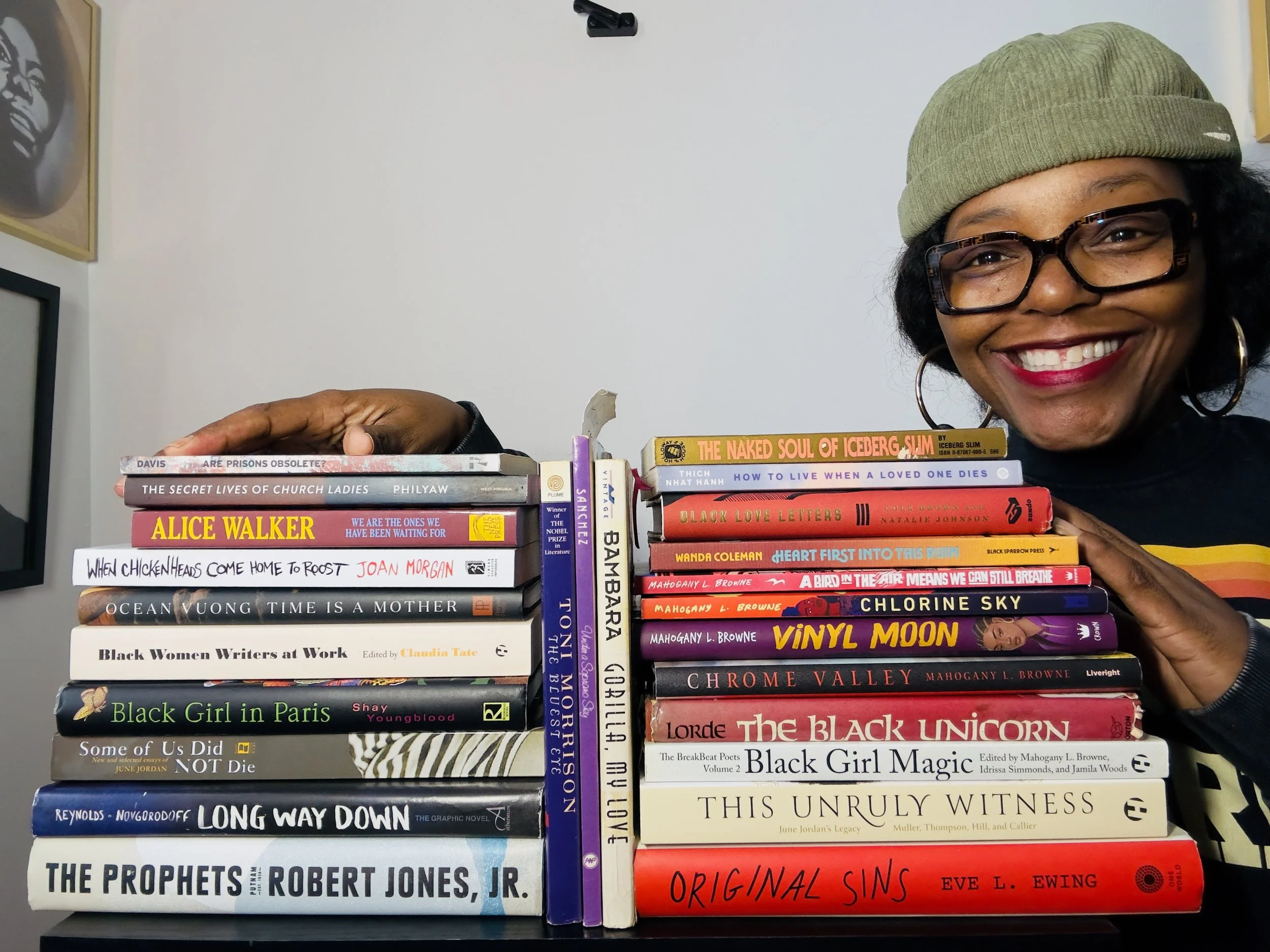
Today on The Stacks, we’re joined by poet, writer, organizer, and educator Mahogany L. Browne. Mahogany is the author of three novels and several poetry collections, including Woke: A Young Poet’s Call to Justice and the National Book Award–longlisted book, A Bird in the Air Means We Can Still Breathe. Today, we talk about who pushed her toward writing for young people, how she’s celebrating her birthday this year, and what motivates her to keep doing the work.
The Stacks Book Club pick for April is Room Swept Home by Remica Bingham-Risher. We’ll be discussing the book with Mahogany L. Browne on Wednesday, April 29.
LISTEN NOW
Apple Podcasts | Spotify | Google Podcasts | Overcast | Stitcher | Transcript
Everything we talk about on today’s episode can be found below in the show notes and on Bookshop.org and Amazon.
Top Chef (Bravo)
The Jenesis House (Sedona, AZ)
Sweet Valley High (UPN)
The Bluest Eye by Toni Morrison
Paradise by Toni Morrison
“Ep. 417 Paradise by Toni Morrison — The Stacks Book Club (Namwali Serpell)”
“'End of an era': Bakery housed in historic Black Panthers building abruptly closes its doors” (Sharon Song and Jana Katsuyama, KTVU.com)
A Bird in the Air Means We Can Still Breathe by Mahogany L. Browne
“The History of Honey Magazine, Pt 1: The Sweet Edition” (Culturati, Breakbeat Media)
Blurred Vision by Mahogany L. Browne
Ghost by Jason Reynolds
Black Girl Magic: A Poem by Mahogany L. Browne, Illustrated by Jess X Snow
Moby-Dick by Herman Melville
Heavy by Kiese Laymon
Hunger by Roxane Gay
Eloquent Rage by Brittany Cooper
Born a Crime by Trevor Noah
How the Word Is Passed by Clint Smith
Breathe by Imani Perry
London Falling by Patrick Radden Keefe
Strangers by Belle Burden
Light of the World by Elizabeth Alexander
“Ep. 72 The Light of the World by Elizabeth Alexander — The Stacks Book Club (Dani McClain)”
The Year of Magical Thinking by Joan Didion
A Taste of Power by Elaine Brown
Inciting Joy by Ross Gay
Salvage the Bones by Jesmyn Ward
Black Girl in Paris by Shay Youngblood
Soft Core by Brittany Newell
Luster by Raven Lelani
“Ep. 347 Luster by Raven Leilani — The Stacks Book Club (Justine Kay)”
Emily in Paris (Netflix)
Room Swept Home by Remica Bingham-Risher
I’ll Tell You When I’m Home by Hala Alyan
“Ep. 316 The January Children by Safia Elhillo — The Stacks Book Club (Hala Alyan)”
The Hunger Games by Suzanne Collins
Blessing the Boats by Lucille Clifton
“Ep. 369 Blessing the Boats by Lucille Clifton — The Stacks Book Club (Tiana Clark)”
“Unabridged: Poetry Therapy” (The Stacks)
If I Ruled the World by Amy DuBois Barnett
Be Easy by Adrian Matejka
Mom Unfiltered by Leah Kim
Cha with Laura and Leah (Laura and Leah)
Little Rot by Akwaeke Emezi
Push by Sapphire
B-More Careful by Shannon Holmes
I Know Why the Caged Bird Sings by Maya Angelou
“Ep. 204 A Journey South with Imani Perry” (The Stacks)
“Ep. 254 Heartbreak is Pivotal to Romance with Camonghne Felix” (The Stacks)
Roots by Alex Haley
Roots (ABC)
“Ep. 410 Romance Is Helpful When Times Are Scary with Jasmine Guillory” (The Stacks)
To support The Stacks and find out more from this week’s sponsors, click here.
Connect with Mahogany: Website | Instagram | Facebook
Connect with The Stacks: Instagram | Threads | Shop | Patreon | Goodreads | Substack | Youtube | Subscribe
To contribute to The Stacks, join The Stacks Pack, and get exclusive perks, check out our Patreon page. If you prefer to support the show with a one-time contribution, go to paypal.me/thestackspod.
The Stacks participates in affiliate programs. We receive a small commission when products are purchased through links on this website.
TRANSCRIPT
*Due to the nature of podcast advertising, these timestamps are not 100% accurate and will vary.
Mahogany L. Browne 0:00
This young man, you may know him, named Jason Reynolds. I could always find him at Peach's bar, and I would come in and he'd be like when you gonna write that book, To which I responded, I write unlawfully. They don't want this. They're not going to teach this in schools. And he said, the kids talk like that too, Mo, they need your voice. I decided, all right, I gave it a shot, and it was a poem that I read called blurred vision. And I read that poem at girls right now, two editors came up to me and asked, Are you working on a young adult novel? I wasn't, but I said, mhm. actually, this is it. I'm almost finished, and now that was the beginning.
Traci Thomas 0:48
Welcome to the stacks, a podcast about books and the people who read them. I'm your host, Traci Thomas, and today I am joined by poet, writer, organizer and educator mahogany l Brown. Mahogany is the author of several novels and poetry collections, including the National Book Award, long listed, interconnected short story collection, a bird in the air means we can still breathe and woke a young poet's call to justice. Today, we discuss her journey from Oakland, California to critically acclaimed poet. We talk about criticism, perfectionism and the books that have shaped her. Our book club pick this month is room swept home by Remica Bingham Risher. We will be discussing that book on Wednesday, April 29 with mahogany l brown returning as our guest. Everything we talk about on each episode of the stacks is linked in our show notes. And if you like this podcast and you want more bookish content, more bookish community. Consider joining the stacks pack on Patreon and subscribing to my newsletter, unstacked on sub stack. In each of those places, I offer you different perks, like over on Patreon, we have our virtual book club meetups, we have our Discord, and then on my sub stack, you're going to be getting my writing and hot takes, my ranking of the books I read each month. And either place you support, you get to know that you're making it possible for me to make the podcast. So head to patreon.com/the stacks to join the stacks pack and subscribe to my newsletter at Traci thomas.substack.com, all right, now it is time for my conversation with mahogany l browne. all right, everybody. I'm so excited. I feel like this episode has been a year in the making, because I met today's wonderful guest a year ago at AWP, and I said, we're gonna make this happen. Because I'm obsessed with you, I don't know when, but we're gonna make it happen. And so I am thrilled today to be joined by poet, author, organizer, activist, artist, amazing human being, mahogany l Browne, welcome. Oh, and also, Oakland girl, yes, well, Oakland woman, but it's an Oakland
Mahogany L. Browne 3:04
I like Oakland girl, as you know, they raised me, they made me, I didn't get to New York until, what, 26 years ago.
Traci Thomas 3:13
That's a long time ago, though. Have you been in New York now? longer than you were in Oakland?
Mahogany L. Browne 3:19
I turn 50 in April.
Traci Thomas 3:21
You turn 50 in April?!
Mahogany L. Browne 3:23
Yes, so I have one year over.
Traci Thomas 3:27
You look 27
Mahogany L. Browne 3:30
Come on, somebody.
Traci Thomas 3:32
I mean 50, how exciting. What are you gonna do for your birthday? Anything?
Mahogany L. Browne 3:37
Ooh, I've decided this is my year long celebration. So I have a 50 birthday bucket list.
Traci Thomas 3:46
Okay, can you share some of the things that are on it?
Mahogany L. Browne 3:50
Oh, absolutely. I've done stuff already. I started. I did like a top chef competition.
Traci Thomas 3:57
Where you cooked?
Mahogany L. Browne 3:59
I judged.
Traci Thomas 4:01
Okay, but do you cook?
Mahogany L. Browne 4:03
Not on purpose. If I do it's always, you know, the problem is this, this is what my partner says, You're good at so many things, that when you are not good at something you like, get turned off very easily. And I could say that about cooking, it is not a promised, you know, success just because I spent two and a half hours on this route don't mean my Gumbo gonna be banging. But my gumbo is banging. I got like, seven, eight staples that I can make
Traci Thomas 4:43
And that's one of them.
Mahogany L. Browne 4:44
That's one of them.
Traci Thomas 4:45
And who were the chefs that you judged?
Mahogany L. Browne 4:49
One was Chef Brian and chef
Traci Thomas 4:51
but these are, like, real chefs. It wasn't like you got your friends together and you were like, We're gonna do a top chef competition. You like, really judged one
Mahogany L. Browne 4:59
Competition space, like a cooking classes. And this is one of their their options. So I was like, I want to go watch people sweat in real time over how my set needs to be prepared.
Traci Thomas 5:12
Oh, my gosh. Wait, this is so true. I turned 40 this year
Mahogany L. Browne 5:15
Yes, and you look 22
Traci Thomas 5:18
Trying, trying so hard I am gonna, I think I'm gonna do a party, but now I feel like for 50 I like this year long celebration idea.
Mahogany L. Browne 5:32
Just do it. I have a New Orleans French Quarter thing scheduled, another trip to Morocco. This black woman wellness space in Sedona.
Traci Thomas 5:43
Ooh. I want to come to that part
Mahogany L. Browne 5:45
Done.
Traci Thomas 5:45
Let me, let me know when that is
Mahogany L. Browne 5:47
On the west coast. I told you I'm doing it everywhere. Okay, I love this. Okay, this is amazing.
Traci Thomas 5:54
So we know a few things about you. We know that you're celebrating your birthday. Yes, we know that you're 49 almost 50. Yes. What's the actual birthday?
Mahogany L. Browne 6:02
4/20
Traci Thomas 6:03
Okay, wait, I love this. Does this make you an Aries or a Taurus
Mahogany L. Browne 6:07
I'm a Taurus
Traci Thomas 6:09
I love an April woman Taurus. I have like, four friends who fall in that very slim there's like, a week, and I love you guys. Love it. I love it. I don't, I don't have any feelings about may women Tauruses, but April, women Tauruses, there is something about you guys that I just love it.
Mahogany L. Browne 6:32
We're just so devout. Our love is devout, our fight is devout, and our demand for luxury and good foods is devout.
Traci Thomas 6:44
Yes, okay, I love this. Okay, here's what I want to know about you. And maybe people listening are curious about this part, since this is a book podcast, what is your story with books? Tell us a little bit about yourself. Where you we know you come from, Oakland. When did you get into books? When did you decide I'm gonna write? When did you decide I'm gonna write books? Tell us a little bit.
Mahogany L. Browne 7:08
It was fourth grade where I knew I wanted to be an author. It was a project in class. Shout out to miss Meeks. Will never forget her. I knew then, oh, this is so cool. I made this book by hand, you know, the wrapping paper and the cardboard, and you oh yeah, do the glue sticks, and you sew, and then you put the story inside. And I just love the practice. I loved the end result. That's when I fell in love for real, for real. I then went to the library.
Traci Thomas 7:45
What about the writing part? Did you like the writing part? Or did you like the book making part?
Mahogany L. Browne 7:49
I have terrible handwriting, but I loved making a story. And I loved how people listened when I was reading. Because as a young person, you're constantly aware of when someone is listening to you and when they're not right. So that was the one thing that I felt. It felt true. I'm writing this thing, and they're listening to me intentionally. So I knew then, and after three stories, everybody was having the same kind of hair color, red. They were like, you know, Irish princesses, sure. I then was like, I need to go to the library. I need new stories. Yeah. Fell in love with all things Sweet Valley High. Christopher Pike, Judy Blume Beverly Cleary but I found Toni Morrison's Bluest Eye. And I had when you were in fourth grade, around seventh grade at that point, so three years in, constantly writing, mimicking Sweet Valley High. And it wasn't until Bluest Eye where I saw myself, and that was scary and amazing. And I was crying in the stacks, like, literally on the floor, like, I couldn't believe all this had happened to this baby, and she was just like me. And that's when I think I became a different kind of reader and absolutely an invigorated and revolutionized writer.
Traci Thomas 9:28
When you say a different kind of reader, what kind of reader were you before, and what kind of reader did that make you become?
Mahogany L. Browne 9:36
The kind of reader I was before was someone who was just excited to share, to read anything. I didn't care if it was bad. I didn't care if there was no representation of the people that lived in my community or went to my school or went to my church. I didn't. I just wanted the story, and in turn, I didn't. After, you know, reading bluest eye, I then realized how much I have the articulation now. I didn't have it then, but I just felt ousted, right, marginalized, even as a reader. So it was then with elder Morrison's work where I was like, Oh no, I can talk about being called the N word while walking to school, and the father being like, good job, son. I can talk about like, I can talk about all these things that are absolutely racialized and a part of my identity and everydayness in this specific country, and that be worthy of a story, be worthy of the page. I don't have to talk about like, I did have boy crushes, but were they more important than the police brutality that I wished witnessed in my community? No, right. My all the men in my family have been impacted by the mass incarceration system, right? All of them, and I didn't have anywhere to write that down, because we were we were told to be shamed. We were taught to be shamed even if they weren't doing anything. One of my uncles got pulled over because he was driving and he did a California roll, is what the cops Oh, yeah, right, so that that's what I mean I was. I was revolutionized and radicalized, because I then realized how many of our stories were not in those pages, and I wanted to be the one to bring them there. At least one of I did find iceberg slam, and you know, the truths, they've been there too, but it just felt so inherently different to what I was experiencing. And I wanted to add that to the quilt.
Traci Thomas 11:44
I think what's so interesting about Toni Morrison, and this is fresh in my mind, because as we're recording this, it's the end of March, which this month on the podcast we read paradise. And one of the things I think a lot about with her work is, like, it's really difficult, like challenging writing, right? Like she is challenging her reader with her skill and her craft. You know, she's not making it easy for you, but it's so good that it really puts every other book in sharp contrast. You know, like, I think as adults, we can all agree that Sweet Valley High and The Bluest Eye are not the same quality, right, sure. But as a child, you're reading these books and you're like, I love these characters. I love these stories. I'm having so much fun because I also love Sweet Valley High. So I'm just thinking about like, the ways that going between those two things was probably so crazy. Like you could like that. You couldn't even, you probably didn't even know that someone could write like that, like that. That was even a way that a story could be told, because at a young age, you're so used to reading books, even though we didn't, I mean, we had YA a little bit, not like how it is now, but like, you're used to reading books that are age appropriate, quote, unquote. And so I've just, I'm fascinated by this idea of, like, you're sitting there being like, these twins are so great, like we were the Robbie whatever, and then it's like acola, like, it's like, quiet as it's kept. You're like, Wait, what the fuck that's not even been a sentence ever in the history of anything you've ever read until that moment.
Mahogany L. Browne 13:28
But how amazing it was is that my grandmother's language, her language
Traci Thomas 13:33
Right like you recognized it.
Mahogany L. Browne 13:35
Oh, my God. It was like my grandma was talking to me. And so, yeah, my grandmother also introduced me to Harlequin romance. Let me say, okay, okay. That was some of my first, earliest on my own readings, like, I think I was eighth, ninth grade. Okay, I wasn't allowed to go where my other cousins could go, so she had the stack, and that's what I was reading. But Bluest Eye reminded me of her, like how she spoke, the sweetness the tell it like it is, yeah, can't get nothing like that.
Traci Thomas 14:11
Do you remember? Have you? You've reread it since?
Mahogany L. Browne 14:15
I haven't reread Bluest Eye since, like, maybe two years ago
Traci Thomas 14:19
okay, but you've reread it since seventh grade?
Mahogany L. Browne 14:21
Oh, absolutely, many times.
Traci Thomas 14:23
Was there ever a time where you reread it and you were like, wait, I read this in seventh grade.
Mahogany L. Browne 14:32
I said nobody was supervising me.
Traci Thomas 14:34
Yeah, that's what my thought was. Was like, seventh grade feels. How did you get any of it?
Mahogany L. Browne 14:39
Well, they wouldn't let me check it out.
Traci Thomas 14:41
Oh, that's why you were in the stacks. Sneaky, sneaky. Okay, so here's my question for you. When did you actually start taking steps towards becoming a professional writer like, when did you actually, like, you knew you wanted to but what, at what point did you go there?
Mahogany L. Browne 15:08
After high school, I was writing articles as a freelance journalist, and then I became like an editor at this independent Hip Hop journalism magazine in Oakland, actually, in Berkeley. I was 22 so 22 I was like, I'm writing for real, for real. And I also worked at the Children's Hospital Oakland.
Traci Thomas 15:33
Shout out.
Mahogany L. Browne 15:34
Yep, walked down the street to get my cake from it's all good. Every single day
Traci Thomas 15:39
They closed. Do you know that?
Mahogany L. Browne 15:42
No
Traci Thomas 15:42
They just closed this year? Like, a few months ago
Mahogany L. Browne 15:45
Devastation.
Traci Thomas 15:46
Yeah, that sweet potato cake
Mahogany L. Browne 15:50
Ugh but also the fact that they had this cake spot in the the belly of the Black Panther office. Yeah, it was so magical. Dang, I'm so sorry to hear that.
Traci Thomas 16:04
Me too. I'm sorry, sorry, everyone's mood downed. Yeah, if you've never had the pleasure of having it's all good bakeries, sweet potato cake. Let me just tell you, you have never lived
Mahogany L. Browne 16:18
Ever, ever, I would come to town, get two peach cobblers, freeze them, and then bring them back to Brooklyn.
Traci Thomas 16:27
Oh, my god, so good.
Mahogany L. Browne 16:29
Highly worth it.
Traci Thomas 16:32
Rip. Okay, here's my question for you, because you write these beautiful YA books, your book from last year a bird in the air means we can still breathe. Is like are these interconnected short stories set during covid in New York City, in Brooklyn and throughout the city, in verse and also in prose, about these kids and the community. And I guess I don't know, I loved this book. I thought it was so sweet and so good. And there's like characters I still think about, and it's like such a what do you even call it? It's like a slice of life book where it's like you're getting all these different people who are connected, but maybe they don't know each other, or they kind of know each other, and it's like, oh, you know the guy who sold us, or whatever, and then you get his perspective, or whatever. Ah, I just loved it. And I guess I want to know, like, when did you decide you wanted to write for young people and why?
Mahogany L. Browne 17:36
That's hard. That didn't come naturally, actually, for me, so doing the journalism bit. That was a three year stint. It moved me to New York. It allowed me to get this internship at XXL and see Kierna Mayo and Jocelyn create honey in real time, interview Little Kim and x and Kelis and like. That was my intro into New York City writing, and within two years, the misogyny took me out, like not being able to walk into spaces because my body was in harm's way just because I'm a woman, right? That kept happening. So the final straw, where, during the interview, I was threatened with being pistol whipped because he didn't like my question while we were driving down the FDR, 65 easily. And I'm like, do I jump? Do I what? Yeah, what do I do? I'm just asking a question about mentorship. That was it, that was it for me. So I fully pivoted focused on poetry. Began touring, and in my touring, I started teaching. some of these poems were not working with young people, right? So I started writing with a little more deftness and mindfulness for my new audience. And after 13 years, this young man, you may know him, named Jason Reynolds, was like the laurist of Brooklyn, and I could always find him at peaches bar, the bar top for brunch, and I would come in and he'd be like, when you go write that book, we're gonna write that book for kids. Mo, you're doing good with poems. You're killing it. But what about the kids to which I responded? I write and speak unlawfully. They don't want this. They're not going to teach this in schools. I cuss too much. It's not gonna work. And he said, the kids talk like that too. Mo, they need your voice. You are telling their stories already. Just put it in this form. And so after a year of that, I decided, all right, I'll give it a shot. And it was a poem that I read called blurred vision. You can still see it online. I'm reading a poem about this young girl who sees the bullying happening to her through an interaction with her best friend, and so she's like witnessing the bullying happen outside of their friendship, and then that friend becoming a part of the bullying group. And I read that poem at what is it girls right now, and they had mentors with traditional editors and the big fivers and all that, and me reading that poem in that space, two editors came up to me and asked, Are you working on a young adult novel? And I said, Yeah. I wasn't. Actually, this is it. I'm almost finished, and now that was the beginning, that first little baby lie, which was in my head. I was writing it. I hadn't written it down, but I was in my head thinking Jason said I should do this. I probably should do this. Oh, they like this poem. I could turn this poem into a story.
Traci Thomas 21:16
And at this point was Jason already writing
Mahogany L. Browne 21:20
Absolutely, he was already, I think ghost was already out by then.
Traci Thomas 21:25
Okay, I did not know, I did not know that Jason was part of your origin story.
Mahogany L. Browne 21:30
Yeah, I just talked about this online. Jason prompted me to do the YA. I had a children's book, so when that editor said, we want to do a book with you. I said, Well, that one's not done yet, but I have this other thing I'm working on. And I showed them black girl magic, the illustrated book that Jess X shinn drew beautifully for and they were like, Oh, we would like that. And whatever else you're doing, we just want to work with you. So that was the beginning.
Traci Thomas 22:01
How affirming. We just want to work with you.
Mahogany L. Browne 22:03
We just want to work with you. And so Jason brought that in, and then Jacqueline Woodson and Jason were talking at Harlem fete to me about options. And Jackie saw the little PDF pages and said, This is brilliant. You have an agent. And I said, No. You want one? And I said, yeah. So Jason got me to write ya Jackie Woodson got me my agent walked me right in, and Nic stone got my first YA novel picked up by my now editor and her editor, Phoebe Yeh
Traci Thomas 22:45
How do the kids respond to you? Do they love you? Do they eat you up?
Mahogany L. Browne 22:49
You know, I want to say yes, they love me, but I think I'm funnier to me than I am to them. I be throwing game I'm cracking up, and they just look at me like, you know, so I just lean in. I lean in.
Traci Thomas 23:11
You know, like you've been with Jason when he's been out in the world. And the kids just like, love him. Oh my. I'm in love with him the way the kids are. I'm like, Okay, you can have him. Fine. I'm not even that into him. I swear.
Mahogany L. Browne 23:26
I'll move. I'll move. Do ya thing. Now I'm not, I don't have it like Jason. Absolutely not.
Traci Thomas 23:36
I just, I'm so I'm so removed from it that I'm like, I'm excited because my kids are six, but I know my kids get a little older and they start to have, like, school visits from authors. I'm about to be the coolest mom ever when I'm bringing you and Nic and Jace, I'm gonna be like, Oh, mommy's friends. Oh, you want mommy's friend to come do a reading at school?
Mahogany L. Browne 24:00
No problem. Let me text Uncle Jay real quick.
Traci Thomas 24:05
Yes, yes, yes. I was like, Oh, Uncle Jason. Oh, yeah, sure. I'm sure he'll swing by, you know, oh, Auntie Mo, yeah, yeah, no, we could get her. I mean, if you guys want her, I mean, she's only, like, only been, like, a National Book Award long list author, like, just like, a 500 times. so.
Mahogany L. Browne 24:19
It me
Traci Thomas 24:21
Yeah. I mean, okay, so what is that? What is it like for you to be, you know, coming coming up from like, you come from journalism, you're a poet. You kind of get, like, talked into doing all this, and then all of a sudden, your work is recognized critically. You're you're on these lists. You are mahogany l Browne, like you are a known person. People cite you as an influence, as as an advocate, as an inspiration, like before we ever met, your name had come up so many times, and Deesha Philyaw is the one who introduced us, but she was, we were at lunch, and she was like, Mo's gonna come too. And I was like, oh my god, I'm so excited to meet her. Like you have become such a force. So what's that been like for you to not only be beloved by your peers, but also to be critically acclaimed?
Mahogany L. Browne 25:16
I'm so thankful, because I don't know if I see it the same. I'm too bust working.
Traci Thomas 25:23
How do you see it?
Mahogany L. Browne 25:25
Yeah I don't see it the same. I do see opportunities. I do see my position in the world, right? Like I'm known in several worlds, not just poetry, not just ya, not just theater, not just Hip Hop journalism, like I've kind of made. I try to make the rounds of all humanities through poetry, and that feels good to know that people remember me fondly and they hold my name up because I come from a space where it's natural to be just a hater. It's just natural to want to say it's not that good, or I don't like her because she did? That's the space I come from, the performance poetry world. It can be community, but it can also be you could be like that little, that little baby in the well. You just can't never get out.
Traci Thomas 26:25
Oh, baby in the well, I thought you said baby in the whale. I was like, Moby Dick?
Mahogany L. Browne 26:29
No, the well, yeah, baby Jessica,
Traci Thomas 26:32
Yes. Oh yeah.
Mahogany L. Browne 26:33
Oh my gosh, I'm thankful. So when you say it, I'm like, Really, that's so dope, because I only hear, you know the naysayers
Traci Thomas 26:43
But that's your personality, I have that too.
Mahogany L. Browne 26:46
I think so. I deal well with adversity.
Traci Thomas 26:49
Me too. One of my family friends is like, is a baseball manager, and we were out to dinner, and he was saying, the wins are never as good as the defeats are bad. And I think, I think this is a personality type, I don't know, maybe everybody feels that way, but I feel like it's like a kind of, like, relentless, hard working, sort of perfectionist kind of person where it's like, you could say 10 nice things to me and one mean thing, and I will take that mean thing and I will keep it in a little locket, and I will remember it, and then I will do, I will fix it, and then I will come back to you and be like, Fuck you. But the 10 nice things completely forgotten. Like, oh, there's something nice about me totally forgot, right
Mahogany L. Browne 27:42
Because it also doesn't feel authentic. I'm wondering if it's not just that, but also maybe because our specific world only recognizes or highlights or celebrates or amplifies the lists and the winners and the accreditation and the prizes, we never say, Yo, you created a form. Yeah, it's amazing. Yo, you invested 25 hours into making sure young people have a writing mentor. Thank you. We only see you won the slam, you won the prize. You're in this fellowship now I can respect you, and I think because of that, I'm never just happy with the win.
Traci Thomas 28:37
Yeah, yeah. Were you an athlete?
Mahogany L. Browne 28:39
I was.
Traci Thomas 28:40
I think this is also part of it. I have a whole theory. I have a whole theory about authors who play sports.
Mahogany L. Browne 28:47
What sport did you play?
Traci Thomas 28:49
Well, I was a dancer, but I grew up watching sports, like deep like, I'm an aggressive sports fan. I did volleyball and basketball in middle school, but I was a dancer, but I have a theory about people who are in fields where you get a lot of real time feedback and and where you take a lot of L's, right? Like, as a dancer, you'll be on stage and your director will be like, you look fat, and you're like, Okay, gotta finish this. Eight counts of eight. Like, you'll be in the middle of a thing, and they'll be like, suck in, and you're just like, okay, like, Thank you for the reminder. Or, like, when you're an athlete, it's like, you lose. Sometimes your team loses. Sometimes you lose, sometimes, like, and that that's just how it is. And and I, I am fascinated by people in like, one of the things that has been the most, like, jarring for me as a person who talks to writers is that a lot of writers who did not have a sports or like that kind of background, like a real time feedback background, really struggle with the criticism. Like, it's like, debilitating for them, whereas, like for me, and I think what I'm hearing from you is, for you, it's like something, not only that it like fuels you, but also that it's something that you are just, like, anticipating. You just know it's gonna be there, and it's like, it's not gonna debilitate you, because it's part of the whole thing. And so I do feel like it's like, if you were an athlete, or whatever you can handle. You're just, like, more primed to handle these things than people who were like, I always wanted to be a writer, and I was like, from a young age, I just was, like, writing, and I'm like, right? I did an MFA and, you know, but I don't know if it's real. That's just my theory.
Mahogany L. Browne 30:38
That's a good theory. I'm actually leaning into it because I'm like, oh, that's something. I'm not disabled, but my feelings are hurt, right? I'm also walking because I know that. Can I curse? Of course, I just sworn like, 50 times because I just thought my brother said he's the one that taught me soft to play, to play softball. He said, um, what you eat, don't make me shit. That someone is, you know, chopping they gums doesn't mean I have to follow them, and what they're saying doesn't have to impact me. I don't have to digest it. I can let it be what it is and keep it moving. Yeah, another friend said while you're sharing all your opinions, just remember you are the one in the audience clapping for me, and I love that those two help me too.
The one that my friend says to me whenever people like criticize an episode of the show, or like I didn't agree with what you said, or whatever they always say, Well, I can't wait to hear your podcast episode on that. You know, looking forward to your episode
I love when they're like, You need to write about this. Maybe you should write that book.
Traci Thomas 31:53
Maybe you should write that book. Yeah, that's exactly right.
Mahogany L. Browne 31:56
You put a lot of effort into this podcast. Okay, I got five emails with distinctively different directions. Baby girl is primed. She got us primed. How dare you. Hold them opinions.
Traci Thomas 32:12
You know, I do send a lot of emails, because you'd be shocked how many people we perfected this email, because over the last eight years, we've had some issues.
Mahogany L. Browne 32:22
I'm not mad at it. I feel held
Traci Thomas 32:25
Okay, good. I'm so glad. Okay, we're gonna take a quick break, and then we're gonna come back and talk more about books. All right, we are back. I did not prepare you for this next question. Okay, this is called Ask the stacks, and someone has written into ask the stacks at the stacks podcast.com, also, people, please send us some of these. I'm really I'm at the I'm at the very end. Okay, email, ask the stacks at the stacks podcast.com, this is from Nichelle, and she says, much like yourself, I enjoy nonfiction. Give me a memoir or true crime and I'm in however, I have read so many of your (traci's) book recommendations in these genres that I feel like there's nothing great left. And then she listed a few of her favorites. And so here are the favorites. Heavy by kiese layman hunger, by Roxane Gay, eloquent rage, by Brady Cooper, born of crime, by Trevor Noah, how the word is passed by Clint Smith and breathe by Imani Perry. Anything similar to these titles would be great. Yes, it's a great list. It's a bunch of my favorites. So I'm gonna give her three recommendations. Okay, I'm gonna invite you to give her one to three, depending on whatever you come up with since I sprung this on you, I can go first, or you can go first.
Mahogany L. Browne 33:45
Okay, you go first while I look okay, and it's nonfiction, nonfiction, memoir or true crime.
Traci Thomas 33:52
Okay, so here's what I decided, Nichelle, because you've read all of my favorites already, I'm gonna give you two brand new books, one that's not even out as you're listening to this so that I know you haven't read it yet, which is London Falling by my other boyfriend, not Jason, Patrick Radden Keefe I like to have at least two boyfriends going. You guys know that about me. London Falling is by Patrick Radden Keefe. He is this book is about, it comes out April 7. It is about a 19 year old boy named Zach brettler in England who is found in the river the Thames. Is that how you say it the Thames? His parents are trying to figure out what happened to him. He has been involved with some sort of seedy dudes from London, and it is deep investigative journalism. You guys know, I love Patrick from say nothing, and also empire of pain, and this is a much smaller story. I think some people are going to be confused why Patrick's writing such a small story, since his last two books were about really big things, but I love it. If you love his kind of writing, I think he's really firing on all cylinders. So that's one. The other one is a memoir. I read this last year, but it came out in January. I did not think I was gonna like this book, but I read it, and I sneaky loved it. It is extreme white mess. It's called strangers by Belle burden. She is like a grandchild of New York City elite socialites. Her husband decides during the first week of covid, you know what? I don't actually want to be married to anymore. Abandons the family. And this is her memoir. And what I like about the book is it does touch on some real stuff about women and marriage and finances, but also because they're so rich it, there's a distance to it that makes it sort of enjoyable. And then the last one is by poet and memoirist. It is light of the world by Elizabeth Alexander. This book is not brand new, but it is so beautiful. We did it for book club here. I want to say in 2019 and I still think about this book all the time. It is about her husband dies suddenly, she's got these two young kids, and it's her memoir. And it is, if you if you've read, you know, Magical Thinking by Joan Didion, to me, it's better. I think this is a better grief memoir. I love this book so much, so those are my three recommendations.
Mahogany L. Browne 36:24
I would recommend Elizabeth as well, one of my favorite and she's a poet, so the language is just succinct, precise, sharp, so sharp, it's so good, and you're you weep a lot. Yeah, I think memoir, taste of power by Elaine Brown. She was the only woman to ever run the Black Panther Party in Oakland. But also she writes about SA cases that occur to her while she is the leader, and how she had to negotiate that space, while also trying to liberate black people. I think I also really, really cannot get over the essay collection by Ross gay, inciting joy, also non fiction, dealing with grief after the loss of his father and after losing my grandmother, my sister and my cousin, all in a span of eight months. That was something that I kept turning to his words, because there's so much gratitude for the departure, like even though it's happening, even though you feel like you can't pick yourself up. This is what it means to be alive. And such a good such a good book to use as a touchstone.
Traci Thomas 37:59
I love it. Those are so good niche shall if you read any of our recommendations, let us know how we did and everyone else, email. Ask the stats at the stats podcast.com I'm begging you. Okay, two books you love, one book you hate.
Mahogany L. Browne 38:12
Two books I love. Salvage the bones by Jessmyn Ward, black girl in Paris, Shea young blood.
Traci Thomas 38:21
I don't know that. I've never even heard of that.
Mahogany L. Browne 38:24
I'm gonna find you a copy. We just lost sister Young Blood a couple of years ago, and she was, she had the tenacity of like June Jordan with the romance of Beverly Jenkins. That's a good merger. Those are my two loves. What did I hate?
Traci Thomas 38:47
Do it, I saw the face. Do it.
Mahogany L. Browne 38:49
Soft core
Traci Thomas 38:50
Oh, with the one with like the glove on it?
Mahogany L. Browne 38:53
Yeah, do not recommend. Because if you have luster by Raven Leilani,
Traci Thomas 39:02
You don't need it. And we do have luster.
Mahogany L. Browne 39:05
We do have luster.
Traci Thomas 39:07
I love luster. We did that for book club here. A joy. I love that book. I love a messy black woman
Mahogany L. Browne 39:17
Black girl in Paris, you're gonna love it
Traci Thomas 39:20
Okay, I can't wait. Who needs Emily in Paris, right? No way. What kind of reader are you?
Mahogany L. Browne 39:29
So I have ADHD, okay. And funny enough, I grew up with it. I knew I had it. My brother has it. My mom has like, it's there. So the way I dealt with it is I just read three to four books at a time. When I'm bored, put it down, pick up the other I have a poetry book, short story collection, a fiction book, and then an anthology of some sort.
Traci Thomas 40:00
Okay, what are you reading right now?
Mahogany L. Browne 40:02
I just finished rereading room, swept home.
Traci Thomas 40:06
And that's our book club pick for the month.
Mahogany L. Browne 40:08
Yes, I had to reread it. That girl, she go. And I'm also reading Hala Alyon. I'll tell you when I'm home, the new memoir.
Traci Thomas 40:19
Okay, that's that's the memoir? So Hala also was on this show two years ago for Poetry Month, which was a joy. I gotta say, I don't read a lot of YA, and I don't read a lot of poetry, but when I do, I do feel like I get the best people.
Mahogany L. Browne 40:36
I'm just saying you choosing the right ones. So which YA people helped changed your mind, like a couple of them?
Traci Thomas 40:41
Who changed my mind. Well, okay, I mean, obviously, Jason Reynolds, I think Fred Joseph is great. I, I mean, I'm gonna be really honest. Suzanne Collins, those Hunger Games, books
Mahogany L. Browne 41:01
We talk about this. You're the only one I can text about it.
Traci Thomas 41:07
I love those books so much. So definitely her. Jose Olivares is a poet who really helped me figure out that I liked poetry. Also Nate Marshall, yep, also Ellen bass. I've never had her on, but she speaks to something in me for real. Last year we did Lucille Clifton with Tiana Clarks, yes, and that combination Tiana and Lucille and I that was pretty wonderful.
Mahogany L. Browne 41:44
Yeah, that's a nice matriarch, right there. Yeah, you have all the people I love.
Traci Thomas 41:50
I mean, so the way that I the way that I pick people for Poetry Month, and for the most part, is that I have a group chat with Nate Marshall and Jose Oliveras. They're like real best friends, and I've just inserted myself in their relationship barely. And the poetry group I title, or the group chat, I titled the three poets, because obviously I'm the third poet. And every year, I reach out to them anytime I read any poem that I think is good. And I tell them I read something that I liked, and in March or in in February, I usually reach out to them and I say, okay, like, what are some collections that you think I would like? Who are some poets this year? I didn't do that because I knew that I was gonna ask you because we had met. But last year they were like, you'll really like Tiana, like they and like, sometimes poets will send over, like, these are the collection, like, a list of collections that maybe we should do on the show. And then I send that list to them, and I say, Okay, you guys tell me. Well, also like, they know my taste, but I don't really know my taste. I have a hard time articulating exactly what it is I like in poetry, and so I'm like, Would I like this collection? Would I like? So they really are my like poetry guides. So far, I'm getting better, I'm getting better, but they have really helped me. So I owe them a great debt of gratitude. And then a few years ago, we did something called poetry therapy, which we made up, which is for a bonus episode, I had five different poets Come on. They each picked an accessible poem that they love. They sent it to me. I read it once before the episode. I read it once on air, and then we discussed it, and we talked about, like, Why do you like it? What stands out? And that was really fun, because I think so many of us struggle with reading poetry and like getting in our heads and thinking there's supposed to be a right answer, and I certainly do, and I feel like talking to poets about poems opens up something, yeah, that maybe you wouldn't get just talking to a person who doesn't write and think about poems in the same way. So I think we might run back Poetry Month again for a bonus episode this month.
Mahogany L. Browne 44:12
That sounds super fun. It's exhaust. It's it's also, excuse me, it's also what they do in poetry workshops, you bring a poem in and you analyze, and all analysis is not this is correct or this is wrong, yeah, a lot of it is, what were you taught? How were you taught to read? And some of us may not have the articulation that is normal to the tradition of poetry, but we absolutely have the words to speak about our humanity.
Traci Thomas 44:46
Yes, something that they do in my kids class or in kindergarten is they will show like a picture, and then they call it notice and wonder. And they're supposed to notice things and then wonder about things. And I've been thinking a lot about that since I learned about that they were doing this. When I read poems like, it's like, there's not a right answer. It's just like, What do you notice in this poem? What do you wonder about this poem? And I'm like, This is so such a more helpful framework for, like, seeing the world. I mean, it's a great framework for kids to start, you know, their education career, but also I was just thinking, like, yes, there isn't necessarily right answer. Just like, this is what I'm getting out of this poem. This is what I'm noticing. This is what I'm wondering. This is about you. Though, I don't know why I'm talking so much
Mahogany L. Browne 45:33
That's good. I love notice and wonder. That is the that's the crux of poetry building
Traci Thomas 45:40
Yeah. I mean, it's a crux of all art, don't you think it's a crux of all art making?
Mahogany L. Browne 45:45
Oh, I would love to believe so. I don't, I don't know, because I think that there's a different kind of muscle used with that alchemy. But I think you're right on the basis, the foundation of being an art curator and creator means you have to notice the world around you, notice what's missing, notice what's there, notice who's remembered, notice who's erased, and then wonder the exact opposite.
Traci Thomas 46:17
Yeah, I mean, I don't necessarily think that this podcast is art, per se, but I do feel like notice and wonder is basically the central tenets of how I read every book, right? Like, that's how I come up with the questions. I notice what has been mentioned in the book, and I wonder, why did you do that? Or I wonder, why didn't you do this? Or I wonder, how did you name that person like so I do, I feel like notice and wonder is like a really good way to be in the world. I think. I love there's a lot of people who could notice and wonder a little more certainly wonder.
Mahogany L. Browne 46:55
Or read. Just read. And not read the books written by AI not read the materials where they created. Quotes from their imagination, stats from their imagination. How you writing a non fiction book with fake facts?
Traci Thomas 47:14
That's nuts.
Mahogany L. Browne 47:15
Can't even build, I can't even build a boat with this. It would sink.
Traci Thomas 47:22
Okay? What are some books you're looking forward to reading?
Mahogany L. Browne 47:24
That are not yet out?
Traci Thomas 47:26
No, it could just be books you've been meaning to get to. It could be anything. Basically, what's on your current TBR?
Mahogany L. Browne 47:32
I actually returned to, like, the older books, but I did finally crack open if I ruled the world? By Amy Louise
Traci Thomas 47:44
Oh, yeah, yeah, yeah. She's like the music writer, right? And she wrote the novel?
Mahogany L. Browne 47:47
From the journalism world. Yeah, I'm reading her. I'm reading be easy, by Adrian matika. His new book is coming out. And I'm reading mom unfiltering, by Leah Kim,
Traci Thomas 48:02
I don't know that.
Mahogany L. Browne 48:04
It's a new non fiction jawn I'll send you. Okay, she does a great podcast called Cha, with her and an astrologist named Laura. They are liberatory, practicing artists. Very dope.
Traci Thomas 48:20
I love it. Are there things you wish were different about your reading life?
Mahogany L. Browne 48:27
I wish I was paid to read. If I was just paid to read, I wouldn't be rushing around.
Traci Thomas 48:34
That's what you think. As a person who's paid to read, I am always rushing around. I never it's not I, I barely get to read.
Mahogany L. Browne 48:44
How is this possible?
Traci Thomas 48:45
So much of my life is everything else that I have to do.
Mahogany L. Browne 48:49
I mean, you are raising two humans. That's a lot of work
Traci Thomas 48:53
They get in the way a lot. Of my reading,
Mahogany L. Browne 48:58
Asking questions, talking about food
Traci Thomas 49:00
Talking to me. I'm like, Don't you see I'm trying to read. No, they're talking to me about Pokemon. I'm like, shut up. I hate Pokemon. Sorry.
Mahogany L. Browne 49:11
Yeah, I wish I had more time. I wish there was just, like, a dedicated time to read for the world. Yeah, that'd be nice.
Traci Thomas 49:18
Yes, that would be really good.
Mahogany L. Browne 49:19
I tried to work in an art practice time. Oh, which I'm holding on for dear life, that one day a week,
Traci Thomas 49:28
What kind of art?
Mahogany L. Browne 49:29
Writing. I'm not really good with my hands.
Traci Thomas 49:33
Me neither.
Mahogany L. Browne 49:34
I can't do collaging. And when people do that, I'm amazed my vision board looks crazy.
Traci Thomas 49:41
You vision board? I do not vision board.
Mahogany L. Browne 49:43
Yeah. I do one at the top of the year just to remind myself what I'm focused on
Traci Thomas 49:47
That's so good. I write a list, a goals list. I don't have the visual arts not that's not something that I have. And similar to you, if I'm not good at something, I'm quick to be like, Oh. Hey, gotta go. Not gonna do it, not gonna spend time on that.
Mahogany L. Browne 50:04
That could be the athlete in us. Because there's some natural instincts,
Traci Thomas 50:09
Yes. Like, people always say, like, Oh, are you gonna write a book? And I'm like, No, I hate writing, and I'm not good at it, and I spend all day reading other people who are great at it. Why would I throw my hat into the ring knowing I'm not even gonna touch the hem, you know, like, I'm just like, I'm not even close. I would never put myself out there in that way, knowing that I suck at this thing compared to everyone else.
Mahogany L. Browne 50:34
As much as you read, I doubt you suck. Let's start there.
Traci Thomas 50:40
Well, I have too high standards. I'm too much of a perfectionist. I'd never finish anything if I tried to write something which I don't want to do, because I actually despise writing. I would, I would, no, okay, do you want to hear a funny story? I'll tell you. This is about me again, but I'm telling you funny story. So had my kids parent teacher conference, and the teacher was like, you know, they're smart, whatever He's smart. He's doing great. But, you know, I've noticed this funny thing, like, we do this thing where we like tell a story, but to come up with a story, but to tell a story, we tell it to like our group, and then, you know, the kid will tell it to me, the teacher, and then they're supposed to sit down and write the story, and your kid will tell the story, and then he'll tell the same exact story to me, so I know he's really thought out the story, but then when it comes to write it down, he just writes sharks the end. And I was like, oh, so what you're telling me is that that's my kid, because that's me. I could talk for 50 minutes, and then when you're like, Okay, write it down. I'm like, we talked about dogs. Thank you. I'm like, this, maybe this is like, hereditary that, like, we are a we are a people of the talking, we are not a people of the writing
Mahogany L. Browne 51:52
We are a [?] people.
Traci Thomas 51:53
Yes, yes, we are. It is giving oral historians. I just started laughing at her. I was like, I'm so sorry, but like this. I was like, this is literally my job, and I hate writing, right?
Mahogany L. Browne 52:12
He says he got it honest.
Yeah, well, we're gonna have to work. We'll work on it, but just know this just might be there might be shorter, might be a lot of haikus. That's what I used to do. We had to do. We had to write poems in school. I would only write a haikus.
Traci Thomas 52:33
Yo. You was slick with it. Good to know.
Mahogany L. Browne 52:29
Nice little sneak.
Traci Thomas 52:31
Okay, wait, we are running out of time, but I gotta give you the last few okay. Okay, ideal reading, setup, location, snacks and beverages, time of day, accoutrement
Mahogany L. Browne 52:42
All of that. I love. My ideal reading setting is beach cabana, the ocean. I can smell it. The heat of the sun. I can feel it. I only have on a bathing suit, but I have enough shade where I can read and tan. I love the sun. Oh, the accoutrement, oh, Pina Coladas. My cup is never empty. Snacks and snacks, jalapeno, kettle chip, a nice little chicken tender, lightly breaded. Lemon Pepper wings of course. a proper fry and a Caesar salad and french fries.
Traci Thomas 53:46
For sure, for sure, for sure. I love this. We could definitely hang out.
Mahogany L. Browne 53:51
We're gonna be fed and read
Traci Thomas 53:53
Though I will be fully in the cabana with a long sleeve shirt on. I do not like to be in the sun. No, I do not like the way my skin feels after being in the sun. It's like that tight, kind of like, Yes, I hate that so much.
Mahogany L. Browne 54:11
Even with sunscreen?
Traci Thomas 54:13
I wear sunscreen all the time, constantly, 50 every day.
Mahogany L. Browne 54:20
Yes. I mean, you are in California. You should.
Traci Thomas 54:23
I do not do any skin routine, except for sunscreen every day. That's it.
Mahogany L. Browne 54:31
Well, that's why you look 22
Traci Thomas 54:33
Well, everything else is a lie. I don't I've never done anything else. Okay, what's the last book that made you laugh?
Mahogany L. Browne 54:42
The last book that made me laugh, Little rot, Akwaeke Emezi.
Traci Thomas 54:48
I love that book. Last book that made you cry?
Mahogany L. Browne 54:52
I haven't cried since salvage the bones
Traci Thomas 54:55
Okay, last book that made you angry
Mahogany L. Browne 54:57
Well that made me angry because I didn't like it. If I'm thinking of like the emotions that were invoked were on purpose. The most visceral memory I have is push by Sapphire that made me that pissed me off. I threw that book across the room.
Traci Thomas 55:21
Is there any book that you feel embarrassed for never having read?
Mahogany L. Browne 55:29
I haven't read any Joan Didion. Isn't there like a yes book she has? Year of Yes?
Traci Thomas 55:37
Hers is the Year of Magical Thinking.
Mahogany L. Browne 55:39
Year of magical thinking, people talk about it all the time.
Traci Thomas 55:42
It's really good. Actually, you should read it. You're kind of in your grief season a little bit right now.
Mahogany L. Browne 55:46
I'm gonna order it.
Traci Thomas 55:48
I did love that book. I read it years ago. I like Joan Didion, but I don't, I don't go hard for her.
Mahogany L. Browne 55:56
I read her essays and articles, but I've never read a book by her.
Traci Thomas 56:00
Yeah. I mean, the Year of Magical Thinking is it is pretty good. Is there a book? Do you have a problematic favorite book?
Mahogany L. Browne 56:09
Iceberg slim. That was a good book. He was a visceral writer. be more careful. Urban lit. Love it, lived it so to read it was like, Yeah, we were there. Do I return to them now? No, because it's kind of like returning to, like, season three of a Perry episodic
Traci Thomas 56:37
Right, right, right. If you were a high school teacher, what is one book you would assign to your students?
Mahogany L. Browne 56:47
Maya Angelou, I Know Why the Caged Bird Sings.
Traci Thomas 56:51
I've never read that.
Mahogany L. Browne 56:52
It's a good one, especially good for young people, because it's real life stuff happening in the book, yeah, but it also centers the childin these like really painful situations, but to know that she survived it and became so much, I think that is extremely helpful for young people who are constantly surviving. They don't have real life numbers for who gets out, who makes it.
Traci Thomas 57:29
Right. I haven't asked this question in such a long time. I used to ask it every week at the beginning of the show. But for some reason, you're making me really want to ask this one. Which is, who would you want to write the book of your life? And you can't say yourself, it's not a memoir.
Mahogany L. Browne 57:47
Imani Perry.
Traci Thomas 57:51
Can't go wrong.
Mahogany L. Browne 57:53
Ooh, or Camonghne Felix,
Traci Thomas 57:57
Those are two totally different books, and I can see, I can see like the different, the different Mos. I love it. Again, two past guests of the show. I can't wait to read both The Imani Perry and Camonghne Felix, mahogany brown story. Okay, last one. If you could require the current president of the United States to read one book. What would it be?
Mahogany L. Browne 58:24
Probably a banned book. Roots by Alex Haley.
Traci Thomas 58:30
I've still never read roots, though I have seen the movie 700 times. I need to read it. I have a copy here. I have my parents copy.
Mahogany L. Browne 58:41
Oh, you got the OG. I got my grandmother's copy.
Traci Thomas 58:45
Yeah, my my dad made us watch that so many times.
Mahogany L. Browne 58:51
That's why you didn't read it.
Traci Thomas 58:53
I just never thought I had to read it. I'm like, I could do the whole movie. I could do from the first moment I could recite the whole thing. We got to go. But everybody mahogany l Browne will be back on Wednesday, April 29 for our book club discussion of room swept home by Remica Bingham rischer, the book you get. Get your copy now. Hurry up. Get it read with us. We're gonna do poems. I know you're scared. Don't be scared. Don't be scared. We've got the great mahogany l browne to help us. So, I mean, if you are scared, it's fine. I'm also scared, but it's fine. It's fine.
Mahogany L. Browne 59:31
We're gonna notice and wonder together.
Traci Thomas 59:33
Notice and wonder together. Thank you so much for being here. I adore you.
Mahogany L. Browne 59:38
Thank you, Traci. I just got to say, you're one of the best things that Oakland California has produced.
Traci Thomas 59:45
Oh, my God, don't say that we come from a place that has produced Ryan Coogler, the Black Panthers Oakland has produced. I think Oakland is over producing greatness
Mahogany L. Browne 59:57
In the water, it's in the water.
Traci Thomas 1:00:00
It is we are. There are two places in the world that are over producing greatness. To me at this moment, one is Oakland and the other is the country of Puerto Rico. Puerto Rico is over producing for their size. They are it. There are so many great Puerto Ricans. Same with Oaklanders.
Mahogany L. Browne 1:00:19
Yo, despite our conditions, we rise.
Traci Thomas 1:00:21
Yes, because of it's such a great place to be from. I'm obsessed with you. Thank you. So you're actually the second Oakland guest this year for book club, because Jasmine Guillory also a great Oaklander.
Mahogany L. Browne 1:00:36
So I'm in the club.
Traci Thomas 1:00:37
Yo. Hell yeah, hell yeah. We gotta, you know, we stick together. All right, everybody, we will see you in the stacks. Thank you all for listening, and thank you again to mahogany l Brown for joining the show and a special thank you to Deesha Philyaw for making this episode possible. Our book club pick for April is room swept home by Remica Bingham Risher, and we'll be discussing the book with mahogany on Wednesday, April 29 if you love the stacks and you want inside access to it, head to patreon.com/the stacks to join the stacks. Pack and check out my newsletter at Traci Thomas, dot sub stack.com make sure you're subscribed to the stacks. Wherever you listen to your podcasts, and if you're listening through Apple podcasts or Spotify, please leave us a rating and a review for more from the stacks. Follow us on social media at the stacks pod, on Instagram, threads and YouTube, and check out our website at the stacks podcast.com this episode of the stacks was edited by Christian Duenas, with production assistance from Sahara Clement. Additional support was provided by Cherie Marquez, and our theme music is from taguergis. The stacks is created and produced by me, Traci Thomas, Traci.