

Ep. 415 The Feeling of Being Known with Tayari Jones
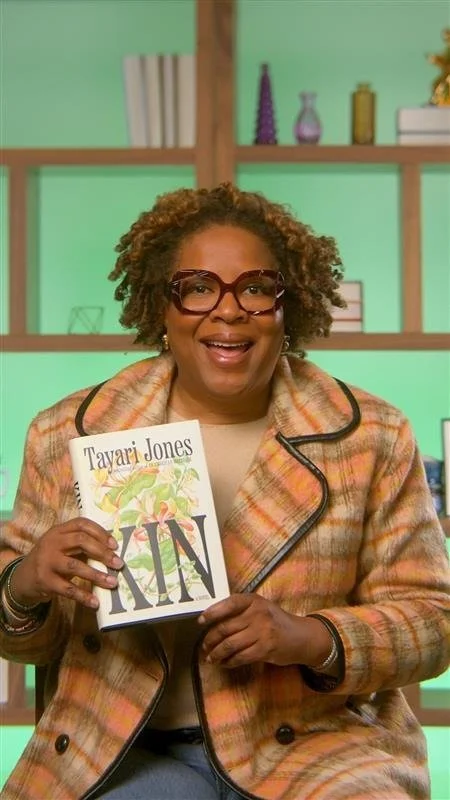
Today on The Stacks, we’re joined by bestselling author Tayari Jones to talk about her newest book, Kin. This novel follows the lifelong friendship between Vernice and Annie, two motherless girls whose paths diverge in adulthood. In our conversation, Tayari shares how Kin was the book she had to write, even though it was not the one she was contracted to write, why she avoided writing a historical novel until now, and how coming home to Atlanta has impacted her as a person and a novelist.
The Stacks Book Club pick for March is Paradise by Toni Morrison. We’ll be discussing the book with Namwali Serpell on March 25th.
LISTEN NOW
Apple Podcasts | Spotify | Google Podcasts | Overcast | Stitcher | Transcript
Everything we talk about on today’s episode can be found below in the show notes and on Bookshop.org and Amazon.
Kin by Tayari Jones
An American Marriage by Tayari Jones
Spelman College (Atlana, GA)
Beaches (Garry Marshall, 1988)
Sula by Toni Morrison
Beloved by Toni Morrison
Song of Solomon by Toni Morrison
Leaving Atlanta by Tayari Jones
Emory University (Atlanta, GA)
Silver Sparrow by Tayari Jones
Dumbo (Ben Sharpsteen, 1941)
“She's a Bad Mama Jama” (Carl Carlton, 1981)
Best of Friends by Kamila Shamsie
“Ep. 237 Girl Fear with Kamilah Shamsie” (The Stacks)
These Heathens by Mia McKenzie
“Ep. 376 People Be Gay with Mia McKenzie” (The Stacks)
To support The Stacks and find out more from this week’s sponsors, click here.
Connect with Tayari: Instagram | Threads | Website | Facebook
Connect with The Stacks: Instagram | Threads | Shop | Patreon | Goodreads | Substack | Youtube | Subscribe
To contribute to The Stacks, join The Stacks Pack, and get exclusive perks, check out our Patreon page. If you prefer to support the show with a one-time contribution, go to paypal.me/thestackspod.
The Stacks participates in affiliate programs. We receive a small commission when products are purchased through links on this website.
TRANSCRIPT
*Due to the nature of podcast advertising, these timestamps are not 100% accurate and will vary.
Tayari Jones 0:00
The only thing you need to know about naming characters. Characters names reflect their parents, not themselves. So the name should contextualize where they come from, not necessarily who they are, which is why, in real life, when you meet someone and they don't match their name, their parents are disappointed, like their parents wanted a Britney, and that's not what they got.
Traci Thomas 0:30
Welcome to The Stacks podcast about books and the people who read them. I'm your host, Traci Thomas, and today I am joined by best selling author Tayari Jones to talk about her new book, Kin, this beautiful novel follows Vernice and Annie, two motherless childhood best friends as they grow apart and together over the years. Today, Tayari and I talk about the power of female friendship, what it means to be a black woman who returns to the American South, and how writing a simple, beautiful novel can be one of the most challenging things. Our book club pick for March is Paradise, by Toni Morrison, we will be discussing the book on Wednesday, March 25 with our guest, namwali serpell. Everything we talk about on each episode of the stacks is linked in our show notes. If you like this podcast, if you want more bookish content and community, consider joining the stacks pack on Patreon and subscribing to my newsletter, unstacked over on sub stack, each place offers different unique perks, like community conversation and our virtual book club over on the Patreon. And then on the sub stack, you get my writing and my hot takes and a little pop culture nonsense. And in both spaces, you're going to get a bonus episode every month. So to join go to patreon.com/the stacks for the stacks pack and subscribe to my newsletter at Traci Thomas, dot sub stack.com. All right, now it is time for my conversation with tayari Jones.
All right, everybody, goodness gracious. We got a good one today. I am joined by Tayari Jones. Your favorite writer's favorite writer. Her new book is called kin. It came out on February 24 it's so good. I am beyond thrilled to welcome Tayari Jones to the stacks. Welcome, welcome, welcome.
Tayari Jones 2:18
Thank you. I'm so psyched to be here.
Traci Thomas 2:20
So Ijust told you I'm going to tell a little intro story, because I started this podcast in 2018 and that's when an American marriage came out. And I remember when the hubbub around the book was everywhere, Oprah, everyone I knew, was talking about, you know, were they team Roy? Were they team Celes like it's like the whole drama. And I read the book, and I loved it so much, and I thought, gosh, wouldn't it be great if one day I could have tayari Jones on the podcast, and now, eight years later, the patience paid off. You are here. It is such a dream and such a treat to have you here. So thank you for taking the time to talk to me. It's like a big fan girl moment unlocked.
Tayari Jones 3:07
Well, thank you for that, for that kind story. I really appreciate it, and I can't believe it's been eight years, right? Since an American marriage, but that's right.
Traci Thomas 3:16
Didn't it come out in like, January 2018?
Tayari Jones 3:20
February 8.
Traci Thomas 3:20
Okay, so these books are sort of, they're like, they have the same birthday. It's like people who have all their kids have the same birthday month.
Tayari Jones 3:26
Yes, yes. It's one of those things. Although, you know, this book was originally supposed to come out in June
Traci Thomas 3:33
And then March. I feel like my copy says March
Tayari Jones 3:35
Yeah, then there was March, and now there's February. But I'm excited and I'm, you know, the sooner the better, really.
Traci Thomas 3:42
Okay, so let's start for real. Will you just tell people in like 30 seconds or so, what kin is about.
Tayari Jones 3:51
Kin is the story of female friendship. Best friends, Vernice and Annie. They have been besties since they were two babies in a cradle. And what they have in common is that neither of them has her mother, although Annie's mother ran off and left, you know, she's said to be God knows where and nieces Mother, you know, has died, as was killed in domestic violence. And so Annie has that hope, as one of the characters says, Annie wakes up every morning with hope that she'll find her mother, and she goes to bed every night disappointed. So one of the questions is, you know, to what end is hope? Is hope a good thing or not? And their lives go in different directions. Niecy goes to Atlanta to seek an education and a life of respectability at Spelman College, and Annie goes running off to Memphis because she has heard that her mother is there. So even though they have taken very different forks in the road when it comes to adulthood, it's about all the ways that their bond, you know, is maintained, and also the way that real life can really test those bonds. Confidence and cause them to fray, but also how they can be healed.
Traci Thomas 5:03
Yeah, let's start with hope. Since that's what you sort of launched out into the world. Is hope a good thing?
Tayari Jones 5:13
I'm gonna say it depends. You know, Annie hopes she'll find her mother. You know, this story is set in the 50s and 60s, back when you could not cyber stalk anyone, that if you wanted to find someone who was missing, you had to get up, put on some clothes, put on some shoes, and go try to find that person. And this is the thing that animates Annie's life, this hope that one day she'll find Hattie Mae. But you know, when she's young, it's one thing, but as she gets older, the constant disappointment wears on her, and she realizes, well, I don't know she realizes, but I realize that that hope takes up space in her life that could be used for something else, for different kinds of love, different kinds of connection, but she's it's almost like she's saving a seat beside her at the table for her mother and no one else can sit there,
Traci Thomas 6:03
yeah, when you write, how much of what your characters are going through or like questioning things like hope or friendship, do you feel like? Then you turn around and think about in your own life, as opposed to the opposite, which is like, how much of you is in this book? How much do your characters sort of push you to think about these big topics?
Tayari Jones 6:26
Well, I never write about a question to which I already have the answer because for me, each novel is a journey, and if I have already know the answer, why am I going to spend five years figuring out how to answer a question I already know the answer to, and I did think a lot about this question of hope, and also the question of how, how to maintain relationships, even when you have what other people would call nothing in common. Like, I don't think people would think that Niecy and Annie have anything in common, but they have in common. This not and it's and they're not bonded merely over the hole in their hearts that's in the shape of their mothers. It's kind of like what they have in common is their desire to live their lives in a different way, their desire to make a different life for themselves, and the feeling, feeling of being known. I think that when I moved back home to Atlanta, you know, I lived in New York for about 10 years, and one thing that I have that has felt very embracing and enveloping being back here in Atlanta is that I run into people I've known my whole life, right? And they know something about me that the people I've met more recently, didn't know even through how they say my name. People who've known me my whole life call me Tiari, almost like the letters T R, E. Sometimes my friends would write notes to me in class and put t r e, and so when I hear someone call me my name in that way, I know that they know who I am.
Traci Thomas 7:58
Yes, this idea of being known. I mean, there's this, there's this, there's a great quote, and my book, it's on page 95 that I that I feel like to me is sort of the essence of the book. And Annie says, what you have the same isn't what binds you. Hearts grow strings because of what you know that's the same. What happened to you that's the same. And when what you want is the same. And I feel like that's sort of what you're getting at, is it's like these two girls to women, maybe on paper, don't seem like they have anything, but they have this shared knowledge, this shared desire. And I think that's like, sort of what makes a book so great. And as I've been reading the book, you know, I've been screaming about on the internet. I've been, you know, calling all my friends, being like, Do you have a copy yet? Because we're recording this before the book's out. Like, you've got to, you've got to pre order it. It's so good. And people are like, Well, what makes it so good? And the thing that I keep saying, and I mean this as like, truly, the highest form of praise, because I don't know if this is like praise to an author, but I mean it in the nicest way, which is like, I don't think that you have done anything to like, reinvent the novel or like, do anything to like, change the form, or to push like that boundary, but what I think you have done here is write an incredibly beautiful piece of writing that tells a story about two People that I just want to be with, like, you have created these women, you've created this story, and you've just done such a beautiful job. And it's such a reminder that, like to me, sometimes the simple best is so much better than the sort of like, How can I put my stamp on it? And I don't, I don't know if you think in that way when you write. But I found this book to be so refreshing, because I was like, this is just a book. Like this is like, what a book should be. I don't know. I don't even know how to like articulate it better.
Tayari Jones 9:54
I do. I know exactly what you mean. It's a very old fashioned story, right? Yeah, two people who've been. You know, started in the same place as children. Their lives diverge. Someone told me that pastry chefs, and I don't even know if this is true, because I don't know any pastry chefs, that you know the yellow cake with the chocolate icing, yes, that is just a basic cake, but that you can judge a pastry chef by how well they can make that basic cake. Is that yellow cake moist? Is that chocolate icing, rich and delicious? It's very simple, but it's where you can really show how well you can bake. And I feel like telling an old fashioned story without a lot of bells and whistles and gimmicks and outrageous twists of plot. You just have to get in there and just tell that story in a solid, old fashioned way, and let the characters that the personalities of the characters, do the work, their relationships, do the lifting. And I wanted that is something that was important to me as I wrote it, to just kind of do the it's like the basic it's like, the little black dress of books
Traci Thomas 11:02
yes, yes. It's like, you got to find the one that is, like, perfect for you. This is exactly, this is exactly what I was getting at, is like, this is a book. This is a novel. This is like, when you think of a novel that's kin, there's no, you know, deuces, no, like, talking goats. It's just these two women. They love each other. They got paths, you know, diverging in the forest. One goes this way, one goes the other way, and you just keep us there in this sort of, like luxurious way, like, I just felt so excited to go back to them. I wanted to be with the book. And I am not really a novel person in general. I prefer non fiction. So for me to be sort of having these like feelings, like, I just, I think it's really special. I think this book is, like, really, really special. And I'm already thinking like every book club, like, I'm gonna tell my mom's book club, like, I just feel like this is a book that people, especially women, will read and feel themselves in some way. There's something for everyone here, without feeling like this is a book for everyone, which I also sort of hate. So I don't know, but I guess the question is, how do you know that you've sort of cut to the bone of the thing, like, how do you sort of either rein yourself in or hype yourself up to get at the like perfectly moist yellow cake?
Tayari Jones 12:27
Well, this book is was the process was so different than anything else, anything else I've ever done in that this is not the book I set out to write. It is not the book I was contracted to write. I had signed a contract to write a contemporary novel set here in Atlanta about gentrification, because I live in a fascinating neighborhood, and I said, This neighborhood is dying to be in a book. But it felt when I started trying to write it, it didn't have the magical thing, like it felt almost like, you know, like an arranged marriage, in a way, in that it made perfect sense that I would write this gentrification novel. I live here. I'm from here. I've come back home. Everything kind of lined up, except the feeling and I so I just took out a clean piece of paper and took a pencil, not even a pen, a pencil that I sharpened with this pencil sharpener. It's an old school pencil sharpener, yes, that you crank like even the electric pencil sharpener. And I just started writing whatever came to mind. And that's when I met these two characters. And I thought, well, certainly, certainly, these are not my characters, because I am not an historical novelist. I am a dedicated contemporary novelist, so this must be backstory. And I said, Well, I don't want to interrupt the flow. I'm just going to follow these characters till they lead me to my real story. And then when I got about 150 pages in, I said, oh my goodness, this is not backstory. This is the story. And then once, I was in this strange land of the 1950s and 60s where I had not intended to travel. I mean, I felt like I had fallen, you know, through a portal in my closet, in the wardrobe, or something. I had to really rely on my storytelling instinct more than the part of me that has control and direction.
Traci Thomas 14:27
Do you feel like that is because you were in a different time, or do you feel like there's something else about this novel that made you depart from your normal practice?
Tayari Jones 14:39
Well, I think the different time for sure, because I was very adamant about why I do not write historical.
Traci Thomas 14:45
Why do you not write historical until now?
Tayari Jones 14:49
Because I think that black writers, and probably other writers of color, you're made to believe that your project is filling in the blanks that you are writing the story. Your mother couldn't tell you're writing a story your grandmother couldn't tell. So I always felt that my gift to future generations is that I was going to tell my story so that that is one less thing that that other person has to do, that she can, that the people of the future can write from their day forward, that they do not have to fill in the blanks. For me, I got this. Don't worry about it. Love that. And so then when I turn up and I'm writing people in the 50s and they're wearing these girdles and such, I was like, what is happening? But I do think that part of the project of this book is that I'm writing the stories like my mother never told me. My mother is not a teller of stories.
Traci Thomas 15:42
So where did you get it?
Tayari Jones 15:44
You know, I almost think that perhaps I did get it because I was not reared around storytellers. My mother is an economist. My father is a political scientist. These people read books that have graphs in them. They don't read for pleasure. Do they read your books? Now? They read my books, and I guess it's for pleasure, but I think it's just because they love you. You love me, yes, and it's what one does when you love your children. You read their books. But I don't, I almost think I was able to develop as a writer, because I never saw it as a way to get approval from my parents, that it was something that was mine and mine alone, because nobody was into this, but me, and I was into it enough for everyone.
Traci Thomas 16:25
And do you remember the first time you realized like this could be something that you did
Tayari Jones 16:33
For my life?
Traci Thomas 16:35
Yes, or even like that, it could be something that I talked to a lot of people, and they talk about, like, I love, I love to write, but it didn't really occur to me that that meant anything bigger than just, like, something I like to do.
Tayari Jones 16:48
Yes, because when I was growing up in the, you know, 70s and 80s, if you were a girl and you like to read and you like to write, people didn't think it meant you were an intellectual. They thought it meant You're a nice girl. Because, you know, I love this. I've said this 800 times. It's going to be 801 to the best of my knowledge, no one has ever gotten pregnant in the library and that challenge, but that I know, I said that once, and this woman raised her hand. She was like, actually in the central branch. So, I mean, I'm sure, but generally, yeah, that was the and that was really the bar for girls. You may remember, I think it was Chris Rock who said that, as a parent, your one job is to keep your daughter off the pole. Yes, and, and I think that means that, that means if your child is sexually appropriate, yeah, there's nothing else to think about. Yeah. And when I was a teenager. I went to I went to college early. I was 16 years old, and I enrolled in Spelman College here in Atlanta, Historically Black College for Women. And it was there that I met a writer, and she was my teacher, and she said to me, what are you thinking about these days? And I got ready to tell her, I feel emotional whenever I tell this story. I got ready to tell her, and she says, No, don't tell me. Write it down. And with that, she became my first audience, and I started to think of my writing as something that was meaningful to someone besides myself.
Traci Thomas 18:18
I love that so much. One of the things that I love talking to writers about, especially writers of fiction, who I think are talented like you, is audience. And you said, you know, this teacher of yours was your first audience. How do you think about audience now? How much are they on your mind as you're writing? When do they come into the process for you. And do you have an intended audience that you're writing toward?
Tayari Jones 18:46
Well, my teacher, her name is Pearl Clegg, and I always keep her in mind. I feel like she's my moral north star when it comes to writing, because she would always say to me, your only job is to tell the people the truth. So I always keep that in mind. But when I think about audience, I also imagine there's an A like an A side and a B side, like a record and the A side, I imagine that the book is being read by people who have experienced what I am writing. I want the book to pass muster with them, and the B side are people who don't know about this world that I am writing that will probably, you know, gain some insight from the book, but you can never confuse the A side and the B side, for example, in an American marriage. I wanted people who had experienced having a loved one incarcerated to see their experience in this work, but I wanted them to walk I did not want I never want someone who is experiencing the hardships about which I'm writing to walk away feeling worse about their situation, right? And I feel that when you concentrate too much on the B side, the people who don't know about this world. So there's a temptation to make it worse, so that these so these new people will see that this is a serious matter. And if you give the if you give the people too much hope at the end, you may worry that the people who don't know will think this problem isn't a problem, right? And I have to remember that the people on the A side, if I cannot imagine a hopeful ending, then how can I expect someone to live a hopeful ending? It is easier to imagine it so like in an American marriage, I had to figure out a way out for these characters that they could I could feel like they were starting on the next chapter of their lives. I didn't solve all their problems, but I had to give them a way, a way forward. And even with Kin, I had to give, you know, I had to give Niecy a way for it. Despite everything that happened, she had to have a possibility. There had to be some light for her.
Traci Thomas 20:57
Yeah, if you, how do you how do you make sure that you are sort of taking care of the A side, when it's something that you're creating, maybe it's something you've never experienced, how do you know that you got the balance right? How do you check yourself
Tayari Jones 21:16
you do the best you can. I mean, you may you may not, do it right, but you do the best you can I do have readers. Like, for Kin, I had some older Spelman alumni who are, like, in their 70s and 80s, read the books so they could to see how things were back then. And that was helpful, because there were little details I didn't get right. Like, I didn't realize that curfew was six o'clock. Oh my goodness,
Traci Thomas 21:40
so early.
Tayari Jones 21:42
That's after dinner, before dinner, you know, little things like that. But then there were other times when I just had to, you know, Wade in the water and hope that, you know, like the like the old song says, you know, God will trouble the water. Because, you know, when I'm writing this plot about these two young women in love, you know, in the late 1950s at Spelman, I didn't have anyone to tell me what was going on behind those closed doors.
Traci Thomas 22:09
When you got the idea for this book, as you're writing with your pencil, your sharp pencil, sharpened pencil, at what point do you realize, like, this is a book about friendship. Like at what point does it become clear to you what the thing you've been doing maybe is?
Tayari Jones 22:31
I knew it fairly early, because in all the early parts well, the way I wrote the book, I had originally written 120 pages, all Niecy 120 pages, all Annie. And then I did some ill advised stuff there at the end. I won't even I had the ending all wrong, okay, but I knew that it was about their friendship. As a matter of fact, I was saying, Oh, this book is like beaches meet Sula, yes, but I do think that that female friendship novel, it is like the, you know, the chocolate cake of of novels, like, it's a kind of a classic kind of setup. But I think I knew it when I finished my 120 pages of all Niecy, that it was about her friendship with Annie.
Traci Thomas 23:18
Yeah, I think the female friendship novel especially feels like yellow cake for black women, like I feel like black women writers take such care to sort of tell these stories of friendship in a way that I think maybe other writers don't value it. Like I like, I think of Sula as sort of being this canonical text among black women, even though perhaps in some ways, like the industry or the critics, like will say beloved, or Song of Solomon, and obviously those books are amazing. Toni Morrison is great. But I do think there's something about Sula, about like the friendship novel between black women that is sacred to us. Did you feel any of that well?
Tayari Jones 24:04
And the cautionary tale that is Sula, yeah, oh yeah. Because you know the end of Sula, she says, All this time, I thought I was missing Jude. I know she chose her husband over her friend, even though her friend tried her now,
Traci Thomas 24:16
yeah, yeah. I mean, it's not like the nudity on all fours was necessarily the best friendship. I don't know. I can't imagine nici and Annie behaving in that way. But who knows? Maybe there's an alternate universe for them,
Tayari Jones 24:31
but luckily, they have very different tastes. But I think, though that Sula really challenged us to say, how much, how much do you value your friend? How much? How much? What is the limit? What is the limit? And I think Morrison says, if there is a limit, you're doing it wrong.
Traci Thomas 24:50
Yeah. How about motherhood? I read this very much as a book about motherhood, even though the mothers are not there, per se, there are mother figures. But the actual, you know, mothers, like you said at the beginning, they they're not really in the book, was that something that you were interested in exploring, like the ways that we mother, or what motherhood could look like, or what was interesting about that piece for you,
Tayari Jones 25:14
what was interesting to me about the motherhood pieces, they're both reared by women who did not intend to rear them, yeah, and I had, and it made me think about all these women who have very imperfectly reared children that they did not want to rear in the first place. And what that what that means, because when people cannot control their we often think about reproductive justice, you know, contraception, abortion, all of these things, as only affecting the person that would be carrying a child or not. But think about this. In the 40s and 50s and 60s, babies were like falling out of the sky almost, and someone had to take them in. So it would not be uncommon for a relative to more or less leave a baby on your doorstep, right? And so there were all these women who were kind of forced into motherhood, and it had nothing to do with their own personal choices. And that was interesting to me about this kind of, I don't want to say like half assed mothering, but it kind of was right, but it also was a great gift for someone who didn't intend to raise a child to raise it at all.
Traci Thomas 26:27
Yeah, a really interesting because Niecy and Annie spend so much time thinking about their mothers, to have a book filled with all of these maternal figures in their lives who do not have children. Mostly, I believe, by choice that doesn't really come up. They just don't have kids, which I also sort of love. It's like, I don't need 200 pages on why you do or don't have kids. But I do think that that's a really interesting way to think about parenting and sort of what we owe each other and our responsibilities to care for one another, despite, you know, capital C circumstances well.
Tayari Jones 27:10
And the mother in law, Mrs. McHenry, she is mothering the hell out of that boy.
Traci Thomas 27:14
She's mothering everybody who will get close to her. She's like, Oh, do you need to need a bra? I got one.
Tayari Jones 27:21
Yeah, like, she, she's there, like, she wants a daughter. Yes, she has three sons. She wants a daughter. She wants a daughter. So she went and found one. All these, all these people, they just decide what kind of who they want in their life. They just go, make it happen.
Traci Thomas 27:35
They do. It's kind of great, and also kind of scary,
Tayari Jones 27:40
yes, and then, like, this idea people have of everyone like, you know, Annie is so romantic about the idea of a mother. And because all these people in this book may not have children, but everyone in the book almost has a mother, that's right. And so Annie, they have all these fantasies of mothers. And everyone says, You only feel that way because you don't have a mother. Trust me, if you had a mother, you would be a little more circumspect.
Traci Thomas 28:07
That's so true. Okay, we're gonna take a quick break and we'll be right back. Okay, we are back. I want to talk about balance. Balance, balance. I think this book is really well balanced. There is tender, there is funny, there is sort of longing or aching. There is sex. We love sex. There's some surprises. How do you strike the I mean, I think I've read leaving Atlanta, I've read an American marriage, and now I've read this, and I do think you are one of our great, balanced writers. Like I always feel like the seasoning is just right. I never read your books and think, Oh, she went too long on this, or too far, or it was just stuck here. It always feel so evenly balanced. How?
Tayari Jones 29:07
I think life is kind of balanced. I feel like, if you try to write a story that mimics the way that life is like, if a story doesn't have anything funny in it, you haven't told the truth, and if a story isn't sad in some way, you haven't told the truth. So I just keep in mind what Pearl told me, You tell the people the truth. Yeah. And I try to just stay with that. I think this book, though, is kind of funny. It's kind of funny, right? I feel that, you know, when I read reviews and stuff, no one ever says this book is funny. And I think I thought it was funny in places,
Traci Thomas 29:39
there's some really funny scenes. There's like, I mean Lula Bell, iconic character. I love her. I mean, she is in the movie of Kin. She is Best Supporting Actress, right? Like, she's the role you want. If you're the actor, that's the Lula Bell is the part. Yeah, everyone wants to be the lead, but I'm telling you, Lula Bell. That's the one. But I do, I do think she's so funny. And I think, I think Annie's really funny.
Tayari Jones 30:05
I think Annie's funny. I think her man, Bobo, is funny with his vocabulary
Traci Thomas 30:09
Bobo's funny. There's a lot of humor in this book.
Tayari Jones 30:12
Baby doll is funny.
Traci Thomas 30:13
Baby doll is funny. I do feel like Annie's side of the story is definitely has more humor. For me, Annie's world feels, I think, on purpose, more colorful, more vivacious. The characters are just, I feel like on on Niecy's side, she's trying so hard to be this prim, proper thing in this world, or the world is trying to make her that maybe, and so I think that we don't get as much.
Tayari Jones 30:36
Oh, but she's got Miss Ola Mae and Miss Jemison.
Traci Thomas 30:39
It's balanced. It's balanced. That's what I'm saying. You're right.
Tayari Jones 30:42
I do feel, in some ways, this is my most southern novel, because all the characters are real. They're the kind of people that you would say, Oh, he's a character.
Traci Thomas 30:52
That's right, that's right. Oh, I have to know. How do you name your characters? I mean, we do have a Shadrach, and I was wondering if that was a nod to Sula.
Tayari Jones 31:00
Of course, always I feel like all my books, I make a wink at Morrison in some way, even the two girls, where one's mother is dead and the other one dances too much and stays out all night. That's like the, you know, the Morrison story. But this is how I name the characters. Here's the important thing, the only thing you need to know about naming characters. Characters names reflect their parents, not themselves. So the name should contextualize where they come from, not necessarily who they are, which is why, in real life, when you meet someone and they don't match their name, their parents are disappointed, like their parents wanted a Britney, and that's not what they got.
Traci Thomas 31:41
Oh, my God, that's so good.
Tayari Jones 31:44
So I think about that. I think about that tension, although Vernice with a V, her name used to be Bernice with a B, but there were too many people in the book whose names start with B, it was good. It was getting confusing, so I had to change it. So I had to switch that, but she was still Niecy, which shows the time she was, you know, raised in Southern so that's what I did for for all of them, I tried to think like, what like Annie is named Annie because her grandmother's too many children. She just gave her a name. She's like, this is the name du jour, and kept it moving. And Franklin, that's his mother's maiden name.
Traci Thomas 32:22
That's so good.
Tayari Jones 32:24
And with Bobo, that's his nickname, of course. And she says, Your name isn't your real name isn't Bobo? He says, What do you think my mother is a vulgarian? No, my name is Carver, after the scientist.
Traci Thomas 32:38
I love Bobo.
Tayari Jones 32:40
I love Bobo too.
Traci Thomas 32:43
What about the cover and the title? How much do you how much to say do you get in the cover? Now that you are tayari Jones
Tayari Jones 32:51
I want to I tell people all the time, everyone gets say in the cover. Everyone there's the you don't have to be somebody to have say in the cover. They want you to like the cover. They want you to like your book. We went through six covers, and I kind of was having a meltdown. Is meltdown is too strong. It wasn't a crash out, but it was definitely emotion. I normally give them a lot of wiggle room on the cover, because I feel they know something about covers that I don't right. I have seen a lot of writers, not a lot, but a number of writers ruin their book by insisting on the cover they wanted. But you don't know anything about marketing. You don't know that cover, but the covers I got, I was like, this isn't the right cover. I don't like it. And as a matter of fact, I had to go to New York because I needed them to see that I'm not an unreasonable person. I'm a nice person. I just couldn't live with those covers. Yeah, I could, I could not, I could not, I could not. And I've never gone to the mat over the cover before, but they just didn't. The covers they had didn't speak to me, and I was in New York, in my hotel room getting ready to see them the next day, practicing seeming sane. And they I got a text with this cover, and I was like, Look at her. She's so pretty, and I was so happy. And so when I got to see them, I told them, I love it. They were happy that I was happy. And that's what I think people forget about your publisher. They want you to be happy because you're going to be representing this book. They want you to be happy.
Traci Thomas 34:21
I love this cover. I love the black kin. I just it's like the juxtaposition of the two things. It's so
Tayari Jones 34:30
the flowers and the honey socks and the letters are so big down. I love it. I love this cover. I mean, I I'm sure that somewhere in this world there is a dress that mimics that pattern, and I want to wear it.
Traci Thomas 34:44
Oh, we got to find that for you, it must exist.
Tayari Jones 34:46
It must exist. And I'm thrilled, like we've done all these adorable things, like we have friendship bracelets to go with the books. Is that not cute? I feel like my publisher has really gone all out in supporting me. And it's been a great experience. I love the trinkets and they also I sent out postcards. I'm big about the mail, but I send postcards because, when I was a debut writer, postcards were the only thing I had to promote my book. And I even paid to have the postcards made, and I would be going to coffee shops, handing them out. And then I went to the Brent loaf Writers Conference, where all the, you know, cool, hot debuts, where I was the kid there off the waiting list, and all the other kids were talking about what they had worn to their luncheon to meet the media. I was like, what other people are having luncheons to meet the media? I felt so cheated, and I felt embarrassed, like, here I am with my little postcards, and I called pearl on the payphone, and I said, they've been having luncheons to meet the media. I feel like I'm so behind, I'll never catch up. And Pearl said, Who are you behind? What are you catching? You didn't write that book for a luncheon. You wrote that book so that people would remember the Atlanta Child Murders. So you did what you're supposed to do, so you're not behind anything. And that was such an important moment for me to remember my purpose, and I wanted to mail postcards for this book, even though I'm at a much different place in my life and career, but I wanted to mail out my postcards just as a nod to that person I was when I wrote my first book and how I remembered. The point was so that the people would remember.
Traci Thomas 36:39
I mean, this is a question that I ask people who have had, you know, I would say tremendous, but I guess it's all relative success in their career as a writer. What is it like for you to kind of come back on the scene with a new book after sort of the success of an American marriage is that something that like messes with you, is that something that you are able to like use, I'm always felt, you know, I've had people who've won Pulitzer Prizes, and they have a new book out, and I'm like, What's it like stepping back into the arena after having this sort of amazing success?
Tayari Jones 37:18
You know, I had to really, I think that may have been part of why I couldn't write the book that I had been contracted to write. I think, I think I had something of a writer's block. And part of it was, well, there it was a multi faceted writer's block. One, it was 2020, yeah. And I was really asking myself to what purpose writing like, you know, there's a pandemic. A million people have died. The young people are in the street with the George Floyd protests, and I'm in my office doing what right? So I think I also had that feeling of like, how is this contributing? And that was one thing that was holding me back. But also, having had a successful book, then you're going to write another book, and you you're trying for another successful book. But I felt that I know so many writers who are so talented, and they've never had one successful book, and then I thought, well, then who am I to ask for another successful book? It seemed like kind of when I was a kid, when my mama would call grabby to say, I'm gonna I'm gonna try. And I felt like I've had so much more than my share. Who am I to keep to want more of this kind of space? But then I realized too, that when I was saying I've had more than my share than was I suggesting that I didn't deserve what I had if it's more than my share. And I realized I was also having a kind of a kind of a crisis of what I ended up calling worthiness. So for the word for every year in the new year, I make a word of the year, okay, and so when I had this revelation, I made my word of the year worthy, and I had a necklace. Apparently, a lot of people deal with this, because there are T shirts out there that say worthy necklaces that say worthy, key chains, cups, everything. But here's what's interesting. In the year that I was working on feelings of worthiness, girl, I didn't write a thing, because when I was feeling worthy, I was just laying on my couch feeling the love I was feeling, the self love I felt like, who needs a book? I'm worthy. I don't need another success. I didn't need the first success. I'm worthy, just as I was, you know, so beautifully made. So that was the lazy year of worthiness. I just, you know, I ate cracker jack on the couch. I watched Netflix. I was just chilling worthily. But then I started to write. You know, when I started to do the scribbling, I made my word of the year discipline. I just I did that, and the writing did come back. But also I had to accept that the writing, when I wrote an American marriage, I was really trying to change to add to the conversation. Conversation about wrongful imprisonment and the way that mass incarceration affects people's lives, real people, their lives, their relationships. But I had to accept that writing is a kind of a modest contribution to what's going on in the world, and do it anyway, and do it just as passionately, even understanding that even with a new humility, I had to write as though I thought a book could change the world, but I had to also do with the humility, knowing that it won't. And I had to get that balance, and that was more important to me than saying, Can I have another successful book? I am stunned. I was worried. Think about I'm writing a book that isn't the book that people ask for. I didn't even tell them. I just turned it in, like, here it is. What did they say? I waited? They said, the editor said she told her assistant, could you pull that contract? Because I don't think this is what we bought, but they but they were, they liked it, and we're all good, we're all good, we're all together. Because I think I wrote it with complete sincerity. And I wrote it not thinking about the contract, because basically, the book is a violation of the contract. I think the contract also was trapping me in the space of commerce. And then when I wrote something that wasn't contracted, it got back to the place of art.
Traci Thomas 41:18
Okay, quick, quick. And then I want to go back to that last point. What is your word of the year this year?
Tayari Jones 41:25
Oh, it's really good. So last year was onward, okay? And this year is, well, it's a little bit of a cheat, because it's a homogram, homograph. So it's present, present and present. So okay, present in that I want to really enjoy this feeling and moment that I'm in. You know, of having a new book out and having a big launch party at a big theater in my hometown, I want to feel that. I want to be present. I don't want to be worried about the future or comparing it to the past. I need present because I'm going to be on a lot of stages, and although, you know, as a writer, my platform isn't as big as, say, someone who's an actress, I'm still going to be speaking to people, and my voice, I'm going to lend my voice to the conversations of what's happening in the world. So I need to present, but also I want to work on my gratitude, my, you know, my gratitude practice. So I have to realize that it's also a present. So that's my word.
Traci Thomas 42:23
That's so good. I also do the word of the year. My word this year is restoration. I had a rough 2025 and in 2023 I made my word abundance, but I was not specific enough, and I got a lot of really hard stuff. I got good stuff in 2023 but it was all it was like too much. And so I tried to get more and more specific with my words. So this year's restoration, I need a good word. Yeah, it's a good word. So, so far, so good. But I do want to go back to this, this balance between commerce and art, because I do think, I guess at the heart of that question about success is the question of commerce, right? Like to be, to be, you know, not proud of your work, I don't know that that's the word, but to feel content with what you've created in the face of knowing that there is an audience and that that audience comes with money, and that that money is how you live your life, and all of that, that balance of like, how do I make a thing that I love and I'm proud of and fulfills me as a writer, and also knowing that eventually I do have to pass it off to someone to tell me if I broke the contract or like to tell me that it is gonna Get friendship bracelets or whatever, like, is that part hard for you at all? Or are you able to be like I did my thing? This is what I made, and the art is the art, and you guys can find about the rest.
Tayari Jones 43:52
Well, one thing I have a day job. I teach at Emory University. I recommend everybody have a day job, because if you have a day job, even if you break the contract and they want their advance back, you still have a job. You will still eat. And that's important to me to know that I will still eat so I can make my decisions somewhat, at least to some level removed from the idea of the money. Because also, I mean, you're a writer like I one thing I did, like, helped me understand how little writers make money. I was in this organization here in Atlanta. That's all like the business leaders and people in corporate America, they make they those people, they make money, yeah? Like, doing well for a writer is nothing compared to doing well for a banker, yeah, so that was also very helpful so you don't get it. Was humbling in a good way. But, like, I would go to their houses, and their homes have, like, circular driveways. You know, their house is so big, and they, if they have more than eight people over, they have to have a vet, have a valet to take the cars. You have to. People over, like, Y'all can park behind the house and go around the corner.
Traci Thomas 45:03
That parking is what we say here in Los Angeles, exactly.
Tayari Jones 45:06
So that. So I'm gonna say that is one that is one thing is that I really got humbled by other people's money. So you cannot be motivated by money that you realize, in the scheme of things, it's not money. But also because I was writing a book that wasn't the contract I wrote a book. I wrote this book the way I wrote my first book, which was, like, I have this idea, I hope they like it, like i i It wasn't, it wasn't determined that it would be accepted, yeah. And so it took me back to that, that little place of a hopeful writer. I think, you know, I always say I want to get back to when I wrote my first book. I didn't even know what an agent did. Yeah, I had never heard of an agent. And so I sometimes say I want to be that person that every time I've said that every book I've written, something catastrophic has happened that made it seem like this book may not come out. And I had to start over. Someone said to me, what makes you successful as a writer is how well you're able to rebuild after catastrophe. Every book, every I've had so many writerly catastrophes where I had to start over.
Traci Thomas 46:15
What is a writerly catastrophe?
Tayari Jones 46:18
One when I was working on my third book, silver Sparrow, my publishing company got sold. They took me out of print, and they refused to sign me for another contract. They said they didn't want to throw good money after bad. And then this is when the app, book scan was just invented. And so everyone you know, whenever there's new technology, people over rely on the tech. Yeah. So they put your name in, see your numbers, and they will return the book unread. And it was, it was suggested that I get a pseudonym and pretend to be a debut. And so I had to finish the book, because I teach, and I tell my students, you write the story your heart calls you to write. So I could not let some app make me stop writing. But I wrote the book completely sure it would never be published. I was out of print. I went to a book event, and they were like, your your books are out of print. And I was like, I felt so bad. I was so sad, and I and I wrote from that place of being like, I've been guaranteed that this will never be published, but I'm writing it anyway. That was a writerly catastrophe.
Traci Thomas 47:21
That is a catastrophe. So something I talk to everyone about here, one is, what's a word you could never spell correctly on the first try? ]
Tayari Jones 47:29
Neighbor
Traci Thomas 47:29
Ooh, good one.
Tayari Jones 47:32
Yeah. Well, now that I'm thinking about it, I know it's E, I but I sit there, I look at it like that looks funky.
Traci Thomas 47:38
It's a weird looking word, yeah. And then the other thing I always like to ask about is, you mentioned the pencil for this book. But what else? What set the scene when you sit down to write, where are you? Are there snacks and beverages? Do you listen to music? Do you have a ritual of lighting a candle or going into a special saying a prayer? I don't know.
Tayari Jones 47:57
I want to warn people against these rituals. Okay, that's how you get writer's block. You end up like Dumbo. You think it's the feather. It's not the feather. You got to be like, I like a feather. I'm Dumbo, and I prefer to fly with the feather. If you have a feather, by all means, I will fly with it. But I don't require a feather, because whenever you make up all these things, you make yourself superstitious. And what happens when one of your lucky socks gets locked, gets lost in the dryer. So I have things I prefer I do, drink coffee. I drink coffee. So isn't this pretty? So pretty? Ooh, that is pretty, so pretty. I drink coffee. I do espresso in this cup. So, like, triple espresso is what I do. And I sit in my little Writing Room, which I, you know, I tidy the area of the desk I'm going to write on. I feel like, if you get the tidiness started before you go to bed, when you wake up, it's already in motion. It increases the chances, yeah, you know, I choose one of the typewriters. There's one like right there. It's one over there. And that's what I do. I do I listen to music. It has to be instrumental. If I listen to music with lyrics. I started thinking about the lyrics
any snacks?
I'm like, What is a bad mama jama? no no snacks, no snacks. Just coffee, no snacks. Okay, because how can you eat the snacks and write?
Traci Thomas 49:12
Listen, I You are probably my episode, 400 and something. Lot of people have snacks. Let me tell you.
Tayari Jones 49:21
What kind of snacks are they eating?
Traci Thomas 49:23
Popcorn, nuts, little candies, gummy bears. Some people don't have snacks
Tayari Jones 49:29
like gummy bears or like gummy bears?
Traci Thomas 49:31
Not gummy bears that are legal in California and illegal in other places. Okay, just regular gummy bears. Those people have talked about substances.
Tayari Jones 49:39
Yeah, I don't mess with substances when I write. I need to be very clear.
Traci Thomas 49:42
Yeah, I think what I found is interesting is that the people who talk most about like drinking a glass of wine or having a drink are usually people who write memoirs.
Tayari Jones 49:51
They need to get inhibitions down.
Traci Thomas 49:53
They need to let loose a little bit.
Tayari Jones 49:57
I have a timer. I have a timer.
Traci Thomas 49:59
Alright do you do like the Pomodoro, like 25 on or something?
Tayari Jones 50:04
Yes, I use the timer when I'm having I find when I'm having a hard time writing, I need a timer. I like the pretty cup. I like the clean desk. Yeah, it's like being in love. When you're in love, it doesn't matter where you go. Y'all can go to McDonald's. It doesn't matter you got McDonald's. You're like, Oh, these are the best fries, just like you baby. But when, when the love isn't going well, you're like, You got to take me somewhere good. We need a date night, yeah? And I need to feel special. Where are my flowers? Yeah? And that's how it is for the writing. For me, when it's going well, I could write on a napkin in a public place, yeah? But when it's not going well, I need to be in my quiet room doing everything I can to kind of bring the Muse around, but once the writing is going well, I can print out that draft and take it anywhere.
Traci Thomas 50:48
Yeah, I have to say there are a few people whose names come up a lot as mentors, inspirations, people that have sort of been kind to writers. And yours is one of those names I mentioned to a few friends of the show that I was going to be talking to you, and every single one was like, I met tayari when I was in college, and she said this to me. I known her since that she's the one we look to. She is so many people just love you, admire you, and I always think that that is so special. So I wanted to tell you they're talking about you behind your back, but it's really nice.
Tayari Jones 51:34
Oh, I appreciate that. But you know, so many people were so nice to me when I was just a little Smurf, and so I feel like that was what was modeled for me, yeah, and I think we have, like, generations, so, like, I think of pearl Clegg as my literary mother, and so these people then Pearl is their grandmother.
Traci Thomas 51:52
Yeah, I love that so much. Okay, two more questions, and we're out of here. One is for people who read and love kin. What are some other books you might recommend to them that are in conversation with what you've created?
Tayari Jones 52:05
Well, of course, you know, we're going to be Sula all day, all day, but also best of friends by Camila Shamsi.
Traci Thomas 52:12
Oh yes, she did. She came on the podcast for that book.
Tayari Jones 52:15
Ah, yes, I just I because I was reading that as I was working on that. So I feel like those two are a couple of you know, real female friendship books and the hard work of friendship.
Traci Thomas 52:27
Can I suggest a book to you now that this book is out in the world? Yeah, it's called these heathens by Mia McKenzie. Have you heard of it?
Tayari Jones 52:34
I love that. I love the title.
Traci Thomas 52:37
Okay, so I'm going to tell we she was on the show last year when the book came out. It's about a teenage girl who gets pregnant in a small town outside of a out like in Georgia, and she has a teacher who take who she asks to help her, who takes her to Atlanta in the 1960s to get an abortion. And she the teacher. It's sort of a comedy. It's sort of Forrest gumpion, the teacher is friends with Coretta Scott King's circle of friends. They go around, but it is about black women in the same time, in the same place. And I, just as I was reading this, I thought, this is sort of the comedy version of a lot of the things that you talk about in kin. And to me, I think they are like a perfect pairing of two totally different books that are talking about what it means and what it meant to be a black woman carving out their own path in Atlanta in the 1950s and 60s. So I suggest it to you. I suggested to listen.
Tayari Jones 53:32
I'm mad that I didn't already know about it. It's so it just
Traci Thomas 53:34
came out last year, and it's probably great that you didn't know about it as you were working on this book, because they are definitely in conversation. But about halfway through your book, I was like, I feel like kin, and the main character in this book is so cute and so sweet, like she's just such a great character. And I feel like it's just, it's a great book. Okay, last question, if you could have one person dead or alive read kin, who would you want it to be?
Tayari Jones 54:00
Oh, that's a really hard question. I mean, of course, for anything, I'm not going to, I refuse. I'm not going to say Toni Morrison, I'm not, not, not. But you know what, I wish Nikki Giovanni. I wish Nikki was alive. I think Nikki would have liked this one. I would love to show it to her. I always, I feel like I I was often trying to please her. She could be a tough customer. You know, she didn't love silver Sparrow, but she liked an American marriage. But I would have liked for her to see this one.
Traci Thomas 54:32
I love that so much. All right, ladies and gentlemen, you can get kin now. Wherever you get your books, it is out in the world. It comes with a huge gold star from me. I think if you like this podcast, if you trust me, I think you're gonna love it. If you don't trust me, you're lost. But Te Ari, thank you so much for being here. Thank you for writing this. Thank you for being a literary star out in the world, for many people to look to.
Tayari Jones 55:02
Well, thank you for all that you do to help writers get the word out there. So there are fewer and fewer places where people can go for book recommendations they can trust, and you do more than your share. So on behalf of everybody, I say, thank you.
Traci Thomas 55:16
Thank you and everybody else, we will see you in the stacks. thank you all so much for listening, and thank you again to tayari Jones for joining the show. I'd also like to say a huge thank you to Emily Reardon for making this episode possible. Our book club pick for March is paradise, by Toni Morrison. We will be discussing the book on Wednesday, March 25 with namwali serpell. If you love the stacks, if you want a little more of it, you want some inside access, go ahead to patreon.com/the stacks to join the stacks pack and check out my newsletter at Traci Thomas, dot sub stack.com make sure you're subscribed to the stacks. Wherever you listen to your podcasts, and if you're listening through Apple podcasts or Spotify, please leave us a rating and a review for more from the stacks. Follow us on social media at the stacks pod on Instagram, threads and now YouTube, and you can check out our website at the stacks podcast.com this episode of the stacks was edited by Christian Duenas, with production assistance from Sahara Clement. Additional support was provided by Cherie Marquez, and our theme music is from tagirajus. the stacks is created and produced by me, Traci Thomas.