

Ep. 416 I Only Wrote By Lava Lamp with T Kira Madden
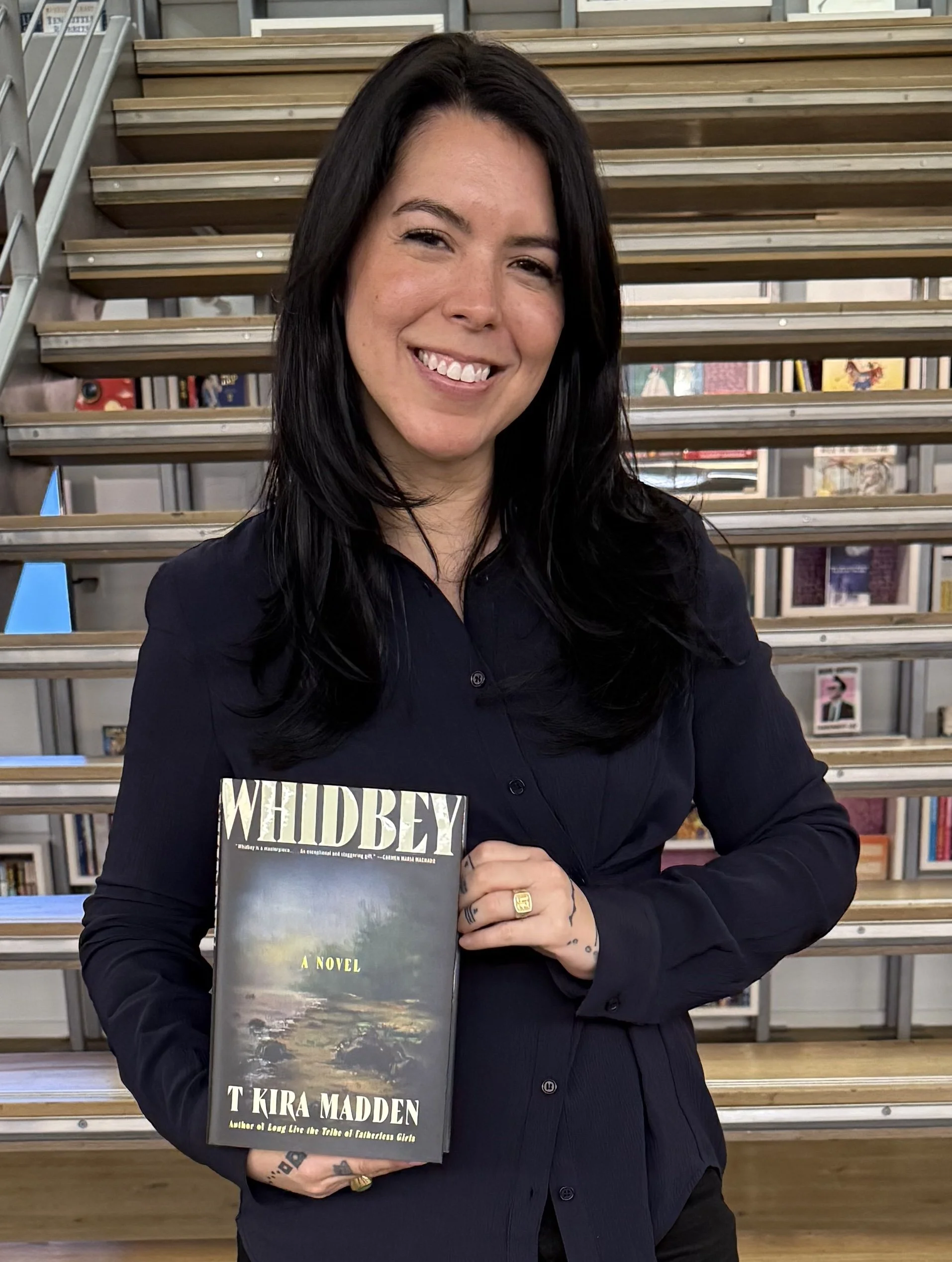
Today on The Stacks, we’re joined by award-winning author T Kira Madden to discuss her newest book, Whidbey. This novel follows three women whose lives intersect in the wake of a man’s murder. We chat about the questions that are left in the wake of trauma, her unique writing process, and how she tricks herself to keep writing fun.
The Stacks Book Club pick for March is Paradise by Toni Morrison. We’ll be discussing the book with Namwali Serpell on March 25th.
LISTEN NOW
Apple Podcasts | Spotify | Google Podcasts | Overcast | Stitcher | Transcript
Everything we talk about on today’s episode can be found below in the show notes and on Bookshop.org and Amazon.
Whidbey by T Kira Madden
Long Live the Tribe of Fatherless Girls by T Kira Madden
The God of the Woods by Liz Moore
Paradise by Toni Morrison
“Ep. 414 Toni Morrison Broke the Novel Form Open with Namwali Serpell” (The Stacks)
On Morrison by Namwali Serpell
We the Animals by Justin Torres
Unstacked (Traci’s Substack)
Mad Men (AMC)
White Lotus (HBO)
There There by Tommy Orange
The Nomad Hotel (New York, NY)
The Year of Magical Thinking by Joan Didion
Ledger by Jane Hirshfield
Middle Spoon by Alejandro Varela
Parsons School of Design (New York, NY)
Fortune Smiles by Adam Johnson
An Everlasting Meal by Tamar Adler
Salt, Fat, Acid, Heat by Samin Nosrat
“Ep. 86 Salt, Fat, Acid, Heat by Samin Nosrat -- The Stacks Book Club (Hugh Garvey)”
“Ep. 402 A Reader First, a Cook Second with Samin Nosrat” (The Stacks)
Start Here by Sohla El-Waylly
“Ep. 301 What Makes a Recipe Good with Sohla El-Waylly” (The Stacks)
Something from Nothing by Alison Roman
Feeding Littles Lunches by Megan McNamee MPH, RDN and Judy Delaware OTR/L, CLC
The Smitten Kitchen Cookbook by Deb Perelman
Good Things by Samin Nosrat
To support The Stacks and find out more from this week’s sponsors, click here.
Connect with T Kira: Instagram | Website | Threads
Connect with The Stacks: Instagram | Threads | Shop | Patreon | Goodreads | Substack | Youtube | Subscribe
To contribute to The Stacks, join The Stacks Pack, and get exclusive perks, check out our Patreon page. If you prefer to support the show with a one-time contribution, go to paypal.me/thestackspod.
The Stacks participates in affiliate programs. We receive a small commission when products are purchased through links on this website.
TRANSCRIPT
*Due to the nature of podcast advertising, these timestamps are not 100% accurate and will vary.
T Kira Madden 0:00
Both books for me, were pretty similar in terms of overwriting, and then the act of discovery was like, What is this that I'm writing toward? I don't actually know until I have those 1000s of pages, and then backing up and saying, like, oh, what's actually the spine here? Like, what? What is the shape? What's the story I'm trying to tell? And sometimes I would go each day and say, Okay, I'm going to put each of these characters into a dinner party scene and see what their relationship is to food, to people at the table, to a menu. So I prompt myself through these different little questions or prompts, just to give myself an exciting writing day to get to know the characters better.
Traci Thomas 0:46
Welcome to the stacks. A podcast about books and the people who read them. I'm your host, Traci Thomas, and today I am joined by award winning author T Kira Madden to talk about her newest book would be this novel follows three women whose lives intersect in the wake of one man's murder. While this is not t kira's debut book, she wrote a memoir a few years back called Long Live The tribe of fatherless girls. Whitby is her first foray into fiction. So we talk about the difference between writing fiction and non fiction, and we talk a whole bunch about how she writes her books. This part of the conversation is totally fascinating. So stay tuned. Our book club pick for March is paradise, by Toni Morrison. We will be discussing the book with Nam Wally serpel On Wednesday, March 25 everything we talk about on each episode of the stacks is linked in our show notes. And if you like this podcast, if you want more bookish content and community, consider joining the stacks pack on Patreon and subscribing to my newsletter unstacked on sub stack. Each of these places offer different perks, like community conversations and virtual book club over on Patreon, and my writing and hot takes on the latest literary and pop culture news over on sub stack. And when you support either or both of these places, you make it possible for me to make this podcast every week. So thank you to the folks who already support and for those of you who are not there yet, now just might be your time, head to patreon.com/the. Stacks to join the stacks. Pack and head to Traci Thomas, dot sub stack.com, for my newsletter. All right now it is time for my conversation with T Kira Māhealani Madden.
All right, everybody. I'm so excited. I'm joined today by tikira Māhealani Madden, whose brand new book, her first novel, but her second book is called Whidbey. It is, well, actually, I'm gonna let you tell the people what it's about? So first, just welcome to the stacks.
T Kira Madden 2:44
T Kira, thank you so much for having me. I'm thrilled to be here.
Traci Thomas 2:48
I'm so excited to have you. Okay, I'm actually really excited to hear you do this. Can you tell people in like 30 seconds or so, what Whidbey is about?
T Kira Madden 2:58
Whidbey is, I'm gonna do my best. Whidbey is the story of three women who are connected after the murder of one man who has impacted them all. Two of the women are adult survivors of his sexual abuse, and one of the women is the mother of this abuser. We meet them mostly in the aftermath of his death.
Traci Thomas 3:18
Okay, that was good. That was good. All right, a thing that I love to talk about here on this podcast is genre. And I love when I read a book, like your book that is sort of a-genrecal, I don't know. It's sort of multi genred. What do you like if, what do you think that this book is? How do you tell like, what's the vibe? How would you describe it in that sort of frame?
T Kira Madden 3:45
I would describe this book as literary fiction dressed up a little bit as a thriller or suspense book. I think straightforward thriller readers would not find exactly what they're looking for here, because it is more of a psychological work. But I does have a who done it? Why done it at its core, and I, my hope for the book is that it also kind of interrogates the idea of genre, like, what is the answer that's most important here? What is driving you reader?
Traci Thomas 4:19
Yeah, I always I love books like this, where as I'm reading it, I'm like, Hmm, I'm so curious. Like, what do I think this is? Because when I started the book, I was like, Okay, this fits sort of in that, like, literary thriller landscape, and it sort of reminded me a little bit of like, god of the Woods by Liz Moore. Like, that same kind of, like, it's thrillery, but it's also very like character based. And then as I kept going, I sort of was like, I don't really care who's done it. Like, I sort of was like, I feel like the thriller part has sort of disappeared for me, in a way. That is really rare. So I'm wondering for you as a writer, how much did you care, or do you care about that piece of it, versus sort of the building these women and creating these characters?
T Kira Madden 5:16
What a fantastic question. I will say I wanted the who done it at the center, but I always knew I wanted to challenge that very question, like, why? Thinking about the true crime phenomenon and kind of how those episodes and how those stories are often built. It's, you know, what made this man the way he is often and then there's the violent crime, and then we never really sit with the aftermath or the things that are less climactic, maybe. And so I always knew there would be this who done it to maybe keep the pages turning, but I really wanted it to be a deep psychological look at aftermath of trauma and how if we remove the big, bad boogeyman from the equation. Does it disappear? Does this trauma disappear? Are things solved? Are they? Are they healed? Because he's gone like I don't think it's a spoiler to say, of course not. And so, yeah, it was important for me that it be this complicated look against like the perfect survivor narrative. And also, I hope, keep that ticking clock of also who did this, there is this mystery at the center, and who, who do we think as a reader is capable of violence because of their proximity to power, proximity to whiteness, proximity to the crime itself. Who do we think is reliable, right?
Traci Thomas 6:41
Nobody, nobody's reliable, right? I mean, in general, no, I do think you've got a lot of unreliable people in this book, which is sort of fun. I mean, one of the things that I was thinking about as I was reading the book, and as people are listening, and as we're talking this month on the podcast for book club, we're doing Paradise by Toni Morrison and Namwali Serpell came on, and she's written this book about Toni Morrison. And one of the things she talks about is like, Toni Morrison teaches you, the reader, how she wants you to read each book. And so as I was reading Whidbey, I was sort of thinking, I'm like, what does tikira want me to like, What is she trying to do to me, the reader? And one of the things I noticed, of course, is that there is no quotation marks in the book. And we've got these, like, sort of shifting points of view. Some are first person. Some are not. We've got letters. We've got, like, it's, there's a lot of sort of shifting. And uncertainty. And so I'm curious for you as a writer, is that something you're thinking about how, how these things impact your your reader, and also, I guess, on top of that, how do you come to all of these pieces to make sure that it fits right and the balance is right, you know.
T Kira Madden 8:05
So my first book, and I know you're a non fiction person as well, but my first book was memoir, and I thought a lot about how I wanted to depict or animate conversations and dialog and memoir, because I was like, quotation marks feel so official. They feel so like, you know, I didn't have I used to always make the joke like nobody has a recorder everywhere they go before our current times. But, you know, to render conversations and dialog that happened when I was a child, it felt strange to use quotation marks, so I leaned into italics for that book. And so going into Whidbey, I wanted to to use that kind of problem or that, that, that challenging thing that I've been balancing, what is true, what is what is of the record? What can we use? When can we use quotation marks? And I realized I wanted the book style and its structure to do as much of the storytelling and tap on the themes as much as the characters are themselves. And so I knew right away I did not want to use quotation marks for the first two sections when we are close to these three women, birdie Lindsay and Mary Beth, as we get to know their stories, because I wanted the lived experience, the consciousness and what's said to almost feel a little bit dreamy or unreliable, of like, what is she really saying versus what she's thinking, and for a reader to kind of sit with the uneasiness of that. And then we move into, and this has been written about a lot. I don't know if it's too much of a spoiler, but we move into an omniscience eventually. Who does use quotation marks? And the point of that is for a reader to then sit with, Oh, does this feel more of the record now that I have quotation marks, now that I have this big, bombastic voice kind of telling me what I should believe? Do I then believe that over the women, do I believe that over the stories I've been. Told up to this point in the book. So my way of thinking about teaching, you know, how do we, you know, a book or an author, teaching the reader how to read it? I love that. I always, I always think about that is, I want a reader to feel really engaged and almost complicit of what, what judgments have I made already? How have I maybe prejudged these characters based on letters, excerpts of a memoir, other documents or other, you know, the distance of third person versus first before I get to you know, maybe the truth. I won't say if it is or not, but
Traci Thomas 10:34
Right, yeah. And why? I mean, I keep hearing you kind of talk about this idea of, like, unreliability or the truth. What is it for you that is interesting to explore as a novelist around this idea, like, why is that sort of the center of this book?
T Kira Madden 10:56
Yeah, that is the question. I think. Because so I was going through my own court case that went all the way to federal trial when I was starting this book, and at the same time, I was also publishing my first book Long Live The tribe of fatherless girls. And with memoir, I was it was my first ever work of nonfiction. I was thinking so much about like, what makes a likable narrator for a memoir, what would make a reader believe me or sympathize with me or find compassion for this narrator or character of myself? And so I'm packaging this, I'm talking about this, this trauma narrative, and at the same time, I'm living in this place of suffering and reliving this trauma from my childhood in a real way, not the narrative eyes polished way, but showing up to court. And I realized when I took the stand in federal trial, when I wrote a victim impact statement, when I had when I was interrogated in these rooms that we find in Whidbey and whidbeys pages, how it was almost this like fun house mirror of that experience, of what makes me likable, what makes me believable. How do I do my hair or dress or speak or articulate this story for a jury or a judge to consider me credible or to believe me or like me, which is such a silly thing to say, but I think, I mean, we see that. We see that over and over again. When we look at cases, any case like Amber Heard like we see how the public can kind of decide what makes somebody unbelievable, and therefore their suffering doesn't matter, or it's not real, or we let it go. And so I wanted this book about the system, largely about the carceral system, the criminal justice system and the and the hierarchy, the victim hierarchy, to really push on well, to really show us some unlikable and unreliable narrators, and then to ask a reader, still, but do you care? But do you believe them with the thing they do remember, the thing that they do say is true. But to have these stylistic choices, like without quotation marks, to kind of have a reader question that the way that one would in a courtroom or in a jury and say, What makes me take that story over this one her word over the other?
Traci Thomas 13:20
Did you find yourself doing things like purposefully to your characters that you could, that you felt like you couldn't do like choices, maybe like what they were wearing, or like how they were engaging in conversation, or whatever, where you were like, I wish I could do this in court. But like, you know, like, were you kind of like living out any fantasies in your characters for yourself?
T Kira Madden 13:43
Yeah, I think for me, as a nonfiction and fiction writer, I always think nonfiction for me when I know it's a work of memoir or essay, it's like coming from a place of grief or longing for the past and kind of reanimating that past. But fiction for me, is all about desire. It's all about fantasy, and I want my characters, and I know, you know, so many readers and writers and listeners are probably really interested in auto fiction and kind of moving a version of themselves through a story. For me, I want my characters to be so different from me, because that's what's fun, like I love to be, to make horrible decisions in fiction and to go to extremes, because then I can live kind of safely in my life and save the chaos and the fire and like the I don't know, I like bringing that to my characters, and then I get to kind of play out these fantasies. See where they take me see where these I think when the work becomes alive enough, the characters kind of start to tell you where they want to go and what the story really is. And so every single character in here is making decisions that I would never make, and that's really fun. You know, they're talking back. They're indulging in the revenge fantasy. See the book started because of a real a real proposition, a real request, moment that I was faced with on a ferry boat to Whidbey Island, when I told a stranger what had happened to me, and the stranger said, Would you like me to kill him for you? No one would know we ever met. I said no, because I'm me. I said no. And I was like, Okay, goodbye, stranger. And that was it. But the book started from the place that you have that you're articulating, of like, what if, what if I did say yes, what if I did give a name? And then was, was sitting and wondering, like, what will happen to this man, and am I responsible? And so that is how this book was born, was from that moment of indulging in the revenge fantasy when I haven't been able to do so in my life.
Traci Thomas 14:52
Yeah, I think it's so interesting that you said readers are interested in auto fiction, because to me, I find auto fiction to be the worst. I hate auto fiction. I'm so not interested in it. I don't know. I feel like I for me, what I don't like about it is, I'm like, just write the memoir, or write or go there and write the novel. But to me, the auto I'm just like, Oh, I feel like this is too close. And also like, not close enough. Do you know? Like, I don't know. I feel like I've read a lot of auto fiction that's around, like, divorce, and I think that's part of why I don't like it, because I'm just like, oh, so did he really say that to you? Or are you making him sound worse? So that will like you more. Like, it feels like very manipulative to me. I don't know. So I prefer either memoir or just fiction. Like, I just just, why don't you just tell me a really good story? I don't need it to be true. Like, hello, yeah.
T Kira Madden 16:53
For me, it depends on the book completely. I have definitely shared your feelings before, especially having written a memoir. I'm like, Come on, go there. I did it. Like, be brave, do this thing, yeah. And then in other cases, like, if, if I hear it was loosely based on someone's life, and they took it to such an imaginative kind of different place, like, like, we the animals. I think you love that book.
Traci Thomas 17:16
Oh, right, yeah. I don't think of that as auto fiction.
T Kira Madden 17:19
I don't either. But you know, that loose kind of he has said that it is autobiographically closed, at least when he was making the film. And I think that is taken to this place of almost surrealism and the fragmentation and style and lyricism is just outstanding. And so I think it depends on the book for me, and yeah, and what someone calls the work
Traci Thomas 17:42
Yeah, I think for me, it's like, the least, the less it feels like a memoir, the more I like, like, if you're using pieces of your life to write a novel, I'm like, great. Like, great. But I feel like, when it's like, auto fiction, when it's classified as that, there's something about it that is like, I get, I think I even when I just hear the word, I'm like, yuck, yeah, I don't know. Okay, I want to talk about this, because one of the things this book does, in a lot of ways, is sort of humanize the bad guy, right? Like, as you mentioned, there's these two women who are the adult survivors of his sexual abuse, and then the third woman is his mom, and she likes him quite a bit. She is not a mom who's like, what have I done here? She's a mom who's like, my child is sort of misunderstood. So a third of the narrative sort of is like humanizing the bad guy. And I'm curious why you wanted to kind of take that approach and maybe, like, what questions were you trying to answer for yourself or for your reader in doing that?
T Kira Madden 18:44
Yeah, that's a great question. I don't necessarily see it as humanizing the bad guy, but humanizing the bad guy's mother and seeing him through these three very different perspectives, because they're all looking at him in a way. They're all looking at him and they're looking at each other and themselves. And there's all these self betrayals and self lies, and I think they all have a lot of mismanaged and mis projected rage and pain. For example, birdie, birdie Chang, one of our main characters, rather than all of her rage being toward Calvin, the abuser. She really hates the memoirs. She's really angry at the woman who she believes is capitalizing on their suffering. And I think that is true to life and how women can turn against women, rather than the person who's caused all of this harm. So I knew, I knew from the very beginning, I didn't want to take on Calvin's perspective, but I wanted to see him through these three different women who both loathe and despise him, and also his mother, who is in this deep well of denial, because it's a real I always find it more interesting for me to write into questions that I find really difficult and almost unanswerable, rather than coming in with, you know, a hypothesis or here's my politics, here's what I'm trying to say that writing often feels really flat for me when I read it and when I write it. So for me, showing up to court, showing up to trial, and having my abusers parents show up every time, and seeing this in many cases, how not only parents, but the friends, the loved ones, someone who knew you in high school, can take a stand and say they would never do this. I know them. They were really cool. I think that is really common and needs to be interrogated and looked at a little bit, taking the mother piece out of it. And so my, my driving question for Mary Beth was, what is the, what is the potency of denial? Like, how deep does that go? What does she really know and how, how strong can love and denial coexist in this way that would allow her to keep showing up over and over again, and does she keep showing up once he's dead, once she's left with only the remains and the stories and the evidence of this violence, which a reader will have to read to find out. But that was really just the driving question that animated her, and of course, she has these qualities about her son that she chooses to hang on to, and then there are scenes where she's holding direct evidence in her hands, and she maybe can't look at it, but I hope to not necessarily humanize him, but build a dynamic character that doesn't feel like a paper doll villain by seeing him through these three women's perspectives.
Traci Thomas 21:39
Yeah, you just articulated sort of your central question for Mary Beth, do you approach your other main characters, and they each have their own central question Is that something that's like part of your process? Yeah, what are your other what are the other central questions for the characters? I'm so curious.
T Kira Madden 21:55
I would say, I mean, they have some I have lists and lists and lists. For birdie, I thought about how, how ruthless could birdie be? How, how many different ways could her rage be misdirected at the wrong people, but really her ruthlessness I wrote, I mean, this book was 1000 plus pages before we shut down, and there are many storylines that didn't make the final cut, including when I put birdie in a scene this is not in the final book, but towards the end, she meets this group of kids on Whidbey Island, and she has the choice of if she will help one of them or not. And that was kind of me getting to know how ruthless is she, how selfish is she? How selfish can her suffering be for Lindsay, I thought a lot about while birdie is obsessed with her injustice in the court system, Lindsay has repressed so much. So my questions for her was, what does that repression look like in the psyche, in the body, for someone who has not at all processed her suffering or trauma and instead has only the framework of how other people tell her she is a survivor or a victim. So hers were largely about repression and what that does to to someone psychologically.
Traci Thomas 23:13
Okay, so this book was over 1000 pages, which is crazy. How do you cut it down? How? How painful is that part? Or is that part thrilling for you? Like I, I hate to write, but I have a sub stack. It's the worst thing that's ever happened to me. And every time I write my sub stack, every week, I write all these words, and then I go back and I read it, and I am giddy with deleting. There'll be like, six paragraphs, and I'll be like, it's a sentence, and it is the thrill of my life, mostly because I have psychological issues where I'm like, I hate writing. Nobody wants to read this. This is bad. So I'm like, get rid of it. But I know for some people, the editing process can be really challenging and really painful, and you spend all this time kind of creating this world, and it's not a weekly newsletter. I don't mean to compare your novel to my trash, but, but it can be really hard to find the things that need to come out. So how is it for you? Because this book is, I think, like my copy is, like 360 I think 368 or something like that. So that's a lot of things that are gone.
T Kira Madden 24:23
Yeah, it's a lot. It's and I think, you know, newsletter and all that's all the same. It's like, it's hard, it can be hard. And I think you need to tune the best gift we can have as writers is not to be precious, and to fine tune our ear to say, Is this necessary? Is this line necessary? Is this moment necessary for a reader to kind of understand what I'm putting down? It can be really hard. My My process is I write on a typewriter, my first draft of every book, and I transcribe onto a computer. And what that means for me, the reason I do it is because I have to challenge every single sentence as I'm transcribing it onto the computer. I don't think I would have the energy or the patience or the discernment to really challenge every single word if it were already in a Word document of a book, because it's hard. It takes a long time. And so I do that process, so I'm I will never break that process, because I need, I need to do what you're saying and say, You know what this scene I am too. It's not good enough for me to spend another few hours to transcribe. It's got to go. And that does feel good sometimes when you're tired and I have carpal tunnel and my fingers are aching, so it already gets cut down, and every line is challenged when I transcribe it onto the computer. And then it's often the great assistance and help of my first readers. And I have a great editor, Jessica Williams at Mariner, who helped me cut this epic beast of a novel down again and then again and again. And we would bloat it, and then we would cut it down and bloat it and cut it down. There are so many storylines. I still miss Mary Beth had a whole love story. There are so much and just thinking about how much could a book possibly contain? And this book does have a lot of characters, a lot of topics, a lot of stylistic choices. It couldn't really contain all of these extra story lines as well.
Traci Thomas 26:23
Yeah, I need to know more about this typewriter. Well, actually, let's take a break, and then we're gonna talk about this typewriter. Okay, we're back. I'm so excited. You know, I love to ask people about how they write, and you planted this seed in my brain with this typewriter. A typewriter is a physical object, so you can't really, like, do you take it places with you? Does it live in a particular room? Does that mean that when you're writing the draft, you don't go anywhere? Like, I need to know how this works.
T Kira Madden 26:56
So I have, there's a lot to say I have. I have a different machine for each of my books, and they are, you know, the color, the model, everything about it has to feel like the energy of this book. So I wrote all of Long live the tribe on a Smith Corona, coronary electric, baby blue. And it just felt like that book. And when I was trying to write Whidbey on it. It's something about that baby blue bubble gum key. It just felt too light and playful for Whidbey. So at a and I've been a collector my whole life. I learned to write on a typewriter on a Selectric when I was a kid that my grandmother gave me. So I've always collected. I've always tried to repair on my own when I can. And so I was at this junk garage sale, and I found this Selectric 2. It's a beast. It's 45 pounds, bright red. It was an extra in Mad Men, I was told, and it was absolutely typewriter. Do we know if that's true? I don't know, but it's gotta be true. $25 yeah, and it was just, it was beat to shit. It was so broken. And I took it to, I go to Philly typewriter. I always drive my machines to Philly typewriter in Philadelphia, one of the last typewriter shops available, and they said they could fix it, and they refurbished it, and it became just this gorgeous beast of a machine that felt so perfect for this beast of a novel. So that became the machine for Whidbey. It's 45 pounds, like I said, so it lives on my desk where I do the most work, and then I have the smaller machines at other desks, like at school and at my parents house, like so when I'm traveling, I always have a machine there, but those are smaller or more portable. I don't take a typewriter to a coffee shop or something, but I have taken them to residencies and shipped them to residencies.
Traci Thomas 28:51
Do you also have a laptop? And do you take that places with you? What's your relationship to your laptop?
T Kira Madden 28:58
Yes, I have a laptop. It does go with me, but that's really, you know, I'm a full time teacher, so my laptop is kind of like where I live as a teacher when I'm doing my work and grading, and that's why I love the machine being something else, the typewriter, because that's when it's like, oh, I can leave my teacher hat behind or my daily tasks, and here I am to write without the distractions of the internet. It's time to work. Once I hear it go on, I use an electric typewriter, so once I hear that buzz and then the thunder of the keys, it's almost like this Sonic cue, like it's time to write without distractions. And so I like, kind of having that on off switch with the two different devices. And during the semester, that's usually when I just transcribe. I'm not really writing in this semester, but I'm transcribing pages and editing.
Traci Thomas 29:47
Oh, my God. I'm obsessed with this. This is incredible. This is really good. Other people have mentioned using a typewriter, but not, not like this.
T Kira Madden 29:55
No, I'm very, very serious about it. I'm building a whole new one for my. Next book right now with a custom paint job. It's a glittery royal blue.
Traci Thomas 30:05
Okay, well, can you tell us anything about the next project?
T Kira Madden 30:08
It's a novel about Hawaii. It takes place on a cruise ship. I think it as White Lotus meets There There.
Traci Thomas 30:18
Okay sold. And glittery, glittery blue. I feel like, though now, knowing about the typewriter, I'm a little disappointed there's not some bright red on this cover, because I feel like, if that is like, it's like, you got to have the tie in to the typewriter, because there's some blue on baby blue on the cover, both covers of your memoir, it shows up a little bit. Yeah, when we get the paper back, we gotta, maybe we need some red like, it's gotta, it's gotta be, like a hint for the people who know about the typewriters to be like, Oh, that's the typewriter thing. Like, Oh, I like that. We gotta talk to the marketing team. It's send some emails. Don't worry.
T Kira Madden 31:03
I did only just realize, I only thought of this the other day, that a tie in that feels like it exists in the book is birdie is a projectionist, and she she in the book is obsessed with her machines and her century JJs and how it feels like a sacred extension of her body. And I was thinking, That's me and my typewriters, like, oiling that up and taking care of that machine. Like, really feels like this, almost like caring for myself, because the machines are so beautiful
Traci Thomas 31:32
You got to send us a picture so I can put it on Instagram of the red typewriter. Like, when the episode goes up, there's like in the stories or something, I feel like I gotta see this. In addition to the typewriter, what else is part of your writing process? Do you have snacks and beverages? Do you listen to music? Like, obviously, with the typewriter, you're dealing with a lot of physical pages. Where do you keep the pages? Do you have a binder? Do you have a stack? Like, how do you go back and find it? There's just so many logistics about all of this.
T Kira Madden 32:06
I'm very ritualistic with writing. I know that that is a great privilege. And you know, my last book I wrote, I was working a nine to five, and it was very different. I had my laptop. I mean, I had my drafts that I did on the typewriter of Long live at a residency, but I had a laptop that I took to the Nomad hotel in the morning before my nine to five in the flat iron district, where I was just writing at six in the morning, when I could between hours with this one I've it's been more long stretches, so summer break and winter break, between semesters. It's not a book I've been able to dip in and out of with an hour here, an hour there, because of how heavy it is and because of how once I get into these characters, I can't really snap out of it and into teacher self. So it's been more winter summer vacations or summer breaks from school. I work in a little office. I don't need much. I i write in the dark, so on the typewriter, I can barely see what I'm typing, and that feels really good to me, because I can't, again, get too fixated. So I'll close the blinds, and ideally, if it's dark out, I keep the lights off and I just have a tiny little lamp somewhere. So I write in the dark. I don't want to see too much of what I'm writing. I have to have the heat cranked up as high as it will go. For some reason, my wife says it makes her nauseous when she opens my office door, like, knocks her out. I think there's something about being born and raised in Florida and being a Hawaiian like that, humidity and like almost like tight chested heat makes me feel like it's time to make something, or time to create, or puts me in the atmosphere I don't know. I need to write in the heat if I can no music whatsoever, just the thunder of the keys and the rhythm of that value,
Traci Thomas 33:58
Snacks and beverages?
T Kira Madden 34:00
Popcorn, if I have a good writing day, otherwise, I write best when I'm hungry, and I try to write until I have to eat, and then I'm done once, once I eat dinner or a huge lunch, then it's reading time. The rest of the day, I write best when I'm hungry. It's kind of a superstition, but popcorn is is always the final draft and always when I have a good writing day, I make myself some popcorn as if, like, I'm gonna, I'm gonna entertain myself today. I don't know what that cue is.
Traci Thomas 34:27
I love it, but something I'm noticing about you is you're very physical. Sounds like you're a very physical creative person. Have you noticed, or did you notice a difference in process when it came to the I mean, obviously you said you had a nine to five, so it was like, different time for the memoir and the novel. But like, one of the things I think about is, like, with a memoir, you might not know how the story's gonna work or like, but you sort of know what the story is. And for a novel, you're creating something sort of out of. Mean not sort of, you're creating something out of whole cloth. So did you run up against any, like, writer block ish type things? I know some people don't like that phrase, but like, Did you run up against things in the novel where you're like, I don't know where this is going, or I don't know who this person is, or I don't know why this matters, or, like, does that stuff happen for you,
T Kira Madden 35:21
always, always. And I think you know, with many people with memoir, they do know the story they're trying to tell, or roughly, you know, we think of my year of magic, the Year of Magical Thinking. It's like one year in a person with but with my book like it spans my whole life almost, yeah, a regret. I almost like, well, I spent it all in the first Yeah, but I say that because both books, for me were pretty similar in terms of overwriting, and then the act of discovery was like, What is this that I'm writing toward? I don't actually know until I have those 1000s of pages in both cases. Oh, what's the actual through line I can find here? They were both really like so much typing, just in this exploratory mode of I have these questions. Here's me trying to ask them, through scenes, through memories, through fragments, through XYZ, how I move my characters through the text? And then it's not until finishing, and then backing up and saying, like, oh, what's actually the spine here? Like, what? What is the shape? What's the story I'm trying to tell? So they're actually very similar, this Act of, like, discovery, and not really trying to impose any sort of, here's exactly what the story wants to be. I think that would feel, it's almost like writing on the on the computer that would feel too rigid to break. So if I just keep writing the scenes, and I just prompt myself through the questions I already mentioned that each character has, and sometimes I would go each day and say, Okay, I'm going to put each of these characters into a dinner party scene and see what their relationship is to food, to people at the table, to a menu, to, you know, can they afford this meal? Like just asking these questions. I did that I asked another day was I'm going to put each of them in a sex scene and see what's their relationship to power and their body and shame? And so I prompt myself through these different little questions or prompts, just to give myself an exciting writing day, to get to know the characters better. Some of those scenes did end up in the final draft. Some didn't, but only then can I see what they're made, of the decisions they would make, and then they begin to build a story. I think.
Traci Thomas 37:40
yeah, that's so interesting, sort of like, just like, exercises, like, yeah, like, like, little little, little dalliances into the world.
T Kira Madden 37:49
It has to be fun. I have to keep it fun. It takes so long. It takes eight it took eight and a half years for a sad book. So if I don't, and I work with animals, I've worked with horses my whole life. If you don't keep things interesting and fun, it's like they will sour to the ring. They won't go in and work, because they'll know, oh, it's going to be hard work today. This is the same thing every day. And some days you just walk them around and you they think they're going to go to work, but no, you just get a treat. You just get to hang out. I'm just going to brush you today. And that's how writing is for me. I have to keep it playful,
Traci Thomas 38:24
and you do that so you intentionally, sort of like trick yourself.
T Kira Madden 38:27
Yeah, always. And some of that work is you asked about process. I i believe in redecorating my desk for every project, so finding like tactile things for my desk, like toys and smells. And for long live, I had, I only wrote by lava lamp, and had just like glossy tabloids and Tamagotchis on my desk so the tactile objects and smells of them could bring me into that place. And for this, it was like models of slugs and pine needles and Driftwood from Whidbey Island, like all of these things that I could touch and taste and smell that brings that element of play back when it
Traci Thomas 39:11
you're like a method actor, writer, like sense memory, like writer, I love this.
T Kira Madden 39:19
Thank you.
Traci Thomas 39:20
You are the Marlon Brando of writing. You're like, I gotta be, I gotta be in it. I gotta have the lava lamp. Like we're going back to the 90s. We got to get the Tamagotchi.
T Kira Madden 39:30
I take it very seriously. I shadowed a projectionist to write birdie as a projectionist. So I take it all very seriously.
Traci Thomas 39:38
I love that so much. Speaking of birdie, how do you name your characters?
T Kira Madden 39:44
Oh, I find it so difficult. Sometimes I think I don't know. Sometimes the name just comes out of nowhere. Birdie's name was when I started this in early 2017 Her name was Corey, which I forgot about until recently, and I don't. Know when she became birdie, but I was reading a lot of Jane ledger, or, sorry, Jane hershfield Her book ledger, and she has this poem called the bird net. And the epigraph of would be, is from that poem. It says I once decided to pretend to be angry than I was, and that's the epigraph. And I think Jane hershfield's birds from her book ledger really stayed with me. So maybe that's where birdie came from. I think Lindsay's one of those that came out of the blue. Lindsay with a Z and Mary Beth is is named after my godmother, whose name is Mary Beth. They're very different people, but they have a similar syntax and moxie and energy to them
Traci Thomas 40:46
There's also, there's a trace in the book, and then there's also a brief moment of a Traci with an eye, which obviously I was like, Thank you. I'll take that. You and Alejandro Varela both have traci's with eyes in your books. So you two are my favorite authors to have ever existed. Like, Oh, hello. This book must be perfect. Traci with the eye working at TSA or whatever.
T Kira Madden 41:12
Yes, I lay with the alphabet too above me. Always another process thing so that I don't have to for you. Well, it's a few things. This book has more than 115 characters listed in it, which I didn't realize until the copy editors, they sent you kind of a cast list. So it's something like 115 120 characters. And so, for one reason is I don't want too many characters with the same letter that begins their name that could be confusing. And so Traci, I love Ts. I had to get a Traci in there T Kira. And the other is, I think that we tend to, at least I tend to lean on the same words and sounds often. So I love an alliterative s, for example, like I lean on that, and I have my same kind of moving word bank in my head as I speak and as I write. So if I have random words written down beside me, and also the alphabet, I can look up and say, What's a oh, let's lean into F. Let's think about, I don't know. It's just kind of a game I can play with myself to lean into different Sonic resonances and on the line level.
Traci Thomas 42:30
When did you know you wanted to be a writer?
T Kira Madden 42:32
When I was a little kid with that typewriter? That's when I really I know it might sound like a romantic story, but I really did write, like, early books when I was a kid, like that was what I wanted to be. That's all I wanted.
Traci Thomas 42:45
It's so interesting because, like hearing you talk about all the little like tips and tricks and like little things that you do to kind of like get yourself in into the ring, to continue your metaphor it, it reminds me of other people I've spoken to who came to writing later in life, who have sort of had to, like, trick themselves into doing it in some ways. So I thought I wasn't sure if this was, like something that came to you later in life, and that's how you'd sort of like, gamified it for yourself, or, like, not gamified, but like, found ways to keep it going.
T Kira Madden 43:15
I think I've always wanted to be a storyteller. I just wasn't sure how I wanted. I was a musician as a kid, I was a drummer. And so I think even that, that love of percussion, I hope, comes through in my sentences and sounds. I went to Parsons School of Design for college, and at that point I wanted to be a fashion designer, and so playing with colors and draping and telling a story with a collection, I think is not so different than being a writer. So I had these different moments of art making, and then I decided, okay, it's it's the written word, but I hope the music, the color, the texture, all of that play is still present.
Traci Thomas 43:58
This makes a lot of sense. Now, this is what I was trying to I was trying to I was trying to figure out, I'm like, this is where the sensory stuff comes in. Like, it's like, you've got these different creative versions of yourself that are all kind of at play when you're writing, it sounds like the physical and then like the sound of the typewriter and, you know, the color and the light and all of that gets like, very clearly coming from. A lot of I couldn't quite figure out where it was coming from. But as you were saying, coming from. But as you're saying that, I'm like, Yes, this makes so much I love. I'm I'm fascinated. I'm very obsessed with this. I did not know we were going to be spending this much time on this today, but I'm very happy to be here. One of the things you mentioned earlier is, once you've written to the point where you have to eat, you eat, and then you go read. What do you go read?
T Kira Madden 44:43
Oh, it depends on the day. Sometimes when I'm really in the work, if I'm lucky enough to be at a residency, for example, and I'm just working on the project, I'll usually be reading things that feel directly related to the project, whether it's research about it, or voices that feel. Feel somehow aligned with the voices of the text. So with this book, I I read a lot of Adam Johnson when I was reading this book his I think he's a fantastic writer. I couldn't believe he blurbed the book. I did not know him. I wrote him a letter out of the blue fan mail, and he asked to read it, and he he gave me that beautiful blurb. But I read his his book a lot. Dark Meadow is a short story and Fortune smiles about a child sex abuser. So reading that at the same time reading the works of you know, Joy Williams and and Margaret Atwood, and you mentioned Toni Morrison, I think in terms of Sonics and music and composing a work of music for each project. That's someone who, you know, I'm never going to write like Toni Morrison, obviously, I don't think I write like any of the writers I just listed, but to feel their musicality and to feel like how they articulate scene and psychology and moments of the sublime or like all of it feeds what I'm doing. So I usually have some North Star texts for everything I'm working on and for myself. Book aside, I read cookbooks.
Traci Thomas 46:15
I love cookbooks. I love a cookbook. What are some of your faves?
T Kira Madden 46:19
Oh my gosh. I love the writing and work of Hedy McKinnon.
Traci Thomas 46:25
Yes, I love her. I love her. She does all the vegetables, right?
T Kira Madden 46:30
yep, yep, yeah, vegetables, yeah. She came to my book launch last night, and I was so starstruck.
Traci Thomas 46:36
Had you met her before?
T Kira Madden 46:37
No, I'd never met her.
Traci Thomas 46:39
So she just, it was just, this is just like a coincidence that she likes you and you like her
T Kira Madden 46:44
Yeah.
Traci Thomas 46:44
Oh my god, how cool.
T Kira Madden 46:48
She's friends with the person, Shirley Kai who shot my author photos for Whidbey, so she heard of it. But I'm such a fan of Hedy McKinnon. I love the food writing of Helen Rosner. I think she's incredible. And Tamar Adler, who wrote an everlasting meal, which is almost like a memoiristic cookbook, ish, but I will read, I mean, I'll read books from around the world. I'll read really dated books, because I find them fascinating and funny. They're so great. I just I read them, like novels before I go to sleep every night. And it feels like traveling. And I think the tedium helps, like calm my nervous system before I go to sleep. I read every step. I read recipes that I would never make. I read recipes for meat, and I don't eat meat. I just read it all. I love it. What's your favorite?
Traci Thomas 47:43
So I am new to cookbook reading, and we did salt, fat, acid, heat on this podcast for book club, like in 2019
T Kira Madden 47:54
I love Samin and her writing
Traci Thomas 47:56
So she came on the show last year, and I love her writing. I also loved Sohla El-Waylly's book. I love to cook, and that book was, like, huge for me as a cook. Like I was like, marking it up, like, this is so useful. Putting your putting your sheet pan in the oven while the oven heats up. Revolutionary. Yeah, crispy for crispy, roasted broccoli. My God, it's changed my life. So like that one I love, I I love the recipes and Alison Romans cookbooks. I think she's like, fantastic at recipes, but I hate her writing. It is so 2015s to me.
T Kira Madden 48:37
Have you read her new ones?
Traci Thomas 48:38
I haven't, I want to.
T Kira Madden 48:40
It's different.
Traci Thomas 48:41
Okay, okay, okay, I'll read it. It's on my list. Like, I'm excited about it. So those are the ones that stick out to me. But, like, I've got small kids, I read this cookbook, like, called feeding littles lunches and, like, was horrible writing, but so helpful. So, like, sometimes, because I really like to cook, I can sort of separate these two things in my brain in in a way that, like, I know people who like literary fiction and then also like a thriller, can separate prose and plot depending I can kind of do that with cookbooks, where I'm like, I really like the writing here, but I'm not like these recipes are not great, or vice versa. I also like smitten kitchen.
T Kira Madden 49:23
these are great recs. samin, like one of the one of my two truths and a lie. Like, most amazing facts that I love, that I hold dear, is that same cooked for me once before salt, acid heat came out, and we were at a residency, and she was just like, Oh, I'm working on a cookbook so humble before the book came out, and she asked if she could cook us all lunch. And I was just such a dope. I didn't know much about cooking at the time, and I didn't read as many cookbooks, and I'm just asking her these basic questions at the lunch table. And she was just so generous and kind in explaining what her book was about. And these cooking. Techniques, and I'm just such a fan. I keep in touch with samin, and I love her writing. I love her new book too,
Traci Thomas 50:06
yes, so she did the show last year for the new book. So it was great. It was so great too, because it's like so felt so different. And, yeah, such a I think you can see growth in a writer, in any kind of writing. But I think in the way that those two books feel so different and both are so good, I was like, Oh, you can tell that this person has, like, lived so much more life between these two books. And I thought that was really exciting as a reader.
T Kira Madden 50:38
Yeah, completely. Like quoting June Jordan
Traci Thomas 50:43
That's what we talked about. I was like, you're really, you're really giving me literary references here.
It's incredible
Yes, I love, I love that we share this. Love such a treat. Most people are like, you read cookbooks. I'm like, I know it's so weird, but we have this, yes, I'm always trying to convince people who listen to this podcast to read cookbooks. I just, I'm like, it's fun. It's really fun. Okay, before we get out of here, I want to know you've written this book that you know is pretty you've said it yourself. It's like, kind of dark. You know, it's about, it's about a sexual predator, not super light. It's not a comedy. And as you mentioned, like you were going through this experience that is, you know, related. So how do you sort of tap into preserve your own creativity when you're writing into something like this?
T Kira Madden 51:41
I find this work. I know it might be surprising for folks to hear because it's such a dark work, but I find writing energizing no matter what. And I think, like we've talked about today, one might be really surprised that a book like this would be so full of play and fun, but it was for me writing. I know, again, that the content is heavy, and some of these scenes are really, really heavy, but, you know, it took me on a really wild adventure for a decade, and ultimately became a place to kind of put that pain and suffering and questions I had, because I didn't have to just sit with the experience alone and do nothing with it when I'm writing, it's almost like taking pain or suffering and finding a use for a function. And so it took me to Whidbey Island, this gorgeous island off the coast of Washington, over a dozen times. It took me to Florida. It took me into working with a projectionist and shadowing them, working with gas station attendants and shadowing them, working with a poison expert, learning about science, writing takes me into places of research that really, you know, ultimately make up a life. This took up a quarter of my life, and that's not nothing. And so it feels like it fuels me and finds meaning and purpose to what's been kind of sitting in the body. So I I always reject the idea that, you know, writing heels or it's simply cathartic, but in a way like the process of it has helped me find a landing place for some of these feelings that feels so otherwise messy and uncontrollable and unwieldy. I can put it to the page.
Traci Thomas 53:28
I read a lot of things that other people tell me are dark and heavy, and that's fine. That is the truth of my life. But one of the things and hearing you talk about your process and sort of the play and all the different ways that you're sort of finding a way into the work and into the story. I actually think that this book is was surprisingly not heavy, given the topic, like, there Mary Beth is, like, such a fun character. There's a lot going on, but like, she is funny and she is sharp, and she says things that you're like, I wish I said that to my sister like she has a sense of humor. And there's so much sort of, I don't know, I don't even know the right word, but there is a levity to this book that surprised me, because I knew the subject matter, and I do think that that probably comes from the ways that you're kind of fine tuning and going back and and making it energize, energize, or the writing is energizing for you. And so some of that, I think, comes through the book. I think when you say, like, this is a book about a person, a person who sexually abused children, it sounds like it's going to be one thing, and it is, that is a fact of the book, but it does not feel like what I think many people assume that it will feel like, if that. I don't know if that feels true to you, but
T Kira Madden 54:47
it does, and I really appreciate you saying that. I've, I've read many good reads reviews. I know we're not supposed to read good reads. You're not supposed to. I know. I know. But one is curious. I get curious. And many have said, Oh, it's it's so dark. It's too dark. And but for me, I do, I do find there to be moments of levity and humor. I'm very interested in black comedy. My favorite writers, that's kind of their their tone, and I love that. And sometimes it takes reading aloud to an audience, to a room at a reading, before I ever hear someone laugh, and then they'll say to me, I didn't know I could laugh until I heard the way that you read it. There is a spiritedness and a life and an absurdity almost like this baketian Like dark humor to it that I hope a reader can pick up on. And I know my sense of humor is not for everyone, but I think many people who have survived, you know, trauma or had dark times, like we tell a story and we can laugh at it, even though everyone in the room might be like, Whoa, that's pretty dark, because we have to find those moments of humor to survive them.
Traci Thomas 55:59
And I think darkness is, like, very relative when it comes to, like, yeah, life, but also books, you know, people like, oh, you only read dark books. I'm like, No, I read light things all the time. And then I'm like, Okay, well, actually, sure, I guess for you it is dark, but for me, you know, so I do think there's some, but I, I personally think that the cover hints at that levity, like the font, to me, I do the font, the art, and then the font, I was like, oh, there's a I don't know, but I feel like I picked up on it right away. And so that's why I think maybe it's the cover. Because usually the cover really, I'm deeply impacted by covers. It's really hard for me to, like, shake a cover
T Kira Madden 56:43
that's so interesting. I have not heard that yet, but I find it fascinating. But yeah, I'm interested in satire and absurdity, and again, opening this conversation with genre like it is, to me, playful in that way, a little bit. Yeah, okay. I have two more
Traci Thomas 56:56
really quick questions, because I already sort of asked you what books are in conversation with your book because you shared the things that you were reading, kind of like tied to the books. I'll skip that one. But what is a word you can never spell correctly on the first try? Or are you an incredibly good speller?
T Kira Madden 57:12
Oh, I'm dyslexic. Okay, so I was gonna say every word, okay, every word, even the most basic, like still received? Oh sure, yeah, I swapped those eyes and ears every time no matter what.
Traci Thomas 57:27
Okay, great. And then if you could have one person dead or alive read this book, who would you want it to be?
T Kira Madden 57:33
Oh my gosh, probably my favorite writer in the world, Lynda Barry, but then I would perish if she hated it.
Traci Thomas 57:44
The double edged sword of this question, she's my favorite writer. Well, T Kira, thank you so much for being here. Everybody you can get your copy of would be wherever you get your books. It is out in the world. There is an audio book. I listened to a very quick portion of it, but it exists if you're an audiobook person. And this was so great. Thank you so much.
T Kira Madden 58:06
Thank you, Traci. This was a blast.
Traci Thomas 58:08
And everyone else, we will see you in the stacks. All right, y'all that does it for us today. Thank you so much for listening, and thank you again to keep and thank you again to tikira Madden for joining the show. I'd also like to say a huge thank you to Eliza rosenberry for helping make this episode possible. Our book club pick for March is paradise, by Toni Morrison, and we will be discussing the book with namwali serpell On Wednesday, March 25 if you love this podcast, if you want inside access to it, if you want to earn a few little perks, head to patreon.com/thestacks to join the stacks. Pack and check out my newsletter at TraciThomas.substack.com make sure you're subscribed to the stacks. Wherever you listen to your podcasts, and if you're listening through Apple podcasts or Spotify, will you please take a moment right now to leave us a rating and a review for more from the stacks. Follow us on social media at at the stacks pod, on Instagram, threads and YouTube, and you can check out our website, at the thestackspodcast.com Today's episode of the stacks was edited by Christian Duenas, with production assistance from Sahara Clement, Additional support provided by Cherie Marquez and art the music is from tagiragis. The stacks is created and produced by me, Traci Thomas.