

Ep. 420 We Read One Poem at a Time with Ada Limón
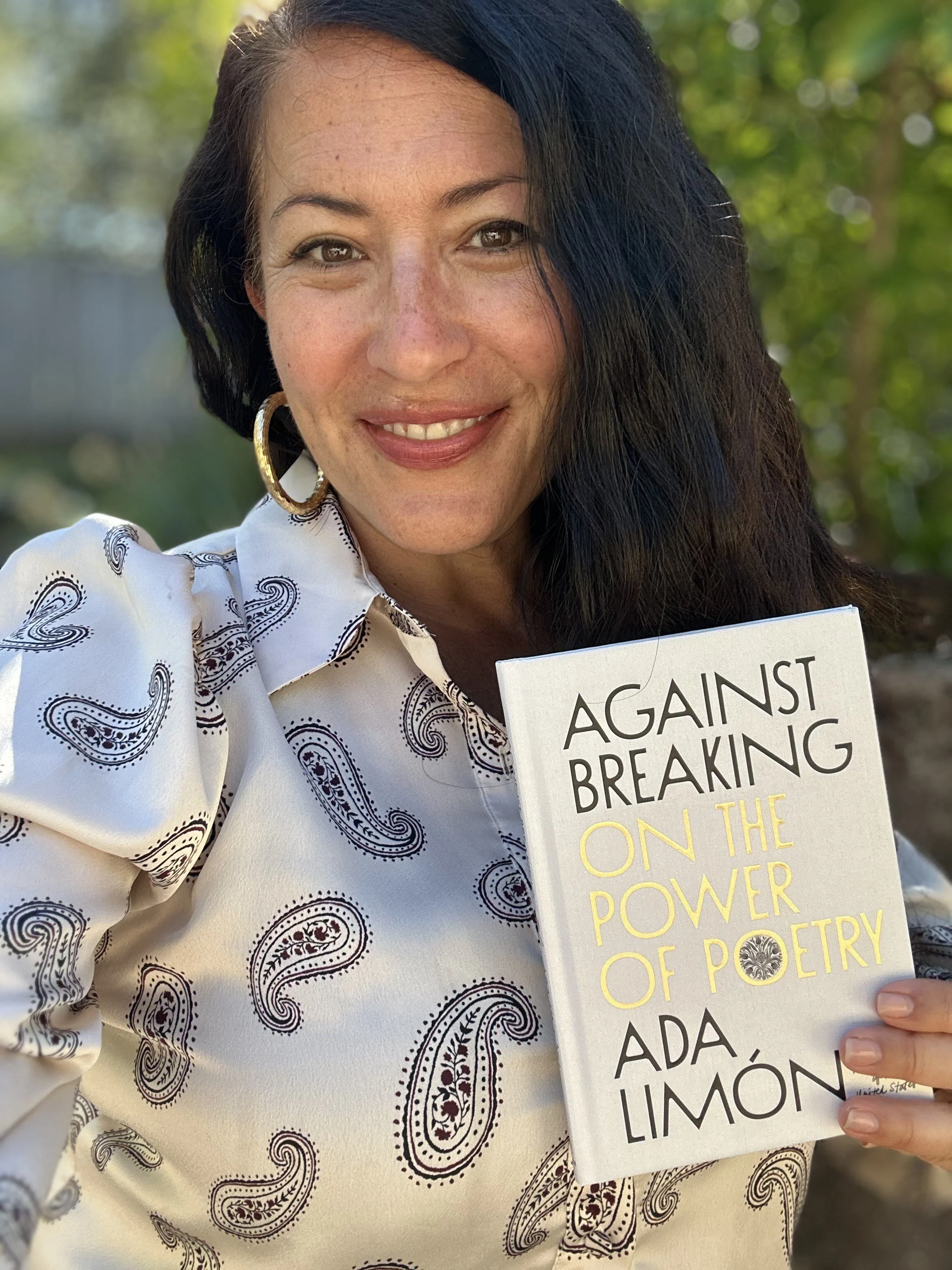
Today on The Stacks, we’re joined by the 24th Poet Laureate of the US, Ada Limón, to discuss her 11th book, Against Breaking: On the Power of Poetry.Derived from her final lecture as poet laureate, this book explores poetry’s profound ability to heal, inspire, connect, and remind us of our shared humanity. We talk about the things poetry can do that prose cannot, how to approach poems you don’t like, and what came after her tenure as the poet laureate.
The Stacks Book Club pick for April is Room Swept Home by Remica Bingham-Risher. We’ll be discussing the book with Mahogany L. Browne on Wednesday, April 29.
LISTEN NOW
Apple Podcasts | Spotify | Google Podcasts | Overcast | Stitcher | Transcript
Everything we talk about on today’s episode can be found below in the show notes and on Bookshop.org and Amazon.
Against Breaking by Ada Limón
“Ep. 365 The Poets that Make Me Understand Myself with Tiana Clark” (The Stacks)
“The Owl and the Pussy-Cat" by Edward Lear
“Ep. 158 Reaching for Answers with Reginald Dwayne Betts” (The Stacks)
“Ep. 161 The Tradition by Jericho Brown -- The Stacks Book Club (Reginald Dwayne Betts)”
The Tradition by Jericho Brown
“Ep. 209 A Poem Is About Wonder with Nate Marshall” (The Stacks)
“The Thing Is” by Ellen Bass
Mules of Love by Ellen Bass
“Try to Praise the Mutilated World” by Adam Zagajewski
“Ep. 417 Paradise by Toni Morrison — The Stacks Book Club (Namwali Serpell)”
Beloved by Toni Morrison
Sula by Toni Morrison
“The New Colossus” by Emma Lazarus
You Are Here: Poetry in the Natural World by Ada Limón
The Hill We Climb by Amanda Gorman
“One Today” by Richard Blanco
“Praise Song for the Day” by Elizabeth Alexander
Fear Less: Poetry in Perilous Times by Tracy K. Smith
Why Poetry by Matthew Zapruder
The Serviceberry: Abundance and Reciprocity in the Natural World by Robin Wall Kimmerer
To support The Stacks and find out more from this week’s sponsors, click here.
Connect with Ada: Website | Instagram
Connect with The Stacks: Instagram | Threads | Shop | Patreon | Goodreads | Substack | Youtube | Subscribe
To contribute to The Stacks, join The Stacks Pack, and get exclusive perks, check out our Patreon page. If you prefer to support the show with a one-time contribution, go to paypal.me/thestackspod.
The Stacks participates in affiliate programs. We receive a small commission when products are purchased through links on this website.
TRANSCRIPT
*Due to the nature of podcast advertising, these timestamps are not 100% accurate and will vary.
Ada Limón 0:00
I think about how easy it is to be overwhelmed by what's happening in the world right now, and it's so much easier for me to think, okay, you know, what I want to do is just sort of turn on the scroll feature in my brain. I then have to remember, not only do I have all these feelings, but so does everyone. I think we have this impression that nobody else cares or sees what we see. But that's actually completely not the case. When you talk one on one to people, you realize, oh, everybody feels this way, or everybody is going through a loss or a grief or a great joy. You know?
Traci Thomas 0:49
welcome to the stacks, a podcast about books and the people who read them. I'm your host, Traci Thomas, and today I am joined by award winning poet Ada Limon. Ada served as the 24th Poet Laureate of the United States, she was recognized as a 2024 Time Magazine Woman of the Year, and was a finalist for the National Book Award. We're here today to talk about her brand new book against breaking on the power of poetry, which is a speech Ada delivered in April 2025 that explores the profound ability of poetry to heal, inspire, connect, and remind us of our shared humanity today. Ada and I talk about what surprised her during her tenure as the poet laureate, the ways that poems can connect us to our own feelings and the feelings of others, and why it's important that we engage with poetry even if we think we don't get it. Our book club pick for April is room swept home by Remica Bingham risher, we will be discussing that book on Wednesday, April 29 with mahogany l Brown. Everything we talk about on each episode of the stacks is linked in our show notes. And if you like this podcast, if you want more bookish content and community, consider joining the stacks pack on Patreon and subscribing to my newsletter, unstacked on sub stack. These are both places where you can get awesome bonus content, like episodes and access to our Discord. And honestly, it's not that complicated. You know what Patreon and sub stack are about? They are about supporting the creators that you love, making it possible for us to do this work every single week. So if you like the show, head to patreon.com/the stacks to join the stacks, pack and or head to my newsletter on substack at Traci thomas.substack.com, all right, now it is time for my conversation with Ada Limon.
Okay, everybody. It is April. It is Poetry Month. And did you think we were going to do a poetry month where we didn't get to talk to everyone's favorite poet. Ada Limon, you'd be crazy if you thought that. I am so honored to have her here with us today to talk about her brand new book called against breaking on the power of poetry. Ada, welcome to the stacks.
Ada Limón 2:58
Hey, it's great to be here, and it's really nice to see you again.
Traci Thomas 3:02
I know I'm so happy we got the pleasure of meeting in Texas at the Texas Book Festival where you were being honored. And instantly I was like, Oh, I get I get the Ada Limon hype, because all of my favorite poets talk about you when they come on this podcast. And then the moment I met you, I was like, Sure, this makes a lot of sense to me. So I'm so glad to have you. Why don't you tell the people what this book is?
Ada Limón 3:30
Yes, against breaking on the power of poetry is a book that is essentially the expanded version of the final talk that I gave during my final event at the Library of Congress, and I was serving as the poet laureate for three years. And really you only have two obligations, and one of the first obligations is to do a public reading, which I had done in September of 2022, and the last obligation is to do a closing lecture. And so this book is the expanded version of the closing lecture that I gave in April of 2025, as my closing lecture as the 24th Poet Laureate of the United States.
Traci Thomas 4:21
Okay, before we get to what's in the book, you briefly, in the introduction, talk about this moment of getting this phone call, and your friend's like, Oh, you're gonna get this, like, video call, you know, maybe do your hair or whatever, which I love as a person who never does anything for video anymore. Is being the poet laureate something that you had wanted? Is that something that's even like on someone's bucket list? Or is this just a thing that kind of like happens to you?
Ada Limón 4:50
I mean, I think as poets, there is this idea that if you are very lucky and you have a long storied room. Brilliant career. You may be asked at some point in your 70s or 80s, I was not it was not something that I was hoping for, not something that I was that was on my radar. If I thought about the poet laureate, I usually thought of more of our elder generational poets that I admire and love and who have been mentors. So I think that was part of the shock, was that it wasn't something I was expecting to do ever and then, you know, if I was asked I had it certainly didn't expect to be to be asked in my 40s.
Traci Thomas 5:41
Okay, so then I guess that begs the follow up question, Where does one go as a as a youthful Poet Laureate? Like, what is? What does that mean for you? Because if it's something that people do in their 70s and eight, it sort of sounds like it's like a swan song. It's like, I'm the poet laureate, and then I kind of just tuck away. But you've I feel like I hope I'm not speaking for you. Feel like you got a lot of life to live, and you probably have a lot of things you want to do. So what do you what? What does that mean for you now?
Ada Limón 6:09
Well, the great thing about it is there have been people that have been mentors to me, that have served as younger Poets Laureate, and including people like Traci K Smith and Natasha Traci way, so I think about that a great deal, what they have gone on to do, and the work that they have created. So for me, one of the gifts about serving is that you give yourself wholeheartedly into the project of service to start thinking about what it is to give a bit of yourself to others, to the wider effort of literacy, the wider effort of poetry, to think larger and beyond yourself and your own artistic makings. And now, as I am still somewhat untangling from that incredible but very, very public position. I'm returning to myself as an artist, and I think that's been really beautiful. I am. I'm still doing a lot of speaking and, of course, releasing books, but it the best thing for me right now is to really take a moment of reflection and to remember what it is to make poems and to remember what it is to be a real, living, feeling, thinking person moving through this world without necessarily the expectations that come with a larger public position.
Traci Thomas 7:40
What does that look like for you? Like, on more like, a day to day level, are there routines or rituals that you've like, tapped back into? Are there things that you're doing to help you get back to yourself as an artist?
Ada Limón 7:54
Yeah, I think that's a great question. In fact, I just came back from traveling yesterday, and one of the big things for me is to get back to nature. As you know, I'm a huge nature lover. In fact, I will be completely indulgent and tell you that I woke up early and I actually went bird watching for a good two hours before we even met together on this podcast. I am, I think that's a big part of it is letting myself observe and look and get a little lost and just not always be making something or not always be putting something out, but also resting, receiving, refueling and that's an equal that's very important to me. I should say, as an artist, is to make sure that I have moments of real receiving that I'm taking in the world, as opposed to always in being interested in the transformation or the output, if you will.
Traci Thomas 9:01
Yeah, okay, I think that's actually a perfect way to get into the book, the speech, because one of the things that I found really interesting is, throughout the speech, you reference different poets, things that you think about. You know, you have a section early on where you talk about, when I'm thinking about starting something, I think about this poem, and when I thinking about finishing something, I'm thinking about this poem. This poem. And you know, in this moment, I think about this poet, and one of the things you say is that you're in the reader and the writer of poetry are then sort of Linked in these ways, right? That you're connected through the reading of someone else's poem. So I would love for you to talk a little bit more about that, because that's sort of what it sounds like. The receiving that you're talking about is like receiving the work of others, receiving the offerings of others. And so I'd just love for you to say more
Ada Limón 9:53
Well, I love that you brought that up, because I feel like it's very attuned to what you do in your work. Which is that moment of recognizing what's important, right? That that when we read something, it goes into our bloodstream, it goes into our life. And if it really matters to us, it stays there. It changes us. It is our chemistry is different afterwards. Our minds are different afterwards. And one of the things I love about your work is that you are constantly talking about what an impact a book can have on you. And I think that this, this book that I've made, is really about celebrating that, but doing it as individual poems. I think oftentimes we think about the literary investment being the novel or the book or the nonfiction or, you know, something that's quite large. But for poets, you know, they travel. Our poems travel one poem at a time. And so you can read one poem and be quite moved by it, and that goes into your whole body and changes you. And so when I'm in my receiving place and I'm reading, I'm deeply moved by certain lines. And if I'm really lucky, my brain retains them and holds on to them, and they become part of me for the rest of my life. I take them wherever I go, and that's something that I feel really lucky to have in my life, and I know that some people think about that when they think of prayers, or they think about that when they think about lyrics to songs or music and poetry is like that for me, that I'm able to keep it in Me and allow myself to be changed by it.
Traci Thomas 11:43
I love that you're saying this, because I do feel like poets are really good at remembering poems, like when Tiana Clark came on the show last year, the whole episode is just her saying, like, oh, and then when Jericho Brown said this, and then reciting like, eight lines of a poem, I'm like, How Does she remember all of this? But I guess it must be something that's like, in the heart of a poet. Poet, you are like, like, in the same way that the musician will be like, Oh, that was in the key of F. And I'm just like, how do you know that
Ada Limón 12:14
that's exactly right, and how a musician might remember all of the lyrics to a song that's not theirs, right, but that music influenced them, or those lyrics influence them. And so that's very much how we are, is that they stick with us because we embody them. And then they become part of not only our life, but our also our work and the work that we make.
Traci Thomas 12:40
And in this sort of it becoming part of you and becoming part of the work that you make, there's sort of this invitation then to the reader, which is like, because I think so, I guess. Let me backtrack in the book, In the beginning, you sort of talk about how, as you're the poet laureate, you're going around the country, you're meeting people, and people are saying things to you. Some people are like, Oh, I love poetry. I read poems all the time. Some people are like, Oh, I secretly write poems. Some people, there's a story about someone's grandfather who had all these poems, and he, like, left the poems for each of the children when he died. Like that. They're all these different ways that people are relating to poetry. And so I guess my first question there is, like, Did that surprise you?
Ada Limón 13:23
You know, it did surprise me. And it was such a gift, because I think that I had the mistaken idea that I was supposed to go into the world and tell people about poetry, you know, in this public position, and then everyone just came up to me and said, Let me tell you about my poems, or let me tell you about my poetry group, or the reading group, or the women's group that meets every Tuesday and we share a poem or, and, you know, I found it so thrilling because, I mean, let me tell you, I just recently went on a bird watching trip With the beautiful writer Amy Tan, and there was a group of us that went to go see the sand hill crane migration in Kearney, Nebraska. And the sand hill crane migration is 500,000 birds that are migrating, and it's one of the largest avian migrations in, I think, in the world, that you can witness, and it's really moving. And here I was on the final day of being able to see the Sandhill Cranes before we left, and one of our guides came up and said, I heard you were a poet. I just said, Oh yeah, I'm a poet. And she said, I'm a poet too. And the first poem I ever got published was about watching the sand hill cranes. And here she was, this nature guide who comes down from Alaska to volunteer so that she's able to not only witness again this migration, but help people witness it themselves. And then he. Here she was in this bird blind as the sun comes up. And what were we talking about? We were talking about poems. And so I feel, like many people think, oh, it's an art form that no one does anymore, but I feel as if, wherever I go, someone's coming up to me and sharing their stories about poems that they read, poems that they love, or poems that they're making.
Traci Thomas 15:24
Yeah, why do you think that we think that nobody's doing poems? Like, what's the disconnect, if everyone's doing poems, why is the line that like nobody's doing poems?
Ada Limón 15:35
I think that it's really difficult to measure. I think when we talk about reading and the reading studies that have come out, where which is, which are pretty brutal, which, you know, shows that Americans are not reading. And yet, I just think that we read one poem at a time. Sometimes we read them on the subway. Sometimes we read them on Instagram, sometimes we read them on social media platforms and blog posts, and they they're not, you can't measure them. And so I think that that's part of that misnomer. I also think that there is, there's a lot of people that write poems that are secret poets, and they don't want to tell people about it, and it's what they do to heal. You know, I think that sometimes there are people that feel very seriously connected to poetry and in a very authentic academic way, maybe hold up the expert craft element of making a poem which is beautiful and useful. But I think that we can't lose sight of the fact that a poem that is just to heal your heart or to get you through the day, even if it's writing in your journal or putting it in your you know, in the drawer in your desk, never to be seen again. That's still a useful thing, but it's still something that can help you. I mean, don't you think we need all the tools we could possibly have right now to get this chaos at this moment?
Traci Thomas 17:17
Yes, I want to get to these tools, because you talked about it in the book. But before we do, I'm going to just share with you. I think maybe we talked about this in person, but I'm going to share with you my relationship to poetry, because it has been years in the making. So when I first started the show, I did not read poems very much at all. You know, I was a theater major, so we had to do a poem for voice and speech class, and everyone got assigned all these, like, very fancy poems, and I was assigned the Owl and the Pussycat. So I was a little bit offended that my teacher gave me this, like silly poem. It was great, and I did a great job. I got an A in that class. But I've always sort of been a little like, whatever about poetry. And in 2020 I believe I posted my like, best books of the year, and there were no poetry collections, and my 10 Best and Reginald Dwayne Betts sent me a message and was like, You should read poems. And I was like, I'm gonna be honest with you. I don't know how to do that. I don't know poems. I don't understand poems. And to get on a microphone publicly and sound like an idiot is not necessarily something that I want to do. Like I have done it. I do it a lot, but it's like, not intentional. And he was like, I will come on the show and we will do a poetry collection. And I said, You know what that sounds great. So that was in 2021 and we did Jericho Brown's the tradition, and I didn't understand not a single poem, but we did it, and Reginald was great. And I said, You know what? Every year we're going to do poetry in April for Poetry Month, like that's when people are thinking about poetry. And I made friendships with some great poets, and every person told me, if you just like one or two poems in a collection, that collection is a success. And that was very hard for me to understand. And in almost every episode, maybe until last year, I would preface it with like, I don't know anything about poems. I don't understand poetry, whatever. But as I started to read more poetry, as I started to think about poems more, I'm realizing that a lot of this was poetry was ruined for me before I even got a chance to really read it in school. Like I was, I think it was Nate Marshall who was like, Traci, you know, poems are not math equations. And I was like, No, I didn't know that. Actually, I thought there was an answer. I thought there was something that I was supposed to get out of a poem, and if I didn't get it, that I had failed as a reader. And so I think one of the things that I now my relationship to poetry is I'm a person who has like, seven or eight poems on my phone just saved that I love, that I go and read like I read Ellen bass's The thing is, at least once a week. I love a beautiful poem. I love it so much. I love it. And then I finally read her collection, mules of love is what it's called. It's incredible. I love every poem. I love that collection. But it started with me reading the thing is at least 20 times on my phone over the course of like, half of a year before I actually got the collection and read it and loved it. And so all of this is to say that I feel like it's true that it's hard to measure how people are reading poems, but I also think fundamentally, people who do not feel the call to read poems, who feel like the pressure to read poems, we've been done a disservice previously in our relationship to poetry like that. We have we have been told, or felt like, we've been told that there's a right way to poem, and it's not true.
Ada Limón 20:53
It's not true. It's not true. And as much as I love collections of poetry, I love individual books. I always tell people, if you are new to poetry in general, you should probably start with anthologies so that you can skip around and read a poem that you like, and if you or read a poem you don't like and skip it. You know, I always say that if you're driving in your car and you are listening to the radio and you don't like a song, you turn the channel, yeah, it doesn't mean that you don't like music, right, right? Like you are going to dislike some poetry like that is, that is the other part I think that people are concerned about is that they think I didn't like that one poem by Robert Frost. So I don't like poetry. We assume one thing is the whole thing, and poetry is as different as songs are individual songs. And so you might love one poem by one artist, and then you might not like the other poem by the same artist. So I think you this that's important. Yeah, go ahead, please.
Traci Thomas 22:03
My follow up question is, then, for me, when I don't like a poem, I assume that I didn't get it, whereas when I don't like a book or I don't like music, I feel like I have the vocabulary to say why I didn't like this book, because I felt like the character development was not there. It was really flat, or I didn't like this song because her voice sounded bad, like she didn't have the range, whatever it is. But with poems, if it's like, this is Robert Frost, I'm like, Oh well, it's Robert Frost. It must be me. So how do people develop the skill to feel confident enough to not like something and know that like it's just a taste thing, and not to feel like they're a failure.
Ada Limón 22:48
Well, sometimes it is just a taste thing, and sometimes that's okay. And there are some times also there where you may not get it. I mean, I think that for years, I was really put off by John Ashbury. I thought that was a poet that I would not I had no interest in reading. It seemed unnecessary, unnecessarily complex. It felt like it was purposely obfuscating the point. And then, as I aged and developed as a human being and as a poet, I really took my time and read his work, and then I fell in love with it. So I think there are poems that you may not like at certain moments in your life, and they might not mean something for you at that time. There are also poems that we're speeding through, because we may think, you know what, I want to read a poem, and then we just kind of read it really fast, and we know, okay, yeah, it didn't do anything for me. But then you might be sitting somewhere, and someone goes, Oh, you don't like that poem. And you go, Oh, you know it never did anything to me. And then they go, let me read it to you. And then you go, oh. And then they read it to you, and you go, oh. And then you go home, and you read it aloud, and you go, Oh, because that's the other thing. Poetry is really meant to be out loud. And so you you absorb it with the music. And sometimes, you know, and I once heard Arthur Z, our current poet laureate, talk about this, which was that he was writing these beautiful lyric poems, and he was reading them at the Dodge Poetry Festival. And he said, If you don't know what's happening and you're looking for a story to hold on to, and you're looking for something to grasp, he's like, I just want you to think of this as music. I want you to listen to it and let your mind wander and let the images wash over you and the music of the poems wash over you. But don't keep trying to grasp on to something as if you were reading it like a paragraph or hearing it like a paragraph. So a lot of times, it's just releasing and you're starting to. Listen to the ideas of your own self, your own body, and how it responds to the poem. So I think that a lot of times, if we dislike a poem, it might be at that moment in time it's not the poem we're supposed to read. It might be that it is too difficult for us and that it needs to be read aloud and then read aloud again, and then read aloud again. And by the fourth reading, you think, how did I ever live without this poem? You know? So it's, I think it's, you know, I just, I want to grant every new reader of poetry to just love one poem for a little while, and then you might look up that poet and go, who do they like? And then you think, oh, okay, maybe I'll read that other poem. Then you think, oh, maybe not this one. And then you'll find one and go, Oh, yeah, this is a good one, you know. And I think that, I think that it can be difficult when we feel as if we are we have to like every poem that was ever written by anyone in order to call ourselves poetry fans, you can like one poem and be a fan of poetry,
Traci Thomas 26:08
right, right. Okay, I want to ask you one more thing about reading poems out loud. I like to get a lot of poets on the record with this one. Yeah. What is your relationship to the end of the line and to the punctuation. And how do you navigate that when you're reading a poem out loud?
Ada Limón 26:27
Yeah, I used to not read the line breaks when I was first starting out as a poet in graduate school. I thought the point was to read to pay more attention to the punctuation and to the period. And then I was taught really brilliantly by many different mentors, including Colleen McElroy and Mark duty and Marie Howe. And there was a moment when I realized that the unit of poetry is really first the sound and then the word, and then the clause, and then the line, then the sentence. And so I notice the line break, and I try not to pause in a really strong way, but there's a slight moment where anything could happen, and I hold that, I hold that in me. So it's like, oh, I don't know where it's going, Yes, and thank you. The surprise of the line break.
Traci Thomas 27:35
I knew I liked you because you agree with me. I studied Shakespeare and I love the line is so important in Shakespeare, more important than the punctuation, oftentimes, or at least equally important. And so when I started reading poetry on this show, and I was always like, trying to acknowledge the line ending, because I it's like, otherwise, why is it there? Right? Why would you end, especially if you're not working within, like, a very intense structure, right? Like it makes sense if you're doing iambic pentameter, that you might have to kind of make it fit, but if you're just writing a poem, it's like, Well, why would there be a line ending if it didn't mean something? And so many poets, even when they read their own poems, they ignore the line ending. And I'm so fascinated by this. And when I started asking poets about this, some of them were like, yeah, no, I don't, I don't. And I doesn't make sense in my brain. Like, if it's a line ending, I'm gonna do something. And I tell people all the time, it doesn't mean you stop. Sometimes. It just means you just, like, you just, yeah, like you said, notice
Unknown Speaker 28:36
we know it's there.
Traci Thomas 28:37
Yeah, it's there. You can't make it not there, so you have to at least reckon with it when you're reading it out loud.
Ada Limón 28:45
And the way I write my poems, I'm very interested in line breaks. They do mean something to me. There is a slight acknowledgement, because that's the tension. You know, poetry really exists in the tension between the line break in the sentence. And I also was raised on Shakespeare. I was also a theater major and this and so Shakespeare was really the first poet I got to know. And so those that's exactly the same way. And if you think about iambic pentameter, is, is is that speech? So it's meant to read like speech. And so when you are then making a smaller, shorter line, that's a more, you know, internal line, and that allows for more space, more breath, more pauses, and it tends to be a little more meditative and quiet. And then when you have a longer line than Shakespeare, and you go, you know, further, then it's more public, it's more chatty, it moves much faster. And so the length of the line is actually supposed to give us the speed right of how we're reading it. And so iambic pentameter. Is supposed to mimic speech, which is how Shakespeare wrote almost everything
Traci Thomas 30:05
right, exactly. And I feel like just when I'm reading like, you know, sometimes you'll have a poem and it'll be shaped interesting on the page, like a pyramid. Or, you know, you know, someone will do something. Words will be spread out all across. And I'm always reading those trying to figure out, you know, maybe there's not a right answer, but I'm trying to make meaning of that choice, especially if I'm reading someone's collection and there's 50 poems and there's only one poem that's in the shape of a pyramid. I'm thinking like this, the pyramids got to mean something. It does. And I think, like for me, that's always really fun as I'm reading poetry, because even if I don't like the poem, or even if I'm not really even paying attention to the poem, I'm paying attention to it in different ways. And I think that's really exciting. And so I do get frustrated when a poet's like, oh, I don't think about that. I'm like, Yeah, what do you mean? I've been spending 45 minutes on this pyramid poem.
Ada Limón 30:58
I totally agree. And I think there are times where poets will say, you know, oh, that's not how I'm working, or that's not how what my intention was, which is totally fair, right? We should listen to the artists and listen to what they have to offer, and we're, you know, for reading and spending time with their work. Our our efforts in that endeavor, should also be taken into consideration. And one of the things I find fascinating is that critics of poetry, and I mean criticism in the best way, the scholars of poetry, you know, we're thinking about the tradition of poetry and where all poetry comes from and that it's in conversation with all other poets. And so a poet might say, Oh, that's not how line breaks work for me, but that is how line breaks work, correct? So they may not see that, right, right? Even when they're making it, they may not see that it's similar to, if you say a musician that says, Oh, I was never thinking about Joni Mitchell when I wrote this. You know, really highly lyrical song with a lot of musical notes in one bar, etc, etc. But we may know we are that is the influence Yes, yes, of music on this artist. So I think that's how, that's how I would think of it.
Traci Thomas 32:31
Yeah, right. Okay, let's take a quick break, and then I want to talk about the tools that we teased earlier. Okay, we are back. I want to talk about the tools, because as you go into your speech, you sort of start at this place of, you know, poems are everywhere. And then there's this moment where you sort of are like, you know, I got to be honest, sometimes I don't want to read poems and I don't want to write poems because I don't want to feel. And that's sort of the first moment where you really bring this idea of feeling as sort of what poems for you are about, I feel or like, what the center of the poem is doing, whether you like it or not, that poems are about feeling something from another person that the poet has offered this to you, and as the reader you, in turn, are are to feel something. And as we continue in the collection, you sort of talk about how poetry that this ability to feel is important right now, that it is useful right now. Will you talk about that?
Ada Limón 33:49
Yeah, well, first of all, thank you for bringing that up. I think I think about it a lot because I know myself. Turns out, the only real person I know is just myself, but I think a great deal about how easy it is to be overwhelmed by what's happening in the world right now, you know, careening from one crisis to another, feeling this sense of chaos, Feeling the sense of an untetheredness to the world. And it's so much easier for me to think, okay, you know, what I want to do is just sort of turn on the scroll feature in my brain and just go and scroll through things look at, you know, social media just sort of numb out, not feel anything. Don't even stop on anything, right? Just go, Okay, next, next, next, next. And I understand that, you know, that's not that dissimilar to wanting to drink, you know, a bottle of wine, or, you know, wanting to, wanting to. Feed oneself into oblivion, all those things I have, all those feelings sometimes, which is, how do I stop myself from feeling and yet And yet, in order to gather courage, in order to be brave and go into the world and to face this moment, which I believe we are all, in some ways, meant to be here at this moment. I then have to remember that not only am I a feeling person, not only do I have all these feelings, but so does everyone. And I think sometimes when we are numbing out, we have this impression that nobody else cares or sees what we see or is going through what we're going through. But that's actually completely not the case. When you talk one on one to people, when you read you realize, oh, everybody feels this way, or everybody is going through a loss or a grief or a great joy, you know, and and I think that that's very easily forgotten these days because we numb out to protect ourselves, which is completely it's not unusual. It's how we, in some ways, stay safe. And, you know, poetry is not always the safe place. Poetry is often meant to ignite us and turn us on to the world and wake us up and just remember that we are living beings, and at some point, all of us, no matter who we are, will eventually die, and we will lose everything we love, and that loss that is inevitable is a huge part of appreciating this world.
Traci Thomas 36:57
In the book you talk about this poem about like praising. It's called try to praise the mutilated world. And it was, you were reading it after September 11 on the subway in the New Yorker. And you say, you just imagine that everybody else was reading it too, which I love. But what you say about the poem, I'm just going to read this little bit. It says it says it wasn't just the poem itself or the instructions and it insisted upon, but the way it reminded me that language had power and it could have power for good. We need a secular, sacred language, something that is galvanizing without certainty, that gathers us without gathering under one ruler, but under the connection that we all have to the human spirit, to each other, to the earth, I love this. Thank you. This, this little bit to me, felt like Aha. The thesis of the thing like this really felt like the heart of the speech that we need this language that we need poetry because it is doing something, it is offering something that maybe, perhaps prose cannot. And you get at this at the end of the speech, you say, like, I'm writing in prose, but I need to be writing in poetry like you're like, I like that. I was thinking of it as far as like the theater, like a play versus a musical. They say, like, when things get really heightened in a musical, that's when the singing starts, right? And I was thinking about that as, like, poetry is the like, jacked up on feeling steroid version of prose, like prose intense. But I want, I guess what I want to know is like, what is it about poetry that you feel like can galvanize us? What is it about this use of the language versus prose? Because I think so many people would say they're more comfortable with prose. So why do you think poetry can unlock this for us?
Ada Limón 38:59
Yeah, I mean, I think it's honestly, it's in the music. I think that there is a music and a rhythm. And I mean, every poem is different, but poetry can do this, which is tap into that musicality that feels like human breath, that it feels like we have to lean into it to listen to again. It can feel incantatory. It can feel as if suddenly there is not just a sense making which prose is focused on, a sense making right we're supposed to we're reading for meaning, but there is an emotional impact, that there is an unlocking of feeling. And I think that's the key to poetry, is that you are supposed to open up. There's a reason why. When you go to poetry readings, people cry. You know, I go to poetry I cry. Poetry readings all the time, and I think that it's sometimes, sometimes not at what was supposed to be a sad poem, sometimes it's the beautiful poem, the one that just says something so good. And you think, yeah, okay, human kindness. Human kindness. Yes, I missed it. I've been missing it. And then you hear it, you hear a poem, and you go, yeah, oh, I needed to be reminded of that. And so it is that idea of not just sense making, but the idea of unlocking our feelings and reminding us that we live in the feelings as well. And I think that there's so many of us that think in order to get out of a moment, whatever it may be, in order to untangle us from the mess we've made as humankind, we have to engage our solely our intellect, and the poet's job is to engage the intellect, yes, but it's also to engage the heart. It's to engage the soul. And in that sense, I find it could be more unifying. When everyone's in a room listening to a poem, there's something that shifts, that feels different than than prose. And I, you know, I read often, and there are times where I'm talking about the poem, or I'm talking telling a story or something, and then I read the poem, and those two events, for me, feel entirely different when I'm reading the audience. There is one that feels like conversation. It's welcoming. We're in a moment, and then the poem happens. And the happening of the poem feels as if we've entered a musicality of the heart, and that is entirely different than the prose, right?
Traci Thomas 42:01
That's so interesting. I don't I don't know that I feel that when I listen to a poem, but I also feel like I have so many other things around poetry, like so many insecurities that it like gets in the way of me being open to the feeling. Do you know what I mean?
Ada Limón 42:18
I do. I do. I had, let me tell you this story. I had this one when I was serving as Poet Laureate. I had this one woman said, I'm so sorry I missed your whole poem about the raincoat poem. She said, You know the one that where your mom is driving you to an appointment and you know she was trying to she said I just missed the ending because I started thinking about my mom, and how my mom used to take me to these lessons to help me with my speech therapy, and she never said anything, and she would just take me to the and she would sit outside the room to make sure I felt safe, and I would do my speech therapy. And, you know, this woman's telling me this whole thing, she's like, so I'm so sorry because I didn't get the poem and I missed it, and I kept thinking, No, that's exactly what that poem was supposed to do. You just had such an authentic experience with a poem, which is that you got three lines in and your brain and your heart made you time travel. It unearthed a memory like that's magical that, to me, is the best kind of success is that someone was moved to re experience something in their own lives because of three lines that they think they missed, but in reality, it entered them back into the world.
Traci Thomas 43:52
Okay, this is making me think of something else in today's day and age where we have these like issues with poetry, let's just say some of us and where the poet is not like the I feel like in the olden days, the poet was like, Oh, the well regarded poet. And now I feel like people are like, Oh, I secretly write poems like it doesn't have the same regard as maybe it once did. I feel like poets, and maybe this is i and professional poets, people who are, I should say, public poets, people who write poetry and want to talk about it, as opposed to the secret poet, are so generous with their readers or listeners, you know, like, what you're saying, you're telling the story, and you're like, No, you got it. Like that is what the poem is supposed to do. I'm wondering, do you think this is something that is inherent in today's modern day poet, or is this something you've had to learn like, this graciousness with the consumer of the poetry? Because I think of like people who write fiction, and someone will be like, Oh, I this is what I got. And they'll be like, No, and it's just like a very like, no, yeah. That's not, right, you did not get that like, in a way that can be or, like, sometimes, you know, someone will put a review on Goodreads, and then the author will come back and be like, well, that's not what I was doing, or whatever. And I've never heard a poet say that in the years I've been doing this, usually a poet's like, I love that you got that. Or that's interesting. I wasn't thinking of that, but that's such a like, so do you think that's just the poet spirit. Or do you think that's something you all have learned, because people are just like, you're just like, please think about poems. I don't care what you get out of it. Just like, think about poems.
Ada Limón 45:31
Yeah, I do think there is part of us that feels like, if you've taken a moment to read anything, we're gracious about it and grateful for it, but I, but I don't think that's everyone. I think there's a lot of really wonderful poets that that are interested in writing for other poets. And I think that's also a beautiful thing, right? You know, that's like the the incredibly talented jazz musician who wants to write or wants to make music for the other incredibly jazz, talented jazz musicians in the room, and they are talking to each other, and it's a gift that we get to witness it, right?
Traci Thomas 46:12
Yes, yes, yes, okay, okay.
Ada Limón 46:13
And they're not gonna look at us and be like, Oh, let me spoon feed you this, right? Like this. So I think there are some poets that are like that, and I think there was, there's a part of me that feels that way sometimes, which is just like, you know, if you don't get it, that's fine. You don't, don't read it, you know. But I also feel like, very early on, I wanted to be a poet that wrote for non poets, right? I always have been. I, you know, I have a My life is full of non poets, as most people's lives are. And I would, I think I would feel sad if I only wrote for other poets. And I love other poets, and my favorite thing is to, you know, have a cocktail and sit around at a poetry table and just nerd out about line breaks and what we're reading, and all of these things. And you know, to talk about the great poets of the past, all those things. But that is not every day for me. You know, every day for me is spent with with people who struggle with poetry. And you know, I, for me, it's important to to offer a way in, you know? Yeah, someone once said, you know, I don't like poetry, but I really like your poetry. And I said something like, well, I'll be your gateway drug, you know.
Traci Thomas 47:33
I guess that's true also. Even my question is, like, so biased, because all the poetry that I read and all the poems that I've talked about, and all the poets that I know are poets who I think are deeply concerned with poetry for non poets. And like this experiment of like or not experiment, but this like effort to bring us in like, I'm thinking of like Jose Olivares, like, I think he would say that he is interested in poems for non poets, and I kind of know his work. And so I think maybe that's also why these are the poets that I feel like are so generous with me and with others, because they're like, the fact that you're here is a affirmation of the work that I do.
Ada Limón 48:11
I think that's exactly right. And I think that there are a lot of people and really wonderful poets who that's not their endeavor. They're Yeah, and, and, and that's a beautiful thing too, you know? And I think that we need all of us.
Traci Thomas 48:25
Yes, I agree. I just, I'm now realizing, as you're saying this, like, of course, I would never read a poem by a poet for other poets, because, And they don't want me. Yeah, exactly, they don't want me and I don't want them. Like, I'm so maybe one day I'll get there right? Like we read Toni Morrison every year, and this is now, we just finished our ninth Toni Morrison novel for the show. And now I'm like, oh, even the hard ones, I feel like I'm getting it. But in the beginning I was like, There's no way I can read like beloved I can barely get through Sula, like I am struggling. And so I do feel like, you know, the more that I read poetry, the more confident I feel, and the more likely that I could maybe dip my toe into the poets for poets community. But I feel so much better in the poems for the for the regular world.
Ada Limón 49:14
Yeah, and I think that that there are poets, and I felt they always exist. I hope they always exist. You know, that are the, are the welcomers, you know, that stand there and say, Come on in. Come on. It's not scary. It's not scary. You know, guys don't ever leave us, yeah. And then, you know, and then there are the poets that are like, No, this is scary, and it should be scary. And, you know, yeah, Tony Morrison is actually a perfect example of that, of the work that when you read, read it and spend time in it and then do it again, you say, oh, oh, it might have taken the third reading. Yes, you know, I remember that experience, um, with her when I first read, when I first reading her, like in high school, I thought, I'm never gonna, I'm never gonna get this. And. And, you know, she's, of course, is one of my favorite all time writers,
Traci Thomas 50:03
right, right. That's how I feel, too. I was so intimidated, and it is. It has been a similar journey for me as with reading poetry, of just like, Okay, I didn't get that like, I'm not gonna spend an hour berating myself because I'm confused about who this person is. I'm just gonna keep going, keep going. When I get to the end, I can reflect, and I can always go back and like, and I do feel like that kind of general, like generosity with oneself is a really useful tool to sort of cultivate when reading Toni Morrison or James Baldwin or poetry, or even, like watching a movie, you know, like, I think a lot of this stuff, and I just, I don't know, for some reason, I feel like I'm just so much more kind to myself in all other forms of reading and art consuming than I am with poetry and then, like, going to the art museum, I that's even harder for me than poetry. That's the one where I'm like, I don't get it. I hate it here. Like, I gotta go, I gotta get out of this room.
Ada Limón 50:55
Yeah. And people, people know themselves, right? You know the thing that you kind of feel as if you don't belong there, right? And I think that there's a lot of people who feel that way about the visual arts, you know, sometimes they're like, I like a photograph, I don't like a painting, or, you know, I mean, yeah, that to me is, I find that really interesting, and I think we, we should have those discussions, because, to me, Oh, that's interesting. So you don't, what is it about the photograph, but not the painting of the, you know, I don't know, like that is, that's fascinating. So to me, it's an interesting, you know, conversation starter. And I think, you know, for some people, they really feel as if they've poetry's failed them, and because they've tried. And I and I get that, and I get that too, and I think it is, it's okay to not like it. It really is. You know, there are people that don't like music. There are literal people that don't listen to music, you know, so. But I, for one, think that the more we expand our minds and have these great conversations and open up to possibilities of poems and the possibilities of different art forms, the better we are as as a species. I think it's part of our evolution. And you know, as we focus on the real dangers of artificial intelligence, poetry is so deeply human that, as well as art, making is so deeply human that I think, you know, we need to make sure that it flourishes and remains and keeps that part of us alive that wants to speak back to the world in a real, authentic way.
Traci Thomas 52:55
And I think you talk about this very briefly in the book, and I think you should write a whole book about this. Actually, is about this, like confrontation between AI and poetry. And I think it's true for AI and art in general. And I think that in some ways this is like, if we think of it in sort of war language, this battle between the artist and the artificial intelligence is it's so interesting to think of like poets and painters and singers and whatever as being on the front lines in a certain way. But I do feel like that, because, as you say in the book, like people want to know if AI can write a poem, because writing a poem is so like human. So can AI be human? And I just, I thought that was so interesting. Before we get out of here, there's a few questions I have to ask you, which is one, how do you like to write? How many hours a day? How often do you listen to music? Are you in your home? Are you out somewhere else? Are there snacks and beverages? Talk about it.
Ada Limón 53:58
Well, I love to write at home, and ideally, because I'm a California girl, I like to write outside. for me, I like to have Hydration Station. Is what I call it, which is like all the different beverages.
Traci Thomas 54:16
What are they?
Ada Limón 54:16
Black coffee, water and then kombucha, usually kombucha, and then, and then I like to just have, sometimes I bring out some books for inspiration I had, and then I have a journal that I write in every single day. Now the journal sometimes is just ends up to be a to do list, because it's that kind of day, and I allow that to exist. But it also has my dreams in it. It has the things that I need to do, and then it also has lists of things that I'm interested in. Sometimes it has lists of species of birds I've seen. But So oftentimes, when I do have a moment to sit down and have a concentrated writing time, I turn to the journal and I think, oh, there's all. This stuff here that I've been working on, and so it's sometimes there's whole lines of poems, sometimes there's whole drafts of poems in there. So I write a lot longhand, and then eventually, as I get my draft together, it goes to the computer for more of an editorial perusal. But yeah, so ideally, that's the case, and then, you know, because I'm on the road quite a bit, and I speak at a lot of different universities, and which is just a joy. And also am lucky enough to have, you know, against breaking is actually my 11th book in the world. But, you know, I have trained myself to be able to write on planes and in hotel rooms and pretty much anywhere. The big thing for me, I love music. I love it. I love it. I cannot listen to it while writing. I think I'm a mimic, and maybe a mimic and a magpie. I look for shiny objects. I constantly it's all I can hear. And what I am looking for when I'm writing a poem is to somehow unearth my own music, the music that's been moving through me. And I need to hear not only the voice and the voice underneath the voice, but also how it echoes back and that music that it's making. So, so no, I can't, I can't listen to music
Traci Thomas 56:29
that makes sense in the book. You say you've been to almost every state. What states Have you still not been to?
Ada Limón 56:36
North Dakota, South Dakota and Alaska? That's it, just three, yeah, but I'm planning. I'm hoping, I'm hoping to get to Alaska this year. I got this beautiful invitation from North Dakota, and I really wish I could have gone, but it was right on the heels of something else, and I physically couldn't, couldn't swing it, but, but no, I would, I would love to go to to all three of those places at some point. And, and, yeah, and read poems.
Traci Thomas 57:05
Okay, this is the last thing I want to ask you about in the book. Towards the end, you talk about the poem on the Statue of Liberty. You talk about these, like public poems, and how you know the lines in that poem. We all know, or many of us know, or at least some of them, we at least know the you know. Give us our I mean, I don't know it, but give us our weary. Give us your weary, you know. So I'm I was thinking about that, what are other public poems that we know? Because I was thinking about how public poems, and your whole project, the you are here poetry collection, and you went out to these national parks, and you put poems in the parks. And I was thinking a lot about how, if you are not confronted with a poem in your everyday life, whether that's Instagram or maybe a public poem, you might not people might not ever think about poems, or they might not ever know how to find a poem because they're not going to buy a collection, or they're not going to go to the bookstore or the library. And so I was just thinking like, what are other poems that we know from, just like out in the world?
Ada Limón 58:01
Yeah. I mean, I think that one of the best examples is in New York City, and also in different cities, is poetry in motion, so that you encounter a poem on a subway, right, or written, you know, and that it's in the poster and or you have on the bus, and I feel like that's actually really always a wonderful moment where you see something and you think, Oh, I'm thinking about something else. And then you, then you read it, and you realize you've read it before. And then you, oh, I really, really love this. I think that's an example of the public encounter with poetry, which is what I was hoping to do with the Parks program is so that someone could have that kind of parks experience, but then also read a poem, and then think about maybe writing their own response to the natural world. I also think of inaugural poets, you know, I think Amanda Gorman and Richard Blanco and Elizabeth Alexander and all those wonderful poets that did the incredibly, seriously hard work of creating an occasional poem for a presidential inauguration, which I think is just massively difficult. So that's another example,
Traci Thomas 59:21
if I become President, will you write my inaugural poem?
Ada Limón 59:23
Okay, here and now, I will say, yes
Traci Thomas 59:27
Well, if I become president and then you don't do it, I'm gonna be so mad. I became president and then Ada said it with she wouldn't do it anymore.
Ada Limón 59:36
We will shake virtually.
Traci Thomas 59:38
Yes. Okay, deal. Okay. Two more questions. One is for people who love against breaking what are some other books that you might recommend to them that are in conversation with what you've created?
Ada Limón 59:49
Oh yes, there's a new book by Traci K Smith called fear less, and it's a little more craft heavy about poetry and. It's beautiful and brilliant. And of course, anything by Traci K Smith is just marvelous. I would also say the book Matthews of Pruder, why poetry a little longer? And one of the things that I think is really beautiful about that as he goes through and dissects other poems, which is really wonderful. And then I would also say the very small and lovely book called service berry by Robin wall Kimmerer, which is about creating a gift economy and taking lessons from nature. So I would say those books, just off the top of my head,
Traci Thomas 1:00:37
I love it. Okay. Last one, if you could have one person dead or alive, read the book. Who would you want it to be?
Ada Limón 1:00:45
Oh, wow. You know, this is just going to be a personal one, which is my teacher and really one of my first mentors, Colleen McElroy, who passed away a couple of years ago in Seattle. I would love for her to read it, because she knew me as this young, 19 year old, 20 year old who barely knew how to write a poem, and she taught me so much about not just making poems, but how to really appreciate poetry and read it in a way that I had never really thought about before. And so she was my teacher as an undergraduate, and I think about her often.
Traci Thomas 1:01:23
I love that. Thank you so much. Ada, thank you for being here. Thank you for offering this book to us. And I just, I just love you. Thank you. I can't wait to be president,
Ada Limón 1:01:33
yay. I can't wait to read a poem at your inauguration.
Traci Thomas 1:01:37
I'm gonna become president just for Inauguration Day, and then I'm gonna be like, You know what? I gotta resign. I got the poem. I'm done. It's too much work. I don't want this job.
Ada Limón 1:01:47
No, we need you. You have to stay.
Traci Thomas 1:01:50
Thank you so much.
Ada Limón 1:01:52
Thank you. Thank you for all the work you do, and it was such a delight to see you again.
Traci Thomas 1:01:57
You too, and everyone else, we will see you in the stacks. You thank you all so much for listening, and thank you again to Ada Limon. I'd also like to say a huge thank you to Ellie Crowley and Vaughn fielder for helping to make this episode possible. Our book club pick for April is room swept home by remica Bingham risher, which we will be discussing on Wednesday, April 29 with mahogany l Brown. If you love the stacks, if you want inside access to it, head to patreon.com/the stacks to join the stacks. Pack and subscribe to my newsletter at Traci Thomas, dot sub stack.com make sure you're subscribed to the stacks. Wherever you listen to your podcasts, and if you're listening through Apple podcasts or Spotify, will you take a moment to leave us a rating and a review. I know it seems like nothing, but it's actually a great way for new listeners to find the show and understand what they're getting with each episode. For more from the stacks, follow us on social media at the stacks pod, on Instagram, threads and YouTube, and you can always check out our website at the stacks podcast.com this episode of the stacks was edited by Christian Duenas, with production assistance from Sahara Clement. Additional support was provided by Cheri Marquez, and our theme music is from taggierigis. The stacks is created and produced by me, Traci Thomas.