

Ep. 426 Lonely Crowds by Stephanie Wambugu — The Stacks Book Club (Chanda Prescod-Weinstein)
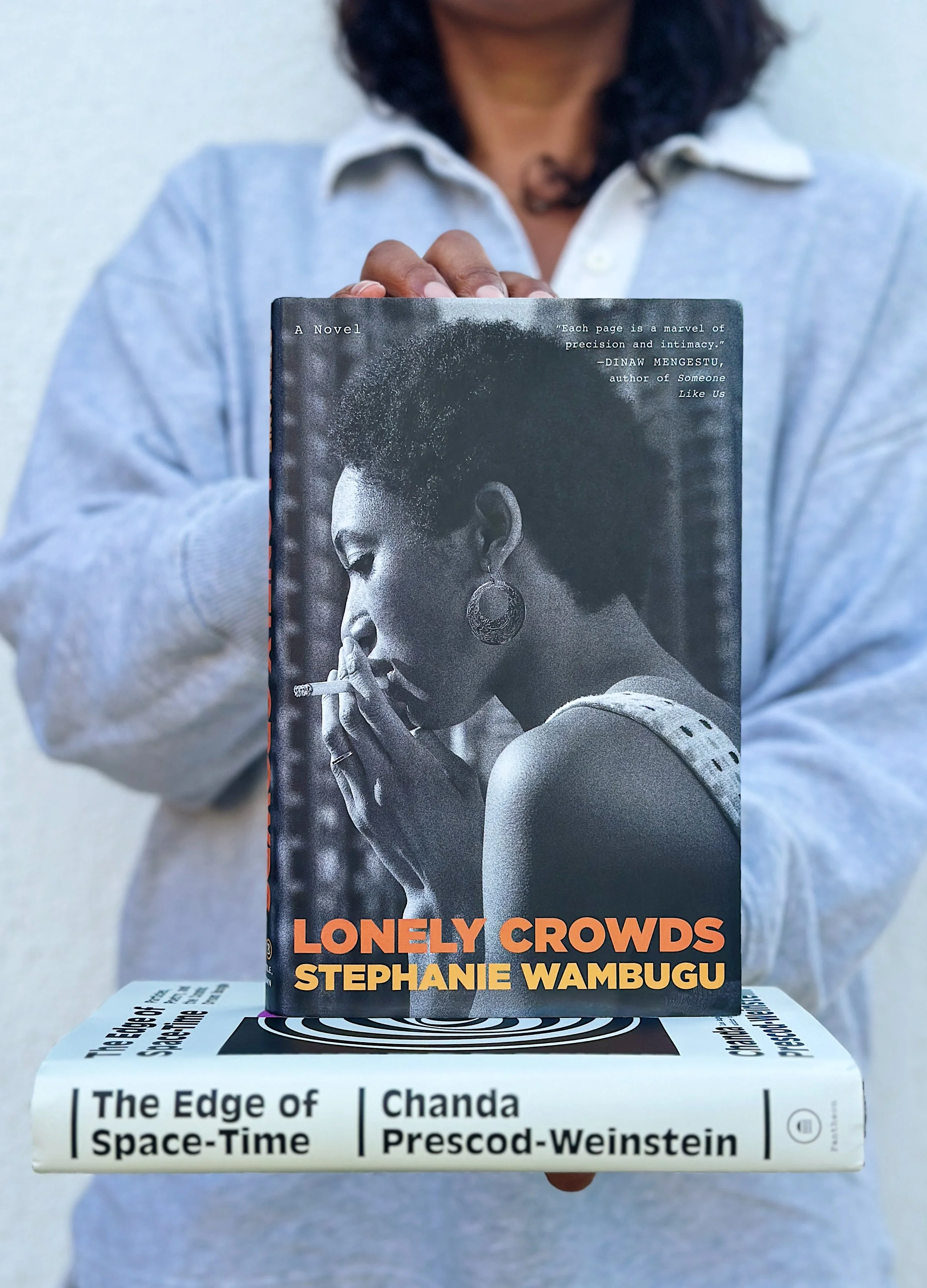
It’s The Stacks Book Club Day, and we’re once again joined by award-winning author, theoretical physicist, and cosmologist, Chanda Prescod-Weinstein, to discuss Lonely Crowds by Stephanie Wambugu. Set in the early ‘90s, this book traces the decades-long friendship between Ruth and Maria, whose intense childhood bond is tested in adulthood by the glamorous yet competitive nature of the New York City art world. Chanda and I chat about the complicated balance of making art and making money, discuss how first-person writing plays into the unreliable narrator trope, and try to figure out who exactly is on the cover.
Listen to the end of the episode to hear what our June book club pick will be!
LISTEN NOW
Apple Podcasts | Spotify | Google Podcasts | Overcast | Stitcher | Transcript
Everything we talk about on today’s episode can be found below in the show notes and on Bookshop.org and Amazon.
Lonely Crowds by Stephanie Wambugu
The Edge of Space-Time by Chanda Prescod-Weinstein
Kin by Tayari Jones
The Hunger Games by Suzanne Collins
Parable of the Sower by Octavia E. Butler
Diaries by Franz Kafka
Moby Dick by Herman Melville
The Divergent Series by Veronica Roth
Candyman (Bernard Rose, 1992)
Ordinary Notes by Christina Sharpe
Is God Is (Aleshea Harris, 2026)
Ordinary People (Robert Redford, 1980)
Upward Bound by Woody Brown
Loyalty Bookstores (Washington D.C.)
“Ep. 404 The Best Books of 2025 with MJ Franklin and Greta Johnsen” (The Stacks)
The Alchemist by Paulo Coelho
To support The Stacks and find out more from this week’s sponsors, click here.
Connect with Chanda: Instagram | Website | Bluesky
Connect with The Stacks: Instagram | Threads | Shop | Patreon | Goodreads | Substack | Youtube | Subscribe
To contribute to The Stacks, join The Stacks Pack, and get exclusive perks, check out our Patreon page. If you prefer to support the show with a one-time contribution, go to paypal.me/thestackspod.
The Stacks participates in affiliate programs. We receive a small commission when products are purchased through links on this website.
TRANSCRIPT
*Due to the nature of podcast advertising, these timestamps are not 100% accurate and will vary.
Chanda Prescod-Weinstein 0:00
This is also a New England novel, which very much subverts American stereotypes about what kinds of literature comes out of New England, like starting with the fact that it's about black people and not about white people. I mean, not about, like, you know, some mad whaling ship captain, yeah, but there is kind of, I will say, there is kind of a Moby Dick piece in it, in that, like, Maria is almost like Ruth's Moby Dick, in that she's like just chasing her, and it's this unattainable, like, this is not going to work out the way that that you want it to work out.
Traci Thomas 0:42
Welcome to the Stacks, a podcast about books and the people who read them. I'm your host, Traci Thomas, and today is the Stacks Book Club Day. We are joined again by best-selling and award-winning author, theoretical physicist, and cosmologist Chanda Prescod Weinstein. We are discussing our May book club pick, Lonely Crowds by Stephanie Wambugu. This book traces the decades-long friendship between Ruth and Maria, whose intense childhood bond is tested in adulthood by the very competitive nature of the New York City art world in the 1990s Today, Chand and I chat about the nature of obsession throughout this book, how the use of a first person narrative enhanced this story, and how we think about success, capitalism, and the world of art. There are spoilers on today's episode, and be sure to listen to the end of the episode to find out what our June book club pick will be. Everything we talk about on each episode of The Stacks is linked in our show notes. If you're a person who loves books, and you want to talk about books all the time, and think about books all the time, and make friends who also love and think about books all the time. Check out the Stacks pack on Patreon, and consider subscribing to my newsletter, Unstacked on Substack. Each platform is going to offer you different perks, but mostly they're great spaces to be in if you want to be talking and thinking and loving on books. It's not complicated, you join either of these places. We have free and paid options, and by joining, you make it possible for me to make this podcast every single week. So, head to patreon.com/the Stacks for The Stacks Pack, and check out my newsletter at Traci Thomas dot Sub stack.com All right, now it is time for my conversation with spoilers with Chanda Prescod Weinstein, about lonely crowds. Alright, everybody, it is the Stacks Book Club Day. I am joined again by best-selling Chonda Prescod Weinstein, the author of The Edge of Space Time, my favorite scientist, and apparently, according to all of your feedback, also your favorite scientist, Chanda. The people love you. I know why, but you know you never know.
Chanda Prescod-Weinstein 2:53
Thank you for having me. And that's so great to hear, because you know you spend a lot of time with a book, and then you're very anxious about it, and so it's nice that the edge of space time has been so well received, so thank you all.
Traci Thomas 3:04
Yeah, well, we love you. Thank you for being the only person in the universe who will talk to us about science in a way that we don't feel like morons. I say we, but I really just, I probably just mean me. But in case anyone else feels seen by that, it is Book Club Day. We are discussing Lonely Crowds by Stephanie Wambugu. This book came out in 2025 For people at home who have not read the book, we are going to spoil the book. We are going to spoil the book. We are going to spoil the book. So, you've been warned now. And here's what it's about. It's about a girl who turns into a woman, a girl woman named Ruth, who is best friends with a girl who turns into a woman named Maria. They meet in childhood when they're about nine, and for lots of different reasons they become extremely close, almost like sisters. They go to college together, they are roommates, and they are both artists, sort of in different fields, and this book is about their relationship, and I'm going to leave it at that. That's a very general breakdown of the book, but we're going to get into all of it shortly. So I want to start with you, Chanda, where we always start, which is like, what did you think of Lonely Crowds, sort of generally big picture.
Chanda Prescod-Weinstein 4:24
So, I think I'll start by saying that Stephanie Wambugu is an incredible voice, like just incredible, like on the page. The writing is very vibrant, you're in the room, you're seeing everything, you're feeling everything, and also for that reason, this book fucked me up, because you're feeling everything, but I, I can't wait to read what she does next. I was, I was really impressed, and it was so beautifully edited as well, which I, I'm going to credit the writer with that for having the eye to see what she needed to do at the center. Sentence level, it's just, it's all there.
Traci Thomas 5:02
Yeah, I have very similar.. well, I have similar thoughts, but slightly different. I think the prose, the writing of this book is.. it's extraordinary writing. I mean, my understanding is that she was like 26 when this book came out, 27, 26 and for her to have such a clean, clear sense of language for her first book, it just does not feel like a debut, and, and that is said as a person who reads a lot of debuts, because I actually really like some of the, like, clunkiness of the debut, I like to see where someone goes, you know what I mean, like I'm a little bit like, oh, okay, this is where we're starting, like, wow, this, this one's so different, and this book really feels to me felt like a second or third book, like it felt like someone who had really had time to think and reflect on how the writing should be. I don't love a sort of like slow character driven book, so part of this book just like wasn't for my taste, however, I think she's done an excellent job at that thing that I know many people love, but it didn't really like resonate with me as much, because I think I was sort of like, okay, like, when are they going to New York, I guess, like kind of like let's get there, but what I did love, and what did resonate with me was a lot of the conversation about who gets to make art, how they get to make art, how they feel about the making of the art, who owns the art, what does it mean to have money as an art maker, what does it mean to want money as an art maker, like all of those conversations I was really taken with, which also did happen, sort of in the back half of the book, so for me I really liked the second half more than the first half, but the writing throughout, like, so tight, so clean,
Chanda Prescod-Weinstein 6:51
so tight, so clean, like I think it was interesting to read Lonely Crowds after reading Tayari Jones's novel Kin, because it conceptually there was a lot of overlap in terms of like the themes of like black women's relationships with each other and the tensions between childhood relationships and adult relationships and making that transition and and there's obviously like a lot of differences in the actual plots but I just felt like it was very interesting to read them side by side, and I'm kind of glad that I didn't hear about Lonely Crowds until after I had already picked up Kin.
Traci Thomas 7:30
Interesting, yeah, I definitely think they're in conversation, for sure. Those two books, it's interesting, but I, what I found really impressive about the writing was not only is it like really tight, but it just felt so stylized, like there's so much like tone and vibe and like style in the writing, and having you say that about about kin is like even makes that feel even more true, because you know it's like oh it's a friendship novel about two black women like growing up from childhood, like into their college years, and a little bit beyond, or whatever, and you'd be like, "Oh, these are the same book, but because the style is so different, like the way, and both of them use their prose in such like masterful ways, but they do it so differently that the books don't feel that similar, and I think that's really impressive to have that kind of command as a debut, as a debut novelist.
Chanda Prescod-Weinstein 8:26
It was.. it's interesting thinking about her age, also. And I guess I'm saying this as, like, I'm about to turn 44 soon, and so this is my perspective of some, as someone in her 40s who teaches people who are in this, in the age group that she's writing from, her understanding of what the 20s are versus later stages in life. I was like, how did you do that? Because when I was in my 20s, I couldn't understand what the next stages look like,
Traci Thomas 8:54
like what, because you were living in it.
Chanda Prescod-Weinstein 8:56
I was living in it, but she writes as if she's like a 40 year old looking back, yeah, and I don't mean like, like an old fighty daddy, I just mean with like the maturity and perspective of someone, like I feel I felt like maybe I'm just like stupid, and I was, I was a particularly stupid like 26 year old, right, but I'm like I think only in my 40s do I have this level of like kind of analysis of what happened during those years,
Traci Thomas 9:22
yeah, yeah. I agree with that. I felt like, yes, the perspective was like felt very mature.
Chanda Prescod-Weinstein 9:29
This is just me. I sound like such an auntie right now, but I'll accept that.
Traci Thomas 9:34
You can, you can. You know what else I thought was really well done in this book, which is something I've been railing against recently in my life is the first person narrative. This book is written in first person, and usually I'm like, you only need to write first person if your narrator is so unreliable or the stakes are just so high it's impossible for the reader to feel. All the tension of the events with, with it being in third person, so, like, for example, you know, Hunger Games, or like Parable of the Sower, it's like those stakes are just so high, you don't really understand what that's like unless you're in it, and I felt like she sort of fucked up my, my thinking, because I'm like, this is a low stakes first person narrative with an unreliable narrator, but not someone that's so unreliable. But what I appreciated about it is that the ways that Ruth is unreliable is that Ruth's self-esteem and, like, understanding of herself is so warped that it would be impossible to see Maria in the way that we need to if it was in third person I feel
Chanda Prescod-Weinstein 10:50
you know, the interesting thing was, is that actually at some point I realized that it was in first person, and I had not really consciously paid attention to that, and it was actually pretty late in the book that I went back, and I was like, has this been in first person the whole time? I mean, I think one of the reasons that I had the reaction to the book that I did was because I don't feel like I can be objective about this book, because there was actually so much overlap between the story and something that actually happened in my own life, and so I think, because in a way I identified so much with Ruth's perspective, I did not even realize that I wasn't watching it as an objective, like third person narrator, omniscient narrator, because I was like this is the natural perspective on this story, which was like very informative for me,
Traci Thomas 11:42
yeah, yeah. Well, I feel like when first person works well is when you don't really notice it, you know, where it's just like this feels right. If you're noticing it, it's like, oh, the only reason I think I've been noticing it is because in my fiction reading there's been so much of it lately that now I'm like, pay, like, the moment I open that book, I'm like, what's happening? That's like the first thing I look at. So, I don't know that I would have noticed it as much, but I do. But it does feel right for this book in a way that a lot of fiction lately has. It's felt like I'm doing first person because I'm supposed to do first person, but I genuinely don't think you could tell the story in third person, because you'd have too much balance around them, it would be too, I think. If this story is told in third person, it's a lot easier to dislike Ruth. Honestly, I think, like, a lot of her behavior becomes more questionable, whereas if you're with her, you kind of, she, you build endearment towards her in the beginning, so that when things start to get weird, you're like, oh, it's Ruth, whereas if it was more balanced, it would be like, okay, well, Ruth's also kind of crazy, you know,
Chanda Prescod-Weinstein 12:52
there's, there's definitely that element of it, and I think the other thing is, is that Maria is fundamental in accessibility, I think she needs to stay inaccessible to the audience, because I think the point is, is that nobody can access her in a full way, and if you have kind of an omniscient narrator, then you would start to wonder why that omniscient voice doesn't have that insight into her the way it has into Ruth, but I think we're supposed to have the experience of never really knowing Maria fully and never fully appreciating her perspective, and I think that that only works from the first person perspective.
Traci Thomas 13:30
Yeah, but okay, so here's my question. Then, do you think that nobody can ever really know Maria, or do you think that Ruth could never really know Maria?
Chanda Prescod-Weinstein 13:41
I think nobody does. I think because, like, you know, Maria has this partner, girlfriend, maybe wife, I guess, like, towards the end, this is the implication, is maybe they got married, and I think it's like very clear that she doesn't know the side of Maria that Ruth knows, and so I suppose we could question whether, like, the side that Ruth knows is really like Maria at all, but I do think that Maria let Ruth think those things and didn't push back against them very much, and I don't think anybody knows the Maria that Ruth does, including like that version of her being inaccessible, but still being physically present.
Traci Thomas 14:28
As I was reading the book, I was very like pro Ruth in the beginning, and I think by the time I got to the end I had a lot more sympathy for Maria, and part of that, I think, is because the way the book is written in the first person, and the things that Ruth does as the book continues to go on, I started to be like, wait, you're actually not a reliable person, like you're also troubled in a lot of ways, and I think that it made me go back and think like Maria does. Have a lot of other relationships throughout the book, and she has friends, and she's going to parties, and it made me think, like, maybe Maria is keeping Ruth has a special relationship with Ruth, but that that is the outlier, and not the other way around, right? And so, like, I think this kind of sort of confusion, or like different readings of Maria is made possible by this first person narration, right. It's like, how much by the end do you trust Ruth and Ruth's version of the story, and how much, and how much by the end do you can you sympathize with Maria and her experiences, and like, I don't know, I found that to be a really interesting, because like, by the end I sort of was like, wait, wait, I feel destabilized with these women in a way that earlier I did not at all. I sort of felt like, oh, I know what this is.
Chanda Prescod-Weinstein 15:49
Yeah, it's interesting, because, like, I think one of the challenges that I had in reading the first half of the book, the part that happens during their childhood, before they go to college, was it was like very obvious to me that it was a lesbian love story, and I was like, when, when are we going to get to the part where this is sort of recognized, and I was actually really surprised that the first thing that happens is that Maria turns out to be gay, and that Ruth is still walking around saying that she's straight, and I'm like, but you very obviously were obsessed, like Ruth really has a genuine obsession with Maria. Yes, and it starts early on, and I think, like, you know, children's relationships can be complicated, and we should be really careful about adultifying their, their interactions with each other and attachments to each other, but this is very obviously something where Ruth has some deeply felt, and I guess one could say, like masculine, almost patriarchal desire to be Maria's one and only, and protect Maria, and also be kind of the center of Maria's universe, and it's one year kind of like, how come none of the adults are noticing that, right, that she's this level of lonely, and right, and this is like kind of the first, there is an unwell element to it, which is that like that level of obsession with another person, and then Maria has, like, this very fucked up situation at home that kind of makes her need Ruth in a way, materially. It has nothing to do necessarily with emotional attachment, but this is someone who's providing for her, and she needs a family that will provide for her, and I struggled with that a lot. I actually worried. I mean, this is one of those things, like, I have - I have this friend who's always telling me, like, you just have to kind of see how it plays out, and trust the usually he and I are talking about film. He's like, you have to trust the film and trust the TV show, see where they go with it. But I was like, is this going to be one of those books where it's like super gay, but like never gets acknowledged, and then actually very clearly it's not one of those books, but also the unfolding of that was not how I expected, and that might have to do with again like the ways in which like my own kind of friendship with someone who I will call Emily was I was kind of a mix of Ruth and Maria in a way, not so extreme, but I was the one who turned out to be queer, and, and so I was expecting it to be like, well, and then Ruth realized she liked girls, and that, like, never quite happens in the book.
Traci Thomas 18:37
Yeah. Okay. Well, let's, let's go into the book, because I feel like we've kind of, like, I want to get, like, into the plot a little bit. So, first and foremost, the epigraph of this book is when I think about it, I must say that my education has done me a great harm in some respects, and when I first read that, I was like, oh, like, I knew this book, like, I knew they went to college, it's gonna be a book about, like, school, and now, of course, after finishing the book, I'm like, that's actually a genius epigraph, like this idea that education is not just some, like, it's like all the things we're taught, you know, not necessarily in school, but one of the things you say is, like, very early on, this becomes, you know, this is a book about obsession, and when I finished the book, I went back and reread that first chapter, which takes place in the future. Yes, from where the books end. So, the book, there's this opening chapter, it's Ruth's birthday. She's very frantic. People keep asking her if she's okay. She has an encounter with a colleague at the university. She goes to a gallery opening event for her, and it's her birthday. It's just like it's like a very kind of like chaotic opening, and I went back and read it, and on page three it says, "When I met Maria, I learned that without an obsession, life was impossible to live, and I said, "Oh, she's told us the whole book, basically. On page three, I flagged that when I read it the first time. When I went back in my notes, I had that line on page three noted, but when I went back and reread it, I was like, sure. And there's other things in that first chapter that are that, like, that I noticed. For example, she talks about her husband, but doesn't name him, but she does name her mentor and his wife Hildy, who come, you know, and she names Maria, obviously, and I thought that was interesting. And then there's this scene with this teacher that she is a fellow professor or teacher who she has agreed to do something with, and the teacher's like, you know, because things have been so hard lately, I just like want to kill myself, and they like continue to talk, and then Maria Ruth's like, I have to have to go, and she's like, are you okay, did I offend you, and she's like, no, no, it's fine, I have to go, she makes up a lie, and then she ends up seeing the teacher again, and the teacher's like, I did offend you, like, blah blah, and that bit of the book, when I first read it, I'm like, what is this, what is this, and then when I got to the end, and I went back and read it, I was like, oh, this is also right here for us, which we can come back to when we get to the end, because I want to ask you about that. But so we do this opening scene in the future from where the book ends, and then we go back, she takes like some like antihistamine and goes to sleep, and as she's falling asleep, her whole life plays before her eyes, and we go back in chapter two to the beginning, where she first lays eyes on Maria.
Chanda Prescod-Weinstein 21:30
So, can I just say. So, two things. I also went back to the first chapter, and from a craft perspective, I will just say that I'm very curious about whether the first chapter actually started as a short story, like whether that was its own story
Traci Thomas 21:46
I thought the same thing because it also has a different energy, it feels like its own separate thing.
Chanda Prescod-Weinstein 21:50
Yes, yes. And when I got to the end, I was like, wait a minute, I have to figure out where we were in the timeline, because Wambugu does a few different interesting things with subverting readers' expectations, like that epigraph at the beginning is Friends Kafka, and I think, like most readers, or maybe I'm just projecting about myself, but most readers, when we think about Kafka, we think about one story where there's this kind of like impossibility built into the story of anything like working out well, and I'm sure she has her own relationship. This is from Kafka's diaries, so it's like something completely separate, but I do think that there is this element of like tugging on like what are the readers' expectations and associations, and then like not doing the thing that the reader expects, and that first chapter, and then the move to the second chapter is an example of that I actually often am very annoyed by starting in the future and then flashback and so I thought that's what was happening and I didn't realize that the rest of the book was actually going to be a complete forward timeline that never actually links to the first chapter, like there is a break between the end of the book and the first chapter, and that was that was totally not what I was expected, and I feel like she knew what she was doing there.
Traci Thomas 23:13
Yeah, I think that's such a good point. This book, there are so many bits where it's like, oh, I think I know what she's going to do with this piece of information, and then she doesn't do it, and it's thrilling, like I think that is what made me like this book, because even if the pros has had been as good as they were, without a ton of plot, and like having it be such a vibesy book, if it had done what I thought it was going to do, I really would have, I would have disliked it, it would have been too cutesy for me, like I would have just been like okay, but because there was like, she left so many things dangling for us, just like make of this information what you will, which is actually takes me to the next thing I sort of want to talk about. So very quickly, Ruth sees Maria at the store to get uniforms for their new school. She's with an older woman who she does not know who she is at the time, but it's her aunt, and she can't pay for the uniforms, and she's like, "Can I, can you just like basically give it to me on layaway, like I'll come back, I'll pay you back, whatever. And he's like, "No, and sort of embarrasses them. They leave, and from that moment Ruth is like taken by this child. I should also say they are two black girls, and they're living in a part of Rhode Island, and they are going to a Catholic school that is pretty much all white. It sounds like mostly white. If there are other black girls, we don't hear about them. Later that day, or soon thereafter, Ruth goes to the store for her mom to get milk. She sees Maria in the store. Maria says hi. Ruth freaks out, runs out of the store, loses the money, doesn't get the milk, big trouble for her. And then they meet at school. In this period, what I want to talk about is Ruth's parents. We get to meet Ruth's parents, her mom and her dad. Her dad, her parents sleep in different rooms. Her dad appears to be perhaps a homosexual.
Chanda Prescod-Weinstein 25:04
Did you, I mean, he definitely.. he's unwell mentally, and there's like.. there's definitely some.. there's a lot of why.. why isn't he manly enough kind of stuff in there,
Traci Thomas 25:21
right. That's why I thought perhaps that it was a child's understanding of, like, you know, he took her to school when the car broke down, he couldn't fix it, he's not a man enough, they don't sleep in the same room, he's speaking to her about, he's asking her about her feelings, like they were all, I know that he's not the love of my mom's life, and so my understanding, my sense was that that was her child's way to view that he was perhaps gay. That's sort of how I had read it
Chanda Prescod-Weinstein 25:55
Yeah, I think I spent a lot of time very focused on how it was clear that she was interpreting her father through her mother's perspective, and this is kind of an interesting decision on her part, because her father is clearly doing a lot of the caring work with her, but also, and her mother is very emotionally distant with her, but it's almost like she wants to connect with her mom so badly that she's even willing to have this pejorative and patriarchal perspective on her father, because it aligns more with her, her mother, and it's clear that they're both dissatisfied with the marriage, although I think we see her mother's dissatisfaction with the marriage more, I'm her mother seems like she feels like she's trapped in the marriage.
Traci Thomas 26:45
I think that's right, because we get that bit later on where the mom's like, she calls and Ruth's like having a hard time, and the mom's like, "Hey, babe, do you think I should divorce your dad? I know he's talking about this renovation, but, like, I just really, I hate it here, and she's like, "Okay, thanks, bye, yes. Which was a great, a great, I mean, that's the thing about this book. There are these sort of funny bits throughout the book. For a sort of like serious literary fiction book, it does have these sort of funny moments that I really found like kind of charming, and like kind of just like yes, of course, you'd call your mom, and then she'd be like, actually, thanks for calling, I have something I want to talk to you about, about me. This is about me again. I think this first person that, like, really limits the view of the world around is really useful in this book, because it does limit her understanding of her parents, and also there's like the religious aspect too, right? Her mom is very religious. There's this constant reminder that she gives her of like the devil like shows up as everything you ever wanted, you know. There's a part where the mom at the wedding is like, I would never show my shoulders in a church, like there's just like all these.. they go to a Catholic school, so there's all of this sort of outside pressure about respectability that's coming in on her, and I think in a lot of ways that also was what I was responding to with the dad, of like, oh, he's not living up to these standards, like something must be wrong, air quotes, with him, and so my jump was sort of like, oh, well, maybe he's gay, because that would make sense. Why the mom felt trapped, like she needs him, they need the income, they need this and that. But for a child who is sort of unreliable to us, because she's a child, to have picked up like that, my dad is not the great love of my mom's life. I found that to be really like telling in some ways,
Chanda Prescod-Weinstein 28:43
yeah. I think there are two pieces to this, also in relation to both Ruth and Maria, which is that they are both children of immigrants, and I am.. this is also a New England novel, which I think very much subverts American stereotypes about what kinds of literature comes out of New England, like starting with the fact that it's about black people and not about white people. I mean, not about, like, you know, some mad whaling ship captain. So it's, yeah, but there is kind of.. I will say, because I'm a Moby Dick fanatic, I will say there is kind of a Moby Dick piece in it, in that, like, Maria is almost like Ruth's Moby Dick, and that she's like just chasing her, and it's this unattainable, like, this is not going to work out the way that that you want it to work out, but I think that that's like a feature of the parents' relationship that there's the immigrant experience adds a layer of pressure to those kinds of partnerships that divorce takes on a different meaning if you're both poor immigrants trying to make it and you have a child to support, that that's a very different experience. And like, if you're a feeling totally secure citizen who was born in the community and feels like you're part of the community, and I am, Maria has has a different version of it, but I thought about that a lot, that they may have had they been American born and raised, that they might have divorced, but because of the economic pressures on immigrants in a particular way that they don't feel like they can,
Traci Thomas 30:26
is it said whether Ruth's dad is an immigrant?
Chanda Prescod-Weinstein 30:30
Oh, I guess that's a good point.
Traci Thomas 30:34
I can't remember. It might have been said. I know we know that Ruth's mom is from Kenya, because they go back to Kenya when his, her sister-in-law kills herself, and we know that both of Maria's parents and the aunt are from Panama, because the dad tells us that he's from Panama when we meet him later in the book, also. But I don't, I don't know if it was said or if not, but even still, even still, like, for the mom, she's so far away from everyone that she would know, too. Like, what? What community do you have? She works, you know, with elderly people who are constantly dying, right? She, like, is a hospice nurse, so it's not even like she has, like, a work community that's reliable for her either.
Chanda Prescod-Weinstein 31:17
Her parents don't have friends,
Traci Thomas 31:19
yeah.
Chanda Prescod-Weinstein 31:20
And so, like, Ruth not having friends in a way is almost like family culture. If they don't know how to have, and they're not even friends with each other within the family, like, none of them know how to have friends. And in this sense, like, Ruth is kind of breaking out of the mold by trying to have this friendship with Maria, even though it's like a very unhealthy one, but she's trying
Traci Thomas 31:42
And to this point, and to this point, like it's very clear that Maria understands the importance of community from a very early age, because even though her mother has killed herself and her father has gone off, she's raised by the aunt, and when the aunt has the episode where she floods the apartment, and Ruth's like, you need to, we need to call my parents, we need to call the police, whatever, and Maria says to her no, because they will then take me away from her, and she's better off with me than she is alone. So, there is this understanding from Maria that, like, you need people, we need people, we need our people, even if they're imperfect, that like you show up for people, and that seems to be like very important to her. The people who do things for her, she is beholden to in some way, maybe not in the way that they want with Sheila or Ruth later down the line, but that like she does feel an obligation to people,
Chanda Prescod-Weinstein 32:42
yeah. And it seems like Ruth doesn't get that.
Traci Thomas 32:45
No, Ruth has a very transactional understanding of community. Okay, let's take a quick break and come back. I want to talk about mr. Fournier. Okay, we're back. The girls are in their sort of.. it sounds like they started in third grade at this school. They started in third grade, they were nine-ish, but it takes them all the way through graduation. So, I don't know if they came into the school late.. if it's like one of those weird schools that starts in third grade.. I don't fucking know. But they started this school at that age. It's a white school, it's called Our Lady Catholic, and there's like a music choir theater teacher, mr. Fournier, who has a very upsetting, uncomfortable, undefined relationship with Maria. He is one of the people who is close to Maria. He gives her jewelry, he and his wife bring her and her aunt groceries. What did you make of this?
Chanda Prescod-Weinstein 33:48
So I definitely, again, this is one of those subversion. I thought we were definitely going in the direction if this guy is clearly a pedophile who has become sexually attached to Maria, and has maybe acted on it in some way, and involving his wife as a caretaker, as like a charity caretaker, would be a really good cover for, like, oh, wife, this is a student, this is the student you know I pay extra attention to, because she's, she's very much in need, and I think it's like repeatedly implied, but again, with the unknowability, we never really find out, and whatever it is, if Maria is scarred by it, we don't see it, and and there is kind of, so, mr. Fournier, I was also trying to figure out in what way was the fact that he is a Quebecer, relevant because he's, he's a French Canadian, and we get this comes up, we get told this at least once, maybe twice,
Traci Thomas 34:51
yeah,
Chanda Prescod-Weinstein 34:52
and it's almost like maybe part of the confusion for Ruth is, is he different because he's. Off, or is he different because he's foreign, which is like a weird thing for her to raise
Traci Thomas 35:07
is this a cultural thing, or is this an abuse thing?
Chanda Prescod-Weinstein 35:11
Right, is it a cultural thing, or is it an abuse thing, but also kind of odd, given that they are children of immigrants, to maybe,
Traci Thomas 35:17
sure,
Chanda Prescod-Weinstein 35:18
be skeptical of another immigrant in this way,
Traci Thomas 35:22
right, but also to be fair, like I don't think she's ever seen a man take interest in a child in that sort of way, like her dad is caring, but like also sort of distant, like we talked about, so maybe like I don't know, I mean I thought for sure we were getting he's an abuser, but you're right, we don't ever see the impact of that relationship. However, again, we have this such a limited perspective, right? Like, by the time we get to the end of the book, we discover that Ruth is pretty for all the things that Maria is, which is like selfish, oblivious, oblivious, manipulative, narcissistic, all these things, Ruth is equally those things in a more, a more palatable version of those things, right? Like a more acceptable version of those things for women to be, and I'm using acceptable, sort of in air quotes
Chanda Prescod-Weinstein 36:12
Well she's quieter, right?
Traci Thomas 36:13
She's quieter, she's more understated, but she is doing all of the same types of things just in her own way, so I'm wondering if, like, the reason we don't see the impact of the abuse is because she's not worried about that, she's just worried that Maria's back home, that Maria's paying attention to her, and, like, she only really thinks about mr. Fournier when it's in, when he's an impediment to her being with Maria,
Chanda Prescod-Weinstein 36:45
so actually now that you say that, it occurs to me that this is actually a good argument for why Ruth doesn't have kind of this moment of like, oh, I'm gay or bisexual or queer or pansexual, whatever version it is, because there is a way in which she never lets herself fully care for Maria, because she doesn't, she's concerned about the appearance of is Maria doing things that are right and wrong, right, like should she be drinking, should she be doing those drugs, should she be hanging out with that RISD student and buying drugs off of her, or whatever, but there's.. it's true that we never really see Ruth internalize is Maria being harmed by this person, beyond, does that impact.. am I getting in trouble, and am I no longer the epicenter of Maria's universe. Right, I need to be the epicenter of Maria, and that's not to.. I don't want to say that that's not a version, that is a way that love between people happens, because people are often unhealthy in how they love.
Traci Thomas 37:52
Yes,
Chanda Prescod-Weinstein 37:53
right.
Traci Thomas 37:53
Yes,
Chanda Prescod-Weinstein 37:54
but there is an element that she's never able to look at Maria's life as Maria's life, without reference to what does this mean for Ruth's life and Ruth's relationship with Maria, and I think at the high school level you can almost excuse this because you're there is kind of this running thread of there are things that they don't know, they're very naive because they've gone to this Catholic school and have been kind of sheltered in a way, but she does say repeatedly there are rumors about mr. Fournier, which means that, like, what are those rumors? She never actually says she doesn't dwell on, she doesn't sit there with the reader and say, like, I thought about what those rumors might be,
Traci Thomas 38:39
right? Yeah, it's a really interesting way to, I mean, this is, this to me is what makes this book so good. It's like there's all of these just like things in the air, just things in the air, and like there's so many parallel relationships in the book. Like, I kept writing down things as I took notes, like I wrote down like relationships modeled to Ruth, because I was thinking about the epigraph of like this education. It's like, okay, Ruth's parents, Sheila and Maria, mr. Fournier and Maria, Hildy and Mose are like these like really fucked up sort of relationships. And then you know this other question that comes up with mr. Fournier and comes up with Maria and Ruth, Maria, mr. Fournier, Maria, and Sheila Hildy, and Moser, Ed, and Ruth, James, to some extent, is like, are you entitled to things because of your generosity? Are you, are people beholden to you forever because you were generous with them? Can you ever be your own person if someone has ever helped you, right? Because that is sort of the thing that happens with Maria, is everyone is like, well, I want a piece of her, I want a piece of this, because I did this thing and I did this thing, but we also see this with so many of these other relationships throughout the book, and I don't know, I just, I kept thinking about this because. I, to me, it's one of the central issues of the book, is like, how can you create in a world where we don't value art monetarily if you don't have money going in, right? Like, how can you be the thing that you want to be? How can you realize your dreams if there's no money in it, and we live in a capitalist society, right? Like, there's a part where Ruth says her paintings were looking at her like you just want to make money, and they're not wrong, and I'm like, yeah, but why is that any different than anyone else's job? Why should making art be different?
Chanda Prescod-Weinstein 40:33
Yeah, this actually made me think about that meltdown that happened on social media last month, because Veronica Roth announced that she was returning to the Divergent Universe, and I'm, you know, Veronica is like a wildly successful author financially, and I think I don't know her, her money like that, but I think can kind of do what she wants, right, and so is making the decision to go back to the Divergent Universe, and a bunch of people were like this is a money grab and John Scalzi got on, jumped on, and was like, when I write a book, it's a money grab, because, like, I'm literally trying to make a living as a writer, it's my job, it's my job, it's my job, and he was also saying, you know, I read all these books, and nobody ever accuses me of being a money grabber because I'm writing these books, and so he was also pointing out kind of the gender dynamic around this, but I think the interesting thing about Ruth and her relationship to her art is that we never have a moment in the book where Ruth is like, I like doing art, I've realized that this is what I want to be and who I want to be,
Traci Thomas 41:41
we have one moment of that when Maria is missing and they can't find her that night, and she has the talk about trauma with her dad, and the mom calls mr. Fournier, and he's like, she's not here. And then Ruth later goes in her room, and she draws the picture of Maria as a missing person on the milk carton, and she says, like, for the first time, like, time stopped for me. It was all I wanted to do, or like, something like that. She, she talks about this feeling of the feeling of the creating of the art being something that was like fulfilling to her,
Chanda Prescod-Weinstein 42:14
I guess. Like, for me, that wasn't enough of a statement. If this is what I should do with my life, given the life that you're saying, that unfortunately society has set it up such that you're signing up for this life when you begin art
Traci Thomas 42:29
with you. I agree with you that we don't get enough of it, but there is that one glimmer of it. I think my interpretation is like she likes painting, but also she like wants to do whatever Maria is doing.
Chanda Prescod-Weinstein 42:41
Well, so I think the thing that I was very conscious of, what I was going to say, is that Maria is the one who tells her you're going to be an artist and we're going to go to Bard and do art at the same time, and for me that is the governing principle in her decision to become an artist. It's not because she ever has this moment where she's like, yes, I should major in art, because this is like a sensible thing for me to do spiritually. We see that she likes to draw, and that she just kind of does it when she's left to her own devices, and so we see that that potential is there, and in a sense, you know, coming back to this like kind of questions of transactions, and who gives Ruth has this perspective that she's always doing things for Maria, but Maria is literally the only one of the two of them who has thought about Maria needs Ruth needs to do something with herself in the future, and I have figured out something that Ruth can do with herself and will probably be successful at doing, which is how, like, at the end of the day, even though Maria is maybe the more highly sought after artist at the beginning. Ruth is the one who actually makes it as an artist, and I think you can argue that Maria was prescient enough to see that for what it was, and there's an element of that that's also about not only does Ruth not look at Maria, but Ruth doesn't look at herself.
Traci Thomas 43:59
But see, I feel like you're making this case for me that Maria is a lot more, like, a lot more compassionate and caring of a friend than Ruth. Then we're given, then we're told by Ruth that she is like, that she is actually more available, that she is more willing to, like, connect, like she immediately clocks, so they go to college. Ruth is in this art class. The teacher is this mr. Moser guy, or Moser, who becomes her mentor later, who we meet in the first chapter and throughout. And there's this other, this British guy, James, who everybody likes. And then, like, he shows interest in Ruth. Ruth's like all into it. Maria instantly is like, "Fuck that guy, he ain't shit, and Ruth takes it as, like, oh, she's jealous of me, and maybe she is, but also she does clock this scammer dude, right? And, like, later, after he steals her money, goes back to England, tells her he's gonna kill himself, deletes his email, blah blah blah, he starts sending her letters. In New York, and we find out towards the end of the book that Maria has kept the letter, or kept the letters from Ruth to protect Ruth from, like, making a stupid mistake, and, like, not going out to be her own person. She's like, "You needed to be your own person, you needed to do your own thing. The same thing happens with Ed. She clocks Ed. This one feels slightly more like jealousy, or controlling, but even still, that there's some she is somewhat thinking about Ruth in a way that Ruth is not maybe thinking about herself, because it's hard to think about yourself when you're inside a thing like that, but also in a way that Ruth does not seem to be thinking about Maria, and Maria's well-being.
Chanda Prescod-Weinstein 45:37
The withholding of the letters, I thought that was like that comes from a beautiful place, and was also a very fucked up thing to do.
Traci Thomas 45:45
It's so fucked up, it's both of those things. I told, and it's very in your 20s, right? It's very.. I'm 22
Chanda Prescod-Weinstein 45:52
right? And I think there is a way in which the ways in which they love each other is not legible to either of them, like, because, yeah, almost like when they have different love languages, like, if we're going to be corny and say, like, they have different love languages, and also they don't know how to read each other's love languages, and both of them come from the perspective of I know what the other one needs, and so I'm going to try and make those choices, and I think Maria is a lot more cognizant of this dynamic than Ruth is. Maria understands that that's what Ruth is trying to do, and that's one of the reasons that she tolerates it when Ruth is annoying to her, is because she understands Ruth's intention, and all Ruth can interpret things through is the perspective of I don't feel loved in the way that I wanted to be loved, it's because she's withholding love from me.
Traci Thomas 46:49
Yes, like it's a punishment,
Chanda Prescod-Weinstein 46:51
right?
Traci Thomas 46:51
Or like intentional
Chanda Prescod-Weinstein 46:52
Which I think goes back to her family dynamic. I think a lot of that has to do with her mother and her father, and like the fact that like none of them knew how to relate in a healthy, in a healthy way. I will say the part where Maria is like, don't go, let's both leave our spouses and also let's get a hotel together, but also we're not going to have sex, but we are going to sleep together and make this plan to break up. I just thought, I mean, obviously, you know, as the reader, this is a tragedy. This is like this is.. there's no way this is working.
Traci Thomas 47:32
The moment she calls and says, 'Come to my apartment, I said, 'Don't go.
Chanda Prescod-Weinstein 47:37
I know you know it's a tragedy. I will say that I don't think that Maria should have died for it, right, but I do think that what she did there was pretty atrocious, and is almost like all of the bad things that Ruth had done over the years of not being concerned with Maria's actual material well-being in the ways that she should have been are all it's kind of like a retribution that's all balled up into one thing, which was like, and it's almost like I didn't love you back because, like, you couldn't, I couldn't trust the love that you were giving me, and now I'm going to give you what that feels like, all in one big god-awful, like,
Traci Thomas 48:22
right? I mean, that was, that was a very difficult section to read, like that part of the book. I was just like, this is just, it's like you said, you just know it's a tragedy, you just know, you just know it's not good, though. I wasn't, I wasn't sure, how I didn't know that it was the kind of tragedy that it was. I don't think, even though she says, like, she longs for Maria in the beginning, I just assumed that they had had a falling out. I didn't know that she was going to be dead,
Chanda Prescod-Weinstein 48:54
and that we wouldn't know how, like the decision to not tell us exactly, like I mean, I think we're supposed to assume that it was probably suicide. I don't. Did you interpret it different?
Traci Thomas 49:04
That's how I assumed. That's what I thought at the end when I went back to the first chapter, and the way that she started acting weird when the other woman said suicide, because there are a lot of suicides throughout the book, right? Yes, like Maria's mother, then the mother-in-law, James, or yeah, James sort of pretends like he's gonna kill himself, like it comes up a lot.
Chanda Prescod-Weinstein 49:23
Yeah,
Traci Thomas 49:23
so that was my assumption, especially after she goes to the bar, and the man's like, well, just tell them how you feel, or whatever, and it sort of felt like it was like an unrequited love suicide situation, but also that, like, you know, Maria also is extremely troubled, and she does have this like trauma from an early age, and like there is so much that there's also a world that it was not about Ruth at all, right? Like there is a world where just like life got too hard for her, and and maybe you know Ruth, maybe Ruth is a part of it, but like there was a lot going. On for her, and like, you know, the drugs and the alcohol, and like, the whole, like, it just was like, there's so many factors, and she's poor, and she's reliant on this other person, even when they're like making a plan to escape, it's like, where will we go? Oh, well, Sheila's like aunt and uncle have this house, like, wait, what, but wait, before we get, we kind of went to the end, but I do want to talk about a few other scenes, one of which is that earlier in the book, after the stuff with James, Maria comes over to Ruth, takes her to like a river or a lake, they hook up, at which point Maria Ruth has a blood clot situation with her pregnancy that she doesn't know about, and so again to me that also is a similar, like they finally have this moment, and then like this horrible thing happened, and so I thought that was interesting too, like this, this like punishment again, it feels in some ways like a punishment for them, like finally connecting,
Chanda Prescod-Weinstein 51:01
I mean, this is like very much I am very Jewish and very much not Catholic, but it does feel like there is some kind of Catholic thread there about like when she's finally going to have like the love is going to be requited between Ruth and Maria, and then Ruth is punished by this, like what read to me. I actually thought it was going to be an ectopic pregnancy kind of situation.
Traci Thomas 51:27
I thought so too, or like a miscarriage or something,
Chanda Prescod-Weinstein 51:29
right? And that they're like intercourse is literally interrupted by this product of her prior sexual liaison with a man, which also I think that there's like kind of a question there of like whether introducing men as sexual partners into Ruth's life is an impurity in Ruth's life, and that this is kind of the manifestation of that, that as long as she envisions herself as someone who has relationships, sexual relationships with men that she will never be able to have the sexual relationship that actually deep down it's very obvious that she actually wants, and you pair this also with what the there's that scene at the party where Ruth is like, no, no, Maria's gay, I'm straight, and you're like the lady doth protest too much, like,
Traci Thomas 52:25
well, someone's like yeah give it five years, someone's like, yeah, give it a few years,
Chanda Prescod-Weinstein 52:30
right, like, give it, give it a few years, and I think that that moment is kind of, I actually think that Ruth is not, I don't think she's bisexual, I don't think that she, I, she's definitely not straight, but I don't think she's bisexual. I think that she is gay and not dealing with it because she puts all of her gayness onto Maria, like I'm a Maria. She thinks she's a Maria sexual. I think,
Traci Thomas 52:57
like, when she hooks up with Hildy, she's like, "I got my first orgasm,"
Chanda Prescod-Weinstein 53:01
right?
Traci Thomas 53:01
her and James only had sex the one time, and she talks about having sex with Ed, and like, later on, it's like, I went to therapy, and I finally like having sex with Ed, and it's like, but when you hook up with Hildy, and when you hook up with Maria, it's like fireworks,
Chanda Prescod-Weinstein 53:18
you didn't need therapy to enjoy sex with a woman,
Traci Thomas 53:22
right, right, right, right, right, right, and Ed, who we've not talked about at all, but Ed is a guy she meets at this party, he's very nice, he comes from a prominent black family, that's the language that's used around him, he has some money, but not a ton of money, enough to support them, but like, money's not, it's not like Sheila free flowing, he is a writer, he's a novelist who maybe had some success at an early age, and is sort of stalled out, it feels like, and he's a nice guy, kind of conservative in his older older, he's like 35 and she's like 23 or four, I think, right, and he has some success, and he's sort of conservative, and he kind of likes having her as a kept woman, and he gives her a space to paint, and he provides for her, and again, we have this sort of patron artist dynamic. Maria doesn't like him from the beginning. This one feels more like, I mean, it feels like she's right, and also like she's jealous. I liked Ed. I felt bad for Ed. I felt like I felt like Ed should have known better, like I felt like at a certain point Ed should have been like, "This isn't it, we know this isn't it but I do feel like the sunk cost fallacy part of it all, like I do. I had sympathy for Ed in a way, in a, in a more generous way than I think I had sympathy, sympathy for either Ruth or Maria, and certainly more sympathy than I had for Sheila.
Chanda Prescod-Weinstein 54:54
I guess here's what I will say, and again, I just feel like I couldn't be like object. About this book, like Ed reminded me of my frosh year there in college, there was a guy who was like a couple of years ahead of me who kept taking me out for like my favorite cheese fries from this like one place by campus and would just like listen to me talk about like like my latest romantic drama, and this is the year before I came out, so this was like all with like different guys, and I would be like, "Oh, I'm like heartbroken, I broke up with this one, etc. So this guy must have been like 2021 and I was 17, just for content, I was a 17 year old trash, and I don't think that age difference for me, that's not a problem in terms of, like, I don't think it was pedophilic or anything like that, but I was young, so I'm just sitting there, and I'm like, this, and I had lots of guy friends in high school, so I, it was normal for me to talk to a guy a lot, and then, you know, at some point, this guy sends me a really angry email, and he's like, you know, I'm right here, and you're always just talking about these other men, and you don't realize that I'm right here, and Ed kind of reminded me of him in the sense that, like, Ruth was just too young to understand what she was doing there, and he was old enough that he, and was also an adjunct professor, so he's actually teaching people who are about her age. He should have known that this is a person who has not figured herself out, and the kinds of emotional pressure he was putting on her to be available to him in certain ways was actually like really inappropriate. I guess it just kind of reminded me of that moment of, like, you should know better than to want that from someone who is at that age and at that life stage, and I'm more forgiving, like the guy in college who's like actually doing very well now, like I, he was young enough that, like, I imagine being stupid enough to not realize that age difference, but when you're in your 30s, you're supposed to be aware of, yeah. And I found that kind of frustrating about Ed.
Traci Thomas 57:04
I agree. I mean, I feel like Ed, I feel like they all have issues, like, but I felt like, of all the main characters, I was the most sympathetic towards him, because I did feel like, I don't know, I sort of felt like he didn't know what to do, like I felt like he was in a situation that just felt impossible to him, and like maybe because men are immature and like can't like, like, like Ed has his own issues, right? Like, I'm not, I don't think that Ed's great, like I wouldn't want to date Ed, but I felt like compared to Sheila, who so clearly was wielding her money and was like, so I hate manipulative, yeah, like I feel like I was more sympathetic to Ed, I guess, than I was to Sheila, but also Ed had a lot of ick factors, for sure, and you're totally right, like it was a really.. there's just so much manipulation in this book, which feels true to life, like people are really, I think, manipulating each other a lot, especially young artists, that is a world that I was in for a long time, and I have friends now who are extremely successful, talented people who have done the things that you dream to do as actors. However, I remember what it was like in our 20s in New York, and like, how cunning, and how this and that, and who do you know, and who has money, and whose parents this and that, like, so I could relate to a lot of like that piece of the book, and like the jealousy, and the like feeling like you're owed something because you've done justice good. There's a bit in the book where it's like, does one of us need to fail, so the other one can win, and I was like, that is such a 20s, what do they call it, zero sum bias,
Chanda Prescod-Weinstein 58:48
yeah,
Traci Thomas 58:49
like it's like such a 20 year old in your 20s, that's how you think about art, and like creating, and I think some people never can fully shake that, but that to me was like I underlined that line. I was like, this is this is this is the thing
Chanda Prescod-Weinstein 59:04
I think I sympathize the most with Ruth's father and with Maria, and
Traci Thomas 59:11
I think Maria, for me, I think I was mostly team Maria.
Chanda Prescod-Weinstein 59:14
I really, and maybe this is this like me as like a political thinker, I am Maria is structurally the one who is most trapped out of anybody in the story. She's the most de-resourced person, and she's the one in the deepest well of like her. The hand that she has been dealt is fucked, and it's very hard for people to come out of that kind of situation mentally well and able to pursue the resources that structurally they are not supposed to have access to, because everything has been organized around treating someone like her as completely disposable, and yeah, I am. I really, it broke my heart, I guess, that she doesn't survive that.
Traci Thomas 1:00:08
Yeah, I definitely think that I ended up being most fond of Maria, of all the characters. I think she is, in many ways, like, because we only see her in bits and pieces through someone else, she's the, she's the most easy to sort of like project onto, given what we know about her life, like the facts of her life, and also the moment Maria called and said, "Come to my apartment, I said, "Ruth, don't go. Like, I liked Maria the most, I guess, was sympathetic to her the most, and also knew that it was trouble. Any, nobody's getting out of this the way we want to get out of this.
Chanda Prescod-Weinstein 1:00:55
I mean, I guess, like, this really had me, like I mentioned earlier, this like dynamic that I had with this girl, Emily, like in high school, where, like, I will just say, like, she and I were so kind of mutually obsessed that we had, like, written up an entire document of what, like, our future lives together would look like, right down to, and this is, like, very, like, 90s high school students, like, how many phone lines we were gonna have, because, like, we both needed to have our own access to the internet, which, like, involved you each having your own phone line, right? I think that this book had me thinking a lot about how those dynamics can never end well, or that was kind of like the lesson that I learned is that I am, because the symmetry that you perceive in that situation of, like, we're very, very focused on each other, is inevitably going to be broken by going out into the world as adults and being exposed to different pressures and the economic differences between you becoming maybe even more important when you go into adulthood than they were when you were in those economic circumstances as children, and I think, for me, I guess, if I was thinking about lessons I took away from this book, in a way, it was like useful for me to see that there was no way that we were ever going to be able to sustain that, and that, that actually, that isn't what we should like be looking for in our relationships, right? And I thought that that was a really beautiful meditation, but I really do think I am undecided, as beautiful as I thought this book was, and the writing was like masterful sticker in an MFA program, she can teach all the all the students how to, how to do a sentence. I don't know what I think about the decision to kill Maria at the end. It felt a little bit like a trope. I will say that was like the one thing in the book where I was like, you didn't have to do that, and the book would have been fine. I don't know,
Traci Thomas 1:02:54
right? I think the only reason it worked is because there wasn't anything after, like if we had then gotten a scene where she goes to the hospital and, like, says her goodbye, like, I would have been like, 'Get me out of here.
Chanda Prescod-Weinstein 1:03:06
But we do kind of get an after, because you do have to go back and read. I think you're almost supposed to read the first chapter again,
Traci Thomas 1:03:11
again, but I don't think we get an after, in the sense of, like, then I packed my bags and got on the train, and I saw Sheila, and Sheila was so heartbroken, like, or, like, we didn't get an answer of what happened, and so I feel like that allowed it to work, though. For me personally, as I mentioned, I did not have the like emotional connection to this book. This was much more of like a cerebral exercise for me. So when I got to the end, I said, oh yeah, sure, like I wasn't like, ah, Maria, no, I was like, oh yeah, okay, sure, yeah, no, no, totally, 1,000% like, I was like, this, this works, like, I see what you did, see how we got here, wasn't sure, wasn't sure how you were going to end it, I knew we were closing it, like, you know, for me, and it was more satisfying than if it had just ended with her like leaving that man in the car and him being like you're a tease and her going home and like giving Ed a kiss good night and getting into bed, like, like I felt like it was like a button that that worked for me. I have a really small question. After the hotel scene, she goes back home. Ed is furious. He's like, "You stink. I'm going to my mom's when I come back. You better fucking be here, otherwise it's over. She is not there. She's at the hotel, waiting for Maria, who's a no-show. And then she goes home. He's locked her out, and he basically is like, "You fucking suck as an artist, you're lazy, you don't have it. He tells her off, he calls her all sorts of things. He's like, whatever. Do you think that that moment is what she needed to actually become an artist, like a professional artist? Because after that, she starts to have a routine, she gets up every day, it's two hours. Hours in the studio, no more, no less. It's like she starts to get rigid, she starts to teach, she starts to do these things, and I was thinking of, like, was that the moment that, like, really solidified her career as an artist.
Chanda Prescod-Weinstein 1:05:14
Yeah, this is an interesting question, because I will say one thing that I thought about a while while I was reading the second half of the book was the Naya da Costa version of Candyman, and
Traci Thomas 1:05:26
I don't know what any of that means.
Chanda Prescod-Weinstein 1:05:27
Oh, okay, so like kind of at the center of the, and this isn't a spoiler, this is kind of like the headline at the center of the story is this black man who's an artist, and is there is kind of this like same narrative around the first chapter, in particular, the relationship with the gallerist, and kind of like the sort of racist art buyers that you have to kind of deal with, and in that environment, and in Candy Man, this becomes like he develops this like unhealthy relationship with the Candy Man story from the original, the original movie. I'm, and it's actually a really beautiful, and not like jump-scary movie. Like, I would actually say I would recommend people watch it in tandem with Lonely Crowds. I would say it's a beautifully shot film, and it's just too bad that when it came out, I'm people were still kind of in shutdown mode, and a lot of people didn't go see the movie, but I thought about that a lot, about the way that being a professional and a professionally successful artist in that environment involves playing a game in a particular way, and what's kind of like the Candyman film is about you accept white supremacy and smiling to these, I'm condescending white supremacist fuck face art buyers, and kind of what Ed is yelling at Ruth in that moment is that, like, you have to grow up, like, you, which, first of all, Ed should be like, if I'm telling my wife, who's like much younger than me, that she has to grow up. Maybe I should be thinking I should be yelling at myself about my choices, but setting that aside, and I do think that that is the moment where she decides, okay, I am not spiritually connected with this in the healthy way that I would want an artist like me, Chanda, that I would want an artist to be, but she's like, okay, I can play this game, I know how to play games, and then she does it, and that's what we see in the first chapter, is that she knows how to go through the motions, you go to dinner with your husband's friends, you don't really care for, but now this is like what you do when you are a successful New York artist, and she plays the part,
Traci Thomas 1:07:42
yeah, yeah, I think that's right. Okay, we're like, so totally out of time, but quickly, quickly, I want to talk about the title and the cover. First of all, Who is on the cover in your mind? Is it Ruth or is it Maria?
Chanda Prescod-Weinstein 1:07:55
It's Ruth's mother.
Traci Thomas 1:07:58
Ruth's mother?
Chanda Prescod-Weinstein 1:07:58
That's kind of like, I think that that's just like who spiritually in my head. I mean, I think that
Traci Thomas 1:08:06
Do you think Ruth's mother smokes cigarettes?
Chanda Prescod-Weinstein 1:08:08
She's the one that I envision. Yes, I totally envision Ruth's mom having the secret vice that, like, the rest of the family doesn't know about as kind of like nicotine as a coping mechanism.
Traci Thomas 1:08:19
I think this is why I love you, because you literally just were like it's a totally third person. I was like, is it A or B, and you were like, it's F
Chanda Prescod-Weinstein 1:08:27
I guess, like, in saying it's Ruth's mother, I'm also saying it's Ruth, because, like, I do think that actually a lot of the book is Ruth trying to be her mom in a way, while trying to get her mom's attention, like, she doesn't. This is her entire understanding of womanhood and how women relate to other people is organized around what her childlike understanding of her mother is, a very immature understanding of her mother. But, so, I guess, like, I will say it's Ruth in chapter one.
Traci Thomas 1:09:00
Got it I couldn't decide. I went back and forth. I looked at the picture a lot. There's lots of different context clues, like there's the part where Maria cuts her hair very short, but then also we hear, like, you know, Ruth says she only wears black, but this person has a wedding ring on. Like, there's just like all these different things, and then there's a point where I believe Ruth does cut her hair short, and he takes a picture of her outside, like a car smoking a cigarette, and then she hides. I was like, I don't know, so I still don't know. Ruth's mother did not come, did not come to me. I think it's Maria, because I think it's Ruth. Ruth is observing Maria, so our, we're first person, so we're looking at her, we're never seeing Ruth fully, that would be my guess, but,
Chanda Prescod-Weinstein 1:09:42
but there's also this moment where Maria uses this footage of Ruth in one of her art pieces.
Traci Thomas 1:09:50
Oh, yes, and then the paintings that Maria tells Ruth to throw away.
Chanda Prescod-Weinstein 1:09:55
Yeah, so I mean, I mean, obviously the obvious answer is that it's supposed to be both of them
Traci Thomas 1:10:01
sure,
Chanda Prescod-Weinstein 1:10:02
and that actually, like, each of them looking at the cover is going to see, like, this is the other's perspective, they're each other's perspective, I guess, because there is this moment where Maria's like, "Yeah, I took this film footage of you, and then I'm telling you at the art opening, I hope it's okay that you're in this artwork.
Traci Thomas 1:10:24
She's like, I know it's weird to see yourself in art. And then Ruth's like, yeah, no, it's cool. And then she's like, why did I say it was cool? So weird to say.
Chanda Prescod-Weinstein 1:10:31
And at the same time, I'm actually realizing I was like, very like you. And then I was like, but this is kind of, again, her kind of coming back and being like, you did all those drawings of me, and I didn't want you to have them, so there is kind of this like symmetrization of Maria starts to do the things to Ruth that Ruth had been doing to Maria the whole time.
Traci Thomas 1:10:54
Yeah, yeah, okay. Title: Lonely Crowds.
Chanda Prescod-Weinstein 1:10:58
I thought it was really good,
Traci Thomas 1:11:00
for whatever reason, I cannot remember the title of this book. I struggled with that too. Notes, I kept calling it ordinary notes, like the Christina Sharpe book. I have no idea why, but for whatever reason, before I ever read it, like I could not remember the title of this book. I literally did it two days ago when I was in the middle of reading the book, could not remember it. I think it's a fine title, but I just, I wish that it stuck in my brain better. I don't think it's a great title.
Chanda Prescod-Weinstein 1:11:25
Yeah, so I think it's a good title for the content. I'm not sure it's a great title for marketing, if that makes sense, because I think it's captures the feeling of the book, which is that, like, they, they are both dealing with their own versions of loneliness, even as they are often surrounded by people, and I will say also, I ended up reading a significant chunk of the book, both right before and right after I saw Is God Is and the narrative about twins dealing with trauma in Is God Is definitely became kind of wrapped up in my mind, and I do feel like, in a way, that strength, I do think the word lonely was lonely crowds evokes the right image, but I agree, like it was one, I think I kept thinking like ordinary crowds, or like ordinary, I guess it reminded me of the film Ordinary People, in that Ordinary People is also kind of conceptually about fucked up family dynamics, right?
Traci Thomas 1:12:25
Yes, it just didn't - it didn't have a stickiness, not even from a marketing standpoint, but just like in my brain, like those just words just did not latch on for me. I think also because the words are both sort of pedestrian words, like there's nothing that's really grabby about it, like I read that book that came out this year, I think it's called Upward Bound, I think that's what it was called, and also found like that was it's really hard for me to remember, it's just like two words, like yes, I know Upward Bound is used more together, but like this was just a hard, hard for me to lock into. Okay, we did it. We went over time, as I always do for book club, but it was worth it. And if you read the book with us, you wanted that. There's things we didn't even get to that you want. And if you want to talk more about this book, make sure you join the Stacks Book Club on Patreon, because we do a monthly virtual book club chat where we talk about the book as a group. You can join us at patreon.com/the Stacks to do that, and be sure to listen to the end of today's episode, where I will tell you our June book club pick. It's a crazy one, you're gonna hate me, but we're gonna have a good time, and I can't wait. Chanda, thank you so much for reading this with me. Thank you for picking this as our book club pick. I tried to force you to do nonfiction. You said no, I never get to talk about fiction, and I don't know why not, because you're good at it. It was a joy. Thank you.
Chanda Prescod-Weinstein 1:13:50
Thank you for having me. And I also just want to shout out Loyalty Bookstore in Washington, DC, because they put this book in an email in January, I think, and that's how I found out about it, so I just want to give Black, Asian, and Queer owned bookstore credit for putting that book in front of me.
Traci Thomas 1:14:07
I also, we have to shout out MJ Franklin, then from the New York Times, who put this on our 10 best books of the year in 2025 So, shout out to Black and queer book people, and Black, Asian, and Queer book people, and shout out to book people, we did it, but everyone else, we will see you in the stacks. All right, y'all, that does it for us today. Thank you so much for listening, and thank you again to Chanda Prescod-Weinstein for joining the show, and another thank you to Rose Cronin Jackman for making this episode possible. Now it's time for our June book club announcement. We will be discussing The Alchemist by Paulo Coelho. This is a controversial book that is both beloved and abhorred by many, many readers, and we're going to break it all down. Tune in next Wednesday to find out who our guest. Will be for this conversation. If you love the Stacks, and you want inside access to it, head to patreon.com/the Stacks to join the Stacks pack, and check out my newsletter at Traci thomas.substack.com Make sure you're subscribed to The Stacks wherever you listen to your podcasts, and if you're listening through Apple Podcasts or Spotify, please take a moment right now, leave us a quick little review, give us five stars, let the people know that you're listening and you're loving this show. For more from The Stacks, you can always follow us on social media at The Stacks Pod on Instagram, Threads, and YouTube, and you can check out our website at The Stacks podcast.com Today's episode of The Stacks was edited by Christian Duenias, with production assistance from Sahara Clement. Additional support was provided by Cherie Marquez, and our theme music is from Tagirijus. The Stacks is created and produced by me, Traci Thomas,