

Ep. 439 Fish Tales by Nettie Jones — The Stacks Book Club (Sequoia Holmes)
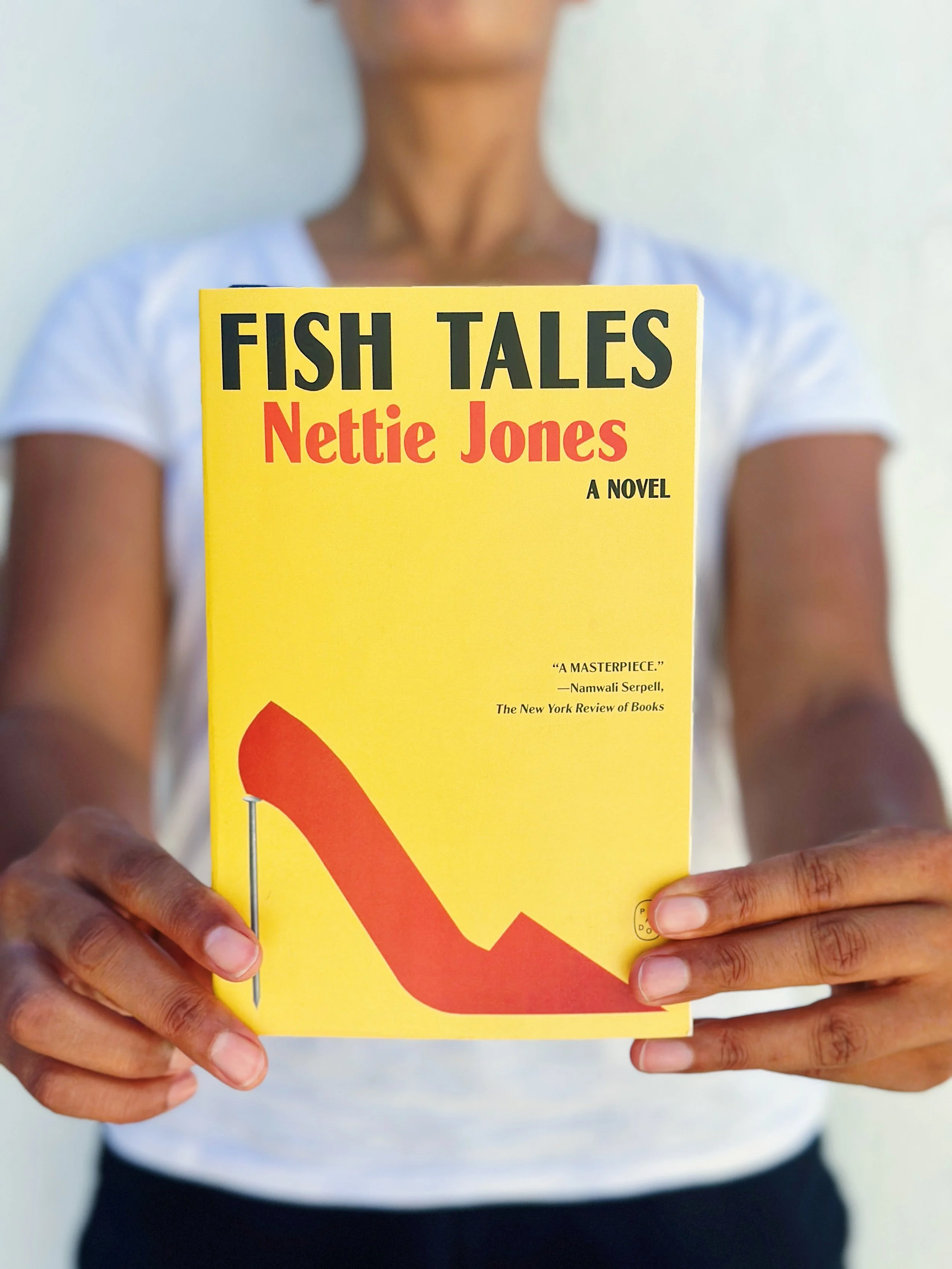
It’s The Stacks Book Club Day, and Sequoia Holmes, host of the Black People Love Paramore and Freshly Pop’d podcasts, is back to chat about our August pick, Fish Tales by Nettie Jones. Set in the 1970s, this dark, satirical novel-in-vignettes follows Lewis Jones, a freewheeling young woman partying her way through NYC and Detroit until her independent lifestyle is upended by her relationship with the handsome yet cruel Brook. In this episode, Sequoia and I discuss the difference between the book’s marketing and its actual content, the distinction between an unlikable character and an anti-hero, and the ways this book is in conversation with the work of its original editor, Toni Morrison.
Listen to the end of the episode to find out what our September book club pick is!
LISTEN NOW
Apple Podcasts | Spotify | Google Podcasts | Overcast | Stitcher | Transcript
Everything we talk about on today’s episode can be found below in the show notes and on Bookshop.org and Amazon.
Fish Tales by Nettie Jones
“Ep. 436 Intoxicated by the Microphone with Sequoia Holmes” (The Stacks)
Sex and the City (HBO)
Liars by Sarah Manguso
Marty Supreme (Josh Safdie, 2025)
Breaking Bad (AMC)
Richard III by William Shakespeare
Hamlet by William Shakespeare
Othello by William Shakespeare
Tar Baby by Toni Morrison
Beloved by Toni Morrison
The Bluest Eye by Toni Morrison
Sula by Toni Morrison
Song of Solomon by Toni Morrison
Jazz by Toni Morrison
Recitatif by Toni Morrison
Paradise by Toni Morrison
“Ep. 417 Paradise by Toni Morrison — The Stacks Book Club (Namwali Serpell)”
Euphoria (HBO)
To support The Stacks and find out more from this week’s sponsors, click here.
Connect with Sequoia: Instagram | Substack | TikTok
Connect with The Stacks: Instagram | Threads | Shop | Patreon | Goodreads | Substack | Youtube | Subscribe
To contribute to The Stacks, join The Stacks Pack, and get exclusive perks, check out our Patreon page. If you prefer to support the show with a one-time contribution, go to paypal.me/thestackspod.
The Stacks participates in affiliate programs. We receive a small commission when products are purchased through links on this website.
TRANSCRIPT
*Due to the nature of podcast advertising, these timestamps are not 100% accurate and will vary.
Sequoia Holmes 0:00
And that is something that I appreciated about it. It was very non-judgmental overall. You know, like there was no morality around it. There was no, you know, like this is how bad people behave, and this is how good people behave. It was literally just a fictionalized, inflated, or heightened version of things that she has experienced. To my surprise, I was like, "Girl, you've been through this,
Traci Thomas 0:23
yeah.
Sequoia Holmes 0:24
Ah, Nettie, you okay? I literally had to look her up. I needed all types of stuff because I'm like, 'Wait, what do you mean that this is this was your life? Are you okay today?
Traci Thomas 0:41
Welcome to the Stacks, a podcast about books and the people who read them. I'm your host Traci Thomas, and it is the Stacks Book Club Day. I am joined again by Sequoia Holmes, host of the Black People Love Paramore and Freshly Popped podcasts. We're going to discuss our August pick, Fish Tales by Nettie Jones. This novel in vignettes follows Lewis Jones, a woman in her 30s living freely and fiercely in 1970s Detroit and New York City, until her party lifestyle goes legit by a handsome and cruel man named Brooke. In this episode, we talk about the marketing and premise of this book, the way Jones explores freedom, cruelty, mental illness, physical health, and so much more in this slim novel, and why we think Toni Morrison was drawn to this project as its editor. Yes, there are spoilers on today's episode, and please make sure you listen to the very, very end to find out what our September book club pick will be. Do you like this podcast? Do you want even more bookish content, hot takes, opinions, raves, and pans? You're in luck. You can join our community, the Stacks Pack, on Patreon, and subscribe to my newsletter, Unstacked on Substack. Each of these places offers you different perks, some of which include bonus episodes, our mega reading challenge, our virtual book club, a whole slew of my opinions on pop culture and books. And by joining either or both of these places, you make it possible for me to make this podcast every single week. So to join, head to Patreon.com/slash the stacks to check out the stacks pack and subscribe to my newsletter unstacked at Traci Thomas. Substack. com. All right, now it is time for my conversation with Sequoia Holmes about fishtails by Nettie Jones. All right, everybody, it is the Stacks Book Club Day. It is august 26, 2026, and we are discussing this month's pick, which is Fishtails by Nettie Jones. But before I talk about the book, I have to introduce you to my illustrious guest. Her name is Sequoia Holmes. She is a podcaster. She is a pop culture aficionado. She was an amazing guest at the beginning of this month. If you haven't listened, go back and listen. And I am thrilled to welcome her back to the Stack Sequoia. Welcome back
Sequoia Holmes 3:06
Hi Traci. I'm so excited to be back. I'm so excited to talk about this book.
Traci Thomas 3:08
Ugh, I am so excited to talk about this book. So before we say a single word about the book, everybody listening at home, we will be spoiling this book. This is a book club pick. We will talk about it in detail. If you do not like spoilers, pause, read the book, come back. That is your right. If you did not read the book but you still want to listen, you will be spoiled. The end. I love you. I mean it. Don't yell at me on the internet. Okay, Sequoia. Well, let me tell the people what the book is about. This book is about a woman named Lewis Jones. She is in her 30s. She is well. It starts with her in her in her teenage years. She's 12, actually, not even a teenager. And it's about her life, the beginning part of her life. She experiences some trauma, and then as she is a young adult into her adulthood, she becomes a sort of free woman, if you will. She has lots of sex. She does lots of drugs. She drinks lots of alcohol, and she's living between New York and Detroit. Now, Sequoia, the question I ask everybody: Where we start broadly, big picture, what did you think of Fish Tales?
Sequoia Holmes 4:15
I did not like this book. I did not like it. I didn't enjoy it. It felt scary, and it felt scary and like a little too visceral. Like again, I really like. I I clearly like the way that Nettie Jones writes, or I like her writing abilities. I don't know that I like the way this was written. Does that make sense? That's my overarching thoughts.
Traci Thomas 4:41
Okay I, I sort of like this book.
Sequoia Holmes 4:45
Did did you?
Traci Thomas 4:46
I did. I sort of did. I have I have some issues with the book, but like I loved her writing style. I thought it was really propulsive. Like I wanted to get through it. I liked the short chapters. I liked the like. Every time something happened, I was like, "Can't get worse than this, or like, "Can't do more than this. She's done it. This is it.
Sequoia Holmes 5:07
Hold my beer.
Traci Thomas 5:08
Like I for like I finished the book, and then I was reading in a review, and I had forgotten about the champagne enema. Like that's how crazy the book is, and I had like had forgotten about a moment that I felt like I'll never forget this in my life.
Sequoia Holmes 5:19
I couldn't forget that if my life depended on it, I read it, walked into my fiance's office, and was like, "Let me tell you about the crazy ass shit I just read in an image that I have in my head that I do not want. They would have never had.
Traci Thomas 5:33
That you'll have for the rest of your life, right? So I, so I did sort of like it. I want to start here, the way that this book is marketed, this book was originally written in 1983. It went sort of off into obscurity. It was republished last year by Farrar Strauss and Giroux. Sure, I'm saying that wrong. FSG, as we call it, for those of us who can't speak, and the way the book is marketed is sort of like this is a fun summer book about a party girl. Like the back copy says, confident and cavalier, Lewis Jones seeks freedom and a good time, leaving mayhem in her wake. Strutting between the Bohemia demimonde of New York City and the affluent black community of Detroit, she guzzles champagne, snorts piles of cocaine, wakes up on silk sheets with a variety of lovers, and then she is upended by the handsome, erudite, often cruel Brooke, a man who has his own bevy of admirers. Soon, Lewis and Brooke are ensnared in a struggle for dominance that launches them into a shock of violence. Does that sound like a book that starts off with a rape followed by a teacher sexually assaulting for years a 12 year old girl into a champagne enema? It like it doesn't even mention that Brooke is a quadriplegic. Like this, I feel that this copy did many people and probably you a disservice. What did you think about this?
Sequoia Holmes 7:12
I feel the exact same way. I'm like, yeah. What? What's the fun part? When was the fun part supposed to come? And then describing Lewis as confident, I would never use the word confident in my life to describe it. Full opposite. Desperate. Full opposite.
Traci Thomas 7:28
Insecure, clingy
Sequoia Holmes 7:29
Anything but. Yes. Yes. Troubled.
Traci Thomas 7:33
Troubled. I feel that I thought I was getting Sex and the City Black 1980s.
Sequoia Holmes 7:42
Exactly what I thought I was
Traci Thomas 7:43
And I got trauma, and that's fine. Like this is a book that I'm glad exists and should exist. But to to put this cover, this yellow cover with a red high heel stiletto, like this is gonna be about a Manolo Blahnik, but not about a fucking abusive relationship and a woman who is an abuser and abused and an addict and all of these other things,
Sequoia Holmes 8:15
right?
Traci Thomas 8:16
Feels like marketing malpractice.
Sequoia Holmes 8:19
No, it was it was completely marketed in a way that I would never market it. Even the cover, like you talked about, obviously we know never judge a book by its cover, right? I've seen this cover for a lot of my life. I have laid eyes on the cover of this book so often, and so I had this picture in my head of what the book was going to be about because I've seen it for 30 years now, right? And I'm like, wow, yeah, that's gonna be a fun, you know, like a maximalist. Yes, you know the way that like black women's houses were decorated in the '80s and the '90s, and it's gonna be maximalist, it's gonna be animal print, it's gonna be blah blah. This is these are the images that I have in my mind, Not visceral, bodily, yeah, you know, like it was a lot
Traci Thomas 9:08
yeah. And I just, I'm like, and that has really nothing to do with what's in the book, like,
Sequoia Holmes 9:12
right?
Traci Thomas 9:13
I feel that what's in the book, I think is quite interesting. It's not for everybody. I understand it's like a lot, and it's like it can be icky for sure, but also you're setting up your reader for failure if they think they're getting click click clack of my heels down the street, and really they're getting a woman being like punched in the face. Like,
Sequoia Holmes 9:35
like
Traci Thomas 9:36
it's just like you need to be prepared for that as a reader in some way. You don't have to give it all away in the blurb, but like you've got to let us know that this is not a cutesy thing.
Sequoia Holmes 9:48
No, you can't start off with confident. You really can't start off with confident and cavalier. Those, you know, I Cavalier, sure, sure, I'll give you that. Confident, you can't. You just can't lead with that. It's not. It's not true to form. It's not true to who she is.
Traci Thomas 10:00
Like at least be like irresponsible or like chaotic.
Sequoia Holmes 10:05
Traci, answer this for me because it it never became super clear to me. Is she struggling with schizophrenia?
Traci Thomas 10:12
Okay, I do want to talk about this in the book. It starts like I said. She's got the the first part of the book is called Disconnect, and it is a bunch of different vignettes around different lovers in her life. Yeah, it starts with her first sort of sexual encounter, or one of her earliest ones. It's on her first because she's pregnant when the book starts at like 12 years old. Actually, I think she's 16 there, and then we go back to when she's 12. Anyways, she's in her teens, and it goes by each of her lovers. So, like, starts with Jason, and then it goes to like mr. Brown, who's her teacher. And throughout this whole first section, there is this like character that she talks to, Cestra, who is this woman in my mind, who she call, who she refers to as her sister. This character to me is a very unclear character. I think on purpose is this a voice in her head? Is this someone she knew and is talking to? Is this just like her conscience? What's going on? Later throughout the book, there are multiple instances of mental health crises where she blacks out. She ends up in mental hospitals. It happens at least twice. One time, I believe she also goes to jail. She's like, or at least she's at least accosted by the police. She's reprimanded. I don't know that she specifically is schizophrenic. Like, I don't know that it specifically says that, but clearly there are mental health issues going on with her, which I also think complicates this idea that this is just like fun, fun, bang, bang, bang. How did you read it?
Sequoia Holmes 11:49
I I started reading it as though she was schizophrenic, and we just weren't having names to it because we talk about Cestra, and maybe I'm mistaken, but I think there was one other named character that she started referring to as her internal monologue, or you know, there was one other person. I think I really could be wrong on that. Where it's like it might have just been Cestra whole time. Yeah, like Cestra telling her to jump out the window during the whatever her. Oh my god! And then there's Kitty Cat. Oh my God! Nice, wonderful. Love Kitty Cat. Kitty Cat. I love love Kitty Cat's character. But Kitty Cat having dealing with his best friend's mental health crises and just kind of being like, "Oh yeah, she went through another one of her things, you know. "Oh yeah, she's like going through another one of her thing. I'm like, "What is what is the thing? What's the thing? She's what is it? Is it is it schizophrenia? Is she borderline? Is it bipolar? Is she manic in these points? Like, what's happening?
Traci Thomas 12:46
Right. Yeah, I think it's definitely undefined, un at least undiagnosed to us mental illness. But I feel like it was pretty clearly something. One of the things that happened to me when I was reading this book that I don't think is actually bared out in the text, but I was sort of like considering it as an option, maybe halfway through the book when I was sort of because there were definitely times where I was like really confused as to what was going on. I think the vignette structure sort of lends itself to that kind of confusion. But I started thinking, what if all of these people are not at all like like she's such an unreliable narrator that they're all like actually unhoused people, and they are sort of like this is like a like her fantasy of her life. So like the things are happening, but they're not actually like going out to these fancy restaurants and like because it would be like she would show up somewhere, and the bouncer would be like, "Oh, you're back, or like whatever. That I was like, "Oh, maybe they are like a quote unquote nuisance. Like maybe her and her crew. Like it's not as glamorous as she's making it out to be. She shares this apartment with Woody, who's her ex husband, and like maybe he feels bad to her for her, and so she doesn't really share the apartment. He's given her like a room, but he can't really control her, and she's in and out, and he's just like trying to do the right thing by her. And I don't know that that's like bared out in the text, but for probably at least a quarter of the book in the middle, like that third quarter, I was really working on like this is going to be the twist. Like that's where I thought the book was going because she like after she goes to the mental hospital at the end of part one, I was like, "Oh, now she's out. She's on the streets. She has nowhere to go, and this is like her delusion of what's happening.
Sequoia Holmes 14:31
There's always Woody. Woody's always like, "Yeah, you can come on back home, babe. We've got your room held for you. But yeah, no, that would make so much sense if it was actually Woody's entire apartment, he's like, "Yeah, my my wife. We never really got a proper divorce.
Traci Thomas 14:46
Yeah,
Sequoia Holmes 14:46
but I don't want her to have nowhere to go, so I put her up in that room sometimes. Just like leave it, leave her alone. If you see her, keep your you know maybe keep your distance. Be mindful she's not all there.
Traci Thomas 14:57
That's sort of how I had read it. I don't. And I don't know if that's bared out in the text, but that carried me through like at least 50 pages. I was like, "Oh, I figured it out, you know, because I'm always like trying to like slew the book to like see if I got it right.
Sequoia Holmes 15:09
Yeah, that's that's really good one. I could I could see that, and that would help make sense of it for me because a lot of it was confusing, like you said. While I appreciate the vignettes in that it kept the pace of the book, you know, really quick and pretty interesting, and every vignette in and of itself was interesting.
Traci Thomas 15:25
Yeah,
Sequoia Holmes 15:26
yeah, I, I, it, it definitely lends itself to a level of confusion that I don't prefer in my books.
Traci Thomas 15:35
Yeah, I don't, I don't prefer to be confused in this way when I read fiction. However, I think like a lot of the stuff she was tackling and the way she was tackling it was really interesting and exciting to me. Like I think about if this book was written now, how precious it would be, and it would be like she's dealing with mental illness, and like everything would be so defined. It would be like Kitty, her friend, who is a man but also likes to dress as a woman, but is not transgender. Like it would just be like so prescriptive, and I liked how this was sort of just like I. He gave me the look, so I walked over and started touching myself, and I'm like, great. I'm like, great, wow.
Sequoia Holmes 16:16
There was also her and Kitty having sex often,
Traci Thomas 16:21
often
Sequoia Holmes 16:21
that that kept confusing me as well. I'm like, why?
Traci Thomas 16:22
Well, this is like the free love thing. This is like was like big in this era. I feel yeah. Of like women can like we have we have Roe v. Wade. Women can be as promiscuous as they want now. They can, and so I think a lot of writers were sort of exploring this at this time, which I think is really like interesting to see her sort of in in a lineage like from this moment this like forgotten text that is now back and being like right this is what people were talking about and I think you know even the reviews at the time were like whoa this is even more than we're used to but that like this is something like that. She was really pushing the boundaries at the time.
Sequoia Holmes 17:06
1,000% I was thinking for 1983. Yeah, this had to be a shocking piece of text to come out in 1983.
Traci Thomas 17:14
Yeah, because it does read really fresh. Mostly, the only things that like don't feel super fresh in the book now are like some of the references. You know, like Kitty has like the voice like Lena Horne, and I think like I know who Lena Horne is, but people, you know, it would be someone more culturally relevant if it was written now, right?
Sequoia Holmes 17:32
But just on the on the on the note of Kitty and her having sex all the time, the reason why it bothered me, there is the cultural narrative that like men and women can't be friends without it being sexual to some degree, and like lots of people genuinely believe that. Yeah, and so I'm like, yeah, I don't fuck my friends. I'm never, I'm never gonna fuck my friend. I'm never gonna fuck my gay best friend. I'm never gonna fuck any of my friends. This is just not gonna happen. Why is she up here? Why are they up here having sex with each other.
Traci Thomas 18:01
Well, you're not Lewis
Sequoia Holmes 18:03
Let me tell you something. I'm sure not. Absolutely not Lewis at all. I mean, like man, Lewis could not be more different.
Traci Thomas 18:11
Yeah there's lots of things that characters and books don't do or do that I would never do
Sequoia Holmes 18:17
I'm like, girl, you making us look bad. Us with besties that are that are male.
Traci Thomas 18:20
Yeah,
Sequoia Holmes 18:21
you making us look funny, right?
Traci Thomas 18:23
But remember, their relationship started with her calling him for sex. Remember, like she calls on Christmas, like dial your desire or whatever.
Sequoia Holmes 18:33
Oh that was Kitty.
Traci Thomas 18:35
Yeah, yeah, yeah. That was Kitty. It was supposed to be two men, but then it was just Kitty, and then they she was like Kitty's the most beautiful man I've ever seen. I sort of like I sort of envision that character, a la like RuPaul, you know, where like sometimes RuPaul's in full drag, and then sometimes he's not, and like is his this other like sort of masculine versus feminine version. Like so, I kind of envision Kitty like that, where Kitty could easily sort of move between these two things, and that like some of...So I sort of feel like in my mind it makes sense because like they're both these like really sexual beings, and that like some of the fun was probably like having sex with Kitty when he's like dolled up, and sometimes it was fun having sex with Kitty when he's like dolled down. I don't know if that's a term. but you know what I mean. Like it was just sort of like they were just their friendship was around fucking and sucking. You know, it sure was like it wasn't probably like your friendships where it's like, so would you want to go to dinner? They were like, do you want to do drugs and fuck? And they were like bringing people into their relationship, like so. I feel like that was the basis of their friendship.
Sequoia Holmes 19:46
Yeah. No. Okay. I forget that that initial yeah prostitution call I would say was Kitty. Yes. Okay.
Traci Thomas 19:54
Did you read the author's note at the end of this book?
Sequoia Holmes 19:57
Um, I think I did. Question mark. Is it the epilogue?
Traci Thomas 20:00
It's yeah, like the little bit where she talks about her own life and how she wrote the book.
Sequoia Holmes 20:04
I was shocked.
Traci Thomas 20:05
I mean, I was shocked, but it sort of made me appreciate the book more because I was like, right, this is not just a totally fanciful story, but like a lot of this is the life that Nettie Jones lived. And have you ever heard of this term, autofiction?
Sequoia Holmes 20:21
No.
Traci Thomas 20:22
Okay, so autofiction is like a type of fiction where authors basic it's autobiographical fiction where authors take their life and sort of fictionalize it. And generally, I hate autofiction. Generally, I think it's just like a way for an author to be like, "Here's what I think about immigration, because I like like I was an immigrant and so like I and then the character will like have like monologs where they talk about like ice or whatever and I fucking hate that kind of shit. A lot of times autofiction it's like about like a relationship like there was a book a few years ago called Liars where this woman like did autofiction of her divorce and like her marriage falling apart and her husband cheating, and like it was a compelling book. But also, I was just like, just write the essay. Like, just tell us what happened.
Sequoia Holmes 21:12
Go to the cut. Write the essay.
Traci Thomas 21:14
But this book is autofiction, and I felt like it read like real fiction. It did not feel to me like Nettie Jones was like preaching to us,
Sequoia Holmes 21:24
not at all
Traci Thomas 21:25
about like yeah, this is what life should be, or like she. It was almost so removed that I was like, she doesn't even have like it didn't feel like she had an opinion about any of this stuff. She just was like, here's what happened,
Sequoia Holmes 21:38
and and that is something that I appreciated about it. It was very non-judgmental overall. You know, like there was no moral, no morality around it. There was no, you know, like oh, this is how bad people behave, and this is how good people behave, and yada. None of that was happening. It was literally just a fictionalized, inflated or heightened version of things that she has experienced to my surprise. I was like, "Girl, you've been through this, Ah, Nettie, you okay? I literally had to look her up. I was like, now who is this woman? I need to. I needed a picture. I needed all types of stuff because I'm like, wait, what do you mean that this is this was your life? Girl. Yeah, are you okay?
Traci Thomas 22:21
like even the part where it got where in her like author's note thing, and she talked about how she like fell in love with a quadriplegic, and I was like, wait, I thought for sure this bit was exaggeration, right? Like maybe she fell in love with the man who had a disability, but like the fact that it was just like her life,
Sequoia Holmes 22:39
yes,
Traci Thomas 22:40
I thought that was pretty incredible.
Sequoia Holmes 22:42
I thought that, and again, like you said, it was really fictionalized. Like it felt like I was reading fiction. It did not feel like I was reading somebody shoehorning a political stance about any specific things through the lens of their life at all.
Traci Thomas 22:54
Yeah, it did. It I I was pretty. I knew that like I had heard. I hadn't read any. I tried not to read anything before I read the book, but I had heard from someone that like she had said during her press run for this re-release that like the book like a lot of the stories came from her life, but that to me was like oh a person like Kitty she knew or like once she had an orgy not right not like even she talks about Woody her ex husband who like she was like well the character Woody is based on my ex husband Frank,
Sequoia Holmes 23:21
like, and I was like, she wasn't even like changing the names that much.
Traci Thomas 23:27
She wasn't, even the main character is Lewis Jones, and the author's name is Nettie Jones
Sequoia Holmes 23:32
Right? I'm like, oh wow, it was so vivid in the fictionalization. It almost read like magical realism sometimes to me, where I'm like, this is so heightened and so beyond my scope. I cannot even picture what you're talking about,
Traci Thomas 23:50
right? And I think probably the vignettes help with that too, because it's like has this sort of there's like no clearly defined space and time. Like sometimes we're in New York, sometimes we're in Detroit, and you're sort of just there's never like, and then I moved to Detroit. It's like no, never. I never know where we are.
Sequoia Holmes 24:06
Right, we're like referencing spaces, and I've never lived in New York nor Detroit, so I'm like they're referencing streets and you know Midtown and blah blah blah. And I'm like, are you in Midtown, New York? You in Midtown Detroit? I don't know. Where are Midtown Detroit? Is there a Midtown Detroit? I don't know what's going on?
Traci Thomas 24:20
It's true, and to your point about like the lack of judgment, I do think that also really helped the book for me. I think if it had felt like preachy in any way, of like let him have sex or like this is a life of deceit or whatever, I would have hated it. But I I did feel like you know, like there's so much queerness in this novel, like not just in the sex, but just like in the presentation of almost everything, and like the way that she moves around, and she just drops off an abortion like on the first page, and she sort of like I don't, I wouldn't say that she like rationalizes or forgives. Like childhood sexual assault from from this teacher, but she doesn't condemn it. Like she does, she just sort of is like, "This happens,
Sequoia Holmes 25:08
yeah,
Traci Thomas 25:08
this happens, and it happened, and you, dear reader, can feel about it how you feel about it
Sequoia Holmes 25:16
right, and I did.
Traci Thomas 25:17
And I just feel like nowadays authors don't trust their readers to feel or do anything. Like she was very much like, if you're reading this book, you're a big kid, you can figure it out.
Sequoia Holmes 25:27
She's like, yeah, you lean on. I'm gonna tell you what happened. You make your own judgment calls, your own feelings, your own vibes about about how you feel about it. Yeah, the the teacher angle in the beginning, it was so non-victim,
Traci Thomas 25:44
yeah,
Sequoia Holmes 25:44
from a circumstance that is objectively you have been victimized, you know, yeah. She's telling it from a perspective that is so non-victim, and only even slips into a victim thought about it when it goes south, when the man marries somebody else or whatever, and then she's yelling at the new wife. You know, oh, he's been touching me since I was 12. He's been molesting me since I was 12.
Traci Thomas 26:08
Right,
Sequoia Holmes 26:09
and she's only doing that because she wants him.
Traci Thomas 26:11
Right,
Sequoia Holmes 26:12
and obviously there's some Stockholm syndrome there.
Traci Thomas 26:16
Yeah,
Sequoia Holmes 26:16
but yeah, even the way that she talks about her own things, where she is objectively the victim, or something bad is happening to her, she almost doesn't give a damn. It's almost like she lives in a world where it's like, yeah, bad things happen. I'm not special,
Traci Thomas 26:28
right? Right.
Sequoia Holmes 26:29
And as a girl who loves a happy ending, I don't like it. I'm like, no, stop. I know bad things happen in the world. I don't want to read about it. Stop.
Traci Thomas 26:40
See, I'm the opposite. I'm a very much bad things happen person, so I I really like it. And again, I just feel like in 2026, this book is so different. I probably hate this book in 2026.
Sequoia Holmes 26:53
It would be really bad. The yeah, the story, the the language used, the specificity, like you said, the naming of everything would be right there, and I'm trying to think: Would I like it more? I don't think there's a world that I like a character like this, unfortunately. You know, and it's not that I always have to like my main characters, but I do want to find something redeemable, and I wasn't able to find that in Lewis personally, it wasn't like she was the worst human being ever. But I also couldn't find anything that I could latch onto from Lewis.
Traci Thomas 27:28
I want to talk about Lewis. We're going to take a quick break, and we're going to come back and talk about Lewis. Okay, we're back as promised. We're going to talk about Lewis because I love an unlikable character, an unlikable woman character specifically. Though I sometimes like unlikable men characters too. Sometimes, but what I was thinking a lot about when I was reading this book is: is she unlikable, or is she an antihero, and do you make a distinction between those two kinds of characters? And if so, what are what's your distinction?
Sequoia Holmes 28:08
I do think those are different. I don't think she's necessarily likable or unlikable. I think she is just really, really human, and I think she's an antihero in that she has no real behavioral character arc, or you know what? She, I guess she does, in that she eventually falls in love with somebody and quote unquote settles down. But she doesn't really have a story arc that is like, oh yeah. And then she learned her lesson, and then things change.
Traci Thomas 28:38
There's no resolution. There's no resolution.
Sequoia Holmes 28:42
There's no dark night of the soul that causes a different behavior soon. You know, and so I think she is the anti antihero. What do you think, Traci?
Traci Thomas 28:53
I think she's an antihero. I I was just thinking a lot about how like when we read books that I call like unlikable women characters. Generally, I mean that they're pretty likable women. They just make bad choices. In this case, I feel like an antihero. Like when I, which is usually used for men, it's usually around like selfish characters who are sort of like very one track minded, and they they want what they want. They're going to do anything they can to get it and keep it. They're manipulative. They're abusive. They're unreliable. They lie to the audience. They lie to other characters.
Sequoia Holmes 29:28
An example would be Marty Supreme.
Traci Thomas 29:31
I didn't see Marty Supreme, but like Breaking Bad example, Breaking Bad is like a is like a very famous one. Some people argue that Carrie Bradshaw is actually an antihero.
Sequoia Holmes 29:40
Yes, I would give that. Yes, yeah, yes.
Traci Thomas 29:43
And so I felt like I felt yeah, like, and also I feel like antiheroes can be very charming. It's like we don't like them because of the bad things they're doing, but we are endeared to them and we want to be with them in a way that an unlikable character. Sort of like they're like a fine person who's just like doing bad things, and you're like stop like an unlikable character. You're like if you just didn't do that, things would be fine. Whereas an antihero, it's like you are bad to the bone, like you are in your core fucked up. And so to me, that distinction felt really important in this book because it wasn't like if she just stopped having sex or like got sober, it was clear to me that like this woman is and and in this case, I mean she has mental health issues and so she's unwell and the alcohol and the drugs and the sex and the like crazy lifestyles all contributing to that. But that like that's who she is. She is fundamentally like a narcissist. She is fundamentally like there is not a behavioral change that would make this person, quote unquote, better for the reader. Like this is just a book about a bad a bad lady.
Sequoia Holmes 30:55
I agree, and I have trouble with people who don't want to be better.
Traci Thomas 30:59
Ah, yes, okay,
Sequoia Holmes 31:00
and she definitely had no interest in being better. And I think that's where I fall off with Lewis, where I'm like, okay, starting off this novel. Okay, I see she's gonna, you know, she's gonna improve. She's gonna, she's gonna get sober, and maybe that'll address her mental health issue. She doesn't. You wouldn't know if your mental health issues are induced by alcohol and drugs, or not, unless you stop the damn alcohol and drugs.
Traci Thomas 31:23
Right
Sequoia Holmes 31:23
But does she have interest in doing that?
Traci Thomas 31:25
No no.
Sequoia Holmes 31:25
Even if it's to the detriment of her mental health, she does not give a fuck. That irks the fuck out of me, out of a out of a Virgo moon girl, whose whose whole language is critique and improvement, critique and improvement. That's how I feel love. That's how I give love. I can't. Lewis is not somebody that I could ever fuck with. Reading about her stress me clean out.
Traci Thomas 31:50
Yeah, yeah. I mean, and you know what I think is going to be interesting. I feel like there will be plenty of people listening to this conversation who feel the same way as you. Like I think this is a book that is super polarizing for readers. I think, especially going in, if you do not know that this is going to be as violent and sort of obscene as it is, you're just not prepared.
Sequoia Holmes 32:13
You're not prepared. It's vulgar. It's vulgar.
Traci Thomas 32:15
And so I feel like there's probably I would guess if I had to guess, I would guess 75% of people who are listening to this are probably agree with you. Not that I disagree with you, but like have come down on this character in the ways that you have. I think I'm slightly more into it just because I like fiction that is just like I like my fiction to be despicable people. Like my favorite characters are always bad guys. My favorite Shakespeare play is Richard the Third. Like I'm like Hamlet, boring. Do not care. I'm like you're scratching the surface for me with like an Iago, you know. But like I, I even like this is gonna sound bad because I'm gonna say this very clear. I do not like this person, but I am so deeply captivated by the fucking horror that is Donald Trump, like I get that his,
Sequoia Holmes 33:07
I do get that,
Traci Thomas 33:07
like his fucked up behavior, his evilness, and then also like his little jokey jokes. Do you know what I mean? Like that kind of person, I cannot take my eyes off of. I hate him. I despise him and everything he's done. And yet, when I see a clip of him, I'm like, "What's this nigga gonna do next?
Sequoia Holmes 33:29
I definitely understand exactly what you mean.
Traci Thomas 33:32
And so I feel like a book like this, she is that kind of person where I'm just like, "You are gonna do the absolute most unhinged thing in every moment because that is who you are, and I'm gonna come with you and openly be like, "What's happening every single time? I'm
Sequoia Holmes 33:54
gonna drop you off at the corner and tell you, "Don't talk to lose my number. Get out of my car. That's right.
Traci Thomas 34:00
I don't want her to have my phone number. Do you know what I mean? Like I will have her number so I can like, hey, where are you at? But like I'll always be no caller ID.
Sequoia Holmes 34:09
Her location's on. She doesn't have your location though. But you need her to keep hers on.
Traci Thomas 34:13
Yes, she can reach me via email at most. You know, and I don't check my email on the weekend, so we'll see.
Sequoia Holmes 34:20
Sorry, girl.
Traci Thomas 34:21
If I see that you're out, I will be out with you.
Sequoia Holmes 34:25
Okay. Okay. That's fair. Yeah.
Traci Thomas 34:27
Okay. The other thing I want to talk about, or one of the other things I want to talk about, is the the split of this book. Disconnect Part One. Connect Part Two. Did you have any thoughts about this? Did you did you try to make sense of this at all?
Sequoia Holmes 34:40
I didn't try to make sense of this at all, and now when I think about it in retrospect, I'm like, makes complete sense. She, you know, it's kind of floating about life in the beginning. She doesn't have any real anchor, and during the disconnect portion, and then during connect, she has a very clear anchor in what's that man, Brooke,
Traci Thomas 34:56
Brooke,
Sequoia Holmes 34:57
trash. He's trash. He's trash. Yeah, he was awful. My god
Traci Thomas 35:02
Which I also loved. I love when there's disability representation and the person is just a fucking monster.
Sequoia Holmes 35:10
I did like that, and I also think, hmm, I'm just for reference where I'm coming from. My dad died of cancer, and I watched him die, and as he got sicker and sicker, he kind of got meaner and meaner. And my dad was a very stoic, very non-emotive, and if there was an emotion, it was nice. Always like very likable, very very nice guy. During that illness, that was taking his ability, he was not. He got meaner and meaner and meaner, and so I feel like that is a very realistic portrayal of someone who went from a really high ability.Yeah, you know, he's a football player and swooned after a wrestler. Yeah, and like swooned after and all of that. Six three, whatever six five, you know, height is really important to men. To now, you you don't you can't lean on your height at all,
Traci Thomas 36:04
right?
Sequoia Holmes 36:07
You don't have the abilities that made people swoon over you in the first place. The something that that does to a person, I liked the way that they portrayed Brooke. That felt very realistic to me,
Traci Thomas 36:20
yeah, yeah, yeah. Two things that you're saying reminding me two moments in the book. One is I can't remember if it was Kitty or Woody, but they say to Lewis, they're like, imagine having to look up at every person.
Sequoia Holmes 36:33
That stuck out to me too,
Traci Thomas 36:35
right?
Sequoia Holmes 36:35
Like because she's always looking down because you're talking to look up.
Traci Thomas 36:39
You always have to look up, and then the other bit was there's a part where I believe after he's told her kind of his story or something, she makes a comment or she's maybe she thinks that that's like I could tell he was even meaner before. Oh, remember she has like some line of like I could tell he was like an even bigger asshole.
Sequoia Holmes 36:59
It was like Sestra talking in her head. I think. Oh yeah, maybe. Yeah, he was even he was he was even a bigger asshole before the accident.
Traci Thomas 37:06
yeah, but I do I do hear what you're saying of like sometimes like I think like some of the resentment that he showed like towards his like his disability and like towards the situation that that he's been living in since he was a teenager. I thought that was really like I thought he was a really fleshed out character.
Sequoia Holmes 37:24
Yes,
Traci Thomas 37:25
especially considering how short the book is and how like in all in the grand scheme of things he only is part of half of the book, which is more than a lot of the other characters. But still, like it's her point of view, and I felt like Nettie Jones was able to like give him complexity and a depth that was interesting, and I think like part of the you know I think one of the things that Lewis says about him is like it was the first time I ever met a man that I thought was like as good as me or was better than me, and so I thought that was really interesting because the whole first half of the book you know she's just bopping around doing her thing, and then she settles down with this person because she finally finds someone who that she thinks is like worthy of her, or like even or like she is needed to be near.
Sequoia Holmes 38:07
Yeah.
Traci Thomas 38:08
As far as like the two parts of the book, the disconnect and the connect. In part one, disconnect. She has that conversation with like Mister Brown's wife, where he says something to her. She says something to her that's like, "You need to disconnect your pussy from your brain. Sorry, I had to.
Sequoia Holmes 38:23
The way that I jumped when I read, I screamed. I think I screamed and laughed. I think that was the only time I laughed out loud reading this. I screamed and I laughed.
Traci Thomas 38:34
Yeah but I do think that like that is the framing of the whole first part. She's running around having sex with everybody because she's like attempting to do this thing, but it ends with her. That section ends with her, you know, in a hospital admitted for mental illness, and then in part two is when she connects her pussy, if you will, and her heart to her brain with Brooke, and that ends with, and this is the big spoiler: her murdering Brooke. Oh did you not think it was a murder?
Sequoia Holmes 39:04
No, I did. I said, "Oh, she just killed him. And then I looked it up, and the internet was like, "No, she didn't. And I was like, "What do you mean? Yes, she did. I was like, "Yes, she did. She took the knife. She took something sharp to his neck, and there was blood. What are you talking about? What are we talking about?
Traci Thomas 39:18
Who said it wasn't a murder?
Sequoia Holmes 39:19
Hold on, I literally just Googled it. You know what? So you never know.
Traci Thomas 39:22
I always think everything is a murder. Every book I read, like every time I read a book, I'm like, "Oh, it was a murder."
Sequoia Holmes 39:28
So she killed him.
Traci Thomas 39:30
There's no other way to read that.
Sequoia Holmes 39:32
I'm like, "What are you talking about? The blood? Well, why was unless she again has psychosis and she made that shit up? She killed him.
Traci Thomas 39:41
Wait, here's what happens. She goes to the apartment after he's like broken up with her, whatever, and Tommy's there, the other woman, because also he has like all these women like waiting on him. I'm just like, I want to meet this man so bad. Like, what was the Riz? Because it was obviously off the charts, right? Like, word to believe is very swaggy over there.
Sequoia Holmes 39:59
And my thought here is when you when she says she met someone who's better than her. I think you can think about it as someone who's worse than her, i.e. more narcissistic than her, yeah, and more alluring in that way.
Traci Thomas 40:08
Yeah, like that he's like he's not necessarily. I don't know if she said better, but like that he is her, but like bonus, like plus,
Sequoia Holmes 40:15
like like really rizzed up,
Traci Thomas 40:17
yeah, yeah, yeah, yeah, yeah. She so they so then he comes back, and Tommy's like, "I'm out of here. Like this is fucking nuts. So it's just Lewis and Brooke in there, and he starts like just like talking shit to her. He calls her a pill popping parasite bitch. He says, "My brain is not paralyzed, Lewis. Yours is, however, and not accidentally. So after they have this fight, she goes and gets Tommy's birthday gift that she'd selected. That's like two like pieces of lingerie, and she says the scissors waited in the shopping bag with the wrappings and ribbons. I picked them up to use on her gifts. How funny it would be to see her face after she opened up those pretty gold boxes and found those beautiful teddies cut in half, I ended up in his study with those scissors. He didn't look at me until I got real close to him. I saw his raw terror. I lifted those black stockings up in the air and draped them over his head. The pieces looked like streams of smoke descending. I tried to stuff one into his mouth. Then I cut holes in the teddies where their button breasts were placed. Brooke didn't say a word; just sat there rigidly. When I finished, he turned, tried to get his telephone off its cradle without taking his eyes off me. As he searched for the nine, I went out like a set of Christmas tree lights. His cries for help sounded so far from us, the blood and the gash in his neck, his arm lifted to protect his head. Boys got hard, hard heads. Cestra whispered,
Sequoia Holmes 41:50
Oh my god
Traci Thomas 41:51
That's a fucking murder!
Sequoia Holmes 41:53
No, yeah, she definitely murdered him. She absolutely murders him.
Traci Thomas 41:55
Okay, glad we got that out of the way. This is why AI ain't shit.
Sequoia Holmes 41:59
I'm telling you, like,
Traci Thomas 42:00
please it's in the text.
Sequoia Holmes 42:03
Right, the text was right there.
Traci Thomas 42:04
Yeah. Then she goes to Woody, and he's like, "Hey, you've got blood a little disheveled. Yeah, it's giving blood.
Sequoia Holmes 42:15
Everything okay?
Traci Thomas 42:16
Everything okay? And he's there with his girl Cookie, and she's like, "And he's like, "Cookie, please leave the room.
Sequoia Holmes 42:22
Get up, kick cookie. You might be like, Cookie,
Traci Thomas 42:25
you need to take that shower. You need to go. And then he, you know, he realizes who he's dealing with. He's probably, maybe, genuinely the only person who ever really loved this woman.
Sequoia Holmes 42:39
Yeah, yeah.
Traci Thomas 42:40
And if not, if not, I mean, who knows? Maybe not love, but like he's one of the few people who always took care of her. It sounds like he he sort of did right by her, and then we get this like epilogue, which ends with where the book starts. Do you remember these like italicized paragraphs about Annie Stewart, Miss Annie Stewart.
Sequoia Holmes 43:05
I do remember the italicized paragraphs, but before we get to that part, can I just say that I really loved the end of this book, like where essentially she says, like the freedom that you gave me felt like you didn't care. Like it didn't feel like like I know that you love me. I know that you care. You were trying to let me be the wholeest version of myself and the version of myself that felt felt the most natural. But your lack of anchoring me felt like you didn't give a fuck about me or like abandonment. That that was so potent and so interesting to me. I loved that portion. It didn't bring the whole book around for me, but I did really like the way that it wrapped up.
Traci Thomas 43:53
So I do feel like the ending is what brought the book around for me. Yeah, I was more on your wavelength. Like I was texting a friend who had read it when I was probably like 70% in, and I was like, "How am I going to talk about this? Like, I don't know that I understand what I'm reading. Like, I don't know. And then after I finished the book, I just texted her and said, "A murder. I'm in. Yeah, because like, there's something about if this book had ended in any other way, her even if it had ended in like a more positive, like I'm walking away, like I don't need you, Brooke. Kind of like you go, girl ending. I would have hated it, right? Like it wouldn't have worked. But even if she just like left him because she found another lover, I would have been like, this is so unsatisfying. But there's something so satisfying about this like character that is so over the top, going out in this sort of like unhinged, violent, murderous thing, and then this epilog where she goes back to Woody and he's like, "I I thought I was loving you. I thought I was giving you what you needed, and she was. Like you gave me the freedom to destroy myself,
Sequoia Holmes 45:03
right? Under just you watched me just destroy myself, and I think that's what got her so hung up on Brooke. He was really critical of the way that she destroyed herself, you know. And because she had never had anybody criticize her, that felt like love to her.
Traci Thomas 45:21
And also there was like a rigidity of his life, right? Like there were things that needed to be done. There was a purpose to being.
Sequoia Holmes 45:28
She was anchored for the first time. Yeah, she never had any anchor at any other point, and for the first time, this person needs me. In fact, he kept saying, "I don't want you. I don't want you, and she kept saying, "But you need me.
Traci Thomas 45:42
You need me. Yeah,
Sequoia Holmes 45:44
girl. Oh my god, this is the again. This is why calling her confident was so shaking to me. Like I'm like confident?
Traci Thomas 45:55
is the confidence in the room with us?
Sequoia Holmes 45:57
No confidence. It's not in the room. It's not in the book. We're not on the same page. There is no confidence.
Traci Thomas 46:02
Right.
Sequoia Holmes 46:02
She has no self-concept. She doesn't know who she is.
Traci Thomas 46:06
Right.
Sequoia Holmes 46:06
That's the bottom line. She has no clue who she is. She keeps waiting for somebody to tell her. Brooke tells her essentially, "You are my caregiver. I will give you a life not worth living, but like that somebody needs you. Quote unquote. And she, boy, does she latch on. Meanwhile, Woody thinks he's doing the best thing for her, letting her be a free spirit, letting her be a free woman, letting her, you know, be poly if that's what she wants to do. And meanwhile, that feels like abandonment to her.
Traci Thomas 46:39
Right. So interesting. There's like two more things I want to just quickly touch on before we get out of here. One is this beginning and the end. So the book opens with these italicized paragraphs about Miss Annie Simmons strutted down her front porch steps on one May Day, butt naked except for a pair of high heeled pink satin bedroom slippers and a short strand of coral colored pop beads, and it goes on to talk about how she like squats down in the street and starts masturbating, and then the police come over, and her husband comes outside, and he says, "Oh, Annie, baby, my poe baby, what's wrong, Annie? Those are the first words I ever remember hearing mr. Simmons say to anyone other than "Good day. mrs. Simmons didn't say anything; she just lay there looking up at the sky, snot running from her nose, thick spit formed at the corners of her mouth. As they went to pick her up, she looked at them only long enough to spit in mr. Simmons's face. After that, she just closed her eyes and seemed to be asleep. And then, at the end of the book, we have this paragraph, much shorter. mrs. Annie Simmons went berserk one day, walked down out our street butt naked. I was coming home from school. They threw her down on the sidewalk. She kept yelling out, "Help me, Jesus! Somebody help me! They're trying to kill me! mr. Simmons threw his blanket over her and held her down and waited for the policeman. Spit formed at the corners of her mouth as she quieted and stared straight up at the sky. Do you think that Lewis is Annie Simmons?
Sequoia Holmes 48:02
I do, I do think Lewis is Annie Simmons. Yeah.
Traci Thomas 48:06
Do you think this scene is happening right at the end of the book, or do you think this is in some future?
Sequoia Holmes 48:12
Future. I think this is a little bit. Yeah, a little bit of time is passed. Future. Yeah.
Traci Thomas 48:17
So you think this continues, and that Mister Simmons is Woody?
Sequoia Holmes 48:21
Hmm. It never occurred to me who Mister Simmons is, but yeah, I definitely think Miss Simmons is Lewis for sure. What do you think?
Traci Thomas 48:32
So when I started the book, I thought that that that vignette was like something that Lewis remembered as like a child, saying like that just like framed her frame of reference of like a woman could go crazy, and there's a part where they talk early in the book where she talks about that boy Jason and his friends like running train on a girl, and then she goes crazy. Yeah. And so at first, I thought that's sort of where this book was driving that like all of this sex was gonna like make women crazy, but then throughout the book, a few people call her like Anna Lou and Annie Lou, and so I thought that maybe the Lou was like her middle name, Annie Lewis Simmons or whatever, and that I think the most interesting interpretation to me is that this. The I think the most hopeful interpretation to me is that this this italicized vignette happens immediately. after the police are there because they're looking for whoever killed Brooke, and then the reason I think that's hopeful is because then like maybe she gets the help she needs.
Sequoia Holmes 49:32
That's interesting.
Traci Thomas 49:36
I think if it's like in some future, it just means that she continues down this path for like a longer time, which feels like so much bleaker. I think both are probably could be right, but I I think I chose to believe that it was just like she's this is just the next thing that happens. She runs outside, and also because at the end of that the scene we were talking about with her and Woody, where she talks about you know you gave me the freedom to destroy myself, there is a bit right there where she talks about like reaching down and touching her marbleized.
Sequoia Holmes 50:05
Yeah, I mean, I did notice she says she reached down and she was marbleized.
Traci Thomas 50:10
Yeah, yeah, yeah. The tears flowed down her hairy, his hairy chest. I took my finger out of my mouth, placing it squarely on my little girl. She was marbleized. So there is this idea that she was like aroused by all of this, and so she went outside to just like get to finish the job. So I think I don't. I mean I don't know. There's also a version where like again this is just some other person,
Sequoia Holmes 50:31
right? Right. I really do. I really do think it's her. I I like that maybe this happens right after she kills Brooke and goes home and sees Woody. Yeah, I think that's the version I like the most. What I would like your thoughts about is why are the retellings of it so different from the beginning to the end? You know, like in the beginning, Annie Lou spits, and the end not hearing much about the spitting,
Traci Thomas 51:01
right?
Sequoia Holmes 51:01
And again, you know, like there's just like these differences. I'm like, who whose perspective? Or it's like it's coming from two different perspectives. Maybe the first one, I don't know. I'm I'm wondering who these perspectives are.
Traci Thomas 51:12
I hadn't really thought about that. I mean, it's possible that the reason it's shorter is just because like we already know it, so they're just trying to. She's just trying to jog our memory of this scene, and like it would be weird to put the exact same paragraph there, but I think that's sort of like a boring answer. So I think maybe like a more interesting answer is that maybe it's like Lewis outside of her body looking down on it, and no, that doesn't really work. Maybe it's Sestra. I don't know.
Sequoia Holmes 51:41
Maybe so, because I'm like maybe Cestra is her alter. You know, like maybe it's not. Maybe it's maybe yeah. Maybe it's really her alter ego. But because the beginning, the first retelling of that story, almost has an erotic element. Yes, but like in a good way. I can't think of the correct word for it, but it's almost like a glamorous erotic telling of it, and then the second one is bleak. It's not glamorous. It's not. It's not interest. It's not sexy. You know, like it's bleak.
Traci Thomas 52:13
Yeah, she seems more empowered in the first one.
Sequoia Holmes 52:15
He definitely feels more empowered in the first one, and then the second retelling. It's like, oh, this is a lady that is mad that has gone mad. There's nothing empowering about it.
Traci Thomas 52:25
Yeah. Wow. Now I'm really like thinking about this. I I wonder who it who is that person because the first when I first read it, I read it as like a child.
Sequoia Holmes 52:34
Yes.
Traci Thomas 52:35
Who was like me too? Like a child version of Lewis.
Sequoia Holmes 52:38
So let's take that angle then. Maybe the first version, that's maybe that's it. Maybe the first version is a child version of Lewis, like child version of Lewis is watching a lady lose her mind, and the and like through the child's eyes, it's like wow, this is kind of glamorous. I'm like, oh my god, like sensationalized. And then the second time, it's her, and it's not glamorous. It's not sensationalized at all.
Traci Thomas 53:00
But is it like her? But it would be her past self and her current self looking at the same situation.
Sequoia Holmes 53:06
I think it is her past self watching it happen to a different woman. It is her current self watching it happen to her current.
Traci Thomas 53:11
But the person has the same name.
Sequoia Holmes 53:14
Yes, I don't know. Yes, that is my that is my take. That doesn't make sense. I like that.
Traci Thomas 53:18
We're gonna take your we're gonna take your thoughts on this. Feel free to let us know what you're saying. So, one of the things about this book that I do want to touch on really quickly is that it was edited by Toni Morrison. It was one of the last things she worked on before she left to be just a writer herself and stop being an editor. It was this came this book came out after Tar Baby, but before Beloved, so she had not like won the Nobel Prize yet, but she had she had written Sula, Bluest Eye, Tar Baby, and Song of Solomon, and she had published her short story Recitatif at this point. And I don't know how much Toni Morrison you've read, but I could feel I understood pretty quickly why Toni Morrison would want this book. It felt so in conversation with her. It reminded me a lot of Jazz, which she writes after. I believe she writes Jazz after the the next book she writes after Beloved. But there's just like I don't know. I just was like, sure, I I see it, I get it, and also and also in this book, the other thing is that there's not a lot of conversation about race with any of the characters.
Sequoia Holmes 54:28
No,
Traci Thomas 54:28
I assume that everyone was black in the book.
Sequoia Holmes 54:30
Yep, me too.
Traci Thomas 54:31
But like a lot of people, I think you could, I think you could read it that some of these people are white. I mean, Brooke is described as having like alabaster skin and blue eyes. Some people have curly red hair, and you know we know that black people can have all of these things. But I thought that was really interesting that she is not interested in discussing race at all, which which is similar to Toni Morrison's Recitatif. That's a book that is sort of like unraced, if you will.
Sequoia Holmes 54:59
Interesting. Yeah, I think there was something that um I wish that I had a better descriptor of Lewis. You know, like I don't I don't know if she was ever described because like in a realistic world, why are you describing yourself? You kind of wouldn't.
Traci Thomas 55:12
Yeah, you know, we know she was like big. We know she was like big and tall.
Sequoia Holmes 55:15
Right. She kept saying that, and I'm like, from your perspective, from her perspective, right? Because she's so unreliable. Yeah, I'm like, are you big? Like you're saying big? Like I don't know. Like okay, yeah. I just wanted to know. I'm like, what is who is she? She doesn't know.
Traci Thomas 55:30
She had light eyes, also. We know that. Um, and we know she's like pretty. I think we know she's fair skinned as well because I believe she said that like her mother looked like his mother, okay, that and he had a fair skin. There's like a few hints to sort of what she looked like through her perspective, but yeah, we don't really get a ton of descriptor on her.
Sequoia Holmes 55:55
The only person that I thought was white was the the fat lady that she has sex with.
Traci Thomas 56:03
Oh, interesting.
Sequoia Holmes 56:04
I don't know why I read that person is white. I I may have just I may have just
Traci Thomas 56:08
I'm notorious for for reading people like I don't. If you've ever read Paradise by Toni Morrison,
Sequoia Holmes 56:14
no, I haven't.
Traci Thomas 56:14
Okay, so the opening line of that book is they shoot the white girl first, and there's all these girls, and she never says who the white girl is, but I read the book and was had decided. I was like, "Oh, that's the white girl. Yeah, I'm reading the whole last scene, and then I get on to do the episode with Namwali Sirpell, and I'm like, "Oh, so and so, and she's like, "They never, they never. And I was like, "I was like, no, it was the girl with the shorts.
Sequoia Holmes 56:38
I think it was. Yeah, no, that's how I'm like, yeah, no, yeah, she has she has sex with that white lady.
Traci Thomas 56:44
Interesting. I did not read that character as white. Oh, but honestly, I was the opposite. I didn't read anybody as white. It didn't even occur to me that she. It just, I just thought they were all black. I don't know. I just like again. I just was like, this is what it is.
Sequoia Holmes 56:57
Yeah, yeah. No, I thought they were all black too. The fact that she didn't mention race for whatever reason. I thought she mentioned race to that white lady. Maybe she didn't. But yeah, I just assumed everybody was black. They all spoke like black people.
Traci Thomas 57:09
They just all were black to me. I don't know, but I do wonder for like white readers if they read different character like how they would read characters. I don't know. I it felt very black to me, but I also know that Nettie Jones is black. Like I feel like going in, I knew that. I wonder if I didn't know who wrote if it was by anonymous how I would feel. You know, like
Sequoia Holmes 57:32
that's fair. Yeah, Kitty Cat Woody
Traci Thomas 57:37
Kitty Cat is brown. They say something about like kitty cat's like brown skin matched his brown coat, or something like that.
Sequoia Holmes 57:43
Oh, okay.
Traci Thomas 57:45
There's something about his like coat being brown as his skin.
Sequoia Holmes 57:51
Interesting. Yeah, yeah. Everybody, I decide they're black. Maybe because of their names, I'm like Kitty Cat. That's a black man. That's definitely a black man. That's a black man. Sure, Brooke. I'm like, yeah, that's that's probably that's that's a black man.
Traci Thomas 58:03
Brooke, no e. Brooke no e is giving. Brooke no e, right?
Sequoia Holmes 58:06
Brooke, like like like the Brooke.
Traci Thomas 58:08
Yeah, yeah, yeah, yeah.
Sequoia Holmes 58:10
oh yeah, these ears are black people. I don't know. Except for Tommy was white to me. Tommy was also white in my brain.
Traci Thomas 58:16
Oh no, Tommy was very black to me.
Sequoia Holmes 58:18
Whoa, really?
Traci Thomas 58:20
Tommy was. You know what?
Sequoia Holmes 58:20
To be fair, my best friend's name is Tommy, and she's a white woman.
Traci Thomas 58:23
Okay,
Sequoia Holmes 58:24
and so maybe I just had a Tommy reference already, and so Tommy was white to me.
Traci Thomas 58:29
Okay, Tommy was black to me. Tommy was giving like Misty Copeland,
Sequoia Holmes 58:35
hilarious.
Traci Thomas 58:35
Did she like give her like a little like ballerina? Yeah. So I had. she
Sequoia Holmes 58:39
Was she young? Because like
Traci Thomas 58:41
she was young,
Sequoia Holmes 58:42
yeah.
Traci Thomas 58:43
cookie was definitely young, yeah. Her parents do step; they like take a call or something,
Sequoia Holmes 58:49
yeah. And I'm like, why?
Traci Thomas 58:50
Oh, she calls her parents, and it's like he doesn't. He's gonna marry me. Like, tell your daughter to back off or whatever.
Sequoia Holmes 58:56
Right. I'm like, why did you call her parents? I'm like, this must be a kid.
Traci Thomas 58:59
Interesting. Yeah. Okay. Last little thing. Would you think this would make a good movie or a TV show? And if so, who are you casting?
Sequoia Holmes 59:09
Oh, I do think this would make a. I think this would make a fantastic movie. I would need it in a movie. I would go ahead and give it two hours.
Traci Thomas 59:18
I need it. Do not give me eight episodes.
Sequoia Holmes 59:20
Don't give me eight episodes of this. Don't definitely a good movie. Who would I cast? Who could play somebody this messy?
Traci Thomas 59:30
I have two.
Sequoia Holmes 59:30
My thought goes to the obvious, the super super obvious in Zendaya.
Traci Thomas 59:34
Okay, that's one of my castings. Okay, here's why. I sort of have a newer opinion about Zendaya's acting skills, which is that maybe they're not as great as I thought they were after seeing Euphoria, I think some of that is because the material she picks is very white male, and so I would like to see her have an opportunity to do a part that is written by a black woman about a black woman,
Sequoia Holmes 1:00:01
yeah,
Traci Thomas 1:00:01
and not an unraced person, like we were just talking about, and to see, can she do it? Because we know she can do Rue and Euphoria, but my opinion about actors is, if you can only do one part great, you are not a great actor. You have to be able to do a. You have to transform a little bit here and there, you know. I feel like for her, it's an opportunity. My other pick, who I know could fucking do it and would eat the shit up, is Ruth Negga.
Sequoia Holmes 1:00:32
Oh yeah, yeah, yeah, yeah, yeah, yeah.
Traci Thomas 1:00:35
Because that bitch can do crazy as fuck, and she is like so unsettling and dynamic, and just like she's small, she's very small, and she's a little old for the part because I think she's supposed to be like 32, and I think Ruth Negga is probably like in her 40s. But she looks young as fuck
Sequoia Holmes 1:00:53
She would eat. Yeah, that's a perfect one. That's a perfect casting. Yeah, and there's a portion of the book where they talk about how she's aging, how Lewis is aging. So yeah, yeah, I think she'd be, yeah, I think she'd be good.
Traci Thomas 1:01:08
Okay, I think a movie too. I would love this movie.
Sequoia Holmes 1:01:12
This will be a fun movie. This would be, you know what? I don't know if it would be fun. I would walk away feeling probably profound if it ends in the same way, I would I would walk away being like, ooh,
Traci Thomas 1:01:24
like Ruth Naga being like, you gave me the freedom to destroy myself. Oscar.
Sequoia Holmes 1:01:32
that would bring it around for me in movie form Oscar. That would really bring it around for me in movie form. I think,
Traci Thomas 1:01:36
I think so too.
Sequoia Holmes 1:01:37
Yeah, I'm shocked that this actually hasn't been made into a movie. I guess it wasn't that. Was it not? Was it not that big when it first came out? It like became a cult classic, like grew.
Traci Thomas 1:01:46
Yeah, it went into obscurity. I mean, like it went out of print and everything. I think you know this is really its renaissance, if you will.
Sequoia Holmes 1:01:53
And she only got $3,000 for it
Traci Thomas 1:01:56
Yeah, we didn't talk about the title, but for those of you who are confused, fish is a euphemism for vagina, and tail is like a butt, and also a tail, like a story.
Sequoia Holmes 1:02:10
Coochie tales,
Traci Thomas 1:02:11
yeah. Coochie tales, the film. Right, coochie stories. Okay, anything else you want to say about this book?
Sequoia Holmes 1:02:19
I think I think that's it. I think I think I love talking about the book way than I'm way more than I enjoyed the book. So thank you, Traci.
Traci Thomas 1:02:26
You're welcome. I feel like the best book club picks are polarizing and are more fun to talk about sometimes than they are to read. For people who want to talk more about this book, the Stacks Book Club, which is exclusive to my Patreon at Patreon.com/slash the Stacks, we will be talking about this book on a virtual book club meetup, so join us. You can talk more. You can share all your thoughts and opinions with a bunch of really smart readers who will have all the answers that Sequoia and I could not come up with for you. Right. And for everybody else listening, make sure you listen to the end of this episode to find out what our September book club pick will be. And with that, you can find Sequoia on the internet. I will link to everything in the show notes. She's got a podcast, Black People Love Paramore podcast, and the Freshly Popped Podcast. Say the Daily Popped podcast.
Sequoia Holmes 1:03:12
No I mean it is Daily Pop Culture.
Traci Thomas 1:03:14
It's a daily pop culture podcast called the Freshly Pop Podcast. Boom, shakalaka. But you can find her everywhere. I will link to everything. Sequoia, thank you so much for being here.
Sequoia Holmes 1:03:25
Of course, thank you so much, Traci. This was great.
Traci Thomas 1:03:27
Yay! And everyone else, we will see you in the stacks. All right, y'all. That does it for us today. Thank you so much for listening, and thank you again to Sequoia Holmes for joining the show. All right, now the moment you've all been waiting for: our September book club pick. I am thrilled to announce that we will be reading Brother I'm Dying by Edwidge Dontacat. The book was a National Book Award finalist, winner of the National Book Critics Circle Award, and it is a powerful work of nonfiction and memoir that talks about family strength, immigration, through the stories of her beloved father and uncle, as well as her own brother. We will be discussing the book on the podcast on Wednesday, september 30, and you can tune in next week to find out who our guest will be. If you love the stacks, if you want inside access to it, head to Patreon.com/slash the stacks to join the stacks pack and check out my newsletter at Traci Thomas. Substack. com. Make sure you're subscribed to the stacks wherever you get your podcasts, and if you're listening through Apple Podcasts or Spotify, please leave us a rating and a review. For more from the stacks, follow us on social media at the Stacks Pod on Instagram, Threads, and YouTube, and you can also check out our website always@thestackspodcast.com. This episode of The Stacks was edited by Christian Duenies with production assistance from Sahara Clement. Additional support provided by Sheree Marquez, and our theme music is from Tagurigis. The Stacks is created and produced by me, Traci Thomas.